Your ShelfYour Projects

Review and Herald, Vol. 90, No. 17.

Christian Fruit-Bearing

Review and Herald

Apr 24, 1913

Review and Herald Publishing Association · Takoma Park Station, Washington, D. C. · Apr 24, 1913

Christian Fruit-Bearing

“Let love be without dissimulation. Abhor that which is evil; cleave to that which is good. Be kindly affectioned one to another with brotherly love; in honor preferring one another; not slothful in business; fervent in spirit; serving the Lord; rejoicing in hope; patient in tribulation; continuing instant in prayer; distributing to the necessity of saints; given to hospitality. Bless them which persecute you: bless and curse not. Rejoice with them that do rejoice, and weep with them that weep. Be of the same mind one toward another. Mind not high things, but condescend to men of low estate. Be not wise in your own conceits. Recompense to no man evil for evil. Provide things honest in the sight of all men. If it be possible, as much as lieth in you, live peaceably with all men. Dearly beloved, avenge not yourselves, but rather give place unto wrath: for it is written, Vengeance is mine; I will repay, saith the Lord. Therefore if thine enemy hunger, feed him; if he thirst, give him drink: for in so doing thou shalt heap coals of fire on his head. Be not overcome of evil, but overcome evil with good.”

THE GENERAL CONFERENCE DAILY BULLETIN

will be issued daily, excepting Sabbaths, from May 15 to June 9, and will contain full detailed report of the Conference.
All who can not attend this great gathering of our workers and leaders should have the Bulletin.
Only two more weeks before this Conference begins. Time now to send order for Bulletin. Will be too late soon.
PRICE, 50 CENTS FOR THE SESSION
Get All the Meetings for Only 2½ Cents' Expense Per Day

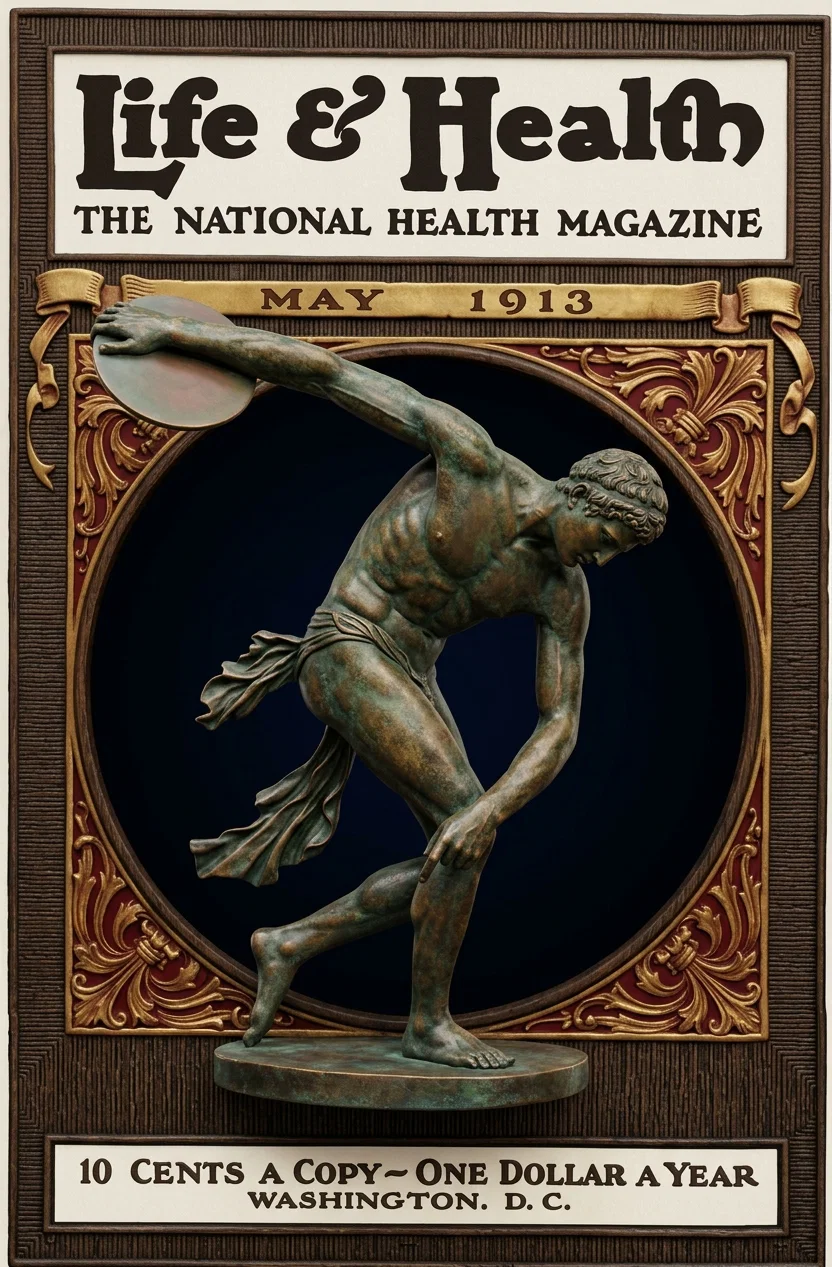
WHY A VEGETARIAN?

Do You Belong to the “Meatless” World Majority or the “Meat-Eating” Minority? Read the Startling Revelations in this “Vegetarian,” “Heredity,” “Complexion,” and “Diseased Meat” Number.

A FEW MAY FEATURES

Vegetarian Salads Campaign Against Diseased Meat Law of Heredity My Lady’s Complexion Dental Hygiene of the Child How to Make a Family Garden Questions and Answers Friedmann Tuberculosis Cure Is Castoria Injurious? Cure for Tapeworm Asthma Laxative Tablets Artificial Baby Foods Substitute for Coffee
An easy-selling number. Thirty or more valuable articles and other features. Tells not only what foods to AVOID, but also how to prepare SOMETHING BETTER.
Send $1.00 for 20 copies; $2.00 for 50; $4.00 for 100; or $8.00 for 200. Single copy, 10 cents. Fifty or more, 4 cents each, post-paid.
Send 10 cents to-day for sample copy, terms, etc.

ORDER THROUGH OUR NEAREST AGENCY

If you do not know the address of our Agency, ask “Life and Health,” Washington, D. C.

The Judgment

L. D. SANTEE
Is it true that an angel in glory Is recording the acts I have done, That he writes down the pitiful story Of the course I have run?
Is it true that each thought is recorded, Of folly or anger or sin? And will justice for each be awarded When at last the Judge shall begin?
Ah, yes. And the record is growing, As the days pass away into years. Alas, what will be the sad showing When Jehovah in judgment appears?
In the day when the saints shall adore him, And worship the Lamb that was slain, Shall I stand unforgiven before him, And know that repentance is vain?
In the day when the world is divided And the Judge in his grandeur is seen, When a refuge for all is provided, Whose record is shown to be clean;
In the day when the world is on trial, With the dead raised from earth and from sea By the call that will take no denial, Then what will my life's record be?
Thank God, there is hope for the fallen, For Jesus can cleanse every stain, The dark crimson record appalling, In the blood of the sacrifice slain.
With our sins all confessed and forgiven And the record made whiter than snow, We may enter the glories of heaven, Where life's waters forever shall flow.

The True Church

MRS. E. G. WHITE
TRUE Christians will be Christlike. The Redeemer clothed his divinity with humanity, and came to our world—a world seared and marred by the curse of sin, a vale of darkness and woe—to accomplish a great work, as he announced in the synagogue of Nazareth: “The Spirit of the Lord is upon me, because he hath anointed me to preach the gospel to the poor; he hath sent me to heal the broken-hearted, to preach deliverance to the captives, and recovering of sight to the blind, to set at liberty them that are bruised, to preach the acceptable year of the Lord.” Each church-member is to be a representative of the character and spirit of Christ. By precept and example the essential elements of a true, healthy, influential Christianity are to be revealed. Christ should be constantly set forth as the fountain of life, mercy, and love.
Brethren, have we any truth in advance of others? Is its influence on our character of any worth to us? When we bring that truth into our hearts, weave it into our characters, carry out its sanctifying principles in our daily lives, we show that we believe it to be worth defending, and that we will individually contend for the faith once delivered to the saints. We shall look to Jesus and catch his spirit. In this age the mind is inclined to lose sight of Jesus, and what is the result?—The tenderness of Christ is not cherished, and hearts are hard and unfeeling. Were Christ on earth to-day his solemn rebuke would be upon many who profess to be Christians, who have entered into church fellowship, because they do not have the mind of Jesus, are not meek and lowly of heart. When self is exalted there can not be a ready sympathy with the poor and lowly and oppressed.
By beholding we become changed. Through close study and earnest contemplation of the character of Christ, his image is reflected in our own lives, and a higher tone is imparted to the spirituality of the church. If the truth of God has not transformed our characters into the likeness of Christ, all our professed knowledge of him and the truth is but as sounding brass and a tinkling cymbal.
“Hear the word of the Lord, ye rulers of Sodom; give ear unto the law of our God, ye people of Gomorrah. To what purpose is the multitude of your sacrifices unto me? saith the Lord: I am full of the burnt offerings of rams, and the fat of fed beasts; and I delight not in the blood of bullocks, or of lambs, or of he goats. When ye come to appear before me, who hath required this at your hand, to tread my courts? Bring no more vain oblations; incense is an abomination unto me; the new moons and sabbaths, the calling of assemblies, I can not away with; it is iniquity, even the solemn meeting. Your new moons and your appointed feasts my soul hateth: they are a trouble unto me; I am weary to bear them. And when ye spread forth your hands, I will hide mine eyes from you: yea, when ye make many prayers, I will not hear: your hands are full of blood. Wash ye, make you clean; put away the evil of your doings from before mine eyes; cease to do evil; learn to do well; seek judgment, relieve the oppressed, judge the fatherless, plead for the widow. Come now, and let us reason together, saith the Lord: though your sins be as scarlet, they shall be as white as snow; though they be red like crimson, they shall be as wool. If ye be willing and obedient, ye shall eat the good of the land: but if ye refuse and rebel, ye shall be devoured with the sword: for the mouth of the Lord hath spoken it.”
Let all who claim to keep the commandments of God, look well to this matter, and see if there are not reasons why they do not have more of the outpouring of the Holy Spirit. How many have lifted up their souls unto vanity! They think themselves exalted in the favor of God, but they neglect the needy, they turn a deaf ear to the calls of the oppressed, and speak sharp, cutting words to those who need altogether different treatment. Thus they offend God daily by their hardness of heart. These afflicted ones have claims upon the sympathies and the interest of their fellow men. They have a right to expect help, comfort, and Christlike love. But this is not what they receive. Every neglect of God’s suffering ones is written in the books of heaven as if shown to Christ himself. Let every member of the church closely examine his heart and investigate his course of action to see if these are in harmony with the spirit and work of Jesus; for if not, what can he say when he stands before the Judge of all the earth? Can the Lord say to him, “Come, ye blessed of my Father, inherit the kingdom prepared for you from the foundation of the world?”
(To be concluded)

The Coming of the King

DAVID J. BURRELL, D. D.
“Where is the promise of his coming?” 2 Peter 3:4.
The word here rendered “coming” is parousia, literally “a drawing near” or “being alongside.” It is the technical word which was used by the sacred writers to designate the second coming of Christ. In the early church a deep emphasis was laid upon this doctrine; and there is reason for profound regret that the edge of expectancy has been permitted to wear off.
It will be remembered that soon after the resurrection of Christ he met his disciples by appointment on a mountain in Galilee, where he discoursed with them on the great truths of the kingdom; and then, “while they beheld, he was taken up; and a cloud received him out of their sight. And while they looked steadfastly toward heaven as he went up, behold, two men stood by them in white apparel; which also said, Ye men of Galilee, why stand ye gazing up into heaven? this same Jesus, which is taken up from you into heaven, shall so come in like manner as ye have seen him go.” Acts 1:9-11.

Prophecies of His Coming

That was in the year 33 A. D., and it was now the year 66 A. D. A generation had come and gone, and still the promise was unfulfilled. “Hope deferred maketh the heart sick.” So it came to pass, not only that the faith of some of the disciples was shaken, but that scoffers arose, saying, “Where is the promise of his coming?”
Now nineteen centuries have passed and the followers of Christ are still waiting, and scoffers are still asking, “Where is the promise?” Are we to conclude that there has been some mistake? Is there really such a promise? and if so, where is it?
First, it was spoken in terms clear and unmistakable by the angels on the mount of ascension: He “shall so come in like manner as ye have seen him go.” This promise can not be explained away by referring it to the influential presence of Christ. It is true that he has been the commanding figure in history since those days. The power of all the Cæsars and Alexanders and Napoleons combined is not comparable with that of him who cometh from Bozrah, with garments dyed red in the wine-press of redeeming grace. But this does not answer the demands of the promise that he “shall so come in like manner as ye have seen him go.” It will not answer to explain it away as a reference to the miracle of Pentecost. He did, indeed, so pour out his Spirit on that memorable day that his church was baptized with power for the great campaign before it. But this was not the coming here referred to.
Nor was the prophecy fulfilled in the coming of Christ at the destruction of Jerusalem. He came then with his fan of retribution in hand to purge his threshing-floor; but this was with no such benignant glory as when he ascended into the heavens that were opened to receive him. Nor are the conditions of this promise met by the sympathetic coming of Christ referred to in his words, “I will not leave you comfortless: I will come to you.” Here is a splendid truth, which is realized in the experience of every follower of Christ; but it does not exhaust the matter in hand. The parousia lies deeper yet. Still less can the promise be explained away by referring it to Christ’s sustaining grace in the dying hour. He does meet us at the threshold of the valley of the shadow and offer his rod and staff to comfort us; but this does not cover the case. The promise given on the mount of ascension is that he shall come at a definite time and in a definite way; and this coming is further described in his own words: “They shall see the Son of man coming in the clouds of heaven with power and great glory . . . with a great sound of a trumpet.” Matt. 24: 30, 31. “Then shall he send his angels, and shall gather together his elect from the four winds, from the uttermost part of the earth.” Mark 13: 27. Such passages as these obviously refer to a personal coming, at a definite time, in the clouds of heaven, and the holy angels with him.

The “Golden Thread,” in Scripture

Second, the promise in the Scriptures, running all through them like a golden thread. The first prophecy in the Old Testament is the protevangelium at the gate of paradise; in that prophecy there is a distinct reference to the final triumph of the Seed of woman over the power of sin. And thenceforward there is a continuous line of prediction with respect to the parousia. It is traceable in the Levitical system of Messianic rites and ceremonies, as well as in the prophetic books.
You may read the same promise in Daniel’s vision of the image with head of gold, breast of silver, thighs of brass, legs of iron, and feet of iron and clay. Babylon, Medo-Persia, Greece, Rome; they come and go. And, behold, a stone hewn out of the mountain without hand smites the image so that iron and brass and silver and gold are reduced to dust and swept away like the chaff of the summer threshing-floor. Let Daniel himself interpret it: “In the days of these kings shall the God of heaven set up a kingdom, which shall never be destroyed: . . . it shall break in pieces and consume all these kingdoms, and it shall stand forever.”
If the Old Testament speaks with no uncertain sound, the New Testament is clearer still. There are approximately a thousand allusions in the teachings of Christ and his apostles to this return of the King. In the twenty-fourth and twenty-fifth chapters of Matthew we have what is familiarly known as the parousia discourse of Jesus; and whatever of uncertainty there may be as to its interpretation in detail and particular, there is no room whatever for any uncertainty as to the promise which it contains of his coming to reign gloriously in this world of ours. The teaching of the apostles is of the same tenor. Paul and Peter, James and John, were all looking for his appearing in the clouds of heaven. The book of the Revelation would be a mere dream-book, a panorama of meaningless visions, if the parousia were left out of it.
The Christians of the early church took Christ and the apostles at their word, and awaited his coming with joyful expectancy. In trying times of persecution the hope of his appearing was their strength and support. Their customary greeting morning and night was Maran atha, “The Lord cometh!”

The Promise Read in History

Third, the promise may be read clearly in the logic of events. If the angels had delivered no message to the disciples on that mountain in Galilee, if the Scriptures had made no prediction of the parousia, it would still be forced upon us by the fact that the centuries have been moving forward in converging lines of increasing light toward one focal point. What is this “one supreme divine event to which the whole creation moves”? Call it the “Golden Age” if you will. It borrows all its luster from the fact that Christ, coming down through the centuries, is flooding the world with light. He is coming to reign! “The tabernacle of God is with men, and he will dwell with them, and they shall be his people, and God himself shall be with them, and be their God.”
The nations that were in darkness are emerging into light. It is less than sixty years since Commodore Perry opened the ports of Japan, and Japan is one of the great powers of the world to-day. It is less than forty years since Livingstone died in middle Africa, and lo, the face of Ethiopia is turned toward the rising sun! It is not a decade since the decree against foreigners was annulled in China, and, behold, “the great wall” is no more. The darkness is lifting; the nations of earth are wheeling into line. For what? It is for wise readers of history to ask, What shall the end be? . . .
In the religious world there are three signs: First, the opening of the doors of the nations for the incoming of the gospel. In the Missionary Concerts of forty years ago there were earnest prayers for the opening of the doors. No such prayer is heard to-day. The hands of all the nations are beckoning, like those of the man of Macedonia, and all people are calling, “Come over and help us!”
Second, the enlistment of volunteers. In my seminary days it was a difficult matter to induce theological students to offer themselves for missionary service; now it is almost impossible to restrain them. The missionary boards are embarrassed. Only the choicest candidates are permitted to go. . . .
Third, the ingathering of souls. William Carey preached seven years in India without a sign of success; then KrishnaPal was converted. Now who shall count the converts in India? It seems but yesterday that our missionaries were permitted to enter Korea; to-day Korea is a yellow harvest-field. They are coming to Christ, “a nation in a day.”

Signs of Its Near Approach

In the world of unbelief there are three signs: “First, the decay of the false religions. Of all the great religions of the centuries there are only three which survive, namely, Islam, Buddhism, and Christianity; and of these, as Max Mueller said, ‘two are moribund.’ The only religion on earth which lives to carry on a propaganda for light and civilization is the religion of Christ.
Second, the silencing of open and avowed infidelity. At the beginning of the last century the air was rent with the vociferations of Thomas Paine and Voltaire and Jean Jacques Rousseau. There was not a nation in the world which did not have its brave cohort of infidels who stood forth impiously shaking their clenched fists at God. The last of the old guard were Bradlaugh in England and Ingersoll in America; and they have gone their way.
Third, the appearing of false teachers within the church. “When the Son of man cometh, shall he find faith on the earth?” The disciples were repeatedly and most earnestly warned that in the last days false teachers were to come who would deceive, if it were possible, the very elect. They were admonished that there must first be “a falling away” before Christ could come to his own. . . . That time is now. If infidelity has ceased to fulminate its impieties outside the church, it is largely because the same work has been undertaken by men in canonicals. The Trojan horse has been wheeled within our walls. Shall we lose heart by reason of that fact?—Not at all! If a hundred millions of professing Christians were to be led away by false teachers into the wilderness of unbelief, there would still be four hundred millions on earth professing the name of Jesus and presumably true to their consecration vows. And that would be twice as many Christians as there were a century ago. The great promise holds true. And, what is more, the signs indicate that its fulfilment may not be afar off. In view of these facts, what shall we say?”

The Believer’s Attitude

First, let us believe in the promise. For thus it is written; and thus it must be. “Beloved, be not ignorant of this one thing, that one day is with the Lord as a thousand years, and a thousand years as one day. The Lord is not slack concerning his promise, as some men count slackness; but is long-suffering to us ward, not willing that any should perish, but that all should come to repentance.” 2 Peter 3:8, 9. Here is the reason for his delay. It is not because he has forgotten, but because he is long-suffering toward the children of men.
Second, let us be ready. “For in such an hour as ye think not the Son of man cometh.” Let us watch, therefore; not as those who stand with folded hands looking out of their windows, but rather as those who, with their sleeves rolled up, are busy in God’s harvest. He looks to us for a helping hand in the work which must needs be done before he shall part the heavens asunder and come down.
Thus let us renew our consecration to Christ. For the highway must be cast up for his coming; the stones of stumbling must be gathered out. There is something for us to do, and when it is done, O happy day! The heavens shall part asunder and his people shall cry, “Maran atha! Behold him!” For we shall see him with these eyes! Meanwhile, blessed are they that love his appearing. Amen; even so come, Lord Jesus. The grace of our Lord Jesus Christ be with you all,—Christian Herald of Oct. 11, 1911.

Receiving the Spirit

The Holy Spirit—No. 15

Receiving the Spirit

G. B. THOMPSON.
A WRITER relates how a trolley-car in a rural district suddenly stopped, and the conductor, being new at the work, walked to the nearest house supplied with a telephone and called to headquarters, “The power has gone off. What shall I do?” At once the office telephoned back, “The power is all right. Put on your trolley and come home.” The power was present, but in some way the car had lost the connection with it.
This explains the standstill efforts in the experience of many churches and individuals. At times there seems to be some motion something like a rocking-horse or a cane-mill, but no real progress. The power is a living reality ever with them, but they have either never had a connection with it or have lost it. The organization and machinery may be all right, but if we do not have a vital connection with the Source of power, it will do us no good. “The body without the spirit is dead.”
We have carefully studied in former articles some of the things that interrupt our personal connection with the Spirit, and cause the flow of dynamic power to be weak. The story is told of a man whose Artesian well ceased to flow as it had formerly done. The connection with the hidden reservoir seemed to be in a measure cut off. An examination, however, revealed an old carpet stuffed into it. When this was removed, it flowed as before. There are many Christians whose experiences are similar to this well. They run well for a time, but the fountain suddenly seems to be stopped. Doubtless all that is needed is to have some old rubbish removed from the heart.
One other important point to be considered in the reception of the Spirit is that of faith. It is by faith that the connection is made between the soul and the promises of God. Without faith it is impossible to please God. All that God has promised is received by faith. We receive the Spirit by faith. Many are making the mistake of trusting to their feelings, but feeling is not a safe guide.
“Christ hath redeemed us from the curse of the law, being made a curse for us: for it is written, Cursed is every one that hangeth on a tree: that the blessing of Abraham might come on the Gentiles through Jesus Christ; that we might receive the promise of the Spirit through faith.” Gal. 3:13, 14.
We are redeemed that we might receive the blessing of Abraham, that we might receive the promised Spirit. The blessing of Abraham is righteousness by faith. Rom. 4: 1-3. We receive righteousness not by works or feeling, but by faith, as the unmerited gift of God. But many stop here. The text, however, encourages us to go a step farther. Having received from God the forgiveness of all our sins and the imputed righteousness of Christ, we are then in a condition to reach out the hand of faith still farther and “receive the promise of the Spirit through faith.” “But as many as received him [by faith], to them gave he power to become the sons of God.” John 1:12. “But ye shall receive power, after that the Holy Ghost is come upon you.” Acts 1:8. “But tarry ye in the city of Jerusalem, until ye be endued with power from on high.” Luke 24:49. Power is bestowed through the Spirit, and receiving the Spirit is receiving power. The Spirit is received by faith. We therefore receive power through believing. Having received righteousness from God by faith, by the same faith we are to lay hold of the Holy Spirit for power in our personal experience, and to enable us to labor for the salvation of others.
When Jesus met with his disciples after his resurrection he “breathed on them, and saith unto them, Receive ye the Holy Ghost.” John 20:22. The word here translated “receive” is the same word that is translated “take,” where Pilate said, “Take ye him, and judge him,” and, “Take ye him, and crucify him.” John 18:31; 19:6. Jesus therefore said to his disciples, “Take ye the Holy Ghost.” We “take,” or “receive,” the Spirit by faith. By faith the disciples were to receive, or take, the Holy Spirit with them in their work. How simple this is! Just as we are to accept the forgiveness of our sins by faith when we have confessed them, just as we take a proffered gift from a friend, so we are to receive by faith the fulness of the blessing of the Spirit of God when we have, so far as we know, put away our sins, and opened the channel of blessing into our hearts. This is beautifully illustrated in the following incident:—
“There is a story of a ship called the ‘Central America.’ The drinking-water had failed, and the crew were in great need. They ran up a flag of distress. The flag was seen by the captain of another ship, and through the speaking-tubecame the question, ‘What is the matter?’ ‘Water! water! we are dying for want of water!’ The answer came back, ‘Dip it up; you are in the mouth of the Amazon.’ The mighty Amazon was pouring a flood of fresh water far out to sea. They dipped it up. There was no need to ask further for drinking-water.”
“Whosoever drinketh of the water that I shall give him,” said Jesus, “shall never thirst; but the water that I shall give him shall be in him a well of water springing up into everlasting life.” John 4:14. From this eternal, living spring, this river, this Amazon, which is constantly flowing, as from the smitten rock, we have but to “dip” and drink. Have you put away every known sin? Have you prayed for the Spirit? Then “take,” “dip,” “drink.”
And what a rich blessing! When we by faith receive the Spirit into the heart, we are told it brings all other blessings in its train. “In whom we have redemption through his blood, the forgiveness of sins, according to the riches of his grace.” Eph. 1:7. “That he would grant you, according to the riches of his glory, to be strengthened with might by his Spirit in the inner man.” Eph. 3:16. The riches of grace is all that we get from the cross upon which our Redeemer died; the riches of glory is all that we get from the throne of the eternal Godhead. We get pardon from the cross; we get strength and power from the throne. Wonderful riches, indeed!
More than this, we are instructed that those who consecrate soul, body, and spirit to God will receive the “breath of his own Spirit,” and through cooperation with Christ be able “to do the deeds of Omnipotence.”
“Christ’s ascension to the Father, as we know, was the condition of the descent of the Spirit; and concerning this the Lord said, ‘He that believeth on me, the works that I do shall he do also; and greater works than these shall he do; because I go unto my Father.’ Thus the ministry of the Spirit was announced to be mightier in results than that of the Son. This would not seem easy to credit. If we were ignorant of the facts of science, and some one were to show us a reservoir of water, and tell us that this element is capable of three manifestations, liquid, vapor, and solid, and ask us which would be the most powerful, we might say the solid form; and looking at the iceberg, which can crush a huge ship as you grind a dry leaf between your fingers, this conclusion would seem to be justified. But science would point at once to the vapor, so light, so impalpable, and in its finer forms invisible, and remind us that this is the power that is moving our huge steamships, drawing our countless railway-trains, and driving our ponderous factories—the greatest motive force in our modern civilization. The blessed Trinity has been manifested to us in two forms in this dispensation. First, he came as the Word made flesh, the incarnate Lord, with the might of his divine manhood, which could silence the winds, still the waves, open the gates of the grave, and reverse the laws of gravitation. Is not this the most powerful revelation of God? ‘Greater works than these shall ye do,’ is his answer. When God comes as the secret invisible Spirit, like the wind, which we can not see and can not tell whence it cometh or whither it goeth; and when this Spirit shall dwell in his fulness in believers, moving their wills, inspiring their words, and energizing their actions, then shall be seen the greatest things for the glory of God and the salvation of souls, that have yet been witnessed.”—“The Twofold Life,” pages 187, 188.
Shall we not receive this blessed Spirit by faith, and experience daily this mighty power that the Lord has promised? We need to appropriate by faith the blessings the Lord has promised to us, and placed within our reach.
Continue reading: A. G. DANIELLS