Your ShelfYour Projects

Review and Herald, Vol. 90, No. 25.

The Master Sculptor

Review and Herald

Jun 19, 1913

Review and Herald Publishing Association · Takoma Park Station, Washington, D. C. · Jun 19, 1913

The Master Sculptor

MARGARET J. PRESTON
'Tis the Master who holds the mallet, and day by day He is chipping whatever environs the form, away; Which under His skilful cutting, He means shall be Wrought silently out to beauty of such degree Of faultless and full perfection that angel eyes Shall look on the finished labor with new surprise, That even His boundless patience could grave His own Features upon such fractured and stubborn stone.
'Tis the Master who holds the chisel. He knows just where Its edge should be driven sharpest to fashion there The semblance that He is carving; nor will He let One delicate stroke too many, or few, be set On forehead or cheek, where only He sees how all Is tending, and where the hardest the blow should fall, Which crumbles away whatever superfluous line Would hinder His hand from making the work divine.
With tools of Thy choosing, Master, we pray Thee, then, Strike just as Thou wilt, as often and where and when Thy vehement stroke is needed; we shall not mind If only Thy chilling chisel shall leave behind Such marks of Thy wondrous working and loving skill, Clear carven on aspect, statue, and face, as will, When discipline's ends are over, have all-sufficed To mold us into the likeness and form of Christ.
— The Examiner.

Special “World’s Christian Citizenship Conference” Number

This subject is of such importance that we feel compelled to devote this second number to its consideration. Place a copy in the hands of every delegate planning to attend the “Christian Citizenship Conference,” Portland, Oregon, June 29 to July 5.

Partial Contents

Frontispiece—Christian Citizenship Convention Hall The “Second World’s Christian Citizenship Conference” Program of the “Christian Citizenship Conference” Some “Christian Citizenship” Arguments Religious Intolerance in America Governor of Rhode Island and Sunday Law “The King’s Orders”—An Old-Time Argument Madison’s Prophecy Being Fulfilled A Two-Page Poster of 1913 Sunday Bills Is Sabbath Legislation Necessary? International Peace Movement and Religious Liberty Golden Rule Ignored by National Reformers Report of Sunday-Law Hearing Before District of Columbia Commissioners Strong Protest Against Sunday Closing of Post-Offices Mr. Bryan Says Sign the Temperance Pledge
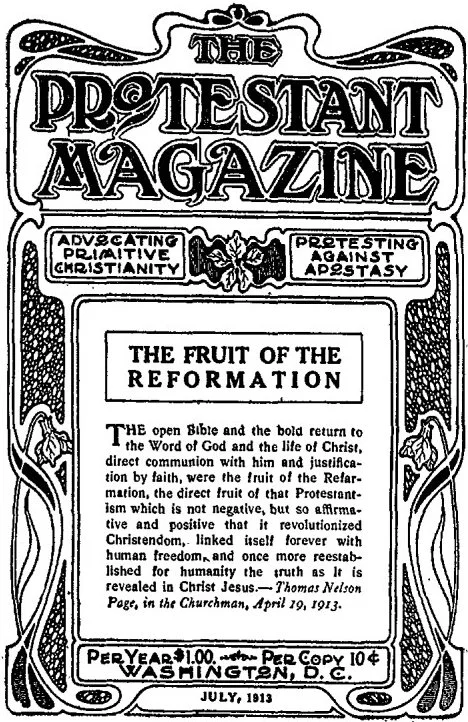
Issued Quarterly, 35 Cents a Year, 10 Cents a Copy
SPECIAL OFFER: 10 copies, one year, to one address or to ten addresses, only $2.00. Send $1.00 for 20 copies, or $2.00 for 50. Address our nearest agency, or
LIBERTY MAGAZINE, Washington, D. C.

“A MOUTH SPEAKING . . . BLASPHEMIES”

Full Proofs Justifying This Bible Definition of the Papacy Found in the June and July Numbers! (See Rev. 13:5.)

We can still begin your subscriptions with the March number containing Part I of “Convent Tragedy” series. If you wish subscriptions to begin with MARCH number, PLEASE SAY SO.

Partial July Contents

Striking Double Frontispiece The Roman Creed—The Mass, Meat, and Murder Catholic Toleration in 313 and in 1913 Ancients and Moderns on Reading the Bible The True Idea of Sacrifice Melchizedek and the Mass Freedom of the Press Upheld A Printer’s Miracle Papal Absolutism Religious Situation in France Rome Demands Division of Public-School Funds Friction in Italy
$1.00 a Year         10 Cents a Copy

Send THE PROTESTANT to Ten Friends

Ten copies, six months, to one address or to ten separate addresses, only $3.00, or 30 cents each. Sender may include his own name, or send $3.00 for five copies, one year.
The Protestant Magazine · Washington, D. C.

The Thirty-Eighth Session Closed

The thirty-eighth session of the General Conference has passed forever. The three thousand delegates and visitors who were in attendance are now scattered. Some of them have already reached home, many of them are still on their way. We can no longer look forward with fond anticipation to this season of communion with heaven and with our brethren. But while we cannot anticipate the occasion, we can recall it with most pleasant memories; for surely it was a blessed meeting. God wrought in behalf of his people.
The religious services of the gathering were not attended with any spectacular features. There was no great demonstration, but one had only to enter the place of meeting to feel at once the distinctive thrill of the Spirit of God, which was present with his people. This was particularly marked in the early morning meetings and in the Sabbath services. The words of the lesson appealed with thrilling power. No worldly, eloquent discourses were delivered. Somehow we rarely find God using such discourses very effectively. The sermon of Peter on the day of Pentecost, from the standpoint of an orator and rhetorician, was a very weak effort. It was the simple story of the cross of Christ; but that story, simply told by the humble fisherman of Galilee, carried with it the mighty power of God to convict men of sin and to draw them to Christ. We believe that many felt something of that same divine influence stirring their hearts in connection with the Scripture lessons given at the recent Conference. It is not by might nor by power, but by the gentle influence of the Spirit of God, that changes are wrought in human character.
If the good impressions made, if the convictions created in many minds, if the new purposes born in many hearts, are carried into effect in the days to come, we believe that the last session of the General Conference will go down in the history of this church as one where God most signally met with his people. Shall we not make it such in our experience?

A Transformation—Not a Revolution

MANY important changes were made in the General Conference just closed. There was created in reality a world conference. The work in Europe was organized into a great division conference. The same was done for the work in North America. The organization of the work in India was perfected. Elder I. H. Evans, who has been connected with the work in Asia for the last three years, was called to the presidency of the North American Division Conference. Elder R. C. Porter, who has spent a number of years in South Africa, was chosen to take charge of the work in the Far East. Elder W. B. White was selected to take charge of the work in South Africa. Other important changes were made in laborers.
Changes in the State and nation involving interests as vital to the state as these are to the church, would quite likely be attended with a great deal of agitation and disorder, possibly bloodshed. They would constitute a revolution. These many and important changes, however, as related to the work of this movement, were effected quietly and with mutual understanding and good feeling. No arbitrary measures were put through. The desire of every heart was for God to lead, and we believe that God has led in the transformation that has been brought about. Some of the workers to whom has come a change of field relate the manner in which God had impressed their hearts and given them distinct convictions as to their field before the changes were suggested to them by their brethren.
We know, however, that although these changes have been mutually agreed upon, and those who have changed their fields have done so believing that God was guiding, many a sacrifice of personal interest has been involved. It is no easy thing for men and women to break away from home and friends and old-time associates and go to unknown fields. It is no easy thing to make of homes and personal effects and household gods chattels of barter and sale. Cherished idols must be sacrificed, and the very life itself placed upon the altar of service. A real test of heroism and loyalty comes here. Thousands of Seventh-day Adventist workers have met and passed this test again and again in their experience. Thousands of others will do it before this work closes.
The question of the consecrated heart is not, Where can I find the easiest place, the position of honor and personal advantage, but, Where can I best serve my Master? In what part of the battle-field can I render the highest service to the cause of Prince Immanuel? Heaven recognizes this spirit. We have the word of the Saviour that he who leaves father or mother, wife or children, homes or lands, for the sake of the gospel, shall find a home among those for whom he labors, and in the end he shall receive the blessed heritage of eternal life. We do not find our assurance today in the things of time and sense; we must endure as seeing him who is invisible.

Fitting His People

THERE was probably no one who was in attendance at the recent General Conference who would doubt that in this meeting God was fitting his people for a greater work and a more rapid work than they have heretofore accomplished. In department work, in open conference work, in committee work, and in the public addresses given, this fact stood out in bold relief.
Our one great business was constantly held before the people—the warning of the world, the completion of the work of carrying the gospel message to the ends of the earth, that heaven might soon put the stamp of completion upon the work which this people is commissioned to do.
Here was a school, conducted in many departments, with all the departments working to a common end,—the better and swifter proclamation of the third angel’s message to the ends of the earth.
In the Sabbath School Department the end in view was the better training and fitting of teachers to teach more perfectly and with more telling results the truths of the message, that the world might the sooner be warned and the way be the more quickly prepared for the return of our blessed Lord.
In the Educational Department the one dominant theme was the better training and better fitting of consecratedteachers who might the more quickly and more perfectly instruct the students of our schools, not only in the elements of education, but in the principles of the gospel, in the tenets of present truth, and in the various branches of activity connected with this work, so that the work committed to this people might be the more quickly done, and the jewels of the kingdom be gathered home.
In the Medical Department the instruction was varied, but the one aim was plainly apparent,—such a fitting of physicians and nurses for the work given to them that the general work of proclaiming the gospel message might be the more expeditiously carried forward; that with the healing of the body there might come that healing of the soul which is of such infinite worth to the individual.
In the Religious Liberty Department there was a free presentation and discussion of the principles of soul freedom as set forth in the gospel, in opposition to the principle of soul bondage that has wrought such havoc in the world; and in the setting forth of these principles there was seen the last phase of the gospel message,—the warning against the application of force in the worship of God, the warning against the worship of the beast and his image, or the reception of the mark in hand or forehead. Thus the training given in this department fitted men and women to do better work in proclaiming the fundamental principles of the message. The heart of the message of the third angel is a warning against compulsion in worship; and this department of the general work is set for the special work of making known to all the world the principles that underlie that warning. As far as the work of the third angel goes, the work of this department must go. The people of all the world must know why it is wrong to bow down under compulsion of law, and worship at the behest of human edicts. So this department contributes its quota to the great project set before this people.
We find the same aim held before the Missionary Volunteer Department. Running through all the plans and suggestions and instructions that came before the members of that department was the great thought of preparing loyal-hearted young workers to go out into the field and bring to a knowledge of the truth those who are yet in the darkness of unbelief, or to whom, though Christians, there has never come the blessed gospel of the everlasting kingdom.
These are but parts of one great work, sections of one great circle whose circumference is the world’s need and whose center is Christ. It is a work not of man’s devising, and therefore no device that is planned against it can triumph over it. Such a work as this is of necessity and demands such a system as this is. The smoothness of its working is one of the miracles of God; the work that it is accomplishing in spite of opposition and persecution contradicts the idea that it is a work of man; and the unfailing prophecies of God’s Word show us, step by step, where we are, and what God has yet for us to do. C. M. S.

Important Features of the Conference

It is a great privilege to be able to attend a General Conference. Here one meets workers from the ends of the earth. They come from the strongholds of Romanism, and Mohammedanism, and heathenism,—grave, earnest, courageous men, who have learned how to give battle to the powers of darkness and snatch souls from the enemy. It is good to hear them tell their experiences, and to listen as they discuss together in the morning council how best the common problems of the missionary may be solved.
Life in the mission field is evidently worth living. It draws out all there is in a man. He becomes broad-minded, resourceful, fearless. The home fields say sometimes that they have weakened themselves by giving so freely of their best men for foreign missions, but such giving has not weakened the cause as a whole. To-day it is rich in capable leaders who are, under God, preparing its triumph in all the earth.
The morning missionary council is one of the outstanding features of the Conference. As the canvassers say, it is worth the price of the whole. How to win the Roman Catholic and the Moslem; how to begin and carry on schools in Africa; what to do with the converted polygamist and his wives; whether to study a new language in the field, or before leaving home; how to co-operate with fellow workers and with the home base; and a multitude of other questions have been considered and discussed. Every contribution is the fruit of sober thought and practical experience. No one talks for the sake of talking. An admirably drawn-up syllabus guides the discussion to the real difficulties of the fields, and Brother Spicer knows how to focus the various contributions and make them shed an illuminating ray on the subject considered.
There is little chance for fanaticism among such counselors as our foreign work is developing. As the denomination takes on its proper load, the pendulum restricts its movement within useful limits. The missionary work is going to prove our salvation. Already the latter rain is falling, in the spirit of wisdom and understanding, to give us largeness of heart and soundness of mind. We need more of the same salutary influence in the home fields. A peculiar people is in danger of falling in love with itself as long as it delays to fulfil its development and to become zealous of good works.
Another feature of the Conference to be long remembered was the gift of eighteen thousand dollars to Loma Linda. Here again the missionaries and ministers led the way in generous giving, and others brought up the rear. It was a wonderful meeting. May the Lord help the workers at Loma Linda to regard this gift as sacred, like the water from the well at Bethlehem that David would not drink, because it is so largely the outpouring of missionary life.
The various departments seem to have had good times, but unfortunately they all came at the same hour, so that any one hoping to get an all-round education in the development of the work was disappointed.
The organization of the camp was a veritable triumph of foresight and generalship. How much the success of the Conference was due to this cause the delegate can only guess. But from the first moment of his arrival he found that his every want had been anticipated. The workers in the reception tent, especially when it was most crowded, suggested a company of angels.
Progress has been the key-note in the reports from the fields. The cause has gained victories all along the line. The quadrennial period before us must witness great advancement. Europe and America are reorganized for closer and harder work. The Educational Department has been putting its house in order for better service. The junior forces are in line. Our own medical college must soon begin to pour out Seventh-day Adventist physicians. The General Conference is set free for definite leadership in the world field. May the arm of the Lord be made bare in the lives of a united and consecrated people.
One cannot help feeling thankful that God has given us Takoma Park, a quiet and beautiful spot, where such great gatherings can come as to a home, rendered dear not only by gracious providences, but also by happy recollections. On this spot old friendships with scattered comrades can be renewed. Here one learns to know and love some who have been only a name on a list of names. There is a sense of satisfaction in coming back to Takoma Park, and a feeling of regret when one stands for the last time on the bridge to watch the fireflies among the trees and listen to the murmur of the Sligo beneath. God speed the day when the great cause with which Takoma Park is so intimately identified shall triumph gloriously.
W. T. BARTLETT, Editor Present Truth, London, England.

The General Conference

Thirty-Eighth Session, May 15 to June 8, 1913

Thirtieth Meeting

June 4, 10 A. M.
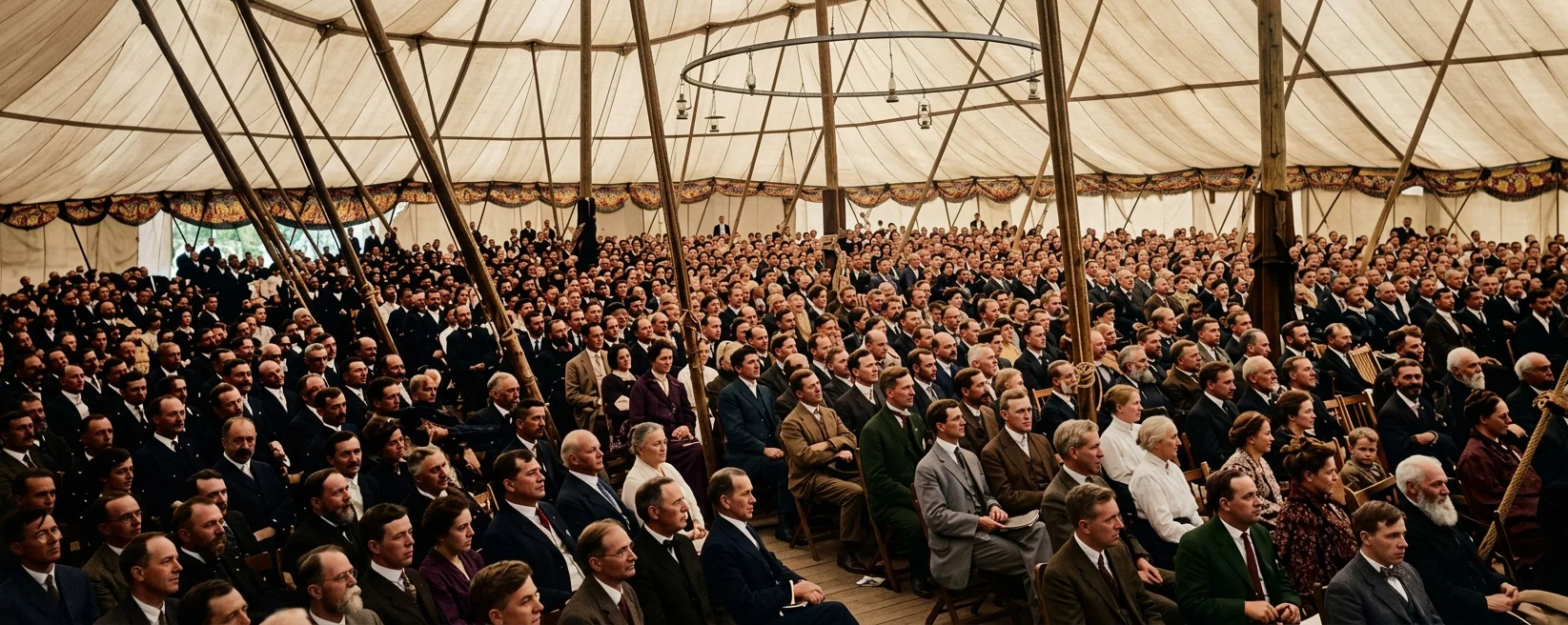
L. R. CONRADI in the chair.
J. F. Huenergardt offered prayer.
L. R. Conradi: The first matter this morning will be found on page 263 of the Bulletin [page 567 of last week's REVIEW], unfinished business, the partial report from the committee on plans.
Resolution 23 was read, requesting the publishing houses to prepare a series of tracts for sale by colporteurs.
Mrs. S. N. Haskell: There are possibilities in the tract work that we do not realize. Tracts can be arranged in packages and sold so that individuals can earn a good living while selling the tracts, and our tracts meet a larger percentage of people than any other class of literature that we distribute. It has been demonstrated that a large proportion have received their first light from the tracts, and I feel quite anxious for this. In city work my husband and I have taken the tracts in large quantities, and have demonstrated over and over again that workers make a good living when handling the tracts. One young man who went to the foreign field last year supported himself during an institute in San Francisco selling tracts at five, ten, and fifteen cents a package. He found that all classes bought readily. They would buy tracts when they would not buy papers, because they would see in the tracts some subject that attracted their attention; and we have felt very anxious that the tracts be placed at a price so that our workers can support themselves selling the tracts the same as selling the periodicals. They can be sold everywhere if this is done.
C. H. Jones: I am sure that our publishing houses will be glad to respond to the call for a series of tracts put up in this way. The interest in the circulation of our tracts is increasing all over the field very rapidly. It has been gradually increasing, until last year our sales exceeded the sales of any other year by far. This year we printed at the beginning of the year a large quantity, thinking we would have enough to supply the field for a year; but we have just received word from Mountain View stating that the tracts are getting low, and that already this year we have sold about a million and a half copies. That is as much as we sold during all of last year. We are now printing another edition to supply the demand.
L. R. Conradi: These are surely cheering reports. Are we ready to go on? Question called.
Recommendations 24 and 25 were read, and question called without discussion.
THE GENERAL CONFERENCE IN SESSION
Number 26 was read, recommending that the word division be dropped from the technical name for the North American and European Division Conferences. It was moved that recommendation 26 be eliminated from the report. The motion prevailed.
Item 27 was read, and question called.
Item 28 was read, relating to the West Indian Union.
G. M. Brown: I wish to call attention of the Conference to the fact that in the first part of the preamble it says, “In view of the request that has come from the West Indian Union that their Spanish territory be turned over,” then the recommendation is that the whole union be turned over. Now, brethren, there is such a thing as too much of a good thing. I believe the West Indian Union Conference representatives and delegates in this Conference would be in hearty sympathy with the idea of turning over this Spanish territory, but I do not believe these delegates would be in harmony with this resolution. And I believe, further, that there has not been the counsel with this delegation concerning this change of plan that there should have been. I move that this resolution be referred back to the committee for further consideration, and counsel with the union delegation.
The motion to refer prevailed, and the whole report was adopted, save for portions referred.
L. R. Conradi: I think there was a section of the General Conference constitution referred back to the committee on constitution. Brother Bartlett will please present the report. I would say this is the matter of delegation, whether the basis shall be one thousand or five hundred. The majority of the members favor a thousand; a few favor five hundred; but we all felt we ought to leave it as it is if it makes a long discussion.
W. T. Bartlett: The section referred back to the committee was Article III, Section 5. But the committee's report asks that a change be made also in Section 4.
[The two sections as changed will appear in these minutes at the close of the discussion, on motion to adopt. The change in Section 4 was accepted without discussion. The report on Section 5 recommended that the numerical basis of representation be one delegate for each thousand members, instead of five hundred, as in the past.]
E. R. Palmer: I do not wish to enter into a long discussion of this proposition, but, believing sincerely that it is wrong, and that it will work an unpleasant hardship in our conferences, I would not like to see it pass without some remark concerning it. I would like to state first practically the wise counsel that our president gave us a few minutes ago,—that we try this for a term and see how it works after this reorganization. We have been on this other basis for a considerable time. That basis has not been sufficient to enable our union conferences to send to this Conference the delegates that they desired to send, and at the opening of this Conference twenty or twenty-five representatives of departments and large institutions were admitted here as delegates at large because the five-hundred basis of representation, in several union conferences, did not admit of sufficient delegation. The foreign fields are not affected by this seriously, because they can control their delegation. We can do the same; but if we cut down the basis of representation, then we are limited in our union conferences and preventedfrom sending the delegates that the union conferences desire to send to the General Conference. It will work practically as it has in the past, something like this: When a union conference meets to select its delegates, and takes up the constitution, it will be found that it is entitled to one delegate from the union, one delegate for each of the conferences in the union, and another for each one thousand members. There will be officials, presidents, leading men in the unions and in the State conferences to fill this number of delegates. But suppose the union conference wishes to send a physician from its leading sanitarium, or from its training-school; or it wishes to send its general agent, who is in charge of its general work throughout the union; or it wishes to send other departmental members, that they may be present at these important departmental meetings, that they may gather encouragement and help and inspiration from a world-wide conference, it cannot do so; for the constitution will not allow of it. The working out of the details of our departmental work and our institutional work upon a broad, strong basis, requires that these men who carry such responsibilities come up to the General Conference, be seated as delegates, work on the committees, have part in these departmental meetings, and join in the work of the Conference. It costs something; but it is worth something to this denomination.
I should be very sorry to see, at the time when so many changes are being made, when they come with such confusing rapidity into this Conference,—I should be very sorry, before we have tried out this plan of divisions or seen where there might develop difficulties, to see our representation cut down in this way. I believe it would be a blow at our organized department work which would bring very serious results, and therefore I plead, notwithstanding the sentiment that a great amount of money has been spent in bringing so many here, I plead that the cut shall not be made in this way, for it will cut out only a little bunch of the delegation. It will not cut out our General Conference men; it will not cut out conference presidents throughout our field, although you say it may work that way; but it will mean that the fifty delegates that you cut out by this action will be cut out of our general agents, our publishing-house men, our sanitarium managers and physicians, and our school men, and heads of other departments; and there is where the real sinews of our organized work are found, so far as details are concerned, and these elements must be made strong and intelligent, and be kept together in a world movement by this splendid interchange of ideas.
If this were to carry, I should move that the words be inserted after “one for each union conference” “and one for each organized department of the union,” so that we might be assured from a constitutional basis that each union conference would have the right to send up to this Conference at least one member from each of its strongly organized departments.
L. R. Conradi: Would you not move an amendment that will help us? If you will move an amendment, we will test the question.
E. R. Palmer: I move that the report be amended by restoring the words “five hundred” in place of “one thousand.” [Seconded.]
The motion to amend was voted upon and passed.
The report was then voted upon, and, as amended, was adopted, as follows:—
[Article III, Sections 4 and 5, as adopted.]
Section 4. Regular delegates shall be such persons as are duly accredited by division conferences and missions, by union conferences not included in any division conference, and local conferences not included in any union conference.
Sec. 5. Each division conference or mission shall be entitled to one delegate without regard to numbers, an additional delegate for each union conference or mission, and for each local conference in its territory, and an additional delegate for each five hundred of its membership. Each union conference not included in a division conference shall be entitled to one delegate without regard to numbers, an additional delegate for each conference in its territory, and an additional delegate for each five hundred of its membership. Each local conference not included in a union conference shall be entitled to one delegate without regard to numbers, and one additional delegate for each five hundred members. Union missions and local missions not included in division or union conferences shall have such representation as may be decided by the General Conference Executive Committee, and accepted by the delegates in session.
A. G. Daniells: Brother Chairman, the officers were requested to name a committee to hear our memorial to the President. We submit these names: C. S. Longacre, J. O. Corliss, R. C. Porter, M. C. Wilcox, K. C. Russell, J. E. Jayne, W. A. Colcord, C. H. Edwards, and S. B. Horton.
L. R. Conradi: I understand that some of the standing committees are ready to report. The committee on plans has a further partial report.
Guy Dail (reading):—

Report of Committee on Plans

Whereas, In the providence of God our brother and fellow laborer, Elder George A. Irwin, has been suddenly taken from us by death,—
29. Resolved, (1) That we do hereby recognize his loyalty to the principles of the advent message, his devotion to its advancement, and his faithfulness in the work; and,—
(2) That we extend our hearty sympathy to all members of the bereaved family, commending them to the God of all comfort, who has provided a balm for wounded hearts in the blessed hope of a soon-coming Saviour; further,—
(3) That these resolutions be spread upon our records, and that a copy of them be furnished to the family of our deceased brother.
It is recommended,—
30. That the work of the North American Division Conference commence June 1, 1913, and that the tithe of the union conferences to the General Conference, and the per cent of tithe from the local conferences to the General Conference, be transferred to the North American Division Conference, beginning with that date.
31. That the Sustentation Fund be transferred at such time as the executive committees of these two conferences may arrange.
32. That the General Conference settle all obligations incurred in administrative work up to June 1, 1913, and that the North American Division Conference assume all obligations incurred in the administration of its work after that date.
33. That, reckoning from June 1, 1913, the North American Division Conference pay from its funds the balance of the appropriations made by the General Conference Committee for work in North America during 1913, as follows:— Atlantic Union ................$24,242 East Canadian ................. 12,586 Columbia Union ............... 21,100 Southeastern Union ............ 7,260 Southern Union ............... 12,720 Southwestern Union ............ 5,631 South Missouri ................ 1,200 Negro Department ............. 26,103 North American For. Dept. .... 12,500 Jewish Department ............. 1,500 International Pub. Assn. ...... 1,500 Loma Linda ................... 10,000 Total .......................$136,342
34. That the General Conference place in the treasury of the North American Division Conference the sum of fifteen thousand dollars as a working capital.
35. That the temporary headquarters for the North American Division Conference be established at Takoma Park, D. C., and that the question of providing permanent headquarters be referred to the executive committee of that conference.
36. That the following departments be maintained by the North American Division Conference: Publishing, Educational, Sabbath School, Missionary Volunteer, Medical, Religious Liberty, Foreign, German, Danish-Norwegian, Swedish, and North American Negro; that it also maintain the Press Bureau.
37. That the North American Division Conference assume the general watch-care of all institutions located within its territory.
Whereas, Medical missionary work is in no case to be divorced from the gospel ministry; and,—
Whereas, Instruction has been given through the spirit of prophecy that the two shall be as closely connected as the arm is with the body; and,—
Whereas, Without this union neither part of the work is complete; therefore,—
38. We recommend, (a) That, for the purpose of strengthening medical evangelistic work, all our larger nurses' training-schools make practical evangelistic work a part of their regular training, and, where necessary, strengthen their courses of study in the Bible, in hygiene, and in health and temperance principles. (b) That all our conference officers be asked to give careful consideration to the advisability of employing our graduate nurses in connection with conference efforts. (c) That all our evangelical laborers make diligent study of the gospel plan of combined medical and evangelistic work as revealed in the life of Christ and emphasized in the testimonies, and seek to make the plan a reality in our evangelistic labor. (d) That, for the qualifying of workers with advanced combined medical-evangelistic ability and evangelistic-medical ability, we recommend the College of Medical Evangelists, at Loma Linda, Cal., and that the work of the college be so arranged as to provide for strong practical evangelistic training, as well as to meet the requirements of State medical boards.
39. Resolved, That we recognize the Medical Evangelist as the official organ of our Medical Department for a medium of communication between our medical workers, and as a means of keeping before our people the progress of the medical work.
Believing that the efficiency of our sanitarium training-schools for medical missionary nurses should be increased, and desiring to see the educational standard of these schools raised; therefore,—
40. We recommend, That Dr. W. A. Ruble, Dr. H. W. Miller, and L. M. Bowen constitute a board of advisers to inquire into the standing of all our schools for nurses, to arrange a more uniform curriculum and course of instruction, and to counsel with the boards of the various sanitariums as to changes which would strengthen their work, also to plan for the affiliation of schools of smaller institutions which have a small faculty with those of larger sanitariums having larger faculties.
41. Resolved, That we request the North American Religious Liberty Department to produce a small book of authoritative quotations dealing with the fulfilment of prophecy by the Papacy, and upon the subject of religious liberty, suitable for general use by our laborers.
L. R. Conradi: Are there any further reports?
W. T. Knox: There is one recommendation that has not yet been acted upon. On page 233 of the Bulletin [page 566 of last week's REVIEW] there are recommendations from the finance committee of the General Conference. Nos. 1 and 2 have been disposed of, but No. 3 has not. I should like to move a substitute for No. 3 as follows: That the General Conference furnish the Loma Linda College of Medical Evangelists $16,000 to enable it to complete its hospital and its equipment, and to establish dispensary work in Los Angeles; and that an earnest effort be made at as early a date as consistent, to replace this in the General Conference treasury by donations from the churches of the North American Division.
The motion prevailed.
The Conference adjourned.
Continue reading: Thirty-First Meeting