Signs of the Times, Vol. 35, No. 20.

Our Letter from Athens

Signs of the Times

Dec 16, 1908

Pacific Press Publishing Company · Mountain View, Cal. · Dec 16, 1908

Our Letter from Athens

By Prof. Warren E. Howell

II.—The Reform Movement in Turkey.

THE Greek press and administration are watching with keen interest the rapid developments in the new experience of their nearest neighbor and former master—Turkey.
It has been only one generation since Greece herself passed through the throes of a revolution that set her free from the domination of the Turk. While a spectator to the struggles and triumphs of her sister state, her appetite is whetted anew for the sweet morsel of genuine liberty and justice. One of the Athenian weeklies, The Truth, says:
"We Greeks hail with sincere joy and unsuppressed enthusiasm the regeneration of Turkey. And we pray from the heart a double prayer; first, that the new constitutional government may be firmly established by its sincere and faithful application to the nation's needs—more sincerely and faithfully than we are applying it here in Greece. And secondly, we pray that, as there have arisen for Turkey the New Turks, so for Greece there may arise New Greeks, who will give new life to free Greece, withered as it is by shameless bartering and base administration before it blossomed and sent forth its fragrance. For here we do not have the constitutional blessings of equality and liberty and justice. We have a shameful unconstitutional traffic in lawlessness, inequality, tyranny, and corruption. That our administrative body may be cleansed and may cease contaminating the soul of the people and the nation, it must be subjected to cauterization, to critical surgery. Where are the new Greeks who will undertake this major operation?"
This is not a very pleasing picture that Greece draws of herself. But while she is felicitating her neighbor on her brighter prospects, and turning the searchlight upon her own failings, would that she might discover the real cause of her shortcomings. While she is eulogizing the freedom of the press enjoyed for the first time in Turkey, would that she might discern that the very stricture she has imposed and maintains upon her own press is strangling the very life out of her own moral being; namely, the prohibition of the printing and circulation of the Bible in a language that the masses can read—the modern Greek.
Righteousness alone exalteth the individual and the nation. When the great teacher and standard of righteousness, the word of God, is concealed in a language unintelligible to the majority of the people, when the saving truth of that word is covered up with the traditions and ceremonies of the established church, and when no one is allowed to work openly for the liberation of the sincere from this spiritual thralldom by teaching the simplicity of the Gospel as it came fresh from its Author, how long shall a people, a nation, remain bound by injustice, unrighteousness, and the tyranny of sin? When will deliverance come from a bondage to a greater enemy than the Turk? Shall we not hope that as Turkey removes the censorship of the press, she may not make the fatal mistake of Greece in retaining it upon the Book of books, and of confining religious freedom to the established church, if such indeed can be called freedom? May we not hope also that if the full liberty implied in a constitution is actually granted in Turkey, Greece will catch the inspiration, and open wide her doors to the free and full entrance of the word that giveth light[?]. "For if Christ shall make you free, ye shall be free indeed."
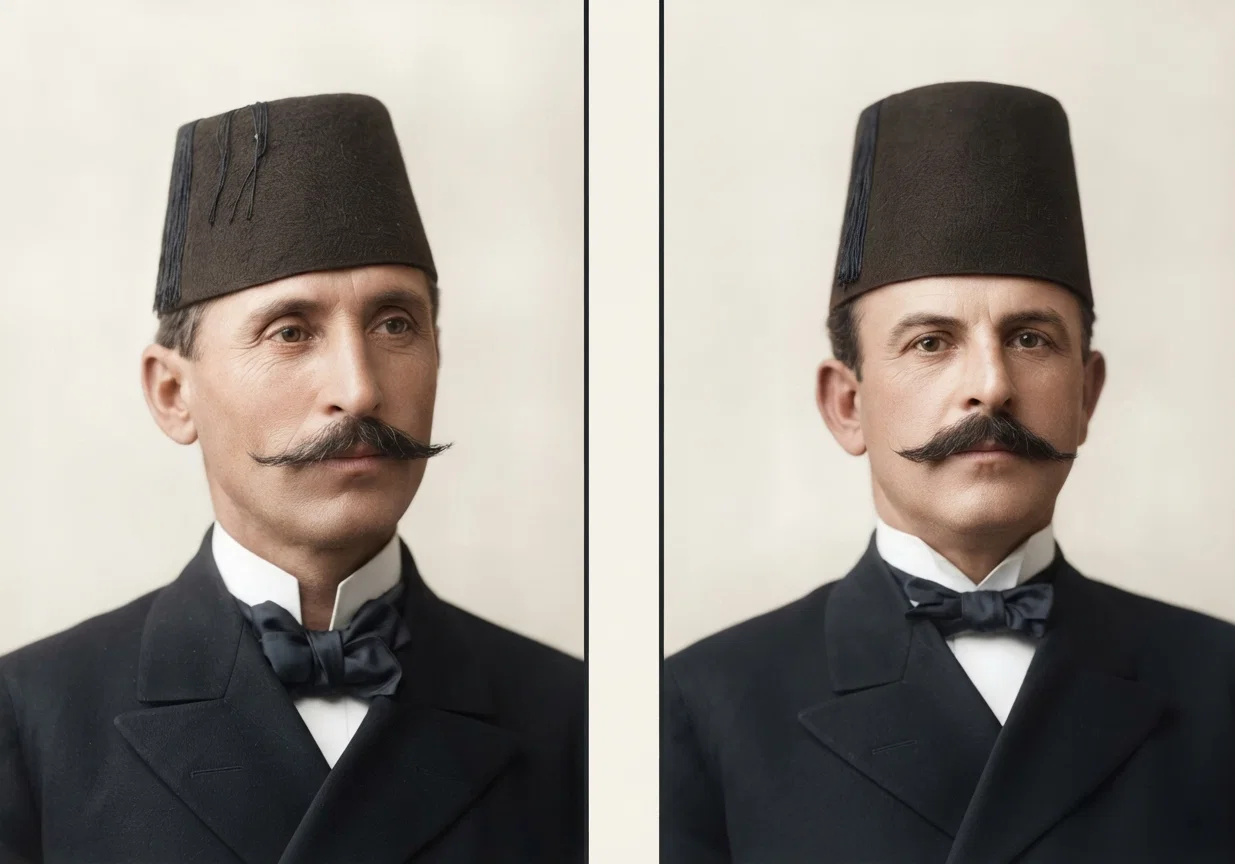
Representative leaders in the movement for a New Turkey.
A street scene in Monastir, Turkey, where the reform movement broke out.

The New-Turkey Movement.

It will aid in understanding the meaning of this reform movement to the subjects of the Ottoman Empire and to the world, if we summarize briefly the leading features of the general status of affairs prior to the granting of the constitution.
1. The sultan an absolute despot.
2. The maintenance of a vast secret police service for political purposes, at a cost of two million pounds per year.
3. Every citizen of education, wealth, or influence, subject to a harrowing espionage. One illustration cited by a Greek correspondent in Constantinople will suffice:
"Constantinople was witness last Friday to the following unexpected sight: Two members of the Cabinet returning home from their offices in the same carriage! When would Cabinet members formerly have dared to meet and converse in private? They would immediately excite the suspicions of the clique at the Yildiz. They would be denounced to the sultan as forming a collusion against the government. Spies would be put upon their track. On coming out of their offices, they would be obliged to return directly to their homes. A spy near the door would note the hour and minute of their exit. As they passed along a fixed route home, a second spy a little farther on would note the exact time of their passing his station. Then a third, a fourth, a fifth, all along the way would do likewise until the last one would note the time the carriage arrived at the house. In the evening these notes would be sent up to the Yildiz, where the exact time required for a carriage to pass from the member's office to his house is known. The notes would be carefully examined and compared. If there were a few minutes' discrepancy in time, the member is set down as a suspect. He saw somebody along the way, he talked with some one, he visited somebody, and the fate of the unfortunate one would be fixed."
4. A strict censorship on speech and the press. Up to a month ago no one dared even to utter the words "freedom," "fatherland," "nation," without fear of arrest and exile or death. Not a Turkish dictionary has contained the words "liberty" or "equality." Only the other day a publisher announced a new edition of his dictionary to contain for the first time in thirty-two years these two and many other words forbidden by the censors.
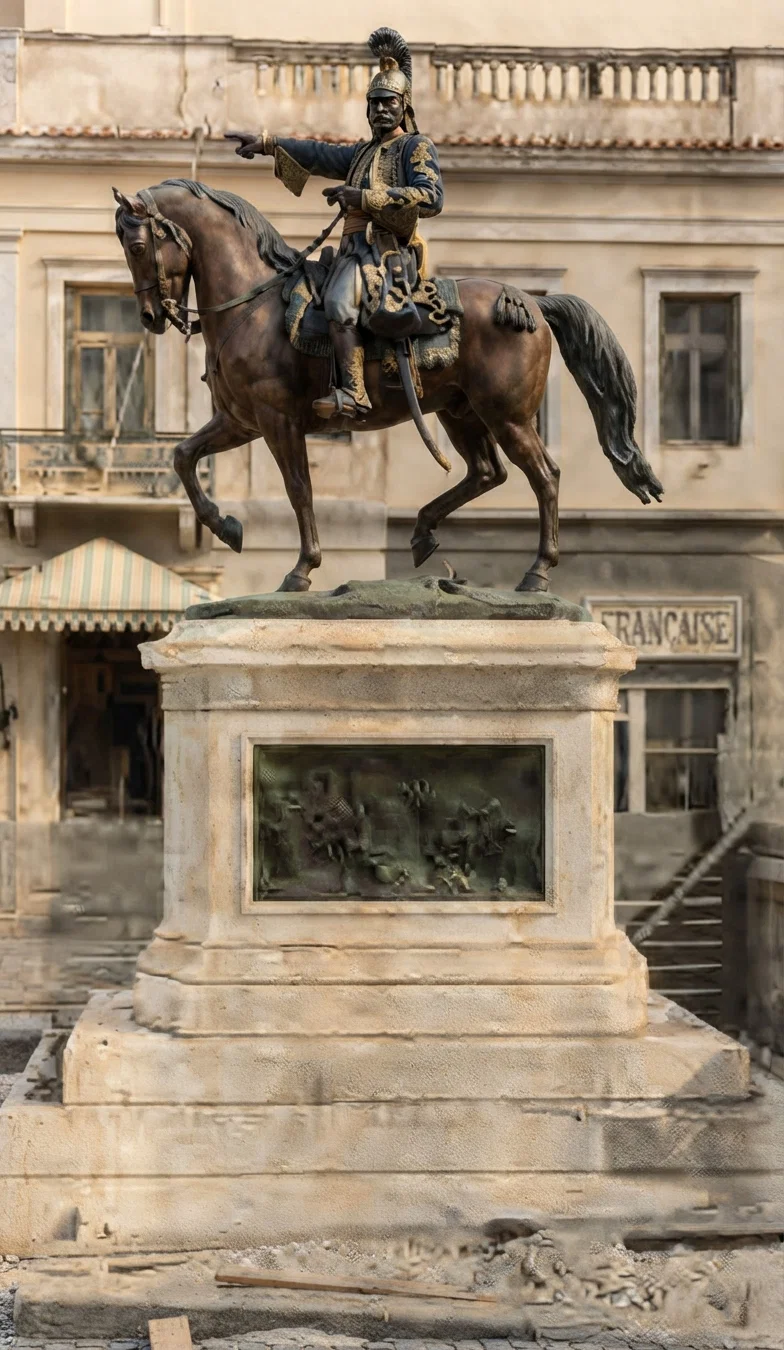
Bronze statue of Gen. Kolokotrones, commander of the Greek army in the War of Independence (1821-1829.) The right hand is pointing toward Macedonia as rightfully belonging to Greece, but yet to be acquired.
5. The condemnation and banishment or execution of political suspects without process of law. The number of political exiles in Europe and Egypt is said to be 5,000; in the United States 200,000.
6. The farming out of taxes, thus making the practical rate of taxation for the taxpayer subject to the greed and ingenuity of the collector.
7. The harpies of the court and the vultures of the provinces preying upon public funds and private fortunes, the latter by intimidation.
8. The harems of the sultan and the rich, filled with women kept in close retirement, with women in general under great restraint.
A method of warfare in Macedonia.
9. Irreconcilable racial and religious prejudices, generating dissensions, bloodshed, and anarchy.
10. Lack of strong central government, the ineffective administration and resulting weakness of which constitute a standing temptation to the powers to interfere in Turkish affairs to their own aggrandizement.
In the face of these conditions, there has been for years a partly suppressed but growing longing for freedom from this terrible oppression. New-Turkism, as the Greek press styles this reform movement, is not altogether of recent origin. More than forty years ago it asserted itself, and all but succeeded in making radical changes in the corrupt administration.
Abdul Aziz, second predecessor to the present sultan, himself a weak character, was persuaded by his prime minister and others of the necessity of seeking to better the desperate situation into which his misrule had brought the empire, by means of constitutional reforms, and was induced to visit the courts of Europe in 1867 to acquaint himself with better methods of administration. But his return was hastened by the death of his prime minister, and Abdul Aziz, instead of profiting by his journey, sank back, under the influence of his harem and a former unprincipled prime minister, into greater extravagance and more arbitrary rule than before. His excesses led his ministry finally to determine upon and execute the drastic measure of deposing the sultan to save the empire from disintegration.
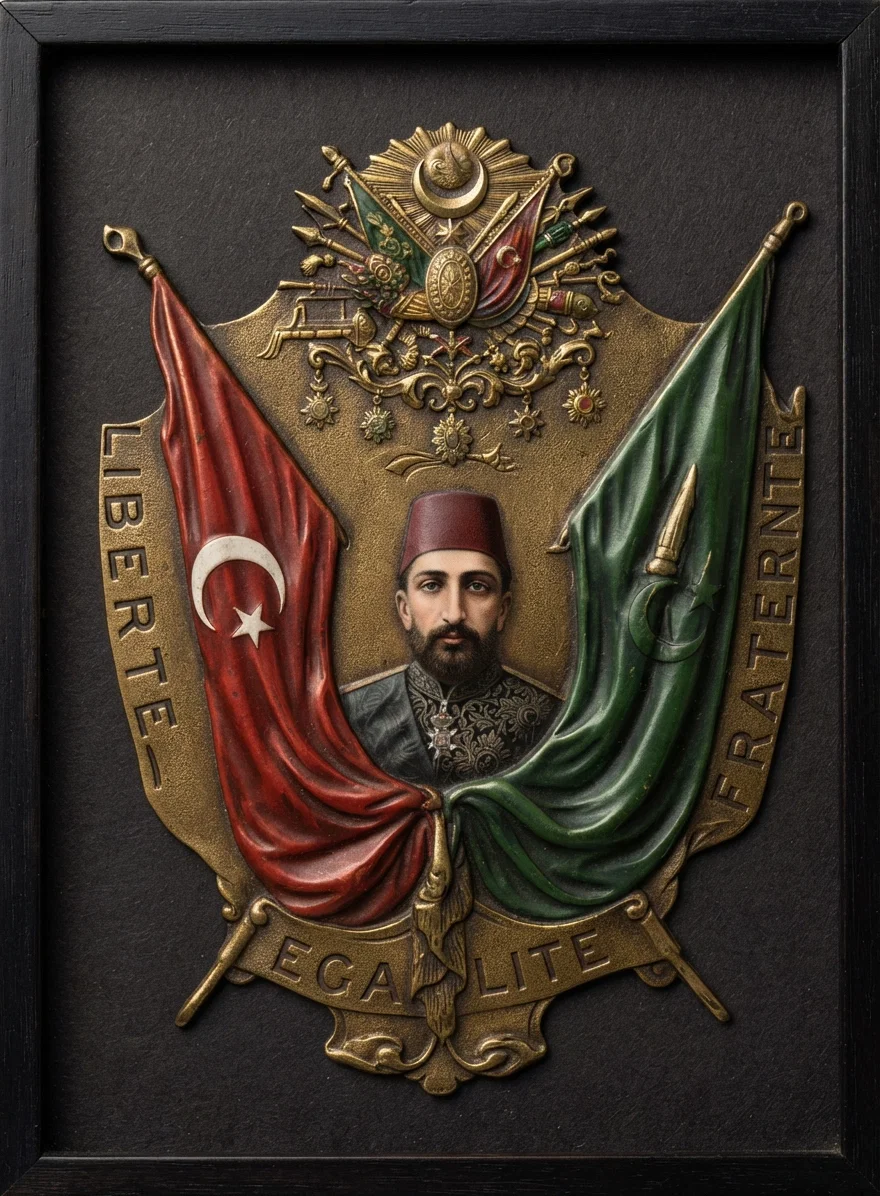
Constantinople post-card representing a medal suggested by the sultan to commemorate the proclaiming of the constitution. In the center is the sultan, on the right the green flag of Mohammed, on the left the red flag of the Empire. Does the sultan feel at home amid Liberty, Equality, and Fraternity?
His successor, Mourat V, committed himself to the constitutional movement, but by intrigues of the deepest dye, on the part of the opposition, he was, after only a few months, declared mentally incompetent to rule, and the present sultan, Abdul Hamid Han, was placed on the throne, Aug. 31, 1876.
Shortly after his accession, he chose as grand vizier, Medat Pasha, the author of the constitution that has just been proclaimed for the second time. In his first address to his cabinet, the sultan attributed the deplorable state of governmental affairs, first, to a disregard of the laws of the Koran; and second, to officials' following their own inclinations and wills instead of fixed principles. To aid in recovering the state from bankruptcy, he lowered the annual allowance for the princes and for the expenses of the court, and reduced his own salary $150,000. He abolished slave-holding, and urged vigorous action in putting down insurrection in the provinces.
Present Grand Vizier, Kiamel Pasha.
He next ordered his ministry to set things in order for the adoption of Medat's constitution for the empire. It was proclaimed Dec. 23, 1876. In his address on that occasion, the sultan said:
"Divine Providence has reserved for my rule the responsibility of carrying out this happy transformation [in form of government], which gives the highest assurance of the happiness of my people. I thank God that I have been made His instrument to this end."
Concerning the fate of the constitution at that time, the sultan said recently, on the occasion of his taking oath to maintain the renewed constitution,
"I granted a constitution in the beginning of my reign, and withdrew it later because the country was not prepared for it. I now proclaim it in good faith and desire it applied at all odds. I am now in the presence of the Sheik-ul-Islam [the highest Mohammedan ecclesiastic next the sultan] and take oath that the preservation of the constitution will be my sole care."
He then took oath twice, and directed theSheik-ul-Islam also to take oath in the presence of the people.
Thus local and international politics in the apparently insoluble Eastern Question take on a new phase. Its outcome will be watched with the keenest interest, especially by the student of prophecy, who, knowing the ultimate solution, has only to watch the unfolding of events to that end, and mark the ways of God in the kingdoms of men. It is a bold move from an unlimited monarchy to representative rule; for an autocrat who has done according to his will for thirty-two years, to submit to the limitation of his power by the will of the people. But the progress of the Gospel among the benighted people of that vast empire has been slow and difficult, impeded and hedged about as it is by every sort of arbitrary and absurd restriction. Have we not a right to expect that before the final crisis is precipitated, involving as it will the peace of the entire world, a respite from the oppressions of men may be granted for the teaching of the Gospel to every creature in that great domain?
That the respite will be a brief one, there is little doubt. But that the constitution has been introduced under more favorable conditions than before, is evident from the considerations—
  1. That the impetus of the movement proceeded from the people.
  2. That it is strongly supported by the army.
  3. That its leaders have been largely educated abroad.
  4. That it has been received with unbounded enthusiasm by the prevailing racial elements, the Turks, the Greeks, and the Armenians.
  5. That the changes are being effected with so much speed and vigor that the opposition can scarcely make a stand.
As for the last fifty years, the attitude of the great powers will have much to do with the success of the movement. Yet there is no power but of God, and we may confidently expect the outcome to be in accord with the divine purpose for these momentous times.
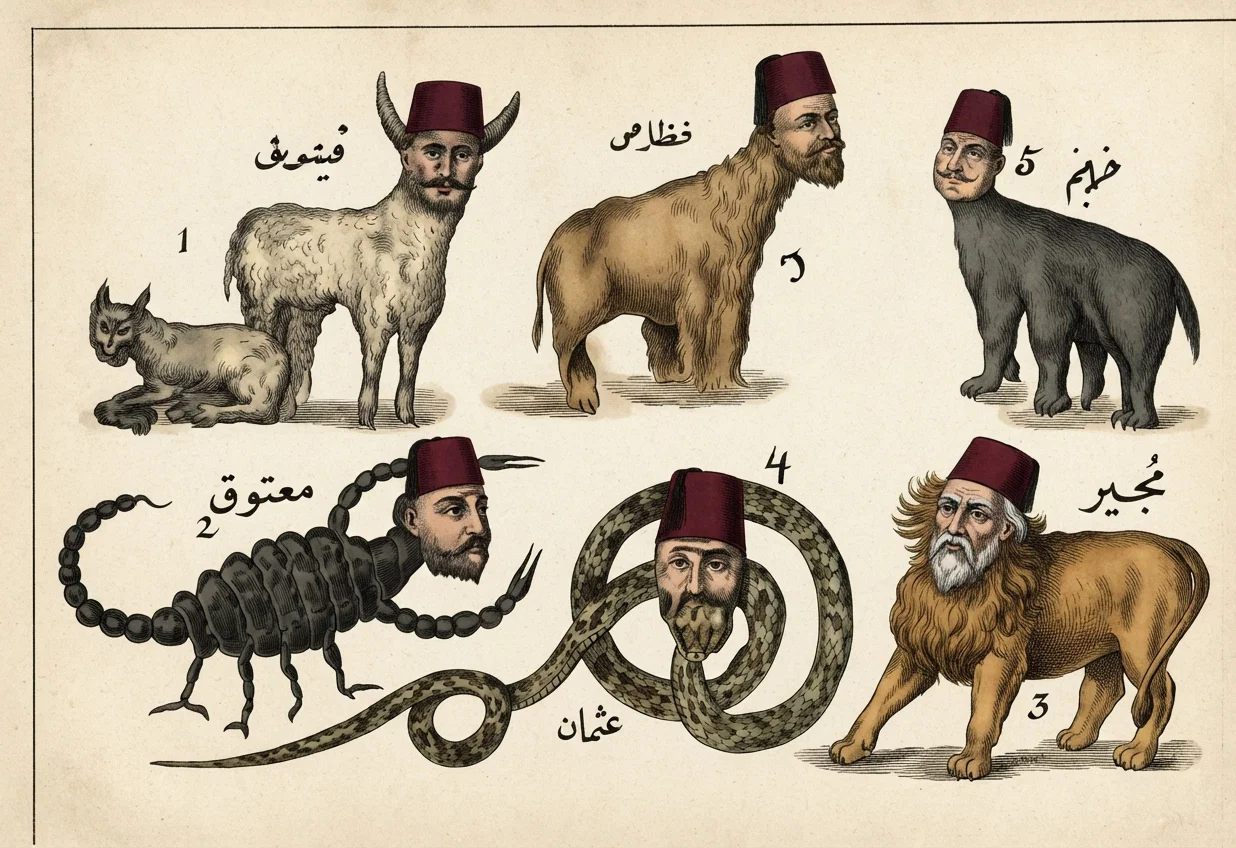
The Powers that Were. Among the first-fruits of the free press in Constantinople. (1) Chief of Police. (2) The Court "Crab." (3) Member of the Imperial Council. (4) The notorious Izzet Pasha who escaped so narrowly on an English boat. (5) Chief of Detective service, cut to pieces by a mob. (6) Aid-de-Camp and Private Detective of the sultan.

The Peace of the Commandment-Keeper

"O that thou hadst harkened to My commandments! then had thy peace been as a river, and thy righteousness as the waves of the sea." Isa. 48:18.
Look at the river, arising as a little brook among the mosses of the green hills, leaping the cataracts, flowing along the fair valley by the home of man, through the forests where only the wild things dwell. With hum of pleasant music, it turns the village mill, dropping over the old wheel, sporting in the eddies, bending low the supple willows. Anon the streamlet becomes a river and bears upon its flood full many a craft. And as a mighty stream it flows on to the broad ocean. Ages roll on, and the river abides; not as an evanescent morning cloud or a transient rain flood, but throughout time a permanent, lasting current, ever speeding on to its destined place.
Such is the peace of those who harken to the commandments of our God. They have always reason for comfort. Their consolation is not like a swollen torrent which is dried up under the burning sun of adversity, but peace is their rightful possession at all times. Do you inquire for the Thames?—You will find it in its own bed, in the thick, black night as well as in the clear, sunny day. So is the commandment-keeper, ever in his place, and at peace.
"When peace like a river attendeth my way, When sorrows like sea billows roll, Whatever my lot, Thou hast taught me to say, It is well, it is well, with my soul." H. F. Graf.

The Sixth Commandment

By J. O. Corliss
As in everything else of God's disposition, His rule for regulating the conduct of His subjects is perfect in form. This is clearly seen in the grouping of the commandments. First, they point out the duty of all toward the infinite Ruler, and at the same time reveal Him as the creator of the universe, thus giving the reason why men and angels should honor Him. Having fully made known Himself, and so laid the foundation for claiming absolute sovereignty over all, Jehovah next proceeds to show how each subject should regard his fellow subjects, giving directions in the order in which these dependents are related to each other.
In this division of moral regulations, parents have the first mention. They are the medium through whom life is distributed to men, and so are entitled to primary honor. The budding thoughts of every human being should be expended in paying deference to those of whose very substance he is a part. Having thus started in life, the same course should be maintained to the end, not only to bestow dignity upon, and bring joy to, one's own parents, but to establish an example by which one's children may profit in turn, in rendering homage to their parents.
Next in order is the duty one owes to his fellow men, whoever and wherever they may be, and under whatever circumstances they may be encountered. "Thou shalt not kill," is the command to every human being. It is highly fitting that such a command should issue immediately following the one requiring all to honor the life of their parents. The life of a fellow man is sacred as the gift of God, and should be so regarded by every one. It matters not how strong a provocation may come to one, nor how great a temptation may beset him, this injunction should regulate his conduct in any and every extreme case.
The reason for this is easy to find. To take from another that which no power but a heavenly one can restore, is to commit the gravest crime possible against a fellow man. Life is valued more than earthly treasure because it can not be gotten by human exertion. A single rash human act may deprive one of life, but all the good deeds of a lifetime can not return it to the loser. With how much care, then, should this precept be studied, lest through some provocation one should step beyond the bounds of due regard for the sacred rights of his neighbor's possession of life.
It is not enough, however, to refrain from the overt act of raising the hand to strike one down with the assassin's weapon. This precept is a part of that "great" commandment which requires one to love his neighbor as himself. One's love for himself invariably leads him to employ every available safeguard for self-protection. In order, then, to do the same for others, he must not only refrain from doing him direct personal violence, but also to throw about him the same means for protection that he would use for himself.
Love is far more than mere expression of sentiment. Love ever displays itself in its effort to uplift the fallen. "In this was manifest the love of God toward us, because that God sent His only-begotten Son into the world, that we might live through Him." "While we were yet sinners, Christ died for us." Rom. 5:8. Love is of that nature that it ever seeks, not only to help those who are degraded and dead in sin, but to elevate them to an equality with the highest, even the angels of heaven. Heb. 2:6-9.
"If God so loved us, we ought also to love one another." 1 John 4:11. But how much should we love others? There are no known degrees in love. "Love is of God." Whosoever, therefore, possesses love and dwells in it, lives in God, and God lives in him. Verse 16. God Himself being love,—that being the essence of His character,—the indwelling of God with a human being is the ingrafting of love into his soul, so that his nature becomes the reproduction of God's nature. And this change is not a fugitive, evanescent incident, as the Lord loves with an "everlasting love" (Jer. 31:3), even to dying upon the cross of shame for His enemies; so when that love makes its abode in any human form, that person must become steadfast in his love toward even his most bitter enemy. This is in harmony with our common Master who said, "This is My commandment, that ye love one another, as I have loved you." John 15:12. This is true love, "indeed and in truth."
To love others less than this, is to violate the great principle upon which the Ten Commandments are founded, because love,—the only really genuine love,—which is the foundation of God's character, is the "fulfilment of the law." Rom. 13:8. The reason for this conclusion is obvious, as expressed in another text by the same apostle thus: "Love worketh no ill to his neighbor; therefore [for this reason] love is the fulfilling of the law." Verse 10.
It is impossible for one who possesses love to work a wrong to another, because love is God’s impulse in man to lead him in the way of righteousness. Without this heavenly stimulus, one is left to be controlled by a power from beneath, in opposition to God’s will and work. Hatred, the very opposite of love, is Satan’s ruling power with men, as it is with himself. Hatred harbored in the heart gives one the worst possible view of others, and causes him to rejoice in the downfall of all not in accord with himself. Nay more, it will lead him to contribute toward that wished-for end, even tho it should be the eternal undoing of one whom he ought to aim to uplift.
One may affirm that he loves God, but even tho he does so with all possible vehemence, yet if he shows hatred for another, he proclaims himself a companion of Satan, of whom the Saviour said: “He is a liar.” John 8:44; 1 John 4:20. The apostle has truly said that no one can really love God whom he has never seen, and yet hate a visible fellow man toward whom the love of God is being manifested in His continuous effort to save him.
More than this, he who muses hatred in his heart toward another is a murderer. 1 John 3:15. Not that he has in very deed raised his hand to strike down the hated one, but he holds in his heart that terrible seed from which, under provocation, may quickly develop overt action. It is a sad misconception of spiritual relations when one can profess to love the Lord and yet have only bitter words of hatred to bestow on another whom he supposes has not treated him with due deference. Like the arch-conspirator against heaven’s peace, such persons conceive an enmity against another, and then talk about it to others until, through the abundance of his merchandise, he becomes filled with violence, even to desiring the destruction of another, or at least of his influence for good. It will be a terrible realization for such when, in the great day of final accounts, they find themselves forever condemned by that section of God’s commandments which says: “Thou shalt not kill.” “It is a fearful thing to fall into the hands of the living God.”

The Love That Seeks to Learn.

UNTRAINED love can make disastrous mistakes, as can ignorance in any other sphere. Yet we are prone to believe that true love is a sort of guarantee against error; that whatever we do in love for others is sure to work out for their good. It is a dangerous notion, from which some have had rude or tragic awakening. Many a mother who has been lovingly indulgent to her boy has lived to realize that those indulgences, born of her devoted and unselfish love, have helped to pave his way to ruin. Love must know, as well as feel. If we really love, we should be willing to study how to direct that love helpfully, instead of letting it take its own way harmfully. What is best for those whom we love, rather than what we would like to do for them, is the question that trained love asks, as over against thoughtless, ignorant love. “And this I pray,” wrote Paul to those whom he loved, “that your love may abound yet more and more in knowledge and all discernment.”—S. S. Times.

Tobacco Makes Men Selfish.

TALKING about the average man’s selfishness, a Washington Street gentleman’s furnisher is of the opinion that “there’s nothing in the world that makes a man so selfish as smoking. I smoked from the time I was fourteen till six years ago, thirty years all told. I thought about nothing but my pleasure in smoking. When once my day’s business was off my hands, when I went anywhere, socially, my chief aim was to get hold of a cigar and be off in a corner by myself. In traveling and on street-cars I know from experience that the average smoker thinks of nothing more than his own comfort.”—Indianapolis News.

A Good Report.

STUDENTS attending school are always pleased to obtain good reports. Good reports point to promotion sooner or later. Every Christian is in the school of Christ. Jesus has made it possible for every student to obtain good reports from time to time; and if his school-days here end with a good report, a student is sure of promotion to the glorious school of Christ in the paradise of God for one thousand years. And then will come another promotion, when the school-grounds are enlarged to embrace the beautiful earth made new. That will be God’s greatest university, the highest school in the universe.
From that university the inhabitants of unfallen worlds, and even the holy angels, will be eternally learning lessons in the greatest of all sciences, the science of salvation. No other school will be, or can be, so well equipped to teach that most glorious science of sciences. And the New Earth university will itself be a lesson book, and indeed the only text-book on that important and sublime subject. Surely we must be there.
But let us return to the present world and learn how we may obtain good reports here, and then see to it that we give all diligence to the all-important matter. This alone will be our truest and highest wisdom. The inspired letter to the Hebrews says, “Now faith is the substance of things hoped for, the evidence of things not seen. For by it the elders obtained a good report.” Heb. 11:1, 2.
Then in the same chapter special mention is made of a long list of ancient worthies who obtained a good report in the school of Christ through faith. Christ was the Author and Finisher of their faith. It was faith to begin with, faith to continue with, and faith to end with. The anchor faith, which includes hope, never lets go. As no one can please God without faith, it is obvious that no one can live a life that will please God, and thus obtain a good report, without constant, abiding faith. Unswerving faith in God, in His word, revealed in loving obedience, will insure a good report.
We must fight the good fight of faith to the finish. Paul says when he finished his course, that he had “kept the faith.” And he was sure of promotion when the Lord comes. And the day of the Lord’s appearing is the appointed time for the promotion of all who have obtained and retained the faith of Jesus till the end, and thus obtained a good report. Glorious day erelong to come, when all the faithful will hear the welcome plaudit, “Well done, thou good and faithful servant; . . . enter thou into the joy of thy Lord.” To be faithful is to be full of faith.
In fighting the good fight of faith, there are many diligent and dangerous foes to meet, so we will need to contend earnestly for the faith once delivered to the saints. The same faith is delivered to us. In this conflict, the great Captain of our faith provides us with an invincible armor. In its make-up, there is the breastplate of faith and love, and over all the shield of faith, which, if rightly adjusted and used, will quench all the fiery darts of the enemy.
Are you in the school of Christ? If so, are you obtaining good reports daily by faith? If you have not yet entered the school, be entreated to apply at once for admission. Jesus will turn none away if they will come in the way He has appointed. Repent, and be converted, and thus be born again, and then, as a little child, you will be received, and at once enter upon the only course that leads to true and eternal exaltation. Whatever may be your achievements or success in this world, your life will be a most wretched and miserable failure if you do not secure a final good report by faith in the school of Christ. “This is the victory that overcometh the world, even our faith.”
O, the faith of the just will very soon end in the perfect day. Then all the overcomers will be made perfect at once. They will be saved to the uttermost. Their personal and eternal salvation being then secured, they will go on in the study of the attributes of the divine Being, ever learning more of His justice, mercy, truth, and love. In like manner His wisdom and power and wonderful works, will ever be unfolding to their enraptured view.
Students in the school of Christ, with gratitude and praise, let us ever remember that our adorable Teacher has made every provision necessary for our constant triumph here and our eternal triumph hereafter.
H. A. ST. JOHN

Two Ways of Giving.

I GAVE a beggar from my little store Of well-earned gold. He spent the shining ore And came back again, and yet again, still cold And hungry as before.
I gave a thought, and through that thought of mine, He found himself a man, supreme, divine, Bold, clothed, and crowned with blessings manifold, And now he begs no more. — Anon.
Continue reading: A New Religious Era