Your ShelfYour Projects

Signs of the Times, Vol. 38, No. 36.

The World's Harvest

Signs of the Times

Sep 12, 1911

Pacific Press Publishing Association · Mountain View, California · Sep 12, 1911

The World's Harvest

IN His fields the Master walketh, In His fair fields ripe for harvest, Where the golden sun smiles slantwise On the rich ears, heavy bending; Saith the Master: "It is time." Tho no leaf wears brown decadence, And September's nightly frost-blight Only reddens the horizon, "It is full time," saith the Master— The good Master—"It is time."
Lo! He looks. His look compelling Brings the laborers to the harvest. Quick they gather, as in autumn. Wandering birds in silent eddies Drop upon the pasture-fields; White wings have they, and white raiment, White feet shod with swift obedience; Each lays down his golden palm-branch, And a shining sickle reareth: "Speak, O Master! Is it time?"
O'er the fields the servants hasten, Where the full-stored ears droop downward, Humble with their weight of harvest; Where the empty ears wave upward, And the gay tares flaunt in rows. But the sickles, the bright sickles, Flash new dawn at their appearing; Songs are heard in earth and heaven; For the reapers are the angels, And it is the harvest-time.
O great Master! are Thy footsteps Even now upon the mountains? Art Thou walking in Thy wheat-field? Are the snowy-winged reapers Gathering in the purple air? Are Thy signs abroad?—the glowing Of the evening sky, blood-reddened; And the full ears trodden earthward, Choked by gaudy tares triumphant? Surely 'tis near harvest-time!
Who shall know the Master's coming,— Whether 'tis at morn or sunset, When night dews weigh down the wheat-ears, Or while noon rides high in heaven, Sleeping lies the yellow field? Only may Thy voice, O Master, Peal above the reapers' chorus, And dull sound of sheaves slow falling: "Gather all into My garner, For it is My harvest-time!" —Dinah Mulock Craik.

"IF YE WILL INQUIRE, INQUIRE YE."

This Inquirers' Department is conducted for the purpose of helping those who are studying the Bible. The answers are oftentimes only suggestive. They are never to be considered infallible, only as they agree with the infallible Word. The writer who may answer them does not consider that his opinion is infallible. He will simply give the best that he has, and plead with the inquirer to search the Word. Such questions only will be answered as, to the editors, seem to minister to the good of the readers and to the mission of the paper. We can not answer repeatedly in the same volume questions upon the same scripture. The name and address must accompany question, not for publication, but as an evidence of good faith, and that answer may be made by letter if deemed advisable. No letters are answered which do not contain the name of the writer. It is well always to enclose stamp for reply.
Note.—To all our correspondents who are asking questions on various texts in the book of Revelation we would say, Study the articles that are appearing, and if these articles on the particular scripture do not answer the question in the mind of the querist, then please write.

3552 — Let No Man Judge You

Will you please explain Col. 2:16: "Let no man therefore judge you in meat, or in drink, or in respect of a holy day, or of the new moon, or of the Sabbath days"?
We wish that our readers would note the context. The one thing seemingly above all others which the apostle desires us to obtain in Colossians is the wonderful truth that we are complete in Christ Jesus our Lord. He desires to present every man "perfect in Christ." In Christ "dwelleth all the fulness of the Godhead bodily," and "in Him ye are made full, who is the head of all principality and power." Verses 9 and 10. In Him have we been buried in baptism, in Him raised to walk in newness of life, being made alive together with Him, having had all our trespasses forgiven. He has blotted out the bond written in ordinances which was against us, which was contrary to us, and taken it out of the way, nailing it to the cross. He has won the victory for us over all sin, and all that represents sin. In Him we are complete; and if we have accepted that fulness of our Lord Jesus Christ we are in that place where no one can condemn us. Therefore the apostle declares, "Let no man therefore judge you in meat, or in drink, or in respect of a feast-day or a new moon or a Sabbath day." God alone is He that judges us. We are not to regard the condemnation of men.
But would we understand by that that we are not to observe the Sabbath of the Lord? that we are not to honor our father and mother? that we may freely transgress the commandment, "Thou shalt have no other gods before Me"? We could not partake of the fulness of Christ and thus do; for having been clothed with His righteousness, we could not consistently go into sin. Having His righteousness placed upon us for our idolatry, we could not consistently go back into idolatry, and thus crucify the Son of God afresh. Having had His righteousness placed upon us for profanity, we could not consistently indulge in profanity. His righteousness would not cover that. Having had His righteousness placed upon us to cover our Sabbath-breaking, we could not consistently go back to Sabbath-breaking. Before the world we would make Him a transgressor in us. Says the apostle Paul: "Shall we continue in sin, that grace may abound? God forbid. How shall we, that are dead to sin, live any longer therein?"
Christ died to save us from that transgression, and to place within our heart God's holy law in all its fulness. That law was wrought out in His character in all perfection, so that He was indeed the living law of God in character. And when we come to God with confession of sin, God's righteousness in Christ covers all the sin that we have given up to Him. That is, in the place of the sin, God looks upon the righteousness of Christ, and reckons that to our account. In the place of our Sabbath-breaking, He reckons Christ's perfect Sabbath-keeping. In place of our idolatry, He reckons Christ's reverence and faithfulness in the worship of God. And so with every commandment of the law.
We may not observe the Sabbath in the way that somebody else demands. Jesus did not. The Jews had their traditionary way of observing the Sabbath. Jesus observed it in the perfect way, in honoring God and doing good to others. They even sought to kill Him because He did not keep the Sabbath in their way.
Some of the Jewish converts to Christianity still observed yearly sabbaths. It is to this, doubtless, that our text refers. There were yearly days which pointed forward to Christ; and some of the converts, with a heart of reverence for the old feasts appointed by the Lord, kept these yearly sabbath days. They are referred to in Leviticus 23. In verse 38 we are told that these are "beside the Sabbaths of the Lord." Some Christians kept the Jewish feast-days. Some of them kept the monthly feasts, or the new moons; others, looking upon the matter in a larger way, did not. These were not things in which the convert should be disturbed. Let no man judge them in those things. Those things were shadows, Christ was the substance. All these yearly days were typical; the weekly Sabbath was not. It antedated sin.
Looking upon it in this way all is clear and beautiful. The text does not in any wise speak against the observance of God's Sabbath, any more than against any other commandment of the Decalogue; and the connection in which it is used shows that the ones to whom the apostle is speaking are those invested in the very fulness of Christ, the perfect Commandment-Keeper, in every respect. The apostle's fear was that troublers would come in, those who would endeavor to disturb, and so weaken the hearts of the young converts in getting them to feel that they must do this, and they must do that; they must keep this tradition, or they must keep that tradition. The instruction is that Christ is the fulness; they must hold fast the Head, they must receive from Him, walk with Him, live in Him, follow Him.

3553 — Shall We Be Disappointed?

The disciples were disappointed when Jesus was put to death and buried; the Adventist people were disappointed when Jesus did not come in 1844. Is there any scripture which clearly shows that the people of God will not be disappointed again at His second coming?
G. W. S.
The disappointment was clearly foretold at the time of the first advent. Our Lord had warned them again and again as to just what was to come, the trial, the crucifixion, and all the events connected with these; but they would not, could not, see. They were blinded with the idea of a temporal kingdom. Even so the disappointment in 1844 was foretold in the book which was bitter after John ate it (Rev. 10:9); in the intimation, both in Habakkuk and Hebrews, that the vision tarry, wait for it. See Hab. 2:1-3; Heb. 10:36. The very context in Habakkuk would indicate that those who looked for the vision and it did not come would need argument to strengthen them; and the prophet is represented as waiting to see what he shall answer when he is reproved, or argued with; consequently the Lord told him to write out the vision. But He assured him that tho it seemed to tarry, it would come, and would not tarry longer.
There is this difference between the great event which awaits us and the two that are referred to: Both of those were marked with definite time. The very year of Christ's first advent was marked. Various events of that advent were marked. Men chose to be disappointed at that time. They would not look upon the words of our Saviour as expressing real, literal truth. Consequently they thought that He would then redeem Israel by a manifestation of great power and pomp and glory. He did redeem Israel in His death, but not in the way they looked for. So in regard to the advent movement in 1844. The 2,300 days reached to that very year. Men thought that the cleansing of the sanctuary meant the cleansing of the earth by fire, and therefore Christ must then come; but He did not come, and many were disappointed, sorely tested and tried, as the prophecy declared to be the case.
But there is no definite time to mark His second coming, no one special point in time to which people can look. God gives the signs which show that His coming is near, and then tells His people to watch and to wait, but assures them that He will come and will not tarry. The very nature of the event itself, coming at an indefinite time, shows that there will be no disappointment to the faithful, but there may be many surprises.
Please explain 1 Peter 3:6.
Read as in the Revised Version: "As Sarah obeyed Abraham, calling him lord: whose children ye now are, if ye do well, and are not put in fear by any terror," or, as the margin reads, "and are not afraid with any terror." The text simply shows the ordinary respect of a loving, dutiful wife of the Oriental countries at that time. The word "lord" is not used in the sense of a divine being at all, but one who is the head of the household. "Whose children ye now are" means children of Abraham; rather, it means children of faith, for "if ye be Christ's, then are ye Abraham's seed, and heirs according to the promise." Those who are children of Christ, who are faithful to God, are not those who are serving Him from slavish fear or terror. They serve Him from love; they do not feel that they are under slavish restraint. The whole passage, verses 1-7, is instruction to both husband and wife which, if carried out by each to the glory of God, would bring blessing to every family. That blessing will never come, however, by the husband's feeling that he must be sponsor of his wife's duty, or the wife that she is the one who is to control the husband and mark out his duty. The instruction to the wife is addressed to the wife, not to the wife through the husband; and the instruction to the husband is addressed to the husband, not to the husband through the wife. Let each one take it as from the Lord, and there will be no difficulty.

3554—Moses and Elijah

Matt. 17:3. In what form did Moses and Elias appear? bodily, or how? M. T. D.
Bodily, evidently! Moses had been raised from the dead, as intimated by Jude 9, while Elijah had been translated without seeing death. They came to comfort our Lord concerning the sufferings through which He was to pass. Luke 9:30, 31. God designed that those disciples should hear their conversation concerning Christ's decease; but they allowed themselves to be overcome with sleep, and consequently missed that which would have helped them in their testing at the time of Christ's death. That transfiguration scene was a miniature representation of Christ's second coming. Compare Matt. 16:27 with 2 Peter 1:16-18. Moses represented those who would be raised from the dead to immortality, and Elijah those who would be translated without seeing death.
Schedule for Week Ending Sept. 23, 1911

OUR BIBLE BAND

Schedule for Week Ending Sept. 23, 1911 Sunday | September 17 | Matthew 7, 8 Monday | " 18 | " 9, 10 Tuesday | " 19 | " 11, 12 Wednesday | " 20 | " 13, 14 Thursday | " 21 | " 15-17 Friday | " 22 | " 18-20 Sabbath | " 23 | " 21, 22

Readings in Matthew

Our readings of this week cover a part of the glorious record of our Lord's life on the earth. The last part of the wonderful sermon (chapter 7), the healing of the leper by a word, of the centurion's servant, of Peter's wife's mother, the stilling of the tempest, the casting out of the demons (chapter 8), the healing of palsied and the forgiveness of sin, the calling of Matthew, the striking parable of the patching of garments and the wine-skins, the healing of the woman with the bloody issue, bringing to life Jairus' daughter, showing the heavenly response to faith, the healing of the blind and dumb, call to the harvest (9), the sending forth of the twelve (10), concerning John the Baptist, revealing the Father (11), our Lord and the Sabbath, casting out demons, the unpardonable sin, the secret of true relationship with Christ (12), a whole chapter of parables, the principal of which are the sower, and the wheat and the tares (13), death of John the Baptist, feeding of five thousand, walking on the water, healing the sick (14), rebuke to ceremonialism, the woman of Canaan, healing in Galilee, feeding the four thousand (15), etc., etc.
We would suggest to Our Bible Band that after reading the chapter they think through it again. Recall the principal events and their great lessons. Then think over again the chapters of the book you are reading. A few minutes spent in this way at each reading will help much in fastening in our mind the plan of the book and the ground over which we have passed. Analyze or separate the remaining chapters of this week's readings. These are precious lessons, as for instance, the keys of the kingdom, the transfiguration, God's depth of forgiveness, laborers in the vineyard, the barren fig-tree, our Lord's teaching, and the men who sought to ensnare Him.

Hope for the Penitent

By Mrs. E. G. White
CHRIST came to manifest the love of God to the world to draw the hearts of all men to Himself. He said, "And I, if I be lifted up from the earth, will draw all men unto Me." The first step toward salvation is to respond to the drawing of the love of Christ. God sends message after message to men, entreating them to repentance, that He may forgive, and write pardon against their names. Shall there be no repentance? Shall His appeals be unheeded? Shall His overtures of mercy be ignored, and His love utterly rejected? O, then man will cut himself off from the medium through which he may gain life eternal; for God only pardons the penitent. By the manifestation of His love, by the entreating of His Spirit, He woos men to repentance; for repentance is the gift of God, and whom He pardons He first makes penitent. The sweetest joy comes to man through his sincere repentance toward God for the transgression of His law, and through faith in Christ as the sinner's Redeemer and Advocate. It is that men may understand the joy of forgiveness, the peace of God, that Christ draws them through the manifestation of His love. If they respond to His drawing, yielding their hearts to His grace, He will lead them on step by step, to a full knowledge of Himself; and this is life eternal.
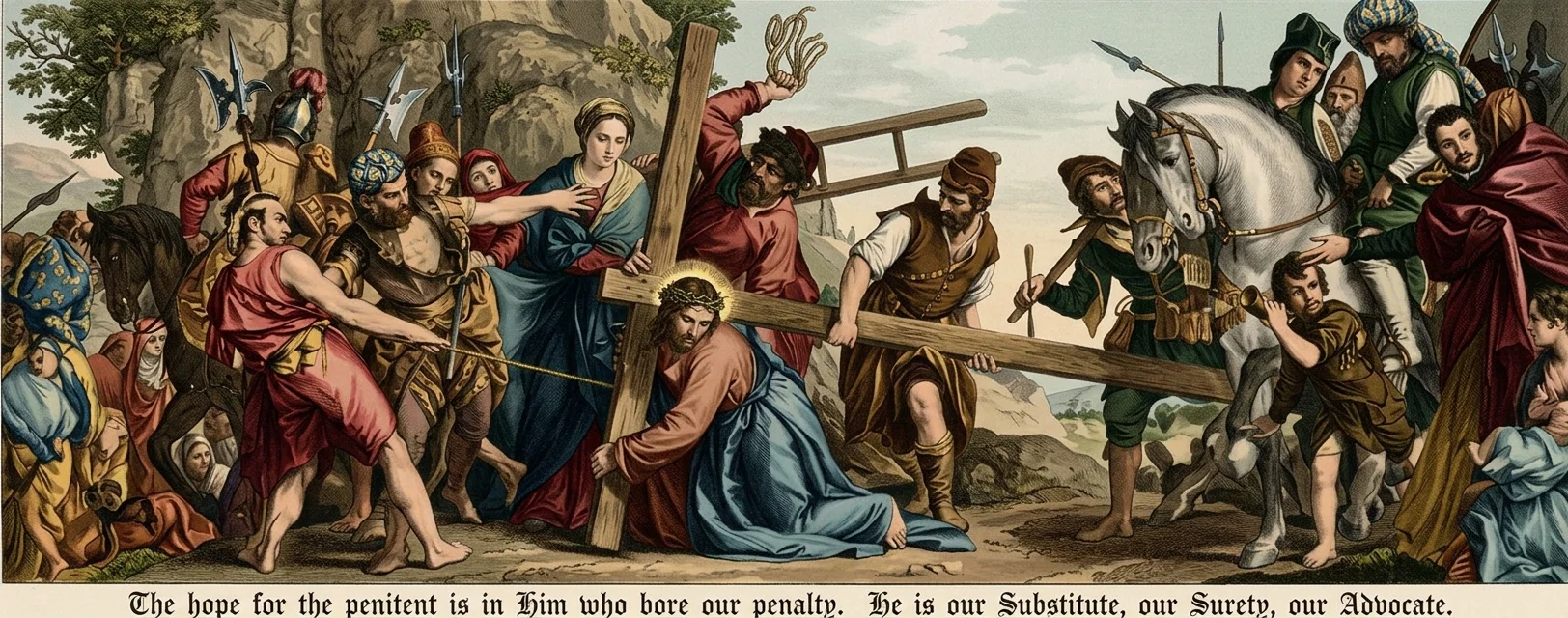
Christ came to reveal to the sinner the justice and love of God, that He might give repentance to Israel, and remission of sins. When the sinner beholds Jesus lifted up upon the cross, suffering the guilt of the transgressor, bearing the penalty of sin; when he beholds God's abhorrence of evil in the fearful manifestation of the death of the cross, and His love for fallen man, he is led to repentance toward God because of his transgression of the law which is holy, and just, and good. He exercises faith in Christ, because the divine Saviour has become his Substitute, his Surety, and Advocate, the One in whom his very life is centered. To the repenting sinner God can show His mercy and truth, and bestow upon him His forgiveness and love.
The hope for the penitent is in Him who bore our penalty. He is our Substitute, our Surety, our Advocate.
But Satan will not permit a soul to escape from the captivity of sin if by any means he can prevent it. Tho all heaven has been poured out in one rich gift—for when God gave His Son, He gave the choicest gift of heaven, and the treasures of heaven are at our command—yet to the repenting soul the enemy will seek to represent God as stern and inexorable, unwilling to pardon the transgressor. At different times letters have come to me from persons who were in despair over their sins. One and another have written: "I fear I am past all help. Is there any hope for me?" To these poor souls the message has been given: "Hope in God. The Father has bread enough and to spare. Arise, and go to your Father. He will meet you a great way off. He will give you His love and compassion."
When the enemy comes in like a flood, and seeks to overwhelm you with the thought of your sin, tell him: "I know I am a sinner. If I were not, I could not go to the Saviour; for He says, 'I came not to call the righteous, but sinners to repentance.' And because I am a sinner I am entitled to come to Christ. I am sinful and polluted, but He suffered humiliation and death, and exhausted the curse that belongs to me. I come. I believe. I claim His sure promise, 'Whosoever believeth in Him should not perish, but have everlasting life.'"
Will such a plea, made in contrition of soul, be turned away?—No, never. By the suffering and death of Christ is proved His boundless love to man. He is willing and able to save to the uttermost all that come to God by Him.
Then as a little child come to God, presenting yourself as suppliant at His feet; for we need not ascend into the heavens to bring Jesus down, nor descend into the earth to bring Him up; for He is ever near us. He says, "Behold, I stand at the door, and knock: if any man hear My voice, and open the door, I will come in to him, and will sup with him, and he with Me." How willing is Christ to take possession of the soul temple if we will let Him! He is represented as waiting and knocking at the door of the heart. Then why does He not enter? It is because the love of sin has closed the door of the heart. As soon as we consent to give sin up, to acknowledge our guilt, the barrier is removed between the soul and the Saviour.

Gems from Wesley

I FOLLOW my Bible in all things, both great and small.
My only rule for doing a thing is plain Scripture.
I try every church and every doctrine by the Bible.
I am determined to do the work of Him that sent me.
I love truth wherever I find it.
While we do live, let us live in earnest.
I feel and grieve, but I fret at nothing.
We have need to use all the common sense God has given us.—Selected.

Do the Dead Return?

By Earle Albert Rowell
WHEN the phenomenon of Spiritualism first manifested itself, while the populace were inclined to accept it as a more pleasing doctrine than was being heralded from the pulpit, scientists the world over rejected it with scorn as a mere trick. But Spiritualism persisted, spread, and developed; and scientist after scientist tested carefully its "wonderful facts," and finally accepted it at its own valuation.
The great English scientist, Alfred Russel Wallace, recently said, "No more evidence is needed to prove Spiritualism, for no accepted fact in science has a greater or stronger array of proof in its behalf." The evidence has been sufficient to convince such world-renowned scientists and thinkers as Sir William Crookes, Camille Flammarion, Hodgson, Hyslop, Funk, Richet, Lombroso, and William T. Stead, to mention only some of the greatest.
The object of this article is to examine briefly a quite full statement by Stead, entitled, "How I Know the Dead Return," in the Harbinger of Light, Australia, and reprinted in the Stellar Ray for June and July, 1909:
The lady whose initials were E. M., and whose tragic fate I have just described [she committed suicide], had promised me that if she died before me she would do four things. She had constantly written automatically with my hand during her life. She promised, in the first place, that she would use my hand, if she could after death, to tell me how it fared with her on the other side. In the second place, she promised me that, if she could, she would appear to one or more of her friends to whom she could show herself. In the third place, she would come to be photographed. And, finally, she would send me a message through a medium, authenticating the message by counter-signing it with the simple mathematical figure of a cross within a circle.
E. M. did all four: (1) She has repeatedly written with my hand. . . .
(2) She has repeatedly appeared to two friends of mine. . . .
(3) She has been photographed at least half a dozen times after her death. All her portraits are plainly recognizable, but none of them are copies of any photograph taken in earth life.
(4) There remains the test of a message accompanied by the sign of a cross within a circle. I did not get this for several months. I had almost given up all hopes, when one day a medium who was lunching with a friend of mine received it on the first attempt she made at automatic writing. "Tell William not to blame me for what I did. I could not help myself," was the message. Then came a plainly but roughly drawn circle, and inside it the cross. No one knew of our agreement as to the test but myself. I did not know the medium, I was not present, nor was my friend expecting any message from E. M.
Stead then gives another experience, which was to him still more convincing:
Twelve months ago this month of December I saw my eldest son, whom I had trained in the fond hope that he would be my successor, die at the early age of thirty-three. The tie between us was of the closest. No one could deceive me by fabricated, spurious messages from my beloved son.
Twelve months have passed, in almost every week of which I have been cheered and comforted by messages from my boy, who is nearer and dearer to me than ever before. The preceding twelve months I had been much abroad. I heard less frequently from him in that year than I have heard from him since he passed out of my sight. I have not taken his communications with my own hand. I know him so well that what I wrote might have been the unconscious echoes of converse in the past. He has communicated with me through the hands of two slight acquaintances, and they have been one and all as clearly stamped with the impress of his own character and mode of thought as any of the letters he wrote to me during his sojourn on earth. . . .
What more evidence, what kind of evidence, under what conditions, is wanted, before conviction is established?
He concludes his article thus:
After this I can doubt no more. For me the problem is solved, the truth established, and I am glad to have this opportunity of testifying publicly to all the world that, so far as I am concerned, doubt on this subject is henceforth impossible.

Reasoning About Messages From the Dead

Now I wish to call attention, not to the incidents recorded, for no one doubts their pathetic reality, but to the process of reasoning by which Mr. Stead has convinced himself that E. M. and his son have been returning to comfort him, with messages and their assurance of happiness in their world.
He bases his faith upon, first, a secret agreement between E. M. and himself; and, second, upon a close intimacy between his son and himself. Expressed in syllogism his reasoning stands thus:
Major premise: Only E. M. and I knew of our agreement.
Minor premise: The conditions of our agreement were fulfilled in every detail.
Conclusion: Therefore they were fulfilled by no other than E. M. returned from the dead.
The second line of reasoning proceeds thus:
Major premise: My son and I had secrets and confidences that only we two knew about.
Minor premise: A spirit or intelligence communicates with me after my son’s death with full knowledge of these secrets and plans.
Conclusion: The communicating intelligence could have been no other than my son returned from the grave to be my companion.
The trouble with this reasoning is that the major premise is not only not proved in either case, but is demonstrably false even on Mr. Stead’s own theory. For even accepting as a fact the return of the dead, we must admit that the spirits of thieves, liars, and murderers can return as easily as those of the worthy and peaceful; and therefore deceit and imposture by spirits of the returned dead can not be held impossible, and indeed is even admitted by Spiritualists. Consequently the fulfilment of any agreement made previous to death, does not necessarily come from the contracting party; for some one or several of these evil spirits, presumably enemies of one or both, might be present and hear the agreement, and after the death of one of the two, fulfil in the minutest detail all the most secret contract in the stipulated time and in the covenanted manner, and do it all for the sole purpose of possibly malicious revenge. That people should be so blinded by the wonders of Spiritualism as not to see such a self-evident truth, is a most surprising anomaly of the human mind.

His Basis of Faith

But the point they take for granted, that since some intelligence does return it must be that of human beings, is the one point above all others that those who are attracted to Spiritualism should demand clear, absolute proof of. Evidence of the senses is by many considered sufficient. And yet every thinker knows that nothing is often more deceiving than appearances. To take a familiar instance, the sun appears to circle the earth, and only by an understanding of the science of astronomy can we be convinced of the contrary.To make the case clearer, let us illustrate with an imaginary instance, which, however, has had its counterpart in the experiences of many. You and your mother, let us suppose, have been the closest of companions for a lifetime. You have had numberless confidences in which no third party has ever been admitted, and about which no one else knows a syllable. You are naturally curious concerning the next life; and when you talk over its mysteries with your mother, you and she enter into secret compact of sixfold nature, the climax and testing point of which shall be her manifestation in flesh as in life, and a conversation concerning certain secret specified subjects. Upon her deathbed she calls you to her side and promises you that if she can she will fulfil the agreement in every detail.

There Is No Peace

By N. D. Anderson
Peace, and there is no peace! Peace, and there is no peace!
Above, the seas are subtly smooth and still, Calm as the face of age—they, too, are old— Gentle as doves, soft murmuring the same. They glass the home of peace, and all the trains Of night and day pass unmolested through Their borders. Peace, and there is no peace! For underneath, in tumult and turmoil, Are born behemoths in the throes of hell! Huge flocks of monsters, each superior to His prototype, fly swiftly to and fro Across the ocean's floor, guarding the ways— With never-sleeping eye watching each other.
Peace, and there is no peace! Peace, and there is no peace!
Forth from a legion caverns of the deep, Swift plunging like to maddened steeds they come, Breaking the placid waters of the seas Into a myriad maelstroms! Flecking the red foam Against the face of heaven, and the depths With terror churning, the monsters are let loose; Behemoths struggle in titanic strife; The sun is darkened; and there are no seas, No lands, naught but the shriek of battle!

Fallacious Reasoning

But this is by no means all. There is another process of reasoning by which Mr. Stead, equally with other Spiritualists, proves to his satisfaction the return of the dead. Expressed in a syllogism the proof is reached thus:
Major premise: Communications from the other world can come only from departed human beings.
Minor premise: We receive messages from the other world.
Conclusion: Hence the dead return to communicate.
In the major premise, Mr. Stead, along with all other Spiritualists, assumes as proved the very thing that most needs proof, and is the most important point in the whole controversy. Spiritualism as a system of the return of the dead breaks down by its own weight of absurdity, and is proved as not only dangerous but positively deceitful and malicious by its own advocates. It is convicted out of its own mouth. For as long as Spiritualists admit that deception is possible—and they admit it on every hand—there is absolutely no security from being led into the grossest error and the most absurd if not harmful practises. Hence even if it were proved that communications from the other world come only from departed human beings, Spiritualism can furnish no credentials to credence.

The Deception

Soon after her death you receive in exact order and manner the fulfilment of the tests agreed upon, till the last and greatest is the only one that remains. Then one day when you are alone and sad, you see grow before you from a nebulous form into a firm and distinct outline, the likeness of your mother. She approaches you, and as in wonder you dare not move or speak, she addresses you in the familiar manner of your mother, and places about you the caressing hand of your mother, and even gives you the mother's kiss. The tones of her voice are the tones of your mother, the hand has that peculiar little birthmark upon its back, that single freckle upon the left cheek is there, and in fact all other peculiarities your mother possessed in life are possessed by your visitor. She then speaks of the stipulated subjects in the agreed order, and in fact there is not a slip, nor a detail lacking. She then presents before you in beautiful language the noble picture of the high ideal she wants you to attain. The highest morality, noblest virtue, and divinest wisdom fall from her lips. And then with a promise to come again, she vanishes, dissolves from view.
This is so far from being a fanciful representation, that it is an adaptation of an experience of a relative of mine, and may be similar to an experience you have had or may in the future have. The pressing question is: Would you be convinced by such an experience that it was your mother, your dearest earthly friend, come back to protect and guide you with her love? Yet bear in mind that the moment you consider it a possibility, you also in the nature of the case open the way for the grossest deception; for if your mother can return, your worst enemy can also, and by gaining your confidence lead you on to ruin under the name and influence of your beloved mother. Having no standard by which to judge, you are at the mercy of the bad men and women who have died. In other words, the appearance of one in the form, speaking the words, and fulfilling the compact of your mother, is proof of one thing, and only one thing, and that is this: That an intelligence from the other world is operating in your presence. Granting that the dead return, you are as much at sea as ever, for that intelligence may or may not be your mother. The fulfilment of the compact and the personal likeness are absolutely no evidence, not to any proof, that it is, according to reason and the rules of Spiritualism itself.
If you are without a standard, an authority by which to judge, you will be always in doubt. The point to be settled first of all is the important one: Are the dead alive? This may sound like a paradox, but it is one of the most serious questions that confront the world to-day. Having shown that admitting the teachings of Spiritualism we are left in a haze of uncertainty and liable to gross deceptions, it will be the purpose of the next article to consider from the standpoint of the great standard, the Bible, the root question, DO THE DEAD LIVE AGAIN?

The Power of Attraction

earth, but in a direct line toward the center of the earth, tho it be thousands of miles away, and can never be reached? It seems an emblem of God, filling all space, operating through all matter. If the dream of astronomers be true, that not only secondaries surround their planets, and planets their suns, but that suns revolve around the center of immense systems, and all these centers through the immensity of space move around one great center, who can ever conceive the magnitude of a force that can thus operate through infinite space with precisely the same law of attraction for vast worlds and for infinitesimal atoms? It is a force never seen, and yet it operates alike in the sunshine and in the dark. It is never heard, and yet it sends its myriads of worlds singing and shining on their way. He who made that power by the word of His Spirit, gives that Spirit to work in us and through us. Nor is it the only exhibition of power. Consider the chemical affinity that draws together the acids and alkalies. With what constant and unseen
power does it operate! Think of that magnetic power which makes the steel filings, tho in a mass of dust and rubbish, and clippings of tin and brass, leave them all and fly up and kiss the magnet. It touches that pivoted needle, and lives and treasure are secure upon the stormy ocean in the darkest night by its unerring guidance. The winds blow ever so fiercely, the cold comes ever so freezingly, the waves roll ever so furiously, and the vessel pitches and sinks as tho it would be submerged; and yet that strange influence, unseen, unheeded, unfelt even by the most sensitive nerves, holds the needle in its place. Who can tell what is power? We see it in its effects, we measure it in its results.
So with spiritual power. We can not tell "whence it cometh, or whither it goeth;" but it breathes upon the human spirit — the stormy passions subside; falsehood, fraud, lust, and avarice disappear; and truth, purity, meekness, and love reign supreme in the soul. It is a transmutation beyond what the philosopher sought in the fabled stone whose touch would transmute into gold. It is a new creature from the breath of Him who created all worlds and breathed into all spirits.—Anonymous.

Power — Spiritual

GRAVITATION, that greatest of all material powers, ceaselessly active, everywhere potent, is wholly beyond our research, or even our conception. Where are those cords, stronger than steel, which bind the planets to their centers? Where are those unseen ties that, like a universal network, envelop every atom in the air, and make it fall to the earth, and not merely to the

Illusions of War

[This poem, which we clip from the "Sierra Educational News" for August, should have been published last week to give force to our horrible illustration in the Outlook department.]
War I abhor, And yet how sweet The sound along the marching street Of drum and fife! And I forget Wet eyes of widows, and forget Broken old mothers, and the whole Dark butchery without a soul.
Without a soul — save this bright drink Of heady music, sweet as death; And even my peace-abiding feet Go marching with the marching street; For yonder, yonder, goes the fife, And what care I for human life?
The tears fill my astonished eyes, And my full heart is like to break; And yet 'tis all embannered lies, A dream those little drummers make.
O, it is wickedness to clothe Yon hideous grinning thing that stalks Hidden in music, like a queen That in a garden of glory walks Till good men love the thing they loathe!
Art, thou hast many infamies, But not an infamy like this. O, snap the fife, and still the drum, And show the monster as she is! — Richard LeGallienne.
Continue reading: An Erroneous Idea