Your ShelfYour Projects

Signs of the Times, Vol. 27, No. 52.

The Wise Men and the Star

Signs of the Times

Dec 25, 1901

Pacific Press Publishing Company · Oakland, California · Dec 25, 1901

The Wise Men and the Star
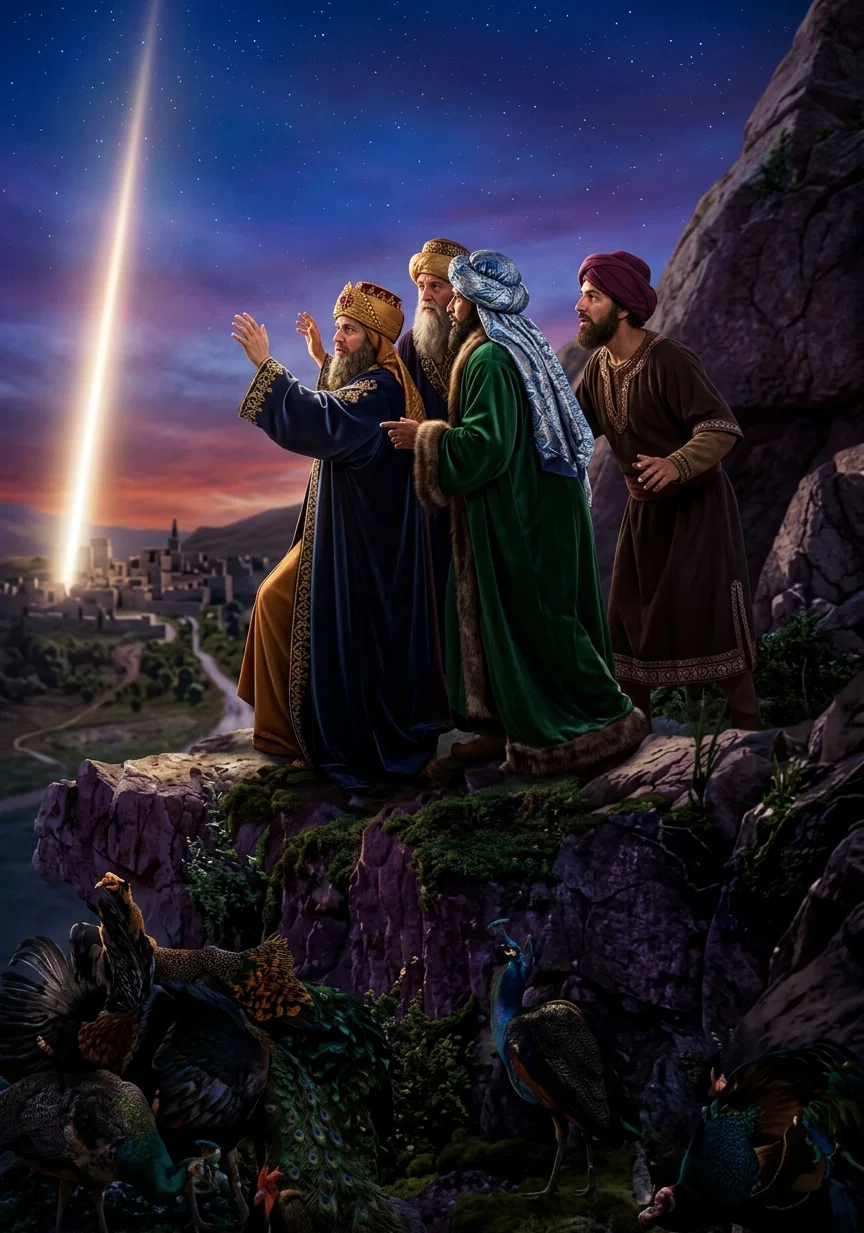
NOW when Jesus was born in Bethlehem of Judea in the days of Herod the king, behold, there came wise men from the east to Jerusalem, saying, “Where is He that is born King of the Jews? for we have seen His star in the east, and are come to worship Him.” Thus reads the simple record in Matt. 2:1, 2.
An Imaginary Idea of the Three Wise Men Beholding the Star.
THE record continues, “When Herod the king had heard these things, he was troubled, and all Jerusalem with him.” He ought not to have been; Jerusalem ought not to have been troubled. Every Jew ought to have been glad at the news. Nay, more, they should have been expectant, eagerly waiting to welcome their King.
WHY? They had all the holy prophecies which foretold those days, and the coming of the Antitype of all the ages. From Moses, “the man of God,” to Malachi, “the messenger” of Jehovah, God’s prophets had foretold the coming of the Just One. Light from these prophecies had penetrated the obscurity of the east. The learned Magi had read of His coming. The Greek copies of the Old Testament had doubtless been read; Isaiah had given them light; for they looked for a child born of a virgin. Balaam’s prophecy, himself a son of the east, had been read:—
“I shall see Him, but not now; I shall behold Him, but not nigh: There shall come a Star out of Jacob, And a scepter shall rise out of Israel.”
THE wise men found the Child, the One whom they sought. Finding Him, they worshiped Him, and poured out lavishly of their treasures at the feet of the pure, sweet Babe. They rightly went to Herod to inquire. He rightly inquired of the priests and scribes; but they knew not. Where He should be born they could read in Micah’s foretelling; but when and how they were ignorant, tho the when and the how had been as truly foretold as the where.
WHY did they not know?—They wished it so. Their Lord did not reign in their heart; they did not want Him to rule in the kingdom. They were not therefore looking for Him to come in His way; they did not know Him when He came. And Herod, who for a little time was seated upon the insecure throne, baptized with injustice, cruelty, avarice, and blood, he did not know; and as soon as he heard, he became jealous of the Lord of glory; Satan took possession of the heart, and he sought to destroy the One to whom he owed his life. He feared the Child born might be the Christ; and fearing it, in his mad jealousy thought to slay the Lord’s Anointed and to thwart God! Jesus “came unto His own, and His own received Him not.” They professed to be His people; they prayed for His coming; but He came in His own way, and their way not being the Lord’s way, they did not know their Saviour and their King.
IT is a principle often demonstrated, a history often repeated. There were doubtless many who professed to be God’s children who went down in the flood. Many thousands of the Jews of Jerusalem who rejected Christ went to a cruel death in the siege of Jerusalem. They refused Christ their hearts, they would not have Him reign over Jerusalem, and they died reaping the fruit of their own choosing. So it will be with all who reject the Holy Child Jesus. If we will not let Him reign in our hearts, if His law is not the law of our lives, when He comes to reign forever over a renewed and glorified earth, we will not know Him; we will have chosen a king to everlasting destruction.
THE wise men knew the Child, humble tho all His environments were. They loved Light, and wanted it. They loved Truth, and sought it. And when they came to Him, who is the Light of the world, the personified Truth, they knew Him. Their acts of worship were but the manifestation of the inner life. They were demonstrations to the Jews that God was no respecter of persons, and that He would mercifully guide every soul who sought Him to the Fountain of all good.
IT is all—that which we have outlined and much more—a lesson for the ages, a lesson for every day in the year. It matters not whether the day called Christmas is the birthday of the Child Jesus. It is absolutely certain that He was not born on this day, anciently a great high day of the old licentious pagan feast of the Saturnalia, filled yet with the gluttony and folly and lustfulness of the heathen times. But whatever the day when Jesus was born in Bethlehem, He may be this day born into your heart and life. “The Word was made flesh, and dwelt ‘among us,’” says the beloved apostle; and the Word wants to come into your flesh, the flesh of every one, and dwell there. And He wishes to do it to-day, every day, that you may share in the joy of the worshiping wise men in pouring out of your heart’s best treasures, and in the song of the angels:—
“Glory to God in the highest, And on earth peace, good will toward men.”
THERE are in every land to-day souls seeking Jesus, the Light of the world. They are accounted infidel, skeptical, pagan; but they are seeking truth and will surely find it. There are wise men in the East to-day who will greet Him in gladness at His second coming. He has chosen some to give to such His message; He has given them theprivilege of heralding the message; He gives to all the privilege of receiving it; and “the wise [those who fear God] shall understand.”
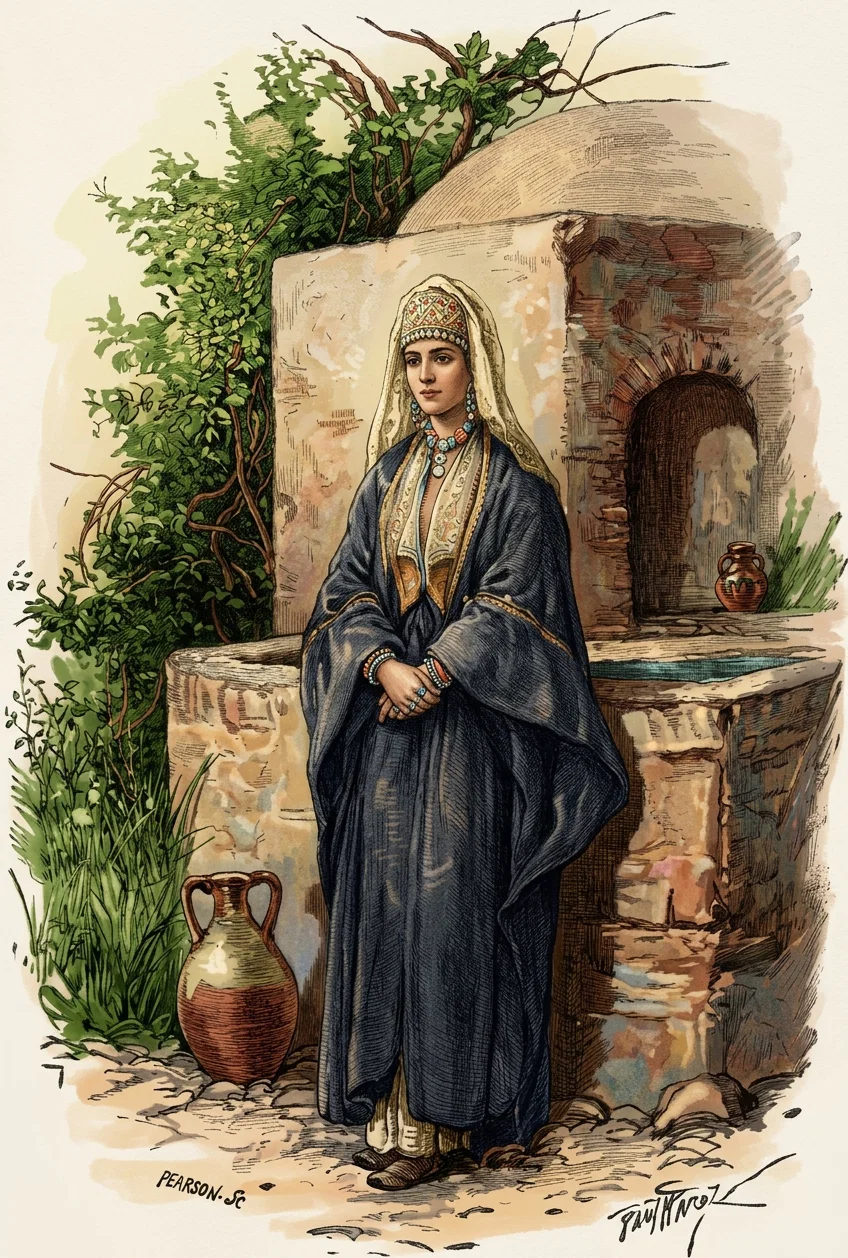
MARY, the mother of Jesus, was not the only woman in whom the Christ was born. She was His earthly mother; but there were other women in Judea and Galilee and Bethlehem then and now, as the woman in our picture, who have the privilege of being the mother of the anointed One. For did not He say, as He stretched forth His hands toward His disciples: “Behold My mother and My brethren! ‘For whosoever shall do the will of My Father which is in heaven, the ‘same is My brother, and sister, and mother.’” How?—By the life inborn from above. By Christ dwelling in the heart by faith. By the reception of the mystery of God, “Christ in you the hope of glory.” It is not His design that we should exalt either His mother after the flesh or His near disciples to the throne of deity, to be entreated, supplicated, or adored as demi-gods. It is character, the inborn Life from above, the Christ dwelling in the heart, that makes humanity precious in the sight of God. Those who receive this life, and do God’s will, occupy the tenderest and closest relationship to our Lord Jesus Christ. Let the truth of His birth come home to us with this truth; and let Him be to each of us what God called Him, Emmanuel, “God with us.”

THE LOVE THAT IS OF GOD.

In this the children of God are manifest, and the children of the devil: whosoever doeth not righteousness is not of God, neither he that loveth not his brother. For this is the message that ye heard from the beginning, that we should love one another. Not as Cain, who was of that wicked one, and slew his brother. And wherefore slew he him?—Because his own works were evil, and his brother’s righteous.”
Hatred caused the first death in our world. After sin came, God gave to men the promise of the Redeemer, who was to die for the redemption of the race, and thus obtain pardon for them. Man was to show his faith in this promise by offering as a sacrifice a lamb without blemish. Thus he was to show his belief in the great truth that without the shedding of blood there is no remission for sin.
“And in process of time it came to pass, that Cain brought of the fruit of the ground an offering unto the Lord. And Abel, he also brought of the firstlings of his flock, and of the fat thereof.”
A Modern Bethlehem Matron, No Doubt Somewhat Typical of the One So Long ago—Mary the Mother of Jesus.
Cain knew that God desired him to bring a lamb without blemish. But he was a tiller of the ground, and he did not wish to add to his offering a lamb of his brother’s flock. My offering is abundant, he thought. But it lacked the very thing that would have made it of value. Without the lamb, all that he brought was valueless.
When Cain presented his offering, he saw nothing to signify that it was accepted by God. But when Abel presented his offering, fire from heaven consumed the sacrifice. “The Lord had respect unto Abel ‘and to his offering; but unto Cain and to his offering He had not ‘respect.’”
“And Cain was very wroth, and his countenance fell. And the Lord said unto Cain, Why art thou wroth? and why is thy countenance fallen? If thou doest well, shalt thou not be accepted? and if thou doest not well, sin lieth at the door.”
“And Cain talked with Abel his brother,” arguing about his offering, refusing to see that it was his disobedience that had made it unacceptable to God. He was angry that the offering of Abel, his younger brother, had been accepted, while his had been rejected. He was angry with Abel for maintaining that God is just. “And it ‘came to pass . . . that Cain rose up against Abel his brother, ‘and slew him.”
“And the Lord said unto Cain, Where is Abel thy brother? And he said, I know not; am I my brother’s keeper? And He said, What hast thou done? the voice of thy brother’s blood crieth unto Me from the ground. And now thou art cursed from the earth, which hath opened her mouth to receive thy brother’s blood from thy hand; when thou tillest the ground, it shall not henceforth yield unto thee her strength; a fugitive and a vagabond shalt thou be in the earth.”
Human beings belong to one great family,—the family of God. The Creator designed that they should respect and love one another, ever manifesting a pure, unselfish interest in one another’s welfare. But Satan’s aim has been to lead men to self first; and yielding themselves to his control, they have developed a selfishness that has filled the world with misery and strife, setting human beings at variance with one another. Selfishness is the essence of depravity, and because human beings have yielded to its power, the opposite of allegiance to God is seen in the world to-day. Nations, families, and individuals are filled with a desire to make self a center. Man longs to rule over his fellow-men. Separating himself in his egotism from God and his fellow-beings, he follows his unrestrained inclinations. He acts as if the good of others depended on their subjection to his supremacy.
Selfishness has brought discord into the church, filling it with unholy ambition. If Christians are sanctified through a belief in God’s Word, why do they so often speak words that would bruise the hearts of others? Why do they acknowledge no law but the law of selfishness? Under the baleful influence of selfishness, men have lost the sense of what it means to love one another with a Christlike love.
Love for Christ unites man to his fellow-man in unselfish interest. This is the science of benevolence. He whose heart is filled with the love that centers in God, realizes that he must deal justly and tenderly with his fellow-beings because they have been redeemed by the blood of Christ. Supreme love for God leads us to seek the highest good of humanity.
Selfishness destroys Christlikeness, filling man with self-love. It leads to continual departure from righteousness. Christ says, “Be ye therefore perfect, even as your Father which is in heaven is perfect.” But self-love is blind to the perfection that God requires.
How great the love of God is! God made the world to enlarge heaven. He desired a larger family. And before man was created, God and Christ entered into a covenant that if he fell from his allegiance, Christ would bear the penalty of transgression. Man fell, but he was not left to the power of the destroyer. “God so loved the ‘world that He gave his only-begotten Son, that whosoever believeth in ‘Him should not perish, but have everlasting life.” To the Redeemer was given all power to impart to fallen human beings for their benefit and blessing.
While on this earth the Saviour was sorely tried. He was tempted in all points like as we are. He poured out His soul with strong crying and tears as He looked upon the backslidden condition of the people He had brought out of bondage. He saw them full of pride and self-exaltation, full of selfishness and covetousness. All this He must labor to overcome. He must live among them the life that God requires all His children to live. He must stand free from the slightest taint of impurity. Not in the least particular must He deviate from the principles of righteousness.
The gulf made by sin has been bridged. All may come boldlyto the throne of grace, seeking help in every time of need. While we were yet sinners, Christ died for us. He took the place of the sinner, that He might present the repentant sinner to the Father, saying, “Lay his guilt on Me. I have espoused his cause.” Holding out His hands, bearing the marks of the crucifixion, the Saviour says, “I have graven that sinner on the palms of My hands. No longer look upon him as guilty. Let him stand before Thee guiltless; for I have borne his iniquity.” At the cross, justice and mercy met together, and righteousness and peace kissed each other. God bowed His head in recognition of the completeness of the offering made for sin, and said, “It is enough.”
As we contemplate the great love of God, shall not our hearts be subdued and softened, yea, broken? Shall we not be filled with patience, long-suffering, and love? Shall we not die to self?
Christ came to this world to reveal the love of God. His followers are to continue the work which He began. Let us strive to help and strengthen one another. Seeking the good of others is the way in which true happiness can be found. Man does not work against his own interest by loving God and his fellow-men. The more unselfish his spirit, the happier he is, because he is fulfilling God’s purpose for him. The breath of God is breathed through him, filling him with gladness. To him life is a sacred trust, precious in his sight because given by God to be spent in ministering to others.
“Beloved, let us love one another; for love is of God; and every one that loveth is born of God, and knoweth God. He that loveth not knoweth not God; for God is love. . . . If a man say, I love God, and hateth his brother, he is a liar; for he that loveth not his brother whom he hath seen, how can he love God whom he hath not seen? And this commandment have we from Him, that he who loveth God love his brother also.” Mrs. E. G. WHITE.

THE WORTH OF A SOUL.

A SOUL redeemed through the blood of the Lamb is the most precious treasure in heaven or earth. The Lord says, “I will make a man more precious than fine gold; even a man than the golden wedge of Ophir.” Isa. 13:12.
The world’s rich men have pearls, rubies, and diamonds, with estimated values high above the listed price of gold. But He that created all treasures has placed the blood-washed soul at a price so far beyond the shining minerals that they can not even be brought into the count.
The Infinite One has given Himself a ransom for a sin-stained soul. But rubies and diamonds do not reach high enough in the scale of value to call out from the Creator either love or compassion. Such things neither obey nor transgress. They have no tried or developed character, and so no moral or positive worth. What, then, is the value of all inanimate things when estimated in the scale by the side of an active, loving soul? In studying the subject, the finite mind discovers itself amazed and filled with joy, but trying in vain to sound the ocean of infinite love.

How to Reckon.

Desiring man to study upon the subject of his possible worth, the Lord suggested the following problem: “What is a man profited, if he shall gain the whole world, and lose his own soul? or what shall a man give in exchange for his soul?” Matt. 16:26. He whose soul is saved, gets a far richer portion than the one who receives only this world. Even tho he should obtain it all, he gets a thing of small worth compared to the value of salvation from sin and death. The part is better for the soul who is saved; for he gets everlasting life, and so has the true riches.
That person who does not get life, really has nothing that he can call his own. He has no means of holding title to anything. Without life, even that which he seems to have must pass away from him, and go to one who has a hold upon eternity.

Is Man Worth the Price?

Why does the Lord do so much to save men? It is not because obligation rests upon Him that He redeems them; for through sin they have forfeited their right to life. Ah, it is love—such love as only God can know and exercise—that constitutes the motive power of redemption.
In the great scheme of the universe, man has become a necessity to fill the complement; and the mind and will of God can not be satisfied without him. “For I am persuaded, that neither death, nor life, nor angels, nor principalities, nor powers, nor things present, nor things to come, nor height, nor depth, nor any other creature, shall be able to separate us from the love of God, which is in Christ Jesus our Lord.” Rom. 8:38, 39.
The joys which are in store for man, and those which the Lord Himself will share with him through the infinite ages, are a part of the great scheme. No being, or thing, can sever the Creator from His purpose in those joys. Man, being included in God’s love, can not be excluded by the opposition of any creature.
As man learns more, he will love more and do better. The increase of knowledge and wisdom will enlarge his perceptions as the ages go by. Neither death nor decrepitude can then encroach upon his faculties. The multiplication of years and cycles will in that time have an inverse effect upon him so as proportionately to enhance the glory of every attribute. The order of things which has prevailed while death ruled, will be reversed when man shall reign in life eternal.
The Redeemer knows what man will become when the blight made by sin is gone. He understands the end from the beginning. Being from everlasting to everlasting, times do not intervene to limit His comprehension. All time is perpetually present with Him. Then all faculties of man’s nature will be but responsive chords vibrating with the happiness of their Lord. As branches of the True Vine, they bear the foliage and the fruit, and manifest His glory. They will receive and impart His love. The more they are loved, the more lovely they will be. Then love bestowed will be love enstored.

Jesus Satisfied.

The joys which the Lord shall reap in man’s salvation will fully compensate for the sacrifice He has made to save him. For, says the prophet, “He shall see of the travail of His soul, and shall be satisfied.” Isa. 53:11.
When the unnumbered multitude of saints, who will compose the blood-washed throng, shout their gladness in the Celestial City, Jesus will be the source of their joy. He will be the Maker and Dispenser of their gladness. From Him, of Him, and to Him, will be the glory. Their virtues will be shared by Him—yes, more, they will be of Him; and multiplying the number, the redeemed will add to the Redeemer.
The worth of a redeemed soul is incomparable, and of its increase in all that makes it glorious, there will be no end. Who can put a price on the companion of his life, or on the child of his flesh and blood? No one with normal mind would ever try to do such a thing. Much less could the worth of a soul who has received the whole wealth of salvation be limited; for the treasure paid becomes incorporated again in the treasury. Therefore the Saviour’s investment in man’s salvation becomes a means by which He will unceasingly multiply his treasures. WILLIAM COVERT.

A DISCOURAGED PASTOR.

Some years ago a pastor of a little church in a small town became exceedingly discouraged, and brooded over his trials to such an extent that he became an inveterate grumbler. He found fault with his brethren because he imagined they did not treat him well. A brother minister was invited to assist him a few days in a special service. At the close of the Sabbath morning service our unhappy brother invited the minister to his house to dinner. While they were waiting alone in the parlor, he began his doleful story by saying:—
“You have no idea of my troubles; and one of the greatest is that my brethren in the church treat me very badly.”
The other propounded the following questions:—
“Did they ever spit in your face?”
“No; they haven’t come to that.”
“Did they ever smite you?”
“No.”
“Did they ever crown you with thorns?”
This last question he could not answer, but bowed his head thoughtfully. The other replied:—
“Your Master and mine was thus treated, and His disciples fled and left Him in the hands of the wicked. Yet He opened not His mouth.”
The effect of this conversation was wonderful. Both ministers bowed in prayer, and earnestly sought to possess the mind which was in Christ Jesus. During the ten days’ meetings the discontented pastor became wonderfully changed. He labored and prayed with his friend, and many souls were brought to Christ.—Selected.

Pity Upon the Poor

HE that hath pity upon the poor lendeth unto the Lord; and that which he hath given will He pay him again.—Solomon.

THE FIFTH COMMANDMENT.

HONOR thy father and thy mother; that thy days may be long upon the land which the Lord thy God giveth thee.
In the first four commandments, we have our relation to God clearly set forth; in the last six, our proper relation to our fellow-man. And the sum of it all is, that we love the Lord our God with all the heart, and our neighbor as ourself. It is but natural, therefore, that our duty to fellow-man should be defined, beginning at the first point possible, that of our relation to father and mother.
The true parent, in his relation to his children, is akin to God. For has not the Lord used this simile again and again, to convey to our minds, in some measure, His love and care for us? “Like as a father pitieth his children, so the Lord pitieth them that fear Him.” “Can a woman forget her sucking child, that she should not have compassion on the son of her womb? yea, they may forget, yet will I not forget thee.” In this last quotation, the Lord selected the most improbable thing which could, in this world, be thought of, in order to show for us His unfailing love. Only in cases of extreme sickness, or of famine, prolonged and cruel, have mothers (true ones, I mean) forgotten their nursing babes, that they have not had compassion on them. Therefore the quotation is not given to show the unfaithfulness of a mother, but the exceeding faithfulness of our God. Yet, as noted above, He chose the tenderest ties of earth in order to make a comparison which we could comprehend. Again: “When my father and my mother forsake me, then the Lord will take me up.” The most improbable thing which could be imagined, that a father or a mother should forsake a child. Altho dishonored, disgraced, trodden under foot; yet the tender, yearning heart of a true father or mother will follow an erring child to prison, to the dungeon, to the very gallows; despising the shame of it all, that they may snatch him from ruin, or show him the way of life.
In that home where poverty reigns, the last crust is given to the famishing child, while the parent suffers on. In case of danger or accident, the parent’s body is thrown, at the risk of life, between the child and harm. Privation, want, sacrifice, poverty; all these are cheerfully endured by parents, that their children may be educated and trained for usefulness in life. Known only to God are the heart-yearnings of the real parent for the child. The parents themselves can never know the depths. As I contemplate these things, all that is within me responds to the command, “Honor thy father and thy mother.”
How may we honor them? First of all, by our conduct. “A wise son maketh a glad father.” As the world weighs matters, the child who makes his “mark” honors the parents most. He who in college secures class honors; he in public life who is promoted in civil or military office, is honored by the world; and his glory reflects credit on the ones who begat him. When a certain young American captain succeeded in capturing the Filipino chieftain, who did not read of the triumph of that aged father and mother on the farm in the homeland? Yet this sort of honor pales into nothingness in comparison with that of which the commandment speaks.
“Children, obey your parents in the Lord; for this is right. ‘Honor thy father and mother; which is the first commandment with promise.’” Parents who are “in the Lord” never ask of their children anything which is not of the Lord. That is, their only regulations and requirements are those already laid down by the Lord. To obey a parent “in the Lord” then, is only to obey the Lord. And since “obey your parents in the Lord” is used in apposition with “Honor thy father and mother,” it would be a stupid mind which could not see that the obedience is the honor.
In this, as in all other matters pertaining to human life, we have a perfect example in Christ, our Saviour. To some who were reviling Him, He said, “I honor My Father, and ye do dishonor Me.” You will remember that He had no earthly father; so that the Father of whom He speaks, must be the heavenly Father. How did this Son honor the Father? “Then answered Jesus and said unto them, Verily, verily, I say unto you, The Son can do nothing of Himself, but what He seeth the Father do; for what things soever He doeth, these also doeth the Son likewise.” “I came down from heaven, not to do Mine own will, but the will of Him that sent Me.” “I can of Mine own self do nothing; as I hear, I judge; and My judgment is just; because I seek not Mine own will, but the will of the Father which hath sent Me.” And through the psalmist He said, “I delight to do Thy will, O My God; yea, Thy law is within My heart.” That was the secret of it all—the fact that God’s law was within His heart. And that, we have seen, is the very work which is promised us in the “new covenant.” We have also seen that God’s law is His life. It is His Spirit. Therefore Jesus could say, “The Father that dwelleth in Me, He doeth the works.”
“The law is spiritual; but I am carnal.” Therefore I, of myself, can never obey the law. But the fruit of the Spirit,—“Against such there is no law.” The Holy Spirit only can fulfil a spiritual law. Therefore, only he who is filled with the Spirit can possibly fulfil the law.
But Jesus had an earthly mother; and it was just as natural for Him to fulfil every duty due her, as it was to fulfil His Father’s will. And why so?—Because His duty to her was part of His Father’s will. He could not have slighted her in the least possible way without displeasing the Father—without grieving the Holy Spirit with which He was filled from the womb. In His last expiring agonies on the cross, He did not forget her. “When Jesus therefore saw His mother, and the disciple standing by, whom He loved, He saith unto His mother, ‘Woman, behold thy son!’ Then saith He to the disciple, ‘Behold thy mother!’ And from that hour that disciple took her unto his own home.”
It is therefore evident that a provision for their temporal wants is included in the honor due our parents. Why not? If we were to provide for them a century of time, we could not more than feebly repay their intense love and untiring watchfulness and care for us, ere we knew aught of danger, or had a thought of care.
In these days of Christ on earth, the selfish heart of man, tho professing to obey God, had found a way to evade this temporal honor due to parents. But it met the open rebuke of the Master. (See Matthew 15.) Said Christ in conclusion, “Well did Esaias prophesy of you, saying, This people draweth nigh unto Me with their mouth, and honoreth Me with their lips; but their heart is far from Me.” Thus, in dishonoring the parent, their honoring of God was only of the lip, not of the heart. How apparent it is, then, that one can not disregard one of God’s commands without breaking the spirit of them all. It is thus that if we “offend in one point, we are guilty of all.”
“Honor thy father and thy mother; which is the first commandment with promise; that it may be well with thee, and thou mayest live long on the earth.” In Exodus, it says, “Upon the land which the Lord thy God giveth thee.” But there is no conflict here, since “the meek shall inherit the earth.” When shall this be? “When the wicked are cut off, thou shalt see it.” “We according to His promise, look for new heavens and a new earth, wherein dwelleth righteousness.” The measure of our dwelling there, will be the measure of eternity.
The violation of this commandment is a sign of the age. “For men shall be lovers of their own selves, covetous, boasters, proud, blasphemers, disobedient to parents.”
The parent’s part in this command is found in these words: “And, ye fathers, provoke not your children to wrath; but bring them up in the nurture and admonition of the Lord.” How few parents of this kind there are, or how many, the Lord only knows. One would think they were not common. “The nurture and admonition of the Lord!” Nurture means nourishment, food, nursing, painstaking and careful training. This means more than physical food and bodily caretaking. “Admonition;” the daily and hourly living and teaching of the Word of the Lord. Having done this, the parent is clear before God. If we have not done this, then a heart-felt confession to God, and to the children so dreadfully wronged, will do much to start us in the right direction. Then, the beginning of a life in harmony with this advice will do all that is possible on the parent’s part to correct the past.
However, after all has been done in accord with the Word of God, yet some may go astray. Is not the Almighty Father the best trainer of children in the world? And did not His first-born of earth rebel against Him? In later years, He said, “Hear, O heavens, and give ear, O earth; for the Lord hath spoken: I have nourished and brought up children, and they have rebelled against Me.” So let that parent who has done, and is still doing, all that heaven permits for the salvation of His children, not despair if the worst is realized. He has done all he could. And let not that child, who, in order to obey God, is obliged to disobey a parent who is out of harmony withGod, think that he is disobeying the fifth command. Your life of obedience to God is a far greater honor to your parents than obedience to them which would involve disobedience to God. “Obey your parents in the Lord.” Not long ago, a young man told me that his father was continually reproving him for keeping God’s holy Sabbath at a loss financially to himself. He wrote his father in reply: “When I was smoking, drinking beer, gambling, attending theaters and other places which are worse, you never reproved me. Why do you continually do so now? Would you rather I would return to my old life of shame? Would I thus honor your name more than I do now?” The dart struck home. That father did not reply to these questions.
In which way do you think he honored the father most?
E. J. HIBBARD.
Continue reading: THE LIGHT OF THE WORLD