[All questions to this department will be answered which to the editors will seem to minister to the good of the readers and to the mission of the paper. The same question can not be answered repeatedly in the same volume. The name and address must accompany question, not for publication, but as an evidence of good faith, and that answer may be made by letter if deemed advisable. It is well always to enclose a stamp for reply.]
2349.—Lost Tribes of Israel.
A Latter-Day Saint said not long ago that the Indians were the lost tribes of Israel. Now I never heard before that there was a lost tribe of Israel. If there is, would you be so kind as to tell me, and where in the Bible it is? L.
We know of no place in the Bible where it speaks of a lost tribe of Israel. The ten tribes were split from the two tribes; the ten tribes went into captivity. Numbers of them came back and joined the two tribes at different times. The Bible often speaks of them as in captivity, but it does not speak of them as lost tribes; that is an invention of man. It speaks of the lost sheep of the house of Israel, and that is true of all those who have wandered away in sin.
Will the promise of the new covenant be fulfilled at a certain time in the world's history or at a time in the life of each person? Will it come to one person at one time and to another person later, or to all at the same time? H.
It is true in both respects. In Jeremiah 31 the new covenant is set over in contrast to the old covenant, a national covenant, made with Israel thru the elders of the people. God's true Israel are those who are His thru the everlasting covenant, the Abrahamic covenant, the new covenant. The thought of the prophet is that there was coming a time when only that relationship would be recognized, and that was true after Christ was crucified. No other nation was recognized then as God's people, save those who had come into relationship with Him thru the new covenant. See 1 Peter 2:9 compared with Ex. 19:4, 5. But to each individual who came into that relationship there came the experience outlined in Jer. 31:33, when God's law is written in the heart, and they know that they are His children. The very fullest sense, of course, in which all that will be accomplished will be when God's children are called home and the earth is made new.
It is worthy of note, if our inquirer will look it up, to see that the expression, "Ye must be circumcised, and keep the law," is omitted from the Revised Version and the better Greek texts. Evidently the law under discussion in the fifteenth chapter of Acts includes the whole Mosaic code which the Lord did not impose on the Gentiles. Every moral element in that law remained. But every moral element of the law is included in the Ten-Commandment law. When Christ came, the ritual law expired by limitation. The great vine which had twined around the great trunk of the moral law dropped off, but the tree stood,—the Ten Commandments remained,—impaired in no part of its life. There will be no trouble to our inquirer whatever, or to any other who earnestly desires to know the truth, if he will keep in mind that God's government is one, eternal, unchangeable; necessarily so from His own perfect, holy, just, loving character. His law is as His government, and that law is summarized in the great Ten Words spoken from Mount Sinai.
In order to win the transgressors back to that law and teach them His character and hold them to Himself, God devised the ceremonial law by which His children could from the very beginning express their faith in Him. In the patriarchal age it was very simple. In the Mosaic age it was very complex, but every act that was performed had its lesson respecting sin and salvation; and sin is, ever has been, and ever will be, the transgression of the moral law of Ten Commandments. Sometimes this ceremonial law has been so intertwined in its moral aspects with the moral law that to the casual observer they have seemed almost the same. It is like a strong, growing green vine on an oak. When the vine is cut it falls and dies, but the oak stands just the same. The life of each is different. So it is with the two laws. We have a ceremonial law in this dispensation, God's simple regulations regarding baptism and the Lord's Supper. The four things imposed on the Gentiles in Acts 15 were things of moral bearing, things which those Gentile converts did not consider were part of the moral law because their minds had been blinded by generations of practice. They were imposed by the apostles because they did have a moral basis.
2346.—Beginning of the Sabbath.
If the Sabbath begins at the setting of the sun, should it not close at the rising? I have been taught that the Sabbath begins with the rising of the sun and closes with the setting, when Sabbath night begins.
F. R.
The definition of a day which God has given in the first chapter of Genesis, repeated over and over, is that the evening and the morning constitute the day, that is, the dark and the light. Day is sometimes used in the sense of the light part, but the whole day is expressed by "evening-morning," the night and day, the day beginning with the evening. "From even unto even shall ye celebrate your Sabbath." Lev. 23:32. Our inquirer would have only a part of the day in this way. God's Sabbath day covers one rotation of the earth.
2347.—Christ's Age at Baptism.
Please explain Luke 3:23 in Revised Version. Jesus was baptized at the age of thirty. His ministry began A.D. 27. Did His ministry begin three years before His baptism? E. F.
Our inquirer has confounded the beginning of the Christian era with Christ's birth. The beginning of the Christian era is four years this side of the real birth of Christ. It was not placed there until the thirteenth century, by Roger Bacon. He found that the paschal full moon A.D. 30 fell on Friday, and this circumstance led him and several others, as Scaliger, Usher, Pierson, to conclude that this was the year of the crucifixion; but Dr. Hale's Chronology shows rather that it was not the year of the crucifixion, but four years before. Christ began His ministry when He was thirty years of age in the autumn of the year 27 A.D. He closed it in the spring, A.D. 31, three and one-half years later.
The Mormon elders claim that this verse means a future probation for those that lived before the Flood, also the heathen who have not had the light of the Gospel in its fulness.
H.
The whole meaning of the chapter is not with the thought of saving somebody who is dead or being baptized in their behalf. The meaning of all of Paul's argument is that Christ died and rose again, and in that rising is our hope. If that were not true, then even those that had fallen asleep in Christ are perished. It is His death and resurrection that avail, but if He has not risen from the dead, what shall they do who have been baptized with that very thing in view? With certain death facing them, and their only hope in Christ and His resurrection, their faith has led them to believe in Him and believe Him to be the resurrection and the life. So they have been baptized in faith in that thought. Read the entire chapter, letting emphasis rest where the apostle has placed it, on the death and resurrection of Jesus Christ, dying for our sins, rising for our justification; connecting with it such passages as Rom. 6:3, "Are ye ignorant that all we who were baptized into Christ Jesus were baptized into His death?" and then see how forcible is Paul's argument—of what use is it to be baptized with all that in view, if there is no resurrection, if Christ is not risen again?
Bazaars, Fairs, etc
2350.—Bazaars, Fairs, etc.
In view of God's plan of the tithe, enjoined in Leviticus and Malachi, is there any authority in the Scriptures for bazaars, fairs, etc., for raising money in churches? Is there any connection between these things and the Jewish customs when our Saviour cleansed the temple in Jerusalem?
L. C. C.
The exercise of pure benevolence is not for show, not to get something out of it ourselves, not to plan it so that it will cost us nothing. We will give from a sense of duty, from a sense of the need of the cause for which we give; from the love of God and humanity. All artificial means for benevolent or Christian purposes have a downward tendency always, and eat out the spirit of pure benevolence. The temple of old became a regular market, in which men sought to make gains in the sacrifices and oblations offered to God. In many of the makeshift ways of raising money to-day people hope to give without sacrifice, and to be compensated in pleasure for all they give.
The Soul and the Body
2351.—I. B. F.—No, Isa. 26:9 does not in any-wise indicate an immortal, immaterial or conscious soul apart from the body. Isaiah simply uses a form of expression that is very common to-day, "With my soul have I desired thee in the night." We would say, With our thoughts we desired the Lord in the night, with our minds we longed for Him; simply the inward powers of his being were reaching out after God. We have no record whatever in God's word that the spirit or soul of man is capable of doing anything whatsoever apart from the body. Neither Gen. 41:8 nor Job 4:15 is any proof whatsoever, nor have these texts ever been so considered by Biblical scholars, so far as we know. The one simply declares that Pharaoh's spirit was troubled, just as the spirits of thousands and millions are troubled to-day. In Job 4:15 the term spirit is doubtless an angel, a spiritual being.
Capital Punishment
By W. W. P.
2352.—W. W. P.—Capital Punishment.—The New Testament is not a book of civil laws, but a book of soul-saving, character-building, Gospel truths. It takes government as it is and exhorts the believers in Christ to “submit yourselves to every ordinance of man for the Lord’s sake” (1 Peter 2:13, 14), unless these human ordinances interfere with our duty to God. Then “we ought to obey God rather than men.” Acts 5:29. The Bible declares as a prediction that “whoso sheddeth man’s blood, by man shall his blood be shed.” Gen. 9:6. And most nations have fulfilled the prophecy. There is much to be said on both sides of the question.
E. L. D.—2300 Days
2353.—E. L. D.—2300 Days.—For the beginning of the 2300 days of Dan. 8:14 see Bible-reading in the SIGNS of Jan. 8, 1908. The beginning of that period of time is shown in Dan. 9:25. The commandment to restore and build Jerusalem went forth in B.C. 457. Ezra 7:7. It is impossible to tell within a few days of the very date of the beginning. It came somewhere in the seventh month, about the time of the day of atonement.
The Change at Christ’s Coming
By J. M. K.
2354.—J. M. K.—1 Cor. 15: 51.—The correct reading of this text is that given in our Common Version, as well as the Revised Versions, “We all shall not sleep, but we shall all be changed.” The “we” refers to believers. Those who live till Christ comes will not sleep in death; but they, with those raised from the dead, will be changed. Verse 40 is a general statement of conditions always true. There were bodies earthly and bodies heavenly then; there are now.
Christ the Teacher and Healer
By Mrs. E. G. White
By Mrs. E. G. White
“Go, and Sin No More.”
“Go, and Sin No More.”
"Go, and Sin No More."
THE Feast of Tabernacles had just ended. The priests and rabbis at Jerusalem had been defeated in their plottings against Jesus, and as evening fell, “every man went unto his own house, Jesus went unto the mount of Olives.”
From the excitement and confusion of the city, from the eager crowds and the treacherous rabbis, Jesus turned away to the quiet of the olive groves, where He could be alone with God. But in the early morning He returned to the temple; and as the people gathered about Him, He sat down and taught them.
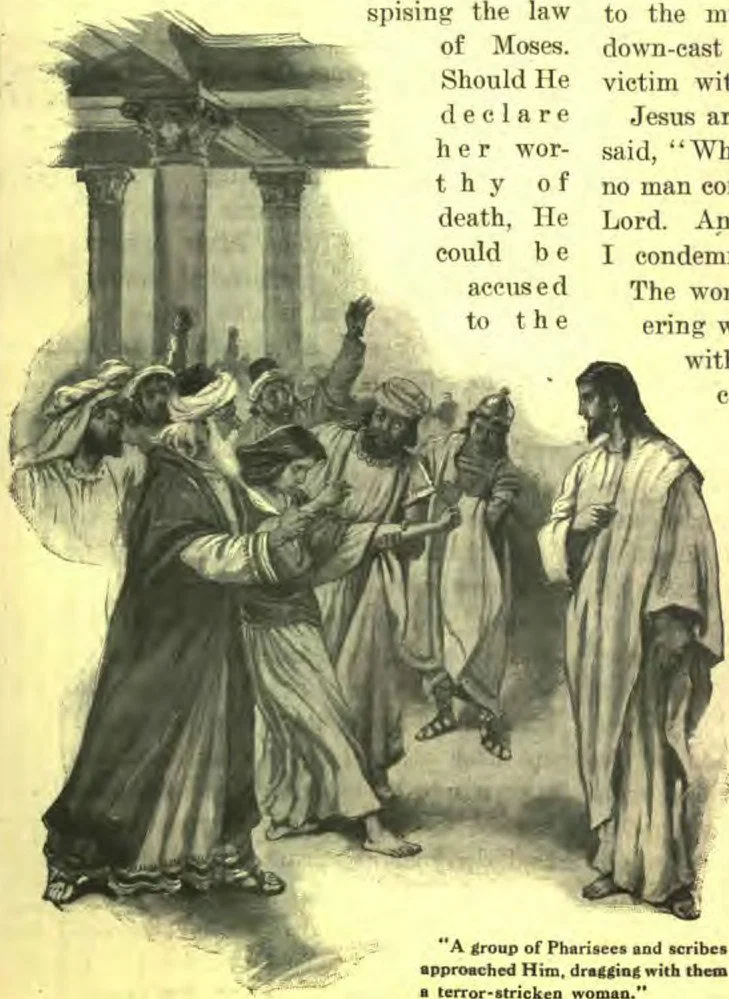
He was soon interrupted. A group of Pharisees and scribes approached Him, dragging with them a terror-stricken woman, whom with hard, eager voices they accused of having violated the seventh commandment. Pushing her into the presence of Jesus, they said, with a hypocritical display of respect, “Master, this woman was taken in adultery, in the very act. Now Moses in the law commanded us, that such should be stoned; but what sayest Thou?”
Their pretended reverence veiled a deep-laid plot for His ruin. Should Jesus acquit the woman, He might be charged with despising the law of Moses. Should He declare her worthy of death, He could be accused to the Romans as one who assumed authority belonging only to them.
"A group of Pharisees and scribes approached Him, dragging with them a terror-stricken woman."
Jesus looked upon the scene—the trembling victim in her shame, the hard-faced dignitaries, devoid of even human pity. His spirit of stainless purity shrank from the spectacle. Giving no sign that He had heard the question, He stooped, and fixing His eyes upon the ground, began to write in the dust.
Impatient at His delay and apparent indifference, the accusers drew nearer, urging the matter upon His attention. But as their eyes, following those of Jesus, fell upon the pavement at His feet, their voices were silenced. There, traced before them, were the guilty secrets of their own lives.
Rising, and fixing His eyes upon the plotting elders, Jesus said, “He that is without sin among you, let him first cast a stone at her.” And stooping down, He continued writing.
He had not set aside the Mosaic law, nor infringed upon the authority of Rome. The accusers were defeated. Now, their robes of pretended holiness torn from them, they stood, guilty and condemned, in the presence of infinite purity. Trembling lest the hidden iniquity of their lives should be laid open to the multitude, with bowed heads and down-cast eyes they stole away, leaving他们的victim with the pitying Saviour.
Jesus arose, and looking upon the woman, said, “Where are those thine accusers? hath no man condemned thee? She said, No man, Lord. And Jesus said unto her, Neither do I condemn thee: go, and sin no more.”
The woman had stood before Jesus, cowering with fear. His words, “He that is without sin among you, let him first cast a stone,” had come to her as a death sentence. She dared not lift her eyes to the Saviour’s face, but silently awaited her doom. In astonishment she saw her accusers depart speechless and confounded; then those words of hope fell upon her ear, “Neither do I condemn thee: go, and sin no more.” Her heart was melted, and casting herself at the feet of Jesus, she sobbed out her grateful love, and with bitter tears confessed her sins.
This was to her the beginning of a new life, a life of purity and peace, devoted to God. In the uplifting of this fallen soul, Jesus performed a greater miracle than in healing the most grievous physical disease; He cured the spiritual malady which is unto death everlasting. This penitent woman became one of His most steadfast followers. With self-sacrificing love and devotion, she showed her gratitude for His forgiving mercy. For this erring woman the world had only contempt and scorn; but the Sinless One pitied her weakness, and reached to her a helping hand. While the hypocritical Pharisees denounced, Jesus bade her, “Go, and sin no more.” He relieved her from condemnation by freeing her from sin.
Jesus knows the circumstances of every soul. The greater the sinner’s guilt, the more he needs the Saviour. His heart of divine love and sympathy is drawn out most of all for the one who is the most hopelessly entangled in the snares of the enemy. With His own blood He has signed the emancipation papers of the race.
Jesus does not desire those who have been purchased at such a cost to become the sport of the enemy's temptations. He does not desire us to be overcome and perish. He who curbed the lions in their den, and walked with His faithful witnesses amid the fiery flames, is just as ready to work in our behalf to subdue every evil in our nature. To-day He is standing at the altar of mercy, presenting before God the prayers of those who desire His help. He turns no weeping, contrite one away. Freely will He pardon all who come to Him for forgiveness and restoration. He does not tell to any one all that He might reveal, but He bids every trembling soul take courage. Whosoever will, may take hold of God's strength, and make peace with Him, and He will make peace.
The souls that turn to Him for refuge, Jesus lifts above the accusing and the strife of tongues. No man or evil angel can impeach these souls. Christ unites them to His own divine-human nature. They stand beside the great Sin-bearer in the light proceeding from the throne of God.
The blood of Jesus Christ cleanses “from all sin.”
“Who shall lay anything to the charge of God's elect? It is God that justifieth. Who is he that condemneth? It is Christ that died, yea rather, that is risen again, who is even at the right hand of God, who also maketh intercession for us.”
Christian Science in the Light of Reason and Revelation
By R. A. Underwood
By R. A. Underwood
IV. New Thought, Healing.
THEY shall turn away their ears from the truth, and shall be turned unto fables, or falsehoods. 2 Tim. 4:4.
Many are accepting the new pantheism who do not claim to be Christian Scientists. It makes little difference as to the baneful results whether it is called Christian Science, New Thought, New Theology, Pantheism, or some other name, so long as its fundamental teaching is that man is his own saviour, and it thereby makes void the Gospel of Christ.
Ralph Waldo Trine, author of “In Tune with the Infinite,” expresses the doctrine in these words: “All is He, since He is all, . . . and if all, then each individual, you and I, must be a vital part of that all. . . . Man is God incarnate. . . . The moment, however, we recognize our divinity, our higher, our God-selves, and the fact that we are the saviours of our fellow men, we become saviours, and stand and move in the midst of a majesty and beauty and power that proclaims us as such.”
The reader may be ready to inquire, What about the many reported cures that are testified to among the followers of Christian Science? Is this all a delusion, or are persons actually cured of disease by this system of faith? These are natural questions that arise, and are worthy of consideration. There are many that are supposed to be healed. I will endeavor to consider these cases in a candid and fair manner according to the facts which have come before me.
Before doing this, let me call attention to one most important factor of this faith; namely, that nobody is sick, nobody is old, or has decrepitude. All that is called sickness or pain is an illusion or a deception. So, according to the doctrine of Christian Science, to say the least, no one is healed, or cured, of pain, or can be; because all sickness is simply imaginary, and not real. So, if the Christian Scientist believes what he claims, all their boasted work of healing the sick is a fake, and not true.
But let us notice the classes who claim to be healed.
1. I well remember a case in our neighborhood some years ago. The afflicted lady was my wife’s cousin, and an intimate friend. She was dying with a cancer. She and the family had accepted the faith of Christian Scientists. When the physician told the woman that she had a cancer, her first step was to send for a Christian Science healer, who came from Cleveland, Ohio. On arrival, the first thing the woman said was, “You are not sick, madam; you have no cancer. All that tell you that you are sick, or have a cancer, are under a delusion. Now, Mrs. ———, repeat what I say: ‘I am not sick; I am perfectly well.’” And so the lady repeated over and over again what the pretended healer said. This was all that the healer did. She carried out Mrs. Eddy’s instruction to an iota, as follows: “Expose and denounce the claims of evil and disease in all their forms, but acknowledge no reality in them.”—“Science and Health with Key to the Scriptures,” edition 1905, page 447.
Now, if what she claimed were true, she could justly take no credit for healing a perfectly well person. On the other hand, if Mrs. ——— was sick, and not a perfectly well woman, as the healer had claimed, then she was simply teaching the woman a lie; and so it proved. However, Mrs. ——— and the whole family were so hypnotized by this healer, and the spirit that goes with the doctrine, that they repeated the falsehood as long as breath was left in the body of the poor woman. My wife, on other occasions when members of the family had been sick, had ministered to their comfort, but now she was forbidden to do anything to relieve the pain and suffering of her dying cousin, because it was inconsistent to do anything for the relief of pain when there was nothing of the kind that existed. The healer and all the family declared she was well till the agonies of death forced the breath of life from her body.
This is a case illustrative of thousands. But a lady said to me, “I was healed.” Well, if you believe the doctrine, you should say, “I thought I was sick, but found out I was not.” That is all that the logic of Christian Science will permit you to claim, so far as being healed is concerned. I have no doubt that there are many who do think they are sick when nothing is in reality the matter with them. Others may have a mind-sickness, or the hypo, and Christian Science may cure this kind of sickness.
Disease is often due to mental causes, such as anxiety and worriment of mind. The expression, “Trust, rest, and live,” contains a truth essential to the health of both the body and soul of man. Christ says, “Come unto Me, all ye that labor and are heavy-laden, and I will give you rest. Take My yoke upon you, and learn of Me; for I am meek and lowly in heart; and ye shall find rest unto your souls.” Matt. 11:28, 29. Man is invited to cast all his care upon Christ, and to “rest in the Lord.” Ps. 37:7. This rest of faith is essential to man’s physical well-being; therefore it is a natural result of law that disease produced by worry is cured by removing the unrest that produced it, even tho the individual’s mind is led to trust in a false hope. When the cause of the disease is removed, nature soon rallies from its effect. Had Christian Scientists recognized this simple, scientific fact, they might have been saved from many disappointments and much reproach.
2. Another class who testify to being healed—and many they are—are either hypnotized, or led by the power attending this movement to claim to be well and healed, the same as my wife’s cousin, who died with a cancer. She said more than five hundred times, “I am well; I am healed,” and kept on saying this till she breathed her last; but it was an untruth. So with thousands who testify to healing. The first step in this system of healing is to declare one is well regardless of all facts in the case. They are asked to tell an untruth, if they are really sick, as the first step in being healed. They must say, “I am well,” and continue to repeat it. It is nothing strange that persons who become hypnotized by this power should continue to declare an untruth for years while suffering more or less from the disease, till they finally go down to death.
The first Christian Scientist I ever had any particular conversation with was in the state of California some twenty-five years ago. The lady was a professional healer and a teacher. She wanted to make a healer and a teacher of me. I asked her to give me a few samples of what I would teach. She answered, “Whatever you believe is, is so,” and made the statement, as an illustration, “I am a girl only sixteen years old.” I said, “Madam, those stooped shoulders, gray hairs, that wrinkled brow, and your dimmed eyes, tell me you have passed three-score years or more of life’s journey.” But she insisted she was only a girl of sixteen summers. Her falsehood did not make it a truth, even tho she kept on telling it till she went down to the grave a few years later.
3. We might admit more than the logic of Christian Science will grant; namely, that some are actually healed who have suffered with disease. This I do not doubt. If this is so, is it not a good work? “To the law and to the testimony; if they speak not according to this word, it is because there is no light in them.” Isa. 8:20. We have seen that from this standard of measurement, Christian Science has no light in it, and only darkness. It is weighed in the balances and found wanting.
Then from what source must this healing power come? The Bible presents two sources capable of performing wonders and even miracles. God is able, and often does, heal the sick and afflicted in a miraculous manner. See Mark 16:15-18; Acts 3:2-16. Another source of miracle working is revealed in doing great wonders for the specific purpose of turning men away from the truth of God unto a false hope. The Lord warned His people anciently against this power in these words: “If there arise among you a prophet, or a dreamer of dreams, and giveth thee a sign or a wonder, and the sign or the wonder come to pass, whereof he spake unto thee, saying, Let us go after other gods, which thou hast not known, and let us serve them; thou shalt not harken unto the words of that prophet, or that dreamer of dreams; for the Lord your God proveth you, to know whether ye love the Lord your God with all your heart and with all your soul.” Deut. 13:1-3.
5In the last days, miracles will be wrought to deceive, if it were possible, the very elect. We have a description of this power given in the following warnings: “Even Him, whose coming is after the working of Satan with all power and signs and lying wonders, and with all deceivableness of unrighteousness in them that perish, because they received not the love of the truth, that they might be saved.” 2 Thess. 2:9, 10. “For there shall arise false Christs, and false prophets, and shall show great signs and wonders, in-somuch that, if it were possible, they shall deceive the very elect.” Matt. 24:24.
A power is brought to view in Revelation 13, of which it is said, “And deceiveth them that dwell on the earth by the means of those miracles which he had power to do.” Verse 14. In chapter 16:14, this same wonder-working power is said to be “the spirits of devils, working miracles,” for the purpose of deceiving all that may be ensnared.
Some question whether the devil has power to heal the sick. It is certain that Christ says he has power to bind men with disease. The Saviour describes, in Luke 13, a poor woman that had been bound by Satan for eighteen years with an infirmity. The Saviour healed this woman upon the Sabbath day, and was accused by the Pharisees of breaking the Sabbath in doing so. Listen to Christ’s answer to their charge. Verses 15, 16: “Thou hypocrite, doth not each one of you on the Sabbath loose his ox or his ass from the stall, and lead him away to watering! And ought not this woman, being a daughter of Abraham, whom Satan hath bound, lo, these eighteen years, be loosed from this bond on the Sabbath day?”
Christ’s mission to this world is to ultimately “destroy him that had the power of death, that is, the devil; and deliver them who thru fear of death, were all their lifetime subject to bondage.” Heb. 2:14, 15. If Satan can bind a man, he certainly has power to loose him. If, then, men are all their lifetime subject to the bondage of disease, thru the power of Satan, and if he can deceive them by healing them, and lead them to reject the Gospel of Christ, he has thereby gained his object.
So it is in the healing work of Christian Science. As already seen by the plainest repeated statements from the prime promoter of this delusion, it rejects, denies, and wrests the truth of the Bible, and destroys, as far as its influence goes, the Gospel of the Son of God by denying the fundamental principles underlying the whole plan of redemption.
May God save the honest seeker after truth and light from the fables and delusions that await those deceived by the false claims of Christian Science.
[Mr. Underwood’s article next week will consider “The Lord’s Prayer; the Ego,” from the standpoint of Christian Science.]
Christ and the Law.
By John Wesley
[From Wesley's Sermon XXVII, Discourse V on the Sermon on the Mount.]
"Think not that I am come to destroy the law, or the prophets; I am not come to destroy, but to fulfil. For verily I say unto you, Till heaven and earth pass, one jot or one tittle shall in nowise pass from the law, till all be fulfilled." Matt. 5:17, 18.
IT is not improbable, some might hope it was so, that He was abolishing the old religion and bringing in another; one which, they might flatter themselves, would be an easier way to heaven. But our Lord refutes in these words both the vain hopes of the one, and the groundless calumnies of the other.
I shall consider them in the same order as they lie, taking each verse for a distinct head of discourse.
Not to Destroy.
1. And, first, "Think not that I am come to destroy the law, or the prophets; I am not come to destroy, but to fulfil."
The ritual of ceremonial law delivered by Moses to the children of Israel, containing all the injunctions and ordinances which related to the old sacrifices and service of the temple, our Lord indeed did come to destroy, to dissolve and utterly abolish. To this bear all the apostles witness; not only Barnabas and Paul, who vehemently withstood those who taught that Christians ought "to keep the law of Moses" (Acts 15:5); not only Peter, who termed the insisting on this, on the observance of the ritual law, a tempting God and putting "a yoke upon the neck of the disciples, which neither our fathers," saith he, "nor we were able to bear;" but all "the apostles, elders, and brethren," "being assembled with one accord" (Acts 15:25), declared that to command them to keep this law was to subvert their souls; and that it seemed good to the Holy Ghost and to them to lay no such burden upon them. This handwriting of ordinances our Lord did blot out, take away, and nail to His cross. Col. 2:14.
2. But the MORAL LAW, CONTAINED IN THE TEN COMMANDMENTS, and enforced by the prophets, He did not take away. It was not the design of His coming to revoke any part of this. This is a law which never can be broken, which "stands fast as the faithful witness in heaven." The moral stands on an entirely different foundation from the ceremonial, ritual law; which was only designed for a temporary restraint upon a disobedient and stiff-necked people; whereas this was from the beginning of the world; being "written not on tables of stone," but on the hearts of all the children of men, when they came out of the hands of the Creator. And however the letters once wrote by the finger of God are now in a great measure defaced by sin, yet can they not wholly be blotted out while we have any consciousness of good and evil. Every part of the law must remain in force, upon all mankind, and in all ages; as not depending either on time or place, or any other circumstances liable to change; but on the nature of God, and the nature of man, and their unchangeable relation to each other.
To Fulfil.
3. "I am not come to destroy, but to fulfil." Some have conceived our Lord to mean, I am come to fulfil this, by My entire and perfect obedience to it. And it can not be doubted but He did, in this sense, fulfil every part of it. But this does not appear to be what He intends here, being foreign to the scope of His present discourse. Without question, His meaning in this place is (consistently with all that goes before and follows after), I am come to establish it in its fulness in spite of all the glosses of men. I am come to place in a full and clear view whatsoever was dark or obscure therein. I am come to declare the true and full import of every part of it; to show the length and breadth, the entire extent of every commandment contained therein; and the height and depth, the inconceivable purity and spirituality of it in all its branches.
4. And this our Lord hath abundantly performed in the preceding and subsequent parts of the discourse before us in which He has not introduced a new religion into the world, but the same which was from the beginning—a religion the substance of which is, without question, "as old as the creation;" being coeval with man, and having proceeded from God at the very time when "man became a living soul" (the substance, I say, for some circumstances of it now relate to man as a fallen creature), a religion witnessed to both by the law and by the prophets in all succeeding generations. Yet was it never so fully explained, nor so thoroly understood, till the great Author of it Himself condescended to give mankind this authentic comment on all the essential branches of it; at the same time declaring it should never be changed, but remain in force to the end of the world.
[In our next issue will be given the second part of Wesley's unanswerable discourse on the law.]
Working for Christ
By D. L. Moody
When I read the life of such a man as Paul, how I blush to think how sickly and dwarfed Christianity is at the present time, and how many hundreds there are who never think of working for the Son of God and honoring Christ.—D. L. Moody.
Human Life.
By James Montgomery
How few and evil are thy days,
Man, of a woman born!
Trouble and peril haunt thy ways:
Forth like a flower at morn,
The tender infant springs to light,
Youth blossoms with the breeze,
Age, withering age, is cropt ere night;
Man like a shadow flees.
And dost Thou look on such a one?
Will God to judgment call
A worm, for what a worm hath done
Against the Lord of all?
As fail the waters from the deep,
As summer brooks run dry,
Man lieth down in dreamless sleep;
Our life is vanity.
Man lieth down, no more to wake,
Till yonder arching sphere
Shall with a roll of thunder break,
And nature disappear.
O hide me till Thy wrath be past,
Thou who canst kill or save;
Hide me, where hope may anchor fast
In my Redeemer's grave.
—James Montgomery.
Action, Not Thought
THE end of man is in an action, and not a thought, tho it were the noblest.—Thomas Carlyle.