Signs of the Times, Vol. 41, No. 14.

THE MAD RUSH OF WAR PREPARATIONS

Signs of the Times

Apr 14, 1914

Pacific Press Publishing Association · Mountain View, California · Apr 14, 1914

THE MAD RUSH OF WAR PREPARATIONS

PEACE SOCIETIES AND PEACE PROPOSALS ARE BORNE DOWN BEFORE IT—ONE GREAT BATTLE-SHIP OF TO-DAY MORE THAN A MATCH FOR TEN OF YESTERDAY—WHERE WILL STRUGGLE END?
The majority of the civilized world would without question agree that war is brutal and cruelly destructive of both life and property; and to the end that civilization may have the mastery over the demands of war, something more than a hundred peace societies and organizations have been formed in the United States and Europe. Millions of dollars are devoted to the work of creating a sentiment that will forever banish war from our planet.

A "NAVAL HOLIDAY"

British statesmen groaning under the pressure of their war budgets have called out earnestly for a "naval holiday," during which time all the nations, by common agreement, would refrain from any new expenditures or work in war preparations. But regardless of the efforts of the peace organizations, and the labors and propositions of statesmen, the war curse grows stronger and stronger. The great nations are feverishly increasing their war preparations; and with an energy that almost approaches hysteria, they are struggling to reach a position where they would have the assured ability to overcome in case of any outbreak of war.
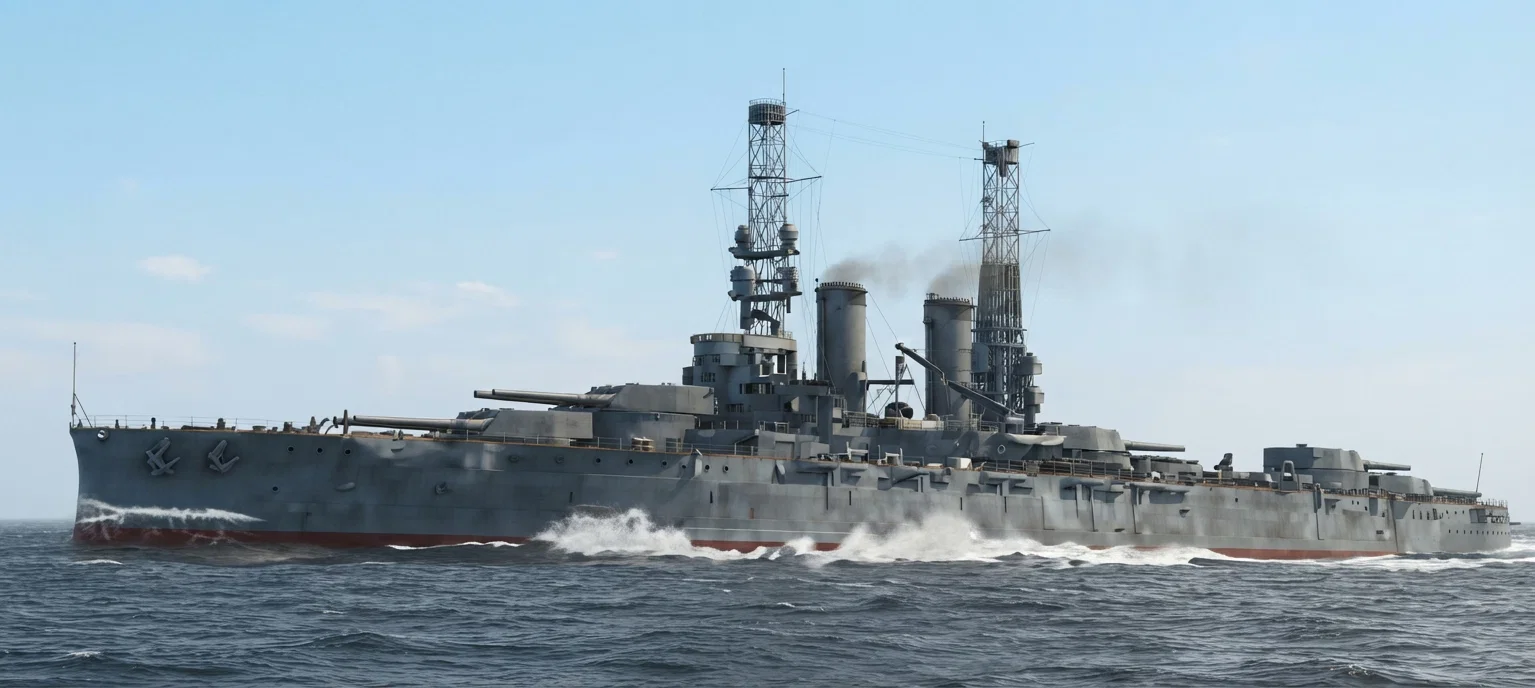
The United States Battle-Ship Wyoming

ONE OF TO-DAY MORE POWERFUL THAN TEN OF YESTERDAY

"Assistant Secretary of the Navy Roosevelt," so says the Scientific American, "in a recent conversation with half a dozen captains of the United States navy, asked them which they would rather command in the event of a fight between one Wyoming and ten Oregons. Five of the six said they would prefer to take the Wyoming. The sixth thought that he would take his chance with the ten Oregons, because the one Wyoming might blow up. Now this unanimous choice of the Wyoming was made for readily understood reasons. The twelve 50-caliber 12-inch guns of the Dreadnought would greatly outrange the old 35-caliber 13-inch guns of the Oregons; and the superior speed of the modern ship of 21 knots, as against the present speed of, say, 14½ knots of the Oregons, would enable the Wyoming to maintain a distance of ten or twelve thousand yards, well beyond the effective range of the old 13-inch pieces, and silence or sink the ten Oregons one by one, or three or four at a time for that matter. It is considerations such as these that have led the naval powers to disregard the pre-Dreadnought battle-ship, in estimating the strength of the first fighting line of modern navies."
The Oregon was authorized by Congress in 1890, and at the time of our war with Spain in 1898 she was considered one of the newest and best battle-ships afloat. Her celebrated journey from San Francisco Bay to Santiago to assist in the destruction of Cervera's fleet made her famous, not only in this country but throughout the world. But in sixteen years it is the unanimous agreement of five out of six navy captains that they would rather have one Wyoming, the latest United States Dreadnought to be put into commission, than ten of those powerful ships of a decade and a half ago; and the sixth captain leaves us to infer that he would rather also have the one Wyoming in preference to the ten Oregons if he could be assured that it would not accidentally "blow up."

WYOMING ALREADY IN THE SHADOW

The awe-inspiring destructiveness of modern weapons of warfare is so well known that a description is unnecessary. And the Wyoming of today is being placed in the background very rapidly by the still more powerful super-Dreadnought that most of the leading nations are building. France, for instance, is about to commence the construction of four of the super-Dreadnoughts of some 29,000 tons displacement, which are to carry sixteen 13.4-inch guns in four quadruple turrets. The whole sixteen of these guns can be swung to either broadside, and eight of them can be fired either ahead or astern. Some of these modern ships are equipping themselves with 15-inch guns capable of hurling a projectile weighing one ton a distance of twelve miles with almost mathematical precision.

THE CAUSES OF WAR STILL WITH US

Winston Spencer Churchill, England's great statesman who has long stood at the head of the admiralty, recently declared: "The causes which might lead to a general war have not been removed. The world is arming as it never armed before. All attempts at arresting it have been ineffectual." And in view of this arming of the nations, Great Britain has declared its purpose to have ten of the new all-big-gun battle-ships in the water by the time any other nation in the world has two.
The Los Angeles Tribune recently stated that "no man is yet able to discern any signs of the advent of that day of universal arbitration that shall put a stop to war and end the waste that is breaking the backs of nations."
Ex-President Eliot, one of the best known and most earnest advocates of international peace, has recently come out with the statement that he sees no reason to expect that the world will be brought, in the next two hundred years, to that point in civilization where it will be willing to accept universal peace.

WAR AND COMMERCE

One of the leading causes for war is the opportunity for the expansion of commerce, and the battle along commercial lines wasnever more intense than at the present time. The leading naval powers are also the leading commercial powers; and while they are seeking to extend their commerce in every possible way and in every section of the world, they are urged to the necessity of building these terrible engines of destruction.

WE MAY KNOW OF THE OUTCOME

These paragraphs are reciting some well-known facts in order that attention may be called to some prophetic utterances of the divine Word that the struggling, war-cursed nations of this earth are ignoring. This prophetic Word makes the positive prediction, in numerous passages, that our world is coming to its end in the throes of an awful and world-wide war.
One of the prophecies that make this prediction is the following: 'And the sixth poured out his bowl upon the great river, the river Euphrates; and the water thereof was dried up, that the way might be made ready for the kings that come from the sun-rising. And I saw coming out of the mouth of the dragon, and out of the mouth of the beast, and out of the mouth of the false prophet, three unclean spirits, as it were frogs: for they are spirits of demons, working signs; which go forth unto the kings of the whole world, to gather them together unto the war of the great day of God, the Almighty. (Behold, I come as a thief. Blessed is he that watcheth, and keepeth his garments, lest he walk naked, and they see his shame.) And they gathered them together into the place which is called in Hebrew Har-Magedon.' Rev. 16: 12-16.
The language of the foregoing scripture is too plain to need any comment. It specifically shows that the kingdoms of 'the whole world' are to be gathered 'unto the war of the great day of God.' This is the great war of Armageddon.

THE CARNAGE OF ARMAGEDDON'S WAR

Another scripture foretells the terrible destructiveness of that war in this language: 'And another angel came out from the temple which is in heaven, he also having a sharp sickle. And another angel came out from the altar, he that hath power over fire; and he called with a great voice to him that had the sharp sickle, saying, Send forth thy sharp sickle, and gather the clusters of the vine of the earth; for her grapes are fully ripe. And the angel cast his sickle into the earth, and gathered the vintage of the earth, and cast it into the wine-press, the great wine-press, of the wrath of God. And the wine-press was trodden without the city, and there came out blood from the wine-press, even unto the bridles of the horses, as far as a thousand and six hundred furlongs.' Rev. 14: 17-20.
It is well to give heed to the clear utterances of these divine predictions. They tell us with unmistakable accuracy the meaning of the events that are shaping in the world. The great day of God, the Almighty, is just before us. There can be no doubt concerning it in the mind of the individual who will carefully study the evidences. And, best of all, God has made provision so that each individual may stand secure from harm through that time, and in the soon coming day of Christ's appearing may enter upon the indescribable bliss and joy of the eternal world,

The Millennium, and Satan Imprisoned

Is the Millennium Before or After the Coming of Christ? — How Is Satan Bound? — The Voice of the Archangel and the Resurrection — The Wicked Are Silenced — The Redeemed Escorted to Glory — How Is Satan "Loosed" for the "Little Season"? — The Final Great Climax
By HAMPTON W. COTTRELL
THE word "millennium" is one frequently spoken from the pulpit and among many religious people, and the period to which it refers is much talked of; but it is not a Bible term. It is derived from two Latin terms,—mille, meaning a thousand; and annus, meaning a year. Thus was coined the term "millennium." However, its equivalent is used several times in Revelation, the twentieth chapter.
The Bible is the Father and Son's joint revelation to man, not the revelation of the prophets and the apostles; for we read, "The revelation of Jesus Christ, which God gave unto Him, to show unto His servants things which must shortly come to pass." Rev. 1:1.

HE BEHOLDS THE FUTURE

When John was on the isle of Patmos, whither he had been banished because of his religion — his faith in the word of God — he was permitted to appear, by vision, in the presence of God, and look down through what would otherwise have been the dim future, and behold coming events. He beheld the premillennial coming of our divine Lord.

HE SAW SATAN BOUND

Said he of Christ: "Behold, He cometh with clouds; and every eye shall see Him, and they also which pierced Him: and all kindreds of the earth shall wail because of Him. Even so, amen. I am Alpha and Omega, the beginning and the ending, saith the Lord, which is, and which was, and which is to come, the Almighty." Rev. 1:7, 8.
Then John spoke of his personal experience: "I John . . . was in the isle that is called Patmos, for the word of God, and for the testimony of Jesus Christ." Verse 9. And when he saw the millennium introduced by the coming of the Lord, and had seen the dawning of the day, he beheld an angel binding Satan. He saw the work of binding completed. He said: "And I saw an angel come down from heaven, having the key of the bottomless pit and a great chain in his hand. And he laid hold on the dragon, that old serpent, which is the devil, and Satan, and bound him a thousand years." Rev. 20:1, 2. Thus we are assured of the length of the millennial day, and that Satan will surely be bound during that period.

UNIVERSAL PEACE IN THE MILLENNIUM

Jehovah has declared universal peace during the millennium. There will be no robbery of money, reputation, honor, or influence. There will be no slavery, either white or black, physical or spiritual; but all will be peace, perfect peace.

THE ANGEL HAD THE "KEY" AND A "CHAIN"

The angel had the "key" and a "great chain" in his possession, and he put Satan in chains. To illustrate: We have known of communities where poverty and wretchedness prevailed, but we were helpless to remedy the situation. But Mr. A is a man of great wealth and influence, and of him it is said: He holds in his hand the key to this situation. He can change this miserable, pitiable condition. Again: A case is being tried in court; and that justice may be meted out, a certain witness must be secured, for he holds the key to the entire situation. He holds in his hand, or has in his possession, the facts.
The hoarding up of millions of money ties up business, binds it as with a great chain. So the angel who has the key and the chain, is in possession of all the evidence contained in the eventful, cyclonic, death-strewn career of Satan from before the beginning of the world until that glorious hour when he is to be placed in solitary confinement for a thousand years.
In the morning of that millennial day, the angel will bind the devil with a chain of facts, from which state Satan will be powerless to extricate himself; and in that condition he must take a vacation from his arduous relentless, soul-destroying work of six thousand years' duration. Hasten on, glad day! Surely this should be the prayer of every Christ-loving soul.

SATAN BOUND AT THE BEGINNING

Satan is bound at the beginning of the one thousand years, and placed in a pit, and the pit sealed, so he can not escape therefrom. No one can enter the pit where he is, for it is sealed. And he can "deceive the nations no more, till the thousand years should be fulfilled." Thus he remains bound during the one thousand years, making the millennium possible. "And after that he must be loosed a little season." Rev. 20:1-3.
The binding of Satan comes in the divine course of occurrences, the first link of that eventful chain being the fulfilment of the Saviour's promise to His people who lived then and now, "I will come again, and receive you unto Myself." John 14:3. The chain thus begun is lengthened by the rapidly succeeding events in close proximity to the coming of Christ.

THE VOICE OF THE ARCHANGEL AND THE DEAD ARISING

Let us notice a few of these events in their order, as based upon the word of God, which in itself is assurance. "For the Lord Himself shall descend from heaven with a shout, with the voice of the Archangel, and with the trump of God: and the dead in Christ shall rise first: then we which are alive and remain shall be caught up together with them in the clouds, to meet the Lord in the air: and so shall we ever be with the Lord." 1 Thess. 4:16, 17.
We have here a series of events,—the coming of our divine Lord; His speaking with a voice like a trumpet, which awakens from the dead the sleeping saints; the momentary change of the Christians who are alive, from mortality to immortality; then the glad reunion of the resurrected saints and the ones who had not died, to be held aloft in the air with their Lord and Master, who is also supreme ruler of the air, thus assuring perfect safety in the place of meeting. "This is the first resurrection." Rev. 20:5, last clause. "Blessed and holy is he that hath part in the first resurrection: on such the second death hath no power, but they shall be priests of God and of Christ, and shall reign with Him a thousand years." Verse 6.
When Christ was here, He said: "In My Father's house are many mansions. . . . I go to prepare a place for you." John 14:2. The Father's house is heaven itself; for where the house was, was where He intended to go, and He went to heaven, and was seated at the right hand of the Father.

HE LEADS THE NATION HEAVENWARD

After the meeting in the air, in further fulfilment of His promise, He leads the nation "born in a day," heavenward; and as they near the pearly portals of the city of God, prepared for them, He speaks once again to His accompanying angelic attendants, in the voice of melody, "Open ye the gates, that the righteous nation which keepeth the truth may enter in." Isa. 26:2. In compliance with the heavenly command, the gates of pearl swing wide open on their glittering golden hinges, and the righteous nation surely enter in to heaven itself; for we read, "After these things I heard a great voice of much people in heaven, saying, Alleluia; salvation, and glory, and honor, and power, unto the Lord our God." Rev. 19:1.

THEIR JOY AT LAST COMPLETE

Their joy is complete. They are at last in the personal presence of their Lord. They occupy seats of honor with Him, and they remain there one thousand years. "And I saw thrones, and they sat upon them, and judgment was given unto them: and I saw the souls of them that were beheaded for the witness of Jesus, and for the word of God, and which had not worshiped the beast, neither his image, neither had received his mark upon their foreheads, or in their hands; and they lived [for they had been resurrected] and reigned with Christ a thousand years." Rev. 20:4.
Thus it is clearly stated that the children of God will spend the one thousand years, or a millennium, in heaven, while Satan is bound and in the bottomless pit.

THE WICKED ARE SILENCED

Those who refuse to acquaint themselves with the Lord now, while His mercy is offered, can not endure the glory of His presence at His coming. When the righteous are taken to heaven, at the time of the first resurrection, the wicked are all silent in death, awaiting the call of the Archangel to judgment at the second resurrection, which is at the latter end of the thousand years. "The rest of the dead lived not again [were not resurrected] until the thousand years were finished." Verse 5.

SIGNALLY MARKED

The millennium is bounded at the beginning by the following events:
  1. The second personal coming of Christ.
  2. The resurrection of the righteous dead.
  3. The translation of the living righteous.
  4. The binding of Satan with this chain of circumstances.
The righteous will spend the millennium in heaven with Christ. "And they lived and reigned with Christ a thousand years."
Satan will spend the millennium in exile. "And he laid hold on . . . Satan, and bound him a thousand years, and cast him into the bottomless pit, and shut him up, . . . till the thousand years should be fulfilled."
The wicked will spend the millennium in quiet, in the silent grave; for they are referred to by the expression, "But the rest of the dead lived not again [the righteous having had their resurrection] until the thousand years were finished." Verse 5.
These are the circumstances that constitute the chain which binds Satan.

WHEN THE WICKED ARE RESURRECTED

The end of the millennium is determined by the resurrection of the wicked, who will then meet the Judge, and hear Him utter the decision that each of them has made for himself: "You, by your course through life, chose the way of death — separation from Me. Eternal death is your portion." See Rom. 6:23.
As men use money with which to do business, Satan uses men with which to do business; and as the removal of money from circulation binds the men of business, so the removal of men from Satan's grasp will bind him. Every other soul will be removed from the earth during the thousand years — the millennium. The righteous will be in heaven. 1 Thess. 4:16, 17; Rev. 20:4; Isa. 26:2; Rev. 19:1. The wicked will all be unconscious in the sleep of death. "Behold, the day of the Lord cometh, cruel both with wrath and fierce anger, to lay the land desolate: and He shall destroy the sinners thereof out of it." Isa. 13:9. See also 2 Thess. 2:8; Isa. 24:1-3.
These are heaven-assured promises and declarations relating to the millennium, the time of beginning and ending, and all detailed conditions prevailing during the period; and they will surely come to pass, "for all the promises of God in Him are yea, and in Him amen, unto the glory of God by us." 2 Cor. 1:20.

WHEN SATAN IS LOOSED FOR THE "LITTLE SEASON"

It is said that after the thousand years, Satan will be "loosed a little season." Rev. 20:3, 7. Removing the people beyond Satan's grasp bound him. The return of the righteous and the resurrection of the wicked will loose him. The wicked will be resurrected at the close of the period; and of the city of God, where the righteous are, we read: "I John saw the holy city, New Jerusalem, coming down from God out of heaven. . . . And I heard a great voice out of heaven saying, Behold, the tabernacle of God is with men, and He will dwell with them, and they shall be His people, and God Himself shall be with them, and be their God." Rev. 21:2, 3.

WICKED AND RIGHTEOUS AGAIN ON EARTH

Both the righteous and the wicked are again on earth. This condition looses Satan for the "little season." He deceives the wicked nations, and they surround the city of God and the camp of the saints with evil intent; and God sends from heaven fire which melts the earth, thus forming a lake of fire as broad as the earth, and Satan and the wicked are destroyed because of their determined course of rebellion against God. Rev. 20:7-10; 2 Peter 3:10, 11. And of Satan it is said that he shall then be brought to ashes in the sight of men, and that he shall never be any more. Eze. 28:18, 19.
During that period of the destruction of sin, and the earth's renovation by fire, the righteous are preserved by the Lord, as were the three Hebrews in the fiery furnace. Isa. 33:14, 15.

THE FORETASTE OF ETERNAL JOY

The millennium is but the foretaste of the eternal joy, peace, and bliss that are now in reserve for the child of God. "I saw a new heaven and a new earth: for the first heaven and the first earth were passed away." Rev. 21:1. "And every creature which is in heaven, and on the earth, and under the earth, and such as are in the sea, and all that are in them, heard I saying, Blessing, and honor, and glory, and power, be unto Him that sitteth upon the throne, and unto the Lamb forever and ever." Rev. 5:13.
Reader, if you have not already done so, choose that good part that can never be taken from you.
The atheist will say the Bible is but the word of man. The doubter who has a theory to sustain may whisper in your ear that Rev. 20:5 is a forgery — that it is not in the original; but so to state is to beg the question, for the combined scholarship of the day retains that verse in all standard revisions.
The millennium can not precede the coming of the Lord; for the Lord has said His coming will be the first event to mark its beginning.
Conditions in the world will continue to grow worse and worse until the beginning of the millennium, or the coming of the Lord. Read James 5; 2 Tim. 3:1-5.
The time for one to make Christ his choice and have an eternity of peace assured, is now, before the time of the millennium, which will be marked by the coming of the Lord; for after that event, it will be forever too late to choose.

Called Back to the Standard of the Cross

DEPARTURE FROM THE APOSTLE'S TEACHING—EFFORTS TO RESTORE OBEDIENCE—A GREAT REFORMATION RESULTS

By Mrs. E. G. White
THE first epistle to the Corinthian church was written by the apostle Paul during the latter part of his stay at Ephesus. For no others had he felt a deeper interest or put forth more untiring effort than for the believers in Corinth. For a year and a half he had labored among them, pointing them to a crucified and risen Saviour as the only means of salvation, and urging them to rely implicitly on the transforming power of His grace.

UNCONDITIONAL SURRENDER ASKED

Paul had a keen sense of the conflict which every soul must wage with the agencies of evil that are continually seeking to deceive and ensnare; and he had worked untiringly to strengthen and confirm those who were young in the faith. He had entreated them to make an entire surrender to God; for he knew that when the soul fails to make this surrender, then sin is not forsaken, the appetites and passions still strive for the mastery, and temptations confuse the conscience.

TARES HAD BEEN SOWN

The members of the church at Corinth were surrounded by idolatry and sensuality of the most alluring form. Paul's firm faith, his fervent prayers and earnest words of instruction, and above all, his godly life, had helped them to deny self for Christ's sake, rather than to enjoy the pleasures of sin. After the departure of Paul, however, unfavorable conditions arose. Tares that had been sown by the enemy appeared among the wheat, and erelong these began to bring forth their evil fruit.
This was a time of severe trial to the Corinthian church. He who had so often urged them to high ideals of purity and uprightness, was no longer with them; and not a few who, at the time of their conversion, had put away their evil habits, returned to the debasing sins of heathenism.

THE TRUE CONDITION CONCEALED

Paul had written briefly to the church, but many of the believers perverted the apostle's meaning, quibbled over his words, and excused themselves for disregarding his instruction. A letter was sent to Paul by the church, asking for counsel concerning various matters, but saying nothing of the grievous sins existing among them. The apostle was, however, forcibly impressed by the Holy Spirit that the true state of the church had been concealed.
About this time there came to Ephesus members of the household of Chloe, a Christian family of high repute in Corinth. Paul asked them regarding the condition of things, and they told him that the church was rent by divisions. The doctrines and ordinances of the gospel had been perverted. Pride, idolatry, and sensualism were steadily increasing among those who had once been zealous in the Christian life.
As this picture was presented before him, Paul saw that his worst fears were more than realized. But he did not because of this give way to the thought that his work had been a failure. With "anguish of heart" and with "many tears" he sought counsel from God.
Gladly would he have visited Corinth at once, had this been the wisest course to pursue. But he knew that in their present condition the believers would not profit by his labors, and therefore he sent Titus to prepare the way for a visit from himself later on. Then, putting aside all personal feelings over the course of those whose conduct revealed such strange perverseness, and keeping his soul stayed upon God, the apostle wrote to the church at Corinth one of the richest, most instructive, most powerful of all his letters.
With remarkable clearness he proceeded to answer the various questions brought forward by the church, and to lay down general principles, which, if heeded, would lead them to a higher spiritual plane. They were in peril, and he could not bear the thought of failing at this critical time to reach their hearts. Faithfully he warned them of their dangers and reproved them for their sins. He pointed them again to Christ, and sought to kindle anew the fervor of their early devotion.

HE SHOWED THEM THE KEEPING POWER

In this letter to the Corinthians, Paul endeavored to show them Christ's power to keep them from evil. He knew that if they would comply with the conditions laid down, they would be strong in the strength of the Mighty One. As a means of helping them to break away from the thralldom of sin, and to perfect holiness in the fear of the Lord, Paul urged upon them the claims of Him to whom they had dedicated their lives at the time of their conversion. "Ye are Christ's," he declared. "Ye are not your own. . . . Ye are bought with a price; therefore glorify God in your body, and in your spirit, which are God's."
The apostle plainly outlined the result of turning from a life of purity and holiness to the corrupt practises of heathenism. "Be not deceived," he wrote; "neither fornicators, nor idolaters, nor adulterers, . . . nor thieves, nor covetous, nor drunkards, nor revilers, nor extortioners, shall inherit the kingdom of God." He begged them to control the lower passions and appetites. "Know ye not," he asked, "that your body is the temple of the Holy Ghost which is in you, which ye have of God?"

A RARER WISDOM AND THE INNER POWER

While Paul possessed high intellectual endowments, his life revealed the power of a rarer wisdom, which gave him quickness of insight and sympathy of heart, and brought him into close touch with others, enabling him to arouse their better nature and inspire them to strive for a higher life.
His heart was filled with an earnest love for the Corinthian believers. He longed to see them revealing an inward piety that would fortify them against temptation. He knew that at every step in the Christian pathway they would be opposed by the synagogue of Satan, and that they would have to engage in conflicts daily. They would have to guard against the stealthy approach of the enemy, forcing back old habits and natural inclinations, and ever watching unto prayer.
Paul knew that the higher Christian attainments can be reached only through much prayer and constant watchfulness, and this he tried to instil into their minds. But he knew also that in Christ crucified they were offered power sufficient to convert the soul,and divinely adapted to enable them to resist all temptations to evil. With faith in God as their armor, and with His word as their weapon of warfare, they would be supplied with an inner power that would enable them to turn aside the attacks of the enemy.

DESIRED THE COMPLETE FULNESS

The Corinthian believers needed a deeper experience in the things of God. They did not know fully what it meant to behold His glory, and to be changed from character to character. They had seen but the first rays of the early dawn of that glory. Paul's desire for them was that they might be filled with all the fulness of God, following on to know Him whose going forth is prepared as the morning, and continuing to learn of Him until they should come into the full noontide of a perfect gospel faith.

THE CHRISTIAN WARFARE AND CELEBRATED RACES

In the hope of impressing vividly upon the minds of the Corinthian believers the importance of firm self-control, strict temperance, and unflagging zeal in the service of Christ, Paul in his letter to them made a striking comparison between the Christian warfare and the celebrated foot-races held at stated intervals near Corinth. He emphasized the preparation necessary to the success of the contestants,—the preliminary discipline, the abstemious diet, the necessity for temperance. "Every man that striveth for the mastery," he declared, "is temperate in all things."
How much more important that the Christian, whose eternal interests are at stake, bring appetite and passion under subjection to reason and the will of God! And after this has been done, the Christian must put forth the utmost exertion in order to gain the victory. In the Corinthian games, the last few strides of the contestants in the race were made with agonizing effort to keep up undiminished speed. So the Christian, as he nears the goal, will press onward with even more zeal and determination than at the first of his course.

IMMORTAL CROWNS AND FADING CHAPLETS

Paul presents the contrast between the chaplet of fading laurel received by the victor in the foot-races, and the crown of immortal glory that will be given to him who runs with triumph the Christian race. "They do it," he declares, "to obtain a corruptible crown; but we an incorruptible."
To win a perishable prize, the Grecian runners spared themselves no toil or discipline. We are striving for a prize infinitely more valuable, even the crown of everlasting life. How much more careful should be our striving, how much more willing our sacrifice and self-denial! Every act casts its weight into the scale that determines life's victory or defeat. And the reward given to those who win will be in proportion to the energy and earnestness with which they have striven.

THE GOAL BEFORE HIM

The apostle compared himself to a man running in a race, straining every nerve to win the prize. "I therefore so run," he says, "not as uncertainly; so fight I, not as one that beateth the air: but I keep under my body, and bring it into subjection: lest that by any means, when I have preached to others, I myself should be a castaway." Paul feared lest, having preached to others, he himself should be a castaway. He realized that if he did not carry out in his life the principles he believed and preached, his labors in behalf of others would avail him nothing. His conversation, his influence, his refusal to yield to self-gratification, must show that his religion was not a profession merely, but a daily, living connection with God. One goal he kept ever before him, and strove earnestly to reach,—"the righteousness which is of God by faith."
Paul knew that his warfare against evil would not end so long as life should last.
Ever he realized the need of putting a strict guard upon himself, that earthly desires might not overcome spiritual zeal. With all his power he continued to strive against natural inclinations. Ever he kept before him the ideal to be attained, and this ideal he strove to reach by willing obedience to the law of God. His words, his practises, his passions,—all were brought under the control of the Spirit of God.

THIS SINGLE-HEARTED PURPOSE

It was this single-hearted purpose to win the race for eternal life that Paul longed to see revealed in the lives of the Corinthian believers. He knew that in order to reach Christ's ideal for them, they had before them a life struggle from which there would be no release. He entreated them to strive lawfully, day by day seeking for piety and moral excellence. He pleaded with them to lay aside every weight, and to press forward to the goal of perfection in Christ.
Glorious is the triumph awaiting the faithful. The apostle, realizing the possibilities before the Corinthian believers, sought to set before them that which uplifts from the selfish and the sensual, and glorifies life with the hope of immortality. Earnestly he exhorted them to be true to their high calling in Christ. "My beloved brethren," he pleaded, "be ye steadfast, unmovable, always abounding in the work of the Lord, forasmuch as ye know that your labor is not in vain in the Lord."
Thus the apostle, in the most decided and impressive manner, endeavored to correct the false and dangerous ideas and practises that were prevailing in the Corinthian church. He spoke plainly, yet in love for their souls. After the letter had been despatched, Paul feared lest that which he had written might wound too deeply those whom he desired to benefit. With trembling anxiety he waited to receive some tidings as to the reception of his message.

THE TRANSFORMATION EFFECTED

During this time of anxiety, he afterward declared, "our flesh had no rest; . . . without were fightings, within were fears." His prayers in behalf of those whom he loved were answered, however, by the coming of Titus, who brought the cheering news that a wonderful change had taken place among the Corinthian believers. Many had accepted the instruction contained in Paul's letter, and had repented of their sins. Their lives were no longer a reproach to Christianity, but exerted a powerful influence in favor of practical godliness.

FILLED WITH JOY HE WRITES AGAIN

Filled with joy, the apostle sent another letter to the Corinthian believers, expressing his gladness of heart because of the good work wrought in them: "Though I made you sorry with a letter, I do not repent, though I did repent." When tortured by the fear that his words would be despised, he had sometimes regretted that he had written so decidedly and severely. "Now I rejoice," he continued, "not that ye were made sorry, but that ye sorrowed to repentance: for ye were made sorry after a godly manner, that ye might receive damage by us in nothing. For godly sorrow worketh repentance to salvation not to be repented of."
That repentance which is produced by the influence of divine grace upon the heart willlead to confession and forsaking of sin. Such were the fruits which the apostle declared had been seen in the lives of the Corinthian believers.

THE SOURCE FROM WHICH TRIUMPH COMES

In expressing his joy over their reconversion and their growth in grace, Paul ascribed to God all the praise for this transformation of heart and life. "Thanks be unto God," he exclaimed, "which always causeth us to triumph in Christ, and maketh manifest the savor of His knowledge by us in every place. For we are unto God a sweet savor of Christ, in them that are saved, and in them that perish."
Paul was now full of faith and hope. He felt that Satan was not to triumph over the work of God in Corinth, and in words of praise he poured forth the gratitude of his heart. He and his fellow laborers would celebrate their victory over the enemies of Christ and the truth, by going forth with new zeal to extend the knowledge of the Saviour. Like incense the fragrance of the gospel was to be diffused throughout the world. To those who should accept Christ, the message would be a savor of life unto life.
Continue reading: Not Far from Thee