Your ShelfYour Projects

Review and Herald, Vol. 83, No. 20.

Contents of the Earthquake Special

Review and Herald

May 17, 1906

Review and Herald Publishing Association · Washington, D. C. · May 17, 1906

Contents of the Earthquake Special

Articles

THE EVERLASTING AND SURE REFUGE
THE EARTHQUAKE
THE “QUEEN OF THE WEST” LAID LOW
SAN FRANCISCO
(A powerful word-picture of the city's visitation, by Fred Hewitt of the Examiner)
WHAT DO THESE THINGS MEAN?
SAN FRANCISCO'S SISTER CITIES TO THE RESCUE
HOW SAN JOSE FARED
LAST DAY DELUSIONS
VESUVIUS IN ACTION AGAIN
STANFORD UNIVERSITY
THE CRY OF THE CHILDREN (Poem)
OTHER TOWNS THAT SUFFERED
MOUNTAIN VIEW EXPERIENCES
DISASTERS OF THE PRESENT YEAR
CHINATOWN REVEALED
SEISMOGRAPHIC RECORDS
A GENEROUS LAND

Illustrations

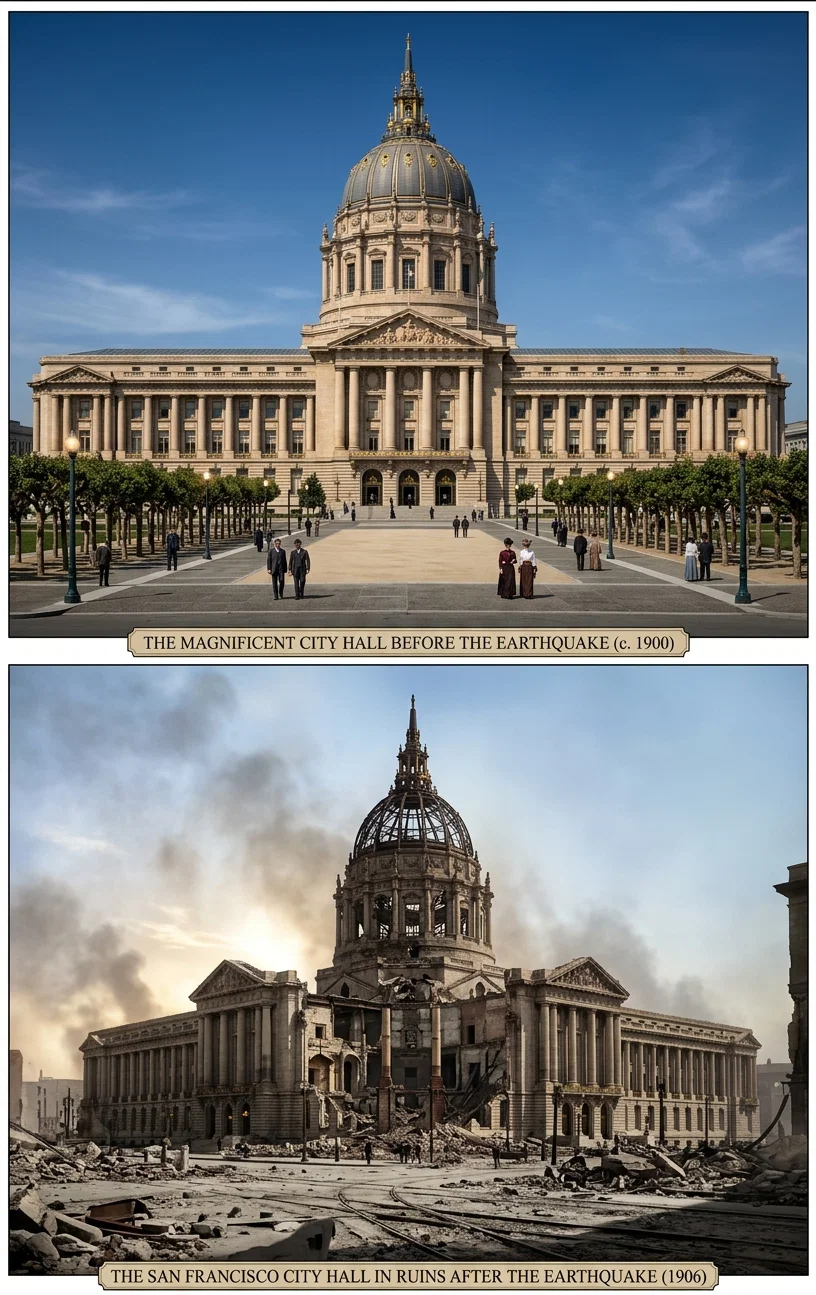
1. MAGNIFICENT CITY HALL BEFORE EARTHQUAKE
2. THE SAME AFTER THE EARTHQUAKE
3. PANORAMA OF CITY ON FIRE—FROM NOB HILL
4. VIEW FROM UNION SQUARE BEFORE THE FIRE
5. CALL AND EXAMINER BUILDINGS AFTER THE FIRE
6. CITY ON FIRE AS SEEN FROM FERRY BOAT
7. UPHEAVAL OF STREET BY EARTHQUAKE IN FRONT OF G. P. O.
8. VIEW OF BURNED DISTRICT SOUTH OF MARKET STREET
9. MAP OF BURNED DISTRICT
10. WRECK OF HOTEL VENDOME ANNEX
11. WRECK OF PACIFIC COAST BUSINESS COLLEGE AND HOME UNION STORE
12. COMPLETE WRECK OF LARGE STORE
13. BIRD'S-EYE VIEW OF VESUVIUS IN ERUPTION
14. MARTIAL LAW AND THE BREAD LINE IN SAN FRANCISCO
15. STANFORD MEMORIAL CHAPEL BEFORE THE EARTHQUAKE
16. STANFORD MEMORIAL CHAPEL AFTER THE EARTHQUAKE
17. STANFORD MEMORIAL ARCH BEFORE THE EARTHQUAKE
18. STANFORD MEMORIAL ARCH AFTER THE EARTHQUAKE
19. STANFORD ENTRANCE BEFORE THE EARTHQUAKE
20. STANFORD ENTRANCE AFTER THE EARTHQUAKE
21. PACIFIC PRESS AFTER THE EARTHQUAKE
22. TWO-STORY UNION STORE AFTER THE EARTHQUAKE
23. CORNER OF PACIFIC PRESS AFTER THE EARTHQUAKE
24. POST-OFFICE, STORE, ETC., AFTER THE EARTHQUAKE
25. PACIFIC PRESS ENGINE HOUSE AFTER THE EARTHQUAKE
26. PACIFIC PRESS BUSINESS OFFICE AFTER THE EARTHQUAKE
27. SEISMOGRAPHIC RECORD OF APR. 19, 1892
28. SEISMOGRAPHIC RECORD OF MAR. 30, 1898
29. SEISMOGRAPHIC RECORD OF APR. 18, 1906

Prices

Less than 1,000 to one name, one address, 3 cents a copy; over 1,000 copies to one name, one address, 2 1-2 cents a copy.
Order direct from the
Pacific Press Pub. Co.
or your State Tract Society, Mountain View, Cal.
San Francisco's magnificent City Hall, which cost six million dollars, as it appeared before the Earthquake. The lower picture shows it in ruins

Modern Christianity

There is something bewildering about the modern perversions of the truths of Christianity. These advocates of the New Theology seem to be full of sweetness and light. They do not wish to quarrel with any one, but desire full permission to propagate their views without hindrance or opposition throughout the various denominations in which they happen to have church connection. There is a sort of fascination in their interpretations of the Scriptures. They almost dazzle the reader with beautiful statements, and appear to present a very spiritual view of both earthly and heavenly things.
We have steadily maintained that those who declare that every operation of God in nature is a miracle, and that all the natural is supernatural, have adopted the essential principle of the New Theology. This is the evolutionary conception of Christianity. It repudiates the idea of any special acts on God's part either in the original creation or in the course of nature or in conversion. Everything is developed under fixed laws, and the only remedy for imperfection is development. It demolishes the old-time views of the creation, the fall, the atonement, conversion, justification, inspiration, etc., and substitutes an entirely new system. It is the principle of evolution applied in the interpretation of Christianity.
Our attention has been called to this matter anew by an editorial in The Outlook (New York), a recognized defender and expounder of the New Theology, from which we take the following paragraph:—
There are three views of Christianity entertained to-day: the first, that man is left to grope his way as best he can to the truth, and that Christianity is the best solution of the enigma of life which he has yet reached; the second, that God has appeared to a special, chosen people, and given to them the solution, and that Christianity is that specially revealed solution; the third, that God is and always has been man's Companion, that revelation is as universal as aspiration, that all religions are partial revealings of God to man and in man, and that Christianity is the supreme chapter in this history of perpetual revelation. The first view eliminates the supernatural, the second regards it as an episode, the third believes in it as universal. . . . The Outlook, in common with an increasing number of Christians, holds the third.
The claim that the supernatural is universal appears at first thought to recognize God as in a closer relation to his works than is usually admitted by orthodox believers, but a more careful analysis of this teaching reveals the fact that it entirely sets aside the God of the Bible, and substitutes for this personal Being an infinite Power to which it ascribes a personality scientifically defined, and distributes it throughout the material creation under the name of the Universal Presence. When this evolutionary conception of God has been adopted, the affirmation that the supernatural is universal, and that the world is full of miracles, is simply another way of saying that the personal God of the Bible is not the god of the present day, and that the miracles recorded in the Bible are the product of a vivid imagination.
A legitimate consequence of this evolutionary principle is the view that "revelation is as universal as aspiration." The real meaning of this statement is that the writers of the Bible were in no sense inspired differently from what the writers of the present day are inspired, and of course the conclusion is that the Bible is of no more authority in matters of religion than any book of this day. And the sum of all this new philosophy is that God is in everything and in every man, and that religion consists simply in developing the good which is already within.
By selecting certain expressions in the Bible and interpreting them apart from their connection and in an evolutionary setting, and by giving to familiar passages a meaning entirely different from that which has been universally accepted for centuries, the advocates of this new system are able- to make it appear that their teaching is in harmony with the Scriptures. This is evidently designed to influence those who still hold that the Bible is the Word of God and a sufficient rule of faith.
It seems necessary to open up the meaning of the smooth phrases in which these sophistries are concealed in order to save our readers from being deceived by them. These things have been urged upon us both from within and from without the denomination, and it is time that we all understood what they mean. It is certainly our duty to heed the exhortation, "Be vigilant." "Beware of wolves in sheep's clothing."

Violence Increasing

Editorial

Violence Increasing

THE religion of Jesus makes for peace. It is the one restraining, conserving influence which is able to prevent strife of every sort. The Christian is a man of peace. When men reject the teaching of Jesus and refuse to accept him as their Saviour from sin, they are utterly unable to contend with their adversary, and are driven to the excesses of evildoing. This condition of things is one of the signs of the last days, when, because of abounding iniquity, “the love of many shall wax cold.” That we have reached such a period ought to be clear to all who are familiar with current history. Offenses against the laws designed to protect persons and property have been increasing in a ratio which is all out of proportion to the increase of population, and the uncontrolled spirit of violence is making demons out of men. What sin means is being more and more fully revealed. The crisis of the great controversy is just upon us. “The morning cometh, and also the night.” In the light which God’s Word sheds upon the present situation we are able to interpret the true meaning of many events which would otherwise be perplexing in the extreme. “The wicked shall do wickedly: and none of the wicked shall understand; but the wise shall understand.” “In nothing be anxious; but in everything by prayer and supplication with thanksgiving let your requests be made known unto God. And the peace of God, which passeth all understanding, shall guard your hearts and your thoughts in Christ Jesus.”

The Mark of a True Prophet

The aim of the true gospel worker is to exalt Jesus Christ as the world's Redeemer. As the gospel exalts Christ, it necessarily lays in the dust the glory and pride of humanity. It points to Christ alone, and forbids men to trust for salvation in anything else.
Opposed to the true work of God is a counterfeit work which exalts the human in the place of the divine. It calls attention to the human agent. The leader in such a movement makes claims for himself. Some of this class are described in Gamaliel's talk to the Pharisees: “Before these days rose up Theudas, boasting himself to be somebody; to whom a number of men, about four hundred, joined themselves: who was slain; and all, as many as obeyed him, were scattered, and brought to naught. After this man rose up Judas of Galilee in the days of the taxing, and drew away much people after him: he also perished; and all, even as many as obeyed him, were dispersed.” Acts 5:35-37.
The false prophet always boasts himself to be somebody, and seeks to draw people not to Christ, but to himself.
The true servant of God, on the other hand, makes no claims for himself. Note the example of one of the greatest servants of God, John the Baptist. “The Jews sent priests and Levites from Jerusalem to ask him, Who art thou? And he confessed, and denied not; but confessed, I am not the Christ. And they asked him, What then? Art thou Elias? And he saith, I am not. Art thou that prophet? And he answered, No. Then said they unto him, Who art thou? that we may give an answer to them that sent us. What sayest thou of thyself? He said, I am the voice of one crying in the wilderness, Make straight the way of the Lord, as said the prophet Esaias.” John 1:19-23.
John the Baptist might have made some claims for himself without being untruthful; for the Saviour said of him, “Among them that are born of woman there hath not risen a greater than John the Baptist;” and “This is Elias, which was for to come.” Matt. 11:14. John went forth “in the spirit and power of Elias,” “to make ready a people prepared for the Lord.” Luke 1:17. But his fulfilment of the prophecy of the sending of Elijah the prophet (Mal. 4:5) was to be made known not by his assertion of it, but by the manifestation of “the spirit and power of Elias” in his work. There was no setting forth of himself; no calling attention to himself. The human agent was to be kept entirely out of sight; Christ alone was to be revealed.
In our own generation a number of men have arisen each setting himself forth as being the prophet Elijah. It is necessary, from their standpoint, that they should assert the claim, for without their own assertion of it the people would never be aware of it. There is nothing in their lives or work which reveals it. Their claim rests upon their own assertion wholly.
It is as true to-day as in the days of John the Baptist that the true servant of God makes no claims for himself, but only says, as did John, that he is an individual with a message. The message is the important thing; the individual is kept entirely in the background, lest the attention of the people should be drawn to a human being rather than to Christ. But the very fact that such a one will make no claims for himself is itself an evidence that his work is of the Lord.
L. A. S.

God’s Providences

God’s ways are not man’s ways. If they were, God would be but a man, and we could not look to him for salvation. But as the heavens are higher than the earth, so are his ways higher than man’s ways. This being so, it must follow that his ways will often look mysterious and dark to human minds, and utterly beyond their comprehension.
God permits seeming misfortunes to overtake his servants and his work. There was Job, a “perfect and upright” man, who was permitted to pass through an experience that forever linked his name with the thought of misfortune and trial. Job regretted that he had ever been born. This was not because Job was not walking in the way that God would have him, but because God permitted Satan to afflict him. He was afflicted because he was righteous; and in it God had a purpose in view. Succeeding generations “heard of the patience of Job,” and beheld “the end of the Lord; that the Lord is very pitiful, and of tender mercy.”
Jacob was a servant of God, yet he was sorely afflicted by the loss of his favorite son Joseph. “All these things are against me,” he exclaimed at one time under the weight of his troubles. But he found a little later that the seemingly great misfortune of the loss of his son was not against him, but, on the contrary, was the means of salvation to himself and his family.
Another example occurs in the history of David. About the time of the battle in which King Saul was killed, David and the company of his followers came to Ziklag, where they had left their wives and children and their goods, and found that in their absence the Amalekites had come upon the place, “and smitten Ziklag, and burned it with fire; and had taken the women captives, that were therein.” “So David and his men came to the city, and, behold, it was burned with fire; and their wives, and their sons, and their daughters, were taken captives. And David and the people that were with him lifted up their voice and wept, until they had no more power to weep. . . . And David was greatly distressed; for the people spake of stoning him, because the soul of all the people was grieved, every man for his sons and for his daughters: but David encouraged himself in the Lord his God.” 1 Sam. 30:1-6.
Why had this terrible misfortune been permitted to occur? David was a servant of God, and in making war upon the Amalekites he was carrying out the purpose of God that the Amalekites should be destroyed. Seemingly there had come a sudden painful experience contradictory to the providence of God in which they had trusted. No one could explain the situation. But David, notwithstanding the darkness of the prospect, “encouraged himself in the Lord.” Then “David enquired at the Lord, saying, Shall I pursue after this troop? shall I overtake them? And he answered him, Pursue: for thou shalt surely overtake them, and without fail recover all.” David did pursue and overtook the Amalekites and smote them with a great slaughter; and “recovered all that the Amalekites had carried away.” More than this, he captured the flocks and herds which the Amalekites had with them. So the seeming misfortune resulted in gain to David, and not in loss.
We need not be perplexed or dismayed when seeming misfortune overtakes the servants of God in the pathway of duty. The same experience has come in the past history of God’s work. It is just as fitting a time for God’s people to encourage themselves in the Lord, as when they are in the midst of the greatest prosperity.
L. A. S.

A Neglected People

THE most neglected by the Christian peoples, so far as missions are concerned, is the Moslem, or Mohammedan people. I believe we Seventh-day Adventists ought to pray for special help to know how to take up work for the Moslem races. Thus far we have done very little for them—just a little in Egypt and Turkey, with a few tracts in Arabic, and perhaps a slight effort in the East Indies. This message is to go to every tongue and tribe, and there must be some way of telling it to Moslem ears.
In his life of Raymond Lull, the first missionary to the Moslems, Dr. Zwemer, gives us the following statistics:—
According to recent and exhaustive statistics, the population of the Mohammedanworld is placed at 259,680,672. Of these, 11,515,402 are in Europe, 171,278,008 are in Asia, 19,446 are in Australasia, 76,818,253 are in Africa, and 49,563 are in North and South America. Three per cent of Europe’s population is Moslem; Asia has eighteen per cent, and Africa thirty-seven per cent. Out of every one hundred souls in the world, sixteen are followers of Mohammed. Islam’s power extends in many lands, from Canton to Sierra Leone, and from Zanzibar to the Caspian Sea.
He says that there are more mosques in Jerusalem than there are missionaries in all Arabia to-day. And if the way of approach is apparently barred in Moslem lands, because of bitterly repressive laws to keep converts from declaring themselves, there are more than one hundred and twenty-five million Moslems, we are told, under Christian rulers, where freedom of missionary effort is granted.
The message of the coming of the Messiah ought to appeal to Moslems. Their old-time recognition of Sabbath-keeping, as when Abubeker led his forces against the Eastern empire, and gave commandment to his followers not to hurt any who had the seal of God in their foreheads, ought to give them an interest in hearing a message from a people keeping the Sabbath of Abraham and the prophets.
Travelers have testified that Mohammedans are expecting the advent of a greater than Mohammed. It is a part of that general expectation of a coming One that has grown up in the hearts of millions in the heathen East.
Let us think more and pray more about this problem of carrying the message in Moslem lands. Somewhere there must be young people whom God will qualify to learn the Arabic tongue, in which so large a proportion of the Moslems must be reached. The missionary activity of the Moslems has carried their tongue widely through the world. A speaker at the London World’s Missionary Congress said:—
Have you any idea of the extent of the Arabic language? When the morning sun rises from the Pacific Ocean, eager eyes are straining from the minarets of China to catch the first beams of that sun; and as they rise out of the Pacific Ocean, the song goes up, “There is no God but God;” and that song is caught up and carried from minaret to minaret, across the whole breadth of China. It resounds in the valleys of the Himalayas; its echo is heard all over the plains of India. It sounds out in the islands of the Indian Ocean. It is caught up and echoed back across Persia, far along from peak to peak, among the mountains of Persia and Armenia and Nestoria and Lebanon. It is carried down into the great Arabian peninsula, and then it is taken up in the valley of the Nile. It is carried to the head waters of the Nile, the great lake region, and it sweeps across the Sudan and the Sahara, and not until the sun has set in the Atlantic are its last echoes overcome by the roar of the surf of that western sea. It is a language more extended over the face of the earth, and which has had more to do with the destiny of mankind, than any other except English.
Day by day missionaries of Islam are teaching their doctrines among the heathen in Africa, India, and other parts. Sunday after Sunday I have seen their preachers in the public squares of Calcutta, explaining the teaching to crowds of Hindus. It is a spreading, blighting influence, and it holds its subjects as in bands of steel. Yet the circulation of the Scriptures by Bible colporteurs is planting the leaven of the new life in many parts of the Moslem world. There are many encouraging signs. Let us pray for these peoples, and somehow yet we shall see the third angel’s message going in among them. W. A. S.

Strange Spiritual Blindness

THERE is a strange blindness which is cast over minds into which has been infused the spiritual poison of the doctrines of Rome. They seem unable to see the plainest distinctions between darkness and light, truth and error. Here is an example taken from some notes in the Sunday School Times, designed to help the primary teacher in instructing the little ones about the Sabbath. Speaking of the plucking of the corn by Jesus’ disciples on the Sabbath day, this writer says:—
Some Pharisees saw them and found fault, saying to Jesus: “Your disciples do that which is not lawful on the Sabbath.” They taught that it was work to rub the wheat from the chaff. So Jesus told them a story about David. (Read and explain it.) Jesus taught that necessary things must be done on Sundays.
Now this writer knew perfectly well that Jesus had no reference whatever to Sunday when he spoke to the Pharisees on that occasion about the Sabbath. Every one knows that it was not Sunday, but the seventh day, on which David went into the tabernacle and ate the showbread. And it is equally plain that it was on the seventh day, not Sunday, that the Pharisees charged the disciples with breaking the Sabbath. The Sabbath in question on both occasions was the seventh day, and there is not the slightest evidence that Jesus then, or at any other time, gave instructions regarding the observance of any other day. Yet, knowing all this, this would-be instructor of the youth calmly substitutes the first day of the week for the seventh in the instructions of Jesus, and states that Jesus was teaching about what it was proper to do “on Sundays.”
Yet, doubtless, this writer does not mean to be untruthful. Doubtless there is no disposition on this writer’s part to be untruthful or to misrepresent in other matters. And yet a worse case of misrepresentation could hardly be found than this effort to mislead the children by a deliberate misstatement of facts relating to a most essential part of the worship of God. The end is to establish Sunday as the Sabbath, and it seems to be considered that in such a case “the end justifies the means,” without regard to veracity.
Another example which we note in the same paper appears in the following statement from some notes on the Sabbath for the “Young Folks’ Class,” by one who has acquired the title “D. D.”:—
The Sabbath, or seventh day, was for some time observed by some Gentile Christians, apparently in deference to their Jewish brethren; but this was strongly opposed by Paul, who commanded that each one should be free to act according to his own judgment. Rom. 14: 5. He warned the Christians of Colosse not to allow any one to pass judgment on them for non-observance of the Sabbath, or seventh day (Col. 2: 16), and wrote to the Galatians that their observance of days and seasons appointed by the Jewish law made him feel that his teaching to them had been wasted effort.
The instruction of Paul to the Romans that each person should “be fully persuaded in his own mind,” and to the Colossians that they should let no man judge them “in respect . . . of the Sabbath,” is all calmly applied by this writer to the seventh day, or “Jewish Sabbath,” and not at all to Sunday, although there is nothing whatever in the apostle’s language which would limit its application in this way. Taking the language as having reference to the observance of a weekly Sabbath, it would be as fatal to Sunday observance as to the keeping of any other day. The writer does not seem to see that his argument demolishes the very thing he is trying to establish. It is like the argument based on the calendar and the round world, that the seventh day can not be kept on a round world, but Sunday can be observed on the same world without any trouble.
How careful ought those to be who are entrusted with the solemn task of guiding youthful minds into the way of life. “Take heed that ye offend not one of these little ones.”
Fitly does the Scripture say, that the doctrines of the “mystery of iniquity” have made earth’s peoples drunken as with wine,—“the wine of the wrath of her fornication.” Rev. 14: 8. The Word of God and the convicting influence of the Holy Spirit have the power, and these alone, to overcome the hypnotic influence of Rome’s doctrines and reveal light from the throne of God to the multitudes in the darkness of error. L. A. S.

An Appeal

By this time the world knows most of the detail of the terrible earthquake and fire which devastated San Francisco, and paralyzed business for a time in the adjoining region. The deep sympathy expressed by the outside world for the sufferers, is also well known, and duly appreciated by the people of the Pacific Coast, whether direct sufferers or not. Not only have foreign nations sent messages of condolence, as to those of a common brotherhood, but contributions of money have been freely offered for relief to the needy. Men of means have given, each from his private purse, many thousands, and one citizen of San Francisco gave an even million dollars. Congress added to these liberal offerings the sum of two million five hundred thousand dollars, until the amount has footed up to over five million dollars.
Could those remote from the unfortunate district become eye-witnesses of the abounding desolation, especially in San Francisco, their hearts would be more deeply touched than before. It is useless to undertake a description of the scene, since it beggars the most eloquent portrayal of it. Standing in the midst of the desolated territory, one may look for more than a mile in any direction, and see nothing but dreary and forlorn wastes.
Here a former street is thrown up in billowy ridges, there an open seam appears, at the bottom of which flows a stream of water. At another point a wrecked building is seen sunken into the ground several feet. Twisted steel frames stand like gaunt specters against the sky, along with broken shafts of brick, and what were once solid walls of masonry. It is a sight long to be remembered, on account of the utter desolation everywhere. One can not but think of what the scene may be in the time when “God shall arise to shake terribly the earth,” and all the cities of the nations shall fall, in the “great earthquake such as was not since men were upon the earth.”
One thing to be thankful for is that, so far as known, not one of our people went down to death in the calamity, though many lost their all; and this, too, in an earthquake which extended its force where most of the largest and most prosperous churches of the California Conference were located.
These losses have fallen quite heavily, too, upon the institutions of our people. While the Pacific Press at Mountain View was not entirely put out of commission by the shock, the damage which it sustained will amount to about twenty thousand dollars. The Branch Sanitarium, located in San Francisco, is a total wreck. The food store and the vegetarian café were both entirely consumed, making a total loss on these institutions of thirteen thousand dollars, to say nothing of the damage to Healdsburg College. Our work in San Francisco ought to be immediately re-established, but can not be started again without help. These institutions were doing excellent work, and should be again permitted to go forward in their God-given service for humanity.
A CORNER OF THE PACIFIC PRESS BUILDING AFTER THE EARTHQUAKE
Our people in the California-Nevada Conference are willing to do all in their power to assist in this crucial time; but, as before stated, most of our largest and best-equipped churches, such as those at San Francisco, Oakland, Santa Rosa, San Jose, Mountain View, Healdsburg, and others, have been placed at a great disadvantage, having all been sufferers from the earthquake. The brethren of the Pacific Coast, however, are of good courage, and desire to be colaborers with our Eastern brethren in recouping these losses according to their ability.
The Lord’s work on this Coast needs help now, just now, when its burdens are heavier than it can bear alone. We believe our brethren everywhere will regard the situation on the Pacific Coast as an appeal to their sympathy and support. This region has ever been prompt to respond to the needs of other parts of the field, and now in our need shall we not be made glad with the substantial sympathy of our brethren who have not been subjected to the strain under which we find ourselves? We believe that we shall, and that right away. Our confidence in the liberality of our brethren has not hitherto been misplaced, and we can not believe that it will be on this occasion, and we confidently look for our loss of thirty-three thousand dollars to be speedily contributed.
The basis of this confidence rests upon the fact that our brethren of the Southern California Conference, whose financial condition might seem to demand that all their energies be expended on the relief of home industries, have generously contributed from their scanty funds two thousand dollars to help repair the losses on our stricken institutions. We thank them from the depths of our hearts, believing that God will reward them for their liberality. Shall not others share with them in this blessing? We believe that many will do so. Let contributions be forwarded at once to Elder I. H. Evans, Takoma Park, Washington, D. C. These funds will be turned over to the Pacific Union Conference, which will attend to the proper distribution of the same.
Signed by the Committee, H. W. COTTRELL, S. N. HASKELL, W. C. WHITE, W. T. KNOX, M. C. WILCOX, J. O. CORLISS, C. H. JONES, E. A. CHAPMAN, W. N. GLENN, H. G. CHILDS, C. M. SNOW, H. H. HALL, A. O. TAIT.

The Last Call for Help for Our Institutions in California

IN the two preceding issues of the REVIEW AND HERALD, appeals have been made in behalf of our work on the Pacific Coast, which has suffered loss as a result of the recent earthquake. Brother Palmer’s appeal set the matter out in a very clear and concise way, and Elder Daniells has also called attention to the needs in a forcible manner. And now that the time is drawing near for the collection, we make this, our last appeal.
We believe that it is one of the principles of the gospel to help one another in times of special disaster and calamity. We may profitably call to mind the incident recorded in the eleventh chapter of Acts, of the prophecy of Agabus in reference to the dearth which came to pass in the days of Claudius Cæsar, and the record shows that “then the disciples, every man according to his ability, determined to send relief unto the brethren which dwelt in Judea: which also they did.”
No doubt these selfsame disciples had many places where they could have used their money to good advantage instead of sending it to Judea to help the people who suffered from the dearth; buttheir hearts were touched by the need of those who were in the dearth-stricken district.
There are doubtless many calls that come to us in our home churches for means to advance the work in our own immediate locality; but in this disaster in California there is a special need. The brethren are in no way responsible for the loss that came to them so unexpectedly, and they find themselves at present powerless to repair the damage. Our brethren are not calling for our donations to restore to them personal losses, which, in many instances, were quite heavy; the appeal is in behalf of the work and cause of God, and it should meet with a prompt and liberal response.
Gratitude for the sparing mercy of our Heavenly Father over us and our property should prompt us to be liberal in our gifts in response to this appeal. The promptness with which private individuals, and cities, and our own government has responded to the need of San Francisco, is astonishing to the world, and should be an object-lesson to us. Disaster to the Lord’s work and institutions should certainly be met as promptly by us as the people of the world meet the needs of their suffering fellow beings.
In a private letter received two or three days ago from one of our isolated sisters, there was enclosed a check for two hundred dollars, to be applied on this donation. We of course do not expect that very many of our people can give so generously as this, and yet there may be some who can give even more. But do not fail to give because you can not contribute a large sum. If all would give as the disciples did,—“according to his ability,”—it would make a handsome sum when it is all put together.
We trust that the elders of the churches will see that this matter is properly presented before their companies. And may the Lord bless not only the donors, but the institutions that are to be the recipients of the gift.
G. A. IRWIN.

The Logic of Facts

THE message proclaimed to the world by Seventh-day Adventists, professedly in fulfilment of the prophecy of Rev. 14:6-12, is the only movement taking place in the world that claims any relationship to that prophecy. This movement is doing just what the prophecy says would be done, in proclaiming the hour of God's judgment and giving the warning against the worship of the “beast” and his “image.” This movement fulfils the prophecy as fully as any movement could fulfil it. The prophecy has either been fulfilled before the time (an impossible supposition), or this advent movement is the fulfilment of it which God intended when he gave it to the prophet. If this movement is not the fulfilment of that prophecy, then the prophecy can never be fulfilled; but this, from the Christian standpoint, is not a possible alternative.
This, therefore, is the final movement in the work of God, the last message which God has for the world; for following this work is the event described in Rev. 14:14, 15. The advent message is a proclamation of the second coming of Christ, and when this movement reaches its culmination, if the message is of God, Christ must come. When this “gospel of the kingdom” shall have been preached in all the world, then the end is due. In the very nature of things there can be no message, no gospel work, beyond this. No new denomination can arise to carry the gospel standard into further fields of truth.
All who would be identified with the work and people of God when Christ comes, therefore, must be identified with this movement and this people. There can be no such thing as separating from this movement under the guidance of the Holy Spirit; no such thing as going from it onto a higher ground of truth. When individuals draw off from this body, it is not the body that has gone wrong. This body must, if the Bible is true, remain the special people of God till Christ shall come. “Here are they that keep the commandments of God, and the faith of Jesus.”
L. A. S.
Continue reading: Christianity in the Old Testament