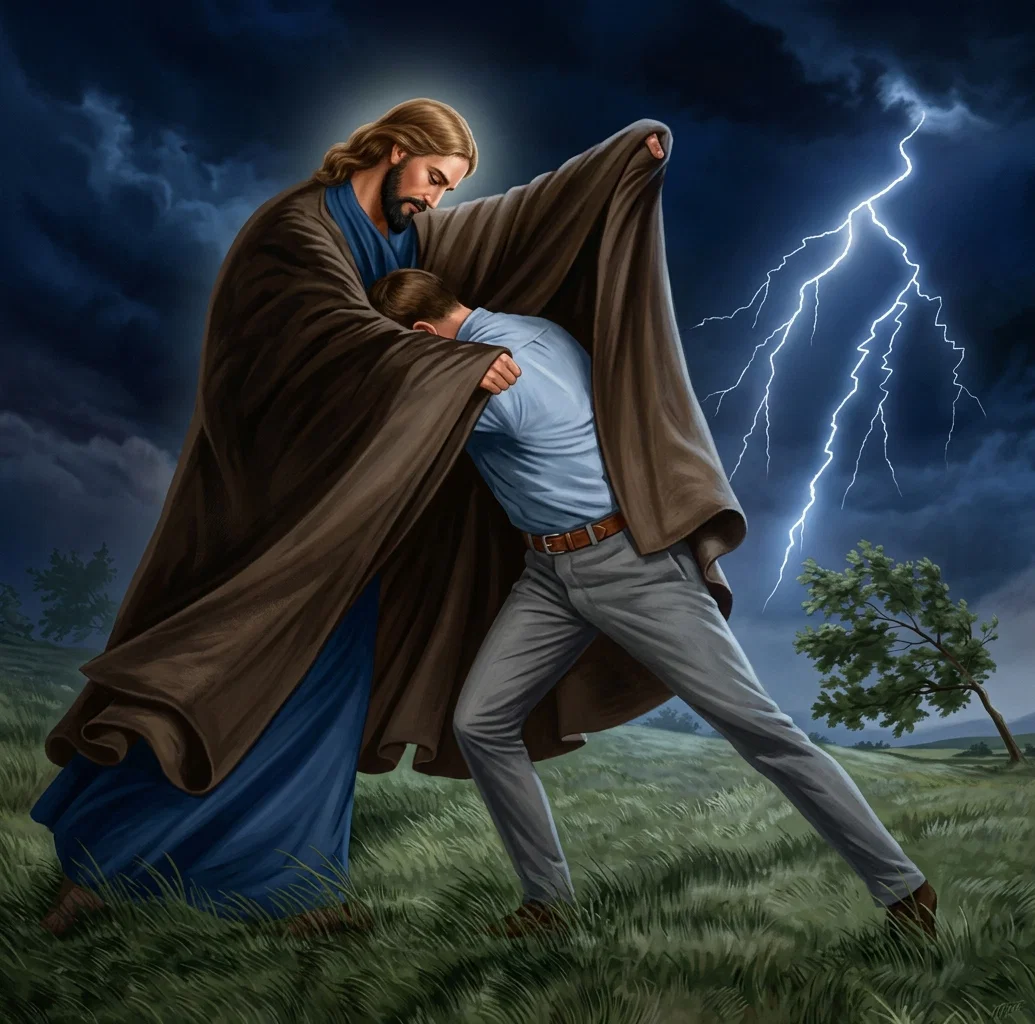
We do not overcome sin by dwelling upon it. Keeping it continually before us, we grow to endure it, to tolerate it, and finally to embrace it. It is a law of our being that we "liker grow" to that upon which we constantly gaze.
We do not forget things by trying to forget. The surest way to remember is to try to forget that particular thing. We do not break up the old ridges in land by plowing in the same way year after year; we cross plow and cross cultivate.
It would be folly to dig away at the weeds to destroy them before we planted our garden or sowed our fields. At the best it would leave but a barren tract.
The secret of overcoming sin is to put righteousness in its place. The counsel of Daniel to Nebuchadnezzar is good for every soul: "Break off thy sins by righteousness, and thine iniquities by showing mercy to the poor." Dan. 4:27. In the place where self sat enthroned, place Christ. Let Him reign. Proclaim Him King throughout the whole man, the spiritual, mental, moral, physical man. Consecrate every member to His service. Think of Him.
Does an old enslaving habit clamor for the mastery? Do not let the mind dwell upon it; think of the very opposite which He would have put in its place. Are you impatient? Speak patiently. Think of Him and His patient bearing of reproach. Are you covetous? Then give to the needy, and keep giving till the expanding joy of self-sacrifice shall exceed the miserly joy of hoarding. Has some one wronged you? Pray for him; do him a kindness.
Do not seek alone to have the demon of avarice or lust or passion or greed exorcised, turned out of his dwelling, leaving it empty, swept and garnished; but fill its every room with the sweet influences of Christ, that there may be no room for the demon and his companions when he returns.
In your own soul "overcome evil with good." By beholding Him, the One "altogether lovely," grow into His likeness.
Sunday Baseball and Religious Liberty
Sunday baseball has been ended on Staten Island, New York, by heavy fines. The ball players have been forced to yield, as the fines made it really prohibitive. But that does not indicate that Sunday is any better kept. Law may compel outward acquiescence, but law can not compel men to serve God. This is something which the fathers of this republic learned; it is something which the sons need to learn anew.
A Lowered Church Standard
By C. L. TAYLOR
How the World Looks upon It
UNDER the heading, "The Church Penalized," the Kansas City (Missouri) "Post," in its issue of Sunday, May 29, 1910, took occasion, editorially, to say a few plain things concerning "the church of to-day." I quote:
Almost every church of Christendom began as did the apostolic church—down among the mud-sills of society, the common people, so commonly despised. But without being able to detail the processes of each, the law of ecclesiastical evolution seems to have seized upon the spirit of the followers of the lowly Nazarene, and a few generations have been sufficient to develop a church pride and aristocracy which have caused the church to "forget the pit from which she was dug," and "the rock from whence she was hewn."
Two or three illustrations prove the rule. The Methodists were a plain, homely folk, laying special stress upon plainness of dress, of meeting-houses, simplicity of worship, and a spirit on fire from a new pente-cost. Fifty years have seen this denomination grow into flattering numbers, highly educated clergy, fashionable congregations, colossal church buildings, cathedral-like in architecture, great pipe-organs, and cultivated choirs singing in an unknown tongue.
The masses and the backwoods have all been left in the apparent race for an ideal of greatness. Seeing the needs of the hour, the Disciples' church came to the rescue, and making better time, because living in a faster age than their Methodist brethren, have, within the recollection of the young man writing this article, grown from the four square wooden walls of the unpainted meeting-house, and as bald a service as it was possible to have, and a ministry which belonged to the common people, and which decried education, and with a prejudice against musical instruments often codified into a law of the congregation—these followers of Him who had nowhere to lay His holy head, have become spurring rivals of their pioneer Methodist brethren, and now worship God in imposing edifices, sometimes looking more like a heathen temple than a house of the manger Babe, and with poetical, philosophical, and logical orators in the pulpit, and the costliest organs in the loft, and also with choirs which seem to have been selected more because of their skilful use of Greek in singing than because of their superior soul power in song. They, too, have broken with their humble origin.
While some portions of this picture may be a little too highly colored, the fact remains that for years the church of Christ has notoriously violated her own principles of professed humility and simplicity in the very ways pointed out in the "Post" editorial. She has adopted and adapted the spirit of the age in her extravagance and love of display, this being especially true in our great cities. And it is a just reflection on the part of many, that as the cost of church buildings and equipment has gone up, the real value of the church service has gone down. The better the pew the poorer the religion.
In these days of doubt and backsliding, of test and trial, of storm and tempest, of infidelity and lawlessness, it is good to remember the Man Christ Jesus, who "shall be as an hiding-place from the wind, and a covert from the tempest." Isa. 32:2.
A Non-Theological Creed
But sad as may be the fact that in outward display the church of to-day is so sadly lowering the standard of Christian profession, sadder still is the fact that she is finding it convenient to abrogate the very fundamentals of Christian doctrine. A clipping from the New York "Evening Telegram" of April 21, 1910, will serve to illustrate the trend of the times:
New Haven, Connecticut, Thursday.—A new confession of faith, which drops the Apostles' Creed and requires no formal expression as to the divinity of Christ, has been adopted by the deacons and will be presented for adoption by the Center Congregational Church of this city.
The significance of this action is that the church has strictly held to Puritan orthodoxy for more than two and a half centuries, having been founded in 1638. New members will only have to pledge themselves to believe in a higher life and to moral purposes. The old confession of faith will be spread upon the records of the church as a historical relic.
As explained by the church officers, the purpose of the change is to make the confession of faith absolutely non-theological and to gather into membership those who have hitherto been debarred by slight theological scruples.
It may be, indeed, that to many religionists "the divinity of Christ" is a matter of "slight theological" importance, and therefore may be advantageously omitted from church belief. To all true followers of the Lord Jesus, however, this doctrine of our Lord's divinity constitutes the very foundation of all Christian living. As well may we believe in a Bible without inspiration, as a Jesus without divinity. Only because He was "God manifest in the flesh," "God with us," was Jesus Christ worthy of our affection and worship. Only divinity can save from sin, and only faith in divinity can bring salvation into men's lives.
Who can not see that in this yielding up of fundamentals the church is veritably allowing her colors to trail in the dust? It is a deliberate surrender to those forces which would make the church only a social club, her faith a mere form of words, her work a purely esthetic quantity. Think of it! People want to join the church, but demand before doing so, that she eliminate those doctrines which are essential to her existence, but which are distasteful to their ideas!
Sensationalism
Along with this surrender of principle in matter of faith, there come practises quite foreign to the spirit of the pure Gospel of the Scriptures. The San Francisco "News Letter" of February 13, 1909, had this to say about present-day popular methods of carrying forward church work:
A clergyman, either in the doctrines he preaches or the manner in which he presents them, must be in sore straits when he resorts to theatrical devices for luring people to his church. The tendency to sensationalism in the pulpit and to extraordinary musical programs, is quite prominent nowadays, and some pastors are even advertising, just as theaters do.
Yes, advertising, and sensational advertising at that, has taken the place in many ministers' work of the drawing power of the Spirit of God, as it was manifested in the work of an Elijah, a Paul, a Luther, or a Wesley. And not only have certain Protestant ministers adopted advertising schemes for themselves, but they have gone into print and boldly advocated their methods as models for their brethren to follow.11But would the ministry dare endorse theatrical plans if their congregations stood in open opposition? Is it not a case of "like people, like priest"? Do not the people "love to have it so"? Have not "extraordinary musical programs" and other mere entertainments been introduced because the majority of attendants upon church services really demand it? The fact is, church-members, unreproved and unreprovable, are so largely in attendance upon and educated by the common theater through the six days of the week, that their tastes call for theatrical food the other one day.
Theatricals Planned for
That the church trend is toward the theatrical, toward loose plans which will draw the multitude, may be seen from the following clipping:
Philadelphia, June 2.—Fairhill Baptist Church, one of the largest in the city, is to be so enlarged and reconstructed as to provide for a roof garden, upon which in warm weather vaudeville is to be presented in conjunction with Gospel services. When the weather is cold or it is raining a spacious auditorium, which the proposed roof garden will surmount, will be used instead.
In justification of the scheme, the pastor, the Rev. Mr. McClellan, is reported to have said:
"It is time that Christians who would win unsaved men and women from the playhouse, card-table, and saloon to the church should provide practical means of making the latter attractive. A radical departure in church work is needed, if we are to appeal successfully to non-churchgoers."
But this is CHURCHianity instead of CHRISTianity. Men and women may indeed be drawn to the church by stage performances and kindred methods, but they are not drawn to Christ. They will find in the end and to their utter dismay that the church had lost her power, and had provided them only a deceptive substitute. It has long been known that plain, open, worldly vaudeville is demoralizing, worthy of all Christians' severe condemnation; but what shall be said of it when it assumes a Christian name, masquerades in the sacred precincts of Jehovah's church, and claims to be able to save people from their sins! No wonder that the theatrical world of nowadays seeks closer union with the church, and claims a place in the work of man's moral uplift.
Boxing Matches
Note the following from the New York "Evening Telegram":
BOXING IN CHURCH
Atlanta, Ga., Friday.—Deacons of a church here have hit on a plan to induce delinquent members to attend services. A boxing contest was advertised to take place in the church last night, and long before the time for the bout to begin every pew was filled.
Shortly afterward two of the deacons appeared gloved for the ring. The fighters faced each other and the fight was on, but after sparring a few minutes, both failing to land a blow, the bout was declared off and the usual services held.
These things are painful. Gladly would all true followers of the Lord Jesus forget them and if possible bury them deep in oblivion. But that can not be. God says, "Cry aloud." Only because earth's millions stand in danger of complete and eternal loss are the sins of God's professed people to be plainly revealed. It may be, yea, it will be, that some will hear the warning and flee from the paths that lead to death.
Honest hearts, one here, another there, in this land and in that, are breathing earnest prayers to God that He will turn back the tidal wave of worldliness which seems about to engulf the church, and give back to them the days of Spirit power and pentecostal preaching. Their petitions will be answered, but not as they expect. The Scriptures declare that the last days will be filled with mighty perils, summed up, as it were, in a church "having a form of godliness, but denying the power thereof." 2 Tim. 3:5. The church as a great whole will not repent and reform. She will go on in her blindness and folly, lowering the standard more and more, until, as a part of great Babylon, she will finally become the rendezvous of evil men and wicked spirits. Rev. 18:2. But "out of her" God will call His people. Verse 4. Upon the platform of "the commandments of God, and the faith of Jesus" (Rev. 14:12) they will take their stand, and triumph when the Master appears.
C. L. TAYLOR.
The Conditions That Make for War
It is worth while to hear from a sensible scientist regarding the conditions which make for war. Prof. Garrett P. Serviss says there "are a few prophecies whose truth ought to be self-evident to all thoughtful observers of modern progress in mechanical science. War will not be abolished within any, at present, measurable time. We often hear the fallacy advanced that modern inventions will make war impossible by making it too destructive. History demonstrates the contrary. The invention of gunpowder multiplied enormously the destructive power of armies, but it had not the slightest effect in abolishing war. It simply brought about an evolution of the military art. As man grows in power he grows in aggressiveness. As the population of the earth increases, the friction increases proportionately." All of which is true. In addition to this, the Bible reveals that there is an evil spirit, with all his demons, who is stirring men constantly to war and strife. The only thing in this world which could prevent the universal war that is coming, is the power of Christ on the human heart, which can only come by faith. No schemes or plans devised by men can ever prevent the awful war which is bound to come.
The Wichita "Eagle," Wichita, Kansas, says: "Wichita is just now, during weather when everybody should try to keep cool, getting into an argument that is going needlessly to develop a whole lot of heat. This is over a proper way to observe the Sabbath day." The Eagle tells how the ministers have entered into the discussion that followed a controversy in the State offices at Topeka over the question of closing such money-making schemes as nickel theaters, vaudeville shows, etc. Some, it would seem, are in favor of closing on Sunday everything in the amusement lines, even to the city parks. Others regard this as going back too far in the direction of the "blue laws." And the discussion goes on. Discussions of this character are persistently arising from time to time in all parts of the world. The Sabbath question is one of the most thoroly alive topics of this time. God has a true Sabbath, as He very clearly shows in His Word. In every such discussion that comes up, some are sure to have their attention called to that Word which shows plainly that not Sunday, but Saturday, is the true Bible Sabbath.
President Wilbur P. Thirkield, of the Howard University of Washington, addressing the immense Sunday-school convention in the Greek Theater at Berkeley, pleaded for religious education in the schools. He said: "We have put the Bible out of the schools, and we are training children to be smart rather than good. I plead for a moral book in the schools, a book on which all religions can agree. . . . Science without goodness is a gospel of dirt. If man misses the Book he misses the development of his larger life." Those last two sentences are true; but when there is placed in the schools a moral book on which all will agree, we have a morality without foundation, without coherence, without solidity, without strength. State schools can not properly teach morals or religion. How could we expect, if we should have moral text-books, that the State schools would give us better Christianity than the schools of the world are giving us now?
Prof. Garrett P. Serviss summarizes an address by Prof. J. J. Welsh before the British naval architects, and in so doing gives us some startling particulars of what future battles may be, with an air-ship as a factor. At a height of one mile an air-ship would be reasonably out of range of high-angle fire. A bomb containing 100 pounds of explosives direct from that height would strike a ship in about twenty seconds, at a velocity of 500 feet per second. During its descent a 16-knot battle-ship would move about 540 feet. That would be allowed for, even as a marksman allows for the flight of a bird. A battle-ship of course could turn, but battle-ships do not turn quickly; and if a number of missiles were dropped from a single air-ship, or a half dozen air-ships should take part, the case of the battle-ship would be utterly hopeless. So, in the mind of the naval expert, the steel-clad leviathans of the deep, beset by swarming enemies in the air, would become the marks for plunging missiles, and their only protection would be to have rival fleets of air-ships, even as they now have torpedo-boat destroyers.
There are good dogs, and good cats, and good horses; but it verges on idolatry when honors are paid to them, after their death, surpassing what is often paid to human beings. For instance, the New York American of a short time ago tells of a St. Bernard dog that was poisoned in the northern part of the city of New York, or in the Bronx district. Services were held at the house consisting of singing and a eulogy of dogs, and this dog in particular, by a minister, the body of the dog was escorted to the grave, and four youthful pallbearers followed the body. At the grave he was buried with human honors by the singing of a song. There are thousands that die in a city like New York who are not cared for in life or death as well as that dog. Surely things are unequal.
A True Conception of Balance.—Attorney-General Wickersham stated the case fairly well the other day in a speech when he said: "You can not expect to secure competent men for the conduct of public affairs if they are to be commissioned as untrustworthy, subjected to constant heckling and misrepresentation, and turned out branded as unfaithful servants at a moment's notice for temporarily unpopular acts. The great question confronting you to-day is to find the true balance between the freedom which the individual citizen must enjoy in order that he may justly prosper, and the protection of the mass of the people from unjust discrimination in favor of the few." There are the very principles of religious liberty in that, and it strikes pretty hard against the recall of judges, especially.
An American artist has been honored by the King. Mr. John McClure Hamilton, of Philadelphia, has been commissioned by King George to paint a picture of the coronation scene in Westminster Abbey. He is the second graduate of the Academy of Fine Arts upon whom such an honor has been bestowed. The first was Edwin A. Abbey, who painted the coronation picture in 1901, when King Edward was crowned.
June 30 the Pacific Coast Company's Alaska excursion steamship Spokane was driven on the rocks in Seymour Narrows with 151 passengers aboard. The steamer was a total wreck, but all the passengers were saved but two, who sprang overboard and were drowned.
One reads with sorrow of the death of the venerable president of the American Bible Society, Theophilus Anthony Brouwer. He died in New York City June 15, 1911, in his 85th year. He has had very long connection with the society—manager, vice-president, president.
As a result of seven years' investigation of the great steel combines, it has been found that there is $500,000,000 worth of "water" in the stocks. $100 in stock has become $490 in capital, and the percentage of profit has been reckoned on the watered stock.
Letters to a Daughter
By Mother
By a Mother
Conscientiousness — Faithfulness
MY DEAR DAUGHTER,—
It hardly seems possible that already half of your precious preparation time is past. Your account of your experience is intensely interesting to us. Your father and I can scarcely realize that our little girl has grown to the capacity of such grave responsibilities.
As you look back over the last two years, and trace the making of your fitness for your present trust, I am sure you can not but admire the wisdom of the makers of your course. You see now, do you not, the importance of much that seemed menial and irrelevant in the earlier months of your training?
I am sure you have been faithful to your best. It speaks volumes to us of the character of your work, that you should be trusted with this case. I want to recall to your mind that mistake about which you wrote me, and which caused you so much sorrow and mortification at the time. I believe it was on a piece of work entrusted to you by this same surgeon by whom you are now engaged. I remember well what a cross it was for you to face this stern man with a confession of your error, and tell him promptly and truthfully the facts, not shirking the blame. My heart bled for you. You remember that you felt he would never trust you again. You see now that that very circumstance proved a stepping-stone to your advancement. Thus do we rise by our failures. The doctor knows he can trust you, because you were brave enough to acknowledge your mistake. Honesty ever brings its own reward. It is “the best policy.” Do not harbor a falsehood even in thought, nor for one moment entertain a violation of your own conscience. Conscience is your heavenly Father’s best gift. It is easily wounded. Every untruth or injustice we inflict upon it, is a stab that weakens its force. It may be stabbed to death—the voice within silenced forever—and we left as a ship without a rudder.
This training you are getting, of having to follow so explicitly to the letter the directions of your physician, is a great education. It makes you alert and exact.
Do not allow yourself to be tempted to make false entry upon your chart. Should you dare to do it, your sin would find you out, and “something will drop dead within you.” Let not your concern be for the good opinion of others, but for the approval of your own conscience and your God. Emerson says: “A man passes for what he is worth. What he is, engraves itself on his face, on his form, on his fortunes, in letters of light, which all men may read but himself. Concealment avails him nothing; boasting, nothing. There is confession in the glances of our eyes, in our smiles, in salutations, and in the grasp of hands. His sin bedaubs him, mars all his good impressions. Men know not why they do not trust him; but they do not trust him. His vice glasses his eye, demeans his cheek, pinches his nose, sets the mark of the beast on the back of the head, and writes, O fool! O fool! on the forehead of a king. If you would not be known to do anything, never do it.”
Remember there is really only one thing that counts, and that is character. Do not set your heart on the doing of some great thing, that may be beyond your reach, but do faithfully the thing at hand, be it ever so small. The large things will come by and by. Or if they never should come, your life-work would be nevertheless complete. What more can we wish for?
The widow’s mite is greater than the Pharisee’s thousands. Of the Bethany woman, the Master said, “She hath done what she could.” Her name has come down the ages as an inspiration to loyal response to present need; not to what we can not do, but to what we can do. It is all the loving Father asks of us, and man has no right to demand more.
“This faith that makes faithful enables us to rest in our humblest endeavor: The lawyer may not, can not, purify his profession; but he can be a pure member in it. The merchant can not stop the iniquitous practises of trade; but he can be an honest merchant, or else go out of business. The mother may not be able to keep down the shallow standards that bewitch her daughters; but she can pitch the key of her own life so high that the dignity of her soul will rebuke these standards and disarm them of their power. The father may not be able to keep his sons from temptations; but he can himself desist from the filthy habit, the loose language, the indifferent life, that his admiring child is more likely to copy from him than from any one else. Our lives can not escape disappointments and weaknesses; but if we could only have faith in the efficacy of doing all we can, there would flow into our lives a sweetness, a wholesomeness, a strength and a peace that would ultimately overflow into the world and into eternity.”
“What shall I do to be forever known?”
“Thy duty ever.”
“This did full many who yet slept unknown.”
“O, never, never!
Thinkest thou perchance that they remain unknown
By angels’ trumps in heaven their praise is blown—
Divine their lot.”
How We Take Trials
By Sunday School Times
THE common frets of every-day life may hurt our lives. No other mood is more common than worry. We can think of many reasons why we should not be anxious, but one of the gravest of all is that it injures our usefulness to others. For it harms us deeply and irremediably. It writes fear and fret on our faces. It blots out the freshness and beauty of our spirits. It makes us wrinkled and old before our time. It takes the zest out of our life. It makes all the world less bright for us. It dims our eyes so that we can not see the blue skies and the stars, nor show them to others. It destroys our vigor and enthusiasm. We do not know how seriously and ruinously we are hurting our own life and others’ if we are letting care into our heart.
So that is the problem of Christian life,—to go through life, however hard it may be, and take no marring, no soiling, no injury whatever. One said of another, “Did you notice how hard her face is?” It was the face of a young girl in years, but it looked old and stern, as if it had lost all its gentleness. It was pathetic to look upon. It told of a life that had lost almost everything that is worth while in living. Yet the experiences in which that life had been hurt and its beauty spoiled, if they had been met in a true Christian way, would have made the face beautiful and the life rich and radiant.—Sunday School Times.
Blessed Secret
BLESSED secret, to learn how to do without things! We need to learn this secret of full life in Christ in spite of minor deprivations, because we can not have all the things that we want—even rich men have been known to want more things—and some of us have to do without things which on the plane of physical life are quite desirable.
If we can gain wealth, it is well to have it, if we receive it as coming from God and use it for His glory; but if we do not possess this wealth, which is the lowest wealth in the gifts of God, we are exhorted to “covet earnestly the best gifts”—that wealth of heart and soul which lies open for the taking to every follower of Christ. Here is wealth worthy of ambition; wealth which is offered freely and without stint; the “unsearchable riches” of Christ, which will make us wealthy to all eternity. Christ never asks us to do without this wealth, the “true riches;” but He says, “Ask, and it shall be given you; seek, and ye shall find; knock, and it shall be opened unto you.”—Advance.
Quiet Workers
By Anonymous
CHRIST'S lowly, quiet workers unconsciously bless the world. They come out every morning from the presence of God and go to their business or their household work. And all day long they toil, they drop gentle words from their lips, and scatter little seeds of kindness about them; and to-morrow flowers of God spring up in the dusty streets of earth and along the hard path of toil on which their feet tread. More than once, in the Scriptures, the lives of God's people in the world are compared in their influence to the dew. It falls silently and imperceptibly. It makes no noise, no one hears it dropping; but it covers the leaves with clusters of pearls.—Anon.
Time for Kindly Deeds
“No LIFE is so short that it has no time for good and kindly deeds.”
Land for Sale
On very easy terms, in beautiful Sonoma Valley, in one, two, three, and six-acre tracts. This property adjoins land that has been donated for church and church school buildings, soon to be erected. For further information, address G. Ritz, Sonoma, California.
An Ideal Home
On corner, 100 x 150. New modern house of six large rooms; excellent water system, sewer, and electricity; model arrangements throughout; variety of bearing fruit-trees; excellent garden; barn. Five minutes walk from S. P. station; frequent trains. Convenient to both school and church. Built for a home and not to sell. Price reasonable.
Address Box 261
Mountain View, California
Bibles.—Remember that we are headquarters for anything in the Bible line. We shall be pleased to send you our catalog of Bible selections on application. Pacific Press, Mountain View, Cal.
Should Tired People Go to Church?
By Christian Instructor
MANY of those who stay at home all day on Sabbath because they are tired, make a great mistake; they are much more weary on Sabbath night than they would have been had they gone to church at least once; as the time must often drag heavily on Sabbath for the lack of something to do and to think about, and the consciousness of having spent the day unprofitably must sometimes add mental disturbance and dissatisfaction to the languor that follows idleness.
Moreover, these tired people would often find refreshment for their minds and their hearts in the quiet services of the church. They would secure by means of them a change of mental atmosphere, and the suggestion of thoughts and motives and sentiments which are out of the range of their work. For a hard working mechanic, or salesman, or housekeeper, or teacher, this diversion of the thoughts to other than the customary themes might be the most restful way of spending a portion of the day of rest.
We happen to know several cases in which this prescription has been used with excellent results. Those who wanted to stay at home because they were too tired on Sabbath to go to church, have been induced to try the experiment of seeking rest for their bodies, in the sanctuary, for a small part of every Sabbath; and they testify that they have found what they sought; that the observance has proved a refreshment rather than a weariness; and that their Sabbaths never gave them so much good rest when they stayed at home, as they have given them since they formed the habit of church-going.—Christian Instructor.
A Name in the Sand
By Hannah F. Gould
Alone I walked the ocean strand.
A pearly shell was in my hand;
I stooped and wrote upon the sand
My name—the year—the day.
As onward from the spot I passed,
One lingering look behind I cast;
A wave came rolling high and fast,
And washed my little lines away.
And so, methought, 'twill shortly be
With every mark on earth from me;
A wave of dark oblivion's sea
Will sweep across the place
Where I have trod the sandy shore
Of time, and been, to be no more,
Of me—my day—the name I bore,
To leave no track nor trace.
And yet, with Him who counts the sands,
And holds the waters in His hands,
I know a lasting record stands
Inscribed against my name,
Of all this mortal part has wrought,
Of all this thinking soul has thought,
And from these fleeting moments caught
For glory or for shame.
—Hannah F. Gould.
For Sale
A number of conditional pledges to the $300,000 Fund were made at the Tulare camp-meeting on the sale of properties. Included in these are ten and twenty-acre ranches in California, a 160-acre ranch in North Dakota, a lot in Hinsdale, Illinois, also one in Los Angeles. Full description of these can be obtained by addressing Elder J. H. Behrens, Box 1304, Fresno, California.
"All That Is Claimed"
By Editor
" 'Questions and Answers' came to hand a few days ago. Have not yet taken the time to go through this book very carefully, but from all appearances it is all that is claimed for it. I am sure this will be much appreciated by those who are fortunate enough to secure a copy. We assure you that we are glad to keep both the 'Signs' weekly and the magazine before our readers by often calling their attention to the papers and the helpful articles which they contain, and we trust that we have been able to add at least a few names to your list in this manner."
"We have received the copy of the premium book 'Questions and Answers,' and have taken the time to glance over its pages. Will say that we like it. We believe it will be appreciated by those who receive it. It certainly can not help being a great benefit to those who will read it. We will take pleasure in calling the attention of our people to the opportunity afforded in securing this good little work in connection with the weekly 'Signs.'"
" 'Questions and Answers' received; and while I have had very little time as yet to look over it, yet I have examined it enough to know that I shall greatly appreciate it, and I shall prize it highly. We are trying over here to do what we can for the paper, and trust we will be able to do even more than ever."
"The book 'Questions and Answers' has been received. It is very much appreciated. . . . It has been found convenient already to answer a question that was asked of us on some scripture. We have a good many such calls, so we expect the book will be a great help to us."
"The book 'Questions and Answers.' I am much pleased with it. These are questions asked by so many. And the answers are well put. . . . We shall do what we can in our field."
"These are questions asked by so many, and the answers are well put"
See ad above
"Questions and Answers"
By Editor
Would you appreciate a brief, practical, intelligent exposition of the "puzzling" or "hard" texts of the Bible? You should have a copy of "Questions and Answers," the new book given as a premium with this paper.
Over 250 pages
Topical and textual Indexes
Almost 300 questions and answers
Substantially bound in cloth
Contains the most important matter that has appeared in the Question Corner Department of the "Signs" for a number of years, very carefully selected and conveniently arranged
Not for sale
Given as a premium
For $2.00 we will send the paper 1 year and one copy of the book
For $3.50 we will send the paper 2 years and one copy of the book
For $3.50 we will send the paper 1 year to two addresses and one copy of the book
Papers and books may be sent to separate addresses
Example—
The paper 1 year . . . . $1.75
Value of the book . . . 1.25
Total . . . . $3.00
Special, paper and book, $2.00
Order through our nearest depository
or address
THIS PAPER
Anger in Controversy
THE moment we feel angry in controversy, we have already ceased striving for truth, and begun striving for ourselves.—Carlyle.