Your ShelfYour Projects

Signs of the Times, Vol. 24, No. 39.

THE MIRACLES OF OUR LORD
Earlier text: UNDER THE LAW OR UNDER GRACE

THE NEW POLICY OF THE UNITED STATES.

Whether the results of the recent war between Spain and the United States will be more fatal to our enemy across the sea than to America, is as yet an open question. While the navy of the United States has been destroying fleets, the victory has been filling the minds of the statesmen with the imperialistic idea of government; and a desire to form an empire around the globe on which the orb of day would never cease to shine, is expressed. Certain it is that territory has been annexed, and a “colonial policy” entered upon. The “Monroe doctrine,” which has been the watchword of Americans, has practically been abandoned. That the United States will retain a foothold in the Philippine Islands seems to be a foregone conclusion. Once this is done, it will be impossible to avoid becoming mixed up in the imbroglio of the European nations.
The entangling relations, and unsettling of the foundations of the governments, are viewed with alarm by many leading men of the country. Alien territorial aggrandizement, and our suddenly joining the burdened military powers of the world, loading ourselves with vast debts and greatly increased annual expenditures, it is feared will be the road which leads from trouble to war.
In a dinner recently given in aid of Sanderson Academy, Charles Elliot Norton, professor of fine arts in Harvard University, in a speech touching the late war, said:—
“And yet our hearts have been heavy with new weight of care, and the very brightness of the sunshine has but deepened by contrast the cloud of our sorrowful thoughts—sorrowful that our nation should have turned its back upon its old ideals, and, standing at the parting ways, should have chosen the ancient path, familiar to the Old World, worn by the bloody feet of hapless generations, and which has never led to anything but ill—the path of aggressive war, of foreign conquest, of alien territorial aggrandizement—the path that leads from trouble to trouble. The black and brutal visage of war has indeed been lighted up from time to time during the summer by the gallant deeds of our men in the service, and by the good conduct and marvelous good-fortune of our navy, and by the general temper of humanity displayed so soon as the actual fight was over by both officers and men. But it has taken on a deeper shade of gloom from the needless sufferings which our brave soldiers have had to endure from the lack of due provision for their needs, alike in camp, on field, and in hospital. It has been a miserable spectacle of incompetency, for which account must be rendered and penalty exacted.
“Peace has nominally come. The actual conflict has ended, but less than 100 days of war have resulted in a revolution in the United States. The foundations on which the republic has rested have been unsettled; the principles upon which the government depends have been violated; we have undertaken obligations which neither our institutions nor our national character enable us properly to discharge; we, the one great non-military power in the world, have suddenly joined the ranks of the nations burdened with great armies and navies; we have loaded ourselves with an enormous additional debt, and with an enormous increase of annual expenditures, a permanent oppressive tax upon the industry of the people; and, further, whatever disposition may be made of the Philippines, we are already, through holding them and claiming the right to dispose of them, brought into entangling relations with the nations of the Old World, and run the risk of losing the inestimable boon which has hitherto been ours.”
And having entered that “ancient path” “worn by the bloody feet of hapless generations,” will we fare better than they? Before us lies the example of the republic of Rome. When she entered that path “worn by the bloody feet of hapless generations,” the historian was compelled to narrate her “decline and fall.” Let us beware. G. B. THOMPSON.
Newburg, W. Va.

THE SHAME OF IT.

RELATING to settlement of present war questions in the Philippines and West Indies the papers say: “Neither the queen regent nor the monarchical parties nor the ministers could afford to quarrel with the Vatican, the Spanish prelates, clergy, religious orders, and the Jesuits, by daring to expel the Jesuits and friars from the archipelagoes, as the natives demand. If the re-establishment of Spanish rule in the archipelagoes is not under American control, there will be stern and merciless military reaction there.”
Indeed! And what does this mean? The pictures, the words, and the works of the “insurgent” (patriot) leaders indicate they are men of conscience and wisdom, as well as nerve. If so, they can be trusted more than they seem likely to be by our Rome-steered “great republic,” They no doubt know Rome as the central soul of the tyranny they are bleeding and dying to deliver their country from. And shall our brave boys be used to help beat back the patriots at the vital point of this whole business? Shall they bleed and die, suffer the pangs of heat, thirst, and hunger, of weary marches, and the torture of fevers, and we pay a million dollars a day to stay the just punishment of the chief enemy of America, as well as Cuba and the Philippines? Our noble President and chiefs in the field in the army and navy may need to watch France. One of the greatest men of this country said: “France, infidel at home, gives her whole power to the Jesuits abroad, in China, Armenia, Madagascar, and elsewhere.” Let them see that she and her confederates in our departments at Washington have little say in these matters. They are the hand in the dark also in present missionary troubles in China.
INDIGNANT AMERICAN CITIZEN.

Notes

NOTES.—The above strictures should include Russia. There seems reason to believe the claim made in the late Armenian trouble, that there has been a secret treaty between the Latin and Greek Churches to work together. The Zassiche Zeitung (Berlin), August 16, says: “France is openly espousing the Spanish cause, and the Russian press is displeased with the American victory.”
To cap the climax, Judge McKenna is named as one of the commissioners to Paris to settle this business; a man who, in addition to being a Romanist, has just rendered a Supreme Court opinion that Southern State laws which rob our Afro-American brethren of the ballot, and of trial by jury, are constitutional—a decision worse, if possible, than that of the ante-bellum Romish Judge Taney, that Northern men must hunt Southern slaves.—Christian Instructor, Aug. 25, 1898.

“ANOTHER ARMY.”

In a recent issue of the Pacific Ensign, Jessie H. Parkinson discourses on “Two Armies.” After referring to the pride with which many people will point to the fact that father, brother, or son was in the battle of Manila, or Santiago, she portrays another army in the following manner:—
“There is another army of America that is not so much talked of in these exciting times. See them as they march on, on, on, unheeded by the vast throngs—marching whither? and for what? Not one of this vast army will ever return. Not one?—No, not one! See them as they march along—men and women, yes, even boys and girls.
“No mother will ever say with tender pride, ‘My son was in that army;’ no child will ever rejoice to tell his comrades, ‘Papa belonged to that army and fell in the great battle.’ No sorrowing widow will receive a pension for the loss of her husband. No flowers of honor will bedeck the graves of the fallen.
“What are the fruits of victory won by such an army as this? What are the fruits?—Poverty, crime, insanity, enfeebled bodies, weakened intellects, blasted hopes, desolate homes, children suffering for the sins of parents, wrecked and ruined lives, lost souls.
“Where is this army going?—Look down, down, down the long line and behold its destination—one hundred thousand graves dug for the army of last year in this free America, another hundred thousand or more for the new army that follows it this year, and the next, and the next, for every year a new and a larger army is being mustered in to take the place of the one last destroyed. Your son may be one of the recruits, father; your daughter may be called for next, mother. The recruiting sergeant spares neither high nor low; mother’s tears and father’s entreaties are alike unheeded by him.
“But can we not intervene as we have done in Cuba? Has our government nothing to say about this needless slaughter?—Aye, our government has something to say, and this is what it says to the devil’s recruiting sergeant, the rum fiend: ‘We must have revenue to carry on the affairs of the nation, and for your gold we will give you a bond, under our hand and seal, agreeing to deliver up to you every year one hundred thousand boys and girls, to fill one hundred thousand drunkards’ graves.’ And the same unholy partnership is entered into between this agent of the devil and our State, our country, and our city. And the money goes to help build and maintain the insane asylums, paupers’ homes, and penitentiaries resulting from it.
“Do you point to the 260 victims of Spanish treachery? For every soul who went down on the Maine there are twenty-score lives destroyed in the United States every year, victims of this unholy greed and criminal indifference.”

A “Christian” Lottery.

As it is sanctioned by a “Christian” emperor of a “Christian” State, it would naturally be called a “Christian” lottery. Here is what we refer to, from the Independent:—
“The institution of a lottery to promote the prosperity of German colonies has been sanctioned, it is said, by Emperor William, and it is to be conducted, we believe, under the auspices of the German Colonial Society. It is expected to yield 5,000,000 marks. This seems to us an anomaly at the end of the nineteenth century; but we are guilty of some anomalies ourselves, as where we license saloons in order to promote the prosperity of municipalities. But the lottery is out of date with us; we have no place either in law or morals for it.”

From Jacob’s Well to Bethel

JOTTINGS FROM PALESTINE. No. 10.

From Jacob’s Well to Bethel.
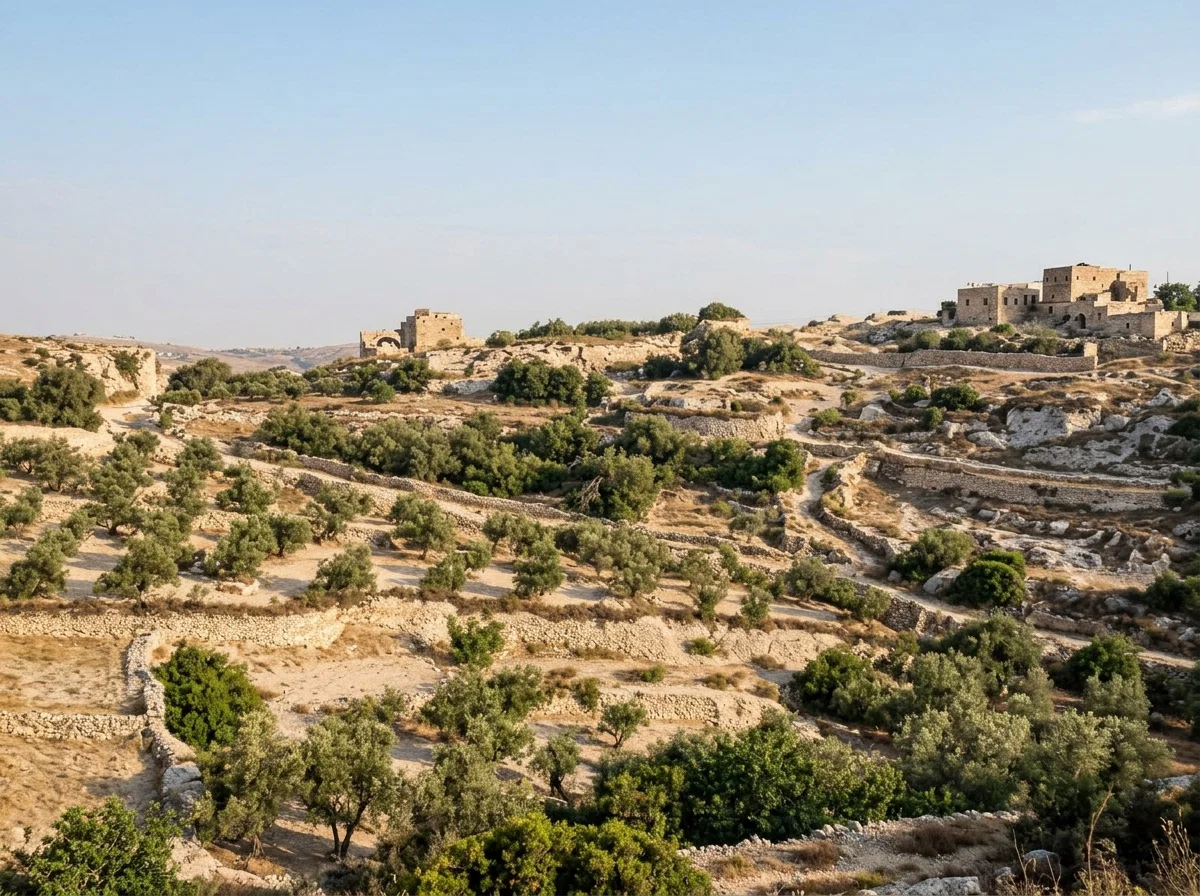
BETHEL AND SURROUNDINGS AS AT PRESENT.
Having rested a while at Jacob’s well, we continued our journey southward, along the eastern slope of Mount Gerizim. For some distance our way lay through a narrow, long valley, with here and there a village perched on the spurs of the craggy hills rising on both sides. Here we more frequently met camel trains than in the hills of Samaria.
It is interesting to see a caravan stop for dinner or for the night. The camels are made to kneel down, when their load is removed, and they are allowed to feed on the fat of the land, which sometimes consists of nothing but a few dry weed stalks or prickly cactus leaves. When the camel is reloaded, he begins to grumble; and when all has been put in place and the men begin to tighten the ropes to make sure of the load, he increases his grumble to a roar, which can be heard over a mile. In his vigorous protest against tight-lacing, the camel shows good sense.
About six miles south of Nablus, we turned in at a village for the night, and secured lodging for ourselves and horses in a general store. This village, like the one in which we lodged the night before, was composed of mud huts. The hut in which we stopped was not high enough to admit of a scaffold; the roof was composed of earth supported by a few trees with all their branches on, laid across the building from wall to wall. The interior, about eighteen feet square, provided places for the horses, a grain bin, the store supplies, kitchen, and dining-place, and sleeping-room. The fire to prepare the evening meal was made of bundles of brush and weeds. The opening intended for a chimney was not always mindful of its function, so that our room was dark with smoke.
This condition of things prevails in these villages. But this has no visible effect on the complexion of the Arab, which has the appearance of smoked bacon.
My companion here purchased grain for his horses. After filling the measure, instead of leveling it off with a straight edge, the seller heaped it full, shook it down, pressed it together, and poured on more, and repeated the same process till no more would stay on, but would run over. This style of measuring has remained unchanged for at least eighteen centuries, as evinced by the words of Christ: “Give, and it shall be given unto you; good measure, pressed down, and shaken together, and running over.”
Next morning we resumed our journey at 4 o’clock, for it was twelve hours’ journey from our village to Jerusalem, and we desired to arrive before sunset, so as to have a good view of the city all the way as we approached it from the north. It was a bright moonlight morning, and the air was crisp with frost like an October morning in Michigan. The morning stillness was often broken by the loud shouting of Arabs, who had either been traveling all night or had started earlier than we. After half an hour’s ride through the narrow, long valley, we began to ascend exceedingly rough, stony ridges, sometimes mounting five or six hundred feet; our horses had to carefully calculate every step. At first we were afraid to trust ourselves on their back, and walked over the worst places; but we soon learned that with four legs they were surer footed than we with two.
About six hours’ ride south of Nablus we passed near Shiloh, where the tabernacle was set up when Israel entered Canaan under Joshua, and where after the conquest the land was divided by lot. Shiloh is situated at quite an elevation, and is in conjunction with a fertile valley. During the time of the conquest of Canaan, it was a central point for Israel, and long afterwards was a significant place. It was at Shiloh that Eli, the high priest, officiated, and that the youthful Samuel served in the tabernacle. It was from here that the ark was taken to the battle and captured by the Philistines, and was never returned again to Shiloh. Here dwelt the prophet Ahijah, to whom the wife of Jeroboam came in disguise. But of Shiloh nothing is left but a wilderness of rocks and stones. Passing south from Shiloh, we traversed alternately small valleys, rocky ridges, and narrow ravines.
Occasionally we passed an olive grove, and patches of wheat. We say patches because very rarely a wheat field is seen. In many places the land is so stony that when the stones are collected, they occupy a large portion of the surface. Sometimes the patches of wheat between the stone walls were no larger than the average dwelling-room. When we passed through, the middle of January, the wheat had been sown and was nicely up.
In this land of lawlessness, the farmers have a hard time. When they free a place from stones, travelers leave the road and pass through the field, to avoid the numberless stones in the road; then the farmer makes a stone wall to keep the stragglers out; but the animals are so accustomed to climbing over stones that soon a breach is made in the wall by the animals climbing over it in order to have a little smooth road through the field. It seems strange that these ways which have been traversed for centuries should be so utterly neglected. With a little organized effort, how much inconvenience and time could be spared! But I suppose that till the end of time these orientals will go stumbling over the stones.
Between Shiloh and Jerusalem the country is more stony than any we had met on the journey from Galilee. But our horses were expert at picking the best route, so we left them to judge where to place their feet next, while we were occupied in scanning the country in all directions; for now we were nearing Jerusalem and the region of many places of interest. We had heard that the best view of Jerusalem from the distance is obtained from the north, so we constantly scanned the horizon to the south. When within four hours from the city, from a rocky height we gained our first view of Jerusalem. It was a splendid sight! Few inland cities can be so distinctly seen at such a distance. And just as distinctly could we see the Mount of Olives to the east of Jerusalem. At the same time, the Mediterranean and the mountains of Moab east of the Dead Sea were in view.
In a few minutes we arrived at Bethel, best remembered on account of Jacob’s dream in which he saw the ladder reaching to heaven, on which the angels were ascending and descending. Such a wilderness of stones! It was not difficult for Jacob to find one for a pillow; it would be more difficult to find a place to lay his head where there was no stone. On Jacob’s return from his long sojourn with Laban, he passed via Bethel, and here erected an altar, of which one is reminded by some altar-like stones hewn from the native rock. Bethel was doubtless doubly sacred to Jacob; for Abraham camped here when he first passed through Canaan.
After the revolt of the ten tribes at Shechem, Jeroboam set up one of his golden calves at Bethel, to keep Israel from going to Jerusalem to worship. Doubtless a suitable temple waserected for the idol. It was here that Jeroboam’s arm was paralyzed when he extended it towards the prophet. To me it was an interesting fact that Jerusalem is plainly seen from the vicinity of Bethel. As Israel came from the north to worship at Bethel, they had a full view of the magnificent temple of Solomon at Jerusalem before their eyes, and were thus constantly reminded of their apostasy. After visiting Bethel, one can better appreciate the fitness of several expressions in the hymn “Nearer, my God, to Thee.” As at Shiloh, one is forcibly reminded of the desolating effects of sin, and how literally the Word of the Lord is accomplished. H. P. H.

THE LORD HATH NEED OF THEE.

O, HATH the Lord no need of me In all His wondrous plan? Nothing for me to be or do? Not e'en the field to scan?
There's not a tree, nor flower, nor shrub, Nor life howe'er concealed, But has some part, some place to fill, Tho not to us revealed.
Be sure, my soul, thy God hath made All things to do and be. Take courage then. Fulfil thy part. The Lord hath need of thee.
MRS. JULIA LOOMIS.

“EVERY CHRISTIAN A MISSIONARY.”

TO BE a missionary is easy enough, says John G. Woolley, in The Voice, but to be a Christian! There is “the business end” of that topic. Jesus Christ was what God would have been if He had been a son, and a brother, and a friend, and a neighbor, and a carpenter, and a Jew, and a Roman subject, in the year of the world 4,000. A Christian ought to be what Jesus would be, in the relationships and occupations of a common man, in the year of our Lord 1898.
And that is “quite a chore;” you can’t do it while you “hold up” a man or a market. You can’t do it while you “run” a dirty party, or soil yourself with usury, or truckle to a lie, for temporary ends. You can’t do it by working at it nights and Sundays, and holding a convention once a year. But every Christian ought to be a Christian.
A missionary is one who is sent. The word is from the Latin mittere—to send. We are all sent into the great world; and into the smaller world which we call our country; and into the smaller world which we call our environment; and the still smaller world which we call our business; and into the still smaller world which we call our home. And every life is sent with reference to other lives.
To realize this fact and live for all, is to be a Christian and a missionary. To realize it and live for self, is to be an infidel and a traitor. To ignore it, is to be a sot. To deny it, is to be a fool. And whether fool or sot or traitor, infidel or saint, we are all born missionaries, the only question being whom we serve.
A missionary is a messenger, not a manager. As liberty is the medium of spiritual life, testimony is the instrument of spiritual power, and time is not of the essence of the undertaking.
Testimony exerts force very gently and very slowly, but coercion would be fatal to liberty—and equally to progress; for every life we move upon is in the circuit of other currents which we can not calculate and do not understand and history teaches, all too plainly, that even when we are surest and proudest of our own opinion, we do well to end our labors as we do our prayers: “Thy will, not mine, be done.”
So, then, after all, the topic, at its simplest, is: Every Christian ought to be a witness to the truth of Jesus Christ. We can not be precisely like Him. We can not be precisely like each other. It would not do for us to be alike. Dr. Bonar’s testimony might be worthless in a place where that of Joe Hess would be conclusive, and vice versa. Christian witnesses, who are “the light of the world,” differ “as one star differeth from another star in glory”—but not in truth. Tho, to be sure, truth is relative in the moral world; starlight and manlight get their color from what is consuming in their bodies; and as the grosser elements are burnt out, the ray whitens and the spectrum simplifies; and so a man’s influence—which is the shine of his character and a large part of his testimony—often changes from year to year, according as he burns, while his truth changes not at all. So much for the missionary.
The message must be true, as per the man. We often hear the statement that illustration is not argument; but in mission work the life of the missionary is the “demonstration of the Spirit.” A man is not fit to teach a truth of the Spirit which his own practise contradicts. A shrew can not teach gentleness; a bigot can not teach tolerance; a tippler can not teach abstinence; a trimmer can not teach “the truth as it is in Jesus.”
The man must be true; the message must be manifest in the man; and lastly, and most difficult, and, from the reformer’s point of view, most important to be urged in these days, is, “The field is the world.”
We have risked the life of the church and made light of the nation’s honor by permitting the silly, wicked, infamous assumption that the mission of Christ was restricted to certain people, certain days, or certain places,—that there was at least one wide sphere of life into which a Christian, as such, had no business to go; that while it was his duty and his privilege to be white, to be clean, to be holy, yet that he might do his politics with dirty hands, and dirty agents, and dirty purposes.
All this time saying to one another, “Go ye into all the world, and preach the Gospel.” That can not mean, Go to China, or Africa. It means, Go where the Spirit of God—visible duty—or the act of God—force of circumstances—leads or drives you. And wherever you are, preach the Gospel.

OUR WORK AND WORKERS.

A CAMP-MEETING is in session at Olathe, Colo., to close October 3.
On the 2d inst. four persons were baptized at Wheelersburg, Ohio.
THE brethren at Memphis, Mo., have erected a new house of worship.
THE Nebraska State camp-meeting is now in session, to close October 3.
A CAMP-MEETING to be held at Edmond, O. T., is announced for October 7 to 17.
AT the recent local camp-meeting at Cambridge, Neb., five persons were baptized.
AT the recent camp-meeting held at Pueblo, Colo., fifty-seven persons were baptized.
AT the recent camp-meeting at Wilmington, Del., twenty-six candidates were baptized.
A UNION camp-meeting of Southern Illinois and Indiana is in session, to hold till October 2.
A LOCAL camp-meeting will be held at Hanford, Kings County, Cal., October 25 to November 1.
BROTHER S. N. HASKELL has been elected president of New South Wales Conference, Australia.
On the 17th inst. two members, mothers of families, were added to the church in Alameda, Cal., by baptism.
THE Montana camp-meeting, at Helena, begins with the date of this paper, to continue till the 9th of October.
“EIGHT MORE have begun to keep the Sabbath,” is the report of Sister Celia Green, a Bible worker in Denver, Colo.
As a result of meetings held in Omaha, Neb., by Brother L. Warren, twenty have commenced the observance of the Sabbath of the Lord.
BROTHER J. W. BARTLETT, of Lopwai, Idaho, reports that four of the Nez Perces Indians are keeping the Sabbath of the Lord as a result of missionary labor.
BROTHER D. E. LINDSEY reports to the Vineyard that three members were added to the church at Clyde, Me., on the 27th ult. Others were awaiting baptism.
TEN persons deciding to walk in the way of God’s commandments is the visible result of meetings held at Whitehall, Mich., by Brethren J. M. Emerson and P. L. Hoen.
BROTHER H. L. HOOVER has been assigned to take charge of the work in New Mexico. This field is attached to Colorado Conference. Brother Hoover’s address is Albuquerque.
IN connection with the tent-meetings held at St. Paul, Neb., a Sabbath-school of twenty-seven members has been organized. Four adults have taken a firm stand on the truth as presented by the laborers.
THE New England Broom and Brush Company is an organization just formed at South Lancaster, Mass., mainly designed to furnish labor for students of the academy at that place. Brother F. L. Mead is president of the corporation.
ON the 10th inst. the Second Seventh-day Adventist Church of San Francisco was organized, at No. 1328 Valencia Street, with a membership of eighteen. Brother H. H. Dexter was chosen elder of the church. Several other names were added after the organization.
THE managers of the Kansas City (Mo.) Mission are calling for additional bedding in anticipation of increased demands as cold weather comes on. They expect to increase their accommodations to one hundred beds. Address, L. W. Felter, 557 Grand Avenue.
BROTHER J. J. HUGHES reports progress of the work at Kearney, Neb., up to the 7th inst., and says, “We have about thirty new Sabbath-keepers. We also have a house of worship bargained for.” To this is added the statement that the interest there was begun the last of April by securing a hundred three months’ subscriptions for the SIGNS OF THE TIMES.
BROTHER F. H. WESTPHAL sends an interesting report to the Review, from which we collate these items of progress: A number of French Waldenses in Uruguay have accepted the truth under the labors of Brother Vuilleumier. A company of sixteen is reported by Brother J. McCarthy in Buenos Ayres. About a hundred acres of wheat and linseed have been planted for the Lord’s cause. At Moreno four families have united with the church, and two persons united with the church at Malabrigo.
OUR workers in the field frequently say that such and such a number have “accepted the truth.” Persons not of our faith may not understand the significance of that expression. It means that they have accepted the Word of God as a whole—“the commandments of God, and the faith of Jesus.” Rev. 14:12. The psalmist says, “Thy righteousness is an everlasting righteousness, and Thy law is the truth.” Ps. 119:142. The Saviour’s prayer was, “Sanctify them through Thy truth; Thy Word is truth.” John 17:17. Then to accept the truth is to accept the Word of God, without any human changes in His law, or any supplementary traditions.

THE WARRIOR’S USE OF THE SWORD.

THE use of the sword to the warrior is not that he may defend it, and try by extraneous means to show his enemies how good a sword it is; it is given him as a means of defense and aggressive warfare. So with the Bible. The Watchman says: “One of the marked characteristics of the late Dr. A. J. Gordon as a preacher was the absolute confidence with which he appealed to the Scriptures. Many preachers spend their strength in seeking to show that what the Bible says is true. Dr. Gordon began by assuming that what the Bible says is true, and then went on to show what that truth meant for those to whom he was speaking. Strange to say that, tho this was his constant method, he was one of the most successful preachers to college students this country has produced. From Princeton, Yale, Amherst, Wellesley, and Brown the testimony is all one way. The ministers who think that their chief business is to defend the Scriptures may find a hint in this.”

PERIODICALS WANTED.

IDA D. ALFORD, Kissimmee, Fla., calls for our denominational periodicals for missionary work. Please send post-paid.
SISTER H. M. SIMERS expresses gratitude for past favors, and says: “I have great need of copies of Our Little Friend, and health periodicals; also more SIGNS, and other literature. . . . God has put right before my eyes the articles in old copies of the SIGNS that I most needed. Papers ten years old have been devoured with relish by some of my friends.”
Continue reading: LESSON III.—SABBATH, OCTOBER 15, 1898