Your ShelfYour Projects

Signs of the Times, December 19, 1916

Are There Signs of His Coming?

Signs of the Times

Dec 19, 1916

Pacific Press Publishing Association · Mountain View, California · Dec 19, 1916
Are There Signs of His Coming?

What Was Foreseen of the Scoffer, and Famines, War, and the Extravagant Rich
By THEODORE B. WESTBROOK
IN these days, when the subject of the second coming of Christ is considered, the people generally say: "Don't be an alarmist. Don't frighten the people, and get them all stirred up, feeling that the end of the world is just ahead of them." Not so with Christ, however. He entertained the question, and called attention to many signs pointing to His return.

The Scoffer as a Sign

One of the signs of Christ's return is the prevalence of scoffers in the world. The apostle Peter says: "Knowing this first, that there shall come in the last days scoffers, walking after their own lusts, and saying, Where is the promise of His coming? for since the fathers fell asleep, all things continue as they were from the beginning of the creation." 2 Peter 3: 3, 4. Not only are these scoffers scouting the idea that Christ's coming is imminent, but they are also denying the fact of the universal Flood in the days of Noah, and are determined to make men believe that they had monkeys for their ancestors, and that the Bible record of the creation of the world is only a fairy tale.
Because of the sophistries of such teachers, the world is being lulled to sleep, and soon an awful surprise will come upon the inhabitants of the earth. Suddenly, with power and great glory, Christ will come. Then there will be no time to prepare to meet Him. Just such men as present-day scoffers were living in the days of Christ. After beholding the many miracles He wrought, they still disbelieved, and asked for a special sign of His messiahship. He said to them: "When it is evening, ye say, It will be fair weather: for the sky is red. And in the morning, It will be foul weather to-day: for the sky is red and lowering. O ye hypocrites, ye can discern the face of the sky; but can ye not discern the signs of the times?" Matt. 16: 2, 3.
The hypocrites are not all dead yet; for men are still able to forecast the weather, but are unable to see that events are occurring in the world which are direct fulfillments of the prophecies of the second coming of Christ.

"Shall Run to and Fro"

Take, for instance, the prophecy of Daniel, where he was told to "shut up the words, and seal the book, even to the time of the end: many shall run to and fro, and knowledge shall be increased." Dan. 12: 4. When we reach the time of the end, according to this prophecy, there will be a great increase of knowledge, both Biblical and scientific. During the last one hundred years, nearly all the great inventions in the world have come into existence.
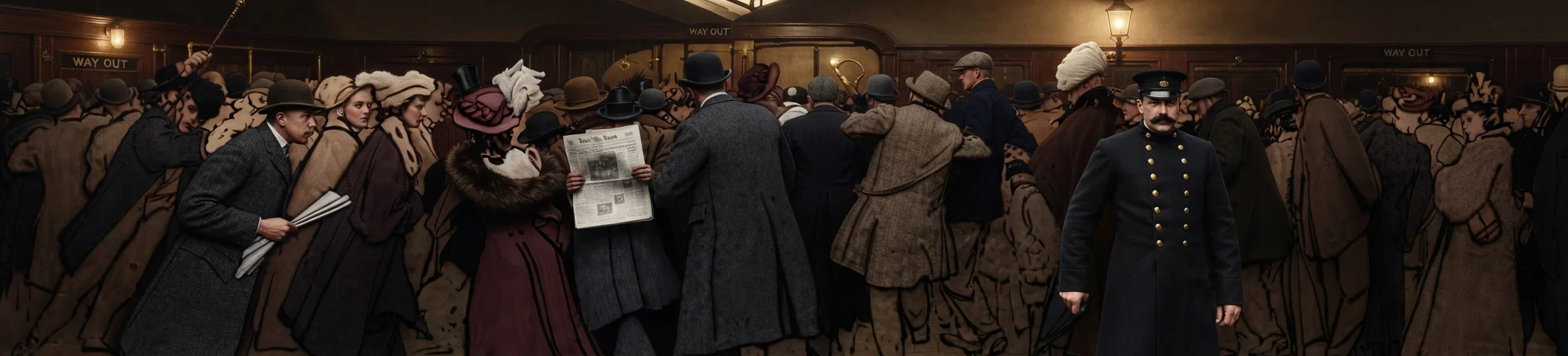
The prophets of old foresaw the automobiles and other modes of rapid transportation. The prophet Nahum said: "The chariots shall be with flaming torches in the day of His preparation. . . . The chariots shall rage in the streets, they shall jostle one against another in the broad ways: they shall seem like torches, they shall run like the lightnings." Nahum 2: 3, 4. This is a clear picture of the automobiles, street cars, and railroad trains that have been multiplied in the land, and that are used to carry missionaries, Bibles, and religious literature to every part of the world, announcing the coming of the great King.

Wars and Pestilences

Among the other signs, Christ mentioned the fact that "nation shall rise against nation, and kingdom against kingdom: and great earthquakes shall be in divers places, and famines, and pestilences; and fearful sights and great signs shall there be from heaven." The Saviour declared that these events would cause men's hearts to fail them "for fear, and for looking after those things which are coming on the earth." Luke 21: 10, 11, 26. Already the nations are engaged in the most terrible war the world has ever seen. Earthquakes are increasing in all parts of the world. Millions of men and women have starved to death because of famine in various places. Pestilences have carried off untold numbers; and notwithstanding the fact that medical scientists are doing all within their power to arrest disease, conditions are constantly growing worse. Pests of all descriptions are covering the earth, until the poor farmer has to fight with all his might to secure a crop. Recent reports from missionaries in South America state that grasshoppers and other plagues obscure the sunlight like a cloud, and in their devastation, leave not a morsel of the farmers' crops. All these things are indications that the earth is decaying.

Warning to the Rich

In James 5, God sends a message to the rich men, warning them of the awful snare the devil has set for their feet. This too is one of the signs of Christ's near coming. The Bible says: "Go to now, ye rich men, weep and howl for your miseries that shall come upon you. Your riches are corrupted, and your garments are moth-eaten. Your gold and silver is cankered; and the rust of them shall be a witness against you, and shall eat your flesh as it were fire. Ye have heaped treasure together for the last days. Behold, the hire of the laborers who have reaped down your fields, which is of you kept back by fraud, crieth: and the cries of them which have reaped are entered into the ears of the Lord of sabaoth. Ye have lived in pleasure on the earth, and been wanton; ye have nourished your hearts, as in a day of slaughter. Ye have condemned and killed the just; and he doth not resist you. Be patient therefore, brethren, unto the coming of the Lord. Behold, the husbandman waitethfor the precious fruit of the earth, and hath long patience for it, until he receive the early and latter rain. Be ye also patient; stablish your hearts: for the coming of the Lord draweth nigh." James 5: 1-8.
The increase of wealth in recent years is phenomenal. At no other period in the history of the world has there been such an accumulation of wealth in the period spanning the life of one man, or one generation. Tremendous fortunes are created in a very brief period.
One writer says: "Such colossal fortunes, such hoarding up of treasures, such combinations of wealth, with such rapid increase of poverty, was never witnessed before. Our age alone fits the prophetic mold."

Room for Dogs, but Not for Children

The extravagant luxury of the rich leads to unrest, and, in some instances, breeds contempt. Many fashionable hotels and apartment houses, while admitting dogs, exclude children. Luxurious suppers are given, where priceless jewels are worn and tens of thousands of dollars are wantonly and lavishly squandered. A metropolitan daily speaks of the surpassing magnificence of one of these princely gatherings as follows:
"The most sumptuous, brilliant, and costly social function that New York has ever known was the fancy dress ball given by Mrs. — at the Waldorf last night. About 800 people were there, of whom more than 450 were women. The ball placed about $500,000 in circulation. The ball began at midnight, and ended at five o'clock this morning. Therefore its pleasures cost at the rate of $100,000 an hour. The cost to the hostess was about $125,000. It was a superb spectacle. People came thousands of miles to attend it."
God declares that His ministers should "charge them that are rich in this world, that they be not high-minded, nor trust in uncertain riches, but in the living God." "For the love of money is the root of all evil: which while some coveted after, they have erred from the faith, and pierced themselves through with many sorrows." 1 Tim. 6: 17, 10.

Can We Buy Heaven?

Can the rich men buy their way into heaven by offering God their wealth when they reach the end of the race? Listen to what the inspired Word says: "Wherewith shall I come before the Lord, and bow myself before the high God? shall I come before Him with burnt offerings, with calves of a year old? Will the Lord be pleased with thousands of rams, or with ten thousands of rivers of oil? shall I give my first-born for my transgression, the fruit of my body for the sin of my soul?" Micah 6: 6, 7. These verses tell us that they cannot buy their way into heaven.
God has provided the way through the sacrifice of His own Son, and pleads with all flesh to believe in Him for the salvation of their souls. I want to urge the reader to accept of Jesus Christ, and prepare for a home in His soon-coming kingdom.
I know, from the Bible, that thousands will fail to accept Jesus Christ; for the apostle John says: "The heaven departed as a scroll when it is rolled together; and every mountain and island were moved out of their places. And the kings of the earth, and the great men, and the rich men, and the chief captains, and the mighty men, and every bondman, and every free man, hid themselves in the dens and in the rocks of the mountains; and said to the mountains and rocks, Fall on us, and hide us from the face of Him that sitteth on the throne, and from the wrath of the Lamb: for the great day of His wrath is come; and who shall be able to stand?" Rev. 6: 14-17.

Holding Our Own

BY CHARLES THOMPSON
IN reply to the inquiry concerning the growth of a church, the answer is frequently given, "We are holding our own." And, strange to say, oftentimes this is accompanied by an air of satisfaction.
But no church should be satisfied without seeing growth. There is no such thing in nature as a standstill. The day a tree stops growing, it begins to decay. The moment the stream ceases to flow, it begins to stagnate. So with the church; it cannot stand still. It was sent forth upon its mission "conquering and to conquer"; and when it ceases to "conquer," it has been conquered.
In the parable of the talents, recorded in the twenty-fifth chapter of Matthew, we read concerning the man who received five talents, that he gained five more. The one receiving two, gained two. Here we find growth. The man receiving one, "held his own," for he returned one. To the first two was given the commendation, "Well done." The last one was addressed as "thou wicked and slothful servant."
From these statements, we can understand how the Lord regards a standstill. To the men returning an increase, He says, "Enter thou into the joy of thy Lord." Of the one "holding his own," He says, "Cast ye the unprofitable servant into outer darkness: there shall be weeping and gnashing of teeth."

Battles of the Remnant Army

"The church is God's organized means for the salvation of souls," and it is therefore called to wage a warfare against sin. The entire membership is to enlist "as good soldiers for Jesus Christ." The warfare is never to cease; for we read, "The dragon was wroth with the woman, and went to make war with the remnant of her seed, which keep the commandments of God, and have the testimony of Jesus Christ." Rev. 12:17. The remnant of her seed is the last of the church militant, and she is to be thrown into the fiercest of the warfare. God has never sent His church forth to meet defeat, but to conquer; hence He expects growth until the end.
The commission given by the great Head of the church to the "remnant army" is, to warn the last generation of people against the worship of the beast and his image, and against receiving his mark; and those called into this conflict, who will eventually stand upon the sea of glass, are those who have "gotten the victory over the beast, and over his image."
Victory grows out of a conflict, and not a compromise. Therefore we are persuaded that growth is, and will be until the end, obtained only by vigorously, enthusiastically, and aggressively pushing the battle against the foe. As a result of constant agitation of and contending for right principles and high moral standards, souls will be enlightened, and saved from the impending doom of the ungodly.
We would urge every church to "anoint thine eyes with eyesalve, that thou mayest see," and thus get a clearer vision than ever before of the message we are called to bear, and with swords newly edged, go forth fearlessly and uncompromisingly in the work to which we have been called. Then, as surely as there is a God, and as truly as there are souls to be saved, there will be growth in the church; for it is written, "As soon as Zion travailed, she brought forth her children."

The Lord's Day

SOME contend that Christians are not to keep "the old Jewish Sabbath," but "the Lord's day." The expression "Lord's day" appears only once in the Bible. It is found in Rev. 1: 10; but as that scripture does not say which day of the week is the Lord's day, other scriptures must be consulted to learn what day the Lord claims as His. Ex. 20: 10 says, "The seventh day is the Sabbath of the Lord thy God." In Isa. 58: 13, He calls the Sabbath "My holy day." Finally, in the New Testament, Jesus Christ Himself says, "The Son of man is Lord also of the Sabbath." Mark 2: 28. Therefore, since the Sabbath, the seventh day of the week, is the only day that God claims as His own, logically and scripturally it must follow that the Sabbath is "the Lord's day." H. A. WEAVER.

Equal Liberty and Religious Liberty

"THE individual who does not believe in equal liberty for his neighbor does not understand the meaning of religious liberty."

My Mission

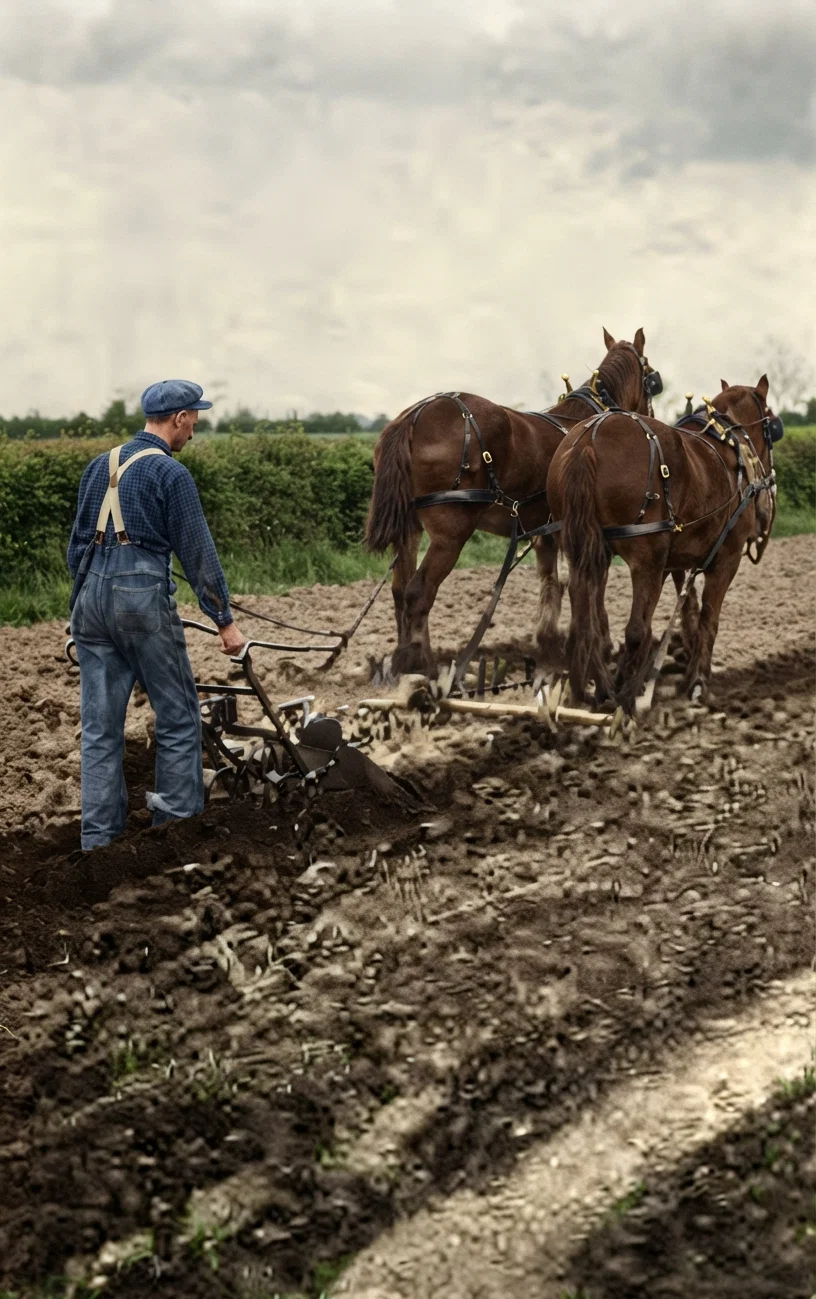
MY brother sailed over the seas to-day to the East To carry the tidings of Christ to sin-blinded souls. I would have gone with him — but God needs me here. Down in the village, the preacher works with his books, Finding the truth, and telling it in the church, Winning the sinners to come to the paths of Christ, Comforting those who mourn, and helping those who die, Preaching to mortals the riches unsearchable. Those are tasks I should like — but God needs me here.
Here on these hills, where my fields lie brown and warm, Here where the soil needs turning, and seed must grow, Here to raise grain and fruits and find milk for the town, Here where the aged mother lingers along with me, Here where the wife and babies laugh and sing — God needs me here, and so I abide with Him.
MISSIONS? Sermons? I fancy God knows best. We cannot all take those high and honored tasks. I'll farm my farm for Him, and help all I can — My brother, the parson, and neighbors far and near. So for a minute I rest on my plow, and think, And God seems very near. There's a light in my soul. 'Help me to live, Lord, and work so that light will spread. Help me to help those who are bearing it over the world.'
I am glad it is meeting night. I'll go down to the church, And say something there about this sweet light of God. — Christian Herald.

Hanged on His Own Gallows

The Cleansing of the Sanctuary in Heaven

By S. PARKER SMITH
ALL through the ages, penitent sinners have been confessing and forsaking their sins, and by faith, placing them in the hands of their Intercessor in the heavenly sanctuary. In this sense, their sins have been accumulating in the heavenly places. They have gone "before to judgment." 1 Tim. 5: 24. This constitutes the "defiling" of the sanctuary, and hence we may readily understand what the cleansing of the sanctuary means.
In Lev. 16: 30, we read, "For on that day shall the priest make an atonement for you, to cleanse you, that ye may be clean from all your sins before the Lord." Now this atonement was made by the same priest, and by virtue of the same blood, as the atonement for the sanctuary. Verses 16-19. From this, it would appear that the cleansing of the people was the thing that resulted in the cleansing of the sanctuary; for by that very means, every case that was on trial before the throne of grace was decided for life or death, and thus, in the earthly type, was removed from the sanctuary.
The same thing takes place in connection with the heavenly sanctuary. Its cleansing will be accomplished when the cases of those whose names are in the book of life have been finally and unalterably decided for life or death; when every one who has ever started in the service of God shall either have had his sins blotted out, or his name blotted out of the book of life. Acts 3: 19; Rev. 3: 5.
As will be brought out in a later article, the Bible foretold that the cleansing of the sanctuary would begin in 1844 A. D.

Must Be Born First

No one is dead to sin till he is alive to God; and no one is alive to God till he is born again. And it is inconceivable that the whole world were born again before they were born at all. Until we are born again, we do not see life, but the wrath of God abides on us. John 3: 36. Sin was not remitted from man when it was imputed to Christ; but sin is remitted when we believe on Christ. Acts 10: 36. Sin was not remitted from man when Christ bore man's sins in His own body on the tree; but in that supreme act of the cross, He opened the way for sin to be remitted when the righteousness of Christ is declared "unto all and upon all them that believe." Rom. 3: 22, 25. This is the truth. And unless our sins are remitted by faith in Christ, to stay remitted, we shall die for them, just the same as if Christ had never borne them in His own body on the tree; and our names will be blotted out of the book of life.

Atonement His Free Gift

To some, it may seem gross injustice that God should punish men for sins whose punishment has already been borne by Christ. Would any just government even on earth be guilty of punishing two persons for the very same crime? A little thought will show that the supposed difficulty is only imaginary. The government of heaven never demanded that Christ put Himself in man's place by suffering for his sins. Christ voluntarily laid down His life for the sheep that were straying. He said: "No man taketh it from Me, but I lay it down of Myself. I have power to lay it down, and I have power to take it again. This commandment have I received of My Father." John 10: 15, 18.
Christ's atonement is not one made with Him, as in the case of Satan, the scapegoat; but He makes it Himself, by the power of His own blood. His sacrifice and atonement are all His own; and is it not lawful for Him to do what He will with His own? "For," He says, "as the Father raiseth up the dead, and quickeneth them; even so the Son quickeneth whom He will." John 5: 21.
The promise of forgiveness and cleansing is only to those who confess their sins. 1 John 1: 9. This is the agreement made before the cross; and God is faithful and just in refusing to quicken—that is, to forgive and cleanse—those who hide their sins. There can be no injustice to impenitent men in punishing them according to their works. Neither can there be any injustice to Christ, who Himself inflicts the punishment. John 5: 27; 2 Thess. 1: 7, 8. No principle of justice can possibly be violated when Christ shall punish the rejectors of His mercy for the very sins which He Himself bore on the cross. In fact, they are infinitely more worthy to die for them than they otherwise would have been.
As we have seen, sins enter the heavenly sanctuary when, by confession and earnest seeking of God, they are placed in the hands of our Advocate at the right hand of God. There, by virtue of the infinite sacrifice on Calvary, He makes atonement for and forgives the sins of those who truly confess and forsake them. The Holy Spirit is given, and angels are sent forth to minister to them that shall be heirs of salvation. Everything is done to enable them to remain faithful. On the day of atonement, all cases will be examined, and a final atonement made for all those who have kept the beginning of their confidence "steadfast unto the end." Heb. 3: 14. Their sins are then "blotted out" (Acts 3: 19), and the decree is uttered, "He that is holy, let him be holy still." Rev. 22: 11.

Prepared the Gallows for Himself

This will finish the cleansing of the sanctuary. As Christ, in His capacity of Advocate, leaves the sanctuary, He bears with Him from that place forever the burden of Israel's sins. The debt of sin has been paid, and they then stand before the law as if they had never sinned. Their iniquity has been caused to pass from them, and they are fully clothed with the change of raiment. Then the shame and ignominy which their great adversary and accuser, Satan, has always tried to heap on their heads, is transferred to his own head.
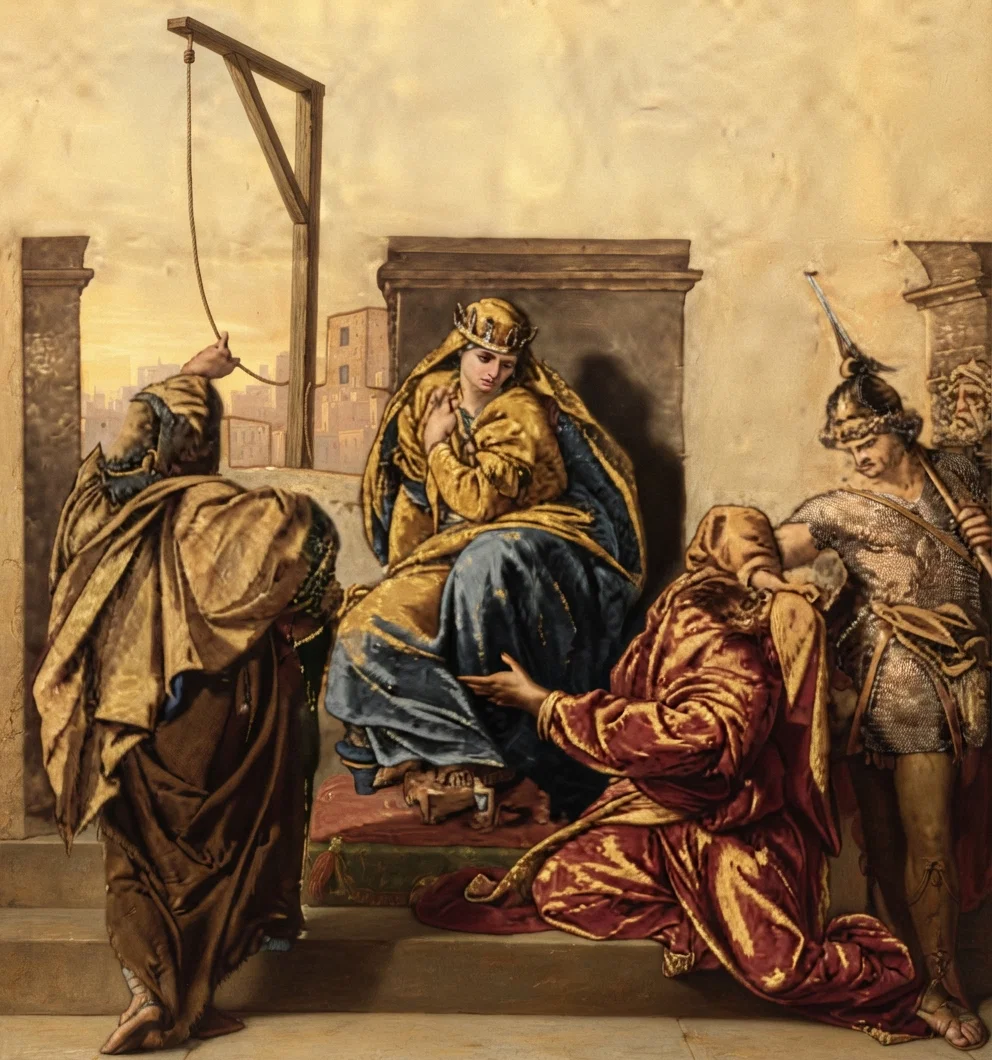
As in the days of Queen Esther, the "adversary and enemy" was hanged on the gallows he had prepared for God's servant Mordecai, so the great adversary of God's people will suffer the punishment he had hoped to see inflicted on them.
The same thing is stated in the seventh psalm: "He made a pit, and digged it, and is fallen into the ditch which he made. His mischief shall return upon his own head, and his violent dealing shall come down upon his own pate." Ps. 7: 15, 16. So Satan will not only suffer or make the atonement for his own sins, but, for his violent dealing against God's people, will suffer the punishment he has sought to bring upon them. While this is true, as seems to be indicated also by Rev. 18: 6, in the sentence pronounced against Babylon, it must not be construed as meaning that Satan's punishment is the satisfaction rendered to the law of God for Israel, or atonement for their sins; for that interpretation would deny the work of Christ, by which their sins were fully disposed of and destroyed.

The Sins Placed on Satan's Head

The sins that are placed on Satan's head are the same outwardly, or objectively, as will be blotted out in the sanctuary. He is declared guilty of them as their originator and instigator. And he is sent away to await the time when he shall pay the final penalty for them in the lake of fire. With him will go those from whom Christ withholds His atonement. Their names are blotted out of the book of life, and to them He will say: "I never knew you: depart from Me, ye that work iniquity." "Depart from Me, ye cursed, into everlasting fire, prepared for the devil and his angels." There they will be burned up root and branch; and from the purifying fires will come forth "new heavens and a new earth, wherein dwelleth righteousness." 2 Peter 3: 13.

When the Test Comes

IT is very easy and natural to think that if we were placed under certain circumstances, we would do great things; but the facts are that we would do just exactly what we are in the habit of doing. The actions of men who are counted great are simply the doing of that which they were accustomed to do, and in most cases, without even knowing that it was of any great importance whether they did it or not.
Of Daniel, when the decree was signed that no one should ask a favor of any king or of any God for thirty days, except of King Darius, we read: "Now when Daniel knew that the writing was signed, he went into his house; and his windows being open in his chamber toward Jerusalem, he kneeled upon his knees three times a day, and prayed, and gave thanks before his God, as he did aforetime." Dan. 6: 10. In this case, Daniel did just what he had been accustomed to do. The few words at the close of the verse express the whole thing,—"as he did aforetime."
When a person has established a habit of doing the things which he knows to be right, he will do them, no matter what the circumstances may be. But if he has not formed this habit, when the test comes, he will be found wanting. G. W. CAVINESS.

Duty and Obedience

GOD calls us to duty, and the only right answer is obedience. Undertake the duty; and step by step, God will provide the disposition. We can at least obey. Ideal obedience includes the whole will and the whole heart. We cannot begin with that, but we can begin with what we have. It is better to obey blunderingly than not to obey at all. — George Hodges.
Continue reading: The Whole World to Be Combined