Your ShelfYour Projects

Signs of the Times, Vol. 25, No. 31.

THE TWO GREAT PRINCIPLES OF THE LAW

Signs of the Times

Aug 2, 1899

Pacific Press Publishing Company · OAKLAND, CALIFORNIA · Aug 2, 1899

THE TWO GREAT PRINCIPLES OF THE LAW.

"And, behold, a certain lawyer stood up, and tempted Him, saying, Master, what shall I do to inherit eternal life?" Christ knew the motives of His questioner, and He threw upon him the burden of the answer. "What is written in the law? how readest thou?" He asked. The lawyer answered, "Thou shalt love the Lord thy God with all thy heart, and with all thy soul, and with all thy strength, and with all thy mind; and thy neighbor as thyself." "Thou hast answered right," Christ said, "this do, and thou shalt live." Supreme love to God and love to our neighbor are the great principles of the law. Upon these two commandments hang all the law and the prophets. Those who keep the first will not transgress the second; for supreme love to God includes all other requirements.
It is essential to our eternal well-being to know more of God; for love to God depends on a conception of His goodness, His excellence, and a knowledge of His will. It requires an appreciation of His character. His law is the transcript of His character, and thislaw He calls upon us to obey. God calls for an entire surrender of the entire being. "Thou shalt have no other gods before Me," is the first great command, and upon this command depends all the rest. This is the substance of all obedience. Let those who profess to be Christians remember that profession will not save them. The life which Christ alone can give is given upon condition of obedience, an obedience which takes in the whole man,—mind, heart, soul, and strength. This is true sanctification. "This do, and thou shalt live," is the only genuine definition of sanctification.
"Hear therefore, O Israel, and observe to do it; that it may be well with thee, and that ye may increase mightily, as the Lord God of thy fathers hath promised thee, in the land that floweth with milk and honey. Hear, O Israel: The Lord our God is one Lord; and thou shalt love the Lord thy God with all thine heart, and with all thy soul, and with all thy might. And these words, which I command thee this day, shall be in thine heart; and thou shalt teach them diligently unto thy children, and shalt talk of them when thou sittest in thine house, and when thou walkest by the way, and when thou liest down, and when thou risest up. And thou shalt bind them for a sign upon thine hand, and they shall be as frontlets between thine eyes. And thou shalt write them upon the posts of thy house, and on thy gates."
Christ presented the requirements of God's law with great force and clearness, but many of His hearers turned away, careless and indifferent. And to-day God's ministers preach the Word with power sent down from heaven, but on the minds of many no permanent impression is made. The messages given by God are not received and practised. It is not thought necessary to bring the controlling power of God into the daily and hourly transactions of life. God is not known by an experimental knowledge, and therefore He can not encircle them with the realities of the unseen world. The eternal reward of the righteous does not impress their minds. The great day of the Lord, which is right upon us, awakens neither alarm nor rejoicing in their hearts. They have a form of godliness, but not the power of the truth. Wrapped in self, nothing can help them till they realize their true condition.
Those who claim to be the children of God, and yet do not obey His commands, who are hearers but not doers of the Word, are regarded by the Lord as bankers regard fraudulent bank-notes. They are not genuine. They claim the name of Christian, but in reality they are heathen. To those who do not practise it, the Word of God is a dead letter. Christ says of such, "I would thou wert cold or hot. So then because thou art lukewarm, and neither cold nor hot, I will spew thee out of My mouth." If they realized that they were sinners, He could plead in their behalf, and the Lord would arouse them by His Holy Spirit. But He can not present them to the Father; for they are worse than dead in trespasses and sins. They hear the Word, but make no application of it to themselves. Instead, they apply the Word to their neighbors. God can be no power to lukewarm Laodiceans.
Without a working faith it is impossible to please God. Truth may be made ever so clear, it may be urged home ever so strongly; yet if not received by faith, it can not work in the heart. The themes presented may be ever so glorious, yet if not mixed with faith in them that hear, the work of presenting these themes will be labor in vain. The message may be one of hope, which if received would be a savor of life unto life, but if not received and acted upon, it is a savor of death unto death. Until the faith that works by love and purifies the soul opens the door for the heaven-sent blessing, the blessing remains outside. Faith must be exercised if we would keep the great principles of God's law.
It is our duty to use all our powers in an effort to know the Word of God. All our capabilities are to be used in the work of becoming acquainted with Him. We love God with an intensity proportionate to the knowledge we have of His attributes and the value we place on the object of which we are in pursuit. To love God with all the heart is to obey His law with pleasure, to meditate upon the eternal excellence of His character. Such love can never be hidden. Let us study His character in the light of His Word, working as those who realize that they are judgment bound, that they will be called upon to give an account for the words they speak and the attributes of character they possess.
Our eternal welfare depends upon our obedience to God, and therefore we should make it our one aim to seek Him most earnestly, that we may gain a knowledge of Him. This is to be our first consideration. All else is to be made secondary to this object. The Word which is our guide declares, "Seek ye first the kingdom of God, and His righteousness, and all these things shall be added unto you." Seeing then that all the powers of mind, soul, and strength are to be given to God, in order that we may use our capabilities to His glory, and in this way increase them, let us search His Word earnestly and diligently to learn our duty to our Creator. Thus we may understand that God makes no requirement without making ample provision for the fulfilment of that requirement. Through the redeeming grace of Christ, man may accomplish everything that God requires of him.
MRS. E. G. WHITE.

The Greatness of God

"Great is our Lord, and of great power; His understanding is infinite."
Man speaks of the "great ones of earth," of the "great nations," and the "great earth." But before our God "the inhabitants" of the earth "are as grasshoppers," and "the nations are as a drop of a bucket, and are counted as the small dust of the balance." He measures the waters, as it were, in the "hollow of His hand," metes out heaven "with a span," weighs "the mountains in scales, and the hills in a balance."
Nay, more; beyond this earth are all the rolling spheres of light. "Lift up your eyes on high, and see who hath created these, that bringeth out their host by number; He calleth them all by name; by the greatness of His might, and for that He is strong in power, not one is lacking." He upholdeth all things "by the word of His power." "By His Spirit He hath garnished the heavens." And of all we can see of their shining hosts we may say, with the Idumean patriarch, "Lo, these are parts of His ways; but how little a portion is heard of Him? but the thunder of His power who can understand?"
But God does not leave the revelation of Himself thus. He would not terrify us with His greatness. He would reveal that greatness; He would show His mighty power and marvelous works. He would declare Himself by His works to be the Omnipotent One; the One All-wise God. But His infinity of power and wisdom in maxima argues for infinity in minima. The God of the great things is the God of the small. He who guides mighty Arcturus paints the wings of the butterfly, forms the delicate petals of the lily, imprisons the sweet-voiced fragrance in the rose, the heliotrope, the violet, and clothes the peach with down, and bestows color and beauty upon leaf and flower. Yea, all of the great things are made up of the littles. The mighty rock is formed of its tiny crystals; the great restless ocean, of the individual drops, each of which is a little sea by itself, in whose "depths" oftentimes a multitude of infinitesimal creatures live and sport.
But even more than this; God is infinite in love. The great lesson He would have us learn from His wisdom and understanding is that He knows everything, and how to accomplish His own righteous will; from His mighty power, that He is able to save to the uttermost and keep unto the end all that is committed to Him; and from the minima—the little things of His creation—that God has a recognition of, a care for, the smallest of all His creatures. And love bids us believe, "He cares for us; He cares for me."
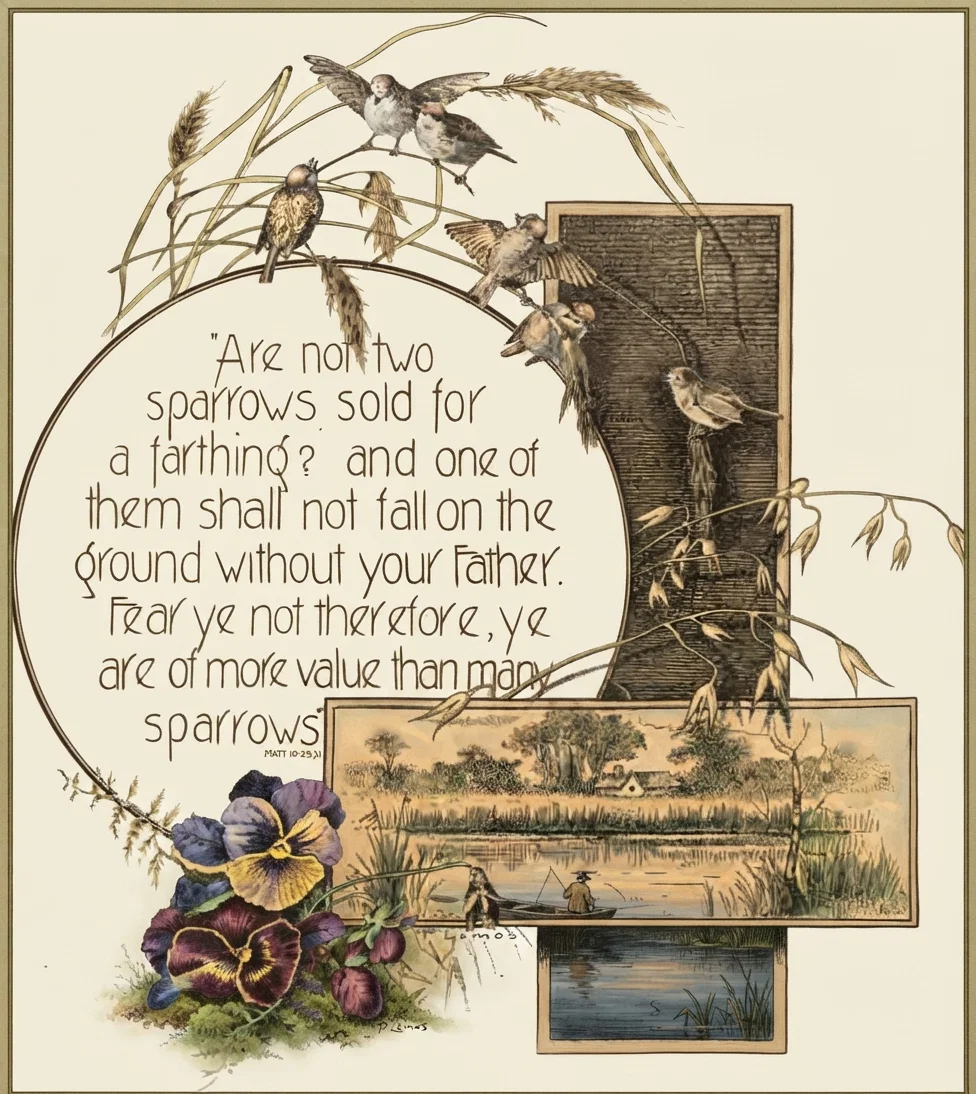
Matt 10:29,31
Matt 10:29,31
This is the lesson of the beautiful text in our illustration. It is one of the precious messages brought to this sinful, care-rent world by the love of Jesus our Lord. Two sparrows are of little worth. Their market value was then but three-fourths of a cent each. They are worth even less now in man's eyes. And yet not one of the chirping feathered morsels shall fall to the ground without your Father's notice. He supplies them with life; and when the life-cord is broken, the great heart of the Father feels the pain, and He notes the sparrow's fall; "not one of them is forgotten before God." O fearful heart, fear not; ye are of more value than many sparrows! God will not forget; has not forgotten. He can not forget; you are graven on the palms of His hands. When Christ died, the nail-marks in His feet and hands were for you. Your sins placed them there. Your direful needs are expressed there. He can not forget you. Night may seem to shut you in; God may seem to have forgotten, because you do not see and hear; but fear not, He "that keepeth Israel shall neither slumber nor sleep." Friends may forsake you; He is a Friend that sticketh closer than a brother. Sickness and calamity may come upon you; Death may smite you; but He is victor over Death; and from your ashes will make you a shining immortal. "Only trust Him, just now."
"I heard the voice of Jesus say, Come unto Me and rest; Lay down, thou weary one, lay down Thy head upon My breast. I came to Jesus as I was— Weary, and worn, and sad; I found in Him a resting-place, And He has made me glad."

THE HOPE OF THE GOSPEL.

THE hope of the Gospel culminates in the second coming of Christ. Around that great event, according to the Scriptures, cluster the all-important destinies of mankind. Then will the faithful in all ages, who sleep in Christ, be raised to immortality. Then will the bodies of the righteous living be changed from corruptibility to incorruptibility, even as the character has been previously changed by the power of God. Then will both classes be taken to the heavenly mansions of the New Jerusalem.
At His coming, also, those who have rejected Christ will perish in the light of His presence. He longed that they should be saved by the glory of His grace. Unmerited favor was poured out upon them. He veiled His glory in human form that they might bear its presence, and yet by faith be changed by its power, and so be ready to meet Him when He came to rescue and prepare the purchased possession. But, alas! they would have none of Him. Of old they crucified Him. Since that time many have crucified Him afresh in His truth and in the person of His saints. But when He appears in the transcendent glory of heaven's King, they will perish in that glory, be destroyed by the forthshining of His presence (2 Thess. 2:8). Then will begin the glad eternal reign of Jesus our King. No more of oppression will the people of earth know. No more war will redden green slopes or crystal waters with the blood of the slain. No oppressive labor-tyrants will pale the cheek and thin the blood by the barest pittance of wage, that he may reap the bigger profits. No race wars will embitter hearts. No disease blanch the cheek or dim the eye. No old age, with bent form and faded locks, will be there. No sextons, no cemeteries, no sad funeral train, or pall, or hearse. Christ the Lifegiver reigns, and the life and glory of God floods the entire earth, and death is no more among those who know Christ Jesus.
All this and more the second coming of Jesus Christ means to this earth and its people. Surely to the people of God it is rightly called "the blessed hope."
"There is a King of Glory, Ere long on earth to rise, Sung in prophetic story, Descending from the skies; The Babe of Bethlehem, 'tis He; It is the Man of Calvary,— Not crowned with thorns, and gory, But crowned with glory now! Not crowned with thorns to-day, Not mocked and led away, But crowned with everlasting glory now!"
M. C. WILCOX.

ROGER WILLIAMS—AMERICA'S LUTHER. No. 3.

It was while Roger Williams was residing at Plymouth among the Pilgrim Fathers that he first became interested in and really formed the acquaintance of the Indians. This chapter of his life is indeed an interesting and instructive one. He cultivated their friendship from the most Christian and philanthropic motives. In one of his letters he says: "My soul's desire was to do the natives good." He immediately began to assert and maintain the principle, which afterward assisted in banishing him from Massachusetts, that the soil belonged to the Indians, and that the title thereto could only be acquired from them, and that the king of England had no right to give away land that did not in any just sense belong to him. He became very intimate with nearly all the leading chiefs, and tells us in a letter which was written many years afterwards: "God was pleased to give me a painful patient spirit to lodge with them in their filthy smoky holes (even while I lived at Plymouth and Salem) to gain their tongue."
In August, 1633, Williams returned to Salem and once more took up his ministerial work for that congregation. The authorities at Boston were not slow to pick a quarrel with him. His bold declarations concerning the iniquities of the charter could not be tolerated. The "sin of the parents," which he could not sanction, was that therein "Christian kings [so called] were invested with a right, by virtue of their Christianity, to take and give away the lands of other men." His position on this matter was absolutely correct and the only one that any true-hearted Christian could take. He argued that the heathen had rights which neither king nor Christian could disregard. But the rights of an Indian were a small thing in the eyes of many.
But the matter of the charter was only one trouble of many. Every practise of the Puritans opposed itself to the great principle of religious liberty which Williams was continually teaching. "The magistrates insisted upon the presence of every man at public worship; Williams reprobated the law; the worst statute in the English code was that which did but enforce attendance on the parish church. To compel men to unite with those of a different creed he regarded as an open violation of their natural rights; to drag to public worship the irreligious and the unbelieving seemed onlylike requiring hypocrisy. 'An unbelieving soul is dead in sin,' such was his argument; and to force the indifferent from one worship to another 'was like shifting a dead man into several changes of apparel.' 'No man should be bound to worship, or,' he added, 'to maintain a worship, against his own consent.' 'What!' exclaimed his antagonists, amazed at his tenets; 'is not the laborer worthy of his hire?' 'Yes,' replied he, 'from them that hire him.' But when Williams openly declared that "the civil magistrates may not intermeddle even to stop a church from apostasy and heresy," every breath was bated, and every hand went up in holy horror.
At first the members of the Salem church stood by their minister. But the antagonists of Williams stopped at nothing. No intrigue was beneath them. The men of Salem laid claim to a piece of land in Marblehead Neck. The case came before the General Court at Boston. It was clearly proved that they were the rightful owners. Nevertheless, title was refused them on the ground that they had chosen Mr. Williams to be their pastor. Of course they were but human, and at last they one and all deserted Mr. Williams, and he was left to stand alone. They were not to be censured for this. It was only natural. Only those whose lives are wedded to principle will stand in such crises. When once a principle is established there are many who will love it and defend it. But in the days when it is warring for a place the case is altogether different. Then only those whose very lives are wrapped up in the advancement of their cherished thought can stand the storm. Such men are the exception and not the rule.
Ere long the contest came. The ember days of autumn hung o'er the land. Amid the dull and gloomy shadows of October, 1635, Williams received his summons to appear before the General Court at Boston and answers for his crimes.
No charges were preferred against his personal piety. None could be brought. The spotless purity of his unstained, unsullied, and unselfish soul stood out in bold relief against the leaden sky of religious despotism. In sermon, in prayer, in loving ministry to rich and poor alike, he had labored with unremitting devotion. Grim sits the court. Its members pose as the tribunal of God on earth. The accused scans their faces all in vain to find one spark of Christian affection, one softening ray of tenderness there.
Forth come the charges: in brief, that Williams had declared that all men were entitled to religious liberty. That the Indians as well as the English had certain inalienable rights. That the civil magistrate had no power of right to punish the consciences of men who believed differently from the majority or the dominant minority. That his royal highness, the king of England, was not vested with letters patent from the Almighty to steal the land of the Redskin, simply because the Redskin happened to be a heathen and the king a Christian(?).
Chief Justice Durfee, in his eloquent anniversary discourse, has described this trial and all that was involved in it, in language that is worthy of the event:—
The future of Rhode Island, to some extent the future of the world, hangs suspended on the issue. Will he, like his church, worn out and desperate, blenching before the unknown, lose heart and yield? Never. He stands unshaken in that "rokic strength" of his convictions. He is ready not only to be bound and banished, but to die for them. "So hour after hour he argues unsubdued, till the sun sinks low and the weary court adjourns. On the morrow (Friday, Oct. 6, 1635), still persisting in his glorious 'contumacy,' he is sentenced, the clergy, all save one, advising to be banished or to adopt the apologetic and felicitous euphemism of his great adversary, John Cotton, 'enlarged,' out of Massachusetts."
Banishment in those early days was no light punishment. The winters were terribly severe. Immense forests of gigantic trees spread everywhere. The snow lay all over the ground, and every tree was clad in a garb of crystal icicles. Redskins and wild beasts were the sole inhabitants of these wild wastes. There were no towns, villages or hamlets for Williams to go to. What should he do? On the face of it banishment meant death amid the most awful sufferings. He begged permission to be allowed to remain till spring. At first this was granted. Afterward, however, there was a complaint made that he still persisted in preaching in his own house. Many people were "taken with an apprehension of his godliness," and thither came to listen to the words which fell from his lips. Without giving him one word of notice or warning, the court, which had been at one and the same time his accuser and his judge, reversed its sentence, and resolved to send him to England in a sloop which was then almost ready to sail.
THE OLD WITCH HOUSE, SALEM. (Side View.)
The reason why the sentence was reversed, and why it was determined to send Williams to England, instead of giving him "enlargement" into the dreary forest wastes, is interesting and instructive. It appears that while he was preaching in his own house he announced his intention of himself establishing a State which should be indeed a refuge for the oppressed of all lands, and wherein the civil magistrate should have no jurisdiction over the conscience. The divines of Massachusetts had thought to silence this liberty-loving soul by "enlarging" him into the forest. But Williams, ever a grand master of circumstances, had determined to seize upon this seeming end to all his plans and projects and turn it into an instrument by means of which to carry them out. When he fled it would not be to sink into "innocuous desuetude," but to uprear that fabric of government which the Puritan Father dreaded so much—to found an asylum for the conscience-oppressed of every kindred, and nation, and tongue, and people. It was to prevent this grand and noble work that the General Court rescinded its former sentence of banishment into the forests and passed one in place of it, the design of which was to send the irrepressible Welshman back to England.
But Williams had a mission from God. He was not easily deterred from his cherished purpose. He quailed before nothing. In the dead of night, January, 1636, Roger Williams prepared to flee from the savage Christians of Massachusetts to the Christian savages of Narragansett:—
'Mary!' (she woke) 'prepare the meet attire, My pocket-compass, and my mantle strong; My flint and steel, to yield a needful fire; Food for a week, if that be not too long; My hatchet, too—its service I require To clip my fuel, desert wilds among. With these I go to found, in forests drear, A State where none shall persecution fear.'

ABANDONED REPUBLICANISM.

THERE are very few people who truly realize the serious consequences involved in the recent steps that the United States have taken in the abandonment of her fundamental principles of republicanism. The suddenness with which the move was made and the most rapid developments that have followed are truly remarkable.
A regular craze has taken possession of the country to become one of the "great world powers." The events that cluster around the capture and retention of the Philippines is largely responsible for this state of feeling. And the efforts made to forcibly subjugate these islands should open everybody's eyes to the fact that the Republic is being abandoned and the Empire is being launched. For it is perfectly clear that when this country seeks to subdue peoples on distant islands and hold them as colonies, the very thing is being done against which our fathers so nobly fought in the Revolution that resulted in the establishment of this government. The Filipinos have the same right to their independence and freedom that the British colonies claimed and fought for in this country a hundred and twenty-five years ago. And for this country to deny such a right is to forsake and repudiate the whole foundation of her republican form of government. The cause, the reactionary forces,are mightily working, and the fearful results will soon be seen.
When this government was founded, the whole world was in a death struggle between kings, nobles, and the privileged classes on the one hand, and the burdened and enslaved people on the other. The minds of men had been enslaved by the superstitions of kingcraft and priestcraft. But the Reformation set the minds of men free, and the people were struggling for their rights and their freedom, both religious and secular.
A commonwealth in which the people might decide their own affairs, a republic where the people might hold their necks from beneath the heel of tyranny and despotism and rule themselves, was their noble and high ideal.
The history of England is one long record of the struggle of the people against the self-styled nobility. She tried hard to establish a republican commonwealth, but got instead a constitutional monarchy. In its operations it has come the nearest, perhaps, to a true republic of any government that has ever existed, aside from the United States.
France made a stormy effort to establish a republic, but got instead the military despotism of Napoleon. Efforts were made elsewhere in Europe to found republics, but none of them ever really became such in the true sense of the word. The United States alone took the bold stand that governments rule in justice only when it is by the consent of the governed, and that all the people have rights that can not be alienated.
This country was at first laughed at because of her "experiments in democracy," but her success led the men of the Old World to first study her, finally to admire her glorious principles and institutions of government, and unconsciously they have been copying her in many ways. America has been a towering beacon of light and progress. America, if true to her righteous principles, would peacefully revolutionize the world.
But America is taking the backward track. There are men here to-day who have become emboldened to such an extent that they openly say that the principles of this government are wrong, and that they should be abandoned in favor of the old cast-off trappings of imperialism and monarchy.
This could mean nothing else than to bring into this country also the conflict between the people and the wealthy and privileged classes. This means to take up the battles of the sixteenth century anew. Old controversies will be revived, and new ones will arise, and frightful will be the scenes as the two commingle.
The intensity of these times will drive the battle forward furiously. Words are tame when we seek to express the awful condition into which this world is—not drifting, but leaping and bounding and plunging.
A. O. TAIT.

PRAYER.

PRAYER is the key to all celestial treasures. Prayer should be made to God continually in childlike simplicity, for nothing so soothes and sweetens life and elevates the soul as prayer. If we would succeed in what we undertake to do, or if we are in sorrow or in trouble, let us go to Him "who is a very present help in trouble," who is ever ready to listen, and never weary, no matter what our prayer may be; and He says, "All things whatsoever we ask believing we shall receive."
"Pray without ceasing" for strength and counsel and comfort in every temptation, resting in Him for victory in every trial. Then we will go about our daily duties with a more enlightened mind, a more earnest will, and be brought into closer communion with God. O, let us know what it is to pray; for what peace it brings to the soul! what love to the heart! It makes joy shine in the countenance, even tho the tears stream from the eyes.
E. HOAGLAN.

THE ONE BOOK.

GOD'S Word is not many, but one. Altho it was written at different times, under varied circumstances, by men of diverse callings, the same spirit of unity runs through the entire sixty-six parts. The one purpose dominates the whole Book, the revelation of God, a Friend, a Saviour. Every circumstance, every history, every biography, every outworking of principle, is given to reveal man's need of a Saviour, his utter insufficiency alone, and that God has met that need in Jesus Christ.
And in the Book God has given lessons for all time, for all ages, for all conditions of human life. It speaks to the ruler and to the slave; to the prince and to the peasant; to the rich and to the poor; to the pious and to the profane; to the despairing and to the hopeful; to the well and to the sick; to the righteous and to the sinner; to the youth and to the aged. And, blessed be God, it brings to each and all a message of hope, and strength, and life, if the message is so received.
That the Lord might speak to all men of all conditions, He used all sorts of men, under varying conditions, in different ages, to bring to us His message. God is the great Master Musician; His messengers are different instruments through which He sings or speaks to the world His teachings. The distinctive tones of the instruments are recognized, some in the very nature of things more melodious and sympathetic than others, but behind the instrument is the Master. God uses the learned and meek Moses, the well-instructed and humble Joshua, the faithful Samuel, the bold Nathan, the shepherd poet-king David, the wise man Solomon, poetic Isaiah, the sorrowful priest Jeremiah, and the mighty Ezekiel, filled with the visions of God, the holy and beloved prime minister Daniel, the herdman Amos, the fishermen James and John and Andrew and Peter, the tax gatherer Levi, the learned Pharisee Paul, the beloved physician Luke, and many others, male and female, God uses to instruct the people of earth. The instruments are many; the Master is One, the Spirit which breathes through all is the one Spirit of Christ.
Then, fellow pilgrim, receive the Word. You will not, can not, know all it contains; the men who wrote the various parts did not see the meaning of all they wrote. Angels do not yet see it all. You will not see the bearing some things in that Word have, because you do not know the circumstances. You can not even see the utter wretched condition of yourself apart from God, and never can, even tho you meet its sad end, eternal death; but God reveals it in His Word, and you may know it by faith. You can not see how Christ, the Innocent, died for you, the Guilty; how by His power He can change your character and make you like Himself, but He can do this, and will if you will only believe—only submit to Him fully. There is hopelessness and death apart from the Word of God. There is hope and life in it to all who believe. "To you is the word of this salvation sent;" will you not receive it and live? M. C. WILCOX.

UNITY OF THE FAITH.

JESUS CHRIST was not a sectarian. That His followers were and are a "little flock," that they were called a "sect," that His children are still scattered among many sects, and some even yet are reckoned as of the world, is not because He so designed. These conditions are the result of unbelief. He did not come into the world to establish any new doctrine, however new it may have appeared to the church and to the world. He came to preach the truth, and to fulfil the Word that had already been given to the world; He came to reform, to restore. To reform, in the true sense, always means to return to the Word of God. So long as men stand by this Word there is no need of reformation.
It was departure from the Word that opened the way for sin to enter—"sin is the transgression of the law;" therefore a reformation is a return to that which Jesus Christ came to fulfil, and He is the way by which the return may be accomplished. He preached the same doctrine that had been proclaimed by Him from the beginning, the same that had before been revealed in the Scriptures, which had been indicted by His own Spirit. 1 Peter 1:10, 11. He came not to destroy, but to fulfil (Matt. 5:17-20); not to change even a jot or tittle of the doctrine that had always been taught in the Word. Of the Scriptures then in vogue, Paul says: "All Scripture is given by inspiration of God, and is profitable for doctrine, for reproof, for correction, for instruction in righteousness that the man of God may be perfect, thoroughly furnished unto all good works." 2 Tim. 3:16, 17.
If the doctrine taught before Jesus came to earth was sufficient to make men perfect, and thoroughly furnish them unto all good works, what would be the need of any new doctrine? Should God change just to accommodate man's apostasy? Not by any means. His appeal to Israel is, "Turn ye, turn ye from your evil ways; for why will ye die, O house of Israel?" Eze. 33:11. "Thus saith the Lord God; Behold, I will take the children of Israel from among the heathen, whither they be gone, and will gather them on every side, and bring them into their own land; and I will make them one nation in the land upon the mountains of Israel; and one king shall be king to them all; and they shall be no more two nations, neither shall they be divided into two kingdoms any more at all." Eze. 37:21, 22.
That all sectarian divisions are because of existent evils is shown in the next verse: "Neither shall they defile themselves any more with their idols, nor with their detestable things, nor with any of their transgressions; but I will save them out of all their dwelling-places, wherein they have sinned, and will cleanse them; so shall they be My people, and I will be their God."
This uniting of kingdoms, or divisions, can only be done in Christ, and by putting away iniquity. The prophecy could not be fulfilled in Israel according to the flesh. There is nomore any recognition of the literal seed. In Christ "there is neither Greek nor Jew, circumcision nor uncircumcision, Barbarian, Scythian, bond nor free; but Christ is all, and in all." Col. 3:11. But the prophecy will be fulfilled, and if literal Israel as such have no place in Christ, who will experience the fulfilment? "We are the circumcision, which worship God in the spirit, and rejoice in Christ Jesus, and have no confidence in the flesh." Phil. 3:3. What is God's ideal of faith and unity?—"Here are they that keep the commandments of God, and the faith of Jesus." Rev. 14:12. This is the objective aim of the new covenant: "Behold, the days come, saith the Lord, that I will make a new covenant with the house of Israel, and with the house of Judah; . . . this shall be the covenant that I will make with the house of Israel: After those days, saith the Lord, I will put My law in their inward parts, and write it in their hearts; and will be their God, and they shall be My people; . . . for I will forgive their iniquity, and I will remember their sin no more." Jer. 31:31-34.
God has one purpose, one standard of doctrine. "Circumcision is nothing, and uncircumcision is nothing, but the keeping of the commandments of God." 1 Cor. 7:19. "Fear God, and keep His commandments; for this is the whole duty of man." Eccl. 12:13. To bring His people to this standard is the purpose of the Gospel, and of the visible church in the earth: "He gave some, apostles; and some, prophets; and some, evangelists; and some, pastors and teachers; for the perfecting of the saints, for the work of the ministry, for the edifying of the body of Christ; till we all come in the unity of the faith, and of the knowledge of the Son of God, unto a perfect man, unto the measure of the stature of the fulness of Christ." Eph. 4:11-13.
W. N. GLENN.

THE LOVE OF JESUS.

The love of Jesus! all it is No mortal man can know; Its height and depth he can not grasp While waiting here below.
By faith we know He came to earth To seek and save the lost; To bring back hope and life again; But who can count the cost?
Yearn then, my soul, to realize Thy Saviour's love the more; But all it is thou wilt not know On this side Jordan's shore. J. P. L.
Continue reading: SIGNS OF THE TIMES SEEN AT THE CHRISTIAN ENDEAVOR INTERNATIONAL CONVENTION