Your ShelfYour Projects

Signs of the Times, Vol. 31, No. 27.

BIBLE LEADERS

Signs of the Times

Jul 4, 1905

Pacific Press Publishing Company · Mountain View, California · Jul 4, 1905

BOOK DEPARTMENT NOTES

BIBLE LEADERS

For the summer trade we have secured a good line of Bibles which we can sell very cheap to our friends. They are not the imported Oxfords, but are a line which we believe will prove entirely satisfactory for the price asked, which has been greatly reduced on some of the numbers.

Terms of Subscription.

Per Year, post-paid . . . . . . . . . . . . . . . . . . . . . . . . . . . . . . . . . . . . . . . . . . . . . . . . . . . . . . . . . . . . . . . . . . . . . . . . . . . . . . . . . . . . . . . . $1.50 Six Months, 75 cts. Three Months, 40 cts. To Foreign Countries, per year, $1.75.

SPECIAL TERMS.

1. One new yearly subscription and one renewal, or two new yearly subscriptions, sent at one time, $2.50.
2. Two new yearly subscriptions and one renewal, or three new yearly subscriptions, sent at one time, $3.25.
3. Three new yearly subscriptions and one renewal, or four new yearly subscriptions, sent at one time, $4.00.
Sample copies sent on application.

TO OUR PATRONS.

Please be careful to write all names of persons and places plainly.
Send money by Post-office Money Order, Express Order, or Bank Draft on New York, Chicago, or San Francisco.
Orders and Drafts should be made payable to the Pacific Press Publishing Co.
Paper money or silver should be sent in a registered letter.
Registered mail is safe. Unregistered mail is at the risk of the sender.
Postage-stamps in five or ten cent denominations will be accepted for small amounts.
The address label on your paper will indicate the time to which your subscription is paid. In case of non-receipt of papers, or any other irregularity, please notify us immediately.
When subscriptions expire, no more papers are sent to the party except by special arrangement.
You are requested to watch the date on your label, and renew early, and save the loss of papers. We can not always furnish missing numbers.
When requesting change of address, be sure to give both old and new addresses.
Important.—If you order SIGNS, Our Little Friend, books, etc., at the same time, use a separate sheet of paper for each. If this request is complied with, it will materially assist in the prompt and accurate despatch of the business.
When writing to the editor, be sure to use a separate sheet of paper.

"REVIEW" TESTIMONIALS.

"All who desire to keep pace with the rapid advancement of this message should be constant readers of the Review and Herald."
A. G. DANIELLS, Washington, D. C.
"I have been a subscriber for the Review for over fifty years. When I was traveling from place to place in foreign countries for two years, the Review followed each week, and sooner or later reached me. I would not know how I could do without it. It ought to be in every family of Seventh-day Adventists. Other periodicals have their place, but none can take that of the Review and Herald."
S. N. HASKELL, Nashville, Tenn.
"Our welcome world-wide weekly, the Review and Herald, has long since found its way to India, and is a real blessing to our people, and a source of inspiration to our faithful workers in the front. It is an expression of the third angel, and every lover of the Message should have it in his home."
J. L. SHAW, Calcutta, India.

Children's Bibles.

No. 9—Pearl type, French morocco limp covers, round corners, red edges, with maps. Size 5½x3½. Price 50 cents.
No. 12—Pearl type, French morocco, overlapping edges, red under gold edges, maps. Size 5½x3½. Price 70 cents.
No. 1405—Emerald type, red cloth binding, round corners, gilt edges. Illustrated with colored engravings. A very attractive Bible for children. Size 4¾x5½. Price $1.00.

Text Bibles, with Large, Clear Type.

(Contain no References or Concordance.)
No. 1702—Small Pica type, cloth bound, red edges. Size 8½x6. Price $1.35.
No. 1730—Small Pica type, limp leather binding, gilt edges. Same size as above. Price $2.00.

Reference Bibles.

No. 1435—Nonpareil type, French morocco binding, overlapping edges, red under gold edges. Illustrated with 32 colored engravings. A very neat, handy Bible. Price $1.20.
No. 8635—Minion type, French morocco binding, overlapping edges, red under gold edges. Only 5/8 of an inch thick. A well-made Bible. Price only $1.75.
No. 9635—Brevier type, French morocco binding, overlapping edges, red under gold edges. Only one inch thick. Price $2.75.

Teacher's Bibles.

(Containing References, Concordance, and Maps.)
No. 7501½—Minion type, Egyptian seal binding with overlapping edges, round corners, red under gold edges. A good substantial book for only $1.35.
No. 8301—Minion type, French morocco binding, overlapping edges, red under gold edges. A thin, well-made Bible for only $1.45.
No. 3621—Bourgeois type, French morocco binding, overlapping edges, silk sewed, red under gold edges. Large, clear type. Price $2.10.
No. 934—Combination Teacher's Bible, containing both the authorized and the revised versions on the same page. Where there is a difference in rendering, the revised is given in a foot-note. The book is substantially bound in leather and leather lined, self-pronouncing, references, concordance, teacher's helps, and maps. Large type. Price reduced from $5.00 to $2.50.
No. 934 Art—Same as above with illustrations. Price $2.75.

Styles of Type.

PEARL—"Now therefore, my son, obey my voice; and arise, flee to Laban my brother to Haran."
BREVIER—"Judge not according to the appearance, but judge righteous judgment."
BOURGEOIS, About the same as Brevier.
SMALL PICA—"And I will sanctify the tabernacle of the congregation."
NONPAREIL, EMERALD, MINION, About like the following:
"He that saith he is in the light, and hateth his brother, is in darkness even until now."
Our complete list of Bibles sent on application.

Pacific Press Publishing Company,

MOUNTAIN VIEW, CALIFORNIA.

THE MAN, THE PERSON, THE INDIVIDUAL.

THE most priceless thing in all this world is character in humanity—righteous, noble, free character. In order that such character may be developed, there must be free choice. No enforced righteousness is true righteousness. No enforced semblance of gentility, no inherited or conferred titles of honor, can make a man truly noble. Only as the soul is untrammeled in its rights and free in its choice, and so chooses the best, can the highest character be developed.
THIS choice and development demand equal rights. And in this respect, as set forth by that grand utterance of the Declaration of Independence: "We hold these truths to be self-evident: That all men are created equal, that they are endowed by their Creator with certain unalienable rights, that among these are life, liberty, and the pursuit of happiness; and that to secure these rights, governments are instituted among men." The "equality" does not exist in physical, mental, or moral qualities or capacities, but in the absolute freedom of choice, in the equal exercise of the same rights.
THE right to life, the right to liberty, the right to seek happiness, so as not to interfere with the equal rights of his fellows, belong to every man; he may not voluntarily surrender them and become a slave. No government can of right deprive him of them. They belong to him as a man, a person, an individual.
FOR the advocacy of these rights the SIGNS OF THE TIMES stands. And for these rights as pertaining not to the German individual, the French, the Italian, the Japanese, the Russian, or the Anglo-Saxon individual, but the individual of every nation and people and tongue and tribe. And for this equality Christianity stands, stands preeminent, unique, alone, among all the religions of earth. Listen to the words of its Chief: "Be ye not called Rabbi; for One is your Teacher, and all ye are brethren. . . . Neither be ye called masters; for One is your Master, even the Christ." Matt. 23:8-10. And listen to this from the chiefest of the apostles: "The God that made the world . . . hath made of one blood all nations of men to dwell on all the face of the earth." Acts 17:24-26. Before God all have equal rights.
AMONG the things which many men find essential to their happiness is religion. But as regards this, the preferences of mankind are many. Yet each one has the unalienable right to choose his own religion or reject all. And this is the teaching of the Master: "If any man hear My words, and believe not, I judge him not, for I came not to judge the world, but to save the world." John 12:47. There is where Jesus Christ stood; there is where His followers ought to stand. By no compulsion or coercion can a man be a true follower of a worthy religion. If there is not that in the religion itself which by its merits, its beauties, its qualities, compel his choice, he has the right to reject it. And every follower of Christ ought to stand for the same thing; the right of the individual, whoever he be, to choose his own religion.
THEREFORE the SIGNS OF THE TIMES as a Christian journal stands not for the rights of the Protestant man, the Roman Catholic man, the Jew or the Gentile man, the Christian or infidel man, but for the rights, the equal rights of the man, whatsoever religion he espouses, or whether he holds to none. The right of the infidel to choose is as sacred as that of the Christian, and none should be so free, so anxious to concede those rights as the Christian.
The government, therefore, which regards the rights of its subjects will not exalt the institution, religious or social, above the man, but the man above the institution. The institution may be honored if men will, but its observance will never be compulsory.
ALL the Catholics in a community may with bared and bowed heads "adore the Host," as it is carried by in solemn procession; but no Protestant is to be forced to bow his head or even to remove his hat. All the Protestants of the community may with reverent air remove the hat and bow the head when the solemn rite of baptism is performed at some beautiful lakeside; but no Catholic should be compelled to show reverence. No one may encroach upon the equal rights of any, but as none can compel him to be religious, none are to compel him to act religiously.
A TRUE government will not subject the individual to the arbitrary demands of the multitude. Man surrenders no inalienable right to society or government. If the government be a true government, it conserves the right to guard the rights of each one and each one in his rights. When, therefore, each one is protected in his rights, all are protected in their rights. And so long as each individual is protected in his rights, so long can no class suffer from the infringement of their rights. The thing to be exalted, therefore, in a just and permanent government, by true citizens, by Christians, is the inalienable rights—common to all men—of the individual man, whether he be pagan or Jew, infidel or believer, Catholic or Protestant; for in this only are the rights of all conserved. This is equity, justice, and Christianity.

TO OUR FELLOW CITIZENS.

IT is with no desire to reflect upon our common country that this issue of the SIGNS OF THE TIMES is sent forth. We are glad to recognize—
That this is a great and glorious country;
That the government was founded on the blessed principles of equality and liberty as no other which ever existed;
That despite all the inconsistencies of state laws, despite the many years of slavery within its borders, it has been the grandest, freest government that earth ever knew; and,
That its flag has symbolized freedom and humanity to all the earth.
We do not wonder that the patriot's heart throbs with new joy and forceful impulses as he contemplates his country's past.
We can understand that to any one less than Christian one of the most beautiful, one of the most thrilling objects upon which a patriot's eyes ever looked with more kindling joy, is the flag of this country,—the Stars and Stripes,—waving in the free winds of heaven.
We respect the whole-souled ardor of the loyal citizen as he responds to his country's call.
All these we appreciate and heartily recognize. We have been there.
But, fellow citizens, the true statesman and the true friend of his country must make deeper research, must take broader view. It will not do to cover with the court-plaster of expediency the ulcers of the body politic, nor limit the view to the little valley of the immediate present nor near probable future, even yet hidden by the glory of the past. He must probe for the rotting ulcer, he must extirpate the roots of the cancerous growth; the life-blood of the body must be purified before the death sores will heal. He must climb the mountain and take a larger, clearer view if he would know the condition and outlook of his country. He must take cognizance of the great general trends which reveal the principles actuating the life. He must know that only by adhering to the law of its life, the reason of its existence, can the nation continue to exist.
The Christian, if he be true to his Master, must search deeper still. He must, by the radium power of God's Word and Spirit, look into the hidden springs of human action. Are the sources selfish?—Then the end is death. Are they unselfish, consistent?—Then there is continuance of life and vigor.
The Christian must get up into the "high mountain," even the high mountain of God, and by faith in the prophetic ken as unrolled in the "more sure word of prophecy," he must see as God sees. He can not look upon the land of his birth as the only land, or the land for him and his alone. He must see that all lands are his, blood-bought by Jesus Christ. He can not as a Christian confine his love to the land of his birth. He will love all men because all are the purchase of his Redeemer; and, as a redeemed one, he is debtor to all, "both to the Greeks, and to the barbarians; both to the wise, and to the unwise;" both to the Russians and to the Japanese; to the each and to the all.
The Christian loves all lands, because "the earth is the Lord's." He loves all because they are the purchase of "the precious blood of Christ." Moreover, he looks beyond this life to the life to come. He believes and knows God. He knows that "the Most High ruleth in the kingdom of men, and giveth it to whomsoever He will;" that even the wrath of man shall praise Him and the remainder of wrath shall He restrain; that when a nation will not work out His will, "He removeth kings, and setteth up kings," and that, finally, Christ Jesus the Branch will have gathered out of the kingdoms of earth those who will be eternally loyal to Him, and who will share with Him His universal kingdom, which is to come by His power alone from the ruin of all earthly kingdoms. All this God has again and again foretold in His holy Word.
The Christian should know as no one else can know, be he historian or statesman, that a nation must be true to the law of its life if it is to continue to live and prosper. He knows that the moment a church, a nation, even as a man, departs from the law of its life, from that moment its decline is at hand.
Has this government departed, is she departing, from the law of her life, from the principles which gave her existence? In the light of the evidence presented in this issue of this paper, in the light of much more which might be presented, could we answer otherwise than to say, "She is so departing?" Bigness is no evidence of strength. Plethora is no sign of health. If the Christian sees the danger, is it not his duty to give warning in no uncertain tones? Can he be excusable to High Heaven if he give it not? Are we carrying out the spirit of the charters of our liberty in weakly yielding to the Church of Rome, in the indorsement of the Sunday institution, thereby constituting a civil court the arbiter of religious differences? Few are those who realize these dangers. Fewer still are those who, amid the craze of commercialism, whirl of patriotic sentiment, the maze of political chicanery, and the flood of political gush for political purposes, dare raise their voices in faithful warning, for fear of being regarded as enemies, or, at least, pessimists. But the truest friends to nation, country, and people are those who give faithful warning of the evil day.
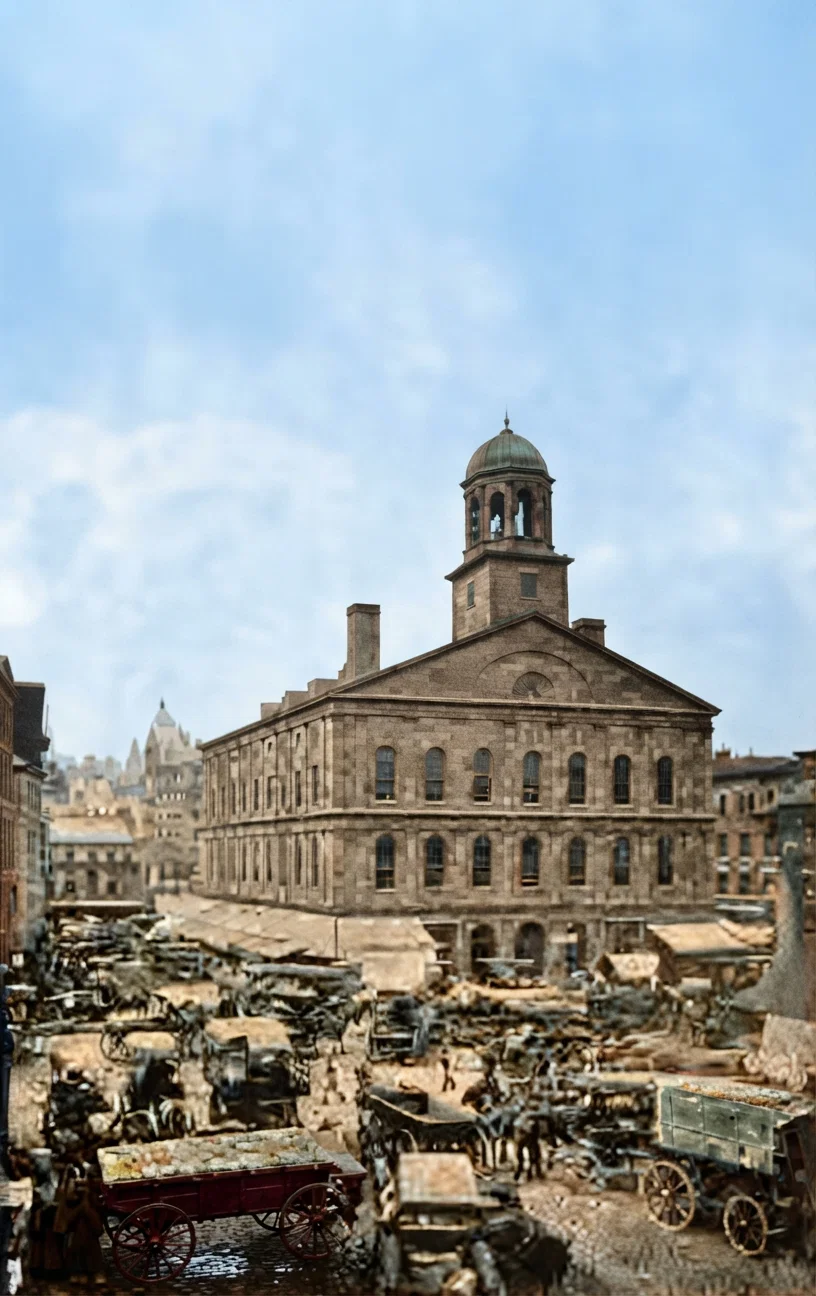
Faneuil Hall, the Cradle of Liberty.
O friends, fellow countrymen, will you not heed the warnings? Statesmen, legislators, judges, will you not, as did the fathers of the Republic, as stated by Madison, see "all the consequences in the principle," and avoid "the consequences by denying the principle"? Or will you be charmed by the siren voice of an apostate Christianity, and lured to ruin, or be carried on to destruction on the almost resistless tide of a plutocratic ambition?
What will be your choice?

The Legacy of Christ

HE, whose principles were most glorious and whose example was most spotless and worthy, has left His children the largest legacy, tho He die penniless.

WHAT FOURTH OF JULY STANDS FOR.

THERE was a time when the Fourth of July stood for solid sentiment, and its annual recurrence meant the reiteration of the rights of all the people, a restatement of the fundamental principles of liberty and free government. But there has been such a departure from republican simplicity in the government, and there has crept in such a marked degree of social caste among the people, such a disregard of the principle of individual or minority rights, such a notable extent of official infidelity and corporate dishonesty, and such a multiplicity of antagonistic combinations in support of conflicting interests, that the old-time idea of "equal and exact justice to all men, of whatever state or persuasion, religious or political," has been well-nigh obliterated.
When there was no oppression of the masses by the classes; when there was no tyranny of official authority; when there was no conflict between capital and labor; when men were considered more than mere objects of exploit; when republican government meant separation of church and state; then the Fourth of July was a day of mutual good-will and of rejoicing in mutual privileges and prospects. The rehearsal of the Declaration of Independence was not deemed a perfunctory ordeal with an obsolete meaning; but it was a reiteration of fidelity to principles that gave good cheer all over the land. The annual orations were more than spread-eagle oratory or political illusion.
There is need to-day of that spirit of high regard for human rights, that love of neighbor as of self, that would make the national anniversary of independence a rejuvenation of the principles for which it stood a century ago. The Fourth of July celebration needs a new impartation of the spirit of 1776. It is hardly to the point that we have the mere tinsel. The nerve-racking cannon and bomb, the pestering fire-cracker, and the hilarious debauch, are ill-befitting an occasion which all would like to enjoy, and have a right to enjoy. Is it not time that a civilized people should be so rapt in appreciation of liberty and equal rights that their sentiments could be expressed in more humane and refined ceremonials than some of those that occupy the most conspicuous place on that day? It is time to have a Fourth of July celebration that means more than an extravagant waste of means upon a superfluity of noise and a momentary flash in the pan. The Declaration of Independence stood for a firm planting of principle, and so ought its anniversary.
G.

BATTLES FOR TWO GREAT PRINCIPLES.

FAR back in the days of Moses, when a people had been delivered from involuntary servitude, we find the first recorded use of the word "Liberty." It occurs in this expression, "Proclaim liberty throughout the land unto all the inhabitants thereof."
It is more than a coincidence that these identical words should have been cast on the bell that was to ring out to the American people their proclamation of liberty from the rule of a country beyond the sea. While that bell had been tolling from its tower, circumstances had been educating a people in the love of liberty. With eyes opened by a divine hand, they had been enabled to see the violation of principles of truth and justice in the liberties which were denied them. Because they had been taxed without representation, because they had been looked upon as subjects rather than as equals, they made this declaration to the world: "We hold these truths to be self-evident, that all men are created equal," etc. It was a principle new to the nations, but in itself as old as Creation. It simply meant that the circumstance of birth could not justly give to any man a preeminence in rights over another. It was a bold statement to make; but it was true, and they made it. It was a broad foundation on which to build; but it was a solid one, and they built upon it. They built wiser than their day, and they built wiser, I fear, than the majority of their posterity in this day are able to appreciate. Without that foundation, the structure they reared could not have stood a hundred years; and a departure from that foundation will see that structure ruined in much less than a hundred years from the date of the departure.
Because they had been deprived of many natural rights, they declared that all men "are endowed by their Creator with certain unalienable rights; that among these are life, liberty, and the pursuit of happiness." Because they had been ruled by one who claimed the inherited right to rule without any regard to the authority of those he ruled, and had suffered under that rule, they pledged their lives, their fortunes, and their sacred honor to the outspoken principle that "Governments derive their just powers from the consent of the governed;" and because those principles were not recognized nor those rights allowed, they declared that "These United States are, and, of right, ought to be, free and independent states." From those plain declarations of principle, and the firm stand which they took upon them, there grew up what was then an anomaly among the nations, an anomaly which persisted by virtue of the principles upon which it was founded.
Now in these later years the remembrance of those principles is fading away, as fades the ink in which they were written. The outlines of those immortal words are dimming to obscurity to-day, and he must look with keen eye who would see those principles in the deeds and words of many of those who are formulating public sentiment to-day.

Civil Freedom Was but Half the Battle.

When that freedom had been achieved; when the nation had been set upon its course, its founders came to realize that the freedom of the body amounted to but little without the freedom of the soul, the mind, the conscience. So they began to set their house in order upon this matter. Even before the Declaration of Independence was put into words, the Colonial House of Burgesses of Virginia, on June 12, 1776, adopted a Declaration of Rights, the following being a portion of one of its sections:
That religion, or the duty which we owe to our Creator, and the manner of discharging it, can be directed only by reason and conviction, not by force or violence, and therefore all men are equally entitled to the free exercise of religion, according to the dictates of conscience.
When the Declaration of Independence had been adopted and published, we find that the Presbytery of Hanover, in Virginia, together with the Baptists and Quakers, sent up a memorial to the General Assembly of Virginia containing these words:
In this enlightened age, and in a land where all of every denomination are united in the most strenuous efforts to be free, we hope and expect that our representatives will cheerfully concur in removing every species of religious as well as civil bondage. Certain it is that every argument for civil liberty gains additional strength when applied to liberty in the concerns of religion; and there is no argument in favor of establishing the Christian religion but may be pleaded with equal propriety for establishing the tenets of Mohammed by those who believe the Alcoran; or, if this be not true, it is at least impossible for the magistrate to adjudge the right of preference among the various sects that profess the Christian faith without erecting a claim to infallibility, which would lead us back to the Church of Rome.
Bunker Hill Monument.
They had seen the injustice of religion established by law—in other words, a union of church and state. They had been whipped, and burned, and banished under such a régime. So they declared as they did, and then went further and said: "We beg leave farther to represent that religious establishments are highly injurious to the temporal interests of any community. . . . Neither can it be made to appear that the Gospel needs any such civil aid."
Naturally the established church was strongly opposed to the cutting off of its financial state aid, its exceptional prerogatives, and advantages over the other sects, just as the British Government was opposed to the severance of its civil and political jurisdiction over the colonies themselves; and so the battle for religious freedom was being waged in the colonies themselves at the very same time that the battle for civil and political freedom was being waged by the colonies against the mother country. Thomas Jefferson declared that struggle for religious freedom "the severest contest in which he was ever engaged." The struggle for religious freedom prevailed, and the established church was disestablished on January 1, 1777.

Later Attempts to Subvert Liberty.

Later attempts were made to commit the country to the virtual reuniting of church and state through the passage of laws for the support of "teachers of the Christian religion." It was another titanic struggle, with Jefferson and Madison championing the cause of religious freedom. They declared that "the enforced support of the Christian religion dishonors Christianity;" that "the religion of every man must be left to the conviction and conscience of every man; and it is the right of every man to exercise it as these may dictate;" that "it is proper to take alarm at the first experiment upon our liberties;" that "the same authority which can establish Christianity, in exclusion of all other religions, may establish, with the same ease, any particular sect of Christians, in exclusion of all other sects;" that "the equal right of every citizen to the free exercise of his religion, according to the dictates of conscience is held by the same tenure as all our other rights."
The attempt to commit the country at that time to a union of religion and the state was enthusiastically beaten, as well it deserved to be. And so there went into the chief document of the state of Virginia these identical words of Jefferson’s original draft, with the expressed hope "that they would endure forever;" "No man shall be compelled to frequent or support any religious worship, place, or ministry whatsoever, nor shall suffer on account of his religious opinions or belief; opinion in matters of religion shall in nowise diminish, enlarge, or affect civil capacities. The rights hereby asserted are of the natural rights of man."
So well had the people of these days become imbued with the justice of the principles therein expressed, that every one of the original thirteen states incorporated the principle, if not the exact words, of the above quotation into their constitutions. As other states were added to the union, this principle so vital to true religious liberty was incorporated into their constitutions also, until now forty state constitutions are so declaring themselves.

In the Fundamental Law.

The national Constitution itself was not allowed to close without its own declaration upon this point; and so the very last clause of the last article but one declares that "no religious test shall ever be required as a qualification to any office or public trust under the United States." But it was not thought that even this sufficiently guarded the religious freedom of the people. So the very first amendment to the Constitution declares that, "Congress shall make no law respecting anestablishment of religion, or prohibiting the free exercise thereof."
With the Declaration of Independence speaking as it does; with the Constitution of the nation speaking as it does; with the Constitutions of forty of these states speaking as they do; and with the history before us of the struggle that was waged by the founders of the nation for religious liberty; it would certainly seem that the people of the United States had spoken plainly enough, and that the lesson had been learned well enough, so that never again in this land could religious persecution raise its head to hurt or punish any for "worshiping God according to the dictates of their own consciences."

State Governments.

But in spite of it all, the principles of church-and-state union whose logical sequence is, and always has been, religious persecution, has been retained, upheld, and promoted in nearly all the states—so far have their legislators lost sight of the principle upon which their own religious freedom rests, the principle upon which the nation was established, the principle "on which the Gospel was first propagated, and the reformation from popery carried on"!
As the battle for civil freedom and the battle for religious freedom were carried on at the same time, by the same people, so the forgetting of the political principles and the religious principles of the nation are going on at the same time, among the same people. As the fathers of the nation declared it "impossible for the magistrate to adjudge the right of preference among the various sects that profess the Christian faith without erecting a claim to infallibility, which would lead us back to the church of Rome," and as the magistrate is now permitted to do that very thing in every prosecution of a Christian for the violation of a Sunday law, it is evident that that claim has been to all intents and purposes erected, and that the nation is now being led just where they said it would be.

Time to Take Alarm.

If it was "proper" in those distant days "to take alarm at the first experiment upon our liberties," it must be eminently "proper to take alarm" at the multitudinous experiments that are made to-day along that line. It certainly is very proper so to do when men in these days have been condemned repeatedly to the "chain-gang," to prisons, and to the payment of burdensome fines for worshiping God according to the dictates of conscience. Out of the persecutions suffered by the Baptists and Quakers and others because of their mode of worship grew the guarantees of religious liberty that were incorporated into our national and state constitutions. But now we have the persecutions as they had them then, and that in spite of the supposed guarantees of religious freedom. America, who should have stood as a light and pattern to the world, who fought the battles of mankind and won, America, the asylum for the oppressed, has forgotten the most vital principle for which she stood, the freedom of the consciences of men. The great hand of an oppressive church is now grasping the seats of government in state and nation, as the founders of this nation warned us it would do when the people departed from the principles of religious liberty.
S.
Continue reading: TIME’S NOBLEST OFFSPRING