Your ShelfYour Projects

Signs of the Times, Vol. 30, No. 1.

Comfort One Another

Signs of the Times

Jan 6, 1904

Pacific Press Publishing Company · Oakland, Cal. · Jan 6, 1904

Comfort One Another
By Llewellyn A. Morrison
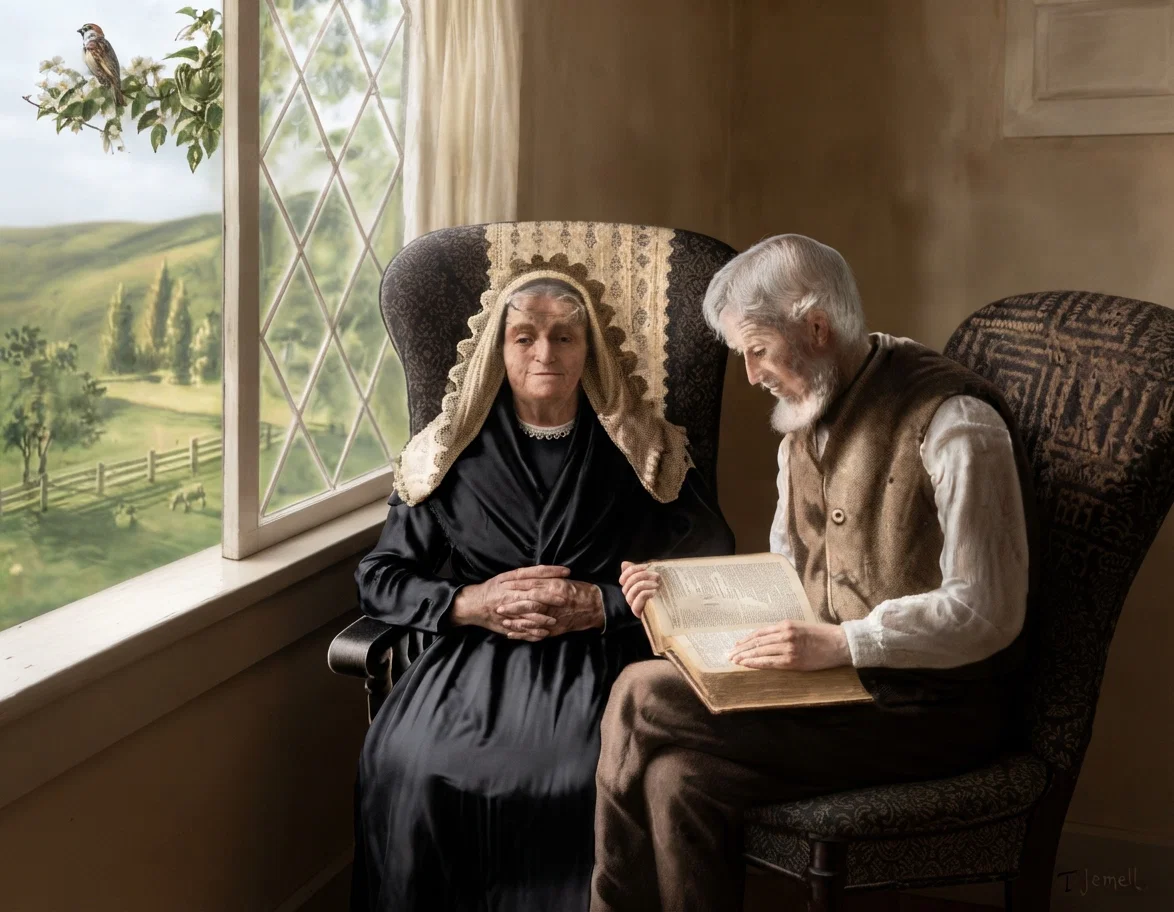
There is always a new message from the Bible every morning— Counsel, precept, song, or story, laden with delight and cheer; Now it is a note of triumph, and anon a pointed warning, Then a gentle admonition or a promise, sweet and clear. Every mortal man is brother to the burden'd one beside him; Every bosom tone vibrateth unto Sorrow's minor chord; So the great Apostle speaketh as a tender heart did guide him: Wherefore comfort one another by the Word. Ah! the souls of men are weary of the shamming and the sinning— Like the restless, roaming ocean, rolling onward evermore, Tossing, turmoil, hither, thither, and the end as the beginning— Breaking, broken waves that never bring their brightness to a shore; Human hopes and earthly "Edens," sordid plans and selfish measures, Each unholy aspiration which doth purpose undergird— All are venal, false, and fleeting; Christ, alone, hath lasting pleasures; Wherefore comfort one another with His Word.
Lo! the Word unveils the finite with the Infinite behind it, Proves the purifying virtue of the poverty and strife, Shows the sacrifice that saveth, with "The Lamb of God" to bind it, Tells of wonderful salvation and of everlasting life; Teacheth how the spirit nurtured by the Spirit, apprehendeth What the eye hath never look'd on nor the ear hath ever heard, And that Heavenly Coronations, by His love, all thought transcendeth: Wherefore comfort one another with this Word. We are children of a Father with "All comfort" in His holding; Jesus is our "Elder Brother" and His blood for us He gave; While the holy Ghost, "The Comforter," each heart by Truth is moulding— So the great, triune Jehovah is omnipotent to save; He is building "Mansions" for us, if, as children, we obey Him— And the "image" and the "likeness" lost, by grace shall be restored; By loving trust and confidence we only may repay Him. Wherefore comfort one another with His Word.
—Toronto, Can.
History of Government BY ALONZO TREVIER JONES AUTHOR OF "TWO REPUBLICS," "EMPIRES OF THE BIBLE," "GREAT EMPIRES OF PROPHECY," ECCLESIASTICAL EMPIRE," ETC.

I. ETERNAL AND FOUNDATION PRINCIPLES.

Individuality.

GOVERNMENT exists in the very nature of the existence of intelligent creatures. For, the very term "creature" implies the Creator, and as certain as any intelligent creature is, he owes to the Creator all that he is, and, in recognition of this fact, he owes to the Creator honor and devotion supreme. This, in turn, and in the nature of things, implies subjection and obedience on the part of the creature; and this is the principle of government.
Each intelligent creature owes to the Creator all that he is. Accordingly, the first principle of government is, "Thou shalt love the Lord thy God with all thy heart, and with all thy soul, and with all thy strength, and with all thy mind." This is pronounced by the Lord to be the first of all the commandments. It is not the first of all the commandments because it was the first one that was ever given, but simply because it exists in the very nature and existence of every intelligent creature, and so inheres in the nature of things as soon as a single intelligent creature exists. It is, therefore, the first of all the commandments, simply because it is but the expression of the inherent obligation in the first relationship which can possibly exist between creature and Creator. It is the first in the nature, the circumstances, and the existence of created intelligences. It is the first of all the commandments in the supreme and most absolute sense. It inheres in the nature and the relationship of the first intelligent creature, and stands as complete in the case of that one alone as tho there were millions; and stands as complete in the case of each one in the succession of future millions as in the case of the first intelligent creature, as he stood absolutely alone in the universe. No expansion, no multiplication, of the number of the creatures beyond the original one, can ever in any sense expand the scope or meaning of that first of all commandments. It stands absolutely alone and eternally complete, as the first obligation of every intelligent creature that can ever be. And this eternal truth distinguishes individuality as an eternal principle.

Equality.

However, just as soon as a second intelligent creature is given existence, an additional relationship exists. There is now not only the primary and original relationship of each to the Creator, for both owe equally their existence to the Creator, but also an additional and secondary relationship of each to the other. This secondary relationship is one of absolute equality. And in the subjection and devotion of each to the Creator, in the first of all possible relationships, each of these honors the other. Therefore, in the nature of things, in the existence of two intelligent creatures, there inheres the second governmental principle, mutuality of all the subjects as equals.
And this principle is expressed in the second of all the commandments, "Thou shalt love thy neighbor as thyself." This is the second of all the commandments, for the like reason that the first is the first of all the commandments: it exists and inheres in the nature of things and of intelligences just as soon as a second intelligent creature exists. And also, like the first, this is complete and absolute the moment that two intelligent creatures exist, and it never can be expanded nor can it be modified by the existence of the universe full of other intelligent creatures.
Each, himself alone, in his own individuality, is completely subject and devoted first of all to the Creator; because to Him he owes all. And in this subjection and devotion to the Creator first of all, each honors every other intelligent creature as his equal; as equally with himself occupying his place in the design of the Creator, and responsible individually and only to the Creator for the fulfilment of that design. Therefore, out of respect to the Creator, to his neighbor, and to himself, he loves his neighbor as himself. And this second eternal truth, equally with the first, distinguishes individuality as an eternal principle.

True Self-Government.

This is original government. It is also ultimate government; because these are first principles complete and absolute; and because they eternally inhere in the nature and relationships of intelligent creatures. And this government, which is at once original and ultimate, is simply self-government—self-government in reason and in God. For it is only the plainest, simplest dictate of reason that the intelligent creature should recognize that to the Creator he owes all; and that, therefore, subjection and honor are the reasonable dues from him to the Creator. It is likewise, a simple dictate of reason that, since his neighbor equally with himself owes all to the Creator; his neighbor must be respected and honored in all this as he himself would desire to be respected and honored in it.
It is also the simple dictate of reason that, since these have all been created, and in their existence owe all to the Creator, this existence with all its accompaniments in the exercise of abilities and powers should be ever held strictly in accordance with the will and design of the Creator; because it is still further the simple dictate of reason that the Creator could never have designed that the existence, the faculties, or the powers of any creature should be exercised contrary to His will or outside of His design. Therefore it is the simplest, plainest dictate of reason that this original and ultimate government, which is self-government, is self-government under God, with God, and in God. And this is truly the truest self-government.
God has created all intelligences absolutely free. He made man, equally with other intelligences, to be moral. Freedom of choice is essential to morals. To have made an intelligence unable to choose would have been to make it incapable of freedom. Therefore, He made man, equally with other intelligences, free to choose; and He ever respects that of which He is the Author, the freedom of choice.
And when, in the exercise of this freedom of choice, an intelligence chooses that his existence, with its consequent faculties and powers, shall be spent strictly subject to the will and within the design of the Creator, and so, indeed, with the Creator and in the Creator, this is in the truest sense strictly and truly self-government.
This truth is illustrated for us on both sides. First, in heaven Lucifer, the most exalted creature, standing in such a height of perfection that he could unerringly pronounce upon perfection—this perfect and most exalted creature chose to exercise his existence, with its faculties and powers, contrary to the will, and outside the design of God. The consequence was that he instantly became the prince of evil itself, the author of all the long train of evil and wo that is in this world and that the universe will ever know.
Then to counteract this whole train of evil and to redeem this world from wo, the Son of God, by whom were all things created, became man, was made flesh, and, as man, walked this earth to reveal to man the true way. And when this most exalted One thus humbled Himself and came to show the way, He came saying to God, His Father, "I am thy servant forever," "I delight to do Thy will, O My God; yea, Thy law is within my heart," "I can of Mine Own Self do nothing;" "the Father that dwelleth in Me, He doeth the works." "My doctrine is not Mine, but His that sent Me." "He gave Me a commandment, what I should say, and what I should speak." "I came . . . not to do Mine own will, but the will of Him that sent Me," "and to finish His work." "Not My will, but Thine, be done." This He did all of His own free, eternal choice. And thus He not only showed the way, but He is eternally "the Way."
Thus, original and ultimate government is self-government, under God, with God, and in God. And upon this earth, only in Christianity, as Christianity is in Christ, is found this true self-government, this original and ultimate government.

CONSECRATION.

BY MRS. E. G. WHITE.
CHRIST asks for unreserved consecration, for undivided service. He demands the heart, the mind, the soul, the strength. Outward observances can not take the place of simple faith and entire renunciation of self. But no man can empty himself of self. We can only consent for Christ to accomplish the work. Then the language of the soul will be, "Lord, take my heart; for I can not keep it for Thee. Save me in spite of myself, my weak, unchristianlike self. Mould me, fashion me, raise me into a pure, holy atmosphere, where the rich current of Thy love can flow through my soul."
It is not only at the beginning of the Christian life that this renunciation of self is to be made. At every advance step heavenward it is to be renewed. All our good works are dependent on a power outside of ourselves. Therefore there needs to be a continual reaching out of the heart after God, a continual, earnest, heart-breaking confession of sin, and humbling of the soul before Him. Only by a constant renunciation of self and dependence on Christ can we walk safely.
There are many who do not make an entire surrender. They do not die to self that Christ may live in them. They adopt His name, they wear His badge, but they are not partakers of His nature. They have not overcometheir unholy ambition and their love for the world. They do not take up the cross and follow Christ in the path of self-denial and self-sacrifice. Almost Christians, yet not fully Christians, they seem near the kingdom of heaven, but they can not enter there. Almost, but not wholly saved, means to be wholly lost.
We need to examine ourselves, to see whether we are indeed worthy of the name of Christian. We hear Christ's voice, clear and distinct saying, "Follow Me." "If any man will come after Me, let him deny himself, and take up his cross daily, and follow Me." "So shall he be My disciple." Are we following Him? He ordered His life and bore His cross for the honor of His Father. Are we doing this?
The same devotion, the same self-sacrifice, the same subjection to the claims of the Word of God, that were manifest in Christ, must be seen in His servants. He left His home of security and peace, left the glory that He had with the Father before the world was, left His position upon the throne of the universe. He went forth, a suffering, tempted man, went forth in solitude, to sow in tears, to water with His blood, the seed of life for a world lost.
His servants in like manner must go forth to sow. When called to become a sower of the seeds of truth, Abraham was bidden, "Get thee out of thy country, and from thy kindred, and from thy father's house, unto a land that I shall show thee." "And he went out, not knowing whither he went." So to the apostle Paul, praying in the temple at Jerusalem, came the message from God, "Depart; for I will send thee far hence unto the Gentiles." So those who are called to unite with Christ must leave all in order to follow Him. Old associations must be broken up, plans of life relinquished, earthly hopes surrendered. In toil and tears, in solitude and through sacrifice, must the seed be sown.
Those who consecrate body, soul, and spirit to God will constantly receive a new endowment of physical, mental, and spiritual power. The inexhaustible supplies of heaven are at their command. Christ gives them the breath of His own Spirit, the life of His own life. The Holy Spirit puts forth His highest energies to work in heart and mind. The grace of God enlarges and multiplies their faculties, and every perfection of the divine nature comes to their assistance in the work of saving souls. Through co-operation with Christ, they are made complete in Him, and in their human weakness they are enabled to do deeds of Omnipotence.

THE REJECTED CROWN.

[Prof. A. T. Robertson, in Baptist Argus.]
SATAN challenged Jesus at the very outset of His ministry. The very first step was resisted. God had set His seal upon His Son at the baptism in the Jordan. The devil was on the alert to prevent the inauguration of the kingdom of God. He had won in the struggle with Adam. He would now measure swords with the Second Adam. In the first encounter Satan posed as the friend of man to lead him into larger light and happiness. So now he appeared as the helper of Jesus in His enterprise of redemption. He offers His aid to every preacher who will accept it, and at the very start of His ministry. It is idle to doubt the genuine temptation of Jesus by Satan. That is what he wishes us to do about our own temptations. Jesus was able to recognize His adversary as an adversary, and not to be deceived by his plausible representations. To be able to see that it is the devil who prompts an action is the first step towards resisting. The power to see what is at stake in spite of the mist and fog around us is essential to victory. The battle is often lost because of the smoke. Satan preferred having Jesus as an ally rather than meeting Him as an enemy. So he offered Him the crown of the whole world. He claimed the world as his and calmly assumed that Jesus could not take it from him without his permission. He appealed to the mightiest human passion, ambition. Alexander had longed to rule the whole world. The Roman Emperor was the practical master of the civilized world. He offered it all to Jesus for the taking. The dream of Alexander would be surpassed. He could have a great Jewish world and satisfy the longings of his people. Constantine had a similar temptation in after ages, and yielded. He united the two kingdoms of the world and religion. The popes kept it up as long as possible. Jesus has not yet conquered the whole world. It was all offered to Him then. "To Thee will I give all this authority, and the glory of them." "It shall all be Thine." It was a glittering diadem. Who would have pushed it aside?
It was an easy crown. He would not have to fight to get it as the Cæsars had done for theirs. There would be no struggle between Jesus and Satan, and Jesus could wear the crown of earth. Why have a prolonged conflict for the mastery of earth when they could both share the rule? They could consolidate the two kingdoms. Jesus could merely graft His kingdom on the kingdom of Satan. There would be many advantages in such a scheme apart from the long war thus avoided. The influence of Jesus would thus be universal. He would at once spring to world-wide rule. He would have access to all the subjects of Satan and on good terms as Satan's friend. The terms seemed easy enough and the results eminently satisfactory—to Satan.
There was only one condition imposed by Satan. He demanded some recognition on the part of Jesus in return for all this surrender of sovereignty and glory. He merely asked that Jesus acknowledge the source from which He would receive the kingdom of the world. That was all. He did not care to back down completely, and could not in dignity get out of the way and give up so much without some gratitude. He wished no trouble about the matter. It was very easily managed. "All these things will I give Thee, if Thou wilt fall down and worship me." Just "fall down and worship me;" that is all I ask. Nobody will see you do it or know about it. You will be just as really King of men.
But Jesus was not deceived by this skilful pretension. He claimed the world as rightly His. He had created it. And if the kingdom of darkness was now supreme, it would not always be so. The kingdom of light would triumph in the end. He would be under no obligations to him who was the cause of all the trouble. He would put no crown upon His head that came from Satan. It was an insult to have suggested it. "Get thee hence, Satan." God alone is to be worshiped, not you. Partnership with Satan meant the supremacy of Satan. Water does not whiten ink but ink blackens water. He could go his way and get ready for battle. He would accept no compromise, but only absolute surrender. Till that defeat it was eternal war.
To Jesus it was a choice between the kingdom of heaven and the kingdom of the world. The acceptance of Satan's terms meant the renunciation of the kingdom of God. Satan offers a compromise with every preacher. He would like a pew in his church and will attend his preaching, if the preacher will only recognize his power. The kingdom of heaven was to be in the world, but was to be an outside power working a revolution in the world, and not a compromise standstill. The leaven was to work till all would be leavened. So Jesus chose the long, hard road to ultimate victory rather than the short, easy path to the dizzy heights of popular applause. To have compromised with Satan meant despair for the world. The battle with Adam had been lost. If this Champion deserted the cause, men would have no hope. Night would settle down permanently upon the world. Hope would die. The shadows would deepen with the hours. It would be everlasting midnight.
It would have been real ignominy for Jesus, and not "glory" as Satan lyingly promised. The favor of God would have been lost. If the Father withdrew His face when His Son hung on the cross as the sacrifice for sin, merely taking the sinner's place, the withdrawal would have been permanent in case of a league with Satan. Eternal night would have come. Jesus would have been ruined. The "good pleasure" of the Father expressed at the baptism would have disappeared. Satan would have been absolute master. So Jesus pushed the crown away. He preferred the cross. Better anything than that. Better the hate of the world and the most shameful death with the smile of the Father than the praise of men and the devil with the frown of God.

Practical Don'ts

Practical Don'ts.—Don't exaggerate. Don't fool with doubts. Don't let success tip you over. Don't dabble in business adventures. Don't make long pulpit prayers. Don't imitate others—better be a poor original than a fine copy. Don't preach long sermons. Don't be cold in delivery—preach red-hot from the heart a positive Gospel. Don't tire people out with long introductions—you can spoil the appetite for dinner by too much thin soup. Don't neglect study and closet prayers—the finest human pipes give forth no music unless filled with the divine breath. Don't bawl or scream—too much water stops mill-wheels, and too much voice drowns sense. Don't scold your congregation, or your burden-bearers. Don't go on after you have finished, let the clatter of the mill cease when the corn is ground.—Dr. Northrup.

No Failure in Christian Work

"THERE is no failure in Christian work, the only failure is in not doing it."

HOMEWARD BOUND.

ARE you watching for the morning? Are you longing for the day? Are you trusting in the Word, the Word of God? We are trusting in His promise, We are joyful in the way, In the way, the blessed way, our Saviour trod.
Chorus:— We are homeward, homeward bound; We are marching toward the day; And our God is leading onward, Leading upward all the way.
We are marching on to Canaan, We are marching joyfully, For our Prince is leading onward to the sky, To that land of joy and gladness Where is love eternally, Where no tear shall ever dim the dweller's eye.
Over Jordan we are going, Over there we soon shall be, Where the light of life shall flood the golden shore; In the mansions of the blessed Dwell through all eternity, Free from sickness, death, and sin, forevermore. C. M. SNOW.

XIX. THE ANCESTRY OF CHRISTIAN SCIENCE.

No one conversant with that class of minds for which allegorizing has a fascination, can possibly fail to classify Christian Science correctly. Neither is he at all likely to mistake it for inspired prophecy. Those who would like to trace its ancestry and kinship may begin with Philo Judæus, born about twenty-five years before Christ.
Judaism and Hellenism, so to speak, came into closest contact in this celebrated metropolis of Egypt [Alexandria], and in their spiritual and intellectual mingling produced what came to be known as Neo-Platonism. . . . The historical importance of his [Philo's] writings, as a conspicuous fountain-head of allegorical exegesis, justifies a fuller notice than their intrinsic merits deserve. . . . His great aim is to exhibit the mystic depths of significance which lie concealed beneath the sacred words. He would not have it supposed that the divine revelation is of easy apprehension by the common mind, for such a supposition would have seemed to him like a disparagement of its hidden labyrinths of divine knowledge, to explore which requires a kind of supernatural vision. . . . He shows not the least regard for the connection and scope of a passage, or for the integrity of Scripture as a trustworthy record of facts.
Accordingly, Philo takes up the book of Genesis, similarly to "Science and Health," and expands its "deep spirituality." If, in the foregoing extract concerning the style of Philo, we supply the words "mortal mind" instead of "common mind," we shall have an exact characterization of Christian Science, tho the author from whom the quotation is made is not treating of the latter at all. We have not space for an extended comparison of that ancient method of Biblical mystification with this its modern recrudescence; we can only indicate the line of investigation for those who wish to satisfy themselves concerning the antecedents of this religio-metaphysical hybrid.
History is simply repeating itself. This hanging of the philosopher's garb on the shoulders of mysticism and calling the dummy "religion," is an old, old trick of the devil to pervert the plain Scriptures. The outcome of this method may be seen by tracing its history down from Philo, the Jews, through Gnostic philosophy, Eclecticism, Neo-Platonism, Clement of Alexandria, Origen, and the other so-called "church fathers." Its result was the perversion of every important teaching of Scripture. In those days it ran into that elaborate system of self-salvation, known as Roman Catholicism; in these days into that much balder scheme of self-salvation that goes by the name of New Thought.
This New Thought doctrine "has differentiated itself from Christian Science," as previously quoted, in its aim to become more cosmopolitan by abandoning the religious guise. This has been facilitated by the fact that physical, or metaphysical, healing—the strong point in Christian Science—is as much within the power of the New Thought, without the religious adjunct, as it is in Christian Science with it. If there be any difference between these two, it is that one is the bone, the other the marrow.
The allegorizing and spiritualizing method may be followed in another phase of it down through the Theosophy of Ammonius Saccus to the veiled Spiritualism of the Neo-Platonists, thence on down to the Boehme, by way of Plotinus and Porphyry, to Emanuel Swedenborg, who gives us another inspired "key" to Scripture. This key-craft is thus found to be likewise an ancient practise. We shall endeavor later on to give the reader a brief review of the doctrines of Swedenborg. For aspirants along this line, we advise a comparison of Swedenborgianism and Christian Science.
But let not the seeker for truth think that all this is necessary in order to determine the Scriptural status of Christian Science. That is a much easier thing. These excursions in history will simply illustrate into what follies the mind of man will run when abandoned to this tendency. The Biblical standing of this system of speculation is tested by its first fundamental proposition. No one acquainted with his Bible needs to know a thing further about Christian Science than this one sentence and its interpretation in order to know for a certainty that its specious teaching is no part of divine truth. Summing up on this point, we have found,—
First, that Christian Science contradicts the Bible in the affirmation that God is all. It matters not what that term means; the most that Holy Writ asserts is, that sometime God will be all in all. By a study of the text in which this expression is used we learn that the difference between the scientists' idea and the scriptural one is just the difference between time and eternity—the difference between what is and what shall be. It must be evident to the most casual glance at the logic of this manner of theory-building, that if I can persuade myself that the conditions of some future heavenly state are those of the present, I can construct on that foundation some truly pleasing air-castles.
This is precisely what Christian Science does. There is not a jot or tittle of inspiration to support this hypothesis of science.
Second, this proposition is an unscriptural assumption of knowledge beyond what has been revealed. We must repeat here some sentiments expressed in our study of Pantheism, namely, God has not revealed the exact relation subsisting between Himself and the physical world. He has not revealed the secret of creation. He has not revealed the ultimate character of the substance we call matter. To say nothing of the ridiculousness of calling that science whose haughty presumption settles with a whiff of breath the whole question of idealism and realism, we are compelled for truth's sake to enquire from Scripture what is the source and motive of this dogmatic solution of unrevealed mysteries. We revert once more to the one hundred thirty-first psalm. Let us resort to catechetics:—
Question—How did David, the man "after God's own heart," profess his humility?
Answer—"Lord, my heart is not haughty, nor mine eyes lofty." Verse 1, first part.
Q.—How did he prove this?
A.—"Neither do I exercise myself in great matters, or in things too high for me." Verse 1, latter part.
Q.—What, then, is indicated by the unwarranted assumption of knowledge beyond what is revealed?
A.—The opposite of humility—pride.
Q.—What does God say concerning divine mysteries?
A.—"The secret things belong unto the Lord our God." Deut. 29 : 29, first clause.
Q.—What, therefore, do we do when we pretend to be masters of such secrets?
A.—We put ourselves in the place of God.
Q.—What is the result of a humble use of things revealed?
A.—"Those things which are revealed belong unto us and to our children forever, that we may do all the words of this law." Verse 29, last clause.
Q.—From this, what must we conclude is the unvarying result of being wise beyond what is written?
A.—The certainty of disobeying the law of God.
It matters not how facile Christian Science may be in juggling with "mortal mind" as a buffer to these plain statements of revealed truth, it is clearly unscriptural. Pride is multiform and deceitful. Many a hermit has been proud of the filthy tokens of his humility. Of all the forms of pride perhaps the most subtle is the pride of self-salvation. O, the endless schemes to save ourselves by money, muscle, or mind! Anything to avoid the stigma of being the utterly unworthy pensioners of God's free grace. Anything but the simple terms of the Gospel, "Lord, be merciful to me a sinner!" If eternal life could only be bought or earned, how we would toil and sweat! What infinite quibbles to state the divine terms just a little more to our fancy! Fallen? O no; we were thus created. Mortal? Never; we are naturally immortal. Vile sinners? Preposterous! man is the most dignified creature in the world—son of God. Christian Science is merely another attempt to obviate the "offense of the cross" by flattering the intellect with a more dignified philosophical gloss to a humiliating truth, combining an ambitious purpose to vindicate God from the charge of being the author of sin and evil. Miserable failures are they all.
In closing this article we shall consider the last thought. The notion that God is the cause of sin, sickness, evil, etc., is one of the phantoms that rise to haunt a brain steeped in the "first fundamental proposition" of Christian Science, that God is all in all. Being all in all in essence, authority, source, etc., it follows of necessity that He must be the source of sin, if sin be a reality like goodness.—"Science and Health," page 470.
At this ghost of its own conjuring, Science stands amazed. But the first fundamental proposition, scriptural or not, logical or not, must be maintained. This is done by denying the reality of evil. But all this is totally unnecessary. It is, however, one of innumerable illustrations that Christian Science doctrine is the product of both an exceedingly narrow logic and a very limited knowledge of the Bible. We shall state the true origin of evil and let the Bible itself vindicate its Author. We shall do this very briefly:—
"God is love." True love must have an object. Therefore the creation of angels and men. But perfect love finds truest pleasure only in voluntary reciprocation. Hence free will. But this involves the possibility that the free agent may refuse to love. This, without reason, actuated by pride, was exactly whatan exalted angel did, one that stood next to Christ in heaven. Eze. 28 : 2, 3, 12-17; Isa. 14 : 12-14; 2 Peter 2 : 4; Jude 6; Rev. 12 : 9. Did God plan this or cause it?—Never.
J. A. L. DERBY.
Continue reading: CONSCIOUS OR UNCONSCIOUS IN DEATH