Your ShelfYour Projects

Review and Herald, Vol. 85, No. 3.

A Special Issue of* THE WATCHMAN

Review and Herald

Jan 16, 1908

Review and Herald Publishing Association · Takoma Park Station, Washington, D. C. · Jan 16, 1908

A Special Issue of THE WATCHMAN

“The Morning Cometh”
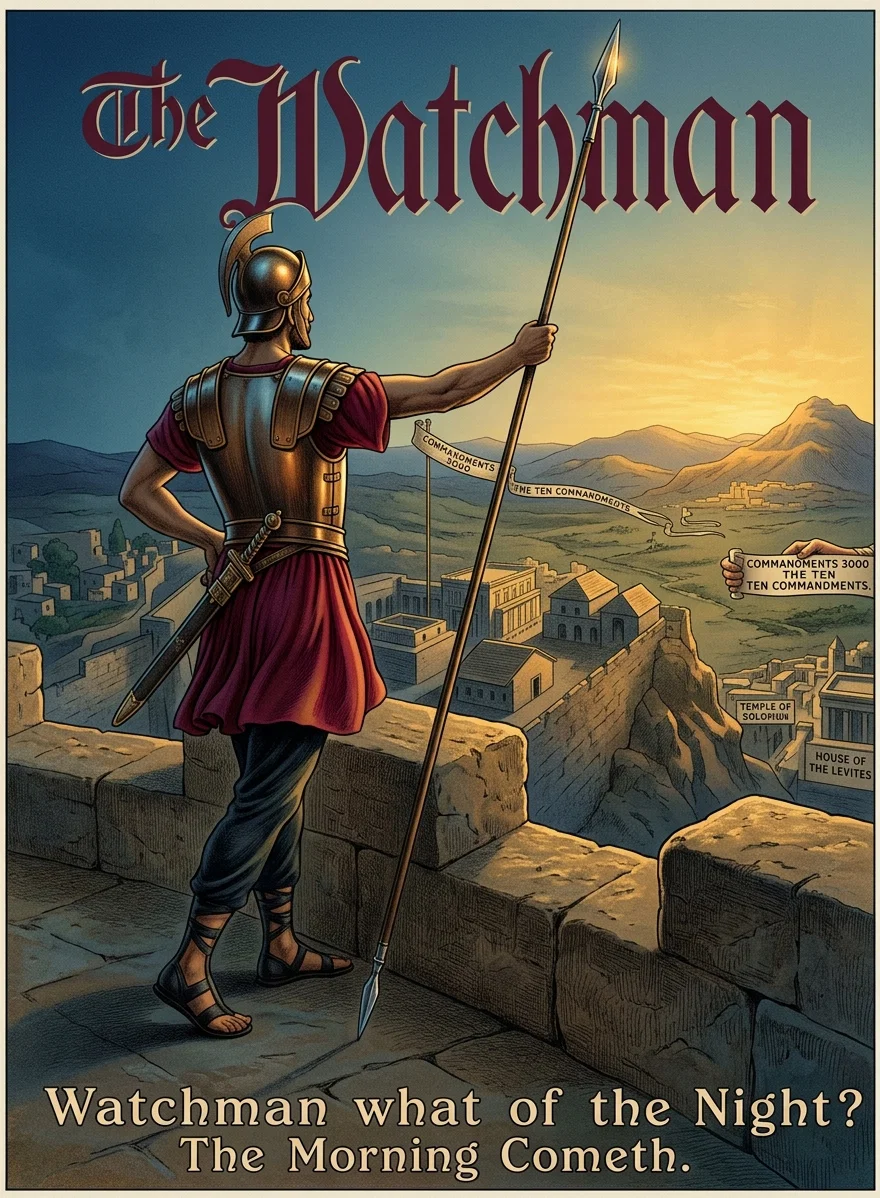
SPECIAL ISSUE                                     PRICE, TEN CENTS
The illustration opposite is a one-color reproduction of the attractive and impressive cover page of the special issue of the WATCHMAN to which editorial reference has recently been made in this paper. This good number of the WATCHMAN shows that the morning of eternity is about to break, and presents in clear, interesting language the stirring truths of the third angel's message. The power of the gospel is in its simplicity. In this issue the essential principles of faith which are to fit men and women to stand faultless in the presence of the Lord Jesus at his coming are forcefully presented in plain, concise terms. This is the best issue ever sent out by the Southern Publishing Association; it will win hearts to the message wherever it is faithfully circulated. The following titles indicate the subjects presented:— “The Morning Cometh”—L. A. Smith. “The Kingdom of Christ”—Mrs. E. G. White. “Immortality Through Christ”—J. S. Washburn. “Christ and the Sabbath,”—K. C. Russell. “The Platform of Truth”—Geo. I. Butler. “Missionary Progress a Sign of the End”—W. A. Spicer. “The Millennium”—R. W. Parmele. “An Important Work in Heaven”—C. B. Thompson. “Peace or War—Which?”—C. P. Bollman. “What Doth the Lord Require of Thee?”—Geo. I. Butler. “The Last Generation”—S. N. Haskell. “Armageddon”—P. T. Magan.
One page presents the Law of God beneath a beautiful three-color picture of Mt. Sinai and the Israelite encampment; in a panel on either side are appropriate texts from both the Old and the New Testaments, while at the bottom of the page is a most noble statement in regard to the Law from the Rev. George Elliot. On the opposite page will be found the testimony of ten eminent church authorities in regard to the fourth commandment.
SOUTHERN PUBLISHING ASSOCIATION, NASHVILLE, TENN.
There are twenty-four attractive pages, with several beautiful illustrations in colors; the cut at the bottom of this page is from one of these. This number bears date of issue Dec. 24, 1907.
The distribution of such a paper as this is one of the most effective ways of placing present truth before the people. This opportunity of doing real missionary work on a self-supporting basis should be prayerfully considered and improved by scores of our brethren and sisters in every conference in America. Those who are working with this issue find that it sells very readily at ten cents a copy. A neat ribbon badge will be sent free, if requested, to any one ordering fifty or more copies.
“It is far ahead of any you have previously published.”—O. F. Dart, Field Missionary Agent, South Carolina Conference.
“I am very anxious to get to work selling this best number of the WATCHMAN I ever saw. I expect to sell thousands of this most glorious paper.”—Washington Morse.
“I expect to sell one thousand or two thousand copies. I think it is the best for the people that has yet been published.”—Alphonse Favel.
“I received 100 specials today, and sold 80 in four hours.”—Elma Pennock, who is selling several hundred copies every week.
The Judgment Message. Rev. 14:6.

5,000 Agents Wanted.

Sample copies                                                     $ .10 In quantities less than 100, to one name and address, each         .05 100 to 499 copies, to one name and address, each                   .04 500 or more copies, to one name and address, each                  .03½ 10 or more mailed direct to lists of names and addresses, each     .06 50 copies, $2.50; 100 copies, $4.00; 200 copies, $8.00; 500 copies, $17.50.

Orders Should Be Sent at Once

Orders Should be Sent at Once. Send Through the Local Society, the Conference Office, the Nearest Publishing House, or Direct to THE WATCHMAN, NASHVILLE, TENNESSEE

Vain Repetitions

It was not against repetitions in prayer and praise that the Saviour warned his disciples, but against “vain repetitions.” In heavenly vision John heard “four living creatures” offering their worship before the throne, and he says of them that “they have no rest day and night, saying, Holy, holy, holy, is the Lord God, the Almighty, who was and who is and who is to come.” This was continual repetition, but not vain repetition, for every time the form was used, it was filled with a greater fulness of meaning, and became the channel for a larger expression of their appreciation of the attributes and character of the King of kings. So it may be in our worship. The question of vain repetition may turn upon the frame of mind in which we present our expressions of praise and thanksgiving, rather than upon the mere form of words. “The heathen looked upon their prayers as having in themselves merit to atone for sin. Hence, the longer the prayer the greater the merit. If they could become holy by their own efforts, they would have something in themselves in which to rejoice, some ground for boasting. This idea of prayer is an outworking of the principle of self-exaltation which lies at the foundation of all systems of false religion. The Pharisees had adopted this pagan idea of prayer, and it is by no means extinct, even among those who profess to be Christians. The repetition of set, customary phrases, when the heart feels no need of God, is of the same character as the ‘vain repetitions’ of the heathen. . . . The most eloquent prayers are but idle words if they do not express the sentiments of the heart.” - “The sacrifices of God are a broken spirit: a broken and a contrite heart, O God, thou wilt not despise.”

Proposed Sunday Laws

THERE is a determined purpose to induce Congress to pass some kind of a Sunday law. During the fifty-ninth Congress six Sunday bills of one kind and another were introduced, but for one reason or another only one of them was reported for passage either in the Senate or in the House. The sixtieth Congress began its first session on Monday, Dec. 2, 1907, and on December 5 two Sunday bills were introduced into the House, and on December 9 another was introduced into the Senate. How many more will be brought forward before the present session closes it is impossible to tell, but if we may judge by the number presented in the short time since its opening, we may not be surprised if the list of four is larger than ever before.
Two of the bills now before Congress are practically duplicates of those previously introduced by the same men. One of these is entitled “A BILL prohibiting labor on buildings, and so forth, in the District of Columbia on the Sabbath day,” and it provides “that no labor in constructing buildings, or railroads, or hauling material therefor, shall be permitted in the District of Columbia on the Sabbath day.” The religious character of this bill is evident both from the title and from the section quoted. It forbids certain kinds of labor “on the Sabbath day.” But why forbid honest toil “on the Sabbath day”? The answer is found in the fact that the Sabbath is a religious institution. But any legislation which is enacted in behalf of a religious institution is necessarily religious legislation, and is one step in establishing religion. And the inevitable result to which the passage of this bill would lead may be readily understood when we remember that among those who profess the Christian religion there is a controversy as to which day is the Sabbath, and this would make it incumbent upon the courts, in interpreting this legislation, to decide which is the Sabbath and thus to settle a religious question. This is not the function of Congress or the courts, whose jurisdiction extends to civil matters only. This bill is so glaring a violation of the principle of the separation of church and state that it is not at all likely that it will pass—at least not in its present form.
Much more plausible in its nature and much more likely to receive favorable consideration is “A BILL to further protect the first day of the week as a day of rest in the District of Columbia,” the provisions of which are as follows: “It shall not be lawful for any person to keep open any place of business or maintain a stand for the sale of any article or articles of profit during Sunday, excepting venders of books and newspapers, apothecaries for the dispensing of medicines, and undertakers for the purpose of providing for the dead, or others for the purpose of charity or necessity; nor shall any public playing of football or baseball or any other kind of playing, sports, pastimes, or diversions disturbing the peace and quiet of the day, be practised by any person or persons within the District of Columbia on Sunday; nor shall any building operations or work upon railroad construction be lawful upon said day.”
While not so baldly expressed in its terms, yet this bill is just as certainly religious legislation as is the one already mentioned. Its purpose is “to further protect the first day of the week as a day of rest.” It is plainly in the interest of a religious institution. It makes certain acts a crime when performed upon Sunday, although honorable in themselves and not forbidden upon other days of the week. The only possible reason for seeking such legislation as this is because its promoters regard Sunday as being different from other days, and wish to compel others to treat it in harmony with such a view of it. But the alleged difference between Sunday and other days is based wholly upon religious belief, and legislation which tends to force an acknowledgement of this difference is religious legislation and an invasion of the rights of conscience.
The true character of the bill is made doubly clear by a provision in section two, which reads thus: “It shall be a sufficient defense to a prosecution for labor on the first day of the week that the defendant uniformly keeps another dayof the week as a day of rest, and that the labor complained of was done in such a manner as not to interrupt or disturb other persons in observing the first day of the week as a day of rest.” This clause plainly shows that it is the real purpose of the bill to compel every person to keep some day of the week as a day of rest, a sabbath. It is evidently the expectation that the large majority will keep the first day of the week, but the keeping of some other day, under certain restrictions, is tolerated. Certain facts about this half-way exemption clause, however, should not escape notice: it does not prevent the observers of another day from being arrested and brought into court, but simply affords a possible ground of defense; it does not therefore shield from the stigma of being treated as a criminal even those who do observe another day; it makes it possible for a person of one religious belief to do on the first day of the week what the bill makes a crime for a person of another religious belief to do on the same day; it does not protect those who observe another day from being disturbed by the public labor of those who observe the first day of the week; and it makes it possible for “other persons” who observe the first day of the week to destroy all the benefit of the clause, so far as observers of another day are concerned, by simply insisting that they are interrupted or disturbed by the labor complained of. And it should not be forgotten, with all the rest, that the power to enact such a law with an exemption clause involves the power to enact the same law without the exemption clause; and that where freedom has been enjoyed, a law compelling a religious observance, even with an exemption clause attached, is a long step toward oppression.
This bill, with its peculiar exemption clause, is a remarkable likeness of some of the religious legislation of the old colonial days, when there was a complete union of church and state. In 1692 the General Court of Massachusetts “enacted a law requiring each town to have a minister for whose support the inhabitants of the town should be taxed.” Later an act was passed exempting Baptists and Quakers from these taxes provided they “usually attend the meeting of their respective societies assembling upon the Lord’s day for the worship of God, and that they lived within five miles of the place of such meeting.” The colonists believed in religion enforced by law, and did not attempt to conceal their purposes under fair speeches about a “civil sabbath,” or by using the civil circumlocution, “the first day of the week.” Their frankness is at least honest and refreshing. But how can those who profess to believe in a separation of church and state consistently enact exactly the same kind of legislation? Is it not perfectly clear that in doing so they really abandon the doctrine of separation and espouse the cause of union?
This bill has been twice approved by the Commissioners of the District of Columbia, and its promoters are quite hopeful that it will pass. An effort will be made to secure a hearing on it before the House Committee, to which it has been referred, and we hope that the opportunity may thus be afforded to present the true principles bearing upon the whole subject of Sunday legislation.
In the Senate a bill has been introduced “to prevent Sunday banking in post-offices in the handling of money-orders and registered letters,” which provides “that the issuing and paying of money-orders, and the registering of letters and delivery of registered mail on Sundays, is hereby prohibited in the mail service of the United States.” The religious character of this bill is not so readily perceived as in the two already mentioned, but the principle of Sunday legislation by Congress is involved in it, and, if passed, will serve as a precedent for enactments of a more pronounced nature which are sure to be urged later. It will be altogether safer to leave the regulations of the post-office department to the proper officials of that department, rather than for Congress to place upon the statute-books a law which, in fact if not in terms, recognizes Sunday as the Sabbath.
We hope that there are still men enough in Congress who will be true to the principles of religious liberty so that no Sunday bill will be passed.

Editorial

There is only one condition upon which we may have peace with God, and that is by an unconditional surrender. On any other basis we shall say, “Peace, peace; when there is no peace.”

The Cost of Victory

WHILE Jesus Christ was our example in righteous living, he was also our example in the manner of achieving success in our undertakings for God. He emptied himself of all that he had save the love that bound him to the Father and to the human race, relinquished everything but sonship in the house of God, and gave himself to and for the salvation of this prodigal world. The key to his success was found in complete surrender. The key to our success will be found in the same act—surrender, not of that which we have, but of all,—all that we have and all that we are.
Because Christ had no other ambition than to save man and man’s forfeited possession, the tempter had no hold on him—“found nothing” in him, and the greatest work of the ages was therefore successfully done. The degree of our interest in the things of this world will determine the degree of ease with which Satan can successfully tempt us. Christ’s undertaking was a success because every other interest was abandoned for its accomplishment. It was a large price to pay; but it was no larger price than the greatness of the undertaking warranted and required. If we deserve success in the work of God as he deserved it, we shall not fail of achieving it.
Man has been left an example that he “should walk even as He walked.” Christ walked in the way that led to success. It is not to be supposed that men can take any other way, any shorter cut or easier way, and find success in carrying on the work which Christ commissioned them to do. Success does not lie in opposite directions when carrying on the same work. What was necessary to success in his case is necessary to success in our case. That was surrender.
Why is surrender necessary?—“Because the mind of the flesh is enmity against God; for it is not subject to the law of God, neither indeed can it be.” Rom. 8:7. Instead of retaining the “mind of flesh,” and letting that rule, “Let this mind be in you, which was also in Christ Jesus.” God and man can not work together for the accomplishment of God’s purpose while man is at enmity with his Maker, nor while man chooses his own way in preference to God’s way. There must be unity of desire and purpose, and the one who is to carry the message must be submissive to the will of the One who has the message to be given. The one who is to use the power must use it in harmony with the will of the One who has the power to bestow, or the power can not be intrusted to him. The one who would be a successful Christian must not set up standards of his own or mark out ways of his own. There can be but one true standard, and Christ has set that up. He has set before us but one way, and that leads straight into the kingdom of God. Outside of that way is only the great “mystic maze” planned to bewilder and delude and lead to destruction; and yet how many are allowing their feet to be guided into these delusive ways whose end is hid in darkness, where ruin waits.
We must be in the channel of God’s working or we can not succeed in his work. Outside of that channel we have only our own feeble efforts. The canal barge will not travel overland. Outside the canal it is stranded. Just so with us. When we have not surrendered our ways to God’s ways, we are as useless for God’s work as the stranded canal barge is for fulfilling its mission. The tower of Babel was such an effort; and it stopped a long way short of heaven.
Paul, living in a generation of philosophers, and educated to the height of scholarship, determined to know nothing in his evangelistic labors but “Jesus Christ and him crucified.”He had a way, but he surrendered it when he found it was not God’s way. There are many ways of our own that look pleasing to us. Hew them to the line of God’s counsel, and you will find the process has left nothing of them that is of real advantage to the cause of God. “Can two walk together except they be agreed?” That question is pertinent to this thought. God’s way is the right way; that way which is opposed to his way is necessarily a wrong way. There is no agreement between these ways; and as there is not, there can be no harmonious action between those who are taking these opposing ways. We can accomplish nothing for God, and therefore can not be successful Christians, while opposing him by refusing to yield to his way.
Whatever we retain to ourselves for our own ends stands in the way of our success in his cause. Paradoxical though it may seem, in surrendering all, we win all; we capitulate, and that makes us victors. Hoarding ourselves and our all to ourselves, we lose all—and ourselves; refusing to surrender, we take our place among the vanquished. In the complete surrender of self, the complete adoption of God’s ways in place of our own, the consecration of our all to his cause—herein lies the key to glorious triumph in the cause of Christ.
C. M. S.

The Personal Experience

While John Wesley and his associates in Oxford had won the name of Methodists by their piety and devotion, it was Spangenburg, the Moravian associate of Zinzendorf, who turned Wesley’s thoughts into the channel that led directly to the great revival of personal religion that characterized the early years of Methodism.
Wesley had come to America, under a Church of England society, to labor for Europeans and Indians in the Georgia Colony. There Spangenburg met him.
“Do you know Jesus Christ?” asked Spangenburg. “I know he is the Saviour of the world,” replied Wesley. “True; but do you know he has saved you?” “I hope he has died to save me.” “Do you know yourself?” “I do.”
With this Spangenburg left him. Wesley felt that by such direct and personal and abrupt questions Spangenburg was rather unfair. But as he thought the matter over, the idea of personal experience in the forgiveness of sin and the assurance of it began to work. Wesley found the Saviour—his Saviour, and the Great Revival was born in his soul.
Luther was prepared for the work of the Reformation, not merely by study of the doctrinal side of justification by faith, but, above all, by the personal experience in the doctrine. He had struggled under the burden of his own guilt, wrestling in agony over his sins. When that text, “The just shall live by faith,” came to him as a living word it wrought reformation in his own heart, and he was prepared to preach reformation truth to others.
We are never to allow gospel truth to become a mere theory. It is a personal experience in those that believe—something that we can submit our lives to anew every day. Every day those who may have been long in the way are to talk with the Lord and pledge the heart’s service to him in personal and actual fellowship with a personal Saviour whose sustaining grace and assurance of acceptance we need to-day just as much as the first day we found him.
Paul never outgrew the simplicity of personal experience, and hence never became a backslidden formalist. “Who loved me, and gave himself for me,” was the key-note of his message of a personal Saviour.
“Happy is he that hath the God of Jacob for his help, whose hope is in the Lord his God.” Ps. 146:5. It is not enough that he is the “God of Jacob;” he must be to the believer “his God,” as well.
W. A. S.

Note and Comment

A Jew as Mayor of Rome

CATHOLIC journals and Catholic leaders in general are shocked and convulsed over the fact that a Jew has been elected mayor of the city of Rome. To add to the perturbed state of Catholic feeling, the new mayor has held the highest office in the grand lodge of Masons in Italy. The Freeman Journal declares that the situation “is absurd, monstrous, anomalous, incredible—but there it is, and what will come out of it is a perilous secret to be revealed in the near future.” The papal official organ, Osservatore Romano, says this of the situation:—
To impose on the city of Rome a mayor who is an Israelite and former grand master of Free Masons is a brutal and outrageous expression of the “bloc’s” program. [He was elected by a vote of the aldermen.] The struggle is not only political, but religious as well, in this war declared against the Eternal City, its faith, its traditions, and the sentiment of its true sons now tyrannized over by foreign sojourners in the city. An Israelite and Free Mason mayor, prejudiced against the administration of this Catholic municipality is an audacious provocation against the sentiments of Catholics throughout the world, an outrageous offense to our city, and an indelible stain on us all.
The “bloc,” to which the journal above quoted refers, was a coalition of all the municipal parties against the Clericals to prevent the latter from evading the state laws in matters of educational and religious establishments. “With a formidable clerical majority in the city government,” says the American Israelite, “it has heretofore been possible to conduct certain municipal departments somewhat after the fashion of the days of Pius IX, national laws to the contrary notwithstanding.” In this, as in many other things, Rome is reaping what she has sown. It certainly is an anomalous condition that the very heart of the papacy, in a city ninety-five per cent Catholic, a representative of that race most despised by Roman Catholicism should be elevated to the highest honor in the gift of the municipality. But it was due to the high-handed operations of the representatives of the hierarchy.

Coming to the Real Issue

THE American Federation of Catholic Societies has set for itself one great task which it does not propose to abandon, that is, the support of Catholic parochial schools by public taxation. At each annual meeting of the society, it reiterates its purpose to accomplish the undertaking. A direct attempt to bring this about was made at Middletown, Conn., recently, when Rev. Dr. Donovan, rector of St. John’s Roman Catholic church, made to the citizens of that town the following proposition: That his parochial school be accepted for public school purposes; that the city pay for the use of these buildings a yearly rental of $4,800; that he supply the teachers. The teachers, would, of course, be such teachers as he employs in the parochial school—nuns or monks; and this arrangement would put into the Catholic rector’s hands the entire control of the school while its support is provided for out of the public treasury—an attempt to secure public support, by public taxation, for schools owned and operated by the church. It was a bold proposition, the opening gun of a great campaign. The proposition was rejected, but not by a great majority—934 to 653. Said Bishop McQuaid, of Rochester, N. Y., as far back as 1875: “We are going to have a desperate struggle on this question [support of Catholic schools from public funds] all over this country for the next generation.” In 1888 the Freeman Journal said: “The Catholic attitude on the school question is uncompromising. . . . The state has no right to educate, but every right to protect itself against parental carelessness. . . . As Catholics we can not allow the state either to teach sectarianism to our children, or to increase a school system, of which we can not approve, with our money.”Therefore this proposition of Dr. Donovan’s is in perfect harmony with the declarations above quoted, and is an attempt to carry into execution the avowed purpose of the American Federation of Catholic Societies, which they declare they will never abandon.
Continue reading: One Hundred and Fifty Thousand Dollar Fund