Your ShelfYour Projects

Signs of the Times, Vol. 27, No. 14.

A CERTAIN SAMARITAN” “HAD COMPASSION ON HIM

Signs of the Times

Apr 3, 1901

Pacific Press Publishing Company · Oakland, California · Apr 3, 1901

“A CERTAIN SAMARITAN” “HAD COMPASSION ON HIM.”
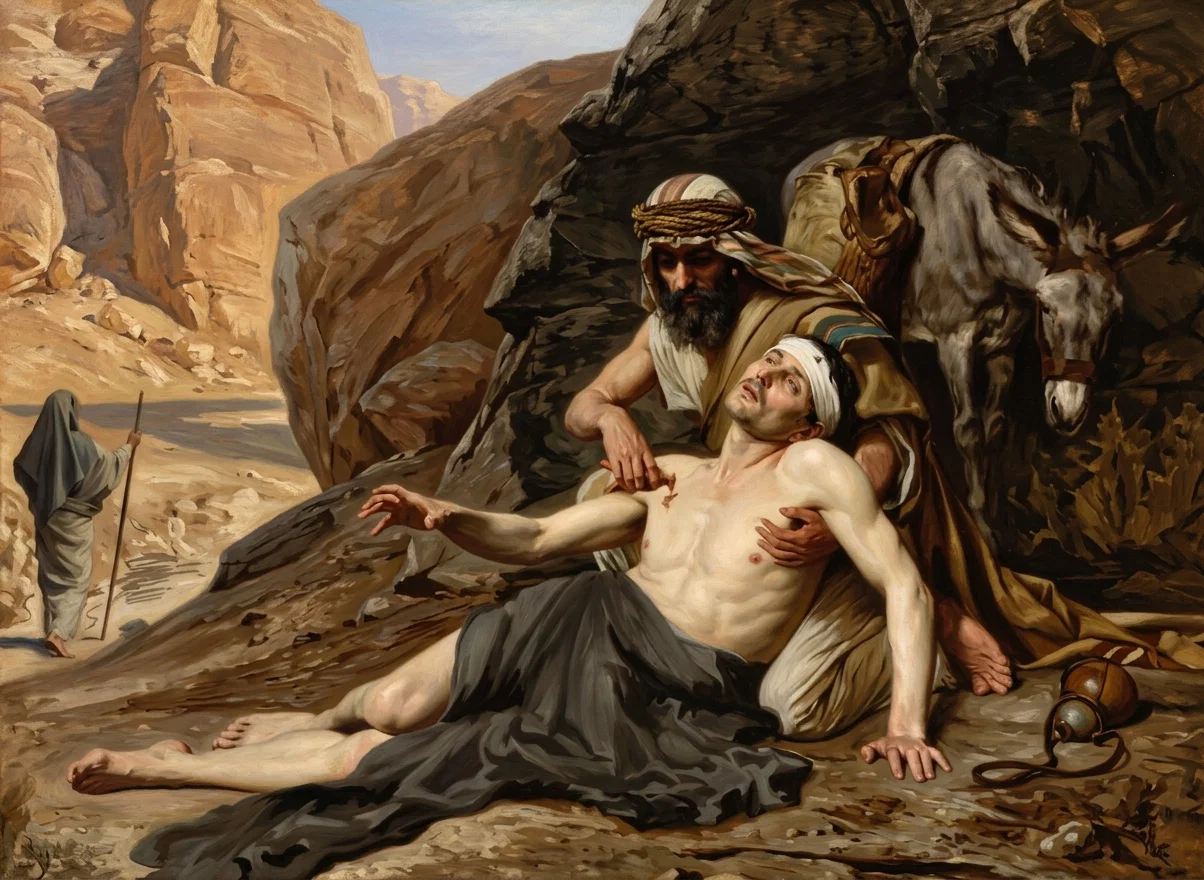
ABOUT twenty miles northeast from Jerusalem is the town of Jericho. Between Jericho and Jerusalem is a dense wilderness that has ever been the haunt of robbers.
IT was along the road in this robber-infested wilderness that the good Samaritan found the unfortunate Jew that had been robbed and supposedly killed. The story of it is in the next paragraph.
“But a certain Samaritan, as he journeyed, came where he was; and when he saw him, he had compassion on him.” Luke 10:33.
“A certain lawyer stood up and tempted Him, saying, Master, what shall I do to inherit eternal life? And He said unto him, What is written in the law? how readest thou? And he answering said, Thou shalt love the Lord thy God with all thy heart, and with all thy soul, and with all thy strength, and with all thy mind; and thy neighbor as thyself. And He said unto him, Thou hast answered right; this do, and thou shalt live. But he, desiring to justify himself, said unto Jesus, And who is my neighbor? Jesus made answer and said, A certain man was going down from Jerusalem to Jericho; and he fell among robbers, which both stripped him and beat him, and departed, leaving him half dead. And by chance a certain priest was going down that way; and when he saw him, he passed by on the other side. And in like manner a Levite also, when he came to the place, and saw him, passed by on the other side. But a certain Samaritan, as he journeyed, came where he was; and when he saw him, he was moved with compassion, and came to him, and bound up his wounds, pouring on them oil and wine; and he set him on his own beast, and brought him to an inn, and took care of him. And on the morrow he took out two pence, and gave them to the host, and said, Take care of him; and whatsoever thou spendest more, I, when I come back again, will repay thee. Which of these three, thinkest thou, proved neighbor unto him that fell among the robbers? And he said, He that showed mercy on him. And Jesus said unto him, Go, and do thou likewise.” Luke 10:25-37, R.V.
THIS poor man that had been robbed and left by the roadside for dead was in need of a real neighbor. He needed some one just then that would recognize in him a member of the human family in a distressing and perilous condition. He needed some one whose heart was overflowing with loving-kindness toward his fellow-men, regardless of race, or nationality, or family relationship. And just such help came to him in the person of the good Samaritan, else the unfortunate man would soon have perished.
THE priest who passed the man in this dying condition was the person who, of all others, should have had his life so bound up in love for humanity that he would have been able to think of nothing else but to help him. The Levites were specially appointed to do the service of God; then how could this son of Levi so disgrace his Master as to leave a sufferer without the needed help? It was left for the Samaritan to act the neighbor’s part.
THAT Samaritan was considered, by the priest and the Levite, asan outcast. They considered themselves so much superior to him that they would have no dealings with him. But when the Saviour presents his real character, how superior does the neighborly Samaritan appear! How sharp is the contrast between an empty, soulless profession and the real life that is representing the law of God, and thus spreading blessings wherever it goes!
THIS parable of the good Samaritan shows that we should not be satisfied with a mere profession of godliness. The priest and the Levite made their profession so strong and so prominent as to be even obnoxious. But the Samaritan without making any particular demonstrations acted the part that every one will act who has the Christ-principle alive in the heart.
THE priest and Levite had all there was to an outward show of piety. They made an open spectacle of the wires and all of what they thought to be the paraphernalia of divine power; but those wires were not connected with the throne of God, and so the heavenly currents were wanting. These men were conspicuous because of their appearance of piety, and they were masters of all the fine-spun arguments that the scholasticism of that time had invented with which to befog and bewilder the minds of men. But their arguments could not convince and convict, and lead to the reforms that build a right character, for they lacked the power of real life.
WE may dispute much and imagine that we are doing valiant service for Christ; we may preach often, and write continuously, regaling ourselves with the thought that we are eloquent, or witty, or something of the kind, but no soul is converted. Our arguments are controverted by the infidel, and the crowds applaud him. But who ever saw or heard of any one that even cared to do aught else than to commend and admire the life that is represented by the Samaritan? All of which shows us that there must be the life of power and then every word will be with power.
T.

CHRIST, OUR GREAT HIGH PRIEST.

The word “priest” is of very ancient origin, and signifies a prince or minister. The necessity for a priesthood is founded in sin. Having violated the law of the Most High, and so denied themselves access to His presence, men have invariably felt the necessity of some intercessory power before that holy tribunal to which they no longer dare approach. The object in securing such an arrangement is to provide, in the presence of God, a representative who may there offer acceptable prayer and praise, with their proper accompaniments of sacrifice.
The office of priest also includes, under some circumstances, the mission of representing God to the beclouded minds of men. Before the development of the Hebrew nation, we read of Melchizedek, who was “priest of the most high God.” Gen. 14:18. But it is gathered that, even tho this man held an exalted office as principal priest, others acted as priests in a lower capacity, tho they were not organized into a caste. It seems that these included the chief, or head, of each family, and descended with the birthright to the first-born son.
But after Israel came out of Egyptian bondage, God chose to relinquish His claim upon the first-born, and so transferred the priesthood to a certain tribe, which had its origin in Levi. The first one to be called in this line was Aaron, who was made head director of the entire order, by virtue of which was established the title of high priest among men.
The work of a high priest being made to include the offering of gifts and sacrifices, it was necessary for Christ to have an offering of this nature with which to carry forward His work in the heavenly priesthood. Heb. 8:3. This He fully provided thru the richest gift conceivable, which was nothing less than the sacrifice of Himself. By this gift His blood became a priceless remedy, by which stains of guilt might be washed from sinful hearts. Eph. 5:2; Heb. 9:14.
Being then raised from the dead, to sit at the right hand of the Majesty in the heavens (Eph. 1:20; Heb. 8:1), He entered an “unchangeable priesthood,” and became the heavenly Representative of no one needy nation alone, but of every individual, in every nation, for whom His life had been sacrificed, even of an entire race (Heb. 2:9). He was therefore constituted the “Captain” of our salvation (verse 10), and the “High Priest” of our profession (Heb. 3:1), being the “Author of eternal salvation” to those who obey Him (Heb. 5:9).
Christ did not become a high priest in the order, or line, of Aaron. This was impossible, because Aaron belonged to the tribe of Levi, and Christ was born of the tribe of Judah. In the earthly succession no one could be a priest who was not of the tribe of Levi. Then, again, the benefits of the Aaronic priesthood were only temporal, because typical, and were confined to those connected with the Hebrew nation, either by birth or adoption, whereas the benefits of Christ’s ministration were to extend to every nation. The first could not make the applicant perfect, hence was weak and unprofitable. Heb. 7:11, 18; 10:1. The heavenly High Priest must therefore be in the fullest sense “Priest of the most high God,” in order to make reconciliation for the sins of all the people. Heb. 2:17. He therefore became a priest “after the order,” or in the line, of Melchizedek. Heb. 6:20.
In all the ministration of the earthly priests, their continued offerings had no virtue by which to remove sin. But the one offering made by the Son of God is able to perfect those who set themselves apart for this purpose. Heb. 10:11–14. Then there is consolation in the thought that, no matter how long we may live, our cases will not have to pass into the hands of another and strange priest, because the one to whom we had first intrusted them has died. No; His is an unchangeable priesthood, and so continues forever. For this reason He is able to press our cases to a successful issue, no matter how long a time they may cover because of our indefinite continuance in life. This makes it certain that He is able to save “to the uttermost” those who come to God thru Him. Heb. 7:23–25.
But, as our everlasting Captain in the plan of salvation, His voice must be heard and His word obeyed by every one who would be certain of success; for the reason that, being the Author, or Cause, of eternal salvation, He fully understands our needs, and is therefore eminently worthy to be recognized as our heavenly Chief and victorious Leader.
J. O. CORLISS.

THE THEOCRACY OF ISRAEL.

THEOCRACY is government directly by God; and God governs by a law that appeals to the conscience of every man. The theocracy of Israel was established, that, being freed from the despotism of their fellow-men, self-government—the reign of conscience—might be restored to as many as would accept it.
Israel was chosen as the people to whom this government was to be given, but none were debarred from its benefits. “One law and one manner shall be for you, and for the stranger that sojourneth with you.” Num. 15:16; 9:14. Citizenship in Israel was open to every one, but was not forced upon any. Only such as did so of their own choice left Egypt; and not one was forbidden to return to Egypt, or to cast in his lot with another people. God’s government is always and everywhere “by the consent of the governed.”
Such officers as were necessary to administer the affairs of government were chosen from among the people; they were part of the people, personally known to them, and knowing them personally. They were not lords, but servants, chosen to minister to and for their brethren. Israel was, in no political sense, a nation. It was, first of all, a church—“the church in the wilderness.” In a secondary sense, it was a confederation of tribes—of families, with such tribal government as was necessary for the defense of equal rights. The law-making power was very close to the people, and each individual was subject to a law appealing directly to his own conscience.
Every man consents “unto the law of God that it is good.” This is true alike of Jew and Gentile; for even the heathen retain a trace of the divine law written in their hearts. “For when Gentiles which have no law do by nature the things of the law, these, having no law, are a law unto themselves; in that they show the work of the law written in their hearts.” Rom. 2:14, 15, R.V.
This being true, living in harmony with God’s law is self-government. “I will walk at liberty,” the psalmist says; “for I seek Thy precepts.” And this is just what every man was offered under the theocracy,—liberty; an opportunity to govern himself; to live under the reign of his own conscience.

The Law of Liberty.

Human wisdom is incapable of devising as perfect a system of self-government as that which God gave to Israel; because self-government is impossible without a law able by its own inherent moral power to speak to the heart of every man, testifying to every soul what is right, and fastening conviction of sin upon the conscience of every transgressor. This only the law of God can do, because only that law is perfect. Self-government is liberty; but liberty is possible only within the “law of liberty,” which is the law of God.
It is true that in Israel provision was made for the summary punishment of such as did evil to their fellow-men—or, it might betterbe said, that in Israel provision was made for the protection by force of the rights of the weak against the aggressions of the strong. But this does not affect the truth that true theocracy is self-government under the divine law. No considerable community of human beings ever long existed in which it was not necessary to restrain by fear of summary punishment such as would not govern themselves so far as to require them to respect the rights of their fellows.

Why God Committed Civil Government to Men.

The instinct of self-preservation leads men to safeguard their own rights, and this God has wisely ordered. Had the Creator reserved to Himself this part of government, after the fall of man, one of two things must have happened,—either punishment for every invasion of human rights would have been so certain and so swift as to have terrorized evil-doers, to the extent of destroying in a measure their free moral agency, or else vengeance would have been so long delayed as to have afforded practically no protection to those who needed it.
Nor does this in any way trench upon the right of self-government. God respects the rights of every man, and He requires each to respect the rights of his fellows. Were it otherwise, there would be no such thing as rights, but only privileges. Every man’s conscience consents that this is just; therefore to do this, to respect the rights of others, is not vassalage, but liberty. It is self-government—the reign of one’s own conscience.
But as some are so constituted that they will not regard even those rights of others which their own consciences tell them they ought to respect; and as these rights must be safeguarded in order to preserve to all equally the right of self-government, those who will not govern themselves touching the rights of others, must be governed in this thing. If they will not yield to the demands of conscience in this respect, they must be restrained by fear of summary punishment. And this not for vindication of the divine law, but for the preservation of human rights, which are all summed up in the right of self-government—the right to live under the reign of conscience; that is, in harmony with conscience.

Liberty of Conscience.

Never has the world seen so perfect a scheme of self-government as that given by the Lord to Israel. Except as touching the rights of others, under the original theocracy the individual Israelite was answerable only to God and to his own conscience.
“Speak unto the children of Israel, and say unto them, If any man of you bring an offering unto the Lord, ye shall bring your offering of the cattle, even of the herd, and of the flock. If his offering be a burnt sacrifice of the herd, let him offer a male without blemish; he shall offer it of his own voluntary will at the door of the tabernacle of the congregation before the Lord.” Lev. 1:2, 3.
Over and over again it is stated that the act of the worshiper, to be acceptable, must be “of his own free will.” Even in time of war only volunteers were accepted. “What man is there that is fearful and faint-hearted? let him go and return unto his house, lest his brethren’s heart faint as well as his heart.” (See Deut. 20:8 and Judges 7:3.) God accepts only willing service; and thus did He teach His people the same great principle, a principle so essential to sterling manhood.

This Was the Reign of Conscience.

All this the Creator did that men might have and practise self-government—self-control; that conscience might reign supreme. And this system developed a people of whom it is recorded more than forty years after they entered Canaan, that “in those days there was no king in Israel; every man did that which was right in his own eyes.” Judges 21:25. This was theocracy; this was self-government; this was the reign of conscience.
Nor was the development of individual character the only advantage of theocracy—self-government under the divine law; for under this system there could be no sudden and complete national apostasy, while under a monarchical system moral bankruptcy of the king meant immediate national apostasy; for of king after king is it recorded, “And he made Israel to sin.”
To sum up, therefore, in a single sentence, not only the theocracy of Israel, but all true theocracy, it may be said that it is self-government; God furnishing the perfect law which, by its own inherent moral power, speaks to each heart, and to which the conscience responds; with the result that, by beholding, the individual becomes changed into the divine image. Self-government, therefore, the reign of conscience, is the highest type of government, because it makes possible the highest type of manhood—manhood which exemplifies most fully the perfection of the divine character.
C. P. BOLLMAN.

OUR DUTY AS PARENTS.

PARENTS have not yet aroused to understand the amazing power of Christian culture. There are mines of truth to be worked that have been strangely neglected. This careless indifference does not meet the approval of God. Parents, God calls upon you to look at this matter with anointed eyes. You have as yet only skimmed the surface. Take up your long-neglected work, and God will co-operate with you. Do your work with whole-heartedness, and God will help you to make improvement. Begin by bringing the Gospel into the home life.
The Lord looks with sadness upon the families in which the parents have not educated and disciplined themselves for the work of training their children. Too often parents have little sense of their accountability. They allow their children to grow up with characters tainted by vice. While they sleep in godless indifference, Satan is sowing in the hearts of their children seeds which will spring up to bear a harvest of death. Yet often such parents resent counsel as to their mistakes. They act as tho they would like to ask those who offer advice, “What right have you to meddle with my children?” But are their children not God’s children also? How does He regard their wicked neglect of duty? What excuse will they offer when He asks them why they brought children into the world, and then left them to be the sport of Satan’s temptations?
Many seem to think that the declension in the church, the growing love of pleasure, is due to want of pastoral work. True, the church is to be provided with faithful guides and pastors. Ministers should labor earnestly for the youth who have not given themselves to Christ, and also for others, who, tho their names are on the church-roll, are irreligious and Christless. But ministers may do their work faithfully and well, yet it will amount to very little if parents neglect their work. It is to a lack of Christianity in the home life that the lack of power in the church is due. Until parents take up their work as they should, it will be difficult to arouse the youth to a sense of their duty. If religion reigns in the home, it will be brought into the church. The parents who do their work for God are a power for good. As they restrain and encourage their children, bringing them up in the nurture and admonition of the Lord, they bless the neighborhood in which they live. And the church is strengthened by their faithful work.
The work of forming the character of children, of properly preserving and developing their physical, mental, and moral powers, is no small task. It is chiefly upon the mother that this task devolves. To do this work as it should be done requires talent and skill and patient, thoughtful care. It calls for self-distrust and earnest prayer. Let every mother strive by persevering effort to fulfil her obligations. Let her bring her little ones to Jesus in the arms of faith, and tell Him of her great need, asking for grace and wisdom.
The mother should surrender herself and her children to the care of the compassionate Redeemer. Earnestly, patiently, courageously, she should seek to improve her own abilities, that she may use aright the highest powers of the mind in the training of her children. She should make it her highest aim to give her child an education which will receive the approval of God. As she takes up her work understandingly, she will receive power to perform her part.
Mothers, leave not your children to gain impressions of evil, impressions which can never be wholly effaced. Day by day imprint on their minds the lessons given by the Saviour. This is your work,—a work which no one but you can do. The home is your mission field. Here you are to work for God. Lay aside every weight and the sin which doth so easily beset, that you may engage as you should in the work of making your children what God would have them. Teach them self-control. Give them something to do. Make the home a school in which they will learn to help others.
There is untold value in industry. Let children be taught to do something useful. If parents are so occupied with other things that they can not keep their children usefully employed, Satan will keep them busy. Many parents allow their children to associate with evil companions, to go to questionable places of amusement, to grow up mischievous and idle. Let such parents remember that the sin of Sodom was pride, fulness of bread, and abundance of idleness.
It is the cry of many mothers, “I have no time to be with my children.” Then for Christ’s sake spend less time on your dress. Neglect if you will to adorn your apparel. Neglect to receive and make calls. Neglect to cook an endless variety of dishes. But never, never neglect your children. What is the chaff to the wheat? Let nothing interpose between you and the best interests of your children. Guard your physical and mental powers, that you may be able to dogood work for your little ones. Show your children that you are determined to be a Bible Christian. Dress modestly. Speak wisely. Be gentle, yet as firm as a rock to principle. Devote no time to needless cooking or stitching. Make your clothes and your food plain. Then you will have time for the culture of your children.
God will call upon you to give a strict account of the work you have done for your little ones. You make them what they are. They will either stand pure and undefiled before God, because you have worked faithfully for them, or, corrupt and defiled, they will be banished from His presence, because you have neglected your work.
Christ placed such a high estimate upon your children that He gave His life for them. Treat them as the purchase of His blood. Patiently and firmly train them for Him. Discipline with love and forbearance. As you do this, they will become a crown of rejoicing to you, and will shine as lights in the world.
MRS. E. G. WHITE.

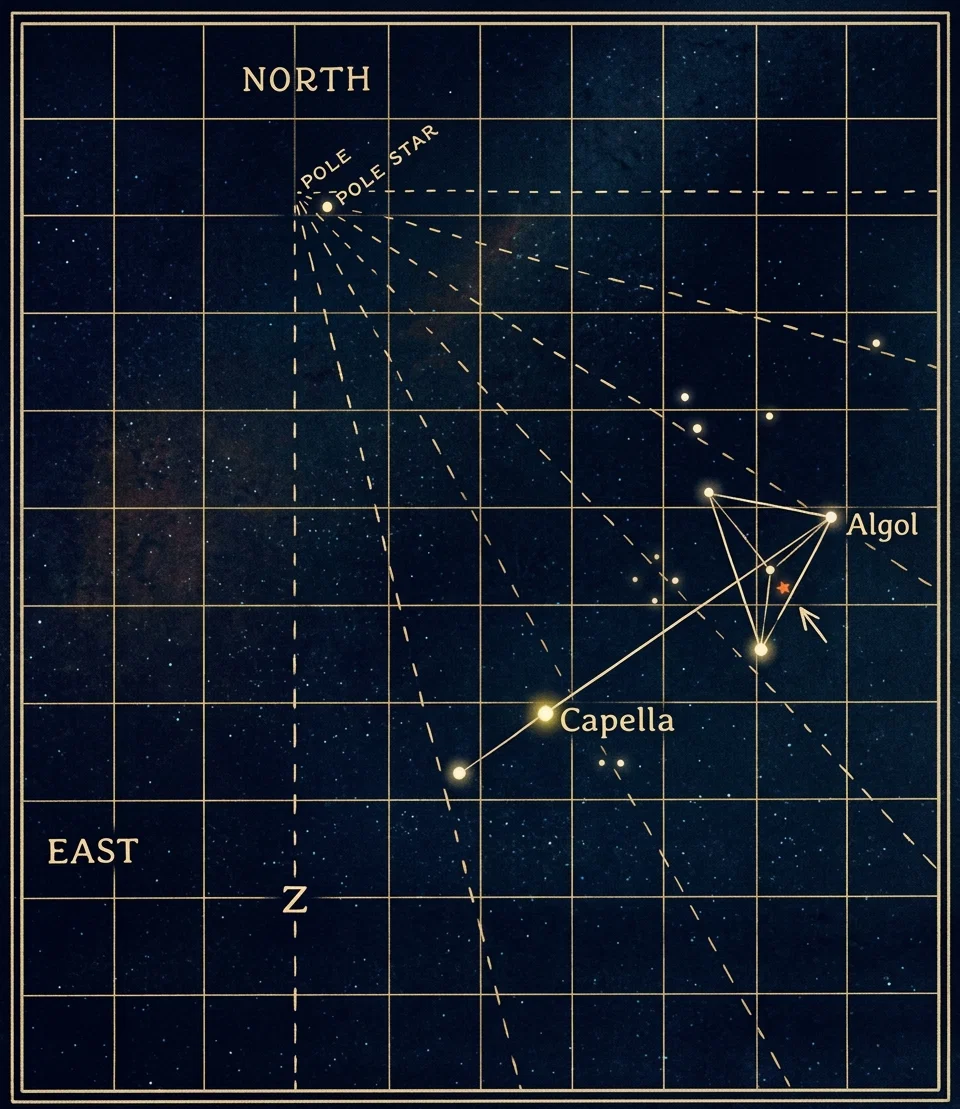
THE NEW STAR IN PERSEUS.

BUT the day of the Lord will come as a thief in the night; in the which the heavens shall pass away with a great noise, and the elements shall melt with fervent heat, the earth also and the works that are therein shall be burned up." 2 Peter 3:10.
Is it possible for the above prophecy to be fulfilled? The unbeliever may reasonably ask. No one ever saw our world burned up; therefore we can not appeal to history; but to argue that it never has happened would not be a new argument, for in 2 Peter 3:4 we read that men will say, “Where is the promise of His coming? for since the fathers fell asleep, all things continue as they were from the beginning of the creation.” Men reasoned this way in the days of Noah, as tho because a certain event did not occur during a certain hour, minute, or second of time, it never did, would, or could happen, reminding one of the witty remark of a certain Frenchman, who, speaking of a shallow reasoner, said that “he thought and reasoned like a fish.”
The occasion of this article is the sudden appearance of the new star, which is just now of such absorbing interest to astronomers, who are giving their united energies to make this shining example of a flaming world yield some of its mysterious secrets. Many of our great observatories are using all possible instruments and paraphernalia to pursue this latest phenomenon as long as it continues bright enough to give promise of results.
The new star will be known as Nova Persei, will be placed in the list of temporary stars, and will be numbered thirteen on the list of well-authenticated naked-eye cases; the first, “the star of Hipparchus,” 134 years B.C.; the last, Feb. 20, 1901.
Some of these have suddenly flamed up after having previously existed as small, insignificant stars, only to fade away again to about their former state, others have flashed into ephemeral glory only to dwindle down, down to utter extinction, so that they have passed beyond the ken of our mightiest telescopes; while some have appeared where no known star was ever known to be. Two, at least, have diminished in brightness, and have changed into small nebulae, that is, clouds of incandescent gas. The fate of the present star is, of course, unknown; it is not known at present (at least to the writer) whether or not it has ever had an existence on our best charts or negatives. It may have been one of the almost countless small stars known to astronomers, or it may prove to be entirely new. By new I mean only that it may have been unknown, and not that it was an entirely new creation.
At least seven of the well-known thirteen that have been discovered in the last 2,035 years, have appeared within the last century; but whether this is because they are more closely watched for, or are becoming more numerous, I do not pretend to say; only one of the seven mentioned was invisible to the naked eye at its brightest period, so the telescope had very little to do with the increasing number.
The present Nova will always rank very high on account of its great brilliancy; for, on the afternoon of February 24, or only four days after it had been photographed as a star of the tenth or eleventh magnitude, it was a half-magnitude brighter than Capella, according to the Lick Observatory astronomers. This marvelous increase of light will be better appreciated when I say that Capella has but two rivals in brightness in the entire northern hemisphere, while it requires a telescope of considerable power to even glimpse a tenth-magnitude star on a dark, clear night. It exceeded, for a few hours, all the stars in brightness except Sirius, the brightest star of all. Only one other of the thirteen ever attained the dignity of a first-magnitude star, that known as Tycho’s star, in Cassiopeia, in 1572, which became bright enough to be seen in full daylight, and has since often been called the “Star of Bethlehem.”
Naturally, we wish to know the reason of this marvelous increase of light. Several reasons have been offered to account for this sudden brightening of temporary stars; but I shall content myself by presenting two, which appear to me to be the best theories.
First, two suns or planets may have had a collision, dashing together with a high velocity. Should our earth, traveling, as it does, round the sun at a speed of eighteen miles a second—forty times faster than a cannon-ball—collide with another body of similar size and mass, there would be a mighty flash of light, while the heat developed would be great enough not merely to melt the two bodies, but they would be vaporized, and thereafter form a single mass of glowing vapor, the condition of thousands of heavenly bodies we see around us, and the astronomers on other worlds would suddenly have a new star in their skies; for our earth would be self-luminous.
If our own and another sun of the countless millions we see around us, should meet in a collision, they would meet the same fate but in a much greater degree, and because of their immensely greater mass would extend to and completely envelop their adjacent planets in a fiery mantle, that would in turn completely vaporize them, the whole becoming one mass, and merely adding one to the thousands and thousands of gaseous bodies that the astronomers call nebulae, and which may be found in every part of the sky.
The second theory is that two bodies may have approached each other so closely that the tidal effects produced by their mutual attractionwould easily account for all the phenomena observed in temporary stars. This is quite as simple as the first theory, but requires a more detailed explanation. It may be readily understood by an illustration taken from our daily experience of ocean tides. Just here I may remark that the theory of tides is to-day one of the most intricate problems confronting astronomers. I do not mean our insignificant ocean tides, altho the A, B, C of our ordinary tides is not thoroly understood; but I mean the far-reaching and stupendous tidal effects of double and multiple star-systems, and of star-systems in clusters, groups, and aggregations of which we know scarcely anything. Another La Place or Newton is needed to solve this grand problem. The tide-raising power, attraction, or pull of our moon upon a particle on the earth’s surface is such that a 4,000-ton weight at the surface, loses about one pound in weight when the moon is directly overhead. I here omit anything of the effect when the moon is underfoot.
Now the law governing the tidal wave, or effect produced between any two bodies, is this: “The tide-producing force of a heavenly body varies inversely as the cube of its distance and directly as the mass.” Taking, then, the moon and our earth, and the distance as 240,000 miles, the power of raising tides would be increased eight times each time the distance between the two bodies should be reduced to one-half. The tidal wave in mid-ocean is from two to three feet high; let us assume two feet; then if the moon and earth came within 120,000 miles of each other, or one-half of the present distance, the mid-ocean tide would be sixteen feet; if the distance is again reduced to 60,000 miles, the tidal wave would be 128 feet, and so on.
The specific gravity of the surface rocks of the earth is about three and one-half times that of water, but for the sake of simplicity we will assume four times; then if our earth was composed of melted rock, and the moon at 240,000 miles, the tides of melted rock would be one-fourth that of water, or six inches high; reducing the distance to 120,000 miles, they would be four feet high; at 60,000 miles, thirty-two feet; at 15,000, 2,048 feet; and at 5,000 miles the tide would be 55,296 feet high, a fiery wave of molten rock over ten miles high!
I have assumed here a molten earth. “Since the fathers fell asleep,” it has had an apparently stable crust. Only an earthquake now and then, or a volcano vomiting its red-hot grist of lava, has reminded us that we live upon a crust that is estimated by our most eminent thinkers and investigators to be only from 40 to 100 miles thick, which, if it should be subjected to a pull, or stress, or strain, such as the moon would give at the distance of 5,000 miles, or even more, would be elongated, and the earth would be pulled out of shape. Even if it were solid, which is almost unthinkable, it would be rent and crushed to powder, and the rocky crust upon which we live would not only be melted by the enormous heat produced by the friction of such an energy, but it would be vaporized. Both bodies would be merged in one, and form a fiery cloud of glowing gas, the very “elements” having been “melted,” yes, vaporized, by “fervent heat.” It seems to me that even Peter’s graphic prophecy hardly does justice to what would happen if ever our earth and moon should approach each other within a few thousand miles.
If two mighty globes like our sun should approach each other, the results would be the same, but in a proportionate degree; for “the tide-producing force of a heavenly body varies inversely as the cube of the distance, and directly as the mass.”
That some such catastrophe has overtaken our new star is at least possible. Passing, as it did, in about four days, from a tenth or eleventh magnitude, to brighter than the first-magnitude star, means an increase of light, and consequently heat, of not less than twenty thousand times.
One of the weakest points of these theories is that the temporary stars fade away so rapidly. Either theory will easily account for the increase; but the decrease seems unexplainable, unless we assume that the stars were converted into a nebula (as they were in two cases), and the nebula continued to expand until, by the very expansion, it would decrease in light, from the fact that the given amount of light would come from a larger area, and must consequently diminish in intensity, but not, perhaps, in amount.
Spectroscopic investigations have been undertaken at all our large observatories; but we must wait for weeks and probably months before they publish the results obtained by the giant instruments. The writer, with a star spectroscope of moderate power, has observed the star on several nights, and found the spectrum crossed by wonderfully bright hydrogen lines (the lines in all but a few stars are dark) greatly exceeding anything he had ever seen before, and indicating (indicating is too mild an expression; demonstrating would probably be nearer the truth) that the body was “wrapped in a mantle of incandescent hydrogen.” Should our sun meet with a similar experience to the new star, the heat, increased probably twenty thousand times, would vaporize this earth, if it did not altogether envelop it in the expanding gases, and thereby make it a part of the chaos of world-matter. Would the Creator permit this? Why not? Has He not said that “the elements shall melt with fervent heat, the earth also and the works that are therein shall be burned up”? Are our ways His ways?
The tendency of all hot bodies is to cool, eventually, and even our sun must cool in time. What is considered the best calculations give it something like five millions of years before it will become so cool that it will no longer shine. Then what? Five million years seems a long time to such an insect as man with his small power and great confidence in himself; but it is scarcely to be counted in eternity. Five million years will come as certainly as to-morrow morning. What would the solar system be without the light and heat of the sun? Life, as we know life, would be impossible; and science can see but one object in the system, and that is life, life as we know it.
There are millions of stars, and all the stars are suns; therefore there are millions of suns cooling—approaching the condition of things that means death to all life with which we are familiar. How many have already cooled? And of the millions of the hot ones, in past eternities, can it be otherwise than that there are millions of cold suns—suns that have reached old age, and expired, ceased from usefulness from mere lack of heat? What can dead suns and worlds do that is good from the standpoint of science or any other standpoint? What greater blessing than for two of these old, decrepit, worn-out suns or worlds, pursuing their cold, dark, trackless way in space, without the ability to give out the power of life—what better thing can happen than a sudden rushing together, and with this crash of worlds putting into each other the fire that makes life possible? Then new heavens and earths would result, and the worn-out matter would be as new and as pregnant with possibilities as it was “in the beginning.” “Behold,” Christ says thru John, “I make all things new.” Rev. 21:5. GAMMA BETA.
Continue reading: WATCHING