Your ShelfYour Projects

Signs of the Times, Vol. 39, No. 10.

SIGNS OF THE TIMES

Signs of the Times

Mar 5, 1912

Pacific Press Publishing Association · Mountain View, California · Mar 5, 1912

SIGNS OF THE TIMES
"IF YE WILL INQUIRE, INQUIRE YE."

This Inquirers' Department is conducted for the purpose of helping those who are studying the Bible. The answers are oftentimes only suggestive. They are never to be considered infallible, only as they agree with the infallible Word. The writer who may answer them does not consider that his opinion is infallible. He will simply give the best that he has, and plead with the inquirer to search the Word. Such questions only will be answered as, to the editors, seem to minister to the good of the readers and to the mission of the paper. We can not answer repeatedly in the same volume questions upon the same scripture. The name and address must accompany question, not for publication, but as an evidence of good faith, and that answer may be made by letter if deemed advisable. No letters are answered which do not contain the name of the writer. It is well always to enclose stamp for reply.

3681 — Trine Immersion

What authority is there in the Bible for baptism by trine immersion? Where is it found? What form of baptism was used in the apostles' time? Is there any other form recorded in history? When and where was the first single immersion practised? F. M. S.
1. There is no authority in the Bible for trine immersion, or triune immersion — that is, immersion three times. Some think that they find it in the formula given by our Lord in Matt. 28:19, “Baptizing them into the name of the Father and of the Son and of the Holy Spirit,” and so trine immersionists dip a part of the body three times face downward. That is, the candidate, with the administrator, enters the water about waist deep, and then dips three times forward. But if the text itself means trine immersion, they do not carry it out, because if it implies three burials it ought to be three burials of the entire body, but they bury only a part of the body once, and another part three times.
Baptizing into the three names does not refer to three baptisms, because there is but one baptism, as we are told in Eph. 4:5. The text in Matthew pertains to the office work of the three manifestations of the Deity — God the Father for character, the Son for humiliation and self-emptying and self-denial, the Holy Spirit for service. The New Testament later than this sums these all up into one baptism in the name of our Lord Jesus Christ.
2. The form of baptism used in the apostles' time is indicated first by the meaning of the word “baptizo,” to plunge, immerse, whelm; and secondly by what that baptism signified. The three great facts of Christianity are set forth in 1 Cor. 15:1-4 — death, burial, the resurrection. Baptism, as stated by the apostle in Rom. 6:3-6, sets forth the same three great facts: “We are buried with Him by baptism into death: that like as Christ was raised up from the dead by the glory of the Father, even so we also should walk in newness of life.” The form, therefore, of baptism, would be the form of burial — the candidate laid down in the watery grave as one who is dead would be, indicating burial.
3. There are other modes called baptism recorded in history. Trine immersion began away back in the early days. So also did sprinkling and pouring.
4. We do not know where the first single immersion was practised. We are told by some that it was common for the Jews to baptize the proselytes they received from the Gentiles. John baptized disciples before he met our Lord; but just who or just when, we are not informed.
See Bible Students' Library, No. 204, “Bible Baptism,” price 1 cent; Words of Truth Series, No. 17, “If's and Why's of Baptism,” price 2 cents.

3683 — God's Rest, Heb. 4:8-10

A writer in the "Baptist Standard" says that this scripture is proof of the change of the Sabbath. P. H.
This scripture teaches no such thing as that. It is not telling us of a change of the Sabbath, nor does it discuss anything akin to it. What the writer is telling us is that God has a "rest" for His children. That "rest" was finished from the foundation of the world,—God's eternal kingdom of rest. For God made the world, and rested on the seventh day from all His works. His works were completed for man. There was made for man all that man could desire, and the appointment of the seventh day was a proof of that fact. But Adam sinned, and he lost the "rest." When God called the children of Israel out of Egypt, there was opportunity for them to have that rest in the land of Canaan; but they went in there with carnal hearts, and consequently did not find the "rest" that God wished to give them. Jesus (see the margin of your Bible—"Joshua") did not give them rest. "Jesus" in the Greek is the same as "Joshua" in the Hebrew. See also the Revised Version, which has "Joshua." Now if Joshua had given them rest, God would have used the Jews, and would have made them indeed priests to the nations of the world, and would have won the world through them; but they went in with a heart of unbelief, and consequently did not find the rest which God wished to give them. Then the Lord puts it as expressed in the Psalms: "To-day"—just to-day—there is rest in the Lord Jesus Christ. It comes right home to the individual heart. God offers a rest to every soul who will leave all his own works, and trust in the work and mercy of God. The only thing that can keep us back from the rest in Christ Jesus is unbelief. The pledge of that rest to us is the Spirit of life and peace. The day of that rest, in its initiation, is when a soul receives the Lord Jesus Christ for his sin, and finds true Sabbath-keeping in Him; and the seventh day is to the saved soul all that God has told us that it would be in His own Word. See Isa. 58:13. The culmination of that rest will be found when God's children enter that glorious holy land that shall never know sin. Of that new earth the Sabbath is still a pledge.

3680 — Questions of the Resurrection and the Bible

What about the contradictory accounts of the resurrection as given by Matthew and John? Are they not entirely different stories? J. W. B.
It is impossible, in the great number of questions we have to answer in this small department, to enter at any length upon the different accounts of the resurrection of Jesus. They are different stories, told by different persons, each of them impressed to tell some particulars concerning the resurrection which others did not tell. The real question regarding all these differences in the Gospels is not as to whether the story is different or not, but, Is the story contradictory? Now John tells some things that Matthew does not, and Matthew some things that John does not. One story, for instance, will pass over what might be considered important items of interest, and events clearly brought out in another story of the evangelists, but these are not necessarily contradictory. It is simply that one omits some events and mentions others. If this critic, or student, will take some good harmony of the Gospels, one of which can be found in the Oxford Bible helps, he will see that all these various statements by the four evangelists are accounted for.
Now Luke, it is thought by some, wrote first. He himself did not witness the events. He evidently received them from the Lord through Peter. Mark did not witness all of them, altho he may have witnessed some of them. He was a young man at that time. But John and Matthew were among the witnesses, among the twelve disciples. Luke probably wrote first; then Matthew or Mark, and later John. Each one of these doubtless saw just what the others had written, but each one of them wrote out, as the Spirit of God dictated, events which would touch some hearts out in the great world from that time on. They made no effort to harmonize their statements. Each of them stated that which was true, stated some things which the others did not state, left out some things which the others did state; but this does not imply contradiction.
We regret that we have no more space to enter into the examination of the stories by detail, but this is impossible.

3682 — The Round World

Would not Sunday be the day for Seventh-day Adventists to keep in America, and Monday the day for keeping Sunday, when we think of the difference of longitude? The new world was not known when the Bible was written, nor even in the apostles' time, and they were preaching to the people of the old world. W. L. H.
There is no difference in the day between the east coast of Asia and the west coast of America. One finds himself journeying eastward or westward, in respect to the days of the week, in harmony with the people of both continents. It is not until the Pacific Ocean is crossed that the day changes, and that was not crossed until later generations; and when it was crossed, navigators had come to that knowledge that was necessary in the dropping or adding of a day, and there has been no trouble, to any extent, at all since that time in keeping track of the days of the week. No one has any trouble whatever in finding out when the first day of the week begins, and the seventh day of the week comes just before the first day of the week. And some of our Sunday friends are so little troubled about that, that they are exceedingly anxious to secure a universal Sunday law for the entire world.
Now the Lord knew the world was round when He created it, knew that men would be scattered all over the world, and knew also that with His great time clock, the sun, they would have no trouble in keeping the Sabbath, and neither have they. The real question, or objection, does not come against Seventh-day Adventists; it comes against the Word. Take two texts, for instance, upon this: one in Mark 2:27, "The Sabbath was made for man;" the other in Acts 17:24-26, "God that made the world and all things therein, . . . hath made of one blood all nations of men for to dwell on all the face of the earth, and hath determined the times before appointed, and the bounds of their habitation." It is this God who has said, "Remember the Sabbath day, to keep it holy." "The seventh day is the Sabbath of the Lord thy God."

3684 — Camel and Needle's Eye

Please explain Matt. 19:24. L. H.
The scripture reads, "And again I say unto you, It is easier for a camel to go through the eye of a needle, than for a rich man to enter into the kingdom of God." Travelers tell us that in the large gate of the city of Jerusalem there is a small gate. When the large gate was closed, a man could get through the small gate by bending, and a camel also could by being relieved of his load, and shuffling through on his knees; and it is supposed that that gate was still called the needle's eye in the time of our Lord, who stated that it was easier for a camel to go through the eye of a needle, or the needle's eye, than for a rich man to enter into the kingdom of God. He could enter only by giving up his riches and yielding all to God. But to our mind the parable is still stronger than that. By a rich man we would understand the Lord means one whose heart is set on his riches, and one whose heart is set on his riches is a worshiper of mammon, and it is easier for a camel to go through—actually go through—the eye of a cambric needle, if so we wish to put it, than for a rich man to enter the kingdom of heaven. And therefore the disciples say, "Who then can be saved?" They did not understand how a man could be divested of his love of riches; but Jesus tells them that with God it is possible.

3685 — To Egypt and Back

How did the virgin Mary travel to Egypt and back? What was the distance?
Evidently she rode on a donkey, as is often pictured by some of the artists. That was one of the ordinary ways of travel at that time, and her husband may have walked by her side, or also ridden one.
The distance was probably about 300 miles from Bethlehem. To the river of Egypt, or the border of Egypt, was about 100 miles, but it was some distance from there to the center, or capital of Egypt, supposing that she journeyed that distance. Journeying in that way, the space covered would probably be not far from twenty to twenty-five miles a day.

3686 — F. S.—A Book of Martyrs

We know of no book of martyrs which covers the history of the world from Abel down to the nineteenth century. For ancient times down to the time of John on Patmos, the Bible is the best. Foxe's "Book of Martyrs" tells the story down to three hundred years ago, but I know of none that has been written since that. The abridged edition of Foxe's "Book of Martyrs" can be obtained from the Methodist Publishing House.
Schedule for Week Ending March 16, 1912

Schedule for Week Ending March 16, 1912

Schedule for Week Ending March 16, 1912
Sunday March 10 Deuteronomy 8, 9 Monday " 11 " 10, 11 Tuesday " 12 " 12, 13 Wednesday " 13 " 17, 18 Thursday " 14 " 19, 20 Friday " 15 " 21, 22 Sabbath " 16 Psalm 78

A Lesson from the Life of Judas

By Mrs. E. G. White
JUDAS was one of the twelve disciples who were chosen to be co-workers with Christ. He was entrusted with the little fund made up from the contributions of the believers, but he had not been fitted for the position of trust which he occupied. Covetousness had not been cleansed from his heart, but was cherished and cultivated. By his unsanctified, subtle reasoning, he magnified his position to one of great importance. His avarice grew as it was indulged, until it was fast becoming the most prominent feature of his character.
The evils of covetousness and avarice, injustice and fraud, were plainly dwelt upon by the Saviour. And altho the name of Judas was not called, nor direct application made to him, yet he felt himself guilty of these things. But he did not separate himself from sins so hateful, and purify his soul by obeying the words of Jesus. Instead of this, he took offense at the word spoken to correct the growing evils of the attributes of Satan.

The Constant Theme

The principles that should govern the heart made new were constantly the theme of the teachings of Christ. But they were not received by Judas. The lessons which the other disciples received and acted upon provoked Judas. Under the impulse of Satan, he acted directly contrary to the principles that Christ was endeavoring to inculcate as to what constitutes Christian character. A power was working from the heart that had been left unclean, unholy, and unsanctified. Tho Judas professed to be a disciple of Christ, this inward principle was constantly at work, and from time to time overmastered him, causing him to give expression to the propensity that was corrupting the whole man. The very principle of the Gospel enjoining mercy to the poor, was made an excuse for his covetousness. On the plea of waste, he made objection when Mary anointed the feet of her Master with the precious ointment.
Christ was in sympathy with suffering humanity. His efforts were always put forth to uplift and restore, never to weaken, to oppress, or destroy. The truly converted man will in heart and life make manifest the outworking of the divine life. The weak and unfortunate will ever awaken in his heart feelings of tender pity and Christlike compassion. There will be no hardness of heart, no harsh, coarse spirit. The water of life, as an inner spring, will be ever uprising to bless all within the sphere of his influence. By such, gifts and offerings are brought to God with a willing heart, a ready mind. They perform acts of mercy and benevolence, not because they are compelled to do so, but because they are partakers of the divine nature, partakers of the character of Christ.
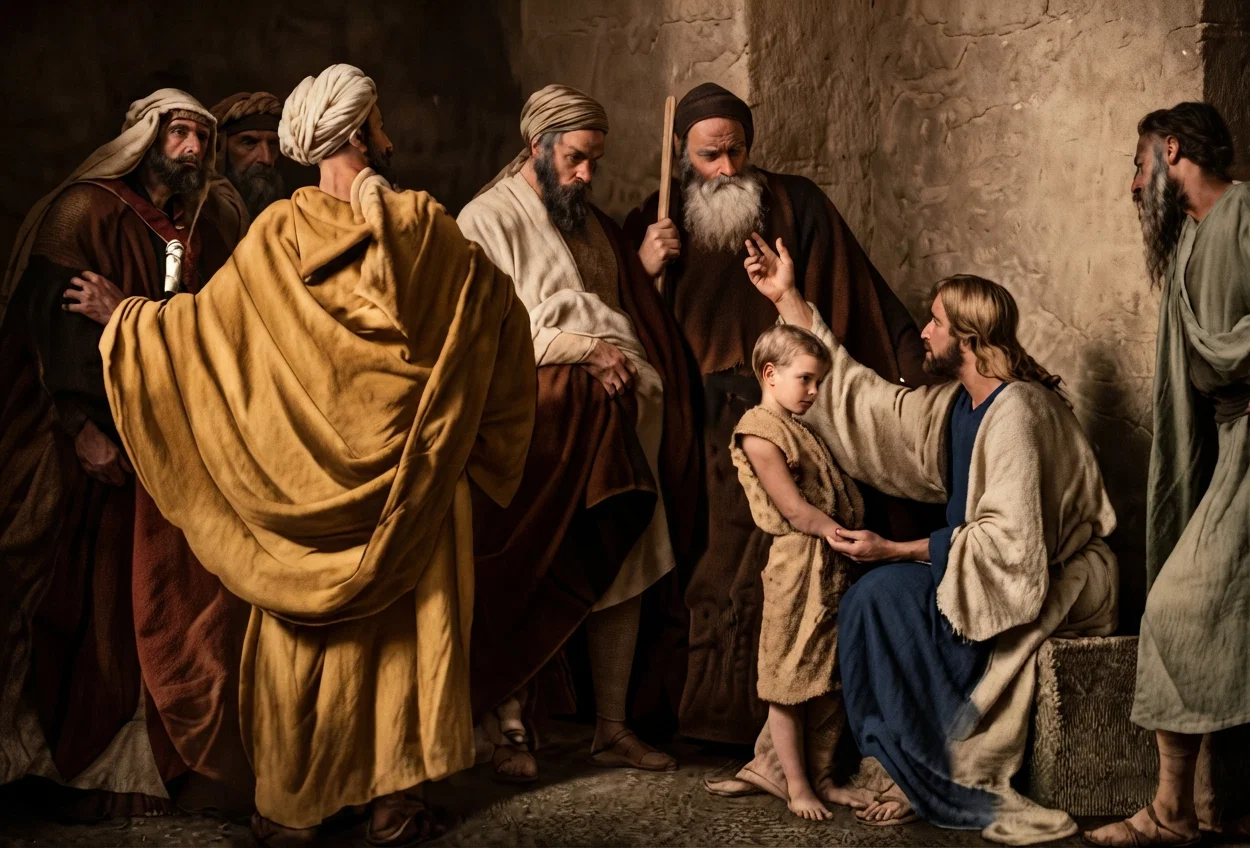
Verily I say unto you, Except ye be converted, and become as little children, ye shall not enter into the kingdom of heaven.

The True Science of Correcting Character

Had Judas had that true life of which Christ is the substance and the source, he would have fed upon that which is conducive to growth in Christ, the bread of life. Cherishing in his heart the life of Christ, feeding on the bread which came down from heaven, he would have had the power of assimilation to Christ. He would have appropriated the nutriment of the living bread,—would have received into his own nature the spirit and life of the words of Christ, and thus would have become one with Him. He would have become, in character, all that he professed to be.
True life is progressive; wherever there is life, there is growth. Had Judas been a doer of the words of Christ, had Christ been abiding in his heart by faith, this growth would first have been manifested in lowly, humble acquaintance with himself and with God. He would have been learning the lessons that Christ gave to His disciples when He asked them, "What was it that ye disputed among yourselves by the way?" The subject of the conversation had been who should be the greatest in the kingdom of heaven. It was a matter that should never have come into their conversation, for its tendency was to arouse selfish feelings, selfish expressions, and eclipse the love of Christ in the soul.

The Lesson from the Little Child

Taking a little child, and setting him in the midst of them, Christ said: "Verily I say unto you, Except ye be converted [from your own natural, selfish characters], and become as little children [free from guile, hypocrisy, and all selfishness and unkindness], ye shall not enter into the kingdom of heaven. Whosoever therefore shall humble himself as this little child, the same is greatest in the kingdom of heaven. And whoso shall receive one such little child in My name receiveth Me. But whoso shall offend one of these little ones which believe in Me, it were better for him that a millstone were hanged about his neck, and that he were drowned in the depth of the sea." What a lesson is this, not only for the disciples and Judas, but also for all who believe on Christ to-day!
Judas heard all this, but he thought, as many think to-day, that such teaching was uncalled for. But if this were so, why did Christ dwell upon such themes? He further added: "Wo unto the world because of offenses! for it must needs be that offenses come; but wo to that man by whom the offense cometh! Wherefore if thy hand or thy foot offend thee, cut them off, and cast them from thee: it is better for thee to enter into life halt or maimed, rather than having two hands or two feet to be cast into everlasting fire. And if thine eye offend thee, pluck it out, and cast it from thee: it is better for thee to enter into life with one eye, rather than having two eyes to be cast into hell fire."

Character Building Needs Close Attention

Here Christ would teach us that the character building needs close and careful attention. This is the work that Judas's keen perception might have discerned if he had received the lessons which Christ sought toteach him. His objectionable traits of character would then have disappeared, and he would have become meek and lowly of heart, like his Master.
And this work is something that we as well as Judas must do. Those who have hereditary tendencies to evil, those who are putting forth thorn branches to wound all with whom they come in contact, should see that the offending members are cut away. Painful as this work may be of separating the evil from our character, it must be done. Selfishness and covetousness, which is idolatry; the harsh and unkind spirit, that, manifested in word or deed, will wound and destroy souls, must be taken out of the life, or the entire man will become offensive to himself and to God. His hard-heartedness will cause him to neglect the very ones who need his help.
"Seeing ye have purified your souls in obeying the truth through the Spirit unto unfeigned love of the brethren, see that ye love one another with a pure heart fervently: being born again, not of corruptible seed, but of incorruptible, by the Word of God, which liveth and abideth forever. For all flesh is as grass, and all the glory of man as the flower of grass. The grass withereth, and the flower thereof falleth away: but the Word of the Lord endureth forever. And this is the Word which by the Gospel is preached unto you."

True Mental Food

This is the bread which came down from heaven, even the Word of God. And this Word, received and appropriated by the living agents, will produce that faith which works by love, and purifies the soul. It will cut away the hereditary tendencies to evil, and the wrong traits of character that have been strengthened by cultivation. However dearly we may prize these, it is better to separate them from our life practise now than to have their predominating power defiling and corrupting the whole man. And not only this, they destroy our influence for good, and, instead of being a savor of life unto life, we become a savor of death unto death.
"Wherefore laying aside all malice, and all guile, and hypocrisies, and envies, and all evil speakings, as new-born babes, desire the sincere milk of the Word, that ye may grow thereby: if so be ye have tasted that the Lord is gracious. To whom coming, as unto a living stone, disallowed indeed of men, but chosen of God, and precious, ye also, as lively stones, are built up a spiritual house, an holy priesthood, to offer up spiritual sacrifices, acceptable to God by Jesus Christ." Judas might have been all this. Blessed as he was with abundant opportunities of eating of the bread of life, he might have formed a firm, Christlike character.
"Wherefore also it is contained in the Scripture, Behold, I lay in Sion a chief corner-stone, elect, precious: and he that believeth on Him shall not be confounded. Unto you therefore which believe He is precious: but unto them which be disobedient, the stone which the builders disallowed, the same is made the head of the corner, and a stone of stumbling, and a rock of offense, even to them which stumble at the Word, being disobedient: whereunto also they were appointed."
God has given His only-begotten Son to our world as our sin-bearer, that He might take away our iniquities. Through His divine merits, every son and daughter of Adam who will believe on Him as the way, the truth, and the life, will be presented faultless before the presence of His glory with exceeding joy. Those who return to their loyalty to God are precious in His sight; for Christ died to redeem these souls from the bondage of sin; He died to secure the eternal happiness of fallen man.
And "He that spared not His own Son, but delivered Him up for us all, how shall He not with Him also freely give us all things?" Our Redeemer has risen from the dead. He led captivity captive, and gave gifts unto men. And now He ever liveth to dispense His blessings in rich currents of grace and power as the circumstances of His believing children may require. And to the sinner His voice is heard in loving invitation: "Incline your ear, and come unto Me: hear, and your soul shall live; and I will make an everlasting covenant with you, even the sure mercies of David." "As many as received Him, to them gave He power to become the sons of God, even to them that believe on His name."

What Shall We Do with the Fourth Commandment?

By Mrs. L. D. Avery-Stuttle

III—Is God Particular?

"DON'T think it makes any difference, anyway," some one said to me the other day; "I just can't see that it makes a particle of difference to the Lord what day I keep, as long as I am sincere, and attend church, and worship Him all the day!" But my friend forgot that he had just been most energetically trying to prove from the Bible, that the first day is the Sabbath. Failing in this, he adopted the same tactics which are made to serve many others who are in like trouble,—he didn't believe it made "any difference anyway."
But some day the whole world will wake up to the fact that the Almighty is very particular. He is not playing a foolish game with man. He is in earnest. Had He not been "particular," do you think He would have given His only Son to die because of one single act of disobedience on the part of one man and one woman?—Nay, verily. Sin is exceeding sinful in His sight, and sin is the transgression of His law.

They Would Not Believe in the Coming Flood

Once in the long ago, a lone man began the building of a huge boat. What struck the people as very singular was the fact that there was no water upon which to launch the boat. But the man who was building it declared to the people that God had assured him of a coming flood, and that those who wished to save their lives would do well to enter the boat.
I suppose some argued one way and some another. They didn't believe the Almighty would send a flood anyway. Why, it had never even rained! And even if the worst came, it would be just as easy for God to save them in one place as in another. They didn't believe He was "particular."
We remember the history of this—the most awful tragedy which ever befell this old earth.
When it was too late, the inhabitants of a doomed world discovered that God meant just what He said.
Uzzah was one of those men who did not believe that God was "particular." He put no difference between the holy and the profane. The oxen shook the ark of God, and Uzzah laid hold of it to steady it. God had forbidden anything of this kind; still under the circumstances, this man ventured to disobey.
Really, he didn't see why he might not touch the ark,—his hands were clean and his motives good. But he was smitten with death for his folly. God was particular.
"O, well," says one, "you may keep the letter of the law if you deem it so necessary. As for me, I can obey God as well in spirit, without the letter."
So thought King Saul. God had commanded him to exterminate the Amalekites and all their possessions,—a nation whose heinous sins reached to heaven. But the king thought he could improve upon the command of God. He would very nearly fulfil his commission—but not quite. He didn't believe in keeping "the letter of the law." So he spared Agag, the abhorred of Heaven, to pander to his foolish pride. Then there were a few nice fat cattle belonging to the enemy. What a pity to slay all these,when they might be saved for an offering to the Lord! "Surely," reasoned King Saul, "the Lord does not really mean me to do so extravagant and rash a deed as to destroy cattle which might be spared on purpose for His glory!" What difference could it make? They were only dumb cattle anyway.
So he decided to risk the consequences, and obey what he probably called "the spirit" instead of "the letter" of the law. And sin is so exceeding sinful, that by the time the prophet Samuel came to him with his awful message, King Saul had actually persuaded himself that he had obeyed the command of God. We know the result of his folly.
But the Uzzahs and the Sauls are not all dead yet; and it is as hard to-day as it was then to make men believe that "to obey is better than sacrifice."
Achan was another of those who thought it made little difference whether God was obeyed or not. Ananias and Sapphira were two more. I need not multiply examples of this kind. God's Book is full of them from cover to cover.
Now, in all candor, what business have you or I to conclude that the Almighty is not able to express His real meaning in plain language? Dare we undertake to improve upon the words of the Most High, to impeach His wisdom, or to correct His laws?
God means just what He says, my friend; no more, no less. When He says, "Thou shalt not steal," He doesn't mean that we may commit petty theft, neither will He approve of dishonesty of any kind, no matter under what flag it may sail. And when He declares, "The seventh day is the Sabbath of the Lord thy God," He means exactly what He says, and no manner of reasoning can make it mean the first day or any other save the one He sanctified at creation. And even tho on every first day for many hundred years the Almighty has been solemnly assured, upon the bended knees of the worshipper, that "this is Thy holy Sabbath," it alters not the truth one whit. God's perfect law is the same. It is as unchanging and as unchangeable as the throne of its unchangeable Author; and tho puny man may seek to batter down the massive pillars of eternal truth, they only loom up the clearer and stronger.

Do You Know Him?

By Nettie Hall
Do you know the Lord of Glory? Do you know Him as your God? Do you feel His gentle presence As you walk the path He trod?
Weary of the paltry pleasures Of this world of wo and strife, Do you feel your soul aspiring To a higher, better life?
Do you feel a deep heart longing For the One you love so well, To come near and ever nearer, And within your heart to dwell?
Sometimes, when in human weakness You have grieved that dearest One, And the clouds grow dense about you, And the dove of peace is gone,
Then in penitential sorrow Do you seek that lovely face, There to find sweet peace and pardon In the riches of His grace?
Do you know the Saviour loves you— Loves you still, His erring child— Draws you closer to His bosom, Shields you from the tempest wild?
Do you pray in childlike fervor, While you closer cling to Him, "Make me more like Thee," my Saviour, Keep me pure and free from sin"?
Do you feel the sweet influence From the Father's throne above, That will make your life more noble, As you walk in perfect love?
Do you grow each day more perfect, While He lives and dwells within, Till your life reflects His beauty, While you sweetly walk with Him?
Is your love for Christ your Saviour Growing stronger day by day? Could a world of sin and folly Tempt you from your Lord to stray?
O my brother, do you know Him, That dear friend forever nigh? Would you, could you, live without Him, Or without Him dare to die?
Continue reading: The Promises to Abraham