Your ShelfYour Projects

Review and Herald, Vol. 88, No. 44.

A Song of Patience

Review and Herald

Nov 2, 1911

Review and Herald Publishing Association · Tacoma Park Station, Washington, D.C. · Nov 2, 1911

A Song of Patience
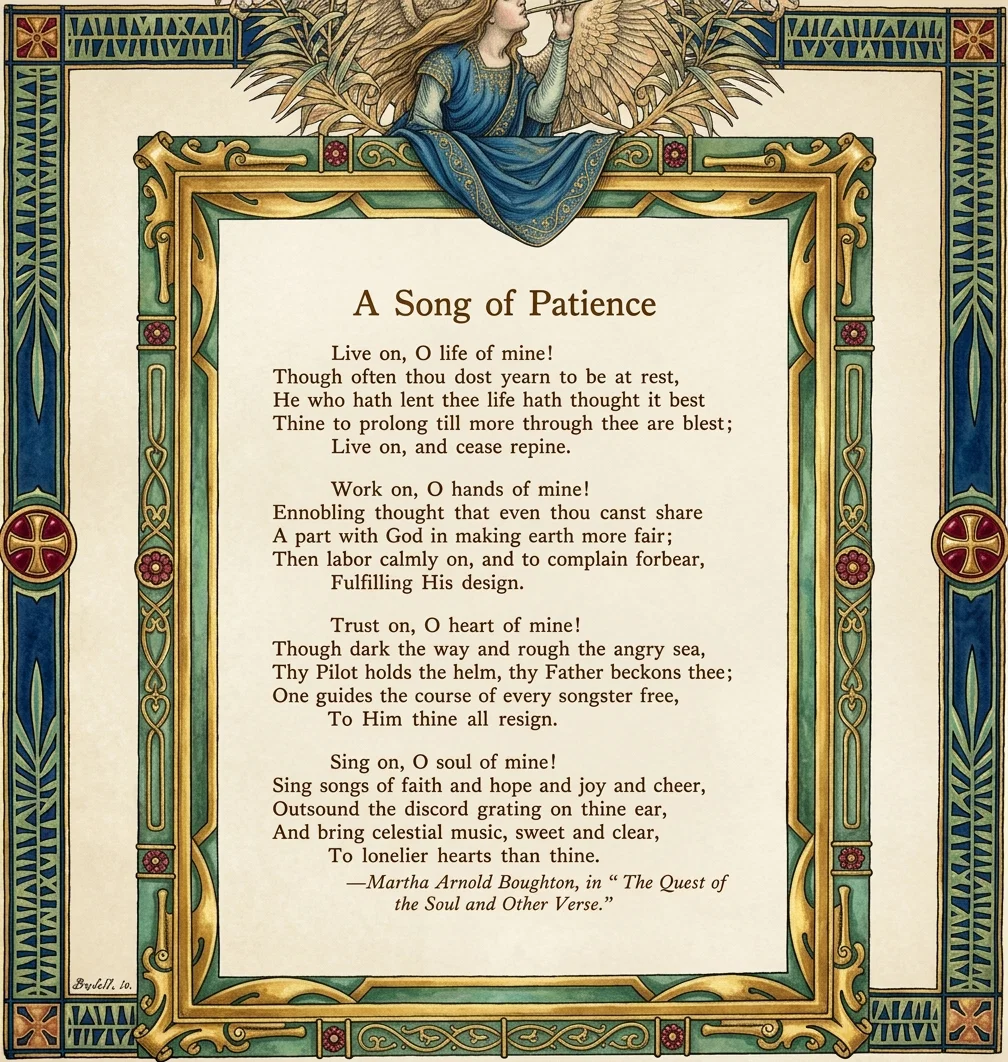
Live on, O life of mine! Though often thou dost yearn to be at rest, He who hath lent thee life hath thought it best Thine to prolong till more through thee are blest; Live on, and cease repine.
Work on, O hands of mine! Ennobling thought that even thou canst share A part with God in making earth more fair; Then labor calmly on, and to complain forbear, Fulfilling His design.
Trust on, O heart of mine! Though dark the way and rough the angry sea, Thy Pilot holds the helm, thy Father beckons thee: One guides the course of every songster free, To Him thine all resign.
Sing on, O soul of mine! Sing songs of faith and hope and joy and cheer, Outsound the discord grating on thine ear, And bring celestial music, sweet and clear, To lonelier hearts than thine.
*—Martha Arnold Boughton, in “The Quest of the Soul and Other Verse.”*

A WONDERFUL BLESSING

The following letter, received this week, should encourage the readers of the Review in buying books to lend to their friends and neighbors:—
“I have recently borrowed a book from a friend of mine, entitled ‘Christ’s Object Lessons,’ written by Ellen G. White, and have derived a wonderful blessing to my soul from reading it.”
Our good books are a wonderful agency for the promotion of the third angel’s message, and a blessing to those who read them.

“Steps to Christ”

A most helpful book for either the seeker desiring to learn the way of salvation, or the man of experience who desires to attain greater heights in the Christian life. A splendid book to lend or give to any one. The following chapter headings give an idea of the contents of the book: God’s Love for Man; The Sinner’s Need of Christ; Repentance; Confession; Consecration; Faith and Acceptance; The Test of Discipleship; Growing up Into Christ; The Work and the Life; A Knowledge of God; The Privilege of Prayer; What to Do With Doubt; Rejoicing in the Lord. Price, paper binding, 30 cents; cloth, 60 cents; gift, $1.

“Thoughts From the Mount of Blessing”

This book is an exposition of Christ’s sermon on the mount. The great principles enunciated by Christ in this wonderful sermon are drawn out like living characters. The work is full of comfort and blessing to all who read it. The book contains 216 pages, and is beautifully illustrated. Price, cloth binding, only 75 cents.

“Christ’s Object Lessons”

The truths taught by Christ in parables are made wonderfully impressive in this book. It is an enlargement and illustration of those principles of righteousness clearly set forth by him who spake as never man spake. All who read it will, like the one from whose letter we have quoted, receive a wonderful blessing to their souls. The book contains 486 pages, is well illustrated, and nicely bound in cloth. Price, only $1.25.

“Ministry of Healing”

A book dedicated to the relief of suffering humanity. This world is one large hospital. Very few, if any, enjoy perfect health. Many millions are suffering from physical ills. To all such, this book brings a special message of comfort and helpfulness. The Great Physician is brought very near to the reader of this book. It is indeed a messenger of life to all who read and lay hold of the principles enunciated by it. Get it, read it, and lend it to some afflicted friend. Cloth binding, $1.50.

“Desire of Ages”

This volume, while being a description of the life of Christ, is vastly different from the many other books which are written upon this subject. The key-note of the volume is the great truth that in Christ the love of the Father is revealed—that “God was in Christ, reconciling the world unto himself.” It has been the work of Satan to misrepresent the character of God, and to deny the authority of his law; while Christ, who was “God manifest in the flesh,” by his death, redeems the transgressor, and maintains the immutability of that law. Thus God’s love and justice are vindicated. This book treats of the development of this purpose as wrought out in the life of Christ. Contains nearly 900 pages, with 38 full-page engravings, 87 illuminated chapter headings, and nearly 300 small cuts. Price cloth binding, $3.
Order of your Tract Society, or of Review and Herald Publishing Association, Takoma Park, Washington, D. C.

THE NOVEMBER NUMBER OF LIFE & HEALTH

Over 100 Helps to Health

¶ Will help to make you a better man or woman physically, mentally, and morally.
¶ Teaches in simple language how you may apply simple home remedies that will prevent as well as cure disease.
¶ This “easy-to-sell” number is a good proposition for new agents. Send 10 cents for sample copy and full particulars.
HEADACHES: THEIR CAUSES, PREVENTION, AND CURE, by the author of “Preston Papers.” Who can estimate its worth to millions of sufferers from this common affliction?
HOW TWO MOTHERS CARED FOR THEIR BABIES: WHY ONE SUCCEEDED AND THE OTHER FAILED, by Lauretta Kress, M. D., of the Loma Linda (Cal.) Sanitarium staff. The first of three articles from the pen of this physician of wide experience in Europe, Australia, and America. Should be read by every mother interested in the successful care of her children.
HOME WATER TREATMENTS: THEIR RESTORATIVE EFFECTS, by G. K. Abbott, M. D., of the Loma Linda (Cal.) Sanitarium staff. Many illnesses can be alleviated and cured through these simple treatments, which may be administered in the privacy of the home.
WHY A SMALL ATTENDANCE AT CHURCH SERVICES? A STUDY ON VENTILATION, by Mary A. Laselle. Call the attention of your pastor, and of your friends’ pastor, to this valuable contribution, showing the relation between good health and good religion.
THE SCIENCE OF WATER-DRINKING, by W. W. Worster, A. B., M. D. There are many things to be learned even about the common, every-day practise of drinking. Well worth reading.
THE HARDENING OF THE ARTERIES, by J. H. Neall, M. D. A lecture recently delivered by this well-known physician. Tells us in simple language what arteriosclerosis means to the life and health of mankind.
¶ The product of the best-combined efforts of the editor, contributors, and publishers. ¶ Buy it, read it, and pass it on to others. ¶ Better still, send $2.00 for 50 copies, sell 20 to get your money back; then sell or give away the other 30 in the interests of true health and temperance reform.
¶ The National Health Magazine How to keep well. How to get well. How to treat disease at home. How to sleep, eat, and dress for health.
¶ Read by over 300,000 people every month. ¶ During the past four months 316 new agents have been added to our list.
¶ The long winter evenings are now approaching, when people have more time to read. Why not apply for a Life and Health agency to-day, through your Conference Tract Society?

PRICES

$1.00 a year, 10 cents a copy.  5 to 40 copies, 5 cents a copy.  50 or more copies, 4 cents a copy.
Send All Orders Through Your Conference Tract Society

What Thinkest Thou of Me?

WORTHIE HARRIS HOLDEN
To-NIGHT I ask thee, Lord, alone, What thinkest thou of me? My friends I know, their love I own; But what am I to thee?
Have I thy talents sown abroad, Reaping the increase due? Called by thy name, am I, O God, Faithful and meek and true?
Search all the corners of my heart, Purge me till I am pure; Let me not e'er from thee depart, But to the end endure.
Would that I had some sheaf to bring Humbly, O Christ, to thee! My blest Redeemer and my King, Thine I must truly be!
Portland, Ore.

Manifestations of Love

T. GODFREY
“And this commandment have we from him, That he who loveth God love his brother also.” 1 John 4:21. This text of Scripture is very plain, positive, and complete. It could not be made plainer or more positive. Love is of God, God; for God is love. God is the great fountain from which flows a constant, ceaseless stream of undying love, watering the thirsty, fainting child of God, reviving and refreshing every soul who is longing for greater and higher attainments. The love of God is imparted to God’s children through the operation of the Holy Spirit. “And hope maketh not ashamed; because the love of God is shed abroad in our hearts by the Holy Ghost which is given unto us.” Rom. 5:5. But, “if a man say, I love God, and hateth his brother, he is a liar: for he that loveth not his brother whom he hath seen, how can he love God whom he hath not seen?” 1 John 4:20.
It is evident that a man can not love God and hate his brother, “for love is of God.” A fountain can not send forth sweet and bitter water at the same time. “He that loveth not knoweth not God; for God is love.” 1 John 4:8. And we know that God is true, and in him is no lie. “And we have known and believed the love that God hath to us. God is love; and he that dwelleth in love dwelleth in God, and God in him. Herein is our love made perfect, that we may have boldness in the day of judgment: because as he is so are we in this world.” 1 John 4:16, 17.
Love is manifested in acts of love, deeds of love; God’s love was manifested in the very act of giving his only begotten Son to die for a lost and ruined world. Says the Inspired Record, “God so loved the world, that he gave his only begotten Son, that whosoever believeth in him should not perish, but have everlasting life.” God’s love was manifested in the gift of his dear Son, which was a gift of love. Says the Inspired Word, “In this was manifested the love of God toward us, because that God sent his only begotten Son into the world, that we might live through him.” 1 John 4:9. “Herein is love.” In the act of giving his Son he manifested his love for a fallen world. “Not that we loved God, but that he loved us, and sent his Son to be the propitiation for our sins.” 1 John 4:10.
“Beloved, if God so loved us, we ought also to love one another. No man hath seen God at any time. If we love one another, God dwelleth in us, and his love is perfected in us.” 1 John 4:11, 12. Love is not manifested simply in feeling and in outward emotion, but in real acts; deeds of goodness, kindness, long-suffering, and mercy. Such are the real manifestations of God’s love.
“My little children, let us not love in word, neither in tongue; but in deed and in truth.” 1 John 3:18. Said Jesus, “This is my commandment, That ye love one another, as I have loved you.” John 15:12. “Greater love hath no man than this, that a man lay down his life for his friends.” John 15:13. Christ did more than this. He gave himself for us while we were yet sinners, enemies against God’s government. Says the Inspired Word, “But God commendeth his love toward us, in that, while we were yet sinners, Christ died for us.” We were reconciled to God by the death of his Son. Now that we are reconciled to God through the infinite sacrifice of his Son, ought we not to love one another? Says the beloved disciple, “Beloved, let us love one another: for love is of God; and every one that loveth is born of God, and knoweth God.” 1 John 4:7. “But the fruit of the Spirit is love, joy, peace, long-suffering, gentleness, goodness, faith, meekness, temperance: against such there is no law. And they that are Christ’s have crucified the flesh with the affections and lusts.” Gal. 5:22-24.
Do we as professed children of God possess the characteristics of Christ, “who is the image of the invisible God, the first-born of every creature”?
Western, Wash.

The Trial at Caesarea

MRS. E. G. WHITE
Five days after Paul's arrival at Cæsarea, his accusers came from Jerusalem, accompanied by Tertullus, an orator whom they had engaged as their counsel. The case was granted a speedy hearing. Paul was brought before the assembly, and Tertullus “began to accuse him.” Judging that flattery would have more influence upon the Roman governor than the simple statements of truth and justice, the wily orator began his speech by praising Felix. “Seeing that by thee we enjoy great quietness, and that very worthy deeds are done unto this nation by thy providence, we accept it always, and in all places, most noble Felix, with all thankfulness.”
Tertullus here descended to barefaced falsehood; for the character of Felix was base and contemptible. It was said of him, that “in the practise of all kinds of lust and cruelty, he exercised the power of a king with the temper of a slave.” Those who heard Tertullus knew that his flattering words were untrue; but their desire to secure the condemnation of Paul was stronger than their love of truth.
In his speech Tertullus charged Paul with crimes which, if proved, would have resulted in his conviction for high treason against the government. “Wehave found this man a pestilent fellow,” declared Tertullus, “and a mover of sedition among all the Jews throughout the world, and a ringleader of the sect of the Nazarenes: who also hath gone about to profane the temple.” Tertullus then stated that Lysias, the commandant of the garrison at Jerusalem, had violently taken Paul from the Jews when they were about to judge him by their ecclesiastical law, and had thus forced them to bring the matter before Felix. These statements were made with the design of inducing the procurator to deliver Paul over to the Jewish court. All the charges were vehemently supported by the Jews present, who made no effort to conceal their hatred against the prisoner.
Felix had sufficient penetration to read the disposition and character of Paul's accusers. He knew from what motive they had flattered him, and he saw also that they had failed to substantiate their charges against Paul. Turning to the accused, he beckoned to him to answer for himself. Paul wasted no words in compliments, but simply stated that he could the more cheerfully defend himself before Felix, since the latter had been so long a procurator, and therefore had so good an understanding of the laws and customs of the Jews. Referring to the charges brought against him, he plainly showed that not one of them was true. He declared that he had caused no disturbance in any part of Jerusalem, nor had he profaned the sanctuary. “They neither found me in the temple disputing with any man,” he said, “neither raising up the people, neither in the synagogues, nor in the city: neither can they prove the things whereof they now accuse me.”
While confessing that “after the way which they call heresy” he had worshiped the God of his fathers, he asserted that he had always believed “all things which are written in the law and in the prophets;” and that in harmony with the plain teaching of the Scriptures he held the faith of the resurrection of the dead. He further declared that the ruling purpose of his life was to “have always a conscience void of offense toward God, and toward men.”
In a candid, straightforward manner he stated the object of his visit to Jerusalem, and the circumstances of his arrest and trial: “Now after many years I came to bring alms to my nation, and offerings. Whereupon certain Jews from Asia found me purified in the temple, neither with multitude, nor with tumult. Who ought to have been here before thee, and object, if they had aught against me. Or else let these same here say, if they have found any evil-doing in me, while I stood before the council, except it be for this one voice, that I cried standing among them, Touching the resurrection of the dead I am called in question by you this day.”
The apostle spoke with earnestness and evident sincerity, and his words carried with them a weight of conviction. Claudius Lysias, in his letter to Felix, had borne a similar testimony in regard to Paul's conduct. Moreover, Felix himself had a better knowledge of the Jewish religion than many supposed. Paul's plain statement of the facts in the case enabled Felix to understand still more clearly the motives by which the Jews were governed in attempting to convict the apostle of sedition and treasonable conduct. The governor would not gratify them by unjustly condemning a Roman citizen, neither would he give him up to them to be put to death without a fair trial. Yet Felix knew no higher motive than self-interest, and he was controlled by love of praise and a desire for promotion. Fear of offending the Jews held him back from doing full justice to a man whom he knew to be innocent. He therefore decided to suspend the trial until Lysias should be present, saying, “When Lysias the chief captain shall come down, I will know the uttermost of your matter.”
The apostle remained a prisoner, but Felix commanded the centurion who had been appointed to keep Paul, “to let him have liberty,” and to “forbid none of his acquaintance to minister or come unto him.”
It was not long after this that Felix and his wife, Drusilla, sent for Paul, in order that in a private interview they might hear from him “concerning the faith in Christ.” They were willing and even eager to listen to these new truths—truths which they might never hear again, and which, if rejected, would prove a swift witness against them in the day of God.
Paul regarded this as a God-given opportunity, and faithfully he improved it. He knew that he stood in the presence of one who had power to put him to death or to set him free; yet he did not address Felix and Drusilla with praise or flattery. He knew that his words would be to them a savor of life or of death, and forgetting all selfish considerations, he sought to arouse them to a sense of their peril.
The apostle realized that the gospel had a claim upon whoever might listen to his words; that one day they would stand either among the pure and holy around the great white throne, or with those to whom Christ would say, “Depart from me, ye that work iniquity.” He knew that he must meet every one of his hearers before the tribunal of heaven, and must there render an account, not only for all that he had said and done, but for the motive and spirit of his words and deeds.
So violent and cruel had been the course of Felix, that few had ever before dared even to intimate to him that his character and conduct were not faultless. But Paul had no fear of man. He plainly declared his faith in Christ, and the reasons for that faith, and was thus led to speak particularly of those virtues essential to Christian character, but of which the haughty pair before him were so strikingly destitute.
He held up before Felix and Drusilla the character of God—his righteousness, justice, and equity—and the nature of his law. He clearly showed that it is man's duty to live a life of sobriety and temperance, keeping the passions under the control of reason, in conformity to God's law, and preserving the physical and mental powers in a healthy condition. He declared that there would surely come a day of judgment, when all would be rewarded according to the deeds done in the body, and when it would be plainly revealed that wealth, position, or titles are powerless to gain for man the favor of God, or to deliver him from the results of sin. He showed that this life is man's time of preparation for the future life. Should he neglect present privileges and opportunities, he would suffer an eternal loss; no new probation would be given him.
Paul dwelt especially upon the far-reaching claims of God's law. He showed how it extends to the deep secrets of man's moral nature, and throws a flood of light upon that which has been concealed from the sight and knowledge of men. What the hands may do or the tongue may utter—what the outer life reveals—but imperfectly shows man's moral character. The law searches his thoughts, motives, and purposes. The dark passions that lie hidden from the sight of men, the jealousy, hatred, lust, and ambition, the evil deeds meditated upon in the dark recesses of the soul, yet never executed for want of opportunity,—all these God's law condemns.
Paul endeavored to direct the minds of his hearers to the one great Sacrifice for sin. He pointed to the sacrifices that were shadows of good things to come, and then presented Christ as the antitype of all those ceremonies,—the object to which they pointed as the only source of life and hope for fallen man. Holy men of old were saved by faith in the blood of Christ. As they saw the dying agonies of the sacrificial victims, they looked across the gulf of ages to the Lamb of God that was to take away the sin of the world.
God justly claims the love and obedience of all his creatures. He has given them in his law a perfect standard of right. But many forget their Maker, and choose to follow their own way in opposition to his will. They return enmity for love that is as high as heaven and as broad as the universe. God can not lower the requirements of his law to meet the standard of wicked men; neither can man, in his own power, meet the demands of the law. Only by faith in Christ can the sinner be cleansed from guilt, and be enabled to render obedience to the law of his Maker.
Thus Paul, the prisoner, urged the claims of the divine law upon Jew and Gentile, and presented Jesus, the despised Nazarene, as the Son of God, the world's Redeemer.
The Jewish princess well understood the sacred character of that law which she had so shamelessly transgressed; but her prejudice against the Man of Calvary steeled her heart against the word of life. But Felix had never before listened to the truth; and as the Spirit of God sent conviction to his soul, he became deeply agitated. Conscience, nowaroused, made her voice heard; and Felix felt that Paul's words were true. Memory went back over the guilty past. With terrible distinctness there came up before him the secrets of his early life of lust and bloodshed, and the black record of his later years. He saw himself licentious, cruel, rapacious, unjust, and steeped in the blood of private murders and public massacres. Never before had the truth been thus brought home to his heart. Never before had his soul been so filled with terror. The thought that all the secrets of his career of crime were open before the eye of God, and that he must be judged according to his deeds, caused him to tremble with dread.
But instead of permitting his convictions to lead him to repentance, he sought to dismiss these unwelcome reflections. The interview with Paul was cut short. ‘Go thy way for this time,’ he said; ‘when I have a convenient season, I will call for thee.’
How wide the contrast between the course of Felix and that of the jailer of Philippi! The servants of the Lord were brought in bonds to the jailer, as was Paul to Felix. The evidence they gave of being sustained by a divine power, their rejoicing under suffering and disgrace, their fearlessness when the earth was reeling with the earthquake shock, and their spirit of Christ-like forgiveness, sent conviction to the jailer's heart, and with trembling he confessed his sins and found pardon. Felix trembled, but he did not repent. The jailer joyfully welcomed the Spirit of God to his heart and to his home; Felix bade the divine messenger depart. The one chose to become a child of God and an heir of heaven; the other cast his lot with the workers of iniquity.
For two years no further action was taken against Paul, yet he remained a prisoner. Felix visited him several times, and listened attentively to his words. But the real motive for this apparent friendliness was a desire for gain, and he intimated that by the payment of a large sum of money Paul might secure his release. The apostle, however, was of too noble a nature to free himself by a bribe. He was not guilty of any crime, and he would not stoop to commit a wrong in order to gain freedom. Furthermore, he was himself too poor to pay such a ransom, had he been disposed to do so, and he would not, in his own behalf, appeal to the sympathy and generosity of his converts. He also felt that he was in the hands of God, and he would not interfere with the divine purposes respecting himself.
Felix was finally summoned to Rome because of gross wrongs committed against the Jews. Before leaving Cæsarea in answer to this summons, he thought to ‘show the Jews a pleasure’ by allowing Paul to remain in prison. But Felix was not successful in his attempt to regain the confidence of the Jews. He was removed from office in disgrace, and Porcius Festus was appointed to succeed him, with headquarters at Cæsarea.
A ray of light from heaven had been permitted to shine upon Felix, when Paul reasoned with him concerning righteousness, temperance, and a judgment to come. That was his heaven-sent, opportunity to see and to forsake his sins. But he said to the messenger of God, ‘Go thy way for this time; when I have a convenient season, I will call for thee.’ He had slighted his last offer of mercy. Never was he to receive another call from God.

“Intolerant to the End of Days”

F. D. STARR
In a work entitled “Spiritual Pepper and Salt for Catholics and Non-Catholics,” by Wm. Stang, published by Benziger Brothers, New York, the following paragraphs appear on pages 119-122:—
“The Catholic Church is intolerant.” We admit the truth of this charge. The Catholic Church is naturally intolerant in matters of religion. She is conscious of being the only true church of Christ, and of holding the eternal destinies of the human race; she considers herself to be alone in the possession of the truth, and all other creeds to be more or less in error. It is her duty to resist and to refute all such creeds, and thereby to cause the true doctrine to prevail. Truth is intolerant; wherefore the church, being the divine depository of truth, is and must be intolerant. She abhors error and all offenses against the truth, especially apostasy and heresy. . . .
“But this religious intolerance of the church does not condemn and persecute persons in error, only false principles. People may be in error of faith, and yet be saved. We have no right to impute guilt to those who are in error; we should show to all the duties of brotherly love expressly enjoined by the church, and let them live in peace.
“But has not the Catholic Church in the past persecuted and punished heretics and those who differed from her doctrines?—Yes, when heresy was a political crime and operated against the civil law, and when religion was so bound into the frame-work of society that to disturb religion was to shake the foundation of government. Even the Justinian Code says: ‘What is done against the divine religion is an injury to all.’ Heresy was considered a graver crime than high treason: ‘Far more grievous is it to offend the heavenly than the earthly king.’ It may be difficult for us to realize this state of public sentiment when in our days we hear blasphemies against the majesty of God vomited forth in public, and his holy name profaned on all sides, and the government officials take no notice of such crimes which were formerly capital offenses. When Europe was Catholic, and the temporal order was united with the religious, sins against religion were sins against the social order, and heretics were rebels against society, and had to be punished on the principle that no man was allowed to teach and spread falsehood. But in our day, when society is no longer professedly Catholic, religious toleration has become almost universal, not because people have become more charitable or more enlightened, but through sheer social necessity. In her doctrine, however, and form of worship the Catholic Church will remain intolerant to the end of days.”
This is a very clear statement concerning the attitude of the Catholic Church toward dissenters. The reason for the present manifestation of toleration is not because of a greater degree of charity or enlightenment, but from sheer necessity. When Europe was Catholic, no toleration was shown to heretics, and of course it is the opinion of that church that Europe and America and every other country should now be Catholic; that the head of the church should possess the civil as well as the ecclesiastical sword. When that condition, to which the church aspires, shall be reached, where will toleration be found? It will be a thing of the past.
There is certainly an important lesson here for Protestant agitators to consider, who are determined to get religion “bound into the framework of society,” just as it was in medieval times. Then, as formerly, “to disturb religion” will be “to shake the foundation of government,” and heresy will be “considered a greater crime than high treason.” Why pave the way for religious intolerance, and thus walk blindly into the very pitfall that the founders of our government saw so plainly would be the result of a union of church and state?
The position is logical that as long as the government makes no laws regulating religious matters, the person in “error,” or the non-conformist, or one of different opinion from the majority, should be allowed to live in peace; but as soon as the state declares in favor of certain religious requirements, then intolerance and persecution must unavoidably follow. Which condition is preferable? Shall we accept the Christian-state idea, and thus open the way for the restoration of the Inquisition and religious persecution? or do we prefer to live in peace, and as far as those are concerned who differ with us, continue to “let them live in peace,” and thus follow the Master? Was he intolerant? Listen to his declaration on this subject: “And if any man hear my words, and believe not, I judge him not: for I came not to judge the world, but to save the world.” John 12:47. He is “the way, the truth, and the life.” Is truth intolerant? Did Paul advocate intolerance? Here are his words on that point: “The servant of the Lord must not strive; but be gentle unto all men, apt to teach, patient, in meekness instructing those that oppose themselves; if God peradventure will give them repentance to the acknowledging of the truth.” 2 Tim. 2:24, 25. The so-called orthodox Protestants sometimes draw unfavorable comparisons between themselves and other bodies of more recent denominational origin. The comparison drawn in the volume under consideration (pages 22, 23) concerning the antiquity of theCatholic Church and the modern origin of other churches, might be interesting to notice in this connection:—
“There never was a Protestant or Lutheran Church before Martin Luther, in the sixteenth century; there never was an Episcopalian or Anglican Church before Henry VIII; there never was a Presbyterian Church before John Knox; there never was a Methodist Church before John Wesley; there never were Quakers before George Fox; there never was an Anabaptist or Baptist Church before Nicolas Stork; there never was a ‘Christian’ Church before Alexander Campbell.”
Our inquiry need not be concerning the antiquity of a church or a belief, but concerning its truthfulness and Scriptural foundation.
Forest, Idaho.
Continue reading: GEO. B. THOMPSON