Your ShelfYour Projects

Review and Herald, Vol. 92, No. 53.

The Time of Trouble

Review and Herald

Oct 28, 1915

Review and Herald Publishing Association · Takoma Park Station, Washington, D. C. · Oct 28, 1915

The Time of Trouble

Arthur W. Spaulding
My God, it is the hour,— The hour of darkness that should come on all the world. Helpless, the souls of men like autumn leaves are swirled Before some dreadful power That sweeps the nations to the yawning maw of hell, With rage unstemmed, with hate no power can quell,— The devils’ whirlwind, and they ride it well.
Shall I, shall we, not pray? Around us, named Thy people, reel the drunken mob, Until the head grows dizzy, and the pulses throb. O, who dare fling the day Among the careless legions of the days gone by: “Eat, drink, be merry; for full soon we die”?— The wastrel’s cheer, and then his last despairing cry!
Suffer it not, O God! Shall scorn of duty and the love of pleasant sin Profane through us Thy sanctuary, till within Mournfully writ is “Ichabod”? Nay! In this closing hour of Thine atonement day Make us to bow our heads, and in contrition pray, “For Thine own glory, Lord, blot out our sins for aye.”
Not for our sakes ’be this! Thy name, O Lord, Thy throne, Thy glory, and Thy grace Are tested by our lives. Let me not face My Master with a traitor kiss, Fawning and feigning with a selfish crown in view. O, if my flaw-filled life be never fused anew, How shall I shame my King before His legions true!
O garden of the bitter cup! Within thy grief-bound walls we press our doubtful way, Willing in spirit, though the flesh forbid, to pray, To lift our Master up, Bearing with Him what angels know not how to bear. Help us, help us, O Christ, to agonize in prayer Throughout this hour of darkness that with Thee we share!

Catholics Call Recognition of Carranza an Insult

THE Morning Star, the official Catholic journal of the archdiocese of New Orleans and the diocese of Savannah, and regarded as the mouthpiece of the Catholic clergy of the entire South, published, in its issue of October 16, an editorial which reads, in part, as follows:—
Mr. Wilson’s recognition of Carranza, the avowed enemy of the Catholic Church, is an insult to the Catholics of this country. It is a direct challenge to them, and we hope that not only Catholics,—but every true lover of religious freedom, for which the glorious flag of our country stands, will give him such an open answer at the polls as will prove to him that no President of the United States can so flagrantly ignore the lawful and respectful request of 16,000,000 fellow citizens without paying the penalty.
This is the only way open to Catholics in which they can take up the gauntlet thrown down by the President of the United States. It is the only way in which all true lovers of religious freedom, irrespective of creed, can show to the administration at Washington how they revere and are determined to uphold this fundamental principle of the American Constitution.—Quoted in Washington Post, October 17.
It is evident that the Catholic Church intends to make itself a political factor in America.

A Billion Dollars for National Defense

THE probable extent of President Wilson’s plan for national defense is presented in the Washington Post of October 19:—
A national defense program that probably means an expenditure on the army and navy of upward of $1,000,000,000 in the next six years will be laid before the people by President Wilson November 4, when he goes to New York to make his first public address since the scope of the policy upon which his administration has embarked became known.
According to plans laid out by experts of the Navy and War Departments, this expenditure would produce by 1925 a first line of dreadnaughts and battle cruisers numbering forty-three; a fleet of coast defense submarines that would fringe the Atlantic and Pacific coasts with an almost solid line of interior defense against attack; a fleet of nearly one hundred and seventy-five destroyers and squadrons of huge seagoing submarines to operate with the battle squadrons at great distances from shore.
For the army, there would be at the end of six years a trained force of 1,200,000 men, including a regular army of 140,000 and the proposed continental army and reserves; a ring of fully manned coast defenses, equipped with the largest and most powerful guns yet built, and a vast reserve of field guns, machine guns, howitzers, and big-gun ammunition.
In addition, the enormously increased capacity of private munition plants would give assurances of ample supplies of small arms and field-gun ammunition.
A definite step toward enlarging the navy was taken yesterday, when contracts were awarded for twenty-two of the fighting craft authorized by the last Congress.

Note and Comment

The Superdreadnaught “California”

THE keel of the superdreadnaught “California” was laid at the navy yard in Brooklyn, N. Y., at noon, October 14. It is to be the first electrically propelled battleship. When completed, the “California” will represent an outlay of about $15,000,000. This is only the beginning of the expense to which the American people will be put to prepare for future war.

Another Nation at War

BULGARIA is the twelfth nation to enter the European war, and the end is not yet. It would seem that only the restraining hand of God can prevent this present war from developing into a universal conflict if the great European struggle continues much longer. The United States, which seemed on the verge of being drawn into the maelstrom, has so far been spared, but no man knows what a day may bring forth. It behooves us to work while it is day; for “the night cometh, when no man can work.”

Plan of Increasing United States Army

THE plan to increase the United States Army is a striking illustration of the preparation for war which is a sign of the times in which we live. Secretary Garrison’s plan, which has been approved in its entirety by President Wilson, calls for a total of 140,000 men in the regular army, and the creation of a citizen force of 400,000 additional men, to be known as the Continental Army, besides the 129,000 trained members of the National Guard.
The men to compose the Continental Army will sign contracts binding them to serve the government for six years. During the first three years they will be required to serve two months each year. While serving with the colors, they will receive the same pay as officers and men of the regular army. During the other three years they will be subject to call to the colors in the event of war or of threatened war.

National Preparedness No Subject for a Thanksgiving Sermon

The MINISTERS in New York City have received letters from the Conference Committee on National Preparedness asking them to talk in favor of preparedness in their Thanksgiving Day sermons. Dr. William F. Merrill’s reply, which was published in the New York Times of October 18, is well stated:—
Even if we grant that an increase of armed force is necessary in the United States at the present time, it is no cause for thankfulness. At best it is a concession to a vicious and abnormal state of things in the world, and a confession that, as a people, we are not high-minded enough to dare to act as Christians should. It is grotesque to suggest such a subject for the national day of thanksgiving. One might as soon give thanks if an outbreak of crime all over this country should lead New York City, in a panic of fear, to double its police force, spending on it the money which should go into making the streets and homes of the citizens safer, better, and cleaner.
I hope the churches of this city will treat the request the way it deserves, by refusing or ignoring it.

President Wilson and Carranza

CARRANZA, whose recognition as leader in Mexico is said to be due to President Wilson’s selection, is characterized by the Catholic press of the country as a villain of the worst type, and the President is warned that unless he changes his selection he will suffer at the next election. Carranza is opposed to Romanism. The October Protestant, in a thirteen-page article by a Mexican statesman well qualified to speak on the subject, shows why the Mexican leaders oppose Romanism. Now is the time to circulate this excellent number of the Protestant Magazine.

Who Is a Missionary?

By general usage the term “missionary” is restricted in its meaning. The one who goes on a mission to the heathen, or who distributes tracts and Bibles to the poor and outcast, is considered as alone worthy of such a designation. This is but a narrow conception of the full significance of the word. Take the Bible record of Christ’s work, which might properly be considered as presenting the best definition of missionary effort, and it is the one who does good to others that is entitled to this name. Acts 10 : 38.
With this view of the subject, how it broadens the idea of missionary labor! Then not alone he who goes to earth’s remotest bounds to carry the gospel to pagans and cannibals is worthy of the name, but he who, wherever he may be, does good to his fellow men, is a missionary. He may not be able to preach, he may not possess wealth to give away, but in every act of doing good, he is doing missionary work. It may be but a cheering smile, a hearty handshake, or a hasty “God bless you” at parting. The service may be only a neighborly act of kindness, the gift of a loaf of bread, or the rendering of aid in sickness; yet if the motive be grounded in love, and the good of man and the glory of God be sought, the act, however small, will not go unnoticed by the Great Teacher. “And whosoever shall give to drink unto one of these little ones a cup of cold water only in the name of a disciple, verily I say unto you, he shall in no wise lose his reward.” Matt. 10 : 42.
Weary mother, there is comfort in this thought for you. How often have you inquired, What can I do for God and humanity? You need not go to India or Africa to become a missionary. In the performance of little deeds of kindness, you can attest your love for God and for your fellows. How often you speak a word to one who is weary, and sad, and heartsick! How often you minister to a sick neighbor, lovingly reprove a wayward child, and by your cheerful smile lighten your own load of care and anxiety, as well as make more happy all with whom you come in contact. Your efforts also in behalf of your own loved ones, the members of your own family, should by no means be lightly regarded. You have a work which none others can do, and the value and importance of which you yourself cannot estimate till future years bring the glad fruition of your labors. It may be your companion knows not God. How great your responsibility to live God’s character before him! Your consistent life and devotion, your charitableness and patience under severe trial, your consistent Christian demeanor at all times and under all circumstances, will have more to do in winning him to Jesus than all the sermons to which he may listen.
What a responsibility also rests upon you to train your children for God, molding their young minds after the similitude of the divine, and directing their young and inexperienced feet in the paths of righteousness. But few mothers, comparatively, sense the solemn importance attached to their influence in their own household.
With the limited view of the work of the missionary so commonly held, some feel constrained to neglect their families, or consign them to the care of inexperienced hands, while they enter upon some public missionary work, feeling that in so doing they are proving themselves martyrs as well as missionary laborers. With this spirit we have but little sympathy. The first work of the mother is for her children. In her own home she has a field for missionary operations, the importance of which no other labor can transcend.
We do not say that women of families should never engage in public work. They should not devote their time to such work to the neglect of their own families. Our sisters should do all the outside missionary work possible,—far more than they do today,—but they should sense the fact that, in these evil times for the young, their duty in bringing up their own children in the fear of God is paramount to every other work which might enlist their interest. The children themselves may be enlisted in the missionary cause by a little tact and planning on the part of the earnest parent.
The need today is the manifestation of the true missionary spirit, in its fullest measure, in the home, in the church, and among all men. He who gives his life in its entirety, as Christ gave his, to bless and save others, is a missionary in the truest and broadest signification of the term. F. M. W.

Small Beginnings

We should learn not lightly to esteem the day of small things. In fact, we note that when God works, it is frequently from small and apparently insignificant beginnings. There is no bluster or noise in the marvelous and incomprehensible works of nature. The giant oak grows silently from the little acorn. Millions of tons of water are lifted noiselessly into the air, to fall and refresh the earth. It is “first the blade, then the ear, after that the full corn in the ear,” and then the harvest. From Adam and Eve have sprung the human race. From a few disciples in the “upper room” the church has grown to cover the earth. From five small barley loaves the multitude was fed. From the mustard seed, among the smallest of seeds, a tree comes forth in whichthe fowls of the air may rest. A tiny spring in the mountain is the beginning of a great river on which the commerce of a continent may be carried.
Moments are but fragments of time, but from them the eternal years are made. The mighty ocean is formed from tiny drops of water. A slight cold may result in a burning and deadly fever.
This law holds good in spiritual matters. The kindly word, the sympathetic look, the little deeds here and there performed daily, leave their influence, and start vibrations which reach into the eternal years. Little seeds of love unconsciously planted are watered by the rain and sunshine of God's grace, and bring forth a bountiful harvest.
The destiny of souls turns on the little things in life, the giving of a cup of cold water, visiting the sick, clothing the naked, and feeding the hungry.
We need to learn the great importance of the little things and sow by the way such seed as will bring to us a harvest of joy. He is commended who is faithful in that which is least.
G. B. T.

Returning Thanks

A GOOD brother in one of the churches writes to the General Conference, giving thanks for the good news from the mission fields sent out from month to month in the Second Sabbath Readings. We print the letter just as an expression of the spirit in the hearts of the believers far and near. It is this spirit of love for the message and of sacrifice for the extension of the work of God, which keeps this movement spreading steadily on to the uttermost parts of the earth. Our brother writes:—
I feel moved by the Spirit of the Lord to pen a few lines, returning thanks for the many missionary readings sent to us and for the help I have obtained through them. It has been a great help and encouragement to me, and I trust by the help of God I shall be able to return some good offerings to the Lord by the end of the year. Dear brethren, it is my heart’s desire to see this work prosper where I am placed as a leader, and I do rejoice to hear how the heathen are receiving this last message of mercy. I am trying my very best, though I am not strong. W. A. S.

A Challenge to the Young People in Our Schools

Two weeks ago there appeared in the World-Wide Field department an appeal from our missionaries in China and the surrounding countries. We feel certain that this appeal has touched the hearts of all who have read it; yet it should have come with especial force to the young people who are now in our advanced schools preparing themselves for service in the Lord’s work.
For definite results definite plans are needed. A ship that drifts with the tide and the wind never arrives at the desired haven. It is certainly in the providence of God that the young people in our colleges and in some of our academies have been led to join themselves together in foreign mission bands, whose active members are those young men and young women who have formed a definite purpose to go to foreign fields when prepared. It is indeed encouraging to see the membership of these bands increasing. While there were 245 persons in these bands in the school year of 1913-14, the membership for last year was reported as 509. What will it be this year?
The appeal of our brethren in the East is such as will stir those who are ambitious to make their lives count for the advancement of God’s work in the world. The call is for “loyal, consecrated young men and women who have the qualification of leadership. It is for those who have executive ability, that they may direct the work in our local missions, and stand at the head of our various mission departments and institutions.”
Leadership is not developed in a day. It requires time for oaks to grow. We have been many times told that it is not only the privilege but the duty of our young people to aim at great achievements. We should “attempt great things for God.”
It is to be hoped that many of those now in school will definitely decide to prepare themselves to answer this appeal from the Asiatic Division. God will surely bless them and guide them to the right field. If for any reason it may not seem best to the Mission Board to send them out, they may be foreign missionaries here in the home field. Let us pray to the Lord of the harvest that he send forth laborers into his harvest, that the work may soon be finished and the eternal day be ushered in. L. L. C.

A Providential Call

JUANA AUGUSTIN related the following incident at a missionary meeting which I attended in Manila:—
I have decided to serve the Lord every day of my life. If I see men or women in the street, I always look at their faces while thinking at the same time how best I can give them the truth. I do the same in the Sabbath school that I attend. Whenever I see a new face in the Sabbath school, I do not let the owner go home without asking his address, as I want to establish every one in the truth that he has heard.
Last Sabbath [Aug. 7, 1915], while I was at the Sabbath school at the Oriental Cinematograph, I found a Catholic woman standing by my side at the beginning of the class. I had noticed that when we stood to sing, she, too, stood up and sang. While Elder Porter was speaking, I was looking at the face of this woman, and I was convinced that that was the first time she had attended our service. Before the sermon was over, there was something in my heart that moved me to speak to the woman. So I decided to talk to her after the meeting. Soon after the service had closed, I approached her and asked who had brought her to the meeting. She said that nobody had brought her there, but that she had been looking for some time for the place of the Adventists’ meeting. I was glad when I heard her say this, and I thought probably the Lord had called the woman. I asked her if she would like me to go to her home and give her a Bible study. She was so glad when she heard that I would be willing to do this.
The same afternoon I visited her, and we studied on the second coming of Christ and also some of the signs of his coming. While we were studying, I saw her face gleaming with joy and thirst for the truth. I went to her the next day and gave her another study. After the study she related to me how the Lord had called her by means of a dream.
One night she dreamed that the Protestants were having a meeting just in front of their house. When she went to hear, she found on her way a number of big hogs. She said to herself, “What are these big hogs?” and she stopped. While she was looking at the hogs, she heard a voice which said, “Leave the hogs alone, and go on.” She walked on, and found a big, deep well at the end of the road. At the well, where a rope was hanging, there was a man who said to her, “If you do not hear the word of God, you will fall into this pit.” And again the voice said, “You must leave your wicked life, stop lying, and return to God.” When she heard the voice, she was afraid, and said to herself, “Did I tell a lie?” After meditating awhile, she found that she herself was a liar. She awoke, and asked the Lord to forgive her all her sins. She then decided to follow the Lord. While she was inquiring for the truth, a Protestant woman who was living with her asked her to go to her church; but she said, “I don’t want to, because I am seeking for the real truth.” And the Lord led her to the place for which she was looking.
She came on Sabbath morning to the hall where Elder Porter was speaking, although she had not known that our meetings were being held there. After the service her face beamed with joy as she related how the Lord had led her to the place of meeting where she heard the message for which her heart was longing. She entreated me to continue the studies with her, and said that she should like to be baptized.
I shall long remember that beaming face, as with intense interest this woman hung upon every word of that service. Her interest was an inspiration to the speaker, and at the close she related to me her experience as here given. R. C. PORTER.

The Western New York Conference

It was my privilege to attend the annual meeting of the Western New York Conference, held at Rochester, N. Y., October 5-11. The delegation was not large, but from the beginning of the meeting, unity prevailed in the discussion of the resolutions adopted and in the election of officers. Elder H. C. Hartwell was elected president, and most of the officers and committeemen who served during the previous year were reelected.
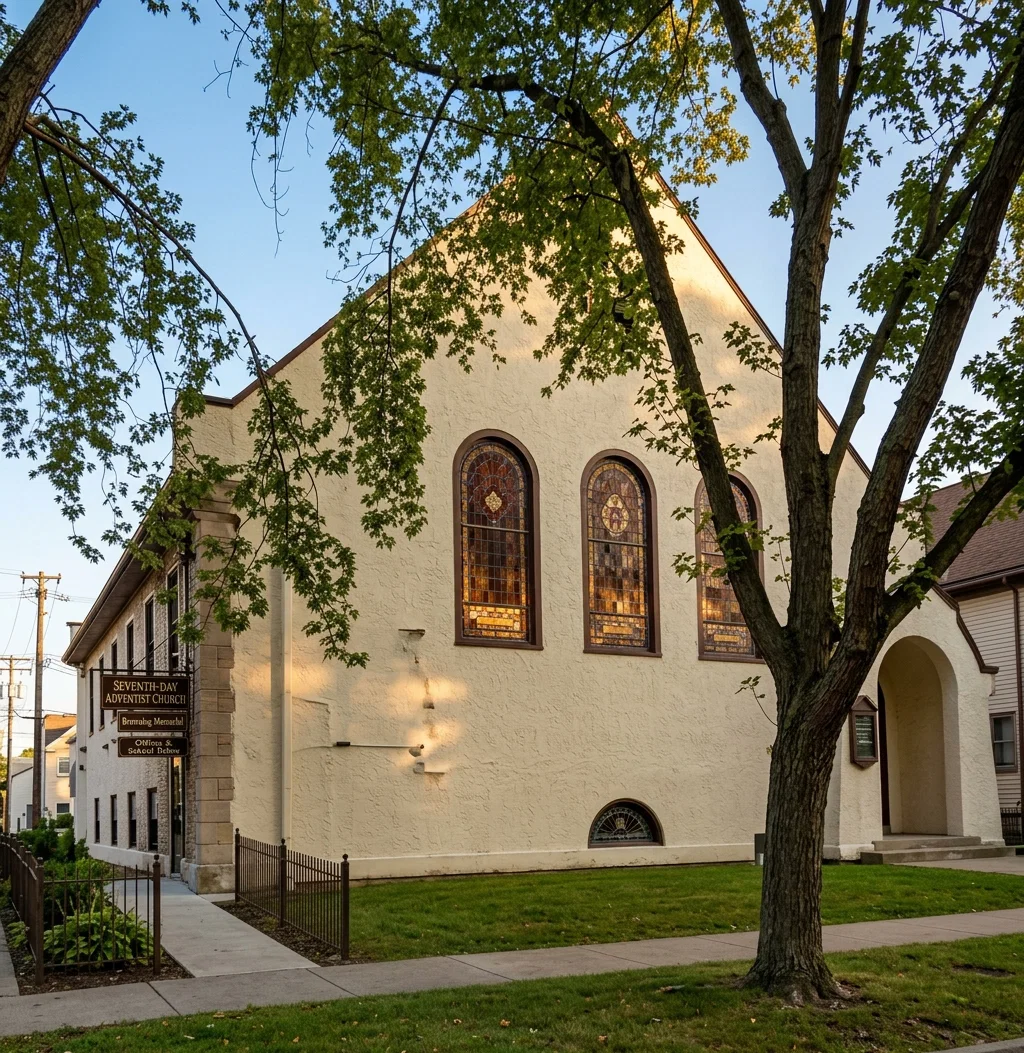
The meetings were held in the new church at Rochester, a beautiful building, given by Miss Hannah Browning. It cost about $11,000, and will seat about 300 persons. Below the church are office rooms for the conference and the tract society, a good schoolroom for the church school, and a prayer meeting room. The building is lighted with electricity and heated with vacuum steam. Having such a representative place of worship, it seems that the cause of God should rapidly grow in Rochester, and that the place should become a strong center for the third angel’s message in western New York.
Rochester was once the center of our work. Here, Brother James White and his colaborers began to print a periodical for the promulgation of the third angel’s message. It was in this place, too, that Spiritualism had its beginning, almost simultaneously with that of the third angel’s message.
SEVENTH-DAY ADVENTIST CHURCH AT ROCHESTER, N. Y.
On Sabbath and Sunday there was a good attendance of our people. On Sabbath afternoon, Brother A. E. Sanderson, the home missionary secretary of the union, gave an earnest talk on the Harvest Ingathering campaign, and the brethren present set $2,000 as a goal toward which to work in soliciting funds. Elder A. G. Daniells was present the last day of the conference, and several opportunities were given him to present his stirring message concerning the advancement and great needs of the work in the Far East. His talks were much appreciated, and were a source of inspiration to all. More than $700 in cash and pledges was raised for foreign mission work.
During the conference two licentiates, Miles R. Coon and F. C. Carlson, were ordained to the gospel ministry.
The brethren and sisters in the Western New York Conference seemed of good courage, and we believe there will be a marked growth in the work in that conference in the near future. I greatly enjoyed my stay at the conference, and was especially pleased to note the spirit of unity and cooperation which prevailed.
I. H. EVANS.

The Bible Sabbath

Is the First-Day Rest an Institution of God's Planting?
(Concluded)

WHAT SAITH HOLY SCRIPTURE?

1. In the beginning, the first day was employed by God in the work of creation. Gen. 1:5.
2. Throughout all the Old Testament history it was one of “the six working days.” Eze. 46:1.
3. It was the day of Christ's resurrection; but Inspiration says specifically that “the Sabbath was past” when that “first day of the week” came. Mark 16:1, 2. Inspiration called this first day merely by the ordinary secular name in common business use, and suggested not a word of attaching any sacredness to the day. For some of the disciples it was a day of journeying, in which the risen Christ joined them. Luke 24:13-29. Later he appeared to the other disciples in Jerusalem, gathered not in meeting, but at supper in their common dwelling house. Mark 16:14.
4. The only religious meeting recorded of the first day of the week was that at Troas, in Acts 20:6-13. The context shows that it was an evening meeting, after the Sabbath,—Saturday night, as we would call it,—for the Bible reckoning is from evening to evening. It was the last time the believers were ever to see the apostle's face, and as they lingered after the close of the Sabbath, he held an all-night farewell meeting, breaking bread with the believers, leaving at daybreak Sunday morning for the eighteen- or twenty-mile journey afoot, across country to Assos. And while he spent that first day traveling afoot, his companions were journeying by boat.
Conybeare and Howson (of the Church of England), in that standard work “Life and Epistles of St. Paul,” tell the plain fact of the inspired record—save that manifestly they should not have applied the title “Jewish” to God's Sabbath (not the Sabbath of the Jews, but “the Sabbath of the Lord thy God”):—
It was the evening which succeeded the Jewish Sabbath. On the Sunday morning the vessel was about to sail.—Chap. 20, page 520.
And describing the road between Troas and Assos, they add:—
Strength and peace were surely sought and obtained by the apostle from the Redeemer, as he pursued his lonely road that Sunday afternoon in spring, among the oak woods and the streams of Ida.—Id., page 522.
5. Once again the “first day of the week” is mentioned, in 1 Cor. 16:2. But that scripture says no word of any sacredness of the day or of any religious observance of it. The apostle was gathering a fund for the poor at Jerusalem, and asked every believer to “lay by” something every first day of the week, so that the money would be ready when he came. As Dean Stanley (Church of England) comments:—
There is nothing to prove public assemblies, inasmuch as the phrase παρ’ ἑαυτῷ (“by himself, at his own house”) implies that the collection was to be made individually and in private.
And Neander's “Church History” says:—
All mentioned here is easily explained, if one simply thinks of the ordinary beginning of the week in secular life.—Vol. I, page 339.
To meet the emergency of need in Judea, these believers were asked to look over their business affairs at the beginning of each week, until Paul should come, laying aside a gift as God had prospered them.

NO SUNDAY SACREDNESS IN THE NEW TESTAMENT

This is the record—not one suggestion in all the New Testament of Sunday sacredness, to say nothing of precept or commandment of the Lord. The late R. W. Dale, D. D. (a leading Congregationalist), of England, wrote:—
It is quite clear that, however rigidly or devotedly we may spend Sunday, we are not keeping the Sabbath. . . . The Sabbath was founded on a specific, divine command. We can plead no such command for the observance of Sunday. . . . There is not a single line in the New Testament to suggest that we incur any penalty by violating the supposedsanctity of Sunday.—The Ten Commandments, pages 106, 107.
That religious classic, Smith and Cheetham's “Dictionary of Christian Antiquities,” says that the “notion of a formal substitution” of the first day for the seventh,—
and the transference to it, perhaps in a spiritualized form, of the Sabbatical obligation established by the promulgation of the fourth commandment, has no basis whatever, either in Holy Scripture or in Christian antiquity.—Article “Sabbath.”
Dr. E. F. Hiscox, author of “The Baptist Manual,” says:—
There was and is a commandment to “keep holy the Sabbath day,” but that Sabbath was not Sunday. It will, however, be readily said, and with some show of triumph, that the Sabbath was transferred from the seventh to the first day of the week. . . . Where can the record of such a transaction be found?—Not in the New Testament—absolutely not.—The New York Examiner, Nov. 16, 1893.
Such declarations by well-known scholars might be multiplied; but it is not necessary. The record is open—any one may see it. There is not a word in Holy Scripture of any First-day sacredness.
The Sunday institution is not a plant of our Heavenly Father's planting.
There has been no change of the Sabbath by divine authority. Men may choose to rest on any other day, but that cannot make such a day God's rest day, his holy Sabbath. One cannot change one's birthday by celebrating another day as such. It is a fact of history that on a certain day of the month one was born. That fact cannot be changed by choosing to celebrate another day as the birthday. Just so it is a fact of divine history that God rested on a given day of the week, and on no other. That made the seventh day his rest day.
It is different from other days in character also, for he blessed it and made it holy. To deny the difference between the holy day and the common days is to say that when the great Creator blesses and makes holy, it is a vain performance. That cannot be. It would take away all hope of holiness or salvation for men. The blessing is upon the day, as every soul finds who keeps it by faith.

HOW THE CHANGE CAME ABOUT

When men choose to set apart another day than that blessed and sanctified of God, it is plainly a setting up of the humanly appointed time against the divinely appointed time. It is exalting man's sabbath against God's Sabbath. It is man exalting himself “above all that is called God.” 2 Thess. 2:4.
This was what made the Roman Papacy. The apostle Paul wrote that in his day the spirit of lawlessness was already working. He said it would lead to a “falling away” from the truth of God, and the full exaltation of the man of sin. 2 Thessalonians 2. The falling away came. As Dr. Killen (Presbyterian), of Ireland, says in the preface to his “Ancient Church:”
In the interval between the days of the apostles and the conversion of Constantine, the Christian commonwealth changed its aspect. . . . Rites and ceremonies, of which neither Paul nor Peter ever heard, crept silently into use, and then claimed the rank of divine institutions.
In his “Development of Christian Doctrine,” Cardinal Newman (Roman Catholic) tells how rites and ceremonies were borrowed from paganism:—
Confiding then in the power of Christianity to resist the infection of evil, and to transmute the very instruments and appendages of demon worship to an evangelical use, . . . the rulers of the church from early times were prepared, should the occasion arise, to adopt, or imitate, or sanction the existing rites and customs of the populace, as well as the philosophy of the educated class.—Pages 371, 372.
Thus along with other adaptations came the Sunday festival. Dean Stanley (Church of England) says:—
The retention of the old pagan name Dies Solis, or Sunday, for the weekly festival, is, in a great measure, owing to the union of pagan and Christian sentiment with which the first day of the week was recommended by Constantine to his subjects, pagan and Christian alike, as the “venerable day of the sun.”—“History of the Eastern Church,” Lecture 6, par. 5.
Thus the Sunday institution comes in, marked by its pagan origin, and adapted to ecclesiastical purposes by the church of the “falling away” that grew into the Roman Papacy. To quote again from the Baptist author, Dr. Hiscox:—
Of course, I quite well know that Sunday did come into use in early Christian history as a religious day, as we learn from the Christian Fathers and other sources. But what a pity that it comes branded with the mark of paganism, and christened with the name of the sun god, when adopted and sanctioned by the papal apostasy, and bequeathed as a sacred legacy to Protestantism!—New York Examiner, Nov. 16, 1893.
No wonder that with the coming of the latter days, and the proclamation of the message of preparation for Christ's second coming, there should come a call to Christians to follow Christ and Holy Scripture in keeping God's holy Sabbath.
Again the voice of Jesus is heard in protest against traditions that make void the commandment of God.
“Every plant,” he says, “which my Heavenly Father hath not planted, shall be rooted up.” Matt. 15:13.
W. A. S.

Blessed Are the Poor in Spirit

A. E. HASSELL
WHY did Christ say, “Blessed are the poor in spirit,” rather than, Blessed are the strong and courageous,—those who, it would seem, are well able to bear much? He had reason for his statement. The strong feel able to walk alone, and their very strength proves their weakness. God must set such aside unless they can get their eyes open, realize their own weakness, and learn of him. The poor, the weak, feel keenly their need, and must have some one to lean upon, some one to cast themselves upon with their whole weight and burdens. Then God, who delights in mercy, can come and revive the poor and the humble. He is their strength, and loves to be their strength. “To them that have no might he increaseth strength.” Isa. 40:29. Therefore Paul could say, “When I am weak, then am I strong.” A plain contradiction, it would seem, but it is true in the life of him who is a true follower of the meek and lowly Jesus.
Said Mary, “For he that is mighty hath done to me great things; and holy is his name. And his mercy is on them that fear him from generation to generation. He hath showed strength with his arm; he hath scattered the proud in the imagination of their hearts. He hath put down the mighty from their seats, and exalted them of low degree. He hath filled the hungry with good things; and the rich he hath sent empty away.” Luke 1:49-53.

“He Delighteth in Mercy”

They that are whole need no physician. It was the self-sufficient, self-trusting Pharisees and scribes that stood aloof and found fault with Christ, that lost the blessings of heaven, which they so much needed; but in their pride they would not acknowledge their need. The poor, the needy, the helpless, the lame, the blind, the halt, the palsied, the lepers, the sinners,—the very outcasts,—received the blessings of heaven because they saw and felt their deep need and reached out for the blessing. It was the prodigal son, hungry, that came to himself and was welcomed to his father’s home.
It was David who saw the depth of his own sinfulness, humbled himself although king of Israel, and confessed and cried for mercy, that obtained it. For God “delighteth in mercy.” But the haughty Saul, who came only with miserable excuses and tried to cast the blame for his own misdeeds upon others, was finally left to himself, and lost kingdom, life, and all. The one, the Spirit of God could reprove and lead right again, and continue to lead, while the other refused correction, and God could do no more for him.
As God’s people and as individuals, the same paths lie before us, and we must choose which spirit shall control us. Shall we take to heart the many merciful reproofs that God has sent to us in his Word and by his servant, and humble ourselves, repent, rend the heart, confess and forsake our many sins and misdeeds, obtain mercy, and gain the kingdom and everlasting life? or shall we continue in hardness of heart, feel rich and be content with our attainments,—with what we are and do, or have done,—and in our blindness refuse to advance in faith and spirituality, satisfied that all is well while we have the outward form without the power? If we take the latter course, we can read our sad fate in that of Saul.
May God help us to heed the warning, “Be zealous therefore, and repent.” Each one of us must decide his own case. Let us not rest until we are sure that we have decided on the right side. “Behold, I stand at the door, and knock.” “He delighteth in mercy.” Will you open to him? Will you remove the stumblingblocks that the Lord of mercy may come in?
Kent, Wash.

GENERAL ARTICLES

GENERAL ARTICLES
GENERAL ARTICLES
Continue reading: The Foreign Missionary