Any religion might as well go down <page-break/> which cannot be sustained by lo
Page 1
American Sentinel
July 14, 1898
Pacific Press Publishing Co. · New York · July 14, 1898
Any religion might as well go down418which cannot be sustained by love to God and to one's fellowmen.
IT is useless to invoke the aid of human law in the warfare that is not against flesh and blood, but against “spiritual wickedness in high places.”
TRUTH and righteousness cannot fall to the ground while God remains upon his throne. That which embodies truth and righteousness needs no support from the civil arm.
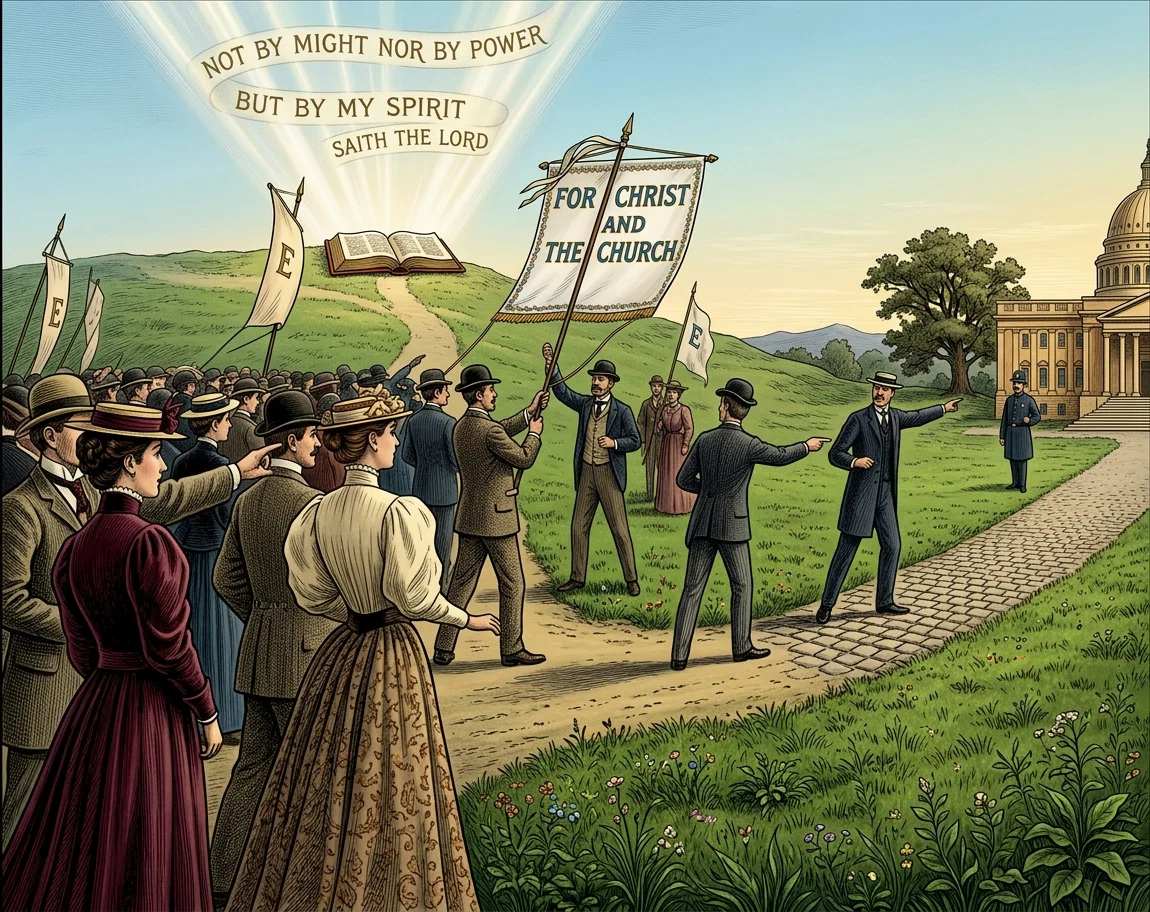
Which Path: to the Word of God or to the Legislature?
If law could make men better, there would be no need of the gospel.
—o—
NO AMOUNT of legislation can separate conscience from the Sabbath.
THE “snapshot” is a poor way to get a correct photograph of character.
—o—
ALL Christian institutions have their support in God; and they need no other.
THE institution of the Sabbath can be neither civil nor uncivil. It is purely religious.
—o—
The carnal nature is the architect of hell.
—o—
Not all is
Christian
that appears
angelic.
—o—
“THE weapons of our warfare are not carnal.”
—O—
THE gospel of God cannot be preached by the law of man.
—o—
ANY “moral reform” that is not wrought in the heart is a delusion.
—o—
CONSCIENCE is one of the things which the Sunday law aims to close up.
“CHARITY” is never found far from her sister graces faith and hope.
Persuasion Vs. Compulsion.
By H. A. Hellier
BY H. A. HELLIER.
It is the duty of the State to protect liberty of conscience, and in matters of religion the extreme limits of its authority have been reached when it does that. It was because they recognized this principle clearly that the evangelical princes of Germany uttered that memorable protest, when in answer to the decree of the papacy, demanding the suppression of the Reformation, they said, “Let us reject this decree. In matters of conscience the majority have no power.”
The annunciation of this principle is made more significant when we remember that when the princes said that, they realized that they were fighting against the powers of earth and hell, and that they would probably pay the penalty with their property, freedom, and even their lives. It is in the footsteps of these noble men that the Protestants of the world to-day profess to be following yet how far have they strayed from that path! All over the land they have organized societies that have as their object the domination of the State by the Church. This they deny, and say, “We merely wish the State to put on righteousness,” or “We wish to see Christ enthroned as King of the Commonwealth.”
Now, religion has nothing to do with the State, or the State with religion if they both keep in their proper sphere, and only when religion has lost its vitalizing principle, and has become but a form, does she seek union with, or aid from, the State. Therefore, those, the majority who are clamoring for Sunday laws, and insist that the minority must observe their Puritanical Sabbath in deference to the majority, have, in this age of enlightenment lost sight of the vital principle of freedom of conscience, which was so clearly recognized by the evangelical princes amid the moral darkness of the sixteenth century.
How strange it is that these people cannot see that the State cannot put on righteousness, and how strange that they do not realize that this movement betrays the print of Satan’s cloven foot, inasmuch as it is, like everything else emanating from him, the antipodes of the teachings of Christ; for he never attempted to legislate righteousness onto the State, or on the individuals composing it. No, indeed; his gentle voice of entreaty sinks into the hearts of individuals, saying, “Come unto me, all ye that labor and are heavy laden, and I will give you rest,” and “Whosoever will, let him take of the water of life freely.” Again, “If any man hear my words and believe not, I judge him not; for I came not to judge the world, but to save the world.”
In everything Christ leaves the individual to choose whom he will serve; but his professed followers instead of following him and presenting his righteousness, thus persuading the sinner individually to accept it, must needs make the sinner righteous by legislating righteousness onto the State. How they can make the State holy without first converting every sinner composing the State, they do not undertake to explain, for they cannot. If those who are doing this work of Satan, but who do not realize it as such, and who honestly think as did Paul, that they are doing God’s service, would only go on bended knees before the throne of grace with hearts humbled by Christ’s Spirit and ask for light on this question, God would flood them with light, and his Spirit would show whither their feet were tending, and lift them from the groveling ranks of the arch-enemy to the mighty ranks of the Omnipotent Prince who will soon vanquish all intrigue and sin, and rule the universe in peace and righteousness.
THE city authorities of Cleveland, Ohio, maintain an attitude of firm hostility to all desecration of Sunday by baseball games and public sports, and as a result it is said the Cleveland League Ball Club will be transferred to some other city.
SOME of the most troublesome people in the world are those who have a surplus of conscience—enough for themselves and for all their neighbors.
THE test of Christianity is love; not that which men may call love, but the love of God. Christianity means being like God in our disposition toward others.
But what is the love ‘of God? The Scripture says: “Herein is love, not that we loved God, but that he loved us, and sent his Son to be the propitiation for our sins;” and “God commendeth his love toward us in that, while we were yet sinners, Christ died for us.” John 4:10; Rom. 5:8.
As God loved those who were his enemies, so must Christians love their enemies. They must love all men and count all as their brethren.
But how is love of our enemies to be manifested? The answer is plain. If we are actuated by the spirit of God, our love for all men will be manifested in sacrificing for them even as God did. “For God so loved the world, that he gave his only begotten son, that whosoever believeth on on him might not perish, but have everlasting life.” John 3:16.
How then can the spirit of love—the love of God—be reconciled with the spirit of war? We cannot reconcile it. The spirit of love says that we should lay down our lives for our enemies. The spirit of war says that our enemies should lay down their lives for us.
The Christian warfare does not mean death to our enemies, but death to self. And if Christians are engaged in this warfare, they will not at the same time be engaged in any other.
A Little Piece of Ancient History Which Is Also Modern.
By A. T. J.
In considering the new and “imperial” career that is being opened before the United States, and sanctioned by so many in high positions, we have remarked that there was one republic that had passed over this ground once before in the history of the world. That republic was Rome. It is interesting to read the statements made to-day concerning this “colonial policy” and “colonial career” that is opening up before “imperial America,” and compare it with what has long been written of the course of Rome as she passed over the same ground. It is now claimed on behalf of the new, “Imperial America,” that she must accept this great responsibility that has fallen upon her of extending the blessings of liberty to the world. And that she must discharge this sacred office by beginning to deliver from the oppressive rule of Spain, the people of the Philippines, San Juan, Cuba, perhaps the Carolines and so on to the other oppressed peoples of the world. It is said that America will thus extend the blessing of liberty, just because of the blessing of liberty, she will bestow freedom, entirely from love of human freedom as far as possible to all the world.
All this is precisely what Rome proposed to do. Rome claimed that she never wished to make any conquests of any people, nor to control any territory, outside of her own boundaries of Italy. All that she ever did outside of Italy was altogether out of pure benevolence and solely to extend to oppressed peoples the blessings of liberty, of which the Romans were the exemplars before the world, and in behalf of the world, and which they so sincerely loved that they couldn’t be content at all so long as any other people were not enjoying this wonderful liberty. Therefore they would man fleets and raise armies, send them over seas at great sacrifice and immense expense to fight battles for strange peoples, only that those peoples might have the blessing of liberty of which Rome was the world’s conservator.
One example will illustrate this whole subject. The Romans had sent an army into Macedonia to fight against Philip the Second in behalf of the States of Greece and to save them from being oppressed by Philip. The Roman army was successful, Philip was thoroughly conquered and a treaty of peace was concluded, but “all Greece was in uncertainty” as to what should be their fate, now that the Roman power was predominant in both Greece and Macedonia. It was the time when the Isthmian games were celebrated in which all Greece participated and where vast crowds were assembled to witness the contests, then “the multitude being assembled in the stadium to see the games, a herald came forward and published with a loud voice” the following proclamation:—
“The senate and people of Rome, and Titus Quintius, their general, having overcome Philip and the Macedonians, ease and deliver from all garrisons, taxes and imposts, the Corinthians, the Locrians, the Phocians, the Euboeans, the Phthiot Achaeans, the Magnesians, the Thessalians, and the Perrhoebians; declare them free, and ordain that they shall be governed by their respective laws and usages.”
“At these words, which many heard but imperfectly, because of the noise that interrupted them, all the spectators were filled with excess of joy. They gazed upon and questioned one another with astonishment, and could not believe either their eyes or ears; so like a dream was what they then saw and heard. It was thought necessary for the herald to repeat the proclamation which was now listened to with the most profound silence, so that not a single word of the decree was lost. But now, fully assured of their happiness, they abandoned themselves again to the highest transport of joy and broke into such loud and repeated acclamations that the sea resounded them to a great distance; and some ravens which happened to fly at that instant over the assembly fell down in the stadium; so true is it, that of all the blessings of this life, none are so dear to mankind as liberty! The games and sports were hurried over with neglect and disregard; for so great was the general joy upon this occasion that it extinguished every other thought.”
“The games being ended, all the people ran in crowds to the Roman general, and every one being eager to see his deliverer, to salute him, to kiss his hand, and to throw crowns and festoons of flowers over him, he would have run the hazard of being pressed to death by the crowd had not the vigor of his years, for he was not above thirty-three years old, and the joy which so glorious a day gave him, sustained and enabled him to undergo the fatigue.
“The remembrance of so delightful a day and of the invaluable blessing then bestowed was forever renewing and for a long time the only subject of conversation in all times and in all places. Every one cried in the highest transports of admiration and a kind of enthusiasm that there was a people in the world, who at their own expense and the hazard of their lives, engage in a war for the liberty of other nations; and that not for their neighbors, or people situated on the same continent, but who crossed seas, and sailed to distant climes, to destroy and extirpate unjust power from the earth, and to establish universally, law, equity, and justice. That by a single word, and the voice of a herald, liberty had been restored to all the cities of Greece and Asia. That a great soul only could have formed such a design; but to execute it was the effect at once of the highest good fortune and the most consummate virtue.
“They called to mind all the great battles which Greece had fought for the sake of liberty. ‘After sustaining so many wars,’ said they, ‘never was its valor crowned with so blessed a reward as when strangers came and took up arms in its defense. It was then, that almost without shedding a drop of blood, or losing one man, it acquired the greatest and noblest of all prizes for which mankind can contend. Valor and prudence are rare at all times, but of all virtues justice is most rare. Agesilaus, Lysander, Nicias and Alcibiades had great abilities for carrying on war, and gained battles both by sea and land; but it was for themselves and for their country, not for strangers and foreigners, they fought. That height of glory was reserved for the Romans.’”
Honest old Rollin’s “reflections” upon this, are important to-day, as the United States seems about to start,420in this same identical path. These reflections run thus:—
“The reader may perceive in the events above related one of the principal characteristics of the Romans which will soon determine the fate of all the States of Greece and produce an almost general change in the universe: I mean a spirit of sovereignty and dominion. This characteristic does not display itself at first in its full extent. It reveals itself by degrees; and it is only by insensible progress which at the same time is sufficiently rapid, that we see it carried at last to its greatest height.
“It must be confessed, that this people, on some occasions, show a moderation and disinterestedness, which from a superficial view, seem to exceed everything we meet within history, and which we feel it incumbent on us to praise.
“Was there ever a more glorious day than that in which the Romans, after having carried on a long and dangerous war, after crossing seas, and exhausting their treasures, caused a herald to proclaim in a general assembly, that the Roman people restored all the cities to their liberty and desired to reap no other fruits by their victory, than the noble pleasure of doing good to nations, the bare remembrance of whose ancient glory sufficed to endear them to the Romans?
“Had this deliverance of the Grecian states, proceeded merely from a spirit of generosity, void of all interested motives; had the whole tenor of the conduct of the Romans been of the same nature, with such exalted sentiments, nothing could possibly have been more august, or more capable of doing honor to a nation. But if we penetrate ever so little beyond this glaring outside, we soon perceive, that this specious moderation of the Romans was entirely founded on a profound policy; wise indeed, and prudent, according to the ordinary rules of government; but at the same time very remote from that noble disinterestedness so highly extolled on the present occasion. It may be affirmed that the Grecians then abandoned themselves to a stupid joy: fondly imagining that they were really free because the Romans declared them so.
“The Romans declared loudly in favor of those republics [of Greece]; made it their glory to take them under their protection, and that with no other design in outward appearance, than to defend them against their oppressors; and further, to attach them by a still stronger tie, they hung out to them a specious bait, as a reward for their fidelity—I mean liberty, of which all the republics in question were inexpressibly jealous, and which the Macedonian monarchs had perpetually disputed with them.
“The bait was artfully prepared, and was eagerly swallowed by the generality of the Greeks, whose views penetrated no further. But the most judicious and most clear-sighted among them, discovered the danger that lay concealed beneath this charming bait; and accordingly they exhorted the people from time to time in their public assemblies, to beware of this cloud that was gathering in the west; and which, changing on a sudden into a dreadful tempest, would break like thunder over their heads to their utter destruction.
“Nothing could be more gentle and equitable than the conduct of the Romans in the beginning. They acted with the utmost moderation toward such states and nations as addressed them for protection; they succored them against their enemies; took the utmost pains in terminating their differences and in suppressing all trouble which arose among them; and did not demand the least recompense for all these services done for their allies. By these means, their authority gained strength daily and prepared the nation for entire subjection.
“Under the pretense of manifesting their good will, of entering into their interests, and of reconciling them, they rendered themselves as the sovereign arbiters of those whom they had restored to liberty, and whom they now considered in some measure as their freedmen. They used to depute commissioners to them to inquire into their complaints, to weigh and examine the reasons on both sides, and to decide their quarrels; but when the articles were of such a nature that there was no possibility of reconciling them on the spot, they invited them to send their deputies to Rome, but afterwards they used to summon those who refused to be reconciled; obliged them to plead their cause before the senate and even to appear in person there. From arbiters and mediators, having become supreme judges, they soon assumed a magisterial tone, looked upon their decrees as irrevocable decisions, were greatly offended when the most implicit obedience was not paid to them, and gave the name of rebellion to a second resistance. Thus there arose in the Roman senate, a tribunal which judged all nations and kings, and from which there was no appeal.
“We see by the event to what this so-much boasted lenity and moderation of the Romans was confined. Enemies to the liberty of all nations, having the utmost contempt for kings and monarchy, looking upon the whole universe as their prey, they grasped with insatiable ambition the conquest of the whole world. They seized indiscriminately all provinces and kingdoms, and extended their empire over all nations; in a word, they prescribed no other limits to their vast projects than those which deserts and seas made it impossible to pass.”
This extract will be good to keep, and to read along with much spread-eagleism that has been and that will be manifested upon “Imperial America,” “our colonial policy,” and “our obligations to extend the blessings of liberty to oppressed peoples” and “to all the world.”
A. T. J.
IN Congress recently, during the consideration of a bill appropriating $25,000 to make improvements upon a piece of ground near the city of Washington, it was intimated that this was desired mainly to increase the value of a tract of land held by Methodists, who hoped to erect upon it a Methodist college. Mr. Henderson offered in favor of the measure the argument that “we have in this city a Catholic university, and Congress has given it every facility, by roadways and street improvements, to afford it easy facilities in connecting with the city.” This illustrates how easily and naturally one wrong is sought to be justified by another wrong, when a wrong precedent has once been established.
“ACQUIRE a government over your ideas, that they may come down when they are called, and depart when they are bidden.”
Three Sabbaths.
By Ellet Joseph Waggoner
THE LORD'S SABBATH—THE JEWISH SABBATH—THE POPE'S SABBATH.
BY E. J. WAGGONER.
One can in truth speak of sabbaths in the plural only as one can speak of many gods. “There is no God but one. For though there be that are called gods, whether in heaven or on earth; as there are gods many and lords many; yet to us there is one God, the Father, of whom are all things, and we through him; and one Lord, Jesus Christ, through whom are all things, and we through him.” 1 Cor. 8:5, 6. So, though there be various sabbaths, so-called, there is but one true Sabbath, the Sabbath of the Lord.
THE LORD'S SABBATH.
The word Sabbath means rest. It is a Hebrew word transferred into the English language. When the Hebrews used the word “Sabbath,” it conveyed the same idea to them that the word “rest” does to us. The fourth commandment therefore really says to us: “Remember the rest day, to keep it holy. Six days shalt thou labor, and do all thy work; but the seventh day is the rest of the Lord thy God; in it thou shalt not do any work, thou, nor thy son, nor thy daughter, thy manservant, nor thy maidservant, nor thy cattle, nor thy stranger that is within thy gates; for in six days the Lord made heaven and earth, the sea, and all that in them is, and rested the seventh day; wherefore the Lord blessed the rest day and hallowed it.”
We must not make the mistake of judging the Lord’s rest from what men are accustomed to call rest. God is not a man. We should rather learn from God’s rest what rest really is. God’s rest is not mere physical rest from weariness. This we know from two facts. First, “God is Spirit.” John 4:24. Not “a spirit,” as though he were one of many; but he is Spirit, as it is rendered in the margin of the Revision. Second, “The everlasting God, the Lord, the Creator of the ends of the earth, fainteth not, neither is weary.” Isa. 40:28. The Lord therefore did not rest because he was tired, and his rest is not physical, but spiritual, since he is Spirit. “They that worship him must worship him in Spirit and in truth.”
God rested, not because he was weary, but because his work was finished. When work is finished, and is well done, nothing but rest remains. In six days God finished his work, and as he surveyed it, he pronounced it “very good.” There was no flaw in it. It was without fault before him. Therefore since God’s work was done and well done at the close of the sixth day, “He rested on the seventh day from all his work which he had made.” He had no sad reflections, no regrets. His rest was not marred, as what man calls rest so often is, by any such thought as, “To-morrow I must go at that work again;” nor, “I wish I had done this portion a little differently;” nor, “If I could do that over again, I could make an improvement;” nor, “That last day’s work is so bad that I cannot bear to look at it; I was so tired when I got to it that I couldn’t half do it.” Nothing of the kind. Every portion of the work, even man, was as perfect as it was possible for it to be, and God took pure delight in contemplating the work from which he was resting because it was complete and perfect.
This is the rest which he offers to us. It is not something he imposes on us, but which he in everlasting love and kindness gives to us. Rest is not a task that is laid on one. It is not a burden. They who look upon the Sabbath as a burden, have no idea of what the Sabbath of the Lord is. It is rest, perfect, unalloyed rest.
Jesus Christ is the One by whom the worlds were made, “for in him were all things created, in the heavens, and upon the earth,” therefore he is the One who offers us this rest. To every soul he cries, “Come unto me all ye that labor and are heavy laden, and I will give you rest.” Matt. 11:28. The rest is found in him, because in him the works of God are completed. In him is the new creation, and if any man be in him, he is a new creature. On the cross Jesus cried, “It is finished,” thus showing that in his cross we find that perfect rest that comes alone from the finished work of the Lord.
This rest is gained by faith. “We which believe do enter into rest.” How so?—Because by faith we have the finished, perfect work of the Lord as our own. “This is the work of God, that ye believe on him whom he hath sent.” John 6:29. Believing him means receiving him; and since in him the works of God are complete, it follows that by believing on him we find the rest.
The rest that Jesus gives is rest from sin. The heavy laden whom he calls to him are those who are burdened with the weight of their sins. All men are thus burdened, “for all have sinned.” Our best works are utterly worthless. Christ will have a people who are “zealous of good works” (Titus 2:14, 15), but the good works must be those which God himself has wrought for us in Christ. Only his work is enduring. “His work is honorable and glorious; and his righteousness endureth for ever.” Ps. 111:3. Therefore, “by grace are ye saved through faith; and that not of yourselves; it is the gift of God; not of works, lest any man should boast; for we are his workmanship, created in Christ Jesus unto good works, which God hath before prepared, that we should walk in them.” Eph. 2:8-10. It is “not by works done in righteousness, which we did ourselves, but according to his mercy he saved us, through the washing of regeneration and renewing of the Holy Ghost, which he poured out upon us richly, through Jesus Christ our Saviour.” Titus 3:5, 6.
It is by the works of God, therefore, that we are saved, and not by our own. Good works there are in abundance, and they are for us too, but through no work of our own; solely through the perfect work of God in Jesus Christ. If the works were our own, then the rest would be our own; but God gives us his rest, not ours, because only his works can yield perfect rest. “He hath made his wonderful works to be remembered” (Ps. 111:4), or, literally,422“He hath made a memorial for his wondrous works.” That memorial is the seventh day, the day on which he rested from all his works. That day he has blessed and sanctified, made holy. Its holiness has never departed from it, for “whatsoever God doeth, it shall be for ever.” No matter what man does, nor how man regards the day, its holiness remains.
“There remaineth therefore a rest to the people of God;” and the seventh day, which God for ever declares to be his rest, is that by which he makes known to us the perfection of his rest, because it calls us to contemplate a finished and perfect new creation. It reveals to us the everlasting God, the unwearied, almighty Creator, who has wrought and laid up great goodness for them that trust in him before the sons of men. Ps. 31:19. It reminds us that we are “complete in him, which is the head of all principality and power.” It tells us that, although we have sinned, and brought the curse upon God’s perfect creation, the cross of Christ, which bears the curse, restores and perpetuates the perfect work of God, so that through it we may stand without fault before the throne of God, just as when man was first made. “Thanks be unto God for his unspeakable gift.”
THE JEWISH SABBATH.
There is such a thing as “the Jewish Sabbath,” or the Sabbath of the Jews, but it is a far different thing from the Sabbath of the Lord. Many people imagine that if one observes the seventh day he is keeping the Jewish Sabbath; but that does not at all follow. No one keeps the Jewish Sabbath if he keeps the Sabbath “according to the commandment.” There is the same difference between the Jewish Sabbath and the Sabbath of the Lord, that there is between a man and God. Let us explain:
“The seventh day is the Sabbath of the Lord;” but we have seen that the Lord’s rest is spiritual rest, which the seventh day commemorates. A man may cease from physical toil on the seventh day of the week, and not keep the Sabbath of the Lord. If a man stops work on Friday evening at sunset, and abstains from all labor until the next day at sunset, merely as a form of worship, and in order that he may be physically better able to go at his work again, or with the thought that he is thereby discharging a duty, and gaining the favor of God, that is not keeping the Sabbath of the Lord. To keep the Sabbath of the Lord is to delight in the Lord. Those who do not delight themselves in the Lord, do not keep his Sabbath, no matter when they abstain from labor.
It is absolutely impossible for one who is not a Christian to keep the Lord’s Sabbath; for, as we have seen, God’s rest comes only from his perfect work, which is found only in Christ. “We which believe do enter into rest.” Therefore no Jew, so-called, as distinguished from a believer in Christ, keeps the Sabbath of the Lord, even though he apparently rests on the seventh day of the week. His rest is his own rest, and not the rest of the Lord.
Do you see the difference? The Jewish Sabbath falls on the same day of the week as the Sabbath of the Lord, but it is not by any means the same thing. It represents only the man himself, and his own work. Instead of being the sign of justification by faith in the work of the Lord, it is the sign of self-righteousness, as indicated by the question which the Jews asked of Jesus: “What shall we do, that we might work the works of God?” They counted their own works equal to God’s works. Their obedience was not the obedience of faith, but only of form. From such a Sabbath may the Lord deliver us. It is from it that we are delivered in the Sabbath of the Lord, for we are saved from our own works, and given the perfect works of the Lord. “The seventh day is the Sabbath of the Lord,” but let us beware of making it a mere caricature of rest. Let us take it for what it is: the rest of the Lord.
THE POPE'S SABBATH.
This is something entirely different from the Sabbath of the Jews, and infinitely different from the Sabbath of the Lord. The Sabbath of the Lord is the acceptance of God’s own works, and rest in them alone, allowing him to work both to will and to do of his good pleasure; the Jewish Sabbath represents the vain attempt of zealous and self-confident men to do the works which God himself does, and which God alone can do; but the pope’s sabbath signifies the substitution of man’s work for God’s work, as being not only as good, but even better. It dispenses with even the form of the commandment of the Lord. Let us see how this is.
The Lord’s Sabbath has been sufficiently dwelt on for the present. We know what it is. We have seen that the Jews’ sabbath is the observing of the form of the Lord’s Sabbath, without the substance which can come only by faith. It falls on the same day, but is man’s sabbath, not the Lord’s. The pope’s sabbath has nothing in common with the Sabbath of the Lord, not even in form, but utterly repudiates it. Thus, a papist book, entitled, “A Sure Way to Find Out the True Religion,” says:—
“The keeping holy the Sunday is a thing absolutely necessary to salvation; and yet this is nowhere put down in the Bible; on the contrary, the Bible says, “Remember the Sabbath day, to keep it holy (Ex. 20:8), which is Saturday, and not Sunday; therefore the Bible does not contain all things necessary to salvation.”
This is only one out of many similar citations that might be given, but is sufficient to show that in the observance of Sunday the Catholic Church deliberately repudiates the Word of the Lord, and sets itself above it. It has placed its sabbath on an entirely different day from the Sabbath of the Lord,—a day which even God himself could not possibly have made his Sabbath since on it he began his work,—in order to emphasize its claim to be above God. It would teach men that they are to obey the church rather than God.
Notice that the citation speaks about the necessity of “keeping holy the Sunday.” But God has not made the423Sunday holy. In fact, the Bible knows nothing about such a day. It does know the first day of the week, which it calls a working day, but the Sunday, a day composed of parts of two days, was made in Rome. The only day that God has ever spoken of as holy is the seventh day of the week. That day He himself has made holy, and all he asks of us is to keep it holy. But since God has not made the Sunday holy, it follows that if man is to keep it holy, man himself must make it holy. All the sacredness in the world that Sunday has is that which man gives to it. The Sunday sabbath, therefore, stands as the sign of man’s pretended power to make things holy. For if man can make one thing holy, it is evident that he can make anything holy. If man can make and keep a day holy, then he can make and keep himself holy. The pope’s sabbath is thus the sign of his claim to take the place of the Lord as the sanctifier of sinners.
While the seventh day is the sign of God’s power to save by his own works, the Sunday is the sign of man’s assumed power to save himself by his own works entirely apart from, and in spite of the Lord. It repudiates the Lord, in repudiating his Word. Take notice that this is said of the pope’s Sunday, and not of all those who regard it as a holy day. There are thousands who are keeping the pope’s day, honestly supposing it to be the Sabbath of the Lord. Such of course believe in justification by faith, although they unwittingly observe the sign of justification by works. It is for the benefit of such that this article is written, that they may be wholly consistent in their profession of faith. We are dealing with facts, regardless of how men may stand related to them; and the facts are that the Lord’s Sabbath is justification by faith; the pope’s sabbath means justification by works, and that man’s own works. On which side will you stand?
What Is the Everlasting Gospel?—No. 4.
By C. H. KESLAKE
BY C. H. KESLAKE.
The everlasting gospel, as brought to view in Rev. 14:6, 7, is to be proclaimed at the very time when the work of enforcing the worship of the beast through the reception of the mark, is in process of fulfillment. Not only is this so, but it is with direct reference to this work that the gospel is to be proclaimed. This will be seen from the reading of the message itself: “Fear God and give glory to him . . . and worship him that made heaven and earth, the sea and the fountains of waters.”
It has always been the duty of all created beings to worship him that made them. No one will dispute this. To this end has the gospel ever been preached. Why then should it be necessary to give a special message for this purpose as expressed in the Scripture under consideration? It is in view of the fact that at such a time a professedly gospel work is being carried on with the avowed object of compelling the people to worship God. But as we have seen, the truth is that those who would yield to the influences brought to bear upon them, would not be worshiping God, but the power symbolized by the beast of Rev. 13:1, which we know is the papacy. And there are many true-hearted Christians, who are walking in all the light they have, and who have no other desire than to serve God with undivided affection. For their sakes, as well as for others who would heed the invitation, the gospel must be proclaimed.
Being professedly a Christian work, it could not be wondered at that at first there would be thousands who would have no other idea but that such a work was really Christianity, and so for a time be deceived. And they would also be given to understand that the mark to be enforced would be set forth as the test of Christianity as to whether one was really worshiping God or not.
Inasmuch as this work would be professedly gospel work it will be clear to all that when begun it must be started by Christians.
It is of the highest importance that we do not lose sight of the fact that the gospel call to “Fear God” etc. is really a call to keep the commandments of God; for it will then be seen that the point wherein one is failing to fear God and to give glory to him is with reference to one of the commandments.
In view of the fact that this work will be carried on by Christians we may ask what has been the attitude of the Christian Church with reference to the law of God and one’s obligation to it? From the time of the Reformation the church has been divided on points of doctrine, but never in their teachings have they been disloyal to the law of God. With one accord they have taught that it is necessary for the commandments to be kept by all.
But while this is so they have with one accord taught their communicants and others to violate one of the commandments. The fourth commandment, as all know, requires that the seventh day shall be kept holy unto the Lord. But notwithstanding it is so plainly enjoined, another day has been put in its place—a day, as pointed out last week, that was never kept by the Lord Jesus; a day that he never commanded his followers to keep; a day that his apostles never did keep, nor thought others to keep; a day for which in the Scriptures there is not the slightest hint of sacredness or sanctity. And that day is the day commonly called Sunday.
We have pointed out that the mark, whatever it is, is something that cannot be found in the Bible, and yet would be enforced as one of the commandments of God. Yet the fourth commandment is the only one concerning which the church fails, in her practice, to regard, putting this other day (Sunday) in the place of the day the commandment itself requires, and this Sunday is the only day ever sought to be enforced by civil law and called a mark. Thus again it is proven that SUNDAY IS THE MARK OF THE PAPACY (or the beast). And thus Sunday424being the mark of the papacy it is absolutely certain that it is not, cannot be, nor ever was rightly the mark of God.
But while this is so, it must ever be remembered that it by no means follows that those who have honestly observed Sunday supposing it to be the Sabbath of the commandment, have been accounted by God as beast-worshipers; nor would we insinuate such a thing. To quote the language of another on this point, we would say that “the test upon this question does not come until Sunday observance is enforced by law, and the world is enlightened concerning the obligation of the true Sabbath. Not until the issue is thus plainly set before the people, and they are brought to choose between the commandments of men, will those who continue in transgression receive the mark of the beast.”