Your ShelfYour Projects

Review and Herald, Vol. 91, No. 21.

Rome in Politics and Religious Legislation

Review and Herald

May 21, 1914

Review and Herald Publishing Association · Takoma Park Station, Washington, D. C. · May 21, 1914

Rome in Politics and Religious Legislation
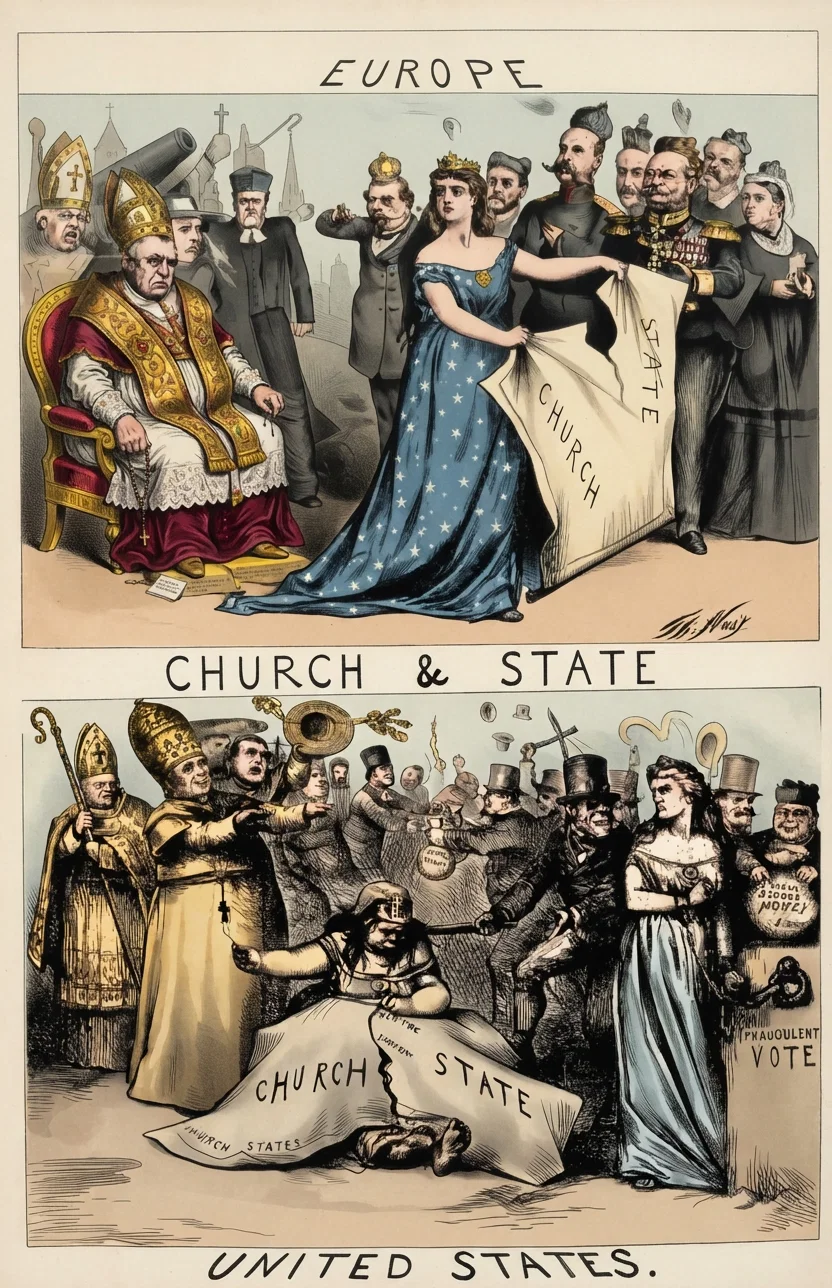
One of Four Full-Page Illustrations in the "Picture Section" of the June "Protestant Magazine" Now Ready
"Governor Sulzer, Tammany Hall, and the Roman Catholic Church; the Hierarchy and the Public Schools," is the title of one of the six leading articles in this epoch-making Rome in Politics and Religious Legislation number. The other three features of the "Picture Section" are "The American River Ganges; the Priests and the Children," a cartoon that appeared in Harper's Weekly in 1871; "Hon. William Sulzer, the Former Head of Civil Government in the State of New York, Who Refused to Yield to the Demands of the Roman Hierarchy" (photograph), and a photograph of "Cardinal Farley, the Head of Ecclesiastical Government in the State of New York, Whose Personal Representative Sought to Influence Governor Sulzer." The other five leading articles are: "A Consistent Protestantism Demanded;" "The Demand for More Chaplains in the Navy;" "Roman Catholicism in the Light of Scripture and History;" "History of Religious Toleration in Maryland—No. 2;" and "The Absolute Infallibility of Scripture." The opinion of the Christian Herald on the front cover page, entitled "The Real Meaning of Religious Legislation," is alone well worth the price of this number; also M. Viviani's notable speech on Romanism in the French Chamber of Deputies, which was ordered to be posted on billboards throughout France.
START EARNING YOUR SCHOLARSHIP WITH THIS NUMBER! EVERY AMERICAN WILL WANT TO GET THESE PROOFS OF ROME'S HOSTILE ATTITUDE TOWARD THE PUBLIC SCHOOLS, AND ALSO THE BIBLE PROPHECIES AS TO THE MEANING OF THESE AND OTHER CURRENT EVENTS. SEND $2.00 for 50 copies today; or $1.00 for 20; or send $1.50 and we will mail the magazine to FIVE FRIENDS FOR SIX MONTHS. ORDERS FOR 1,000, 500, 100, and 50 copies are POURING IN RAPIDLY. THIS NUMBER WILL SELL EVERYWHERE—TO CATHOLICS AS WELL AS PROTESTANTS.
Address your tract society, or the Protestant Magazine, Washington, D. C.

THE WORK

AND THE WORKERS
Over half of the first edition (35,000 copies) of the June number of the Protestant Magazine was sold in advance!
Price of paper-bound volumes of Liberty for 1913, 60 cents postpaid; cloth volumes, 90 cents, postpaid. Now ready.
Earn a year's scholarship by selling 2,000 to 2,700 copies of Life and Health, Liberty, or the Protestant Magazine. A number of students have secured a full scholarship in three weeks in this way.
Brother H. E. Loop, field missionary agent of the Upper Columbia Conference, writes to Liberty Magazine: "I am anxious to have our workers this year club Liberty with their orders for best binding. Please mail me several subscription guaranty books."
Read Daniel Webster, James Madison, and other patriots in the current issue of Liberty,—the "Pilgrim Fathers," "Church Monopolies," and "Sunday Law Court Decisions" number. See what two leading Congressmen and two college professors say about Liberty.
The Southern California Tract Society, 417 West Fifth St., Los Angeles, Cal., has just printed a special Protestant Magazine letterhead, artistic and effective. The clergymen in that part of the Golden State are receiving the Protestant for February, and other issues, through the courtesy of the tract society.
Buy, read, and scatter everywhere the great June or "Antitobacco" and "Death to Flies" number of Life and Health. It sells "like hot cakes." Contains twelve great articles against Tobacco and Alcohol. The cover design—a boating scene in Bohemian Switzerland—is a thing of beauty, and helps to sell this number. Send $2.00 for 50 copies or $1.00 for 20 today. Sell 20 or 10 to get your money back.
Prof. O. J. Graf, president of Emmanuel Missionary College, Berrien Springs, Mich., writes of some most interesting experiences in connection with the student campaign in behalf of the Protestant Magazine in Niles, St. Joseph, and Benton Harbor, Mich. "The dragon was wroth," he says. No students arrested at Niles, though Rome tried her best to have them arrested. "At Benton Harbor ten young women sold between 200 and 300. They had some stirring experiences." "Nine young men canvassed St. Joseph. Before they had been at work long, they had thoroughly stirred up the Catholic element, which at noon, soon after they had had their dinner, led to their arrest. For several hours they were in the hands of the city officials. As they marched with the chief of police at their head and another officer following them, the boys held up their Protestant Magazines for the people to see as they went by. . . . In due time they were released, and then a number of magazines were given away. This, of course, could not be hindered. The experience has been a great blessing to those who had a part in it, and also to the entire school." More news later.

An Appeal for Unity

C. M. BABCOCK
THE most effective method that Satan has ever devised by which to retard the work of God is to get discord into the church. It is his studied aim to accomplish this whenever and wherever possible, because he knows that a discordant church is a defeated church. But in order to accomplish his purpose he must find some one whom he may use as an instrument to sound the note of discord. He is declared by the Scripture to be the accuser of the brethren, but he must always have an instrument through whom he may bring his accusations.
As in the garden of Eden he used one of the wisest and most beautiful of God's creatures as a medium through whom to accomplish the ruin of the race, so now he selects as his instruments those who have influence and prestige, if he can enlist them in his cause; and it is surprising how many there are who lend themselves to his purpose of disrupting the church by stirring up strife and discord.
However, Satan does not confine himself to any class or kind, but uses as his agents all who are willing to be used. I do not mean to suggest that any of our dear people deliberately decide to become the agents of Satan to hinder the cause of God; but the devil suggests some seemingly very important reason for making complaint about a brother or a sister in the church, and in their zeal they are determined to bring that brother or sister to account. They carry their criticism and complaints to others, and soon things are in a turmoil, and that church is well on the way to defeat. It makes little difference whether the occasion for the complaint is real or only imaginary; the result is usually the same. Division and discord disrupt and paralyze the church, and destroy its effectiveness as a soul-winning agency.
The church on earth serves two distinct purposes in connection with the great work of soul saving. First, it is God's organized agency for the rescuing of the lost; and second, it serves as the spiritual home of those who have been rescued. The importance of united effort in order to accomplish large results is well established both in the world and in the Bible. As suggestive of the multiplied power of concerted action, we are told in Deut. 32: 30 that one may "chase a thousand, and two put ten thousand to flight." This would seem to indicate that two individuals by uniting their efforts would increase their strength tenfold.
How important, then, that there shall be harmony and unity of effort in every church!
The church of God becomes invincible wherever unity prevails. This is well illustrated in the experience of the early church. When the disciples ceased their strife about who should be the greatest, and all discord was put away, they were clothed with the power of the Holy Spirit, and became a mighty agency in the hands of God for the salvation of men. That period in the history of the church is symbolized in Rev. 6: 2 by a white horse and a rider with a bow in his hand going forth "conquering, and to conquer." On the other hand, history furnishes instance after instance of defeat resulting from internal discord. One of the most notable examples is the overthrow of Jerusalem. Just before and even during the time of the besieging of Jerusalem by Titus, the Jews within the city wasted their provisions, depleted their strength, and destroyed their lives by warring among themselves; and, of course, they were overthrown. To read this bit of history gives one a feeling of sympathy and pity for the folly of their course; but, brethren, let us see to it that in this larger warfare, in which we are engaged in a conflict with the mighty powers of darkness, we do not repeat their folly.
Not only is the church of God shorn of her power for conquest by discord, but it ceases to be a place where God can bring the "little ones" in Christ with safety. What a disappointment it must be to our Heavenly Father when a church so far loses that spirit of love and harmony by which men are to know its members as Christ's disciples, that God can no longer with safety add newborn souls to it.
The supreme purpose of the church is saving men and women. If, then, it fails of its purpose, either because it is shorn of its power to win men and women or because it has become so discordant that God cannot safely add men and women to it, it has no occasion for a further existence. What is your church doing in this matter of soul winning? What are you doing as an individual to win men to God? We are to make this year the banner year of our history in soul saving, and every one must be at it. We must lay aside all our differences and all join in the one great work to which we are called.
Redfield, S. Dak.

Eventide

F. J. TAYLOR
FATHER, eventide has come, And I pray thee take me home. Have I failed to do my best? Yet I come to thee for rest.
Gleaning in the fields of toil, Have I left some wheat to spoil, So that some might want for bread? Some kind word have left unsaid?
Have I left some heart in grief Where I might have brought relief? Failed the needy to befriend? Failed a helping hand to lend?
I have tried with earnest heart Faithfully to do my part; Yet some days have seemed so long, Days when right gave place to wrong;
Days when everything in life Seemed but one continual strife; Days with cross so hard to bear That I yielded to despair.
I've had days of sunshine, too: Bright flowers by my pathway grew; Their sweet faces kissed with dew Seemed to wake my heart anew.
Father, does the setting sun Find my work but poorly done? Still, O, take me home to thee, Where I long so much to be!

Twenty Cents a Week for Missionary Funds

WM. COVERT

THIS amount may be large for very poor persons or for children; but it is not excessively large for the average adult, and it is very small for the person whose income is one hundred times that amount. Suppose we count only one week at a time, and then pay it in, and keep doing so through the entire year; we have then paid only $10.40, and the same amount paid by one thousand would be $10,400. Many of our people are investing sums ranging from $500 to $1,000 or more each year in houses and lands or other property which does not, as a rule, help forward the missionary work very much. But if as much could be paid into the missionary till, it would enlarge the financial ability of our Mission Board in a marvelous degree. Why not do so?
If there should come a great missionary awakening among us, so great as to cause all our surplus funds to get into the soul-winning channel, what a stir it would make! Something will come to pass before another decade of years rolls by, to accomplish this very thing. It may come through the furnace of affliction, or it may result from a special outpouring of God's Spirit upon his people; but it certainly will come, and our attitude toward God's work will most likely determine how it will come.
We should not hesitate about doing our duty. There should be no holding back nor niggardly giving when God opens the way to do a liberal thing. The providential openings among the nations should be to us the voice of God to go forward. These openings in all lands are to God's commandment-keeping people now what the opening of the Red Sea was to Israel when Moses stretched forth his rod and pointed it toward the opposite shore. The harvest is ripe, and ten thousand reapers are needed to gather in the grain while the day is waning. An intelligent understanding of the situation will be obtained only by those who are liberal with their funds, and who study our missionary reports to acquaint themselves with the world-wide field.
The progress of the work as reported in every issue of the REVIEW AND HERALD is soul inspiring. Each time the REVIEW comes from the press, we get news from many lands, telling anew the blessed message that Jesus is coming soon, and each time it tells us to hasten the work if we would be ready to enter in while the door is open. Read and ponder over these reports; talk of them in the home; repeat them in the social meetings; write about them in scores of letters; get them published in the papers; and, above all, live as if you believed in the soon coming of the kingdom.
Think about the small amount of work that had been done in giving the third angel's message to the world forty-five years ago, and then view it as it is now. Our people have been doubling in numbers every ten years, and facilities for the propagation of the work have increased in about the same ratio. If the next ten years witness the missionary extension of our work as much as the ten years just now closing, where will the outposts be then? We are sure the Lord wants it to expand in the future as rapidly as it has in the past. Ten years ago we were trying to get our people up to ten cents a week for missions, and now we are reaching forward to the mark of twenty cents a week. We shall not retrograde on this line of advancement in the future. Shall we be given another decade in which to lengthen our cords and strengthen our stakes? What does the reader think about it?

Ministering to Soul and Body

Early Counsels on Medical Work—No. 8

Ministering to Soul and Body

MRS. E. G. WHITE
THE Health Institute has been established . . . to relieve the afflicted, to disseminate light, to awaken the spirit of inquiry, and to advance reform. This institution is conducted upon principles which are different from those of any other hygienic institution in the land. Money is not the great object with its friends and conductors. They conduct it from a conscientious, religious standpoint, aiming to carry out the principles of Bible hygiene. Most institutions of the kind are established upon different principles, and are conservative, making it their object to meet the popular class halfway, and so to shape their course that they will receive the greatest patronage and the most money. . . .
This institution is designed of God to be one of the greatest aids in preparing a people to be perfect before God. In order to attain to this perfection, men and women must have physical and mental strength to appreciate the elevated truths of God's Word, and be brought into a position where they will discern the imperfections in their moral characters. They should be in earnest to reform, that they may have friendship with God. The religion of Christ is not to be placed in the background, and its holy principles laid down to meet the approval of any class, however popular. If the standard of truth and holiness is lowered, the design of God will not then be carried out in this institution. . . .
I was shown that a larger work could be accomplished if there were gentlemen physicians of the right stamp of mind, who had proper culture, and a thorough understanding of every part of the work devolving on a physician. The physicians should have a large stock of patience, forbearance, kindness, and pity; for they need these qualifications in dealing with suffering invalids, who are diseased in body, and many of whom are diseased both in body and in mind. It is not an easy matter to obtain the right class of men and women, those who are fitted for the place, and who will work harmoniously, zealously, and unselfishly for the benefit of suffering invalids. Men are wanted at the Institute who will have the fear of God before them, and who can minister to sick minds, and keep prominent the health reform from a religious standpoint.
Those who engage in this work should be consecrated to God, and not make it their only object to treat the body merely to cure disease, thus working from the popular physician's standpoint, but to be spiritual fathers, to minister to diseased minds, and point the sin-sick soul to the never-failing remedy, the Saviour who died for them. Those who are reduced by disease are sufferers in more than one sense. They can endure bodily pain far better than they can bear mental suffering. Many carry a violated conscience, and can be reached only by the principles of Bible religion.
When the poor, suffering paralytic was brought to the Saviour, the urgency of the case seemed not to admit of a moment's delay, for already dissolution was doing its work upon the body. When those who bore him upon his bed saw that they could not come directly into the presence of Christ, they at once tore open the roof, and let down the bed whereon the sick of the palsy lay. Our Saviour saw and understood his condition perfectly. He also knew that this wretched man had a sickness of the soul far more aggravating than bodily suffering. He knew that the greatest burden he had borne for months was on account of sins. The crowd of people waited with almost breathless silence to see how Christ would treat this case, apparently so hopeless, and were astonished to hear the words which fell from his lips, "Son, be of good cheer; thy sins be forgiven thee."
These were the most precious words that could fall upon the ear of that sick sufferer; for the burden of sin had lain so heavily upon him that he could not find the least relief. Christ lifts the burden that so heavily oppressed him: "Be of good cheer," I, your Saviour, came to forgive sins. How quickly the pallid countenance of the sufferer changes! Hope takes the place of dark despair, and peace and joy take the place of distressing doubt and stolid gloom. The mind being restored to peace and happiness, the suffering body can now be reached. Next comes from the divine lips, "Thy sins be forgiven thee," "arise, and walk." In the effort to obey the will, those lifeless, bloodless arms are quickened; a healthful current of blood flows through the veins; the leaden color of his flesh disappears, and the ruddy glow of health takes its place. The limbs, that for long years have refused to obey the will, are now quickened to life, and the healed paralytic grasps his bed, and walks through the crowd to his home, glorifying God.
This case is for our instruction.Physicians who would be successful in the treatment of disease, should know how to minister to a diseased mind. They can have a powerful influence for good if they make God their trust. Some invalids need to be relieved of pain before the mind can be reached. After relief has come to the body, the physician can frequently the more successfully appeal to the conscience, and the heart will be more susceptible to the influences of the truth. There is danger of those connected with the Health Institute losing sight of the object for which such an institution was established by Seventh-day Adventists, and working from the worldling's standpoint, patterning after other institutions.
The Health Institute was not established among us for the purpose of obtaining money, although money is very necessary to carry forward the institution successfully. Economy should be exercised by all in the expenditure of means, that money be not used needlessly. But there should be sufficient means to invest in all necessary conveniences which will make the work of helpers, and especially of physicians, as easy as possible. And the directors of the Institute should avail themselves of every facility which will aid in the successful treatment of patients. . . .
To raise the Health Institute from its low state in the autumn of 1869 to its present prosperous, hopeful condition, has demanded sacrifices and exertions of which its friends abroad know but little. Then it had a debt of thirteen thousand dollars, and had but eight paying patients. And what was worse still, the course of former managers had been such as to so far discourage its friends that they had no heart to furnish means to lift the debt, or to recommend the sick to patronize the Institute. It was at this discouraging point that my husband decided in his mind that the Institute property must be sold to pay the debts, and the balance, after the payment of debts, be refunded to stockholders in proportion to the amount of stock each held. But one morning, in prayer at the family altar, the Spirit of God came upon him as he was praying for divine guidance in matters pertaining to the Institute, and he exclaimed, while bowed upon his knees, "The Lord will vindicate every word he has spoken through vision relative to the Health Institute, and it will be raised from its low estate, and prosper gloriously."
From that point of time we took hold of the work in earnest, and have labored side by side for the Institute, to counteract the influence of selfish men who had brought embarrassment upon it. We have given of our means, thus setting an example to others. We have encouraged economy and industry on the part of all connected with the Institute, and have urged that physicians and helpers work hard for small pay, until the Institute should again be fully established in the confidence of our people. We have borne a plain testimony against the manifestation of selfishness in any one connected with the Institute, and have counseled and reproved wrongs. We knew that the Health Institute would not succeed unless the blessing of the Lord rested upon it. If his blessing attended it, the friends of the cause would have confidence that it was the work of God, and would feel safe to donate means to make it a living enterprise, that it might be able to accomplish the design of God.
The physicians and some of the helpers went to work earnestly. They worked hard, under great discouragements. Drs. Ginley, Chamberlain, and Lamson worked with earnestness and energy, for small pay, to build up this sinking institution. And, thank God, the original debt has been removed, and large additions for the accommodation of patients have been made and paid for.

The Boy Scout Movement

S. B. HORTON
THERE is so much in the Boy Scout Movement to attract favorable notice that one hesitates to point out any unfavorable feature connected therewith.
That movement may be said to occupy a world of its own. It was introduced into America in 1910, under the tutelage of Lieut.-Gen. Sir Robert S. S. Baden-Powell of the British army. It has about three hundred thousand members in the United States, officered by a president, three vice presidents, chief scout, three national scout commissioners, and treasurer, and has for its honorary chief the President of the United States. Its national council includes senators and representatives of Congress, army officers, lawyers, doctors, clergymen, and other men of prominence and influence in the nation. It is not a religious organization, yet in its membership oath it declares, 'I promise on my honor to do my best to honor my God and my country.' The purpose of the movement is stated in its literature. 'The aim of the Boy Scouts is to supplement the various existing educational agencies, and to promote the ability in boys to do things for themselves and others. It is not the aim to set up a new organization to parallel in its purposes others already established. The opportunity is afforded these organizations, however, to introduce into their programs unique features appealing to interests which are universal among boys. The method is summed up in the term scoutcraft, and is a combination of observation, deduction, and handiness, or the ability to do things. Scoutcraft includes instruction in first aid, life saving, tracking, signaling, cycling, nature study, seamanship, campcraft, woodcraft, chivalry, patriotism, and other subjects. This is accomplished in games and team play, and is pleasure, not work, for the boy. All that is needed is the out of doors, a group of boys, and a competent leader.'
At the fourth annual meeting of the National Council of the Boy Scouts of America, the Secretary of State, the Secretary of the Navy, the Secretary of Agriculture, and five United States senators spoke in approving terms of the movement. Chief Scout Executive James E. West told of the disappearance of successive barriers which, through misunderstanding, have to a greater or less extent interfered with the extension of the benefits of scouting to all boys. He referred to the fact that the National Socialistic party, the Roman Catholic Church, and the Mormon Church are now actively encouraging the Boy Scout Movement, and that chambers of commerce and boards of trade in many cities are also cooperating to make the movement a success.
Scoutcraft demands that its members shall be trustworthy, loyal, helpful, friendly, courteous, kind, obedient, cheerful, thrifty, brave, clean, and reverent—most desirable attributes to be sure. But the question must appeal to the careful student, What reason is there for seeking other than the natural realms in which to develop these attributes? What has become of the home and the church in the matter of training the boy? Is there not positive danger that the seeds of alienation will be sown by this well-intentioned movement? As the Lutheran for January well observes, the movement is 'an irresponsible organization beyond the jurisdiction of the church. It touches the boy's life at a point where he is most responsive, and hence commands his interest and loyalty to a greater degree than either the home or the church can [apparently]. It comes into direct competition with the spiritual and redemptive agencies of the home and the church, and necessarily detracts from their influence and power. In other words, the agency that supervises the boy's sports wins him, and the agency that exercises guardianship over his spiritual and eternal interests is left a poor second. It strikes its roots in soil that is foreign to the church, and hence becomes parasitic in character.'
Furthermore, the Boy Scout Movement tends in the direction of developing the spirit of militarism; and who does not know that the spirit of militarism is a barrier and a constant menace to the development of peace and the furtherance of the golden rule doctrine? Boys with a military training are certain to long for an opportunity to show their valor upon the battle field sooner or later, and it should be remembered that the American republic was reared upon the fundamental principles of antimilitarism. In this connection we refer to the following quotation:—
'Monarchies may flourish and aristocracies may fatten on war, but republics live by minding their own business and respecting the rights of their neighbors. Under whatever name or form, the military republic becomes the subject of personal government, because militarism generates in its armies an esprit de corps, which proves stronger than the loyalty of the soldier to the law.'—'The Hand of God in American History,' by Robert E. Thompson, president Central High School, Philadelphia, page 197.
Besides, there is a tendency in such movements to monumentalize the principles of federation, or combine, against which the Scriptures admonish us. See Isaiah 8.
In the light of these observations there is necessarily a clashing of interests, especially where the responsibilities of home and church influence obtain. Where the Boy Scout Movement directs its activities in behalf of boys who are not under Christian, parental, or church influence, it may not be objectionable. But the theory that boys must be trained along the lines of least resistance is wrong in principle. The strength of the great oak is the outcome of its experience with the winds and the elements. We coincide with the editor already quoted: "It is more important for him to be trained in the sphere of his duties than in the sphere of his sports." It is true that "all work and no play makes Jack a dull boy," yet how eminently superior from the viewpoint of fundamentals is the play which is supervised by parental and church influences; the play in which father, mother, or sister may take part if they desire. It must also be remembered that if parental responsibility is to give way to outside specialization, God is not honored. The training of the boys and girls must be supervised by father and mother if the Word of the Lord is to guide.
This article is not intended to discount the commendable aims of the Boy Scout Movement, but to indicate that by committing to foreign realms those duties in training which naturally and very properly belong to parental and church precincts, we invite alienation of the boy from the parent and the church. Any plan to develop character by training the boy in spheres beyond his years and environment is unsafe and unreliable. It will be a sad day for the country's future when character-building responsibility shall be transferred from the home to the forest, the mine, camp fires, trailing, and military discipline.

"The Falling Away" and the Kingdom of Antichrist

LEE S. WHEELER
THE second coming of Christ was not the first event which the church in the days of the apostles was instructed to expect. "For that day shall not come, except there come a falling away first, and that man of sin be revealed, the son of perdition." 2 Thess. 2:3.
The apostles taught that Christ would appear again the second time, personally and visibly, to resurrect the dead, judge the world, and establish the everlasting kingdom of God in a regenerated earth. Heb. 9:27, 28; 1 Thess. 4:13-18; 2 Tim. 4:1; Matt. 25:31-41; Revelation 19, 20.
From the time of Christ's resurrection and ascension, his glorious return and the resurrection of all believers to a life of immortality were ardently believed in and taught as "the blessed hope." Titus 2:11-13; Acts 1:9-14, 22; 4:2, 33; 1 Corinthians 15; 1 Thess. 1:9, 10.
The pernicious influence of Greek philosophy, however, in its tendency to attach a mystical interpretation to the fundamental doctrines of Christianity, particularly those connected with the resurrection and the future state, is frequently alluded to in Paul's writings. Acts 17:18, 32; 2 Tim. 2:18; Col. 2:8; 1 Tim. 6:20; 2 Tim. 1:10-15.
From the opening of the second century onward Gnostic mysticism in the Eastern church, and Neoplatonism in the West, ate like a canker at the doctrinal teachings of the church; and in this "falling away" from the truth as it is in Jesus, the way was prepared for the establishment of that spiritual despotism in which the church supposed itself to be the kingdom of God, and man ruled as lord in the place of Christ. Notwithstanding, "everywhere the Scripture points to the kingdom of God as a thing of the future."—Schaff-Herzog Encyclopedia of Religious Knowledge, article "Kingdom of God." See Dan. 7:27; Matt. 19:28; 1 Cor. 6:9; Gal. 5:21; 1 Cor. 15:50-53; Revelation 20.
"In the West the expectation of a glorious kingdom of Christ found adherents for a long time."—Catholic Encyclopedia, article "Millennium."
"The earliest Christians had been second adventists. This belief gradually died down, and was no longer fundamental at the time of the conversion of Constantine. That event and the subsequent triumph of Christianity resulted in its complete eclipse."—"The Holy Christian Church," by R. M. Johnston, M. A., page 193.
"Constantine, the first Christian Cæsar, . . . was the first representative of the imposing idea of a Christian theocracy, or of that system or policy which assumes all subjects to be Christians, connects civil and religious rights, and regards church and state as the two arms of one and the same divine government on earth."—Schaff's "Church History," Vol. I, Third Period, page 12, par. 2.
"In the year 330, the emperor Constantine transferred the seat of government from Rome to Byzantium, which from that time was styled Constantinople. The temporal influence of the popes commenced to increase, nor did the emperors complain; nay, they were too willing to be relieved of the weight of government in Italy."—"Studies in Church History" (Catholic), by Parsons, Vol. I, page 502.
Still, however, the Roman emperors, to whom since the days of Augustus had descended the cherished title of Pontifex Maximus, had not relinquished the prerogative of supreme jurisdiction in religious affairs, by virtue of which Constantine upon his conversion to Christianity assumed all the authority of Moses, assembled the General Council of Nice, dictated the policy of the church, and attempted the suppression of heresy and the unification of the church under his own sovereignty. From Constantinople for more than two centuries the Roman emperors continued to exercise such authority until, "with the decay of the empire, the title [Pontifex Maximus] very naturally fell to the popes, whose functions as administrators of religious law closely resembled those of the ancient Roman priesthood; hence the modern use of 'pontiff' and 'pontifical.'"—Encyclopedia Britannica, article "Pontifex Maximus."
"The old Roman Empire was tottering to its fall; the church stood fast, ready to step into its inheritance. It was not simply that the world power, the enemy of Christ, had been vanquished; the fact was that it had gradually abdicated its political functions in favor of the church. Under these circumstances Augustine was led, in his controversy with the Donatists and as an apologist, to idealize the political side of the Catholic Church,—to grasp and elaborate the idea that the church is the kingdom of Christ and the city of God. Others before him may have taken the same view, and he, on the other hand, never forgot that true blessedness belongs to the future; but still he was the first who ventured to teach that the Catholic Church, in its empirical form, was the kingdom of Christ; that the millennial kingdom had commenced with the appearing of Christ, and was therefore an accomplished fact."—Id., ninth edition, Vol. XVI, page 317.
"According to the system of the 'direct divine right,' the Pope has received, immediately from God, full power to govern the world, both in spirituals and temporals. The temporal ruler is only an official of the pontiff, and as he receives the temporal sword from the pontiff, to be used in conformity with the order of God, he may be deprived of it by the Pope when he uses it against that order."—"Studies in Church History" (Catholic), by Parsons, Vol. II, page 203.
This view is said to have first been taught by John of Salisbury, 1159, by Thomas a Becket, and by Henry De Suza, compiler of the Laws of Suabia (1365), who asserted that "since the coming of Jesus Christ, all the dominions of the infidel princes were transferred to the church, and are vested in the popes, as the vicars of Jesus Christ, the King of kings."—Id., page 203.
Cardinal Gibbons, in "The Faith of Our Fathers," page 23, furnishes us the following:—
"The church is called a kingdom: 'He shall reign over the house of Jacob forever; and of his kingdom there shall be no end.' Now in every regulated kingdom there is but one king, one form of government, one uniform body of laws, which all are obliged to observe. In like manner, in Christ's spiritual kingdom there must be one chief to whom all owe spiritual allegiance, one form of ecclesiastical government, one uniform body of laws which all Christians are bound to observe; for every kingdom divided against itself shall be made desolate."
To the rest of the religious world the claims of the Papacy have seemed most extravagant and wicked; yet it must be evidentto any reflective mind that if the assumption that the church is the kingdom be granted, the whole system appears logical and Scriptural, for of the kingdom of Christ it is said: "I shall give thee the heathen for thine inheritance, and the uttermost parts of the earth for thy possession. Thou shalt break them with a rod of iron; thou shalt dash them in pieces like a potter's vessel. Be wise now therefore, O ye kings: be instructed, ye judges of the earth." Ps. 2:8-10. Again it is said, "The nation and kingdom that will not serve thee shall perish; yea, those nations shall be utterly wasted." Isa. 60:12. Consequently, if this interpretation is to be allowed, all the decrees of intolerance and all the crusades of extirpation waged against infidels and heretics must be conceded to be but the exercise of the legitimate authority of the church over the state. Protestantism has no defense, free governments no ground for existence, by any system of religious teaching which assumes that the kingdom was set up at the first advent of our Lord, or that the prophecies relating to the kingdom are to be given a mystical interpretation.
On the other hand, those who in the twentieth century maintain the apostolic doctrine of the future coming and glorious kingdom of Christ upon earth, and who cherish still the "blessed hope" of the primitive Christians, see clearly in the rise of the papal sovereignty and its long and persecuting career, a fulfillment of Paul's prediction of "the mystery of iniquity," "the falling away," and the development of "the man of sin," who, assuming to sit in the temple of God and to reign over the church as God, has instead of the kingdom of Christ developed the despotic monarchy of Antichrist. Dan. 7:17-26.
Detroit, Mich.
Continue reading: How We May Increase the Income