Your ShelfYour Projects

Signs of the Times, Vol. 27, No. 42.

I AM THAT BREAD OF LIFE

Signs of the Times

Oct 16, 1901

Pacific Press Publishing Company · Oakland, California · Oct 16, 1901

I AM THAT BREAD OF LIFE.
JESUS CHRIST left heaven that He might bring to earth the bread of life. Ever since the leaves of Eden withered, ever since the shadow of death threw a pall over the erstwhile tenants of Eden, ever since the covetousness of the carnal heart made merchandise of a brother’s need, the children of this world have toiled and striven and wept for bread. Every herb or vegetable the stomach would endure, every fruit that was not a poison, every nut, every grain, every animal that has roamed the earth, has been used by some people at some time to sustain life or ease the pangs of hunger. The burden that has bowed the back of the world has been the burden of keeping from the door of its homes the gaunt, gray wolf of hunger. The “necessaries of life” are the first consideration in every household; and so has it always been. Since the fall of man, the “business” of brain has been to see that stomach did not lack; and the molding of bread has been a perpetual process in nearly every tribe or people or nation in the world.
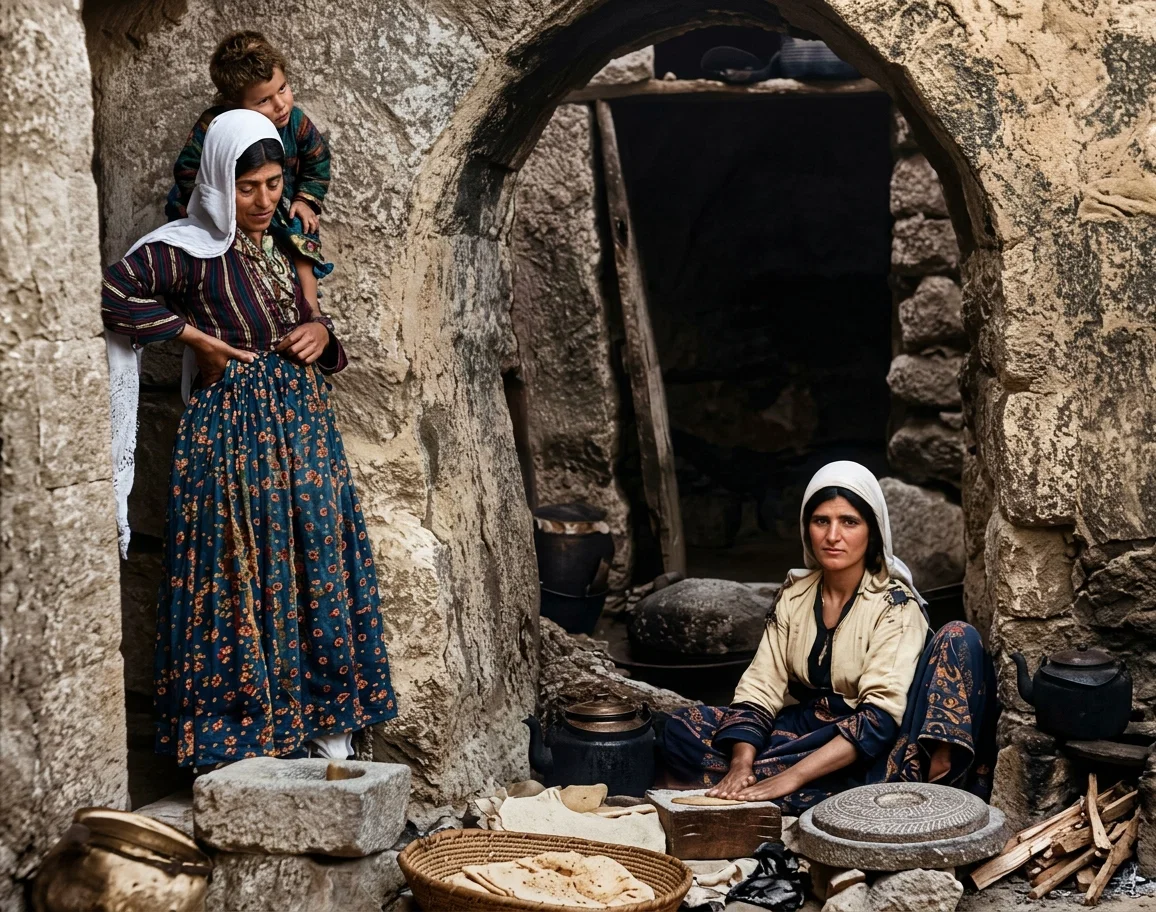
Syrian Peasant Girl of Palestine Making and Baking Bread at the door of the Dwelling.
As SARAH, the wife of Abraham, mixed meal and baked cakes upon her hearth for Abraham’s heavenly visitors, so the peasant girls and women of Palestine to-day sit by their hearth-fires and bake bread for the household. Day in and day out, year in and year out, the women are “grinding at the mill,” heating their primitive ovens, and turning their flattened loaves upon the heated stones. In the picture here given, the Syrian maiden is making and baking bread at the threshold of her home. Around her are the implements of her industry—her kettles, her oven, her basket of cakes, her dough-tray, and the stones with which the grinding is done. The flat stone at her left, with kindling protruding from beneath it, is her oven. In front of the mother stands the “nether milstone,” and in the lower right-hand corner of the picture, just above the broken kettle, is the stone with which the women crush and grind the kernels of wheat, corn, and barley. This is the process and these the implements which have been handed down from generation to generation since the decree of God sent man out of Eden to fight with the thistle and the thorn for the wherewithal to live.
BUT this was not to be the bread of life. Men ate of it, and died. Men toiled for it for themselves and for their families, till, bent and beaten in the struggle, they were laid away, and left the heritage to their children. So man has passed his little day and fought his losing fight in the long battle for bread—and life.
INTO this whirlpool of stress and struggle and strife there came one day the good news of deliverance—the Bread of life had come. Moving among men as one of them was One to whom the Father had given “to have life in Himself” sufficient for the needs of all the world. Man had been struggling to force the unwilling earth to yield him sustenance for his temporal life; and even this must come through the power and the merciful forbearance of God. But the life which Jesus Christ had come to give was the life of which sin had robbed the race, and that was life eternal. The bread which man had eaten in the sweat of his face was the bread that he had earned. It could sustain only for a time the life that God had put in man; so that man never could, through his own labors, “eat and live forever”—never could win eternal life by works that he might do. That must be “the gift of God.” And so the record reads: “The wages of sin is death; ‘but the gift of God is eternal life through Jesus Christ our Lord.” Rom. 6:23.
THAT gift came in Christ, the Son of God, the Son of man, binding in one the attributes of both, and so reconciling man to God. “This is the record, that God hath given to us eternal life, and this life is in His Son. He that hath the Son hath life; and he that hath not the Son of God hath not life.” 1 John 5:11, 12. “Verily, verily, I say unto you, He that believeth on Me hath everlasting life. I am that bread of life. . . . I am the living bread which came down from heaven; if any man eat of this bread, he shall live forever.” John 6:47-51. There never was a sane man in all the history of the world who has not looked up at the stars in their eternal courses, and longed to live forever. So the great question of the sin-bound race has been, “If a man die, shall he live again?” Job 14:14. By virtue of the bread of life he may. Christ declares: “He that believeth in Me, though he were dead, yet shall he live.” John 11:25. “Thy dead men shall live, together with my dead body shall they arise. Awake and sing, ye that dwell in dust; for thy dew is as the dew of herbs, and the earth shall cast out the dead.” Isa. 26:19.
BLESSED be the bread of life that satisfies the hunger of the soul. Mankind has eaten to the full of the “bread of affliction,” and struggled from the cradle to the grave for the bread of temporal sustenance; but now out of the largeness of the abundance of the mercy of God comes the free gift of the bread of eternal life, which, if any man eat, “he shall life forever.” We were shackled to sin; Christ has burst the shackles for us, and set us free. We were bound by transgression to the prison-house of the dead; but Christ has risen, and holds the keys of the grave, and will set at liberty every soul that has put his trust in Him. We have eaten the fruit of our labor that could not give us life; He has given us in its place the life of God, that makes eternity ours, and will permit our feet to tread this earth when sin has been consumed. All this has come through Him who is the Bread of Life.
S.

GOD THE RULER.

The Gospel by Royal Proclamation.

A Troubled King—A Dream and Its Interpretation—Self-Exaltation—Humiliation and Humility—A Converted Soul.
It is a wonderful lesson that the fourth chapter of Daniel opens before us. It is a lesson which, if it had been learned by Nimrod, the first king of Babylon, the beginner of earthly kings, and had been followed ever since, would have wrought out a far different story of earth’s ages. It is worthy of profoundest study by the mightiest of earth; it is a lesson for these very days through which we are passing; for let us repeat again, as we abundantly showed in the beginning of these studies, that the book of Daniel is pre-eminently God’s instruction to nations in the last days.
The story is set before us in the Scripture; read it. Note first of all that this chapter is a royal proclamation. It is not a story that Daniel tells himself; it is a story which the king of Babylon tells of himself and Babylon and Daniel and God. The story has not yet been found among the archives of Nebuchadnezzar by the archæologists. We doubt greatly if it will ever be found. Yet we believe that the king wrote it for all posterity. Daniel himself may have copied it from the clay tablets, or the black basalt slabs upon which the king caused it to be inscribed or engraved. But Babylon remained idolatrous, and it is easily understood how the devout pagans who succeeded Nebuchadnezzar, notably Nabonadius, aided by the priests of heathen cults, did their best to obliterate the knowledge and worship of the true God from Babylonian history. It would not have been flattering to their wisdom and position as teachers to let it remain, to reveal to future generations that their mightiest emperor had been humbled and taught by the God of a despised nation. But God has, through Daniel, given us the faithful record.
It is a beautiful introduction with which the king opens his proclamation:—
“Nebuchadnezzar the king, unto all the peoples, nations, and languages, that dwell in all the earth; peace be multiplied unto you. It hath seemed good unto me to show the signs and wonders that the Most High God hath wrought toward me. How great are His signs! and how mighty are His wonders! His kingdom is an everlasting kingdom, and His dominion is from generation to generation.”

The Dream and Its Purpose.

Then follows the reason of the royal proclamation. In his highest prosperity, his kingdom at peace, Nebuchadnezzar again dreams, and the dream troubles him. He sends again for the magicians, the enchanters, the astrologers, the soothsayers, the men of learning, the men of experience, the men of craft. He this time tells them the dream, but they do not know the interpretation. He at last sends for Daniel, tells him the dream of the great overshadowing tree, reaching in height to the heavens, seen by all the earth, beautiful in foliage, furnishing fruit and shade for all. He sees a holy watcher, who takes cognizance of things earthly, come down, and command, “Hew down the tree, and cut off his branches, shake off his leaves, scatter his fruit; let beast and fowl flee for safety, but do not destroy utterly. Leave of his roots in the earth, bound as with iron and brass; let him be humiliated to the utmost, till seven times pass over him.” This is the substance of the dream. The purpose is thus stated:—
“The sentence is by the decree of the watchers, and the demand by the word of the holy ones: to the intent that the living may know that the Most High ruleth in the kingdom of men, and giveth it to whomsoever He will, and setteth up over it the lowest of men.”

The Interpretation.

Reluctant was Daniel to tell the interpretation to the king. He tells the king that he could wish that the dream and its interpretation referred to the king’s enemies, but he tells it as God gave it.
1. The great tree referred primarily to Nebuchadnezzar, the great ruler of Babylon. He had “grown and become strong.” Everywhere among earth’s nations his power and greatness were acknowledged.
2. God also had seen the king. Heavenly watchers had noted his sins—pride, arrogance, and oppression of the poor. His continuance of rule in that way could not be suffered. In the face of the lighthitherto given of God, and acknowledged by the king, he could not be suffered to go on in transgression. God would make one more effort. The king would not walk in humility, God would humiliate him. This was the decree: “He had chosen the natural selfishness of the beasts; he would be driven out to dwell with them, to eat as they did, be separated from his kingdom and friends,—a practically insane man,—till seven times should pass; till he knew that the Most High ruled in the kingdom of men, and gave it to whom He would. The word rendered ‘times’ means a set period. Josephus tells us that Nebuchadnezzar thus suffered seven years, tho there are those who hold that it means month. Yet the word indubitably refers to years in Dan. 7:25.
3. Daniel told it all as a warning to the king that he might escape the evil, according to the instructions of Jeremiah. He therefore pleads with the king to break off his sins by righteousness, and his iniquities by showing mercy to the poor.
This appeal not only shows Nebuchadnezzar’s sins, but reveals the true secret of co-operation with God in successful character-building. “Break off thy sins by righteousness.” There is no other way. “Nature abhors a vacuum.” There is no righteous idle soul. There is no righteous empty life. The character which God requires is positively righteous, bearing the fruits of righteousness. Righteousness—right being, right doing—must take the place of sin. Mercy must reign where lawlessness oppressed the poor. Mighty temples erected to the gods would avail naught if their material came from the sweat and blood of the needy.
It was Nebuchadnezzar’s privilege to save his humiliation by humility. God desires to humble no man. He wishes man to see and know and recognize by faith his true condition,—a creature of a moment, dependent on God for every breath he draws. Realizing this, man will be humble. He will acknowledge God as ruler; himself as servant. This was the privilege of Babylon’s proud king. Great as he was in human comparison, he was nothing in God’s sight. But Nebuchadnezzar had not yet learned humility; so God in His love for the man, and generations to follow, humbled him.
Not willing to learn thoroughly by faith, the king must learn by experience. For a time he walked more softly before God,—a year, the record tells us,—pursuing his great work of building; and then, ascending the top of his gold-plated palace, he looked over the magnificent city which he had been so instrumental in enlarging, embellishing, and beautifying;—he saw its walls, its temples, its palaces, its canals, its bridges, its hanging gardens, —and, his heart swelling with pride of his own greatness, he exclaimed: “Is not this great Babylon, which I have built for the royal dwelling-place, by the might of my power and for the glory of my majesty?”
It was the spirit of Babylon’s founders: “Let us build us a city, and a tower, whose top may reach unto heaven, and let us make us a name, lest we be scattered abroad upon the face of the whole earth,” altho God had told them to multiply and fill the earth. It was the spirit of Babylon’s original king, who, in the beginning of all rebellion, rebelled against high heaven, and said: “I will ascend into heaven, I will exalt my throne above the stars of God; and I will sit upon the mount of congregation, in the uttermost parts of the north; I will ascend above the heights of the clouds; I will be like the Most High.” It was rebellion against the instruction of God through Daniel, “The Most High ruleth in the kingdom of men.” And this is a characteristic of Babylon in all ages.

The Fulfilment.

Perhaps Nebuchadnezzar had persuaded himself that the sentence of the dream would not come true. But he could no longer deceive himself. No sooner were his boastful words uttered than the voice came from heaven:—
“O King Nebuchadnezzar, to thee it is spoken: the kingdom is departed from thee. And thou shalt be driven from men, and thy dwelling shall be with the beasts of the field; thou shalt be made to eat grass as oxen, and seven times shall pass over thee; until thou know that the Most High ruleth in the kingdom of men, and giveth it to whomsoever He will.”
The same hour it was fulfilled. The king was driven out from among men, ate grass as the oxen, his body unsheltered, and his hair grown coarse and long like lion’s hair, and his nails as bird’s claws.
But God did not leave him. During all the time doubtless the cause of his humiliation was with him; and the proud king learned the lesson, and thus he records it:—
“And at the end of the days I Nebuchadnezzar lifted up mine eyes unto heaven, and mine understanding returned unto me, and I blessed the Most High, and I praised and honored Him that liveth forever, whose dominion is an everlasting dominion, and His kingdom is from generation to generation: and all the inhabitants of the earth are reputed as nothing; and He doeth according to His will in the army of heaven, and among the inhabitants of the earth: and none can stay His hand, or say unto Him, What doest thou? . . . Now I Nebuchadnezzar praise and extol and honor the King of heaven, all whose works are truth, and His ways judgment; and those that walk in pride He is able to abase.”
This is the burden of the converted king’s message to all people—God rules; we are at the most and best but instruments, suffered to remain for our testing and salvation, for His glory. The king’s insanity passed away; his clearness of intellect returned; the kingdom and all its glory was restored to him; his counselors and lords sought him; he was established in his kingdom; and more excellent majesty was added. He learned that man could rule better under the great God of heaven than to trust in himself.

The Lesson for the Ages.

For the last days it is written, “The ‘Most High ruleth,’” God is Governor over the nations. He suffered earth’s true original prince, Adam, to rebel, and yield his dominion to Satan. He has for thousands of years suffered the usurper Satan to exercise his limited control; God has made a portion of the usurper’s wrath to praise Him, the remainder He has restrained. He brought Babylon to the throne of empire; He gave into her power the kingdoms; but the Most High did not abdicate. When Babylon could be used no longer to God’s glory, Medo-Persia followed; but the Most High ruled. After Medo-Persia came Grecia; but the Most High ruled. After Grecia came the iron imperial kingdom of Rome,—came the intermingling of the principles of democracy and socialism, the clay; but the Most High ruled.
To-day Great Britain, France, Germany, the Great Bear of the north, and the Great Eagle of the West, are talking proudly and arrogantly and boastfully of their prowess, their deeds, their culture, their wealth, as tho they reigned by right of themselves; and never did Babylon need more than they to know the truth of our lesson,—“the Most High ruleth in the kingdom of men, and giveth it to whomsoever He will.” Their tenure of stay is their recognition of God, not in words, but deeds, the glory to Himself which will accrue from their existence. When the time comes that they fail, as it certainly will, according to the “more sure word of prophecy,” the everlasting kingdom of God will succeed all earthly rule, and the temporal kingdoms of men will have passed forever.
The Most High rules. He permits sin to work out its own evil fruit that the unbelieving may be forever satisfied; that His own word may be forever demonstrated to be true, even on its negative side. Its positive side will, to the children of faith, be an eternally unrolling demonstration of the truth, the righteousness and love of Him who alone has the right to reign.

A CURE FOR SPIRITUAL POVERTY.

The poverty of modern Christian life will never be cured until a far greater portion of time, until a far greater earnestness, is put into the hard and happy work of praying. It is instructive to read in the life of Frederick Maurice how he would often be engaged in prayer all the night through; and if everything were known, it would be found that all Christians who have made a deep mark have sought and found the Lord in a like manner. To live in the atmosphere of prayer is to live in the atmosphere of miracle, in the atmosphere of the New Testament, and it is in this way, and in this way only, that faith in the divine manifestation is kept alive and burning.
When the strength, the joy, the peace, and the power of the Christian church are unimpaired, it is because her ministers and her people are proving that through Christ we have access in one Spirit to the Father, and confessing that Jesus is Lord in the Holy Ghost. Then there is no complaint of failures to attend Christian worship. There is a longing even on the part of those outside to touch the hands of those who have walked with the Most High. The brethren are able to speak one to another of what the Lord has delivered unto them, of their comprehension of the supernatural revelation. They shine with the divine splendor which fills each star, one star differing from another in glory. The Holy Ghost comes upon them, and the power of the Highest overshadows them. So confessing with their mouths the Lord Jesus, and believing in their hearts that God has raised Him from the dead, they are saved.—British Weekly.

Our Vicarious Lives

“WHETHER we will it or not, our lives are vicarious.”

THE HOME OF THE SAVED.

THE Son of man is come to seek and to save that which was lost.” Luke 19:10. God in the beginning made this earth to be inhabited. Isa. 45:18. He then gave man dominion over it. Gen. 1:26. When man was overcome by Satan in the garden of Eden, he lost this dominion. Heb. 2:8; Luke 4:4-6. Man in the beginning was made perfect. Eccl. 7:29. After his fall, he lost this perfection of character, and Adam and Eve hid themselves among the trees when God came into the garden. Man also by his fall became subject to death; for “the wages of sin is death.” Rom. 6:23. Christ came to restore to man all that he had lost in the fall, namely, his home, his character, and his life; for as the text reads, “The Son ‘of man is come to seek and to save that which was lost.”
Now let us cover this subject in another way. In Gen. 13:14-17, the Lord made a promise to Abraham that he and his seed should inherit all the land that he could see northward and southward and eastward and westward. Paul, in speaking of the same promise (Rom. 4:13), said that it embraced the whole world. In Acts 7:5 it is further said that Abraham died without having received enough land to set his foot on. These statements would seem to be contradictory; but the apparent contradiction is explained by the apostle Paul in his letter to the Hebrews. Heb. 11:8-15. Here the statement is made that Abraham looked forward by faith to a heavenly country—the New Jerusalem—whose Builder and Maker is God. In Gal. 3:29 we learn that all Christians are the seed of Abraham.
If Abraham died without receiving the inheritance, he must be resurrected before he can receive it; and this is made plain by the account of the valley of dry bones (Eze. 37:1-14), where it is stated that those who are brought from the grave are placed back in their own land. But before this is done, the earth must be made new, as recorded in 2 Peter 3:9, 13, where it is plainly stated, “We, accord-‘ing to His promise, look for new heavens and a new earth, wherein ‘dwelleth righteousness.”
In Isa. 35:1 there is a beautiful description of the earth as it will be after this work is done, where it is made plain that the redeemed will walk on the new earth. In Isa. 65:17-23 is shown what will be done on the earth after it is made new. As every country has its capital, so the new earth will have its capital city, which will be the New Jerusalem: “I saw a new heaven and a new earth. . . . And I ‘John saw the holy city, New Jerusalem, coming down out of heaven, ‘prepared as a bride adorned for her husband.” Rev. 21:1, 2. The following verses in the same chapter give us a description of this beautiful city. It is said to be 12,000 furlongs, or 1,500 miles, in circumference, having twelve foundations, walls of jasper, streets of pure transparent gold, and gates of pearl. We believe this to be a literal city, because verse 24 says that the nations of the saved walk in it, and the kings of the earth do bring their glory and honor into it.
The tree of life will be there, bearing all manner of fruit, and yielding her fruit every month, and the leaves of the tree will be for the service of the nations.
Isa. 66:22, 23 states that from one month to another and from one Sabbath to another shall all flesh come to worship before the Lord. They will come up every month to partake of the fruit of the tree of life, and on the Sabbath to worship God.
“And the inhabitant shall not say, I am sick.” “And God shall ‘wipe away all tears from their eyes; and there shall be no more death, ‘neither sorrow, nor crying; neither shall there be any more pain; for ‘the former things are passed away.” “And the Spirit and the bride ‘say, Come; and let him that heareth say, Come, and let him that is ‘athirst come, and whosoever will, let him take the water of life ‘freely.” Thus the Saviour invites all to come. He is not satisfied to prepare the feast and then send out word that all may come who will, but He sends out an earnest invitation. He insists that they shall come.
I would say to you, Come, if you would inherit mansions where sickness, sorrow, pain, and death can not enter; if you would have right to the tree of life, and eat and live; if you would drink of the river of life, clear as crystal. Come, if you would walk those streets of transparent gold; if you would behold those beautiful foundation stones; if you would see the King in His beauty, seated on His azure throne.
C. H. BATES.

THE RAINBOW IN THE CLOUD.

The Lord declared the Ten Commandments to be His covenant. “And He declared unto you His covenant, which He commanded you to perform, even Ten Commandments; and He wrote them upon two tables of stone.” Deut. 4:13.
God made covenants with the nation and with individuals that depended for their perpetuity upon the mutual faithfulness of the contracting parties. Man often failed on his part, and in consequence nullified the covenant. See Heb. 8:9. But the Ten Commandments were not a covenant made with the people, but one enjoined upon them, a commanded covenant, dependent for its perpetuity, not upon the people, but upon God, who changes not.
God’s righteousness is declared to be everlasting, and His “commandments are righteousness.” His law is also declared to be “the truth.” See Ps. 119:142, 172. So long as God continues to be righteous, His commandments will continue righteousness.
God is the Creator of all things, and it is said that “He hath made His wonderful works to be remembered.” Ps. 111:4. How “to be remembered”?—By keeping the Sabbath: “For in six days the Lord made heaven and earth, the sea, and all that in them is, and rested the seventh day; wherefore [for which reason] the Lord blessed the Sabbath day, and hallowed it.” So long, therefore, as the reason for keeping the Sabbath remains, that institution will continue unchanged.
The Sabbath, as part of the Ten Commandments, is declared to be “a perpetual covenant.” See Ex. 31:16 and Gal. 3:7, 29. Have you seen a rainbow in the clouds the past summer? If so, you have seen an example of what God means by the term “perpetual.” See Gen. 9:12–17. The Sabbath will continue at least as long as the rainbow beautifies the face of the storm-cloud. Will you be in harmony with God and nature? Will you keep the memorial of the Creator’s wonderful works in earth, and sea, and sky? No longer continue to respect the counterfeit Sabbath (Sunday) of the man of sin, who laid his hand upon the law of God to mutilate and change it. Worship God.
A. SMITH.

THE LIVING WORD.

Its Nature and Work.

THE Word, as we have it in the Scriptures, is God’s thought for the redemption of man. As revealed in the earthly life of Jesus, the Word made flesh, it was God’s thought made audible and manifest. The Word in the Scriptures is but one phase of God’s thought, which is vast and unsearchable, for Paul, by inspiration, exclaims, “O the depth of the riches both of the wisdom and knowledge of God! how unsearchable are His judgments, and His ways ‘past finding out! For who hath known the mind of the Lord? or ‘who hath been His counselor?’” This Word is, as it were, the capstone of His thought for the entire universe, disclosing the beauty, the grandeur, and the perfection of His character to His unnumbered worlds.
Ezekiel symbolized God’s thought for all His created beings by a wheel within a wheel. God’s eternal thought for the children of His love is the formation of a character like His own, represented by the outer wheel, perfect in its proportions. But sin marred the image of God in man, and the plan of salvation was introduced, and became the wheel within a wheel, for the restoration of God’s character. Because man wandered from the thought of God, the Father said to him, “My ‘thoughts are not your thoughts, neither are your ways My ways. ‘ . . . For as the heavens are higher than the earth, so are My ‘ways higher than your ways, and My thoughts than your thoughts.” But God, in His infinite love, has provided a way in which fallen man may have God’s thought enthroned within, to become His flesh, His very being. Jesus, the only begotten Son, is the living Word. By receiving this living Word within the heart, we shall return to God’s thought for man; for it is written that we are “born again, not of corruptible seed, but of incorruptible, by the Word of God, which liveth ‘and abideth forever.” Because this Word is an incorruptible seed, it possesses creative energy, and will work in us “both to will and to ‘do of His good pleasure.”
The Word of Christ is the bread of life, which is furnished for every soul that lives. To refuse to eat this bread is death. He that neglects to partake of the Word of God “shall not see life.”
Not only are the words of Christ living bread, but they are living water as well, quenching the burning thirst of him who will drink and live. This living water is supplied in abundance; for Jesus says that it is “a well of water springing up into everlasting life.” It is supplied for him who is athirst. The Spirit invites: “Come: . . . whosoever will, let him take the water of life freely.” With such a supply before us, need we hunger or thirst, and not be filled? Faith eats and drinks, and is satisfied. Receiving the Word is believing the Word, and this is eating Christ’s flesh and drinking His blood.
LILIAN OTIS MCPHERSON.

Its Relation to Christ’s Second Coming

MODERN SPIRITISM.—No. 7.

Its Relation to Christ’s Second Coming.

THE teaching of Spiritism respecting the second coming of Christ is multiform, inconsistent, and unscriptural. When Christ ascended in the cloud, the angels in white apparel declared, “This same Jesus, which is taken up from you into heaven, shall so ‘come in like manner as ye have seen Him go into heaven.” Acts 1:9-11. The language is plain, emphatic, and unequivocal. He is to come again as He went away, personally, visibly, and in the clouds of heaven.
But Spiritism has denied this, and spiritualized the whole glorious doctrine away. It has, in fact, itself claimed to be the second coming of Christ. Thus, in the early days of Modern Spiritism, the controlling spirit of Mrs. Conant, a famous medium, said:—
This second coming of Christ means simply the second coming of truths that are not themselves new, that have always existed. . . . He said, “When I come again, I shall not be known to you.” Spiritism is that second coming of Christ.—Banner of Light, Nov. 18, 1865.
But the arch-deceiver well knew that such a gross perversion of Christ’s promise to “come again” would not satisfy all. It might suit and deceive some, but it is too apparent a heresy to be received by all. The promise is too plain that Christ will come again in person. So, through Spiritism, Satan provides another deception, which more nearly resembles the event described in the Scriptures. Through “materialization” he has Christ come actually in person, but in secret, in the “cabinet,” or “secret chamber.” The following graphic and almost thrilling description of “A Wonderful Materialization,” appeared in the Cincinnati Inquirer a few years ago:—
Friday morning we had a private seance, at which only eight persons were present, including Dr. Pence. The medium entered the cabinet, and in about twenty minutes was entranced. After a little while, during which the controlling spirit talked as usual, the cabinet door opened, and a majestic form appeared that filled us with awe; for there in the door stood, in majestic grandeur, Jesus of Nazareth! the Lord of glory! the King of kings! the pure and holy Christ of God! He had come according to promise, and stood manifest before our eyes. He stood looking at us for several moments, and then said, “You are faithful soldiers, and greater wonders than these shall you yet see.” These words he spoke in a low voice, yet distinct enough for all to hear. He reached his hand to Mrs. Lewis, who sat nearest to the cabinet. She then took it, and gave him a bouquet of flowers. He then reached his hand to Mrs. Dr. Cutter, who sat next to Mrs. Lewis, then to Mrs. Kline, who had stepped on to the platform. He took her by the hands, then laid his hands upon her head, blessed and kissed her. He then beckoned each one of us to him, took us by the hand, and blessed and kissed us before retiring to the cabinet. He had stood in the door and on the platform nearly half an hour. He had on a white robe, and a crown upon his head, in the center of which glittered a beautiful gem. A faint halo was visible surrounding his sacred head. He left us awe-stricken with his sacred presence. This was the masterpiece of materialization. Surely these are the days foretold by John the revelator, when he declared that Jesus Christ should come again a second time, with power and great glory; and have not the dead arisen throughout the land, and angels returned, appearing unto many?
Would to God every mortal could have seen, and know as we now know, this glorious truth. The Saviour of mankind has reappeared; the second advent has arrived; the heavens are opened; the dead are raised; mortality is swallowed up in immortality; death has lost its sting, and the grave its victory.
Having thoroughly examined the cabinet, the seance room, and the medium, we are prepared to witness to the world that the materializations that have occurred in our presence are genuine and true. Signed by Mrs. John Edson, Van Wert, Ohio; Mrs. A. Kline, Van Wert, Ohio; Mrs. Lucie E. Lewis, Jacksonville, Florida; Mrs. Dr. A. B. Cutter, Louisville, Kentucky; Mrs. R. Conn, Mrs. Eliza Kummel, Mrs. O. W. Rose, Van Wert, Ohio.
After reading the foregoing, who can doubt that this is indeed one of the very deceptions of which Christ, in His great prophecy recorded in the twenty-fourth chapter of Matthew, warned us? Referring to the last days, He said, “Then if any man shall say unto you, ‘Lo, here is Christ, or there; believe it not. For there shall arise false christs and false prophets, and shall show great signs and wonders; insomuch that, if it were possible, they shall deceive the very elect. Behold, I have told you before. Wherefore if they shall say unto you, Behold, He is in the desert; go not forth: behold, He is in the secret chambers; BELIEVE IT NOT. For as the lightning cometh out of the east, and shineth even unto the west, so shall also the coming of the Son of man be.’” Matt. 24:23-27. The advocates of Spiritism here tell us that Christ has come, that He has already appeared,—appeared in the “secret chambers,”—the cabinets so frequently used by Spiritistic mediums. They boldly declare and witness to the world that He has “come again the second time, with power and great glory,” as foretold in the Scriptures; that they have actually seen Him, conversed with Him, been blessed and even been kissed by Him! Is not this indeed a masterpiece of delusion? And does it not stamp Spiritism as an antichristian device and a Satanic delusion? Those who have been tampering and experimenting with Spiritism have little realized the kind of fire they have been playing with.
Christ said when they should say, “Behold, He is in the secret ‘chambers,’” we were to “believe it not.” He is not to come that way. His coming is to be as visible as the lightning in the heavens. But these Spiritistic witnesses not only declare that He has appeared in the secret chambers, but that this sort of second coming is in harmony with the Scriptures, citing the Revelation given through John particularly. But they show their ignorance or disregard of the very scriptures they refer to. They express a wish that “every mortal” could have seen what they saw, and they profess to have seen the second coming of Christ. But when Christ comes the second time, “every mortal” will see Him, for His revelation through John declares, “Behold, He cometh with clouds; and every eye shall see ‘Him.’” Rev. 1:7. This shows how much reliance can be placed upon the use and application of the Scriptures by Spiritists. The christ who comes in the “secret chamber,” it will be noticed, speaks “in a low voice;” but when the Christ of God comes again, He descends from heaven, “with a shout, with the voice of the arch-angel, and with the trump of God,” and the dead are raised. 1 Thess. 4:16.
But the world is not through with the lying wonders of Spiritism. The climax has not yet been reached in its history and wonder-working. As intimated in the foregoing extract, greater wonders are yet to be seen. We have not yet witnessed all the mighty signs and marvelous wonders foretold by Christ in the words, “For there shall arise ‘false christs, and false prophets, and shall show great signs and wonders; insomuch that, if it were possible, they shall deceive the very ‘elect.’” In the near future we shall behold great signs and startling wonders as the result of the miracle-working power of demons. And then, as a finishing touch to all, will come Satan’s great, final, and crowning masterpiece of deception. This will constitute the subject of our next article. W. A. COLCORD.
Continue reading: FEW OR MANY