Pacific Press Publishing Association · Mountain View, California · May 30, 1911
"IF YE WILL INQUIRE, INQUIRE YE."
By Editor
This Inquirers' Department is conducted for the purpose of helping those who are studying the Bible. The answers are oftentimes only suggestive. They are never to be considered infallible, only as they agree with the infallible Word. The writer who may answer them does not consider that his opinion is infallible. He will simply give the best that he has, and plead with the inquirer to search the Word. Such questions only will be answered as, to the editors, seem to minister to the good of the readers and to the mission of the paper. We can not answer repeatedly in the same volume questions upon the same scripture. The name and address must accompany question, not for publication, but as an evidence of good faith, and that answer may be made by letter if deemed advisable. No letters are answered which do not contain the name of the writer. It is well always to enclose stamp for reply.
What temple is meant here? Please explain the scripture in detail, the water, the measuring line, the trees, the east country, the desert, the sea, the healing, the marishes, etc., etc. C. A. S.
It would be more needful to study this prophecy in detail if it were ever to be fulfilled; but all these later prophecies of Ezekiel's were conditioned on Israel's acceptance of God's plan and the forsaking of sin. See Eze. 43:9, 11; 44:6, 21, 24; 45:9. The vision of chapters 40 to 48 is one. The prophecy is of a sanctuary, a restoration of the land of Canaan, and of Jerusalem, after the return from Babylon. But it was based on Israel's yielding to God.
These conditions are clearly set forth by another prophet of the same period. Jer. 18:7-10. If Israel had returned to God with all their heart, Jerusalem would have been renewed; a veritable river of life would have welled up from underneath the temple, spreading out as it flowed on, healing the salt land and fetid marshes. The Dead Sea would have been filled with fresh, living water, and there would have been a great lake in the Jordan Valley connecting the Dead Sea and the Sea of Galilee, and this inland sea would have abounded in fish. Great blessings would have come to land and people; but the people would not. The return from Babylon was only partial; and in the place of God's blessed plan, the best He could give them was the temple built by Zerubbabel.
The east country was the desert land surrounding the Dead Sea. The word "marishes" ought to be "marshes." In a general way spiritual lessons may be drawn from this; but the prophecy is of things that would literally have been. In a faint way they are typical of the glorious restoration in the new earth. Revelation 21, 22.
3449 — Eternal Life and Immortality
I have been under the impression that we receive eternal life when Christ comes. I find in my Bible that God only hath immortality. 1 Tim. 6:16. How can I harmonize this passage with 1 John 5:11, 12? Kindly explain this to me. Subscriber.
Thus writes a Bible reader eighty years of age. It is not a hard question if we do not confound eternal life and immortality. The first is God's uncorrupted life given of God and received and held by faith, the second is God's seal on the physical man of incorruptible character. Before man sinned he had the life of God; the Creator breathed within his nostrils "the breath of life." This was the eternal life of the eternal God; for we could conceive of His having no other. That life came into man according to the law of God's character. "The commandment . . . was ordained to life." Rom. 7:10. "In the way of righteousness is life; and in the pathway thereof there is no death." Prov. 12:28. But when man sinned, he perverted that law in his own being, and thus perverted the life; and death resulted. So Paul found that the commandment "ordained to life" was to the sinner "unto death." The sinner, therefore, does not possess eternal life. It flows out from God as such, but the carnal mind perverts the channel, and the life issues in death.
But because the law was no longer a channel for life, "the Righteous One" "gave Himself" in order to bring to man the righteousness and eternal life the law could not give. Rom. 8:1-3. Therefore he who accepts Jesus Christ receives in Him eternal life. "For God so loved the world, that He gave His only-begotten Son, that whosoever believeth on Him should not perish, but have eternal life." John 3:16. "He that believeth on the Son hath eternal life." John 3:36. "He that eateth My flesh and drinketh My blood hath eternal life." John 6:54. "He that believeth hath eternal life." Verse 47.
What more power has the Christian than other men unless he has more and divine life? Let faith grasp and hold the precious, mighty boon. "These things have I written unto you, that ye may know that ye have eternal life." 1 John 5:13, A.R.V. This is the life which Paul had. Gal. 2:20. This is the life which quickens and heals this mortal body. Rom. 8:11. But if we sin, we pervert its channel, and die. If we use God's life in overcoming sin to the end, God will stamp upon our complete being at His coming His own image and the glorious seal of immortality, incorruptibility, deathlessness, forever. Now eternal life is conditional; then it will be absolute, blended with the glorious immortality given at our Lord's second coming. Then rejoice in "eternal" life now.
The scripture reads: "For behold this selfsame thing, that ye sorrowed after a godly sort, what carefulness it wrought in you, yea, what clearing of yourselves, yea, what indignation, yea, what fear, yea, what vehement desire, yea, what zeal, yea, what revenge! In all things ye have approved yourselves to be clear in this matter." Paul had reproved the Corinthian brethren for certain gross sins they were tolerating. See 1 Corinthians 5. Under the reproof the church was stirred, and the sinners repented. 2 Cor. 2:1-11. Their repentance was not the sorrow of the thief who is caught (Jer. 2:26), but they sorrowed because they had sinned against God. And verse 11 proves the genuineness of their repentance. It bore fruit in careful examination and duty-doing; in clearing themselves of sin by confessing and forsaking sin; in indignation against the sin; in a proper fear lest they should fall; in earnest desire to serve God; in revenge against the lusts of the flesh by putting them to death by the Spirit. It was a repentance that renewed the heart.
3444 — Use of Wine and Strong Drink
By Editor
Is not Prov. 31:6, 7 literal language? May not strong drink be used to revive the “heavy-hearted and discouraged” now as then? Friend and Reader.
The passage reads: “Give strong drink unto him that is ready to perish, and wine unto those that be of heavy hearts.” The A.R.V. has, “wine unto the bitter in soul.” Spurrell reads, “Give the intoxicating draft to the dying, and wine to the afflicted soul.”
It can readily be seen that the strong drink is in contrast to the wine. The one intoxicates, while the other cheers. The former is given, as anesthetics are given now, to relieve the suffering of the dying.
The common word for “wine” in the Old Testament is “yayin.” It is a generic term including all sorts of wine, literally and figuratively, wine that intoxicates, wine that cheers, wine in the wine-press. The corresponding generic word in the New Testament is “oinos.” As of old, “the bitter of soul,” the greatly afflicted, are inclined to fast. It is a physiological fact that eating or drinking that which is pleasant changes the life currents and raises the spirits of the despondent. Sweet wine is well fitted to do this.
And yet drinking wine, so easily fermenting, was attended with danger. Hence it was forbidden to priests and princes. It is spoken of as a blessing, a comfort, that which is good; it is also shown to be a curse. The difference between it is guarded by that line indicated by the text in Prov. 23:31: “Look not thou upon the wine when it is red, when it sparkleth in the cup, when it goeth down smoothly [margin, “moveth itself aright”].” A.R.V. On the one side, the new wine is cheering, nourishing, unintoxicating. On the other side it is “a mocker” (Prov. 20:1), and at the last “biteth like a serpent, and stingeth like an adder” (Prov. 23:32). The glutton, the heavy drinker, was quite likely to cross the line. The tendency was in that direction; hence in some cases, as with priests, its absolute prohibition. Lev. 10:8-11; Eze. 44:21; Luke 1:15; Prov. 31:4. God commended the abstinent Rechabites. Jeremiah 35. Timothy would not drink it because of the danger of its leading to the love of fermented wine, and its need was therefore enjoined by the apostle. 1 Tim. 5:23. But then while his stomach was troubled and his infirmities “often,” the wine was to be “little” in quantity. Christians are priests and kings, and of the last generation John the Baptist is a type (1 Peter 2:9); surely they ought to be abstemious, to drink no strong drink or fermented wine. All use ought to be on the hither side of the line drawn by Prov. 23:31. The whole general testimony of God’s Word is against the use of intoxicating drinks. Read Prov. 20:1; 23:20, 29-35; Hab. 2:5, 15; Isa. 5:11, 22; Eph. 5:18.
Other correspondents will see from the above that the generic terms “yayin” and “oinos” cover all kinds of wine, sweet wine as well as fermented wine,—“must,” “vinegar,” and fermented wine. There is no proof that Jesus ever tasted fermented wine. He was called by His enemies a “wine-bibber,” but the same evidence would prove Him a glutton. We can not believe that He made wine, and then placed within it the poison of the ferment. Then, too, it was the custom among the Hebrews to use—at the beginning of their feasts sweet wine, and the words of the governor of the feast show that the wine made by Jesus was the beginning wine. John 2:10. Jesus used the power of the Creator to manifest forth His glory. He created the elements of the grape and changed the water to good wine, on the right side of Prov. 23:31.
The seeming difference between the first two scriptures lies over the twofold meaning of hearing,—hearing yet not understanding, and not hearing in the sense of not understanding. See Matt. 13:13-16. Paul heard and understood. Those who were with him heard a sound, but they did not hear the distinct voice in the sense of understanding. Isa. 35:9 speaks of a time when there shall be no more ravenous wild beasts as we now know them; Isa. 11:7 of a time when the nature of the beasts shall be changed. They will no longer be ravenous.
Why does the margin of Acts 13:42 read, "in the week between, or in the sabbath between"? C. G. P.
The expression is placed there as a different translation of the Greek. The word translated "next" sometimes means "intervening," but it also means "next." This is shown by verse 44. The American Revised Version and nearly all others read "next."
Do all stand literally before the judgment-seat of God?
We are judged out of the things written in God's books, and we stand before Him in the light of that absolute record of deed and motive. In the final execution of that judgment it seems that all will stand before Him literally. This is at the end of the thousand years. The events of Revelation 20 are not in chronological order.
Hosea was a prophet of the ten-tribe kingdom, beginning before Isaiah, say about B.C. 785. His work continued for sixty years, but all his written prophecy can be easily read at two sittings. From Jeroboam II to Hoshea in Israel, from Uzziah to Hezekiah in Judah, he faithfully points out the sin of Israel. Many of his figures are borrowed from rural life. The customs of his days are frequently referred to. Notwithstanding the strong condemnations, there are kind and encouraging appeals to a better life.
Isaiah is the greatest and sublimest prophet of the Old Testament. Beginning in about B.C. 760, his work as prophet covered the reigns of Uzziah, Jotham, Ahaz, and Hezekiah. His message is full of great prophecies of the future age. Some circumstances of the apostatizing trend of that time become fit symbols for the greater days, the more important events, of the Messianic age. How clearly the culmination of the peace cry is given in chapter 2! and how forcibly the awful backsliding is set forth in chapters 2 to 5!
One at least of God's calls to Isaiah is given in chapter 6. Chapter 8:9-22 is a graphic prophecy of last-day confederacies and the vice of spiritism. Christ is clearly predicted in chapters 9 and 11; and chapters 13 and 14 are wonderful prophecies concerning Babylon and her highest king Lucifer, and God's refuge from Babylon's doom. Moab, Damascus, Egypt, and other lands come also within the field of the prophet's vision.
About His Father's Business
By William Covert
By William Covert
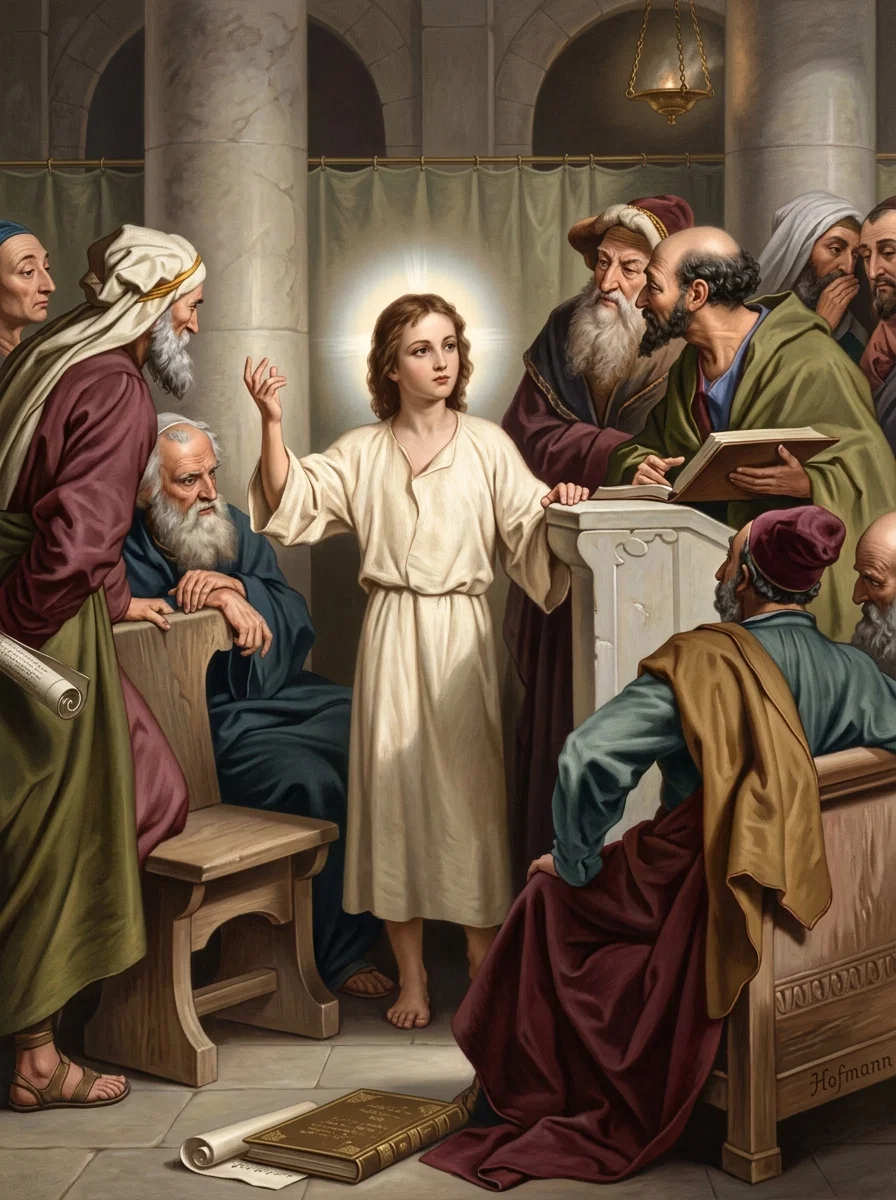
JESUS attended the Passover services of His people at Jerusalem with Joseph and Mary, His mother, when He was twelve years old, this being the age, according to Jewish regulations, when a son was first permitted to engage in the Passover services. Altho He had never before engaged in the celebration of these rites, He had doubtless seriously studied their significance, and was enabled at that time, through Spirit-quickened mind, to comprehend the national and the Gospel lessons they contained.
JESUS AT TWELVE YEARS OF AGE IN THE TEMPLE
In those times there was associated with the Passover gathering a short term of school in the temple, where special lessons were given for the benefit of those who wished to know more about the real meaning of these annual services. No one else then could have as deep a personal interest in things studied in this temple school, as the twelve-year-old Jesus; for He was the Christ of whom Moses and the prophets wrote, the Holy One of Israel who had come down from heaven to give His life as a ransom for man. All the sacrifices offered pointed to Him. He was the source and the center of all that the Passover meant, and the time had come for Him to know that He was the Lamb of God that should take away the sin of the world.
The twelve years of His allotted childhood had passed away; and opportunity was enabling Him to learn that He was the promised Messiah, the Son of God, and not the son of Joseph. The Spirit of wisdom and of quick understanding was upon Him. The Spirit of counsel and of might, in fulfilment of Isa. 11:2, 3, enabled Him to comprehend the true significance of all the rites He was permitted to celebrate. These qualifications made Him superior to the instructors then in the temple; therefore David had said for Him, "I have more understanding than all My teachers: for Thy testimonies are My meditation." Ps. 119:99.
The teachers in the temple school should have been able to show how the Passover rites pointed to the atonement which the Redeemer would make for transgression. But what they lacked in ability was supplied on that occasion by Jesus, the youthful Nazarene, who had joined the classes.
He doubtless spent much of the time during His stay in Jerusalem at the temple school. It is certain that He either became so deeply interested in the studies, that He did not know when His people left for their homes in Galilee, or else He remained behind on purpose. He could be about the Father's business by remaining in the temple, and He gave Himself up to this business.
Joseph and Mary were anxious to get home to look after their temporal affairs, and did not think to let Him know when the time came for them to return home; so they departed and traveled one whole day without Him. When the night came on, they searched the whole camp over, but could not find Him. Then they returned to Jerusalem to see if He could be found there.
Sadly they traversed the streets, and inquired of the watchman to learn if they had seen Him. This searching they kept up for three days, and then found Him in the temple, sitting in the midst of the doctors, both hearing them and asking them questions. All that heard Him were astonished at His understanding and His answers. Luke 2:46, 47.
Then His mother asked why He had treated them thus, causing sorrow to their hearts. Jesus answered, "How is it that ye sought Me? wist ye not that I must be about My Father's business?" He showed by this answer that He knew He was the promised Messiah, and not the son of Joseph. It seems, too, that providence was overruling affairs so that Joseph and Mary could retrace the eighty miles between Jerusalem and Nazareth in company with Jesus rather than return with a visiting multitude, for they needed to know more fully the character of the sacred trust God had committed to their care.4
It was necessary that they be taught more about the meaning of Christ's mission to this earth, and how it would be done. His tarrying at Jerusalem caused them to part company with the returning throng, and connect with Jesus only on their journey home.
Jesus Himself did not enjoy the spirit of the multitude, neither did He want His earthly guardians to partake of their ways. In holy counsel and quietness He wished to return with Joseph and Mary to Nazareth, for He was yet to spend eighteen years waiting for the year to come which had been announced by Gabriel for the presentation of "Messiah, the Prince." Dan. 9:24-26.
Probably on His return to Nazareth He spoke of the significance of the dying lamb in the Passover rites, and of the atoning work the heavenly Father had sent Him from heaven to perform. What an opportunity this homeward journey afforded Jesus to talk of the great things which redemption must do for mankind, and how God must work to correct the desolations that sin had wrought!
He did what He could to help them to see the scope of His work and to impress them with their need of cooperating with Him in His "Father's business."
It is very possible that with all His labors of this character they failed to understand the fulness of His mission; but let us strive to know what our relation to it should be, and how we should cooperate with Jesus in His Father's business of saving sinners from destruction, that they may enter into the everlasting kingdom.
Triumph Over Temptation
By Ellen G. White
Plan of Salvation—No. 3
By Mrs. E. G. White
THE coming of Christ to our world was a great event, not only to this world, but to all the worlds in the universe of God. Before the heavenly intelligences He was to take upon Himself our nature, to be tempted in all points like as we are, and yet to leave an example of perfect purity and unblemished character.
Satan and his angels exulted as they discovered that the Son of God had taken upon Himself the nature of man, and had come to be man's substitute, to engage in the conflict in our behalf. The human family had been overpowered by the deception of the enemy; "for all have sinned, and come short of the glory of God," and the enemy hoped that Christ also would become a victim to his seductive wiles. Satan gloried in the opportunity of besieging the Son of God with fierce temptations. Because He had taken upon Himself the nature of man, Satan deemed that his victory was certain, and with every malignant device in his power he strove to overcome Christ.
Triumph Over Temptation
The steadfast resistance of Christ to the temptations of the enemy brought the whole confederacy of evil to war against Him. Evil men and evil angels united their forces against the Prince of Peace. The issues at stake were beyond the comprehension of men, and the temptations that assailed Christ were as much more intense and subtle than those which assail man as His character was purer and more exalted than is the character of man in his moral and physical defilement. In His conflict with the prince of darkness in this atom of a world, Christ had to meet the whole confederacy of evil, the united forces of the adversary of God and man; but at every point He met the tempter, and put him to flight. Christ was conqueror over the powers of darkness, and took the infinite risk of consenting to war with the enemy, that He might conquer him in our behalf.
His Plan for Reaching Us
The Redeemer of the world clothed His divinity with humanity, that He might reach humanity; for, in order to bring to the world salvation, it was necessary that humanity and divinity should be united. Divinity needed humanity, that humanity might afford a channel of communication between God and man; and humanity needed divinity, that a power from above might restore man to the likeness of God. Christ was God, but He did not appear as God. He veiled the tokens of divinity, which had commanded the homage of angels and called forth the adoration of the universe of God. He made Himself of no reputation, took upon Him the form of a servant, and was made in the likeness of sinful flesh. For our sakes He became poor, that we through His poverty might be made rich.
He humbled Himself to pass through man's experiences, and He would not turn aside from the plan by which salvation could come to man. Knowing all the steps in the path of His humiliation, He refused not to descend step by step to the depths of man's wo, that He might make expiation for the sins of the condemned, perishing world.
What humility was this! It amazed the angels. Tongue can never describe it. Pen can never portray it. The imagination can not take it in. Sinless and exalted by nature, the Son of God consented to take the habiliments of humanity, to become one with the fallen race. The eternal Word consented to be made flesh. God became man.
His Heroism of Suffering Reproach
But He stepped still lower; He humbled Himself to bear insult, reproach, accusation, and shameful abuse. In the world which He made, which was sustained by the word of His power, there seemed to be no room for Him. He had to flee from one place to another until His life-work was accomplished. He was betrayed by one of His followers, and denied by another. He was mocked and taunted. He was crowned with thorns, and forced to bear the burden of the cross.
He was not insensible to ignominy and contempt; He submitted to it, but He felt its bitterness as no other being could feel it. Pure, holy, and undefiled, He was yet arraigned as criminal before the eyes of the world. From the highest exaltation the adorable Redeemer took step after step in the path of humiliation.
He Suffered It All for Man
He consented to die in the sinner's stead, that by a life of obedience man might escape the penalty of the law. He humbled Himself, and became obedient unto death. And what a death! It was the most shameful, the most cruel — the death upon the cross as a malefactor. He died not as a hero in the eyes of man, loaded with honors; He died as a condemned criminal, suspended between the heavens and the earth — died a lingering death, exposed to the tauntings and revilings of a debased and profligate mob. "All they that see Me laugh Me to scorn; they shoot out the lip, they shake the head." He was numbered with the transgressors, and even His kinsmen according to the flesh disowned Him. He was forced to see the sword pierce the heart of His mother — He beheld her sorrow. He expired amidst derision.
But all His sufferings were counted as of small account in consideration of the result He was working out in behalf of man, and for the good of the whole universe. He expired on the cross exclaiming, "It is finished;" and that cry rang through every world, and through heaven itself. The great contest between Christ, the Prince of Life, and Satan, the prince of darkness, was practically over, and Christ was Conqueror. His death answered the question as to whether there was self-denial with the Father and the Son.
Tho I with tongues of men may speak, and angels' tongues as well —
Tho I with pleasing eloquence of things divine may tell —
Unless my acts are acts of love to men of every class,
Like clanging cymbal I'm become, or as the sounding brass.
Tho I've the gift of prophecy, and know all mysteries, too,
And tho all knowledge I possess of things both old and new,
And tho my faith is such that I the mountains might remove,
If I have not the love of Christ, in vain these gifts must prove.
And tho I scatter all my wealth to those who are in need,
And tho I give my living flesh the hungry flames to feed,
Unless the love of Christ has come within my heart to reign,
Whatever else I may possess for me is all in vain.
Love is long-suffering and kind to all men, great and small;
Love envies not, vaunts not itself, is not puffed up at all;
Unseemly it does not behave; its own it seeketh not;
It is not easily provoked, and thinks no evil thought;
Rejoices not in wickedness, but does in truth rejoice;
Bears, hopes, believes, endures, all things, and does the same from choice.
Love never fails; but prophecies shall fail and tongues shall cease,
And present knowledge pass away — love ever reigns in peace.
For now we see only in part — part prophecy to-day;
But when that which is perfect comes the partial's done away;
I, when a child, spake as a child, so understood and thought;
But soon as I became a man I childish things forgot,
And now abide faith, hope, and love — may they abide with me;
But love is now and evermore the greatest of the three.
Inspiration in Every Happening
By Elizabeth Gibson
To ONE born to sing, every happening is an inspiration.—Elizabeth Gibson.
Looking Upward
"The traveler turns his face toward the place to which he is traveling; and so the righteous look up, while the wicked look downward to the earth."
Duty
SOME Christians do not like the word "duty," because it has a hard and cold sound. D. L. Moody used to object to the use of this term in reference to religious life. He did not like to hear people talk about the duty of prayer or reading the Bible or worship. He insisted that we should do these and all other things that ought to be done from the noble impulse of love. Love is a warmer, sweeter word than duty.
But duty and love are inseparable. Duty is a debt, and doing duty is paying one's debt. Love is a debt, a duty, the one all-comprehending duty. "Thou shalt love the Lord thy God with all thy heart, and . . . thy neighbor as thyself. On these two commandments hang all the law and the prophets." "Love is the fulfilling of the law."
We are all indebted to God. He is the Author of all our mercies. "What shall I render unto the Lord for all His benefits toward me?" asks the psalmist; and Jesus answers, "Render . . . unto God the things that are God's." Render to Him thanksgiving and praise and honor and worship. All these are due, and more. We owe Him ourselves. We are His. We shall never fulfil this precept until we have rendered and surrendered ourselves to Him.—Anon.
Christ's Coming the Destruction of All Earthly Kingdoms
By H. W. Cottrell
By H. W. Cottrell
THE second coming of Christ will bring an end to the reign of all earthly kings and kingdoms. All who are in authority will then surrender that power at the feet of King Jesus.
His coming will also terminate the long, cruel, dark reign of selfishness and sin. The King of the universe will then take to Himself His subjects, and they will dwell evermore with Him in a kingdom then to be set up, of which kingdom and reign it is not our purpose to treat in this article.
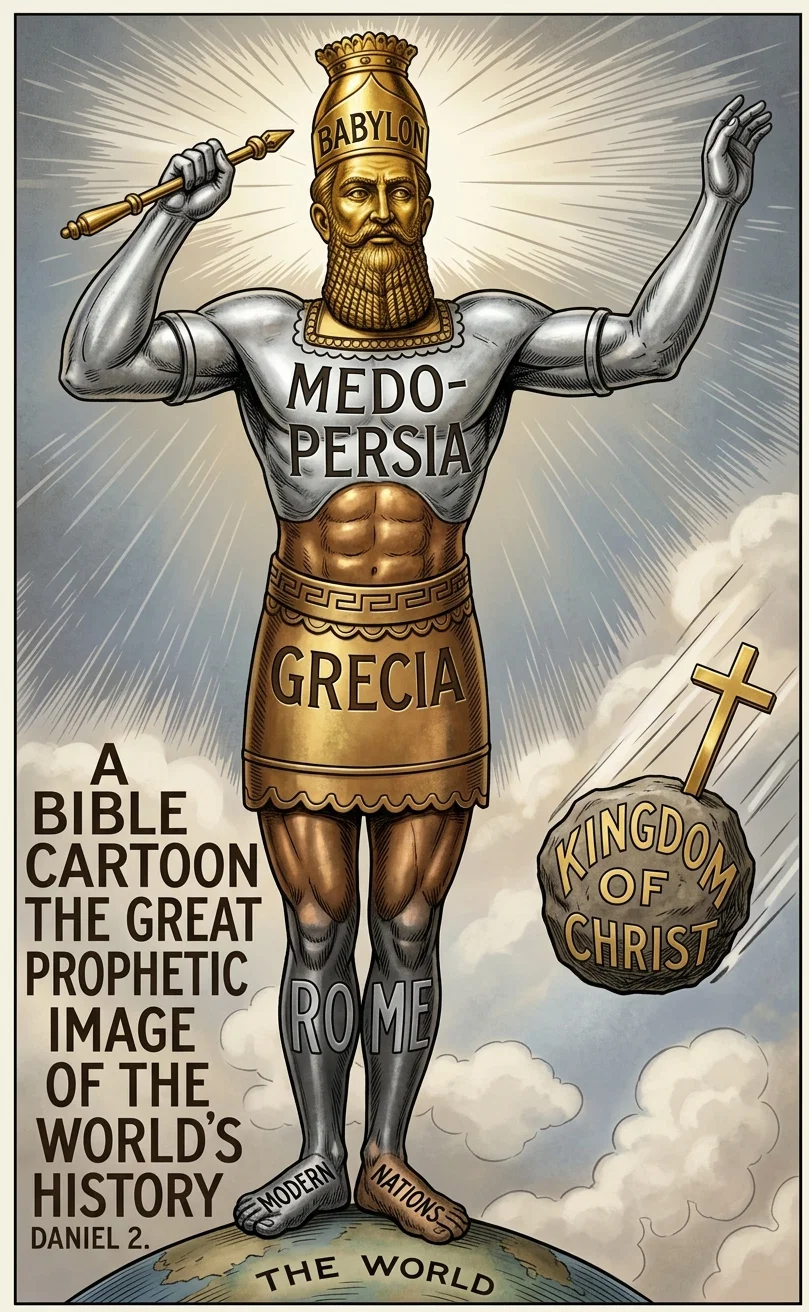
Earthly kingdoms have borne sway for thousands of years. Four universal kingdoms have swayed the scepter, some for a longer and others for a shorter period of time. Babylon was the continuation of the old Assyrian kingdom, and was the first world kingdom. That she was a world kingdom is evidenced by numerous scriptures (to say nothing concerning the historical evidence of the fact), one of which reads, "Nebuchadnezzar the King, unto all people, nations, and languages, that dwell in all the earth." Dan. 4:1.
Successive Empire
While it is true that other kingdoms existed, yet all were subject to the kingdom of Babylon, and to the dictates of its King. They were thus brought into subjection by arbitrary power—force. The history of the King is summarized in the words, "He became great in the estimation of men, and he died." The kingdom acquired world renown; and while it was great, its subjects were providentially humbled in the sight of men by its being conquered by the Medes and Persians.
This kingdom having absorbed the authority of its predecessor, also its subjects, all others stood in awe of it. It also had world-wide authority; and when it reached the zenith of its greatness, it fell, suffering its humiliation at the hand of the Grecians.
Alexander, at the head of the Grecian world power, then took the reins of government; and in the prime of manhood and worldly greatness, the whole earth appeared to be blossoming in honor, power, and human exaltation before him and to him. Even he, Alexander the Great, succumbed to death in the midst of his worldly greatness. Dan. 8:20-22.
Later followed Rome, the iron kingdom, which bore universal earthly sway; for we read of a world-wide decree issued by this kingdom, through the specific authority of its King, "And it came to pass in those days, that there went out a decree from Cæsar Augustus, that all the world should be taxed." Luke 2:1. Thus the fact is evidenced that the kingdom was world-wide, and the King its sole monarch.
It was the rulers in this kingdom that endeavored to take the life of the "child Jesus." This great power, with an allied power, put to death the Redeemer of mankind on Calvary's cruel cross, while He was tendering to each individual an endless life.
The prophet Daniel forecast the future of this kingdom and all other earthly powers in the following language, the final culminating point to be reached at the second coming of Christ:
The Fourth Monarchy
And the fourth kingdom shall be strong as iron: forasmuch as iron breaketh in pieces and subdueth all things; and as iron that breaketh all these, shall it break in pieces and bruise. And whereas thou sawest the feet and toes, part of potters' clay, and part of iron, the kingdom shall be divided. Dan. 2:40, 41.
In harmony with God's Word, Rome was divided, and thus it has been and will continue to remain for all time.
The Gospel in prophecy pictures the thrilling event of the final destruction of all earthly kingdoms, in its metaphorical description of the breaking to pieces of the historic metallic image of the second chapter of Daniel. This image is explained to represent the earth's four universal kingdoms, while the stone therein represents the kingdom of Christ.
Earthly kingdoms must give way to the heavenly kingdom, kingdoms of time to the kingdom eternal. "Thou sawest till that a stone was cut out without hands, which smote the image upon his feet that were of iron and clay, and brake them to pieces. Then was the iron, the clay, the brass, the silver, and the gold, broken to pieces together, and became like the chaff of the summer threshing-floors; and the wind carried them away, that no place was found for them; and the stone that smote the image became a great mountain, and filled the whole earth." Dan. 2:34, 35.
The Eternal Kingdom
From the time of the second advent of Christ, henceforth and forever, there will be no "place" for earthly kingdoms. But Christ and His kingdom will bear universal and eternal sway.
The subjects of every earthly kingdom, and of every other finite form of government, have died throughout ages past, and left the kingdom to other people. But at the coming of Christ, when time is absorbed by eternity, and temporal powers are no more, the eternal kingdom will come into possession of the children of God, and it "shall not be left to other people." Dan. 2:44.
With the aid of the prophetic telescope as placed in the student's possession in the seventh chapter of Daniel, we view the dim vista of earth's past history, and see the four universal monarchies rise and then fall. We behold the fourth universal kingdom—Rome—divided into ten divisions. "Thus he said, The fourth beast shall be the fourth kingdom upon earth. . . . And the ten horns out of this kingdom are ten kings that shall arise." Dan. 7:23, 24. "And in the days of these kings shall the God of heaven set up a kingdom, which shall never be destroyed." Dan. 2:44.
The culmination, however, will be reached when all things earthly give way to Christ, the King of the universe. "And the kingdom and dominion, and the greatness of the kingdom under the whole heaven, shall be given to the people of the saints of the Most High, whose kingdom is an everlasting kingdom, and all dominions shall serve and obey Him." Dan. 7:27. "And when the chief Shepherd shall appear, ye shall receive a crown of glory that fadeth not away." 1 Peter 5:4.
Many Are Called, Few Get Up
The teacher asked, "Who can tell me the rest of the verse beginning, 'Many are called?'" and a little girl piped, "I know it—'Many are called, but few get up.'"
The Bible's Secret
By Henry Van Dyke
THE literary influence of the Bible appears the more wonderful when we consider that it is the work of a race not otherwise famous or potent in literature. We do not know, of course, what other books may have come from the Jewish nation and vanished with whatever power or beauty they possessed; but in those that remain there is little of exceptional force or charm for readers outside of the Hebrew race. They have no broad human appeal, no universal significance, nor even any signal excellence of form or imagery. Josephus is a fairly good historian, sometimes entertaining, but not comparable to Herodotus or Thucydides or Tacitus or Gibbon. The Talmuds are vast storehouses of things new and old, where a careful searcher may now and then find a legendary gem or a quaint fragment of moral tapestry. In histories of medieval literature, Ibn Ezra of Toledo and Rashi of Lunel are spoken of with respect. In modern letters, works as far apart as the philosophical treatises of Spinoza and the lyrics of Heinrich Heine have distinction in their kind. No one thinks that the Hebrews are lacking in great and varied talents; but how is it that in world literature their only contribution that counts is the Bible? And how is it that it counts so immensely?
The fountainhead of the power of the Bible in literature lies in its nearness to the very springs and sources of human life—life taken seriously, earnestly, intensely; life in its broadest meaning, including the inward as well as the outward life; life interpreted in its relation to universal laws and eternal values. It is this vital quality in the narratives, the poems, the allegories, the meditations, the discourses, the letters, gathered in this Book, that give it first place among the books of the world not only for currency, but also for greatness.—Henry Van Dyke.