Your ShelfYour Projects

Review and Herald, Vol. 92, No. 30.

The Judgment of Babylon
Earlier text: Teaching the Gospel Through the Chinese Character

The Old Pasture

I’VE been dreaming, dear, of childhood, and the early bygone days, I’ve been back among the early scenes I knew; I have trod the fields and woodlands and the half-forgotten ways, Through the pasture where the pennyroyal grew.
The pines are on the hillside where cattle used to feed, The orchard trees have shrunk to one or two; The old cellar now is darkened with tree and vine and weed, In the pasture where the pennyroyal grew.
I have heard again the tinkling of the bell upon the cow, As I urged her lazy footsteps through the dew, With a tender hand upon her—I can feel her motion now— Toward the pasture where the pennyroyal grew.
Where I called her through the bushes, now is forest dense and high, Where the sunlight glints below the whole day through; And the trout brook is still singing through the valley land near by, In the pasture where the pennyroyal grew.
We are older grown, my darling, since those pleasant bygone days, And the early friends now left us are but few; But I’m younger to have traced again the half-forgotten ways, Through the pasture where the pennyroyal grew.
— Lights of Home.

Conducted by Mrs. I. H. Evans, Takoma Park, Washington D. C

Assisted by Miss Lora E. Clement
Through the columns of this department, hints will be given on all matters pertaining to the home life. Short articles and letters are solicited from home makers, telling of their everyday experiences,—their joys and sorrows, their failures and successes.

Fruit Canning Suggestions

LORA E. CLEMENT
Only the best-flavored fruit, such as is fresh, firm, and not overripe, should be selected for canning. If possible, use cooking utensils of aluminum, granite, or earthenware. Thorough sterilization of the glass jars and covers is very important, and must be done with painstaking care. They should be washed in hot soapsuds and rinsed with clear boiling water just before using. Be careful to clean the covers well; scrape them with a knife if necessary, to remove hardened sediment; see that they are perfect in shape, and neither dented nor bent. Use new rubbers if possible. Dip them in hot water before using, but do not allow them to lie in it. When you are ready to fill your can, place it on a thick cloth wrung out of hot water. Be sure the fruit is boiling, and fill the jar to overflowing. If there are air bubbles in evidence, run a silver knife down the edge of the can until they disappear. Screw the covers on tightly enough so there will be no leaking when the cans are turned on end. They may be tightened, and the edges pressed down, when the contents of the cans have cooled..
Canned fruit should be wrapped in paper, and kept in a cool, dark place until needed for use.

Save the Fruit Juice

Very often in canning season you will have more juice than is desirable if the fruit is to be used for sauce. In this case some jars may be filled with juice alone. This will serve for flavoring sherbets, cold drinks, etc. The juice of fruit too ripe for successful canning or preserving also may be utilized in this way.
Blackberries, raspberries, cherries, and other small fruit may be canned after the manner of strawberries, except that they are usually put to cook in a small quantity of water, unless prepared sirup is used.

Strawberry Time

June is the month for strawberries. These may be served fresh in a variety of ways, and make an especially pleasing dessert when garnished with their own leaves. For serving in this way, the berries should be large and evenly colored. They are then picked up by the stem with the fingers, and dipped into powdered sugar before eating. The flavors of pineapple and strawberry blend well, and sugared strawberries served with sliced pineapple are delicious.
Strawberries for canning should be picked over, placed in a colander, and washed in cold water; then carefully hulled. Put a layer of berries into an earthenware or granite dish, then sprinkle with sugar, cover with another layer of berries, and so on, using from three fourths to a cup of sugar for each quart of berries. Place in the refrigerator or cool cellar overnight, or at least for several hours. Never allow strawberries to stand in water; their own juice is sufficient. When ready to can, drain off the juice, heat it to boiling, and then carefully drop the berries in and let them boil gently for about fifteen minutes. Keep the berries well under the sirup with a granite or aluminum spoon, and remove all scum. Letting the berries stand in sugar and then dropping them into boiling sirup hardens them and helps them to keep their shape. Some housewives hold that if the cans, when filled with berries, are laid on the side, and turned frequently while cooling, the fruit will be evenly distributed in the sirup and never rise to the top. The ideal way is to prepare just enough fruit to fill one jar at a time, but of course this is not necessary.
It is hard to preserve strawberries so that they will retain their flavor and color. The berries often shrink, and it is said they can be most successfully preserved in the sun. Pick over the berries and wash them carefully before hulling. Put them into sterilized jars, filling them nearly full. Make a thick sirup, using as many pounds of sugar as there are pounds of fruit, and half as much water as sugar. Boil this for fifteen minutes, and then pour over the berries, filling the can to overflowing. Cover the jars with glass covers, and place them in the hot sun for three successive days, being careful to take them indoors as soon as the sun goes down.

“Curing,” a Mischievous Boy

“Joe is impossible to have around the house, he is so incorrigibly mischievous,” a mother complained to me. “He simply takes the house apart. He meddles with every clock, lock, or screw, and we never know what is going to happen next.” To illustrate, she told me of an unpleasant experience the family had had on account of Joe’s mischievousness in the early fall, when the steam had first been turned on. It seemed to them for a while as if the whole house was going to be blown up, for steam was escaping everywhere. Joe calmly came forward and announced that he knew what was the matter, that he had unscrewed certain valves to see what would happen, and that he knew how to fix those valves. This, to the mother’s great surprise, he did. “And,” concluded the mother, “I fixed Joe, to help him remember not to meddle again with the valves.It was very plain that what Joe needed was not punishment or suppression of his mechanical inclinations, but a chance to make use of them. I advised the mother to have him join a mechanical class in the neighborhood, where the boys also had gymnastic instruction under a competent leader. This proved to be exactly what Joe needed. He found great pleasure in his new classroom; he learned the use of certain mechanical devices there; and before very long, instead of being an annoyance to everybody, he became a very genuine source of pride to the household. He had a corner in the house which he called his shop, whence emanated all kinds of original and ingenious mechanical toys.—Mariam Finn Scott, in Good Housekeeping.

A Can of Paint

WHILE there are not many housewives who have personally wielded the paint brush for freshening the interiors of their homes, those who have done so, even to a limited extent, will agree that the possibilities which lie in a can of paint, a good brush, and a can of turpentine are as great as they are varied.
My first attempt at painting was two years ago. Wishing to give the woodwork in our dining room a new coat of paint, I wrote to several manufacturers, and found that the little booklets they send out gave me full information about qualities and prices, and also directions as to the best mode of application.
The old paint on the window sills was badly cracked and broken, so I procured some very heavy sandpaper, as advised in one of the little booklets, and rubbed down these particular spots till I had an almost smooth surface. If I had done the work exactly according to directions, I should have carefully sandpapered the whole, or used a varnish remover, but I wanted to simplify the matter. After using the sandpaper, I wiped the surface with a dry cloth to remove all loose particles, and put on a single undercoating, allowing it to dry well; then I added a finishing coat of white eggshell enamel—that is, enamel with a semigloss finish like an eggshell—requiring no rubbing.
The room had a baseboard, doors, window frames, and a simple mantel. I did not find the work difficult, and the result has been satisfactory.
In cleaning, I use a slightly dampened cloth, preferably of flannel. After wiping the surface with this, I rub it dry with cheesecloth. When the paint is badly soiled, I have found it a good plan to put one teaspoonful of kerosene and one teaspoonful of Spanish whiting in two quarts of water. This solution thoroughly cleans the white woodwork; it must then be finished off with a dry rub. It is not advisable to use kerosene on polished or highly glossed enamel, as frequent applications destroy the surface.—McCall’s Magazine.

The Health and Temperance Work

Reasons for Giving Health and Temperance a Place in Our Evangelistic Campaigns, and Suggestions How to Do It

THE apostles tell us that health for the body is not to be separated from health for the soul. “Beloved, I pray that in all things thou mayest prosper and be in health, even as thy soul prospereth.” 3 John 2. The expression “even as” indicates “in like manner” or “in the same degree as;” that is, the writer is solicitous for the health of the body as well as that of the soul. If God in this manner couples together the welfare of the soul and the body, surely we should not separate them.
The apostle Paul writes: “I beseech you therefore, brethren, by the mercies of God, to present your bodies a living sacrifice, holy, acceptable to God, which is your spiritual service.” Rom. 12: 1. The sacrifice formerly, it will be remembered, was to be without blemish physically; and in like manner are we in this dispensation to present our bodies unto God as far as possible physically perfect. In so doing we are rendering to him spiritual service, we are offering him reasonable worship. See margin Revised Version. In caring for the body, then, we are worshiping God, as well as when we read the Bible and pray. True reformation of the soul is accompanied by reformation of the body.
This method of combining physical and spiritual labor was the advice of the apostles, and the practice of the Master. At the opening of his public ministry it is recorded, “And Jesus went about in all Galilee, teaching in their synagogues, and preaching the gospel of the kingdom, and healing all manner of disease and all manner of sickness among the people.” Matt. 4: 23. He also taught this method to his disciples as he first sent out the twelve to preach. “And as ye go, preach, saying, The kingdom of heaven is at hand. Heal the sick, raise the dead, cleanse the lepers, cast out demons: freely ye received, freely give.” Matt. 10: 7, 8. What God hath joined together, let not man lightly put asunder.
This method is taught also by the “Testimonies for the Church” in our day. “Medical missionary work is the right hand of the gospel.”—Vol. VII, page 59. “When properly conducted, the health work is an entering wedge.”—Vol. VI, page 327. “Medical missionary work is the pioneer work of the gospel.”—Ministry of Healing, page 144. “Medical missionary work is in no case to be divorced from the gospel ministry.”—Testimonies for the Church, Vol. VI, pages 240, 241. “The gospel ministry is an organization for the proclamation of the truth to the sick and to the well. It combines the medical missionary work and the ministry of the word.”—Id., page 300. “Every gospel worker should feel that the giving of the instruction in the principles of healthful living, is a part of his appointed work.”—Ministry of Healing, page 147. These quotations and others that might be given show the true relation between the gospel and the health work.
In addition to the above, there are certain beneficial results that will accrue if we give the health and temperance work its proper place in our evangelical campaigns. In the first place, it will set us on vantage ground in our efforts for others. Emphatically, this is the time to ally ourselves with the best class of every community on the liquor question, and on all other associated health questions.
In the second place, it will educate new converts. As the principles of health are a part of the message, those uniting with the church ought to be thoroughly instructed in them.
It will educate old converts. Many of our own people always attend the public evangelical efforts for others. Some of these perhaps have forgotten their teachings and practices of former days. All such ought to be born again—to health principles.
It will also tend to rejuvenate our health work generally. For some years our medical work has not been making progress commensurate with that of other branches. In some parts of the field the medical department exists almost wholly on the letterhead of the conference stationery. Now may not one reason for this condition be that we have not thoroughly instilled health principles into the lives of the people in the first place, or have failed to do adequate follow-up work after they have come into the church? The preaching of the full free gospel will do much to solve our vexing medical problems and to revive the health and temperance work among us.
But how shall all this be accomplished? Every tent or hall effort should have at stated intervals, perhaps once a week, a health and temperance service. Platform lectures may be given alone, or be illustrated with charts; slides may be used; demonstrations may be given, etc. If possible, one of our physicians who is also able to do public work, should give the instruction. If a sanitarium is near, it will be glad to assist. In the majority of cases, however, no sanitarium is at hand, and no doctor, nor even a nurse. Under these conditions the work will fall on the preacher. Physiologies, books on hygiene and on simple diseases and treatments, articles on tea, coffee, alcohol, and tobacco, the use of drugs, etc., are to be had easily these days, and at a moderate price. With a reasonable amount of time and application to these subjects, good work can be done for the people without a medical education. Much is said in the Testimonies about the medical worker being able to do gospel work; but it must be remembered that much is also said as to the gospel worker’s being able to do health and temperance work. It is encouragingthat our Ministerial Reading Course this year contains a volume designed to supply some of this instruction.
Now, all that has been said as to the desirability of the minister being able to do medical work, applies as well to the Bible worker, and even more so; for she will have many an occasion to give the treatment as well as teach the principles of health. An especially ideal combination is the nurse who is a good Bible worker. Our schools and sanitariums ought to be turning out many Bible workers and nurses equipped for this combined service, for our evangelical work would be stronger if it could put into the field more true medical gospel workers.
Every public effort should have a liberal supply of health books, periodicals, and tracts for sale or to give away. These are to be displayed in a conspicuous place, and be in charge of some one who will push their distribution. Such literature makes excellent material for house-to-house work. We have some good tracts on alcohol, tobacco, and a variety of other subjects. Our Youth’s Instructor is a live publication along antinarcotic and antialcoholic lines, and Health and Temperance will be of more value for the summer’s campaign than ever before. The little book recently published, “The Shadow of the Bottle,” is receiving wide commendation and quick sales. All this ammunition ought to be used in the present season’s campaign.
The press may be used to a larger extent. The editor is coming to be more powerful than the orator, and this fact needs to be taken advantage of. Today witnesses more health and temperance and general social uplift work than ever before, and this makes it easier for our health principles to play the part of the entering wedge.
When all our workers engage in gospel ministry to both spiritual and physical needs of mankind, then will they find more abundant success. This was the Master’s method.
H. N. Sisco, M. D.

All in All

As slips the stream into the parent sea And finds repose upon that billowy breast, So sinks my seaward hastening soul in Thee, And findeth rest.
As wee birds nestle ’neath the mother’s wing, And fearless, find there shelter, love, and care, I rest me in the covert of thy wing, Protected there.
Earth follows daily on its winding path, E’er curving inward to the kindly sun; So in the course thy gracious wisdom hath My days are run.
As moves the shackled winter to the spring With fettered arms, her gentle hands laid bare, To thee my soul her clanking chains would bring And leave them there.
As song birds greet the May and flowers unfold, And perfumed blossoms scent the balmy air, For thee my flowers of life their hearts of gold With others share.
As waning night drops off its cloak of gloom, And radiant morn advances to the day, From doubt and sorrow unto thee, my home, My soul’s away.
Grain-laden fields, and youth, and happy love, And promised comfort after days of pain, Are ripples on the deep sea of thy love, Saviour of men.
— Caroline M. Butterfield.

Energy of Will

HALF the race fall short of reasonable possibilities because they lack energy of will, and not for lack of clear intelligence or delicate sensibility.—Joseph Baldwin.

A Burst of Music

“EVERY new day comes into the world a burst of music; we may make it a dirge, a dance, or a grand life-march,”
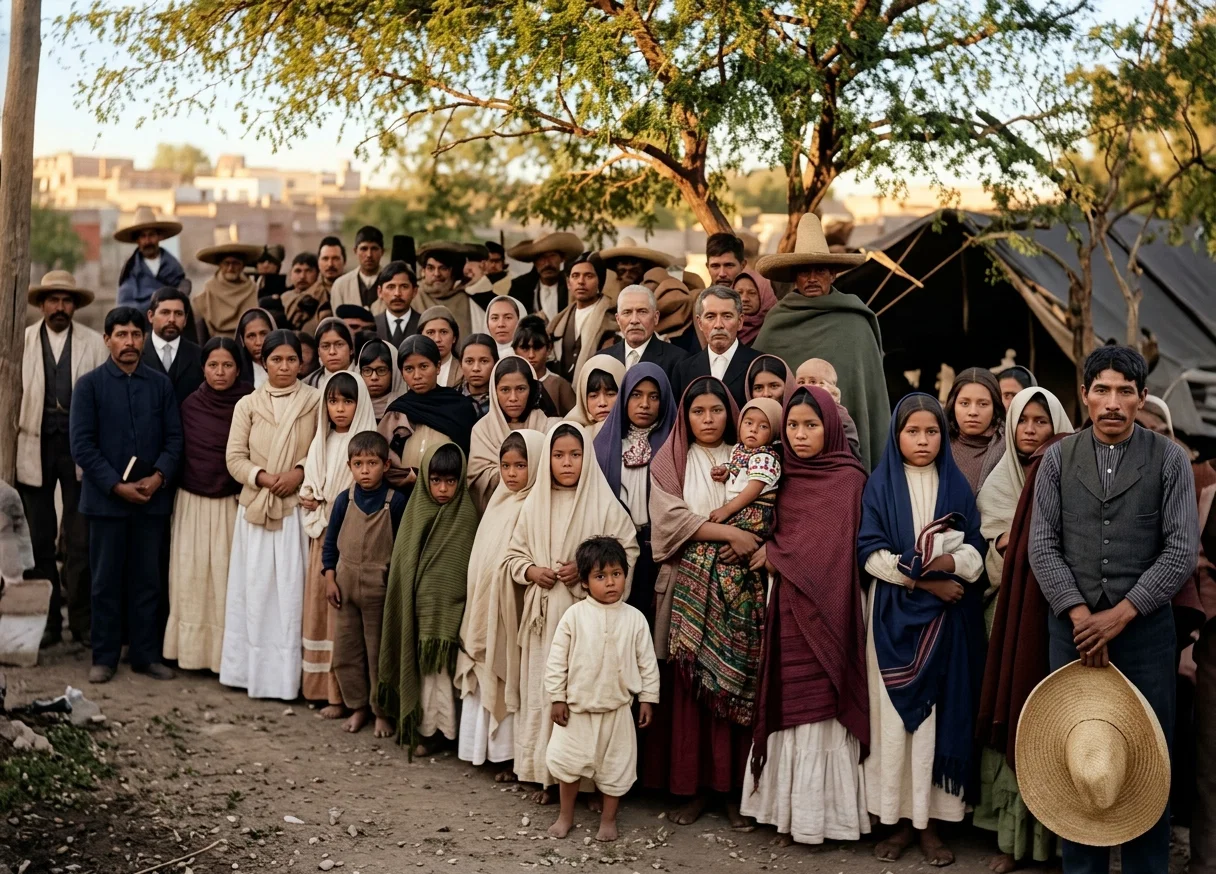
A GROUP OF MEXICAN SABBATH KEEPERS

Mexico

SAN LUIS POTOSI.—How it cheered our hearts when we learned that the Thirteenth Sabbath Offering for the present quarter is to be devoted to the work in the North Spanish Union Mission, of which Mexico forms a needy and considerable part. We feel that one of the greatest needs of this mission field is a training school for native workers, to educate them to go into sections of the country where it would be impossible for a white man to work, even if there were enough foreign laborers to enter all parts of the field. Native workers have been largely responsible for our past and present success in foreign lands, and we hope that a Spanish training school for such workers may soon be a reality in this part of the world's great harvest field.
The members of our native church and Sabbath school are very happy about this offering for the Spanish work, and are especially anxious that it may help us in the erection of a church building in this city of sixty thousand people. San Luis Potosi is the capital of this state, in which there are six companies of believers. If a strong work could be established in this city, it would have a great influence upon our work throughout the state, and be an encouragement to our scattered believers. It is practically impossible to place our work upon a substantial basis without a church building. This could now be erected for less than two thousand dollars United States money, on account of the low rate of exchange, whereas it would cost five thousand dollars at the normal rate. One of our native brethren has given one thousand dollars Mexican toward the building of this church. To do this he sacrificed much; and so far as I know, it is the first gift of this size ever made by a Mexican to our work. Before his conversion he was a drunkard, but now he is a sober, industrious man, and is superintendent of our Sabbath school.
A number of substantial business men are interested in the truth, and we are praying that they will accept it. One of them speaks English fairly well. Our work has gone forward encouragingly, more especially since the last week of prayer. At that time we sought the Lord earnestly for more of the Holy Spirit, and our prayers were answered.
We have as interesting a Sabbath school as any of equal size anywhere. The offerings for missions are steadily increasing, and for the first quarter of 1915 amounted to $18.85 Mexican. We shall probably reach our goal of twenty dollars for the present quarter. All our expenses are met by special collections.
The people here love the truth, and are glad to hear of its progress in other lands. The message does much for them when once God gets hold of their hearts. We are well and of good courage; we love our work, and rejoice that we can have a part in telling this good news of salvation to others. When we read of what has befallen our workers and believers in some parts of Europe, we feel that the Lord has especially favored us, for thus far during the revolution this city has not suffered much. No battle has been fought for its possession, and no general looting has taken place, although some horses have been commandeered for the army.
The most needy fields are not always those farthest away. Bleeding Mexico needs the gospel of peace. Pray for us in our work, and with your prayers give to the Lord of the harvest a liberal offering for the advancement of his truth in this part of the vineyard.
E. W. THURBER.

California

“Ask ye of the Lord rain in time of the latter rain; so the Lord shall make bright clouds, and give them showers of rain, to every one grass in the field.” Zech. 10:1.
SURELY the time has come for the Lord to do a work, making bare his mighty arm before the people, and giving a power to the message that we have not yet seen. The calamities by land and sea, the European difficulty, and the unsettled conditions that obtain in all walks of life, clearly indicate that the Lord is making a short work in the earth, and we shall see rapid work in the gathering of souls for the heavenly garner.
Never have I been more thankful for a part in the Lord’s work than at the present. It has been my privilege the last eight months, beginning Oct. 4, 1914, to hold two series of evangelistic meetings in the Central California Conference, one at Bakersfield and the other at Fresno.
During the services 143 have signed the covenant to keep all the commandments of God, by his help. Of these 107 have united with the church, and others will do so soon.
The newspapers have printed 228 articles, averaging over seven inches each, on the message. The publicity thus given has resulted in getting the truth before many who could not attend the services, and has encouraged a good attendance. The attendance at the evening service has averaged from 100 to 800.
The offerings during these services have amounted to $919.37, which has more than covered the expense of the meetings, aside from the laborers’ salaries.
The churches of Bakersfield and Fresno have given valuable service in advertising the meetings and in faithful attendance. The spirit of unity and co-operation was specially manifested by the workers and the church.
Associated with the writer in these meetings held in the Central California Conference at various times were the following-named workers: Elders B. E. Beddoe, N. P. Neilsen, E. H. Adams, and J. R. Patterson, Professor Beardsley, Brother R. R. Breitigam, and Miss A. Bond, Mrs. R. Jackson, Miss G. Patterson, and Miss L. Dart, Bible workers.
The Fresno church has a membership of 418, 152 having been added during 1914 and 1915. We are thankful indeed for the blessings of God showered in this place, and we ask the prayers of our people for the work in Fresno.
A. S. BOOTH.
Ogden, Utah.

Washington Missionary College

THE Washington Missionary College has just closed its first school year — a most successful term from the standpoint of both teachers and students. The total enrollment was two hundred and eleven. The majority of these young people have an earnest desire to gain a preparation for more efficient service in the Master's vineyard, and a large number of them are spending the summer in canvassing and other lines of gospel work, planning to continue their study next fall.
An excellent Christian spirit has pervaded the school. During the week of prayer, observed in many of our colleges about the first of May, the Lord came especially near to the young people in Washington, and with few exceptions, every unconverted member of the student body made a start in the Christian life.
One item of special interest is the effort made to liquidate the College debt. This movement originated with the literature class. On their own initiative, unknown to the faculty, they interviewed all the students to learn how many would like to assist in this enterprise during the summer. At one of the last chapel exercises the subject was introduced, and one student after another arose and told what he was willing to do for the school that had done so much for him. Many pledged the proceeds of one week in the canvassing field; some pledged cash; others pledged a certain amount per week during vacation. Then one teacher after another caught the spirit, and promised to give one week's salary toward the payment of this debt. It is hard to determine just how much will be raised in this way, but the loyalty which prompted the effort means much for the College.
Exceptional opportunities have been enjoyed by the members of some of the English classes in practical experience in editorial work. The advanced rhetoric class furnished copy and edited a number of the Signs of the Times weekly, while the journalism students did all the office work on the College number of the Youth's Instructor.
With a view to equipping its students for practical as well as intellectual duties at home and abroad, Washington Missionary College offers an excellent industrial training along various lines. Just before the close of school this department gave a very creditable exhibit of work done in sewing, carpentry, domestic science, dentistry, and printing.
The general public and the student body are indebted to Prof. C. Hamer and his music students for two delightful evenings, as they closed a profitable year's work with the rendering of the beautiful cantata "Ruth, the Moabitess," and a piano recital. The accompanying College song, written by the music director, has been much appreciated by the students, and is sent out with the hope that others may be thereby inspired to come and learn to love "Our Washington."
The exercises of commencement week began with the baccalaureate sermon,
given by President J. L. Shaw on Sabbath, May 22. The graduating exercises proper were held in the Takoma Park church. Prof. B. G. Wilkinson gave the commencement address, and diplomas were presented by Elder W. T. Knox.
There were five graduates from the college course, receiving the degree Bachelor of Arts: Mr. Richard Farley enters the ministry in Virginia; Mr. Roland Loasby answers a call to South America; Mr. Irving Steinel takes up work in the District of Columbia Conference; Mr. Josef W. Hall is under appointment for China, and Miss Ella A. Iden goes to New Jersey to take charge of the Missionary Volunteer, educational, and Sabbath school work.
Those finishing the medical evangelistic course were Misses Lily McCully,
Edith Frye, Amelia Sauerwein, Helen V. Price, Hazel Stout, Ethelwyn Hibbard, and Lillian Peterson. Some of these nurses have taken up work in the Washington Dispensary, and others will enter the Bible work or sanitarium work.
Misses Lenoa Huguley, Sarah Harkins, Lorraine Fankhouser, Sadie Detwiler, Maria Jiron, Mary Herr, Earnestine
Woolgar, and Mr. Albion Keihnhoff completed the academic course. Most of these young people are planning to return to the College next year and continue their school work.
A summer school will be held in Washington July 1 to August 11. Church-school teachers will be in attendance from the Columbia and Atlantic Union Conferences. During this time a ten-day Educational and Missionary Volunteer Convention will be held in behalf of the young people in the Washington College district.
Professor Shaw tells us that prospects are bright for a large attendance with the opening of the next school year. The majority of the old students will return, and a large number of new applicants have already written for admission.
Ours is an age of specialization. The work of the world demands a trained mind, a keen eye, a skillful, steady hand. And is this standard too high for God's service? In the words of Peter the Great, "we must educate, educate, educate," if we would give the closing message for this day and generation in a manner pleasing to our King. There is a world-wide call for young people with a consecrated education, who are willing to say, "Anywhere, any time, anything for the Son of God and the sons of men."
Lora E. Clement.
Continue reading: Medical Convention Report