Your ShelfYour Projects

Review and Herald, Vol. 87, No. 8.

He Is Coming

Review and Herald

Feb 24, 1910

Review and Herald Publishing Association · Takoma Park Station, Washington, D. C. · Feb 24, 1910

He Is Coming

He is coming! He is coming! When the winter days appear, When the trees are gaunt and leafless At the closing of the year— When the snowflakes, softly falling O’er the earth, their mantle fling, Hark! the sound of voices calling: “He is coming! Christ our King!”
He is coming! He is coming! Though the night is wrapped in sleep, Yet the air is full of music, And the stars their watches keep; And the winds that murmur weirdly And the giant branches swing, Seem replete with voices calling: “He is coming! Christ our King!”
He is coming! He is coming! Yes, we feel it in our hearts; At the sound our pulses quiver, And the very life-blood starts. O, the time of mirth and gladness! O, the words that sweetly ring Through the vista of the ages: “He is coming! Christ our King!”
— Rev. J. I. Cameron.

WHAT THE BOY IS MADE OF

H. T. MUSSELMAN discusses in a forceful article in March LIFE and HEALTH some of the vital features of Boyhood. W. H. McKee tells the story of the Byron Center Home. The Hookworm—What It Is, and What It Does; Good News for the “Meat Strikers;” Tuberculosis Infection; How Cottonseed Oil Is Made—These constitute a partial contents of the March number of LIFE AND HEALTH.
Some time ago the editor of LIFE AND HEALTH attended a series of lectures by H. T. Musselman, editor of the YOUTH’S WORLD, and was so deeply impressed with the speaker’s principles that he requested him to contribute a series of articles on “The Boy” to LIFE AND HEALTH. This Mr. Musselman consented to do, and the series is now running, and will continue for the entire year. In the March number Mr. Musselman deals with the subject, “What a Boy Is Made Of,” outlining the elements which go to make up the character of our future generation of men.
This series of articles was introduced in February, but the writer fairly gets launched into his subject in the March issue, and the series promises to be one of unusual importance. Every Seventh-day Adventist parent should make it a point to get this magazine and follow these articles very closely. Mr. Musselman’s closing paragraph this month indicates the trend of his discussion:—
“We have tried to point out the essential elements in the soul of your boy. All these elements are vital, and are nature’s forces for the making of strong men out of real boys. If we take time to understand them and see their combination with other particular elements in each individual boy with whom we work, we shall be able to aid the boy in his unfolding manhood. If not, we shall hinder him rather than help, and only God knows what the end will be. Take time to know what the boy is made of.”
Mr. McKee, superintendent of the Byron Center Home for Girls, tells the story of the founding of this institution in the March LIFE AND HEALTH. None who are interested in the uplifting of the fallen, should fail to get the March LIFE AND HEALTH and read this and other interesting articles which it contains.

Hookworms

You have heard about the hookworm, the little parasite which is as small as a fine needle, but which was big enough to set all of the South a-tremble when it was discovered not many months ago. We have been waiting to have some one who knows tell us about this wonderful little creature. We have such an article in the March number of LIFE AND HEALTH, by Dr. Newton Evans, himself a practitioner in the South and instructor in two medical colleges in the city of Nashville, Tenn. Dr. Evans has made an extensive study into the subject of the hookworm disease, and presented a paper at the recent hookworm conference at Atlanta, Ga. His article deals mainly with the doings of this conference on the hookworm disease.

For Meat Strikers

The vegetarian has plenty of company these days and is not the lonesome individual he has been painted, for there have been vast additions to the ranks of the body which they represent. Vegetarianism is the fashion to-day with great numbers, owing to the celebrated “meat strike.” Down in Cincinnati a few weeks ago, the foreman of the factory was discussing at the table the present high prices of meat. As the discussion grew tense and heated, he carelessly scribbled on a piece of paper a resolution which soon after he had typewritten and circulated throughout his factory, with the result that some scores of people swore off eating meat until the prices should drop. It was like a match applied to dry tinder. From hundreds, the numbers of “meat strikers” quickly grew into thousands. The agitation was rapidly carried from Cincinnati to other cities, and at once the movement spread throughout the country, and to-day there are thousands of “meat strikers” in all parts of United States.
Though the principle which actuates this strike is not food reform, but rather price reform, the situation nevertheless presents an unusual opportunity, and this opportunity has been seized by the Editor of LIFE AND HEALTH to present to the readers an excellent article by Geo. E. Conforth on “Meals Without Meats.” Whether you are a “meat striker” or not, this article can not fail to interest you.

Tuberculosis

The first thing that we want to know about any disease is how to keep from taking it. We have read a great deal about tuberculosis and tuberculosis conventions. The whole country has been stirred up in a general campaign against the horrors of the white plague. The magazines have bristled with articles on tuberculosis, and the articles in turn have bristled with facts, statistics, and percentages. All of these have been to good purpose, but one of the most practical things that have been written, is the article in the March LIFE AND HEALTH by Dr. Achard, of Ravenswood, Chicago, on “The Paths of Tuberculosis Infection.” Dr. Achard’s article is more than usually instructive upon a subject regarding which every one should be thoroughly informed.

Cottonseed Oil

With butter at 40 cents a pound in most of the large cities, and other shortenings at proportionate prices, the housewife to-day has to take as much interest in the subject of shortenings as a banker takes in current financial news. For this reason, we know that few women who receive LIFE AND HEALTH will miss reading Dr. Godsmark’s article on “How Cottonseed Oil Is Made,” in the March number.
The above are only a few of the leading features of this excellent number. There are a great many others of equal interest.
Stirring reports from the field indicate that the work of selling LIFE AND HEALTH constantly becomes easier for those who concentrate their efforts in a given locality.
Commissions on copies of “Life and Health” sold by agents in 1909 aggregated over $18,000. Write to-day for terms Address Your State Tract Society, or

Review and Herald Pub. Assn.

Takoma Park, Washington, D. C.
SOUTH BEND, IND.              NEW YORK CITY

The Children Respond

The Children Respond. — As special effort was made for the young people of that day, the response came in surrenders to God. James White, then in Oswego, N. Y., where the paper was being published, appended this note to the sister’s letter:—
A very interesting work is now going on among the children of the “remnant” in this city. Their salvation has been the principal subject in our meetings for the last two Sabbaths, and God has wonderfully blessed us. The truth has had a good effect on us, as well as the children. In the evening following the last first-day, we had a meeting for their special benefit, and the Spirit of God was poured out in our midst. The children all bowed before the Lord, and seemed to feel the importance of keeping the commandments, especially the fifth, and of seeking salvation through Jesus Christ. This was one of the most interesting meetings that I ever witnessed.
Still the Personal Burden. — There have since come in the Sabbath-school, the church-school, and lastly the departmental young people’s work,—agencies that were lacking in the early days. We thank God for them. Still the burden of prayer to God and of persuasive effort for the children and youth must be laid upon the heart of every parent and every believer; for now applies the prophecy of Malachi to which that sister referred: “And he shall turn the heart of the fathers to the children, and the heart of the children to their fathers.” W. A. S.

Gathering Them In

It is the gathering time. The Lord's lost and wandering sheep are to be gathered into the fold of the truth of God for this last generation. For nearly a full generation, now, Seventh-day Adventists have had the commission to go “into all the world” to seek the wandering. The hour is late, and we are far behind. From the uttermost parts of the earth come reports showing that the Great Shepherd is going before us by his Spirit, seeking out his flock in the dark and most populous corners of the earth. From Sierre Leone, on the African West Coast, Elder D. C. Babcock sends the following report:—
During the year 1906 Brother and Sister R. P. Dauphin were engaged in mission work in the interior of Sierre Leone for the United Brethren in Christ. The Lord blessed their efforts, and two churches were raised up.
They became quite dissatisfied with their spiritual condition, and sought the Lord earnestly for a deeper work of grace in their hearts.
One night Mrs. Dauphin had a very remarkable dream. She said the place became very gloomy, and she felt something terrible was about to take place. She felt she was among a number of people who were going to receive the seal of God. They never spoke a word to one another, but hastened on to the place where they were to receive the seal.
The worldly were beating drums, and been dancing (as the natives do), and looking after their business as usual.
As the company drew near to the place where they were to receive the seal, she saw a tent pitched, and looked about for her husband; at last he came, and they both entered the tent. When she entered the tent, she saw a table, and a white man behind it, with some colored people. She saw the people pass along and receive the seal, along with her husband and herself. She awoke, and was greatly troubled about it.
Five months after, they came to Freetown, and Brother Dauphin came over to visit me at the mission house. He soon embraced the Sabbath. His wife, however, opposed him; and when we opened our tent-meetings, he invited her to go, if only for one night. After several meetings had been held, she decided to go with him. As soon as she stepped into the tent, her dream came up before her, and she whispered to her husband about it. That night I took for my text Rev. 7: 1-3, the seal of God. She soon saw that the seal of God and the Sabbath were the same. She whispered to her husband again, “I am going to keep the Sabbath.” They are both faithful and earnest workers in the message.
What is the meaning of incidents such as these that come to us now with multiplying frequency from all parts of the world? I believe they are signals of encouragement to us, to cheer and hasten us on with the gathering message to all the tribes and tongues of earth. The Lord is thinking of those “other sheep.” “For thus saith the Lord God; Behold, I, even I, will both search my sheep, and seek them out. As a shepherd seeketh out his flock in the day that he is among his sheep that are scattered; so will I seek out my sheep, and will deliver them out of all places where they have been scattered in the cloudy and dark day.” Eze. 34: 11, 12. W. A. S.

The Great Missionary

“God anointed Jesus of Nazareth with the Holy Ghost and with power: who went about doing good, and healing all that were oppressed of the devil; for God was with him.”
In this brief Scripture quotation is comprehended the history of Christ’s life on earth. He “went about doing good.” This was the object with which he came to this world, and most worthily did he fulfil his divine mission. No little act or word was deemed too small, and no laborious, painstaking effort too great, in the prosecution of his purpose.
For all classes alike he labored. The poor were as welcome as the rich, the obscure and illiterate as well as the influential and learned. While he heldconverse with the doctors of the law, God instructed the learned Nicodemus, or healed the daughter of Jairus, he also graced the table of Levi, the publican, with his presence, touched with healing power the loathsome bodies of the poor lepers, and as a crowning evidence of his regard for virtue and not worldly station or influence, chose as his disciples twelve men from the lowly walks of life, because in them were found the principles of humility and obedience.
In his own home, in the church, and in the world, Christ bore out the character of one sent from God. Of him in early life we have the record that he was subject unto his parents. We can reasonably suppose that as the “carpenter’s son,” he bore his share of the family duties and burdens. Of his tender regard for his loved mother, even under circumstances of the most painful personal sufferings, we have evidence in John 19:25-27. As a church missionary we find him ministering to his disciples’ needs after the multitude had retired. Patiently and painstakingly did he teach them as babes the mysteries of the kingdom. And for their physical needs and temporal necessities he likewise had regard. How often he manifested for them the tender solicitude expressed in Mark 6:37, we may never know. But “come ye yourselves apart into a desert place, and rest awhile,” no doubt often greeted the ears of the weary disciples.
He labored as zealously for the great stranger world. He ministered to their physical and spiritual needs alike. He caused the blind to see, the lame to walk, the dumb to speak. He cast out devils, healed the lepers, and raised the dead. He fed the hungry, often ministering to the temporal as an avenue to the spiritual. In all this, Christ was representing God to the world.
Christ is our example. By doing as he did, we will represent him to men. Are we truly representing him to-day? Are we going about doing good—missionaries in the home, the church, and the world? If we are not missionaries in the home, we are not fitted for such service in the church, and if we are not missionaries in the home and church, we have no calling for the unconverted world. The duties nearest us should first claim our attention. Faithfulness in the performance of those, however small they may appear, will fit us for more abundant labors in the service of our missionary Master. Caring for one’s own, not alone in temporal matters but in the spiritual as well, is the distinguishing characteristic between the worshipers of true and false gods. Too many to-day have a burden for foreign missionary labor who have never demonstrated in their own homes their love for souls. Labor for God is not confined to great achievements. Assisting a weary wife or mother, giving a welcome, cheering smile to the tired husband or father, administering to the poor, the sick, the despondent, and the discouraged on every side,—all this is missionary labor of the highest and most practical Christlike character.
F. M. W.

Young People's Work

Editorial

Young People's Work.—The beginning of work for the youth and children was in the beginning of the advent message. While battling for a firm platform of truth, against a scoffing world, the early workers were not unmindful of the young people and their needs.
An Earnest Call.—The first published note regarding special effort for the children and youth is found in the Present Truth for April, 1850. A sister, Rebekah Whitcomb, wrote that her mind had been greatly exercised for the salvation of the children of the “remnant;”—
My soul has been drawn out to pray almost continually for many days past over this subject. I feel sure that God did promise many years ago, in answer to prayer, to save my children, and I have relied on his promise; but now I have come in earnest to seek the fulfilment of it. . . . O brother, examine God's Word, and see what great and precious promises he has made to his people respecting their children. Why have they let go their hold of them? . . . I have long believed that the last two verses of Malachi would have a more complete fulfilment at Jesus' second advent than at his first.

A Work Worthy of God

From Adam’s time till time shall end, God’s work in the earth is that of gathering a people out from among the contaminating environments of sin to stand loyal to the government and person of the Creator throughout eternity. It has been a work worthy the hand of the Almighty.
But when that work is complete, when the inhabitants of this world have made their final decision for or against God, and the loyal ones have had the seal of God placed upon them, then begins that other work — that sad work — of cleansing the future home of the redeemed, removing sin and all who have identified themselves with it. This is the work to which the prophet Isaiah refers in the following scripture:—
“Jehovah will rise up as in Mount Perazim, he will be wroth as in the valley of Gibeon; that he may do his work, his strange work, and bring to pass his act, his strange act. Now therefore be ye not scoffers, lest your bonds be made strong; for a decree of destruction have I heard from the Lord, Jehovah of hosts, upon the whole earth.” Isa. 28:21, 22.
The prophet speaks of it as the Lord’s strange work and his strange act because the executing of judgment is not a work of pleasure to him who created man. It is a “strange work” in another sense. Never before has God brought judgment unmingled with mercy. All the punishments heretofore brought upon mankind have been brought for the purpose of making rebellious men sense their condition, thus opening the door for their return to the Father. When everything has been done that divine love can do, those who are still unyielding, still rebellious, still refusing to give up their sin, will be punished with everlasting destruction. This punishment is not meted out as a lesson to future generations; for there will be no future generations. It is not meted out to bring sinners to Christ; for all will have decided before the execution of that judgment whether they will be the Lord’s, or whether they will not. The purpose in it will be the eradication of sin from the entire universe of God. It will accomplish that purpose; for every root and seed of sin will be burned out in the searching and sin-consuming fires of that day. Both the root and the branches of sin will be consumed in that fire. See Mal. 4:1.
The complete finishing of that work is brought to view in the following words of the Saviour: “The Son of man shall send forth his angels, and they shall gather out of his kingdom all things that offend, and them which do iniquity; and shall cast them into a furnace of fire: there shall be wailing and gnashing of teeth. Then shall the righteous shine forth as the sun in the kingdom of their Father. Who hath ears to hear, let him hear.” When all that causes offense, and all who practise iniquity, have been gathered out of this earth and consumed, the work will have been done for all eternity. It will never need to be repeated. Angels and men will have seen the consequences of Satan’s work in the long, sad history of this earth under his usurpation. The terrible tragedy which has left its cruel marks in the hands and side and feet of the Son of God will never need to be re-enacted for the warning of any of God’s creatures.
With the universe freed from sin and every possibility of its repetition, Christ will establish his throne on the scene of his humiliation and victory. “There shall be no curse any more: and the throne of God and of the Lamb shall be therein: and his servants shall serve him.” Rev. 22:3. Where the seed of sin has been industriously sown for six thousand years, the blessed tree of life shall bloom again. Where hate has bedewed the world with tears and blood, love will then strew it with fadeless flowers and fill it with everlasting peace.
C. M. S.

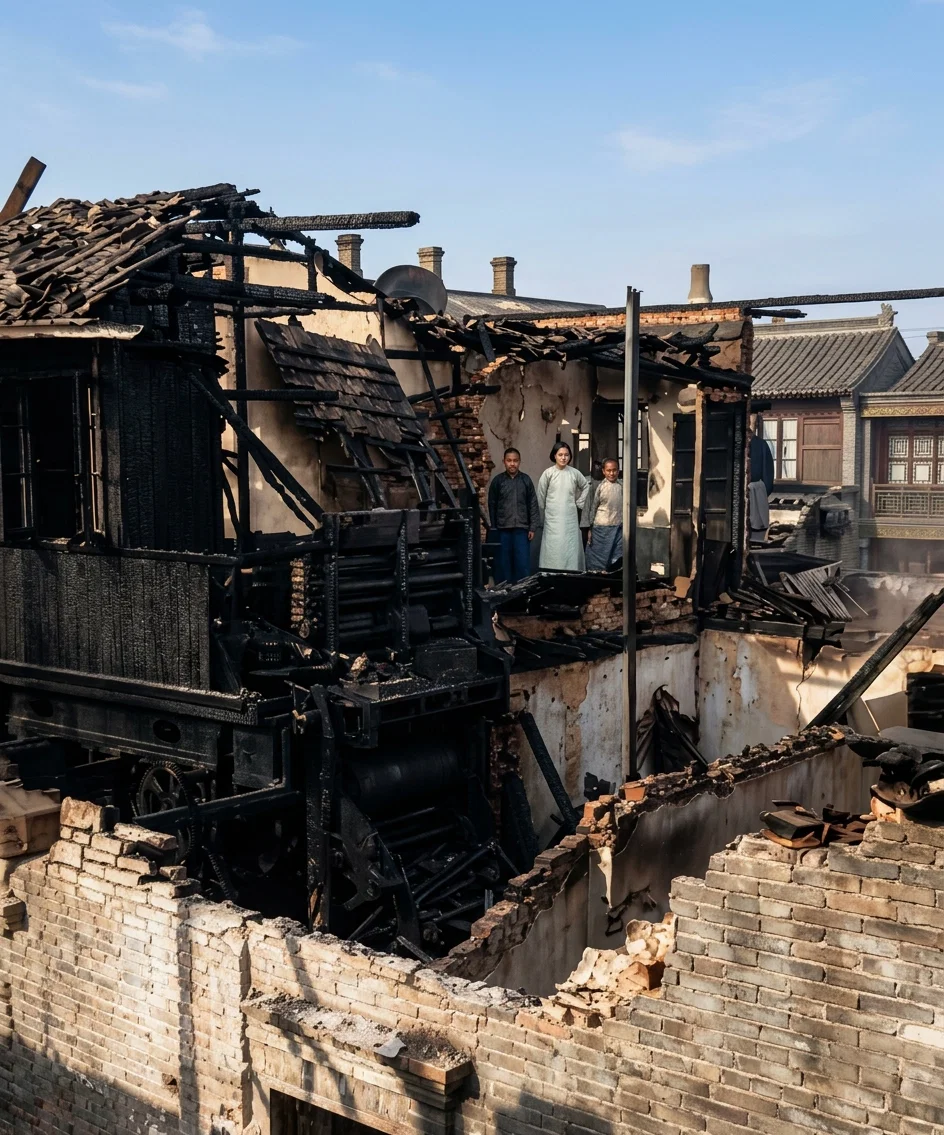
The Fire at Our Chinese Press

LETTERS from Shanghai tell of the fire, on December 28, at our Chinese press quarters. The Chinese press has the burden of printing for four hundred million people. It is the greatest of the mission fields. Yet, after sixty-six years of the message, we have not yet a publishing house of our own in China. Provision for such a plant is made in the $300,000 Fund. Small though this fire loss was at Shanghai, the experience calls upon us to make haste in the establishment of a proper printing-office in safe and sanitary quarters, to take up in real earnest the printing of the message for China's millions.
Quartered as they were, in native houses, our brethren of the press were continually threatened with disaster. Dr. H. W. Miller wrote of experiences just before the fire:—
During the last week three fires have occurred within a small radius of us; the first was two rows of Chinese flats. As we watched them burning, our minds turned to our office, and we thought that if a fire started in that series of flats, it would sweep us out. Last Saturday night a fire broke out in the drying-room of the Commercial Press, adjoining us,

Growth of the Chinese Publishing Work

and it looked for a time as if the whole establishment was to go with the flames, but it was checked without doing a great deal of damage.
Our Chinese publishing work has been growing in a most encouraging way. Dr. Miller writes:—
RUINS OF OUR CHINESE PRESS
In order to get out the work we had in hand we have been obliged to practically double our press staff since September 1. One new platen press was added, as it required one press going all the time to print the covers of our monthly paper, the circulation of which has steadily grown. Already we have received orders for the February number of the (Chinese) Signs of the Times to the amount of fifteen thousand. We had just printed and shipped to the field sixty-five thousand Sabbath calendars before the fire.
Never have we witnessed such prosperity in the publishing work in this field as during the past few months. We have perhaps realized as much as any one the unsuitableness of Chinese houses for operating a printing house even on a small scale: the scrap paper about such an office, where a foundry is a necessity; the lighting by lamps, and the constant use of gasoline, all of which must be in adjoining rooms of a very combustible house, is a condition that has given us much anxiety at times. We carried an insurance on the machinery and stock, but the rate was very high, owing to the existing conditions.
And now comes his account of the fire:—
Last Tuesday morning, at a little after 1 A. M., a fire broke out in the kitchen of a Chinese house, two houses to the north of our printing press, in the same row of flats. These houses were used as binderies by the Commercial Press. The fire spread very rapidly, and by the time any of us living near by could be called, the fire had begun to mow down the buildings to the north and south. It was a still night, otherwise nothing could have been done to check the flames. The city fire company will not bring the engines outside of the concession, and the water was at very low pressure. Pieces of hose were secured and attached to the nearest hydrants.
While these were being put in operation, the Chinese used small hand pumps, which spurted about a pint of water at a time; others carried water in pails. At last those who had the hose, wet down the buildings, beginning at our office, at about the middle of the building, and were able to check the flames at that point. Our pressrooms and type-rooms were in flames before any of our brethren arrived, and practically everything in them that was combustible burned. The Chinese type, amounting to about four thousand pounds' weight, was melted. The two platen presses, the hand-power cylinder press, the stitcher, saw-bench and tools, some printed stock, plates, and a few cuts were in the pressroom, and are lying surrounded by a mass of the débris of bricks, tiles, and half-burned wood, with melted type spattered over them. The little Army press was on the second floor in the type-room, and it went down with the débris. Quite a little of the Wenli stock was damaged by water, although the greater part can be saved. Some of the English type was melted in the cases, but most of it is in good condition. Several hundred dollars' worth of paper stock was saved. All the office furniture, the foundry, machinery, matrices, and subscription list were saved. The library books were all saved, with slight damage due to being thrown out of second-floor window. We believe most of our machinery can be put in shape again.
Our greatest loss was on the Chinese type. It is covered by insurance, however, and we see no reason why we should not recover most of its value. The financial loss will not be the most important matter; the setback given to our publishing work at this time is what we deplore. The Sabbath-school lessons for the first quarter were mostly off the press, and would have been sent out this week, but nearly all the plates were melted and the printed stock burned or spoiled by water. We have the translators at work on them, have gathered out our matrices, and are putting the job in the hands of the Commercial Press at once. We hope to print our cover pages for the paper on our own platen presses, but the other matter we will hire done. We are therefore turning off over half of our staff, and keeping only the translators, the man for the foundry, and the men for the platen presses. We will use up our stock of paper and occupy only half the former building until we can make some other arrangements, or until we get into our own buildings.
We do not feel justified in again buying new fonts of type and employing as many workmen as we had, with no place of our own for them to live in, having them scattered about in this wicked city. For the past year and more those connected with the management of the press have felt that we should be out of the heart of this city.
We feel of good courage, though it seems that the publishing work in China has a struggle for existence. It weathers all storms, however, and steers right ahead. Yesterday the mail brought a word of good news from Brother Han, saying that a young minister who came to Ying Shang to look after the interest of the Chinese Christian Union there, had, through literature and Bible studies, begun keeping the Sabbath, and was sending our literature to his friends in Shan-tung. Such reports are continually coming to us, and letters have been received from tracts and papers sent into Manchuria. The literature issued last year has brought its returns from many quarters of our field. While we feel called to greater activity than ever before in producing and circulating our publications, yet we believe that the light given us to move out of the cities with our institutions is intended as much for China as for other countries. And now before any institutions are actually begun, and at a time when consideration must be given to the establishment of a publishing house, sanitarium, training-school, and educational work, should we not consider what bearing the presenttrying experience just passed through should have in guiding us to make the right move forward?
We are not planning in any wise to relinquish our efforts in the circulation and production of literature. We must do many times more than has been done. It became necessary to remove the treasurer's office in order to provide room for the press in the half of the building left us.

The Lord's Day

THE apostle John declares that he was in the Spirit on the Lord's day, and that he was given a vision of celestial glory. To what day does he refer? Some there are who teach that this was Sunday, the first day of the week, but it is safe to say that there is no Scriptural authority for such teaching.
To one who will take the Scriptures of truth as his guide, it is clearly evident to what day the apostle refers in this scripture. We need only to read the great law of Jehovah as contained in the ten commandments. There it is plainly stated that “the seventh day is the Sabbath of the Lord thy God,” and that the Lord, because he rested on this day himself in the beginning, blessed it, and made it holy, and constituted it man's rest day.
He refers again to this day through the prophet Isaiah, when, in pronouncing a blessing upon those who observe a true fast, he says: “If thou turn away thy foot from the Sabbath, from doing thy pleasure on my holy day . . .” The Lord himself, when he was on this earth, plainly distinguished between the days of the week, and he signalized the seventh day of the week—the Sabbath, which God had made in the beginning and given to man—as the particular day of which he was the Lord. He says: “The Sabbath was made for man, and not man for the Sabbath: therefore the Son of man is lord also of the Sabbath.”
Tracing the history of the days through the Holy Scriptures, we find that the seventh day of the week is the only day which has been especially honored by the designation, the Lord's day. We must, therefore, conclude that the day on which the apostle John was in the Spirit was the seventh day of the week instead of the first day; and truly what more appropriate time could have been chosen than God's holy Sabbath for him to begin to reveal to John the mysteries contained in the book of Revelation?
On lonely Patmos, shut out from all the world, in the quiet hours of the Sabbath day, God came near to his lonely, trusting servant, and gave him such revelations of his glory, and such communion with his Spirit, as the human heart is unable to fathom. A measure of this Sabbath blessing given to John is in store for every one who will still give to God his own in Sabbath service. “Blessed is the man that doeth this, and the Son of man that layeth hold of it; that keepeth the Sabbath from polluting it, and keepeth his hand from doing evil.”
To one who seeks this blessing the Lord says: “If thou turn away thy foot from the Sabbath, from doing thy pleasure on my holy day; and call the Sabbath a delight, the holy of the Lord, honorable; and shalt honor him, not doing thine own ways, nor finding thine own pleasure, nor speaking thine own words: then shalt thou delight thyself in the Lord; and I will cause thee to ride upon the high places of the earth, and feed thee with the heritage of Jacob thy father: for the mouth of the Lord hath spoken it.” F. M. W.

The $300,000 Fund

During the last General Conference, no resolution seemed to awaken a deeper interest, or receive more hearty response, than that which provided for what is known as the $300,000 Fund. This is doubtless because of the objects to which the fund is devoted.
In America our institutional facilities have been greatly multiplied. We are glad for every facility we possess for the furtherance of this message; but in only a few of the other lands, with their teeming populations, has even a beginning been made in securing like facilities in ever so modest proportions. There our chief, and many times only, asset is the missionary who has left a comfortable home and a salubrious climate to carry the message to the less favored lands; and too often have our minds been shocked and our hearts saddened to hear of these God-fearing men and women, after great toil and sacrifice, losing their lives in the fever-stricken regions where they have been compelled to live in unsuitable and insanitary quarters; and thus the work has apparently been set back for years.
The resolution that gave birth to this effort to raise the $300,000 Fund very clearly and concisely outlines the object and scope of the movement. It is as follows:—
We recommend that the General Conference Executive Committee at once start what shall be known as the $300,000 Fund for institutional work, and missionary homes in foreign fields, a certain portion of this money to be raised each year during the succeeding quadrennial term.
Four years were allotted to this work, which makes the task a feasible and comparatively easy one. But already 1909 is in the past, and we are well into the year 1910. We must be up and doing at once, if this task is to be accomplished in the appointed time.
It is now designed to raise the fund in three yearly efforts. It is gratifying to note that already some conferences have made a decided start, and by resolution have decided to give this work the right of way over pressing local affairs. If this spirit generally prevailed, a speedy and successful termination would be assured.
The REVIEW AND HERALD will contain each month a statement showing by conferences the progress of this work. The report in this issue (on page 13) is for funds received up to the last of January, 1910. Minnesota is the banner State, having been the first conference to pay into the General Conference treasury the full amount of its yearly instalment. It is expected, however, that other conferences will rapidly follow.
The work is now on. The needs are urgent. Shall we not all, conference officers and members, make a quick and successful campaign, and thus gladden the hearts of our brethren in less favored situations, and place their work on a more favorable basis?
W. T. KNOX.

The Value of Medical Missions

The value of medical missionary work in carrying the gospel into the great regions beyond is being demonstrated at the present time in nearly every mission field. Where one medical missionary was laboring a decade ago, there are a score at the present time. The nearer the church approaches to the methods of working pursued by the Lord in seeking an avenue to men's hearts through ministering to their temporal needs, the more potent will be its efforts. This is true especially in labor in heathen lands. Speaking of the work of this class of missionaries, A. T. Pierson, the editor of the Missionary Review, in the January number of that magazine, speaks as follows:—
Perhaps no one sign of the times is more impressive than the multiplication of healing agencies on the foreign field. Hospitals, dispensaries, manned and equipped most completely and conducted by men of the highest culture, are continually multiplying; as fine physicians and surgeons can be found in the foreign fields as at home. Some of the most promising men have gone forth, from both England and America. There must be some mighty impulse at work, for there is no adequate temporal advantage that attracts.
Garibaldi said to his soldiers in 1849: “I can offer you only hunger and danger; the earth for a bed, the sun for a fire; but let whosoever does not despair of the fortunes of Italy follow me.” Men of brilliant promise are finding their own life worth the living because losing their life for the sake of others. As Dr. Josiah Strong says: “Jesus found servitude a badge of dishonor; he made it a badge of distinction.”
Continue reading: Faithfulness in Health Reform*