Signs of the Times, Vol. 35, No. 21.

Our Letter from Athens

Signs of the Times

Dec 23, 1908

Pacific Press Publishing Company · Mountain View, California · Dec 23, 1908

Our Letter from Athens

III.—Progress of Reform in Turkey.

DIPLOMATISTS say, to quote the words of a pasha of the old regime who escaped with his life to Italy the other day, that "the sultan granted the constitution to check the interference of the powers in the Macedonian question."
To give color to the opinion, we have only to recall that when the constitution was promulgated in 1876, Turkey was at least as near dismemberment through foreign interference as she is to-day, and that the proclamation of the constitution then was as great a surprise to the world as was its issuance on July 23, 1908. In 1876, the near Eastern Question was at a very critical stage, with Russia the chief instigator. In 1908, Russia again, shut out in the middle and the far East, is apparently the prime mover in the recent crisis, with England at her heels, as she also was in 1876.
Altho Turkey did not avoid serious loss of territory and prestige by the granting of the constitution the first time, she seemingly is to gain more advantage by the same course in the present situation; for, while there are apparently insuperable obstacles in applying a constitution to a country of so cosmopolitan a population cherishing intense prejudices and interracial hatred, in a land where the fatalistic, polygamous, antichristian spirit of Mohammedanism prevails, where moral and political corruption have been rife for centuries, yet daily recurring events indicate almost incredible progress in reforms instituted only a month ago. The hand of the reform party, the so-called New-Turks, is unsparing in overturning, rooting out, purging, reorganizing, and regenerating, with little serious resistance by the Anti-Reform, or Old Turkish Party, and with at least the acquiescence of the sultan.

Results of the Reform Movement.

The reform movement grew out of an organization among progressive army officers, by the name of "The Union and Progress Society." In time it spread extensively through the ranks of the army, which gave it great strength when the time came to strike. It broke out in Macedonia, but was soon found to have strong supporters in Constantinople itself. All European Turkey is now under martial law. One despatch says:
"The sultan does not direct affairs in Turkey to-day. Neither is there any regular government, for all government is dissolved. The New-Turks are everything. They have taken into their hands the direction of all European Turkey, from Constantinople to the smallest Macedonian hamlet."
The pressure they brought to bear on the sultan brought the constitution. What they have accomplished to date may be briefly summarized as follows:
1. The sultan virtually acts at their dictation.
2. The political spy system is abolished, thus saving an annual expenditure, it is said, of eight to ten million dollars.
3. The censorship of speech and of the press has been lifted, the first uncensored telegram being sent July 28. Weekly newspapers have changed to dailies, and the size and number of dailies increased, and yet the demand can scarcely be met.
Up to the present, no one dared utter the words "freedom," "fatherland," or "nation," without fear of arrest. Not a Turkish dictionary has contained the words "liberty," or "equality." Only to-day a publisher announces a new edition of his dictionary, to contain for the first time for thirty-two years these two and many other words forbidden heretofore by the censors. The sultan has expressed a wish to have medals or souvenirs struck off bearing the inscription, "Liberty, Equality, Justice," and post-cards have arrived in Athens with an imprint of the same in colors, with a bust of the sultan in the center.
4. A general amnesty has been proclaimed to all political prisoners and exiles. In Monastir alone, 1,600 prisoners were set free, and 2,100 in Thessalonica. One steamer leaving Alexandria the other day had 500 Greek, Armenian, and Turkish exiles aboard, returning to Constantinople. Thousands who have been in exile from one to twenty years, are returning from all points of the compass, among them the son of Midat Pasha, author of the constitution, who had been in banishment twenty-seven years.
5. The resignation of the first cabinet formed under the constitution, because of the opposition tendencies of its personnel, and the forming of a new cabinet that gives general satisfaction, three members of which are said to be Christians—one an Armenian Catholic, one a Syrian Catholic, and one a Greek Catholic. The secretary of war returns from an exile of twenty-two years in Tripoli to take one of the most responsible portfolios in the cabinet. His wife is a Greek of the line of Themistocles. The prime minister has announced his intention to transform the military harbors of Turkey into commercial ports, and thus solve, as he says, the much-discussed question of the Dardanelles.
6. The removing of governors of provinces who belong to the old party, and the substitution of New-Turks in their offices; and the recalling of the Turkish ministers at Washington, Paris, Berlin, and St. Petersburg, for the same reasons.
7. The arrest for trial of many Pashas, Beys, and Effendis, whose unjust and extortionate practices are so well known that the populace clamor for vengeance. Some of this class have made their escape, and a few have been murdered or have committed suicide, notable among the latter being the chief of the secret police system. Of the fugitives, one will serve as a fair sample, Izzet Pasha. He was second secretary to the court at Yildiz, and chamberlain to the sultan. Once arrested, he escaped from confinement, shaved off his beard, disguised himself in a priest's garb, and boarded an English boat just departing, having forced the harbor boatman at the point of a revolver to row him to the steamer. A deputation of New-Turks gave chase with a launch, but being delayed in obtaining the launch, the steamer outstripped them, and they returned to flog severely the official who had resisted their taking the launch. They then telegraphed to the Dardanelles to hold up the steamer there, but the captain refused to give up his passenger without authorization from the British consul, who telegraphed the home office for instructions. A negative answer came on the basis of no extradition treaty between England and Turkey, and Izzet made good his escape.
Izzet Pasha is of Arab extraction, from Beirut, educated in the school of Jesuits there. He is not supposed to have all his harem with him, two of whom are Jewesses, but at least two were seen on the steamer when it touched at a Greek port. Cartoons sold on the streets of Constantinople represent him fleeing, clean shaven, with a blood-stained bag of pounds sterling under his arm, and with the body of a serpent 'because he was a serpent all through his life.' His salary was $250 a month, but his property is valued at 'the dizzy sum of fifty million dollars,' as a Greek paper puts it. An English mechanic who has visited the mansions of many aristocrats, lords, and American 'billionaires,' testifies that he never before had seen such luxurious and costly furnishings as he found in the mansion of Izzet Pasha, one chandelier alone being worth $20,000. The checks on his person when he fled are variously estimated from one-half million to a million and a half dollars. One of his crimes is said to be the accepting of a bribe of $75,000 from the Rumanian Government. The constitution party purpose to confiscate some of the property of these public robbers, and restore it to rightful owners or to the poor.
8. The setting on foot of proper measures for the registration of citizens and the holding of general elections in November.
9. The emancipation of woman. The Union and Progress Society has branches largely composed of Mohammedan women. The Thessalonica branch recently held a public mass-meeting. The vice-president of that branch is the daughter of a former attorney-general in the sultan's cabinet and wife of the present governor of Serres. She and her sister are among the most highly educated of Mohammedan women. At the mass-meeting she appeared for the first time in public uncovered, and prefaced a patriotic speech which she delivered in Liberty Square, with the words, 'Long live the nation! Long live our fatherland! Long live Liberty!' In her address she said:
'Freedom, who, in the person of those who have dared speak in her behalf, has sat bound in the galleys for thirty years, has been liberated from her fetters by the sacred society of Ottomans, 'Union and Progress.' This accomplishment permits us to lift up our heads and look life in the face. In the Koran it is said that we ought to be taught and educated from the cradle to the grave. The Ottoman women who have heeded this injunction of the Koran, fully sense to-day all the mighty significance of the word 'Liberty,' which they have ardently adored. Without renouncing the sacred duties which Islamism imposes upon the companions of men, we unite our joy with that of the whole nation, and heartily fraternize with all. At this transcendent movement we reckon it a duty —
'1. To congratulate from our inmost souls the Ottoman society of 'Union and Progress,' and to cry from the depths of our hearts, 'Long live the Society!'
'2. To curse the memory of the spying ministry who hunted down the noble liberators of our country.
'It is impossible to express our thanks to all these brave champions of liberty, but we include them all in the person of the most esteemed and energetic member of this body, Rephek Bey, whose hand we press from the heart.
'Let us therefore, lady citizens, all shout together, 'Long live Rephek Bey! Long live the Society! Long live Liberty!'
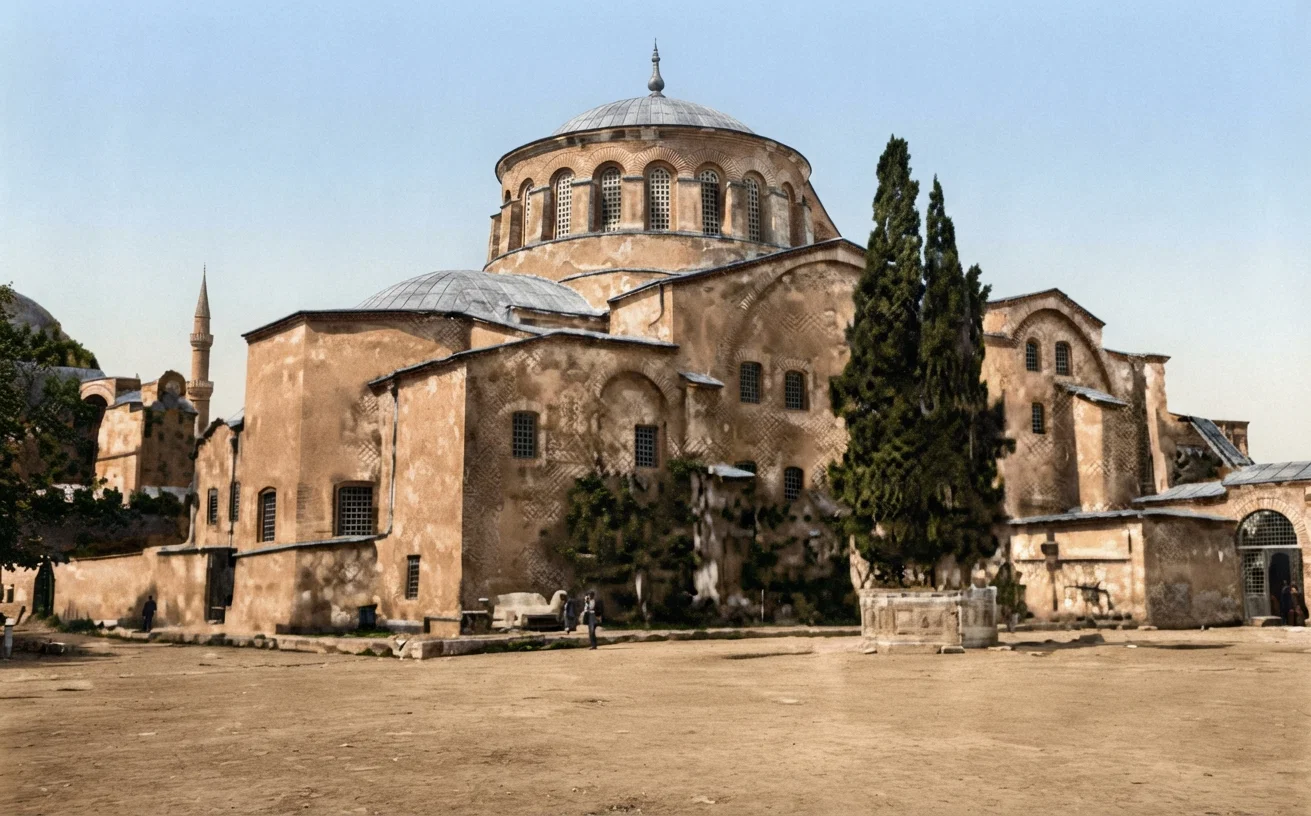
Greek Church of St. Irene, built in the Sixth Century, now used as a museum.
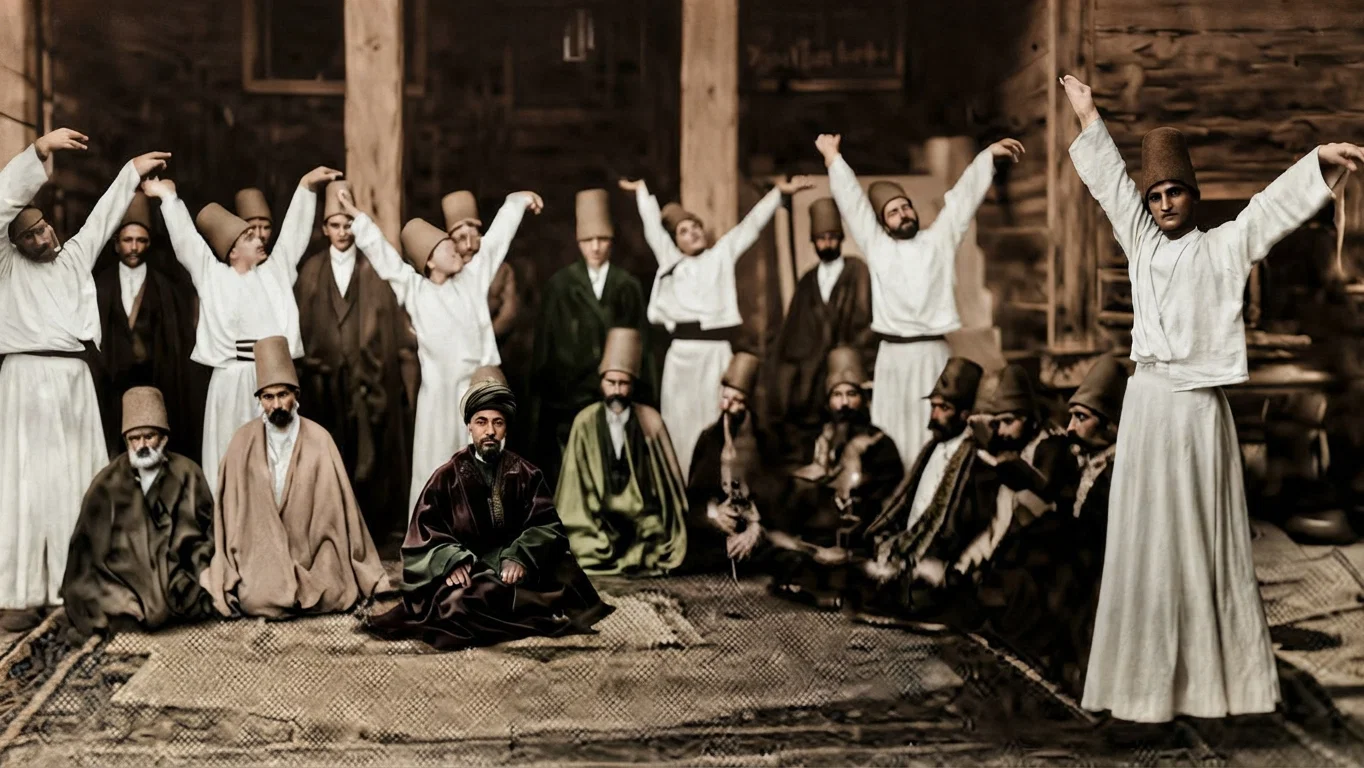
Dervishes at worship. In Mohammedan countries they resemble the monks of Christendom. They have enjoyed the highest respect of Mohammedan princes and Turkish sultans, and do still that of the people. They are to some extent under the supervision of the Sheik-ul-Islam. Their sheik, or leader, sits on the mat, in the center of the picture.
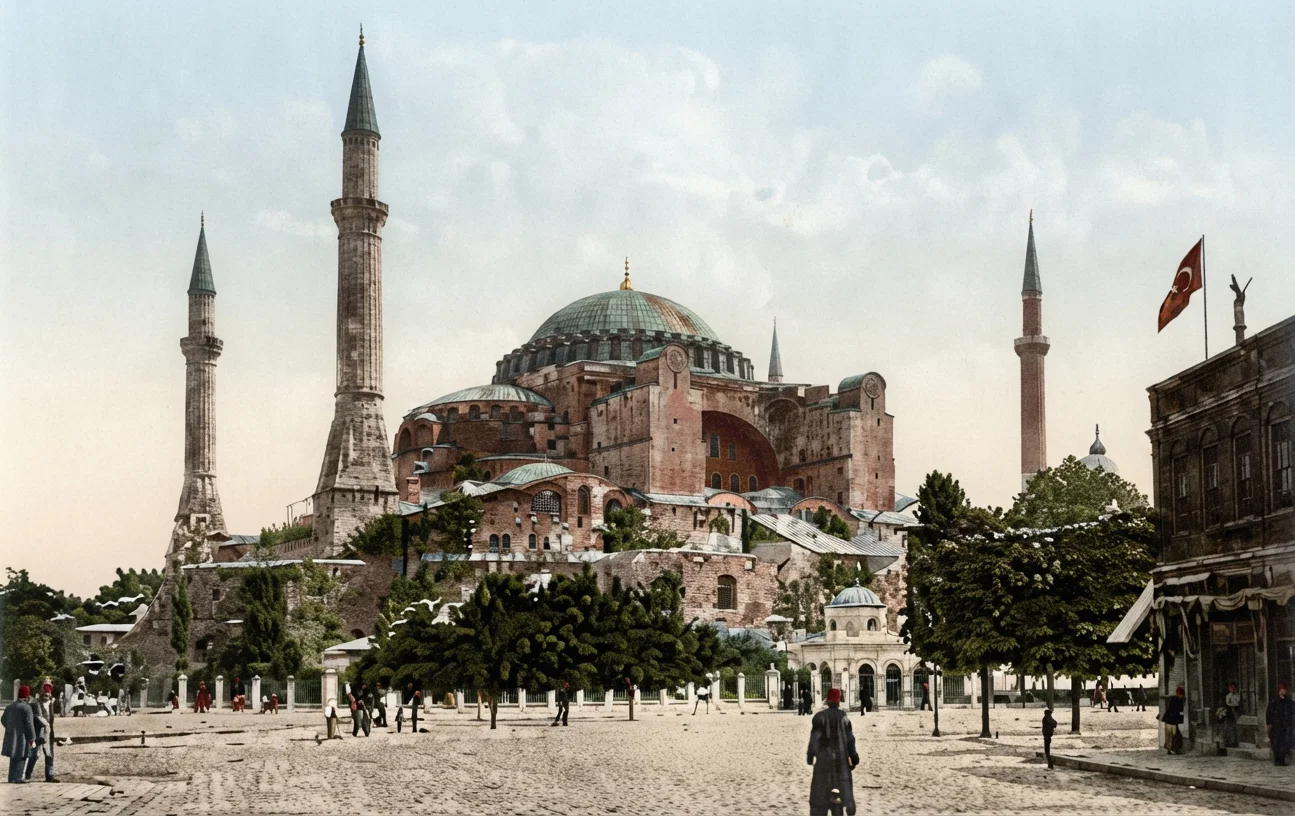
The Celebrated Cathedral of St. Sophia in Constantinople.
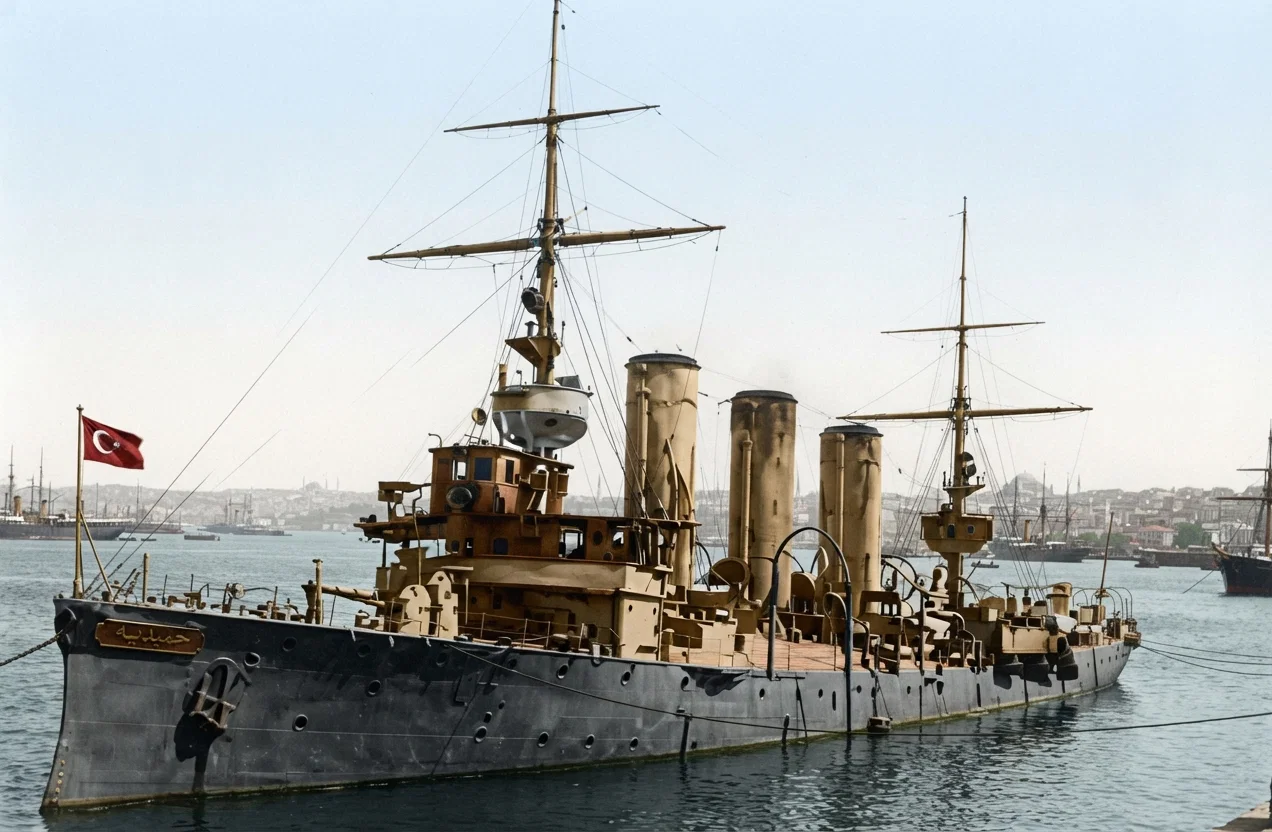
Turkish battle-ship, “Hamidie,” named after the sultan.

Freedom for Women.

Thus set free from austere and absurd restrictions, the joy of these veiled women of the East knows no bounds. In open carriages, with their long concealed faces open to the pure air and sunlight of freedom, they ride through the principal thoroughfares of Constantinople, with large, red ribbons upon their breasts, bearing the inscription, 'Long live Liberty, Justice, and the Constitution.'
One despatch says that the women claim 'equality of rights between men and women,' and that they are organizing a society to attain this end, believing that the constitution will secure to them a broader field of action and usefulness. A correspondent writes from Constantinople:
'The Ottoman women are such enthusiastic constitutionists that if necessity required, they seemingly would themselves defend the constitution from attack by its enemies. The terrible seclusion of the harem has come to an end. For them there has begun the beautiful life of which they have dreamed for ages while shut up behind their enclosures, the life which affords the privilege of walking about freely with the hated veil removed and the face uncovered, the life of the theater, the life of society, of the ball, of the afternoon social. They now look you in the face. They do not drop their eyes to earth on meeting another than the lord of the harem. As I passed up the palace approaches, from which the public have been excluded for ages, I saw inmates of the harem, with white hands, fair, uncovered faces, and sparkling, black eyes, gazing with curiosity and amazement upon the multitudes that surged along to and from the palace. I met some on the street, who fearlessly greeted Christians as they passed by, which, if they had dared do in days gone by, they would have been adjudged guilty of treason.'
It is announced from Constantinople that the sultan has abolished the custom of adding a maiden to his harem at the yearly anniversary of Mohammed's Annunciation, as not being required by the Koran.
So another dark corner of earth is being opened to the bright healing rays of liberty. Shall we not hope that in hopeless Turkey there may be enjoyed, at least for a little season, the priceless blessings of freedom, and that the winds of war may be stayed a little longer, until the matchless opportunities of eternal life through Christ may be set before those who have so long sat in darkness and in the shadow of death?
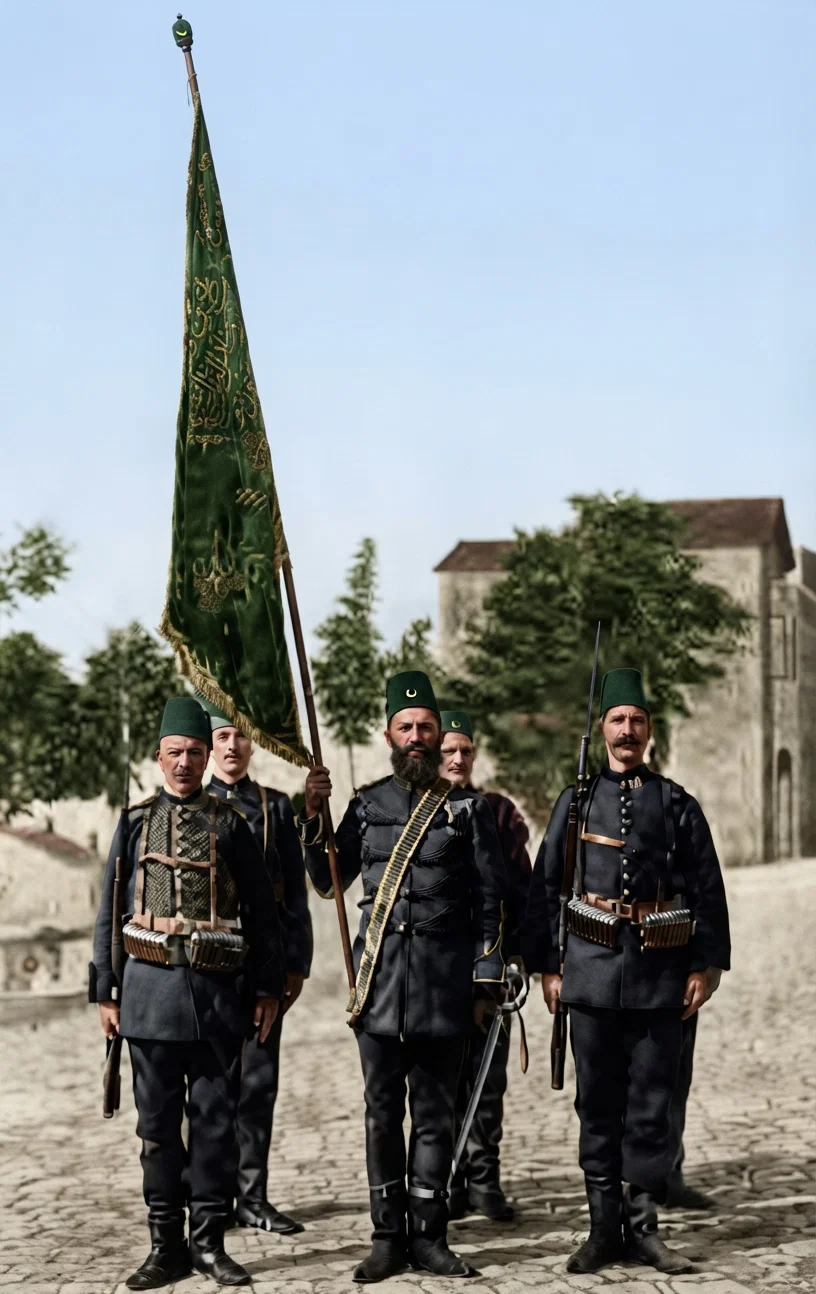
Turkish soldiers and standard bearer. The national flag is red with a crescent and star in white. The religious banner is green.

Fourteen Days of Happiness

I HAVE now reigned about fifty years in victory or peace, beloved by my subjects, dreaded by my enemies, and respected by my allies. Riches and honors, power and pleasure, have waited on my call, nor does any earthly blessing appear to have been wanting to my felicity. In this situation I have diligently numbered the days of pure and genuine happiness which have fallen to my lot. They amount to fourteen. O man! place not thy confidence in this present world! — The Caliph Abdalrahman.

God’s Delays Are Not Denials

NEVER think that God's delays are God's denials. Hold on; hold fast; hold out. Patience is genius.— Buffon.

The Seventh Commandment

By J. O. Corliss

EXT to a man's life, the chastity of his household should be considered more precious than any other consideration. That portion of the great love principle which forbids the destruction of this family treasure, finds its proper place, therefore, in the law, next to the prohibition of murder.
The commandment, "Thou shalt not commit adultery," like other precepts of the moral code, is exceedingly broad, covering so many phases of social life as to convict many who, perhaps, suppose themselves immune from guilt in this particular. Two forms of concupiscent desire are recognized in the Bible, of which this one is the mildest. And yet this form is made to seem so heinous as to cause one to examine himself closely and frequently, lest the hateful thing should find lodgment even in his thoughts.
The great apostle, when writing instruction to the church at Corinth, said: "Be not deceived; neither fornicators, nor idolaters, nor adulterers, . . . shall inherit the kingdom of God." 1 Cor. 6:9, 10. The sins of this list are enumerated in the order of their flagrancy, the worst being first mentioned. According to the original, the word fornication means actually to resort with the vilest characters of the opposite sex, while adultery may be committed by changing one's wife for another without just cause, and also by harboring lewd thoughts.
Thus we hear the Saviour say: "Whosoever shall put away his wife, except it be for fornication, and shall marry another, committeth adultery; and whoso marrieth her which is put away doth commit adultery." Matt. 19:9. This teaching was called out by a question of the Pharisees. History informs us that the Jews of that day, on the supposed authority of Moses, felt free to put away a wife on the slightest pretext. For example: If one found after marriage that his wife had some disagreeable personal habit, of which he was not before aware, or if his wife failed to cook just to his liking, he could without any scruple write her a bill of divorcement and send her away, when both were at liberty to marry again.
In view of this antiquated custom, the Pharisees came asking the Saviour whether it was lawful to put away a wife for "every cause," thus thinking to put the Saviour at variance with Moses. The Lord answered that "He which made them at the beginning made them male and female, and said, For this cause shall a man leave father and mother, and shall be joined to his wife; and they twain shall be one flesh. Wherefore they are no more twain, but one flesh. What therefore God hath joined together, let not man put asunder."
This was clear and conclusive. But to carry out their plan of arraying the Lord against Moses, the Pharisees asked further: "Why did Moses then command to give a writing of divorcement, and to put her away?" The answer of Christ was quick and decisive: "Moses because of the hardness of your hearts suffered you to put away your wives; but from the beginning it was not so." Then came the condemnation of the Jews' course in this matter, by making it a violation of the seventh commandment, as before cited.
There is a lesson in this incident of former days for the people of the present generation. Back there, the "hardness" of the people's hearts was said to be the cause of their frequent divorces, which really constituted the sin of adultery. Now the divorce courts are kept busy six days in the week, and fifty-two weeks in the year, grinding out divorces upon the most frivolous pretense. "Incompatibility" is now sufficient grounds to secure the coveted paper of separation, that both parties may seek new fields of conquest, perhaps only to repeat the divorce-court act; and yet in the face of the Saviour's positive statement that divorce on any other ground than fornication is adultery.
The holiness of true matrimonial alliances is not considered by the multitude, or surely these many applications for legal separation would not be forthcoming. It must be that the marital desires of such were base born, ignoble, and lustful, otherwise the outcome would have been different. At least the adultery which came through the separation sprang from the "works of the flesh." Gal. 5:19.
This sin is again defined by the Saviour in a way to show its hidden depths, and the breadth of the law's requirement. As a part of His inaugural address to His disciples, He taught them the broad meaning of the Ten Commandments. Taking up the seventh one, He said: "Ye have heard that it was said by them of old time, Thou shalt not commit adultery: but I say unto you, That whosoever looketh on a woman to lust after her [have lecherous longings] hath committed adultery with her already in his heart." Matt. 5:27, 28.
This brings the keeping of God's commandments to one as an affair of the heart. Even to hold wrong desire toward the opposite sex, must therefore become a matter of record in the courts of heaven, and enter into the consideration of one's case in the judgment of the great day. Of course one may repent of all such indecent musings, and find forgiveness and cleansing, so that his every thought may be brought into captivity "to the obedience of Christ." 2 Cor. 10:5.
But to cultivate unclean thoughts, one is sure soon to pass the border line between mind adultery and the actual indulgence of fornication. The latter step once taken, one's hope of a future life becomes sadly dimmed. In fact, the "wise man" sets forth the condition of such as well-nigh hopeless. Speaking of the "strange woman" who "forsaketh the guide of her youth, and forgetteth the covenant of her God," he says that her course tends to death. Of those who associate with her in common, he further says: "None that go unto her return again, neither take they hold of the paths of life." Prov. 2:16-19.
This indeed is a dark foreboding, but that which gives it such an abhorrent color may be learned from the statement of the apostle. He says: "Flee fornication. Every [open, or common] sin that a man doeth is without [does not involve] the body; but he that committeth fornication sinneth against his own body," which is God's own temple. The body thus defiled, God refuses to dwell in it. 1 Cor. 6:18, 19. So he who would avoid the gulf directly in the path of fornication, should resolutely set his face in the way of God's commandments, resting in the promise of Jehovah, to keep him in perfect peace whose mind is fixed on Him and His power to save. Isa. 26:3, 4.

"I Will Give You Rest."

By J. A. Powers.
I AM resting in the shadow Of the cross of Calvary; I am trusting in His goodness Who is more than life to me. Well I know His chosen people Age by age were fully tried; Only those who stood the testing To the end were justified; Only those who knew their weakness And kept lowly at His feet Found a strength in His completeness Every tempter to defeat.
Grant me, Lord, the faith and patience That will ever hide in Thee, That will be pure, true, and humble As a lost, saved soul should be. Let me not forget the refuge Of the sheep when wolves are wild; Let me not by worldly folly From that refuge be beguiled. Blessed Saviour, guide and keep me Through life's checkered, thorny way, Till I wake in Thy completeness In the realms of endless day.

Character and Reputation

THERE is a difference between character and reputation. Character is what a man is; reputation is what he is thought to be. Men of good character are generally men of good reputation, but this is not always the case, as the motives and actions of the best of men are sometimes misunderstood and misrepresented. But it is important, above everything else, that we be right and do right, whether our motives and actions are properly understood and appreciated or not. Nothing can be so important to any man as the formation and possession of a good character.—Edmund Burke.

Conquering Difficulties

Is THERE one whom difficulties dishearten, who bends to the storm? He will do little. Is there one who will conquer? That kind of man never fails.—Hunter.

"In Remembrance of Me"

By Mrs. E. G. White
"The Lord Jesus the same night in which He was betrayed took bread: and when He had given thanks, He brake it, and said, Take, eat: this is My body, which is broken for you: this do in remembrance of Me. After the same manner also He took the cup, when He had supped, saying, This cup is the new testament in My blood: this do ye, as oft as ye drink it, in remembrance of Me. For as oft as ye eat this bread, and drink this cup, ye do show the Lord's death till He come."
JUDAS the betrayer was present at the sacramental service. He received from Jesus the emblems of His broken body and His spilled blood. He heard the words, "This do in remembrance of Me." And sitting there in the very presence of the Lamb of God, the betrayer brooded upon His own dark purposes, and cherished his sullen, revengeful thoughts.
At the feet washing, Christ had given convincing proof that He understood the character of Judas. "Ye are not all clean," He said. These words convinced the false disciple that Christ read his secret purpose. Now Christ spoke out more plainly. As they were seated at the table He said, looking upon His disciples, "I speak not of you all: I know whom I have chosen; but that the scripture may be fulfilled, He that eateth bread with Me hath lifted up his heel against Me."
Even now the disciples did not suspect Judas. But they saw that Christ appeared greatly troubled. A cloud settled over them all, a premonition of some dreadful calamity, the nature of which they did not understand. As they ate in silence, Jesus said, "Verily, I say unto you, that one of you shall betray Me." At these words amazement and consternation seized them. They could not comprehend how any one of them could deal treacherously with their divine Teacher. For what cause could they betray Him? and to whom? Whose heart could give birth to such a design? Surely not one of the favored twelve, who had been privileged above all others to hear His teachings, who had shared His wonderful love, and for whom He had shown such great regard by bringing them into close communion with Himself!
As they realized the import of His words, and remembered how true His sayings were, fear and self-distrust seized them. They began to search their own hearts to see if one thought against their Master were harbored there. With the most painful emotion, one after another inquired, "Lord, is it I?" But Judas sat silent. John in deep distress at last inquired, "Lord, who is it?" And Jesus answered, "He that dippeth his hand with Me in the dish, the same shall betray Me. The Son of Man goeth as it is written of Him: but wo unto that man by whom the Son of Man is betrayed! it had been good for that man if he had not been born."
The disciples had searched one another's faces closely as they asked, "Lord, is it I?" And now the silence of Judas drew all eyes to him. Amid the confusions of questions and expressions of astonishment, Judas had not heard the words of Jesus in answer to John's question. But now, to escape the scrutiny of the disciples, he asked as they had done, "Master, is it I?" Jesus solemnly replied, "Thou hast said."
In surprise and confusion at the exposure of his purpose, Judas rose hastily to leave the room. "Then said Jesus unto him, That thou doest, do quickly. . . . He then having received the sop went immediately out: and it was night." Night it was to the traitor as he turned away from Christ into the outer darkness.
Wonderful had been the longsuffering of Jesus in His dealing with this tempted soul. Nothing that could be done to save Judas had been left undone. After he had twice covenanted to betray his Lord, Jesus still gave him opportunity for repentance. By reading the secret purpose of the traitor's heart, Christ gave to Judas the final, convincing evidence of His divinity. This was to the false disciple the last call to repentance. No appeal that the divine-human heart of Christ could make had been spared. The waves of mercy, beaten back by stubborn pride, returned in a stronger tide of subduing love. But altho surprised and alarmed at the discovery of his guilt, Judas became only the more determined. From the sacramental supper he went out to complete the work of betrayal.
The Saviour had not withheld His ministry from him whom He knew to be a traitor. Tho Jesus knew Judas from the beginning, He washed his feet. And the betrayer was privileged to unite with Christ in partaking of the sacrament. A long-suffering Saviour held out every inducement for the sinner to receive Him, to repent, and to be cleansed from the defilement of sin. This example is for us. When we suppose one to be in error and sin, we are not to divorce ourselves from him. By no careless separation are we to leave him a prey to temptation or drive him upon Satan's battle-ground. This is not Christ's method. It was because the disciples were erring and faulty that He washed their feet, and all but one of the twelve were thus brought to repentance.
In partaking with His disciples of the bread and wine, Christ pledged Himself to them as their Redeemer. He committed to them the new covenant, by which all who receive Him become children of God, and joint-heirs with Christ. By this covenant every blessing that Heaven could bestow for this life and the life to come was theirs. This covenant deed was to be ratified with the blood of Christ. And the administration of the sacrament was to keep before the disciples the infinite sacrifice made for each of them individually as a part of the great whole of fallen humanity.
Our Lord says, Under conviction of sin, remember that I died for you. When oppressed and persecuted and afflicted for My sake and the Gospel's, remember My love, so great that for you I gave My life. When your duties appear stern and severe, and your burdens too heavy to bear, remember that for your sake I endured the cross, despising the shame. When your heart shrinks from the trying ordeal, remember that your Redeemer liveth to make intercession for you.
The communion service points to Christ's second coming. It was designed to keep this hope vivid in the minds of the disciples. Whenever they met together to commemorate His death, they recounted how "He took the cup, and gave thanks, and gave it to them, saying, Drink ye all of it; for this is My blood of the new testament, which is shed for many for the remission of sins. But I say unto you, I will not drink henceforth of this fruit of the vine, until that day when I drink it new with you in My Father's kingdom." In their tribulation they found comfort in the hope of their Lord's return. Unspeakably precious to them was the thought, "As often as ye eat this bread, and drink this cup, ye do show the Lord's death till He come."
These are things we are never to forget. The love of Jesus, with its constraining power is to be kept fresh in our memory. Christ has instituted this service that it may speak to our senses of the love of God that has been expressed in our behalf. There can be no union between our souls and God except through Christ. The union and love between brother and brother must be cemented and rendered eternal by the love of Jesus. And nothing less than the death of Christ could make His love efficacious for us. It is only because of His death that we can look with joy to His second coming. His sacrifice is the center of our hope. Upon this we must fix our faith. As we receive the bread and wine symbolizing Christ's broken body and spilled blood, we in imagination join in the scene ofcommunion in the upper chamber. We seem to be passing through the garden consecrated by the agony of Him who bore the sins of the world. We witness the struggle by which our reconciliation with God was obtained. Christ is set forth crucified among us.
Looking upon the crucified Redeemer, we more fully comprehend the magnitude and meaning of the sacrifice made by the Majesty of heaven. The plan of salvation is glorified before us, and the thought of Calvary awakens living and sacred emotions in our hearts. Praise to God and the Lamb will be in our hearts and on our lips; for pride and self-worship can not flourish in the soul that keeps fresh in memory the scenes of Calvary.
He who beholds the Saviour's matchless love, will be elevated in thought, purified in heart, transformed in character. He will go forth to be a light to the world, to reflect in some degree this mysterious love. The more we contemplate the cross of Christ, the more fully shall we adopt the language of the apostle when he said, "God forbid that I should glory, save in the cross of our Lord Jesus Christ, by whom the world is crucified unto me, and I unto the world."

Peace and Good Will.

By Milton C. Wilcox.
HAVE you heard God's angels singing As they sang in days of old, When to humble shepherds bringing Treasures richer far than gold,— Tidings to a world forlorn, Tidings of a Saviour born?
Matters not the day nor season, For the song is ringing yet, Victor o'er weak human reason, To God's triumph music set,— Tidings to a world forlorn Of a Prince and Saviour born.
Do you hear the glad song ringing, Has it set your heart aflame, Is it to your own soul bringing Peace and good will in His name? Jesus, born a Prince and Saviour, Jesus, King, enthroned forever.
Continue reading: Our Bible Band