Your ShelfYour Projects

Signs of the Times, Vol. 37, No. 36.

Our High Priest in Heaven

Signs of the Times

Sep 13, 1910

Pacific Press Publishing Association · Mountain View, California · Sep 13, 1910

Our High Priest in Heaven

Now of the things which we have spoken this is the sum: We have such an high priest, who is set on the right hand of the throne of the Majesty in the heavens: a minister of the sanctuary, and of the true tabernacle, which the Lord pitched, and not man. Hebrews 8:1, 2

Readings in Matthew

OUR readings are wholly in the book of Matthew, beginning with chapter 9, ending with chapter 24. Note the miracles. See in them just what God designs that we should see in them—evidence of His power to save from sin. We would not be understood by this that He is not just as willing to heal now as He ever was, for He is; He has the same power to heal in answer to faith as when He personally touched the blind eyes, laid His hand upon the withered form, spoke to deaf ears, and full and complete healing came; but He would have us understand also that the greatest of all diseases that afflict humanity, the very root and foundation of them all, is sin, and He who healed the palsied man is also able to say, "Thy sins are forgiven thee."
MATTHEW 24 is a threefold prophecy in answer to the disciples' questions as to the second coming of the Master; the first having to do with the various events which would take place before the consummation of the age or the end of the Christian dispensation. Verses 15-20 are especially upon the destruction of Jerusalem, tho there are references to it elsewhere. Then from that time we are carried on through the great tribulation which comes upon God's people to the second coming of our Lord and Saviour Jesus Christ. Special signs are given of that coming; and so far as this chapter is concerned the shaking of the powers of heaven and Christ's coming are the next great events awaiting us.

"IF YE WILL INQUIRE, INQUIRE YE."

This Inquirers' Department is conducted for the purpose of helping those who are studying the Bible. The answers are oftentimes only suggestive. They are never to be considered infallible, only as they agree with the infallible Word. The writer who may answer them does not consider that his opinion is infallible. He will simply give the best that he has, and plead with the inquirer to search the Word. Such questions only will be answered as, to the editors, seem to minister to the good of the readers and to the mission of the paper. We can not answer repeatedly in the same volume questions upon the same scripture. The name and address must accompany question, not for publication, but as an evidence of good faith, and that answer may be made by letter if deemed advisable. No letters are answered which do not contain the name of the writer. It is well always to enclose stamp for reply.

3240.—Sinneth Not. 1 John 3:9

Will you please explain 1 John 3:9? When does this birth take place? Can a person lose it? And if he lose it, can he have it again? H. A. C.
We quote the scripture from the American Revised Version: "Whosoever is begotten of God doeth no sin, because His seed abideth in him: and he can not sin, because he is begotten of God." One reading the context will see very clearly that the apostle is contrasting two different characters and two different sources of character: the one of the devil; the other of God, and making the doing of God's will his business. The apostle is not speaking of detailed deeds, but of essential character. The one is as he is because he is born of the flesh and is led and controlled by the devil. The other is as he is because a new life has come into his being, a new power has taken possession of him. The living Word of God has been received. The old life has been given up, and the new seed has taken root and is dominating his life.
We have no desire to shade down the meaning of the apostle. "Born" would be better as in the Revised Version, "begotten." The full birth of the child of God is not completed till he shall come forth in the resurrection; but he is begotten here by the Word. That change takes place at conversion, when the man yields himself to God and receives the righteousness and life of Jesus Christ. The "can not sin" does not express a physical inability to sin, but it expresses the strength of the purpose in the soul. We read in Shakespeare an expression, "Look you, what I will not, that I can not do." We have the same thought phrased in these words in Luke 14:20: "Another said, I have married a wife, and therefore I can not come." Not that it was a physical impossibility for him to come, but he had no desire to come. He did not will to come. He preferred his wife to the invitation to the marriage feast. So it is in regard to the converted child of God. He does not practice sin. That is not his object, his purpose. We would not understand the text to mean that he can not fail. He may not see all things clearly. Alford remarks that one's having been born is in danger of becoming a mere fact of the past instead of a fact in the present. The apostle does not say that he was born of God, but is. It is the present life with which he deals. Alford tells us that almost all the expositors understand, "because he is born of God," and "because His seed remaineth in him," in the sense of, "in so far as he is born of God he can not sin." It seems as tho this very thought must be understood as expressed in the text, because there are many souls that truly enter Christ's service and truly persevere unto the end, yet who fail; fail through ignorance of understanding God's will; fail in not knowing their own weakness and His strength in certain particulars; fail to know how to apply His grace to the particular sin; yet God counts them His children all the way because it is in their heart to do His will, and if they sin they show that they are His children by the godly sorrow which is wrought in them.
Luther has expressed it as saying that a child of God in this conflict receives indeed wounds daily, but never throws away his arms or makes peace with his deadly foe. Sin is in the flesh; and if the flesh be allowed its way, sin will remain in the flesh. It is sinful flesh that man possesses. Its tendency is to corruption, ever downward. The difference between the begotten child of God and the child of the flesh and of the world is that in the latter sin is dominant, a controlling element or power. In the former the Spirit of Christ is dominant. Sin is compelled to take the place of prisoner. But God gives His life, His Spirit; and the child of faith by that Spirit crucifies or puts to death daily and constantly the deeds of the flesh. Rom. 8:12.
"If one shall lose his living connection with God, can he gain it again?" It seems to us that the whole tendency of the Scripture teaches that he may. Take Jeremiah 2 and 3 for instance, in which God tells Israel that they had departed from Him as a wife departs from her husband, willingly, wickedly, sinning against Him; and yet read the plea that the Lord makes: "Return, ye backsliding children, and I will heal your backslidings." Take the parable of the prodigal son, the son who left his father's house and spent all his living with the wicked and the dissolute. Yet when he came to himself he returned and was welcomed and clothed with the best robe.
God would have the living seed abide in the hearts of His children so that they may be kept from sin. He writes His wonderful Word of life that we may not sin. "These things write I unto you, that ye sin not," or as rendered by some, "that ye may not sin," that is, be kept from sin, have within you that power which will enable you to overcome sin. But He continues, "If any man sin, we have an Advocate with the Father, Jesus Christ the righteous." He will forgive the sin, restore the standing, and count us still His children. It is the abiding life which God desires. Read in connection with it the first seven verses of John 15.
Please explain the comparison of Matt. 17:1 with Luke 9:28. R. W. T.
There is no real difference between the two. The exact time is not stated in either of them. The one says, "And after six days Jesus taketh Peter, James, and John." The other, "And it came to pass about eight days after." The Bible is not always exact as regards time, because the time is not important. So we read regarding the trial, crucifixion, and resurrection of Jesus. Many times this is spoken of as "in three days," "within three days," "after three days," "the third day." All these expressions are used, between which there might be some difference if we were to hold technically to the exact wording.
The Lord gives us just such instances as this to show that we should not do that. After Jesus had told them that there were some standing there who should not taste of death until they saw the kingdom of God come, Matthew then says that after six days—not just six days—but "after six days" the transfiguration scene came, and Luke tells us "about eight days after." We may clearly see that there is no contradiction, but simply a little legitimate latitude in speech.

3241.—The Length of a Generation

How many years are there in a generation? Does not Matthew 1 teach that there are about forty-two years in a generation? May we not take that as fixing the time of a generation?
R. M. G.
The Bible gives us no method by which we may definitely fix a generation. The very fact that it gives different lengths of time of a generation shows that it would have us fix up no definite time. The generation in Noah's time seems to have been 120 years. At least God placed that limit upon that generation. Coming down to the days of Abraham, then we have it stated in the 15th chapter of Genesis that his seed should be a stranger in a land that was not theirs, and should serve that nation where they were strangers, 400 years, but in the fourth generation they would come back to Canaan. That would fix the generation there at one hundred years. In Matthew 1 we have a record of 42 generations from Abraham to Christ. From the time that Abraham begot Isaac, which would be the beginning of the next generation, it was about 1898 years. That divided by 42 would make a little more than 45 years to a generation. From Abraham to David was about 898 years of 14 generations, which would make more than 64 years to a generation. From David to the carrying away into Babylon, 394 years of 14 generations, making about 28 years to a generation; while from the carrying away into Babylon to Christ, a period of 606 years, covering 14 generations, would make about 43 years to a generation. So you see there is no uniformity regarding the length of a generation. God has purposely hidden from us this fact in order that men in the last days may not be setting time for Him to come.

3243.—The Brothers of Jesus

In replying to a question concerning the brothers of Jesus a few weeks since it was not thought necessary to say that the brothers were probably children of Joseph by a former wife. These in the Jewish law would be termed brothers even tho they were not the actual blood brothers of Jesus. Joseph was the father of Jesus in law, and Joseph's children were the brothers of Jesus in law. They belonged to the same family. The circumstances given in that reply would seem to indicate that they were older. The Bible does not expressly say. There are a great many other things which it does not expressly say. It does not satisfy our curiosity, but the reasons given are very probable. We did not intimate that His mother was not a virgin. We supposed every one understood that, Jesus was her first child, and presumably tradition may be correct in saying that He was her only child. Joseph seems not to have been living at the time of the crucifixion, or Jesus would not have commended His mother to John for his care and protection. The act of our Lord would also indicate that she had no other sons herself.

Man's Sin and Saviour

By E. J. Hibbard

X. Christ's Sacrifice and Priesthood

It has been found, by a careful study of the sanctuary service, that the temple itself, and the articles of furniture contained in the holy and most holy places, together with the sacrifices and priesthood, each and all typified something concerning the life and sacrifice of Christ. The temple, as a whole, represented the temple of His body; the sacrifice, His death on the cross; the show-bread represented Him as the bread of life, and the candlestick the light of life. The altar of incense, with its odors perpetually rising heavenward, stood for His intercession; while the law enshrined within the ark in the most holy place was and is a transcript of His character. The Levitical priesthood was a type of His heavenly priesthood, tho these services could but dimly represent that phase of the mediation of Christ for sinners. And therefore at the commencement of Christ's priesthood in the heavenly sanctuary, the Levitical priesthood, with all that shadowed forth Christ's sacrifice and work, ceased by divine order. And hence we plainly read in Heb. 7:12, "For the priesthood being changed, there is made of necessity a change also of the law."
In a previous number we noted that in the plan of God there were two laws, the one pointing out sin, and the other prescribing a remedy therefor. This remedial law provided a priesthood, sacrifice, and the temple service—all shadows of good things to come. But the shadow did not bring perfection; it only pointed out the coming One, through whom alone perfection may be obtained.

Reason for the Changed Law of the Priesthood

The law of the priesthood made it impossible that any should act as priest unless he were of the tribe of Levi and the family of Aaron. But Christ came of the tribe of Judah, and hence could not be a priest according to the law. Again the law prescribed the offering of animals—bulls, goats, lambs, turtledoves, and the like—for sin; yet Christ offered none of these, but His body instead. Hence His sacrifice was not according to the law of sacrifices; for in no case was the priest ordered to offer his own body a sacrifice for sin. Further, the law of the Levitical priesthood pertained entirely to men on this earth; but Christ began His priesthood in heaven. We therefore read that "if He were on earth, He should not be a priest, seeing that there are priests that offer gifts according to the law; who serve unto the example and shadow of heavenly things, as Moses was admonished of God when he was about to make the tabernacle: for, See, saith He, that thou make all things according to the pattern showed to thee in the mount." Heb. 8:4, 5.

The Cross a Necessity

For several reasons it was necessary that Christ should die on the cross. First, because the wages of sin is death, and because sin is the transgression of God's perfect law, and because that law could not be changed to meet the necessity of man in his fallen condition. And that the statutes of heaven might be maintained before the universe, the penalty of sin must be met either by the transgressors or else by One whose life was equal to all of theirs. This was abundantly met in the sacrifice of Christ. It also was only by the death of Christ thatmen could perceive God's love. In their fallen condition all men have conceived the thought that God is their enemy, that He hates them, and that He is always on the watch to get some reasonable excuse for punishing them. But this is the reverse of the truth. It is John the beloved who exclaims, "Hereby perceive we the love of God, because He laid down His life for us; and we ought to lay down our lives for the brethren." 1 John 3:16. And the apostle Paul adds his testimony by saying that "scarcely for a righteous man will one die: yet peradventure for a good man some would even dare to die. But God commendeth His love toward us, in that, while we were yet sinners, Christ died for us. Much more then, being now justified by His blood, we shall be saved from wrath through Him. For if, when we were enemies, we were reconciled to God by the death of His Son, much more, being reconciled, we shall be saved by His life." Rom. 5:7-10.
This reverses the heathen idea of an offended God demanding the death of somebody to satisfy His own wrath; and because He could not justly wreak His vengeance on man, He vented His spite upon His own Son. Now it was not to satisfy God's wrath and to reconcile God to man, but rather to reveal God's love, that man's alienation and aversion to God might be reversed, and man return to his agreement and obedience to God, that Jesus suffered death.

Abolished the Enmity

In the words of Paul to the Ephesians, a third reason might be given why it was necessary that Jesus should die on the cross: "For He is our peace, who hath made both one, and hath broken down the middle wall of partition between us; having abolished in His flesh the enmity, even the law of commandments contained in ordinances; for to make in Himself of twain one new man, so making peace; and that He might reconcile both unto God in one body by the cross, having slain the enmity thereby." Eph. 2:14-16.
It is here seen that in order to make peace between man and God, the enmity which Paul, in Rom. 8:7, declares to be the carnal mind, had to be abolished. This Paul says was done by the cross, "having slain the enmity thereby."
But the enmity, or carnal nature, was not simply to be abolished from our flesh; but in the words of the scripture just quoted, "having abolished in His flesh the enmity," Christ died as herein stated.
This brings us to the fact that in redeeming man from sin, Christ came to this world and was born of human flesh as it was found in the world after four thousand years of degeneracy. "For verily He took not on Him the nature of angels; but He took on Him the seed of Abraham. Wherefore in all things it behooved Him to be made like unto His brethren, that He might be a merciful and faithful High Priest in things pertaining to God, to make reconciliation for the sins of the people. For in that He Himself hath suffered being tempted, He is able to succor them that are tempted." Heb. 2:16-18.
"For we have not an High Priest which can not be touched with the feeling of our infirmities; but was in all points tempted like as we are, yet without sin." Heb. 4:15.

Tempted as Man

Now if Christ had come into this world possessed only of a divine nature without the human, He could not have been tempted at all by sin, much less tempted as we are; and again, had He taken on Him the nature of angels, He could have been tempted only as angels are tempted, and not as man is tempted; and still again, had He taken the unfallen nature of man, as he was in the Garden of Eden before sin entered, He could then not have been tempted in all points like as we are tempted, and therefore could not have felt, under temptation, as we feel when tempted. Upon this point James speaks specifically: "Let no man say when he is tempted, I am tempted of God: for God can not be tempted with evil, neither tempteth He any man: but every man is tempted, when he is drawn away of his own lust, and enticed. Then when lust hath conceived, it bringeth forth sin: and sin, when it is finished, bringeth forth death." James 1:13-15.
With this in view, the most careless reader can easily perceive that what we have just claimed is true,—that as God, or with the nature of angels, or unfallen man, He could not have been tempted as we are tempted. But He was tempted in all points like as we are; and therefore He was obliged to take upon Him a nature such as ours, in order to be tempted like as we are tempted.
But the final temptation, when all others have failed, which Satan brings upon men, is to weigh their lives in the balance between duty to God and obedience to himself. Speaking of Job, Satan said, "Skin for skin, yea, all that a man hath will he give for his life." And this time the original liar told the truth. It was therefore necessary, since all men are called upon to die, that Jesus Christ, in meeting all that man has to meet, should Himself pass through the portals of death. This He did on the cross. Thus from every point of view that the rational mind may conceive, it was necessary, in order that Christ should meet the justice of the divine law, to reveal God's love to man and thereby reconcile him to God, that He should be tempted in all points like as we are tempted. And finally, that He might be a merciful and faithful High Priest, that He should enter this world, be born of the flesh, tempted like as we are, and die as men die, in order that He might be a perfect Saviour. "Now of the things which we have spoken this is the sum: We have such an High Priest, who is set on the right hand of the throne of the Majesty in the heavens; a minister of the sanctuary, and of the true tabernacle, which the Lord pitched, and not man." Heb. 8:1, 2.

After the Order of Melchizedek

It was therefore necessary, after the ascension of Christ to the right hand of God and the heavenly sanctuary and priesthood, that the attention of man should be called from earth to heaven, and from the earthly priesthood to the heavenly priesthood. The book of Hebrews deals almost exclusively with this subject; for in the second chapter, Paul begins by revealing Christ as our High Priest. This is repeated in the third, fourth, fifth, sixth, seventh, eighth, ninth, and tenth chapters. But He is here referred to as a Priest after the order of Melchizedek and not after the order of Aaron; because Melchizedek, in his priesthood, had no predecessor or successor, while in the Aaronic priesthood there were successors, as they were mortal men subject to death. "But this Man, because He continueth ever, hath an unchangeable priesthood. Wherefore He is able also to save them to the uttermost that come unto God by Him, seeing He ever liveth to make intercession for them."
It is therefore evident that, since the ascension of Christ, there has been no divinely ordained priesthood on earth, excepting it be the whole church of Christ, every member of which Peter declares to belong to a royal priesthood, "an holy nation and peculiar people."
"Having therefore, brethren, boldness to enter into the holiest by the blood of Jesus, by a new and living way, which He hath consecrated for us, through the veil, that is to say, His flesh; and having an High Priest over the house of God; let us draw near with a true heart in full assurance of faith, having our hearts sprinkled from an evil conscience, and our bodies washed with pure water. Let us hold fast the profession of our faith without wavering: (for He is faithful that promised.)" Heb. 10:19-23.
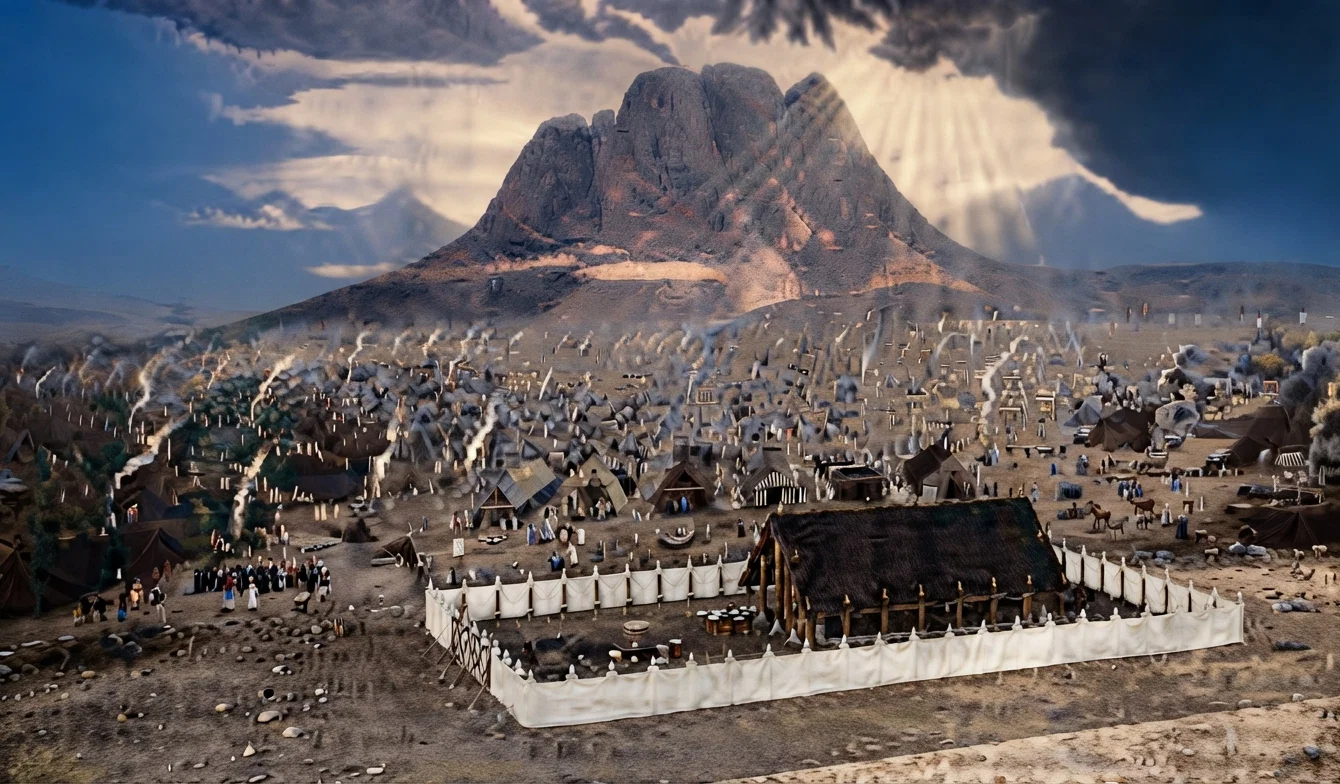
MOUNT SINAI, THE CAMP OF ISRAEL, AND THE SANCTUARY AND COURT COMPLETE

The Christian's Dream

By Henry Quarles Nicholson
I SAW the face of nature change erewhile; On lightning wings my fancy sped the air; The world was once again redeemed of guile, Nor sin nor lust again found lodgment there. The soul-inspiring songs of spirits free, Resounded through ethereal space so clear; The light celestial shone as one vast sea, Its brightness penetrating everywhere.
No longer Death, unfettered, roamed at will; No longer Satan plied his fiendish power; There was no guilt the trusting heart to chill, Since Love, sublime, supremely ruled the hour. Such was the scene my fancy feasted on. While thus entranced, I saw, through space afar, A crystal veil, more dazzling than the sun. 'Twas turned aside, and looped up by a star.
Within this opening, with enraptured view, I gazed spellbound. The Great One thronéd high Brightened the place. With rapture then I knew The wondrous glory of the Deity. No pen can paint, no tongue can words command, However deep in poesy they're skilled, To tell the beauties of that wondrous land, That spread before me and my senses thrilled.
My brightest hopes conceived not, nor my mind, With all its endless reasoning, soared so far Within the bounds of fancy's realms to find A faint conception of the bliss was there. The wild, enchanting dreams of fairy days, With all the vast, luxurious splendor wrought, The mind bewildering in their charmed displays, Were lispings in the alphabet of thought.

Yielding and Temptation

"It is the yielding and not the temptation that makes the sin."

Bearing the Load

“The heavier the load the lighter the heart—if He bears the load with us.”

Temperance in the Family

By Mrs. E. G. White
OUR accountability extends beyond our own well-being. Our influence is constantly affecting others, either for good or for evil. In a preeminent degree is this true of all parents. Fathers and mothers who gratify inclination and perverted appetite, at the expense of health, are not only working against their own physical life and moral advancement, but they leave their perverted appetite and their enfeebled moral power, to their children.
Liquor drinkers and tobacco devotees transmit their insatiable craving, their irritable nerves, and their inflamed, corrupted blood to their offspring. The licentious hand down their own weakness and wickedness, with a host of vile and loathsome diseases, as an inheritance to their children. Fashionable vices are debilitating and debasing the race. In physical strength, and in moral and intellectual power, every generation falls lower than the preceding. In consequence of the sinful habits of men, the world has become a vast lazar-house. Satan exults at the success of his devices. Society is demoralized, the church is cursed, and God is dishonored.

The Reason of Trouble

The violation of God's law lies at the foundation of all the misery that flesh is heir to. It is intemperance, transgression of the laws of life and health, that has shortened the years of men, and made these few years full of sorrow and pain. Parents are not only responsible in most cases for the violent passions and perverted appetites of their children, but for the infirmities of the thousands born deaf and blind and idiotic. Sins of omission and of commission have brought the sure result.
The effect of stimulants and narcotics is to lessen physical strength; and whatever affects the body, will affect the mind. A stimulant may for a time arouse the energies and produce mental and physical activity; but when the exhilarating influence is gone, both mind and body will be in a worse condition than before. Intoxicating liquors and tobacco have proved a terrible curse to our race, not only weakening the body and confusing the mind, but debasing the morals. As the control of reason is set aside, the animal passions will bear sway. The more freely these poisons are used, the more brutish will become the nature and disposition of men.

Educating the Children

Parents who indulge appetite by eating to excess even of wholesome food, place a needless tax upon the system, and their children will be disposed to self-indulgence and gluttony. Such parents transmit their own perverted appetites to their offspring, who have far less moral power to resist temptation than had the parents. Then, instead of seeking to cure the evil which they have wrought, these fathers and mothers, by their own example, educate their children to indulge appetite regardless of reason, and to give loose rein to animal propensities. Many children die before reaching maturity, while many are ruined for time and for eternity, by tempers and appetites transmitted in consequence of the sinful indulgences of the parents.
Unwise, self-indulgent, weak-principled women will urge upon the mother the gratification of every wish and impulse as essential to the well-being of her offspring. But the error of such teaching is clearly seen in the light of facts presented in Bible history. The mother is by the command of God Himself placed under the most solemn obligation to restrain perverted appetite. Whose voice will we heed—the teachings of Infinite Wisdom, or the voice of human ignorance, weakness, and superstition?

The Mother Molding the Child

The thoughts and feelings of the mother will have a powerful influence upon the legacy she gives her child. If she allows her mind to dwell upon her own feelings, if she indulges in selfishness, if she is peevish and exacting, the disposition of her child will testify to the fact. Thus many have received as a birthright almost unconquerable tendencies to evil. The enemy of souls understands this matter much better than do many parents. He will bring his temptations to bear upon the mother, knowing that if she does not resist him, he can through her affect her child. The mother's only hope is in God. She may flee to Him for strength and grace; and she will not seek in vain. Fathers as well as mothers are involved in this responsibility, and they too should seek earnestly for divine grace, that their influence may be such as God can approve.
It is a deplorable fact that there is a widespread neglect of these precepts of the Bible which have a bearing upon life and health. Many make the subject of temperance a matter of jest. They claim that the Lord does not concern Himself with such minor matters as our eating and drinking. But if the Lord had no care for these things, He would not have revealed Himself to the wife of Manoah, giving her definite instructions, and twice enjoining upon her to beware lest she disregard them. Is not this sufficient evidence that He does care for these things?

How Shall We Order the Child?

The inquiry of fathers and mothers should be, "What shall we do unto the child that shall be born unto us?" We have brought before the reader what God has said concerning the course of the mother before the birth of her children. But this is not all. The angel Gabriel was sent from the heavenly courts to give directions for the care of children after their birth, that parents might fully understand their duty.
About the time of Christ's first advent, the angel Gabriel came to Zacharias with a message similar to that given to Manoah. The aged priest was told that his wife should bear a son, whose name should be called John. "And," said the angel, "thou shalt have joy and gladness; and many shall rejoice at his birth. For he shall be great in the sight of the Lord, and shall drink neither wine nor strong drink; and he shall be filled with the Holy Ghost." This child of promise was to be brought up with strictly temperate habits. An important work of reform was to be committed to him, to prepare the way for Christ. Intemperance in every form existed among the people. Indulgence in wine and luxurious food was lessening physical strength, and debasing the morals to such an extent that the most revolting crimes did not appear sinful. The voice of John was to sound forth from the wilderness in stern rebuke for the sinful indulgences of the people, and his own abstemious habits were also to be a reproof of the excesses of his time.

The True Beginning of Reform

The efforts of our temperance workers are not sufficiently far-reaching to banish the curse of intemperance from our land. Habits once formed are hard to overcome. The reform should begin with the mother before the birth of her children; and if God's instructions were faithfully obeyed, intemperance would not exist.
It should be the constant effort of every mother to conform her habits to God's will, that she may work in harmony with Him to preserve her children from the health- and life-destroying vices of the present day. Let mothers place themselves without delay in right relations to their Creator, that they may by His assisting grace build around their children a bulwark against dissipation and intemperance. If mothers would but follow such a course, they might see their children, like the youthful Daniel, reach ahigh standard in moral and intellectual attainments, becoming a blessing to society and an honor to their Creator.
Had parents for years past studied the Scriptures more and the magazines of fashion less, had they realized that their course might determine the destiny of hundreds, and perhaps of thousands, what a different state of society might now exist. We are responsible for the good we might have done, but failed to perform, because by sinful indulgence we placed ourselves in a condition of physical and mental inefficiency. The cause of reform to-day is suffering for want of men and women of integrity and moral worth. They are needed to advocate by precept and example the principles of self-denial which will be a safeguard to our youth.

Cooperate with God

Can we look upon the unbelief, intemperance, and crime that seem to be deluging the earth, without feeling our souls stirred to the very depths? Infidelity is rearing its proud head. "The fool hath said in his heart, There is no God." The cry of fathers and mothers and of nations that have forsaken God, and have been forsaken by Him, will ere long rend the heavens. What can hinder the crime, what stay the wo that is upon all nations? This evil might have been prevented, had previous generations been trained to fear and love and reverence God. Let us now do what we can individually to bring about these changes. Explicit instructions have been given in the Word of God. Let these principles be carried out by the mother, with the cooperation and support of the father, and let children be trained from infancy to habits of self-control. Let them be taught that it is not the object of life to indulge sensual appetites, but to honor God and to bless their fellow men.
Fathers and mothers, labor earnestly and faithfully, relying on God for grace and wisdom. Be firm and yet mild. In all your commands aim to secure the highest good of your children, and then see that these commands are obeyed. Your energy and decision must be unwavering, yet ever in subjection to the Spirit of Christ. Then indeed may we hope to see "our sons as plants grown up in their youth; and our daughters as corner-stones, polished after the similitude of a palace."

Sunset

By R. A. Gilstrap
WHEN my life's sun at last is fully set, When all is dark and silent round my tomb, And earthly scenes are faded from my sight, I wonder if, for all my toil and fret, For all my blindly groping through the gloom, Some soul may have a greater share of light.
When I have done the task that's given me, When He who gave has taken back my soul, And God's true record has been signed and closed, I wonder if the record then shall be,— When all our present trials backward roll,— "He did his best, tho Satan oft opposed."
Is there a task that I have left undone? A little kindly word I left unsaid? A stroke for truth I did not make, but should? Then, Father, grant that at the setting sun, My evening sky may still show clear and red, Impute to me not what I did, but would.
And O, think not upon the times I slipped, Upon the times I faltered in the strife, But of the character I would have shown. For many were the snares, and oft I tripped, And oft I stumbled, in the path of life, Among the thorns by which it is o'er-grown.
And help me still to know that blame and praise, And all the pleasure human friends may give, And all the recompense of earthly bliss, And all the strife or joy of earthly days, Are only loss when we have ceased to live. Thine approbation, Lord, is more than this. Selma, Cal.

Opportunity and Time

GREAT is the worth and excellency of time. All the treasures of the world can not protract, stop, or call back one minute of time. O, what is man, that the heavenly bodies should be wheeled about by almighty power in constant revolutions, to beget time for him! (Ps. 8:3.) More precious are the seasons and opportunities that are in time for our souls; those are the golden spots of time, like the pearl in the oyster shell, of much more value than the shell that contains it.
There is much time in a short opportunity. There is a day on which our eternal happiness depends (Luke 19:41, 42; Heb. 4:7). Lost opportunity is never to be recovered by the soul any more (Eze. 24:13; Rev. 22:11). To come before the opportunity, is to come before the bird is hatched; and to come after it, is to come when the bird is flown. There is no calling back time, when it is once past. See this in the examples you find (Luke 13:26; Eccl. 9:10). It is wholly uncertain to every soul, whether the present day may not determine his leave in this tabernacle, and a writ of ejection be served by debts upon his soul to-morrow (James 4:13; Luke 12:20). As soon as ever time shall end, eternity takes place. . . . We are now measured by time, hereafter by eternity.—Flavel.
Continue reading: Not What I Feel, but What I Will