THE ado made about the pope's last encyclical has revealed a situation between Romanism and Protestantism which it is intensely interesting to study, both for Protestants and for Catholics. The strength of Catholicism and the flaws of papal infallibility have been brought out as they are not often. So have also the strong and the weak points of Protestantism.
The Papacy never changes. It remains what it is or else it ceases to be. This is its logic and the source of its power and endurance. It may vary its methods, its policies, its language. But deep down at the bottom, it is and remains the same. Ne varietur.
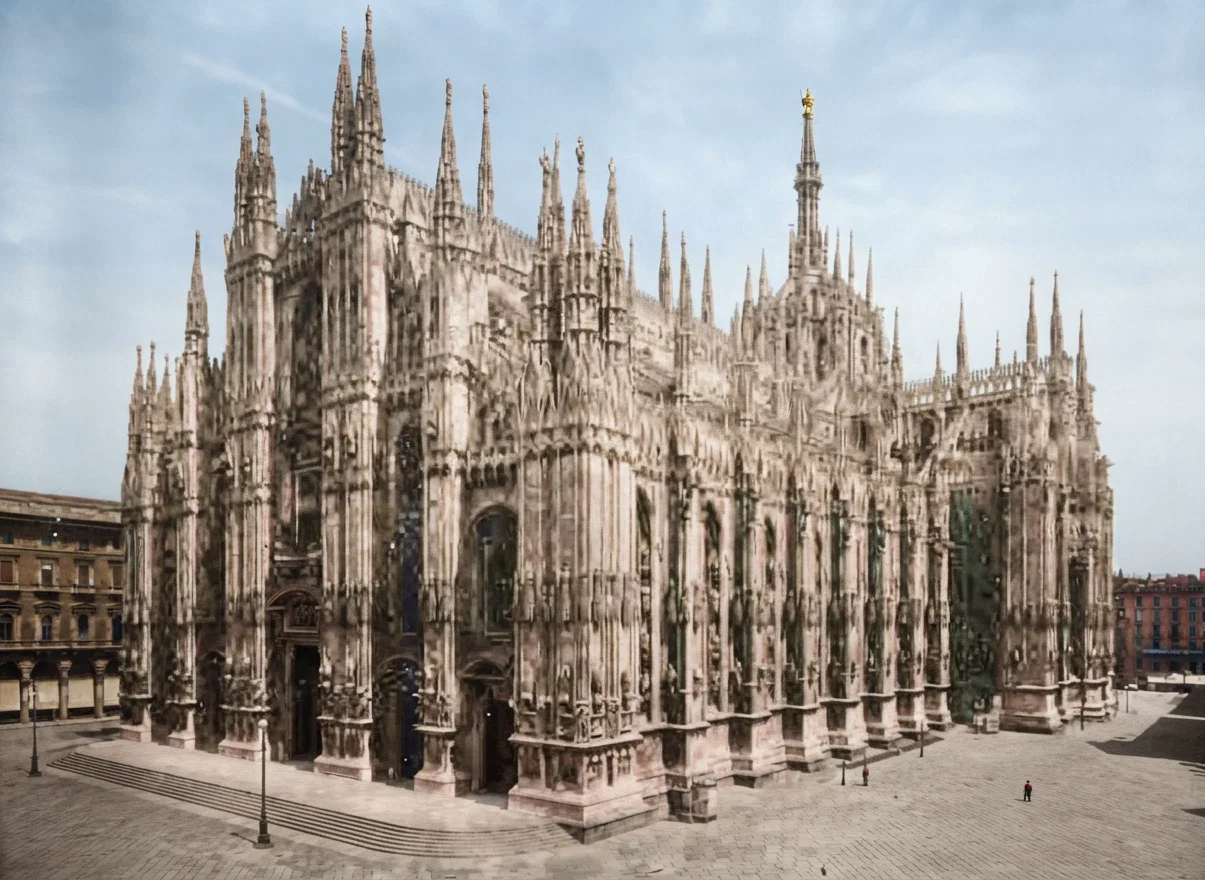
MILAN CATHEDRAL
Protestantism also has strong principles, which once made it a conqueror of no ordinary size, and gave it victories of no small magnitude. These principles are based upon a very old Book. They require faith, self-denial, humility, a change of heart. They offer no satisfaction to the lovers of honors and riches, they make no allowance for the natural cravings after pomp and grandeur.
Principles and Life
The strength of either Romanism or Protestantism is to remain what it is under pain of losing its identity and even its existence. This is well shown by the encyclical and the incidents to which its publication has given rise.
Catholicism, like Protestantism, is constantly threatened by the principles opposed to its own. It must defend itself in some way, it must keep its ground, or else it is doomed. This is well understood in Rome. Leo XIII was a great diplomatist. He secured great advantages for the Papacy on that particular ground. But for a religion, this is not sufficient. The religious element in Romanism was weakening when Leo disappeared. The Conclave felt it. The great clamor among the high clergy was for a "religious pope." And they elected Pius X. Pius X has fulfilled the hopes reposed in him and the promises made by him. He is before all and above all a "religious" pontiff. He does not seem to care how much is lost on political, financial, or diplomatic grounds. He sticks to his papal principles and goes right ahead, fearless of consequences. In this he must be admired. This attitude of his is not a common one at this age of the world. Protestants would do well to follow his example a little more. They would see things moving along differently if they did.
The Papacy and Modernism
The object, or one of the objects, of the encyclical was to put the Catholics on their guard against Modernism, which is simply Higher Criticism applied to Romanism. Modernism, as applied to Catholicism, has fifty per cent truth and fifty per cent error. It calls for freedom of thought and for the use of reason in religious matters. And this is right. But this is destructive of Romish traditionalism and papal infallibility. It also advocates that new species of scientific infidelity which does away with the supernatural and the miraculous in religion. And this is wrong, and it antagonizes that portion of truth which remains in the papal religion.
That element in Modernism which is in harmony with truth is also found in Protestantism. But Protestantism has much more which is destructive of Romanism, it has the Bible truth of justification by faith and the supreme authority of the Bible in all matters religious. For these reasons, the pope is in duty bound to antagonize, condemn, and blacken Protestantism. And so he did in his already famous encyclical.
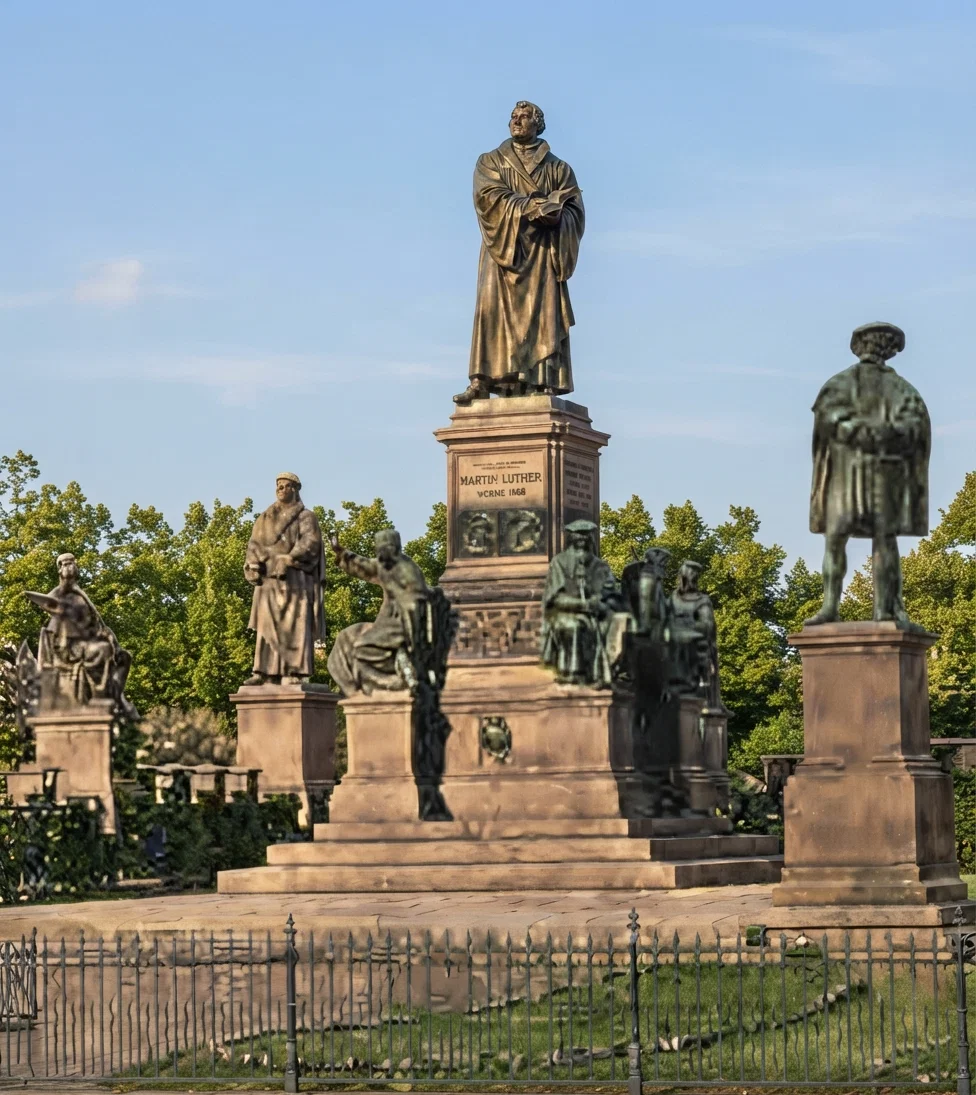
Luther monument at Worms, Germany. The best way to honor Luther and his work is not by memorials of stone, is not the exaltation of the man nor the crystallization of his creed, but the imitation of his faith in the Word of God.
Of course, in this day of telegrams and daily papers, it was to be expected that the papal document would be criticized and cause some rumor among Protestant people. Did the papal Curia expect that it would pass unnoticed by its slumbering adversary? We have no means of knowing. If it did, the facts have shown that it made a mistake, and yet not as gross a one as might be supposed; this will be noticed further on.
Meeting the Mistake
Where the mistake came in was in the way in which the pope met the storm. In order to maintain his reputation of courage and straightforwardness, he should have stiffly stood by his declarations about the Reformers, and insisted upon the publication of his letter among the Catholics of Germany.11[[FIGURE]] Undoubtedly this would have brought about a break between him and Germany. The so-called vicar of God on earth evidently thought that this would be paying too dear a price for honesty. The facts are, as all know, that he flatly denied having made any reference to the Reformers and to the German princes, and he informed the German Government that he had given orders for non-publication of the encyclical among German Catholics.
On the first point the pope was guilty of a self-evident untruth, since the words "Reformers" and "Reformation," and in the same connection the words "most corrupt princes and nations," are found in his letter. On the second point, the pope shows himself untrue to his calling, by depriving his own people of an instruction which he claims to have received from the Holy Spirit, and that for the sole reason that it would cause displeasure among his adversaries. At the same time he indirectly confesses having done the very thing he denies; for if he did not slander the Reformers, why should he suppress an innocent document? But this forced confession will not count among millions of Catholics who have read the encyclical in the public press, and who will retain the impression that the Reformers were villains.
Again, the "Osservatore Romano" declared that the pope "himself, of his own accord, and as a measure of prudence, has taken the necessary and timely steps in order that the encyclical should not be read in the churches in Germany, nor published in the diocesan papers;" but this leaves the clergy free to have it printed and distributed among the people. Nor is this all. The pope does not recall anything. So says the "Osservatore": "The encyclical is promulgated to the whole world from the simple fact of its being published in the official bulletin 'Acta Apostolica Sedis.'"
The whole attitude of Pius X in this affair would be bad enough if he were an ordinary man. But he is the religious leader of millions of souls; he claims to be the vicegerent of the Son of God, the head of the church, God on earth; in a word, an infallible teacher. Before such extraordinary assumptions and from such an exalted source, the whole world, Catholics and non-Catholics, have a solemn right to expect a conduct above ordinary level of uprightness. But what shall we say when we find ourselves facing a mixture of slander, cowardice, and crookedness? Shall we not be confirmed in our Protestantism, and authorized to say earnestly and lovingly to our Catholic friends and neighbors, "Are you absolutely sure that your 'supreme pontiff' is not what the Bible calls 'the man of sin,' the 'lawless one' (anomos), that antichrist who should sit in the temple of God, to be there worshiped as God, and claiming to be God?" 2 Thessalonians 2; 1 John 3.
What the Protestants Did
All over Germany, in Bavaria, Austria, Holland, and Switzerland, loud and indignant protests were heard. Did that prove that Protestantism is true to its principles, true to its name? It would if Protestantism was merely the negative disposition of resenting an insult, instead of the positive quality enabling one to live, maintain, and proclaim some living truths in opposition to some deadly errors. But what was done in Berlin, Stuttgart, St. Gallen, Zurich, and Geneva looked more like a violation of the principles of the Sermon on the Mount, which invites us to bear outrage for truth's sake with meekness and even with joy. Matt. 5: 44, 11, 12; 1 Peter 2: 20-23.
What Protestants Should Have Done
A Protestant way of protesting would have been to issue a calm, clear, and forcible statement of the moral and religious conditions of Christendom in the sixteenth century; of the shameful abuses committed by the clergy, culminating in the sale of indulgences; of the contents and object of Luther's theses; of the principles laid down by him as the true Bible doctrine of salvation; of the great principle which makes the Bible the only rule of faith, and justification the only way to salvation; of the leading errors which these principles pulled down.
Such a statement, scattered broadcast, would have been, it seems to me, an effective and timely way of doing Gospel work. It would not have changed the opinion of the pope, but it would have given to millions of Catholics matter for earnest thought and study.
On the contrary, most of the protestations found fault, among other things, with the encyclical on the ground of its "disturbing and endangering religious peace"! As if Protestants in general were only fearful of having in the future to vindicate and promulgate their faith! Have we come to this? Is Protestantism then dead indeed? Is it true, to-day, as Vinet, the Swiss advocate of evangelical faith, said sixty years ago, that "Protestants there are, but Protestantism is no more"? If so, then let such as are Protestants still take up their appointed work with renewed energy until the grand battle is won.
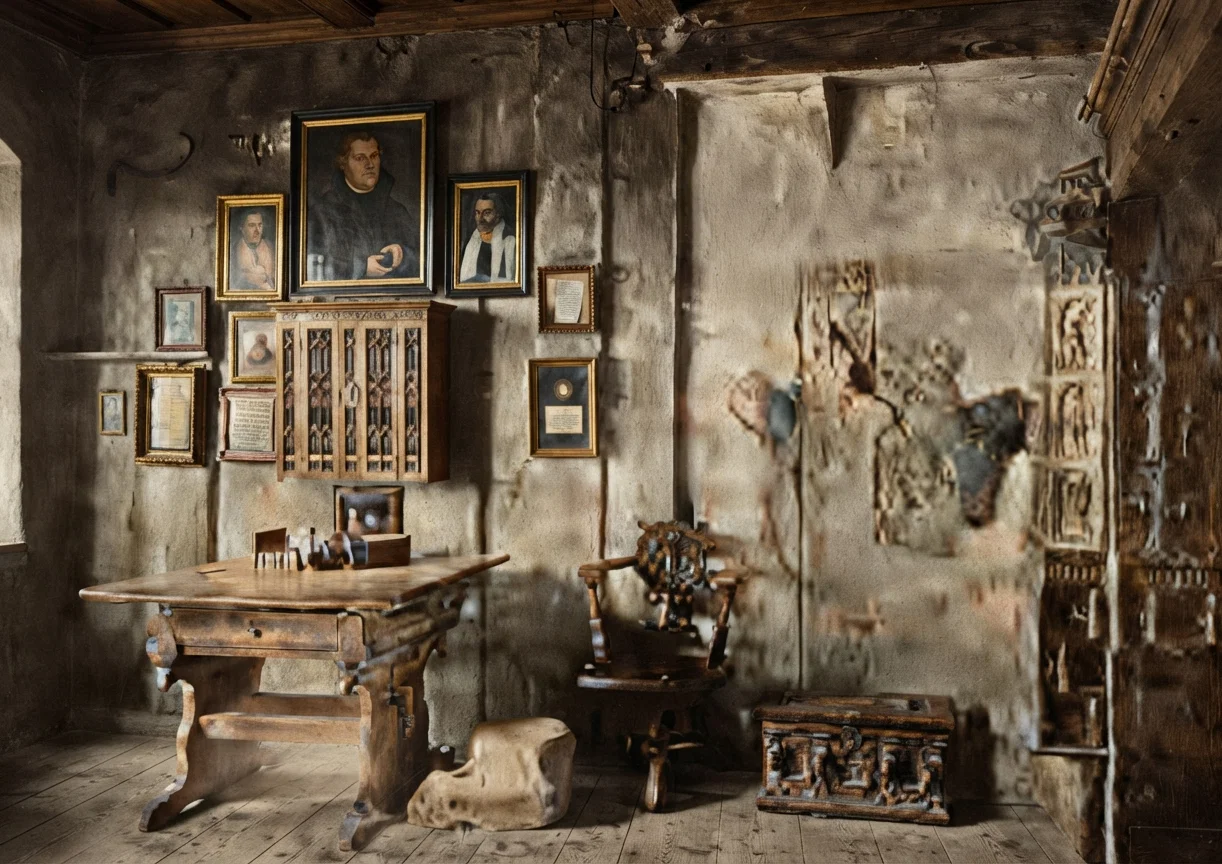
Luther House, Eisenach, Germany
Luther's room in Wartburg Castle, Eisenach, where he did much of his writing
Danger
By Editor
THE Baptist Chronicle not long ago had a thoughtful article on "The Danger of the Rapids." It speaks truly. It goes on to say in substance that the danger on the river is not in the calm, deep current; it is where the river runs over a rocky, shallow bottom and over sand-bars, and that this is just as true in the mental and moral life. "When the currents of thought run swiftly men lose their finer sense of discrimination, and under the nervous stimulant of speed think loosely upon questions which should engage their profound consideration." Out of such movements grow mobs and wars and the mushroom movements of Christianity.
It remarks: "The faster the current of religious enthusiasm flows the more dangers there are along the path of its progress. It is when the stream of Christian endeavor reaches the flood-tide stage that there is the most danger. It is when the cords are the longest that we need to make the stakes the most secure." So came the great apostasy of the first centuries. The slogan at that time was, "The world for Christ," and "every power which could be commanded was turned in the direction of world conquest." And yet out of that unguided, mad rush there came the union of church and state and the Dark Ages.
And so the Chronicle points out the great danger just now in what is called this church federation, altho it does not mention it by name; but it feels that "the churches of Christ face a crisis today very similar to the one which the apostolic churches faced. The cry then was, 'The world for Christ in this generation;' that is the cry today. The demand then was union for the sake of a lost world; that is the demand now." And it asks the question: "Can Baptists enter this or any other movement without compromise? Let the past answer. Can the Baptists compromise the truths of God? Let the individual conscience make reply." "A Protestant hierarchy will as surely fail in spirit and purpose to evangelize the world as has the papal hierarchy. Beware of the rapids. And again I say, Beware."
Back to Nature or Back to the Land
"Back to Nature" is one thing; "back to the land" is another. In "back to nature" some mean back to all the tendencies of the unregenerate human heart wherever it may lead, and that means degradation, bestiality, vice in its lowest forms. "Back to the land," out of the cities into the country, is quite another thing. There one can be less with men; more with God. There is a solitude and aloofness from men which is demanded in the best building up of human character. The whole tendency of the city is away from this. The tendency of the country is to favor it.
"The Western Watchman" of July 7 says, editorially, "In the United States the Protestant women of the land are a unit against child-bearing." It is a gross slander, and the Watchman ought to know it. France for this very reason, the same article tells us, "is a decadent nation." But there is one hope—"There is no remedy for this plague but the Catholic religion. . . . If the world would continue to live, it must become Catholic again." But before the world takes that step, it is well to consider, France was once Roman Catholic. Out of it came her awful infidelity.
The United States Government has discarded thirty-six naval vessels. These cost the Government $9,803,495.90. Thirty-two of them have been sold at auction, bringing $266,779.41; leaving a net loss to the Government of more than $9,536,000. The World of July 25 prints the names of the vessels sold, when they were built, what they cost, and what was realized from their sale. Some of them were built as short time ago as 1894. It will only be a little time before all the navies of the world will be in the junk heap.
The prisons of the United States contain 12,000 persons afflicted with tuberculosis, according to a recent bulletin of the National Association for the Study and Prevention of Tuberculosis. There are only 80,000 prisoners in all the penal institutions of the United States. Hence the annual army of released men is a grave danger to the country. Only twenty-one prisons have facilities for the treatment of tuberculous patients. A campaign for the prevention of tuberculosis in prisons has been inaugurated.
The New York Sunday "World" of July 31 has an article on "The Undefeated Champion of All Ages, the Demon Rum;" in which that demon boasts of the great ones in military, literary, as well as pugilistic annals who have fallen before him. Sad that it is so. Sad that men will in the light of all the past, enslave themselves to alcohol; and every reasonable man in the world ought to count him as a deadly enemy, and abolish him forever.
From different cities of the East comes the news of infantile paralysis, a contagious and infectious disease that takes hold of the little ones and is extremely fatal. It is difficult to understand and hard to control. Men are seeking earnestly for some remedy. It is hoped that a serum from monkeys may through vaccination prevent the disease from developing; but the scientists have given no decision as yet.
Mr. Joyson, late president of the National Educational Association, said in a speech before this body, that "love, justice, mercy, recognition of the rights of others," must dominate the hearts of men before there can be international equanimity. National peace is dependent upon individual peace.
After July 4, 1911, the official flag of the United States will contain in its field of blue six rows of stars with eight in each row. It will take another state to make a perfect square.
Shiloh: the Man of Sorrows
By Mrs. L. D. Avery-Stuttle
Chapter XXVIII.—Death of John the Baptizer
THE festival of the king was ended; the revelry, the feasting, the dancing,—these may be forgotten. But the ghastly tragedy which marked the close of that giddy carnival, can never be forgotten.
At the close of that awful day, in their own private chamber, sat Chuza, the steward of Herod, and his wife Joanna. The steward had just entered the apartment and seated himself upon a divan by the side of his wife.
“What troubleth thee, O Chuza?” questioned Joanna in alarm, “for behold thy cheek is pale and thine eye is filled with a strange light. I have never seen thee thus, my Chuza. Speak; what troubleth thee?”
“Ah, my spouse, truly this is a house of blood! and how shall we abide with murderers?” And the man shuddered.
“Speak, my husband!” commanded the woman anxiously. “Has Aretas, the fierce emir of Arabia, sent an emissary to avenge the insult which the king offered to his daughter? Is the tetrarch dead? What can—”
“Dead?—Nay, nay, not he. But it were far better even the king than the prophet.”
“What! what sayest thou? Who hath slain that righteous man? Surely thou art mistaken, O Chuza?”
“Would God I might be mistaken. Indeed it now seemeth unto me like a ghastly vision of the night. But no, no, Joanna; I have seen a horrible thing to-day, and verily I mistake not.
“It was about the ninth hour when I visited the banquet room, that I might replenish the supply of wine,—thinking of that day at Cana of Galilee when the godlike Nazarene performed the miracle because the wine failed at our marriage feast.
“When I entered the banquet chamber, I was astonished to see Salome, the daughter of Herodias, dancing for the entertainment of the king and his guests, and—”
“Assuredly now, mine husband, thou art mistaken,—for why should the young princess dance like a lewd woman, for the pleasure of these men! the beautiful young princess—”
“She was still dancing,” continued the steward, “when I left the room. When I returned directly thereafter, she paused a moment, as if for rest. Then I saw the king rise from the table and approach her; and as he did so, I heard him ask, as if drunken with her beauty, ‘What wilt thou, and I will give it thee?’
“‘If it please the king, let him give me—’ Then the dancer paused,” continued Chuza, “and I fancied I saw a look of horror creep like a dark shadow into her proud eyes.
“‘I will ask my mother,’ she said, as she hurriedly left the chamber. While I still lingered, she returned, and as if fearing lest her courage desert her unless she made great haste to deliver her murderous errand, she exclaimed, almost before she had reentered the banquet room:
“‘Behold, thou hast sworn unto me, O king. Now if thou regardest thine oath, make haste and give unto me the head of John the Baptizer in a charger; for of a truth he is the enemy of my mother and of thee.’
“The king sprang from the table, where he had again seated himself, like one crazed with horror. Indeed I observed that this feeling of horror which apparently possessed him, had acted as an antidote to the wine with which he was filled, and had sobered him in an instant. I have never before seen the king so astonished and startled, not even when he received the threatening message from Aretas of Arabia. It was as if he had listened to his own death-warrant. His florid cheek turned white as the marble pillar against which he staggered for support, his eyes were bloodshot and bulging, and his nostrils quivered like those of a frightened roe, as he turned helplessly toward his feasting guests.
“‘Behold, ye have heard mine oath!’ he exclaimed. ‘What will ye? shall I not be released therefrom?’
“Then the king turned appealingly to Jazer, the scribe of the temple—”
“I remember him well,” interrupted Joanna, “for he was at our wedding in Cana.”
“Verily; and to-day he sat close beside Jonathan son of Annas, as Herod turned his white face toward them and said:
“‘Thou hast heard the preaching of this prophet, O Jonathan, and thou also, Jazer, and ye know that he is a just man and an holy. Besides, here be others, even some of my lords and captains, who have heard the words of his mouth,—and of a truth I suppose ye will release me from this mine oath. Speak, Jonathan, thou son of Annas; for why should the prophet of the Almighty die?’
“Then, verily,” continued Chuza, while the woman regarded him with a look of deep anxiety, “verily I thought to see the king released of his rash oath. But the lips of Jonathan and of Jazer were as dumb as those of the image of Pontius Pilate, and no man spake to release the king.”
“Why didst not thou, O Chuza!—surely thou didst speak!”
“I? who am I, Joanna, that I should command the king? Hast thou forgotten that thine husband is but a servant?”
“Then did no man arise to defend the prophet? O my husband! my husband! hath the fury of Herodias triumphed?”
“As the Lord liveth, there was none who lifted hand or voice in his behalf; and I, when I would have spoken, my tongue cleaved unto the roof of my mouth, and I was dumb with horror. But in the silence which followed the appeal of the king, I saw him fix his bloodshot eyes despairingly upon me. Then I spake:
“‘Hast thou no power, O Antipas, to deliver that righteous man? Canst thou not break thine oath?’
“For a moment, a look of wavering indecision crossed the livid face of the tetrarch, and I hoped that even my weak influence had sufficed to turn the scale in favor of the prophet. But the next moment the king turned his eyes toward the guests, and saw, even as did I, a sneering smile upon the face of Jazer the scribe and of Jonathan the son of Annas. Tho these men spake no word, I knew by the change which flitted across the face of Herod, that the fate of the Baptizer was sealed. The blood returned to the cheek of the king, and an expression of reckless bravado crossed his face as he turned quickly, and beckoning to one of his guards, who stood in the hallway, he commanded as carelessly and lightly as tho he were ordering a hamper of wine:
“‘Ho, Gilpha, call me Rufas, the son of Varro, the centurion of my father Herod; for, behold, this fellow will do my bidding, even as his father did the bidding of mine.’
“‘Ho, Rufas!’ he exclaimed a moment thereafter to a burly soldier who had hurried to his side. ‘Go thou to the cell of John the Baptizer, and open it in the name of the king. Stay; knowest thou whether this prophet be alone?’
“‘He is alone, O king, save that one Matthias, his disciple, hath just entered, that he might tell the prophet somewhat concerning one Jesus of Nazareth, who, men say, doeth mighty miracles.’
“‘Wherefore pratest thou, fellow? What care I?’ exclaimed Herod carelessly. ‘Go thou to the cell of John the Baptizer, and bring thou me his head. Wait,’ continued the king as he turned and fiercely grasped a large charger from the banquet table. ‘Here, Rufas, bring thou the head upon this platter. Haste! have I not commanded thee?’ This last, added Chuza, “the king said because he saw that the soldier hesitated as if astonished. I saw that by this time, some of the guests appeared horrified, as if they were just awakening from their drunken stupidity, while some stared hard at the king, as if to understand the sudden and unaccountable change in his demeanor.”
“But,” interrupted Joanna, her eyes wide with horror, “but where meanwhile was the dancer, the princess Salome?”
“Meanwhile she continued dancing, with even more reckless abandon than before, and she paused not until the soldier, Rufas, returned, his garment bespattered and his fingers dripping with blood, as he undertook to deliver the charger to the king.
“‘Verily, O king,’ he said, ‘I have obeyed thy command. But by the gods of Rome, I waited not until this Baptizer had finished his prayers. As he knelt, even so he died. But truly, O Antipas, it would have affrighted Mars himself to have seen Matthias, the Jew, when the head of the prophet fell at his feet. Surely he did rush from the cell like unto a maniac, clawing wildly at a stain of fresh blood upon his mantle; and I doubt not he will hide himself somewhere among the mountains. Ha, ha! a brave disciple, this Matthias the Jew!’ and the soldier laughed brutally.
“Then Herod stretched out his hand as if to grasp the platter which Rufas handed him. But once again the face of the king turned livid as his gaze became riveted upon the ghastly thing upon the charger, and he hesitated. His eyes seemed starting from their sockets as he once more reached toward the platter, and laid his jeweled hand upon the gory head, as if impelled by a force which he could not resist. Then, Joanna, I saw him stoop like one in a dream, and raise a long strand of raven hair from which great crimson drops were slowly dripping upon the white marble floor, and place it carefully upon the charger beside the familiar head. Then, as if dazed and bewildered, he approached the dancer, who, I observed, was seized with a violent trembling, and handed her the platter, with its ghastly burden.
“‘Behold, my fathers were Sadducees!’ he muttered. ‘And the Sadducee believeth not in a resurrection from the dead. But verily I tremble lest peradventure the doctrine of the Pharisee be true. Then shall this just man rise from the dead to condemn me.
“‘Go! take this costly gift unto thy mother; for it hath cost the peace of Herod Antipas,—a peace which shall never again rest in his bosom. Quickly!’ he shouted, turning fiercely to the girl, who trembled and hesitated, ‘Quickly!’ Out of my sight with the accursed thing, and tell thy mother that her enemy hath fallen; for Antipas hath kept his oath!’”
(To be continued)
Adoration
By M. D. Warfle
By the late M. D. Warfle
O MY Father, I'll trust in Thee;
Thou hast promised my all to be;
Thy word is sure.
When I suffer, to Thee I'll come;
When I'm tempted, Thy race I'll run,
And be made pure.
O my Saviour, Thy name I love;
Thou art pleading for me above,
Before the throne.
Dear Redeemer, Thy way is sweet;
I am longing with Thee to meet,
In that sweet home.
Thy blessings, Lord, forevermore
Shall cause me Thy name to adore,
For Thy great worth.
Thy matchless name I'll ever praise
Throughout the everlasting days
In the new earth.
IN THREE DAYS
SAN FRANCISCO
Overland Limited
TAKES YOU
To Chicago
ACROSS GREAT SALT LAKE
AND
HIGH SIERRA BY DAYLIGHT
Luxurious High-class Equipment
Electric Lighted Throughout
Pullman Drawing-room
Stateroom
Vestibuled Sleeping-cars
Careful and Attentive Dining
Service
Parlor Observation-car with
Library and Cafe
Ladies' Reading-room
Gentlemen's Smoking-room
Daily News Bulletins
Latest Papers and Magazines
Southern Pacific
Life and Health
By Editor
A PRACTICAL health journal, published with a view of meeting hygienic needs in every home; teaching how to care for the health and how to preserve life; prescribing simple home treatments to assist nature in throwing off diseases rather than adding more poison by using drugs or unnatural stimulants as remedies: teaching how to avoid disease as far as possible, how to manage in the home when sickness does come, and how to combat the disease by simple remedies which nature provides.
Send for sample copy and special rates to agents. Price 10 cents per copy or $1.00 per year.
Address, LIFE & HEALTH, Takoma Park, D.C.
LIBERTY
By Editor
THE OFFICIAL ORGAN OF
THE RELIGIOUS LIBERTY BUREAU
AN illustrated, 48-page, quarterly magazine, published as an exponent and advocate of true religious liberty; defending Christianity and the rights of conscience; upholding the Bible as the infallible word of God; recognizing the church and state as ordained of Heaven for specific and distinct purposes, but vigorously protesting against the alliance of the church with the state in the attempt to advance religion and to promote the state.
Price 25 cents per year. Liberal terms to agents.
Address, LIBERTY, Takoma Park, D. C.
Our Little Friend
By Editor
An Illustrated Paper for the Smaller Men and Women, for the Children and Little Ones
Instructive and entertaining, clean, wholesome, sensible. It is a character builder, a helper to father and mother. Our Little Friend would plant seed in the joyous life of the children in the Present, that it may bear blessed fruitage in the Harvest of the Future. Respect your child's individuality. Take the paper for him or her. Only 60 cents a year.
Address, OUR LITTLE FRIEND Mountain View, Cal.
"Food and Cookery"
Its relation to health, lessons in practical work. Compiled by H. S. Anderson. College Press Print, Loma Linda, California.
The object of the little book is to set forth the values of various kinds of foods, their constituent elements, the best food values, how this food should be cooked, proper combinations, etc., etc. A large number of recipes are given, showing how to prepare the best foods in the best way. It is a neatly printed and helpful pamphlet to every housewife, in fact every one who eats. Can be obtained by addressing the publisher. Price 25 cents. Send postage stamps. Address College Press, Loma Linda, California.
For Sale
Near the Pacific Union College on Howell Mountain, a beautiful home, a fine established business complete. Finest climate; best of spring waters. An excellent location for a sanitarium. Must be sold to close estate. Half cash; would take part in trade for bay properties. This place must be seen to be appreciated. Address C. A. Henne, St. Helena, California.
Who Changed the Sabbath?
By Editor
Have you seen the new illustrated editon of “Who Changed the Sabbath?” On the first page we have a clerical figure represented as chiseling out the Fourth Commandment of the Decalogue. Below it is this text, “He shall think to change times and the law.” Some of the sub-headings are:
What Did the Prophets Say?
Christ’s Teaching and Example
Who Wrought the Change?
The Confession of the Guilty
Protestant Testimony
Sixteen pages, $1.00 per hundred, post-paid. Address publishers SIGNS OF THE TIMES.
Ten Commandment Cards
Our beautifully embossed four-page Ten Commandment Folder is being used in large quantities by teachers for class remembrances. Printed on heavy bristol-board with gold border. Send twenty-five cents in stamps and secure ten by return mail. Pacific Press Publishing Assn., Mountain View, California.
Bibles
By Editor
Bibles.—Remember that we are headquarters for anything in the Bible line. We shall be pleased to send you our catalog of Bible selections on application. Pacific Press, Mountain View, Cal.
981 COPIES IN 122 HOURS
By Editor
On these figures hangs a story. It is the record of sales by a young lady up in North Dakota. If you don't know it then let us tell you these 981 copies represent a net profit of 6 cents a copy to this young lady, or a total profit of $58.86. Now then let us see how much this girl earned per hour. Keep in mind the fact she was doing clean, educational, independent work, requiring but little or no previous training. If she earned $58.86 in 122 hours her profit per hour was 48½ cents. That's correct, isn't it?
Lots of agents make brilliant records for shorter periods of time. For example another young lady in the same state sold 100 copies in 2½ hours, thereby earning a net profit of $2.40 per hour. But the first mentioned record is given to show that agents can do well day in and day out.
Are you satisfied with your work? Are you enabled to do the good that these young ladies are doing? Are you earning as much? Is your work benefiting you physically, spiritually, and educationally?
If your answers to these questions are in the negative, why not write to us at once? We wish to start you with the September number of the
SIGNS OF THE TIMES MONTHLY
Mountain View, California
Our Little Folks' Bible Nature
By Ella King Sanders
By Ella King Sanders
OUR great world is one expression of the wonderful thoughts of God, and to study nature is to better understand these thoughts.
This new child's book gives simple graded lessons on Bible nature, beginning with Light, without which life would soon become extinct.
By easy steps the beginner is given an acquaintance with the wonderful works of God as seen in nature. An excellent book for the home training of children or as a help in the school.
One hundred and forty-four pages, illustrated with new drawings especially made for this book and with thirteen colored plates. Beautifully bound. Board covers, 25 cents; cloth, 50 cents.