“There be some of them that stand here, which shall not taste of death, till they have seen the kingdom of God come with power.” This certainly has a present application; for there are many living to-day who will not taste of death, but will be translated, and see the Son of man coming in his glory. Just before the transfiguration Jesus selected from among his disciples three, and took them up into a high mountain apart by themselves. To these three he gave a vision of things to come, revealing to them special truths to impart to the others. This should have caused rejoicing among them all, but instead of creating joy in the hearts of the others, it evidently caused jealousy, criticism, and division; for they debated with one another which was the greatest.
A father had brought his son to them to be cured of epilepsy. They were surrounded by a great crowd. Before these God designed to reveal his power and compassion. They commanded the evil spirit, as they had done before this, to come out, but with no effect. Samson, after he was shorn of his locks, the record tells us, got up and shook himself as he did aforetime, expecting to manifest God’s strength, but he found not only his locks of hair gone, but his power had departed as a result of his sin. So it was with the disciples. Their power to heal was gone. The afflicted one that came to them for help was disappointed. Angels, who are always ready to co-operate in the restoration of the sick, were disappointed; and the multitude of onlookers said, “They can do no more than others. God’s hand is shortened that it cannot save. This is an incurable case, as pronounced by all the medical men and rabbis.”
This feeling of jealousy and love of the supremacy, was sufficient to rob the disciples of the power to heal the child that was brought to them afflicted with that much-dreaded disease, epilepsy. It was necessary for the evil spirit of jealousy to be first cast out of them by fasting and prayer before God could through them cast the evil spirits out of others. God can manifest his power only through pure channels.
Jesus had no difficulty in healing the child, and he says, “He that believeth on me, the works that I do shall he do also; and greater works than these shall he do.” But this cannot be looked for until all jealousy, evil surmising, and everything unchristlike is cleansed from the soul temple. These diseases, to-day as then, are considered incurable by the medical world, but now, as then, God is touched with the feelings of the infirmities of the sick. He is moved with compassion, and his power is present to heal. He desires that his institutions should be in this world in our day what Christ was in his, a place where incurables may be cured. It is to be said, “What people hath God so nigh unto them, as the Lord our God is in all things that we call upon him for?” “Behold, the Lord’s hand is not shortened, that it cannot save; neither is his ear heavy, that it cannot hear: but your iniquities have separated between you and your God, and your sins have hid his face from you, that he will not hear.”
“Why could not we cast him out?” the disciples asked. The reply was, “This kind can come forth by nothing, but by prayer and fasting.” Is it not high time to awake and put on our strength and our beautiful garments, that God may have pure channels through which to reveal his compassion and love, that the reproach now resting upon his name through misrepresentation in the lives of his professed children, may be removed? Shall we not seek for purity of life, and a cleansing from all jealousy?
Physical Righteousness
Life being a unity, the term “righteousness” may properly be employed for all its ranges. Its appropriateness for physical conditions will be more clearly seen when we take into account that close alliance which modern research has revealed between the bodily and spiritual states. While repudiating, on good philosophical grounds, the medical materialism of a Bichat and others, who make the moral dispositions, good or bad, an affair purely of our organic structure and functions, we nevertheless recognize, with a new clearness, the marvellous interplay between the two. What, indeed, has come about in modern thought has been, not so much the materialization of spirit as the spiritualization of matter. There is no mental change without a physical concomitant. And we never alter the conditions of our bodily life without setting in motion forces which, in a hundred subtle ways, affect for good or ill our inmost character.
With all this in mind, let us examine a little how things stand in the matter of our physical righteousness. A glance only is needed to reveal an extraordinary condition of things. On all sides we find people, of acutely sensitive consciences in what are called moral questions, in this other direction living in flattest rebellion. Let us take a single example of the matter of the air we breathe. The mass of us here are flouting nature every day, and reaping the consequences. We are hearing just now of wonders being wrought by what is called the open-air cure. The consumptive, instead of being dosed with medicines, is dosed with pure air, and gets well under the treatment. What a hint for the rest of us!
There are more than consumptives who need this régime. The truth is, under the modern conditions of industrialism and great cities, we are all of us semi-invalids, and there is only one way of curing us. The English people are suffering a famine of fresh air. The population is dwindling visibly before our eyes. Over seventy per cent of us are shut up in towns, and if any one would know what that means, let him make a simple calculation. The most constant and important of our physical operations is breathing. Moment by moment, by day and by night, sleeping and waking, it perpetually goes on. And every one of the innumerable breaths we draw in the course of a day, according to its quality, whether pure or impure, whether full of ozone or laden with poisonous elements, is telling on our whole nature, making its influence felt on our every organ, our every thought, and the whole quality of our feeling. What will be the sum total of effect here in the course of a year;12what upon the length and effectiveness of our life?
And yet we are most of us regulating our life, or having it regulated for us, as though such a consideration were of no importance at all. We cannot grow decent flowers in the heart of a city, but we think we can grow men. The modern world will have to find speedily some substitute for, or at least some amelioration of, its town and factory system, or it will perish of inanition. Nature’s demands here are too imperative; her penalties for neglect are too appalling. The business of a state, as Thucydides said long ago, is not so much to produce this or that product as to grow men. And you can grow them only in the open air.
In the meantime, why is it that such multitudes of us, who are under no economic compulsions, are yet, from sheer indifference, breaking every day this law of physical righteousness? The strange thing is that those we should naturally regard as guides should be so often among the worst offenders. Look at our clerical, our journalist, our literary classes! They are a legion of pale faces. Their records are full of breakdowns. They give us a dyspeptic theology, and a pessimist literature. And the reason is that so many of them are living just below the level of a healthy view and output. And yet so small a change would often turn the scale. Has not an eminent authority assured us that the difference between happiness and misery is the difference between the spending habitually of one farthing less instead of one farthing more than our weekly income? That is true of our nerve income as well as of that in pounds and pence. And yet, we repeat, so small a change of habit would rehabilitate our nerve bankrupts. Why cannot preachers and writers do their work out of doors? When a caller at Wordsworth’s house asked to see his study, the servant pointed him to the woods and hills outside. They formed the best possible study, and Wordsworth’s use of it accounted largely, we do not doubt, both for the quality of his work and for the length of his life. It is an example for every brain worker to follow. A trained mind can concentrate just as easily outside as within walls, and its thought will be fresher, because fed every moment with better air. It is a régime for almost all weathers. In the winter a man may read or write as he walks, if need be. At all hazards let him be, through the seasons, a Nature’s man, taking alike her buffets and her smiles. She will reward him a hundredfold.
We have touched only one department of physical righteousness, but there are so many others. There is the question of our food and drink. The new conviction of sin of which we have spoken will cut here in many directions. It will smite the ascetic not less than the man of excess. For its standard is the highest physical efficiency, and it will reject as a delusion and a snare the notion that any spiritual excellence can be secured by starving and neglecting the body. On the other hand, the new consciousness will war decisively against the present cult of the stomach. It is certain that multitudes of our ‘well-to-do’ are physically most ill-to-do from their eating habits. Their high living is really very low living. They will never get to the heights with the loads they carry.
And if that is true of eating, still more is it of drinking. Some day, surely, we shall invent a better drink than alcohol. It is good neither for work nor play. As to the former, we may take Huxley’s dictum. Asked about its use as a stimulant for mental work, his reply was: “I would just as soon take a dose of arsenic as I would of alcohol under such circumstances.” And for play, his own experience may be also cited: “I am as jolly as a sandboy so long as I live on a minimum and drink no alcohol.”
Plainly, for its way upward, society wants a new doctrine and a new conscience of the body.—The Christian World.
Important Causes of Indigestion
It has been learned by observations on animals, that the emptying of the stomach is not accomplished at once, but gradually. Constrictions begin about the middle of the stomach, and move toward the outlet, forcing the food that way. The outlet remains tightly closed, opening at somewhat regular intervals, on the passage of food which has become softened; but the presence of any hard lumps delays the opening of the outlet, so the stomach keeps churning and rechurning the entire contents in order to break up that lump, which should have been broken up before it entered the stomach. Finally the stomach contents are emptied into the intestine, lumps and all, but much later than if there had been no lumps. The lumps now proceed with their mischief by irritating the intestinal mucous membrane, and also by furnishing a place for the growth of germs, protected from the digestive juices, so that decomposition is favored. These are some of the reasons why foods should be thoroughly masticated. It is an old story, but those who know it best are just as likely to violate it as the ignorant. We live too fast, we eat too fast, and consequently we die too fast. The man who has no time to masticate his food, will take time to die whether he wants to or not.
In order to insure thorough mastication of the food, liquids should be discarded at mealtime; and soft, pasty foods, if eaten at all, should be eaten in connection with zwieback, crackers, or some other food which will compel mastication.
If breaking up of the lumps were the only object attained by mastication, it might be proper to have all food in a pulpy state; but as the presence of saliva in close contact with all parts of the food is an important factor in digestion, it is better to have some of the food in such a condition that it cannot well be swallowed until well insalivated. When such food, zwieback for instance, is eaten with pulpy food, the whole mass is insalivated.
For those having slow starch digestion, it is better to eat all, or nearly all, food in a state requiring insalivation in order to be swallowed. This will insure a larger amount of saliva in contact with the food. The best foods for the purpose are zwieback, granose biscuit, granose flakes, and health crackers.
Many people have difficulty with green corn or canned corn. The trouble is with the hulls, which should be removed by means of a colander, as no amount of mastication will make them fit for entrance into a delicate stomach.
Those who have difficulty with apples and watermelon can usually avoid it by swallowing only the juice. It is the pulp which, as a rule, causes the mischief.
The digestive disturbance sometimes caused by eating raw banana, may usually be avoided by baking the banana.
Often the disturbance supposed to be due to the eating of some fruit or vegetable, is caused by a wrong combination. It is not well for those having feeble digestive powers to eat fruit and vegetables at the same time.—Pacific Health Journal.
M. C. W
By M. C. W.
A CHILD who was talking to himself said, “I wonder if God made poison ivy! Well, any way, if God made the ivy, the devil put the poison in it.”
So with our lives. God made us pure, to be a blessing; but the devil has put the poison in, making many a curse. Let us each undergo an operation; submit to the knife,—the Word of God,—that the poison in our lives may be cut out, and the love of Jesus flood the soul.
M. C. W
Old Age Made Beautiful
MANY persons have a great dread of growing old. But old age is not necessarily unhappy. A contemporary remarks:—
You sometimes see a woman whose old age is as exquisite as was the perfect bloom of her youth. You wonder how it is her life has been a long and happy one. Here are some of the reasons:—
She knew how to forget disagreeable things.
She kept her nerves well in hand, and inflicted them on no one.
She mastered the art of saying pleasant things.
She did not expect too much from her friends.
She made whatever work came to her congenial.
She retained her illusions, and did not believe all the world wicked and unkind.
She relieved the miserable, and sympathized with the sorrowful.
She never forgot that kind words and a smile cost nothing, but are priceless treasures to the discouraged.
She did by others as she would be done by; and now that old age has come to her, and there is a halo of white hair about her head, she is loved and considered. This is the secret of a long life and a happy one.—Selected.
Our Mission School on the Mountain
By H. A. Owen
H. A. OWEN
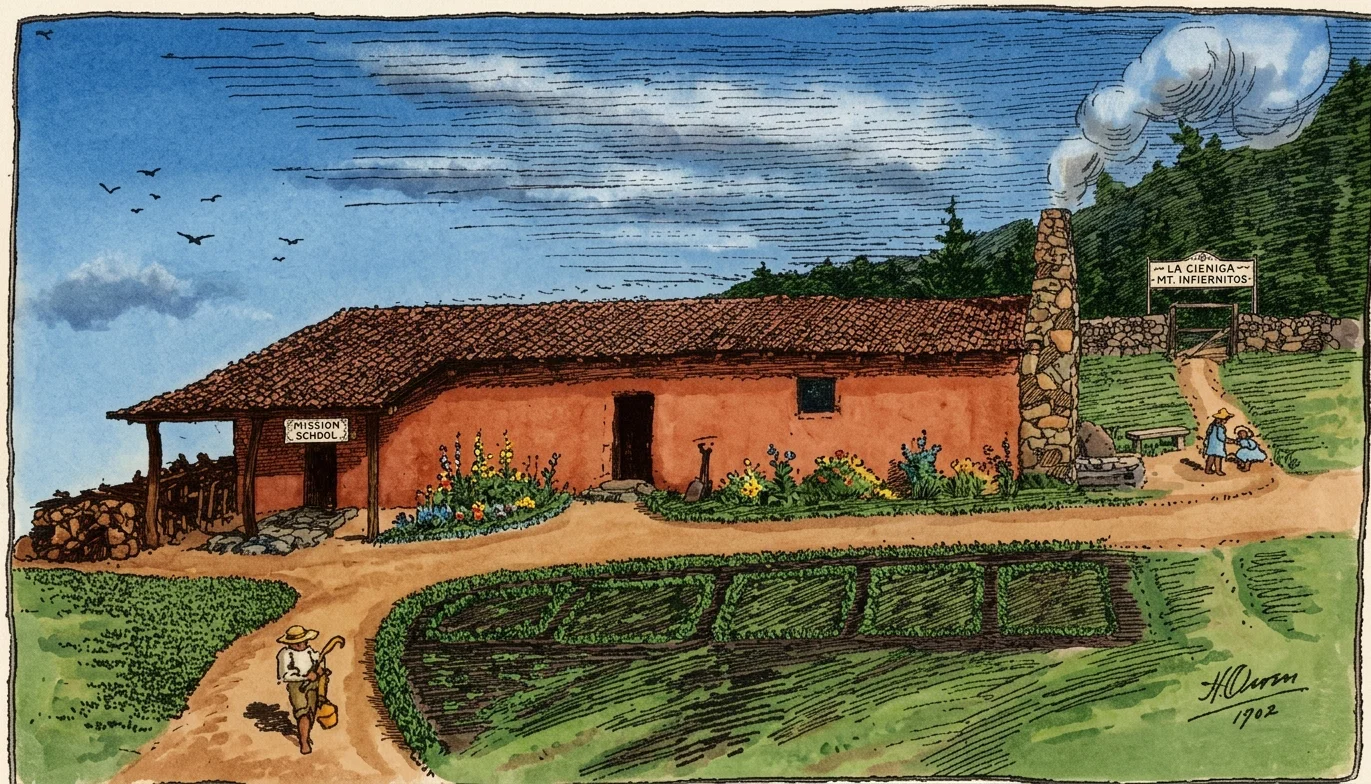
MT. INFIERNITOS, or Infernal Mountain, in its descent to El Chimbo pauses at one point, and spreads out into a beautiful savannah of rich, black soil. Mountain springs water this land, so that in the dry season, when all the country around is dry and brown, the Cieniga, or place of springs, is fresh and green.
THE SCHOOL HOME
To this place of natural beauty Don Juan brought the woman of his choice. A home was built, and Don Juan daily went to his toil in the mine. At evening he came out of the dark tunnel, and mounting his little mule, rode through the pueblo, past the hill of many crosses, and by a winding path reached his pasture gate. In a few minutes he was home.
After fifteen years, bent with toil and the drinking of much guara, he bethought himself of his old home in England, of the days of his childhood, and of his own six dusky children growing up in ignorance in this land so destitute of all human influences that are pure. He said, “What must I do to save my children?” This question, asked in sincerity, is akin to that other, “What must I do to be saved?”
While searching for a suitable location for our school, I learned of this man, and visited him at Mt. Infiernitos. With tears in his eyes, he repeated to me his story. He wished to give his home, farm, and cattle for the education of his children.
The farm was just such a place as we had been praying for as a school location, a good distance from the city (three leagues), high above the malarial levels, good, irrigable land. Our friends in Tegucigalpa rejoiced with us in what we all called a providential opening for our school.
In due time the transfer was made, and we came into possession of a fine piece of property for school purposes, but with only sufficient house room for six students.
Native kitchens have no chimneys, the women working in the smoke. We first built a stone chimney, and set up our cook stove, then there were stone fences to repair and raise. We work in the forenoon with the hired help and children, and have school in the afternoon. I presume this is the first time “Joy to the world” and “Just as I am” have been sung in Central Honduras by native voices. The children are learning rapidly, and we are teaching them of Jesus.
Recently one of the children, the youngest girl, went to spend the night with her mother in the village; but when dark came, and there was no family worship and no song, she cried long to be brought back, and was not content until restored to us the next day.
Before our school came, the dooryard was a cattle pen, a dirty place, bare of grass or flowers. We have fenced it off, sodded the yard, and planted some rose-bushes. The house has been thoroughly cleaned, the woodwork painted, and the mud walls whitewashed. In spite of our poverty we are quite comfortable in our new quarters.
The work that the children can do will nearly pay for their board, thus leaving any earnings of the farm for improvements or buildings.
There are devoted hearts scattered all through the churches of the home land who would help us if they knew more about the work here, and its needs. And how much a little would do!
We are having an oven made for burning tile and brick. The tile is for roofing, and the brick for floors. One dollar (American currency) will pay for the making of one hundred tile, just about enough to cover one student’s cot. One dollar will make brick enough to floor a sleeping room for one pupil. One dollar will make one hundred adobes (sun-dried brick) or a handsome piece of wall. One dollar will bring us one squared timber for the roof, or three boards for the ceiling. One penny will pay for the making of one tile to help cover our school-room. There are thousands of children who would like to know that they had furnished one tile for our Central American school.
There are farmers whose hired men drive teams perfectly harnessed, hitched to such wagons as only Americans own and use. Brethren, if one of you would walk by my side, and see our oxen straining to draw heavy loads of stone up-hill and down on a stone-boat, you would provide us with a two-wheeled cart, out of sheer sympathy. A few days ago I purchased a pair of wheels hewed out of a log. They are unwieldy things, and will soon wabble themselves out of usefulness. I believe that the Lord will put it into the hearts of our brethren at home to furnish us with some of the tools that we most need that our work may represent good sense and economy.
What can be of greater help in advancing the third angel’s message in this field than to gather the young people into a school home and teach them all the gospel? Caribs, Aztecs, Myas, Spaniards, are all ready to send young people to us.
Our school is not, and is not to be, a round-about way of breaking down prejudice, and by and by teaching the truth. Our school teaches a soon-coming Saviour, health of body and soul. All over the country the parents are willing to be instructed, because of the effort for the young. The father of the children we have in our house said, “I hope you will teach them to believe as you do.”
Who will help us make Infernal Mountain a mountain of blessing to this people? The name “Infernal Mountain,” is an obscure one, only used in legal documents and descriptions of boundaries. Its origin is probably from a number of murders committed near our house, the spot being marked by wooden crosses.
Tegucigalpa, Spanish Honduras.
Mission Notes
Of every 1,000 males in the Madras presidency, 26 are Christians; but of every 1,000 males who can read and write, 45 are Christians. Among Christians, 1 in 15 knows English; among Hindus, 1 in 132; among Mohammedans, 1 in 157. But the pre-eminence of Christians over other classes is especially seen in the returns on female education. Taking an average of 10,000 women in each community, the number who can read and write is, for the Hindus, 70; for the Mohammedans, 86; for the Christians, 913. In the Madras presidency there are 20,314 women who can read and write English. Of these, 77 are Mohammedans, 1,770 Hindus, and 18,442 Christians.
The Missionary Herald gives a very interesting account of the life of Edward Chester, M. D., who spent forty-three years in a mission in India. The amount of work accomplished by him, aside from his medical duties, would be considered enough to employ the time of one man. But in addition to ministerial work he had charge of the Madura hospital and dispensary. The attendance steadily advanced from thirty-one hundred the year before he took charge, till the last year it had reached fifty-one thousand, more than twenty-two thousand of whom were new cases. To each of these and the thousands more of accompanying friends, the gospel was daily preached; a leaflet, which served also as a dispensary ticket, was given, containing the ten commandments and the Lord’s prayer, accompanied with a brief statement of saving truth.
From Nyassaland
By Joseph Booth
THE following letter to the Mission Board, from Nyassaland, British Central Africa, reports the opening of the work in our new mission station in the land of Livingstone:—
The Branch family have arrived in good health bodily and spiritually, and are all hard at work. We share the mission house together, and get along excellently, though somewhat overcrowded.
I am intensely gratified to witness the heart gladness the Branch family manifests in the work, and in making friendship with the native African. The latter draw to them in a way that is new in this mission field. Just now Brother Branch is at the Shiloh station, forty-five miles north, strengthening the cause there. We have provided for the furnishing, etc., of the two mission houses, though how best to divide and locate our forces has yet to be discerned. Miss Branch is making herself invaluable as a teacher in plodding school work, twice daily.
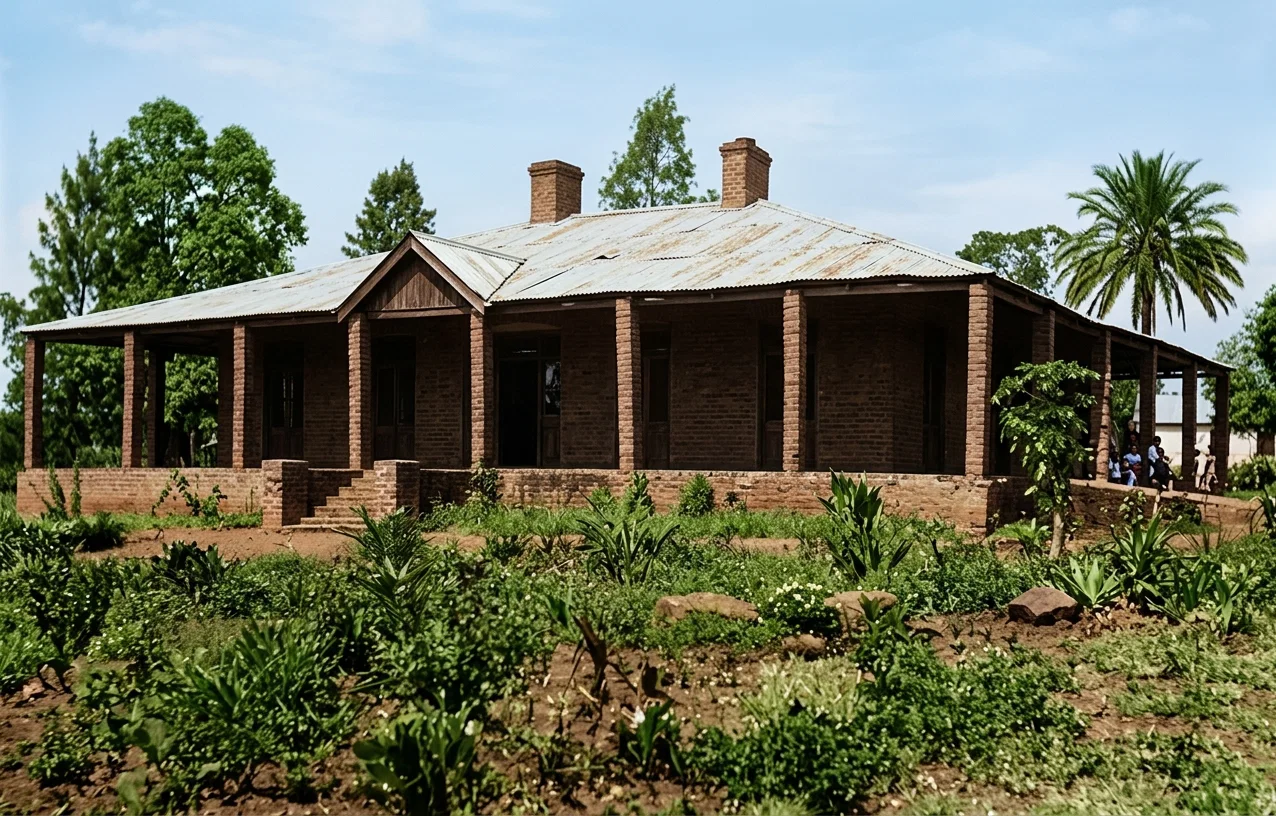
MISSION HOME, PLAINFIELD STATION, CHOLO, B. C. A.
During my stay in America, there has been some trouble among our converts. A few have become Sabbath breakers in order to get a living, while several have become polygamists, led away, they say, by the example of three white missionaries who are known to have fallen. I think about half have drifted or been forced away. There are now about twenty young men students here. Constant applications are being made by converts of other missions who wish to abandon Sunday keeping and study the Bible here; so there is much to encourage us, in spite of disappointments in the past.
Among our workers and students there are some out of each of the following tribes: Yao, Manganga, Chikunda, Chipeta, Angoni, Makololo, Swahili, and Alolo. At present we have no Atonga, though some are writing to request admission.
The Branch family are delighted with Africa, and are constantly wishing that more Seventh-day Adventist colored brethren could be located as missionaries or settlers among the tribes. They enjoy the climate, which to us is decidedly trying, especially to Mrs. Booth and little Mary. I have it in my heart, at some time, if the Mission Board approves, to return to England or America, and collect funds from outside sources for this purpose. I have reason to believe that the advent message can be hastened greatly in this way. We are making brick, and sawing timber for a fair-sized church and school combined, as our present grass school and meeting house is fit only for temporary work. In the wet and windy season I am afraid that Miss Branch’s health would break down, and our services suffer. The church will cost about one thousand dollars. We are working in faith that we shall be able to pay for it as it proceeds.
I am anxious that a beginning should be made, however small, in the far-reaching Swahili tongue. Fourteen tribes know that tongue. We have four brothers of the Swahili tribe, who have come to stay a long time, they say. Their home is six weeks’ journey away to the northeast. I expect to learn sufficient of their language to be of help in some way in the future. They state that Mohammedan preachers are trying to enter their country. Negro teachers will be welcomed in their tribe, they say, but the lives of white men are in danger.
I am sorry to have to report that three fourths of our London purchases are detained at Chinde till the river rises in December.
We hope that plenty of native clothing is on the way; for we are puzzled at present to know how to keep the people around us properly clothed.
JOSEPH BOOTH.
A Voice from Honan, China
By E. PILQUIST
E. PILQUIST
DURING the last four months we have been able to sell nearly thirty thousand Bibles, New Testaments, and portions of Scripture in Honan. I have not made any long trips into the interior for some time, but have been working at home. I go out early in the morning, in order to meet farmers from the country who are coming into town on business, and hand them portions of the Holy Book. These humble farmers are very thankful for the Word, and often sit down in the road and begin to read, and invite me to sit by them and teach them, which I gladly do.
We have rented a good house in this place, and could easily accommodate two families, and they are needed. We have started a Bible class—a real Bible class; for we read only the Bible.
We have a good teacher in our employ, who has opened his heart to the truth as far as I have been able to explain it to him. He not only sees the Sabbath of the Lord plainly, but also keeps it with gladness. He takes great delight in the Bible truth. He is a child of God, and I hope that he may remain firm as the first fruits of our work here. He could engage in evangelistic work, as he is a highly educated man.
The time will soon come when I shall be free to give my entire time to teaching present truth, which is my delight. A few days ago I had a letter from my superior officer in Shanghai, warning me not to tell the missionaries or the Chinese that the seventh day is the Sabbath, and not to tell the people that pork is unsuitable for food. I replied: “When you intrusted me to be a distributor of your society’s Scripture, I promised on my part to do my best to let the people of all classes know what is in the Book you intrusted to me.” The truth must be known, even if we suffer for bringing it to the front. John lost his head for preaching the truth to a certain king, and the time may come when we must seal our faith by our blood. But let us be loyal to our God, firm in the wildest tempest. I know that the Lord will stand by me while I proclaim his Word.
Alberta
By Henry Block
LEDUC.— Elders Flaiz and Boynton recently visited the Sabbath keepers at this place. Sabbath, November 1, Elder Flaiz spoke from Isa. 60: 1, 2. I interpreted his discourse for the German brethren. Surely God calls upon his people to arise and shine. But in order to shine, we must possess light. The Lord says, “Ye are the light of the world.” How great, then, is our responsibility! Elder Flaiz also told us of his experience in Europe. This occasion was one of great blessing to the friends here.
The brethren have built a neat church, and expect to have it dedicated in December. We now have two church buildings in this province, and hope soon to have another. We thank God for the good work that has been done in this part of the great harvest field, and we expect more of his blessing in the future. This is a promising field for labor. Many are moving into this province. Remember the work here in your prayers. HENRY BLOCK.
Trinidad, West Indies
By A. J. Haysmer
ON Wednesday, October 1, by urgent request of our brethren in Trinidad, I started for that place, arriving early the next morning just in time to take the train for Tunapuna, where eight souls were buried with their Lord in baptism. The church there is nearing completion. It is a neat, substantial building.
In the evening we returned to Port of Spain, where we remained a week, holding services, and assisting the brethren in completing arrangements to purchase a lot for a church. They have secured a fine location near the center of the city, at a cost of a little more than one thousand dollars. They borrowed several hundred dollars to make the purchase. In the part of the city where churches may be built, lots are very scarce, and property is rising every year, so it seemed wise to secure this at once.
Money is now needed to finish paying for the lot, and to erect a church with school and depository rooms below. I do not know where the same amount of money could be used to do more good than in this building. Are there not those among our people who would like to assist in this good work? I believe it is the Lord’s will that this should be done.
Before leaving I visited San Fernando, Couva, Almamo, and Tunapuna. At Couva seven were baptized; at Almamo, six. Twenty-one, in all, were baptized by Elder Kneeland during my visit. I was glad to see the work advancing. One of those baptized was a Methodist minister who has taken his stand fully for the truth, and desires to spend the remainder of his life in its promulgation. He is now canvassing for our books. May the Lord bless this brother and his family, and make them a blessing to others.
Several important changes have been made lately in the steamship lines. Trinidad is now the center of the main line. This will make it necessary to remove the headquarters of the mission field and tract society, to that place. This will be an advantage to the work in several ways.
I expect soon to go to St. Lucia, Antigua, St. Kitts, St. Thomas, and Tortola. Some are awaiting baptism. Quarterly meetings will be held at three places.
A. J. HAYSMER.
Kingstown, St. Vincent.
Among the Islands — From Tahiti to Mangareva
By Mrs. G. F. Jones
It is not so much my intention to dwell on the passage between these places as to speak of a few people I have met. Besides myself on board the schooner, there was only one other passenger, a native young woman from Tahiti. The crew were all natives, and the captain was a Frenchman. As none of them could speak English, I did the best I could in talking with them in their own tongue, opening up the Scriptures to them. One man had never even heard of the flood, or of the tower of Babel, or the story of the creation. So I read to him out of the Tahitian Bible the account of the flood, which greatly interested him. I told him why the flood was sent, and how for the same cause God is about to destroy the earth again by fire; another day I loaned him my Bible to read. I found passages which I thought would interest him, and was rejoiced to see that he did not seem willing to stop until he had read for more than two hours. He also promised to buy a Bible, and read every day. The captain, although an intelligent, cultured man, had evidently never before thought of any obligation due to his Maker, or that there could be anything wrong in pleasing one’s self. At the table I had some excellent opportunities of making known to him the gospel of life in answering his questions as to the reason I refused to eat flesh and drink wine, and I was glad to see that he understood and remembered. He also of his own accord promised to buy a Bible.
Another man of the crew told me that he had met some of our missionaries in Rarotonga, but said that he thought the Sabbath was done away. Of course, I showed him that he was mistaken, and I hope he really saw it. The native young woman, who was sick most of the time, became so interested in “Steps to Christ” in the native language that I finally gave it to her to read on the way back to Tahiti. Her trip will occupy at least two months, as she will call at several islands; and meantime I hope that this good book will lead her to Christ.
Soon after arriving at Mangareva, my husband, now captain of the “Pitcairn,” having just arrived from Pitcairn, we were invited to luncheon with the governor and his wife. Here again we had a good opportunity of holding up the word of life, and we were kept busy answering their numerous questions. They quite willingly assented to all we said, but thought it would be too great a sacrifice to change their old manner of living for the present. The diet of the French nation is exactly the opposite to that of health reform, but the Spirit of the Lord can make even them willing to give up their highly seasoned dishes and their wine for his sake who gave his life for them.
We have had two long, interesting visits from one of the priests, and hope to have many more. He would not let the Sabbath question alone, and asked us to lend him our best history of the Sabbath, as he wished to study it. During the conversation, he said that the Catholics accept all the Bible, the same as we do, only they have tradition besides. I asked him what they did if the two did not agree. He replied that such a thing never happened. I then said, “Is not that the case as regards the Sabbath?” to which he was obliged to answer, “Yes, in that case it is;” and soon afterward he admitted that he held a weak position there, and said that he would look further into it. He intends visiting Pitcairn Island with a view to bringing the islanders into the Catholic Church, but we shall hope, and pray, and work to bring him and others into the full light of present truth.