Signs of the Times, Vol. 42, No. 11.

Significance of Social Corruptions

Signs of the Times

Mar 16, 1915

Pacific Press Publishing Association · Mountain View, California · Mar 16, 1915

Significance of Social Corruptions

Moral Decay Throughout the World Is Portentous
By Daniel H. Kress, M. D.
BABYLON was at one time the greatest empire of the world. She appeared to be in the very zenith of her strength and glory, when, on the night of her drunken revelry, the mysterious handwriting appeared on the wall of her palace, announcing her doom. “In that night was Belshazzar the king of the Chaldeans slain. And Darius the Median took the kingdom.” Babylon was not securely great.
America is a great nation. But she is not securely great. The same causes that were responsible for the fall of Babylon will, if brought into her national life, result in her degeneracy and fall. Like causes will bring about like results.

HEALTHY IN APPEARANCE ONLY

The beer drinker, with his florid face, fat neck, and portly body, may, to the unskillful eye, have the appearance of health; but he is far from being a well man. His days are numbered. He is almost certain to die of heart failure, apoplexy, or Bright’s disease, at an age when, under normal conditions, he should be at his best, and of the greatest service in the world.
A country made up of such subjects may appear to be what she is not. Appearances are no infallible guide in determining the health and stability of a nation, any more than they are in determining the health of the individuals comprising it. The physician is governed by what he knows of the history of the cases he examines, rather than by their appearance. If his subject drinks, smokes, and leads a life of dissipation, the physician is justified in making an unfavorable diagnosis and prognosis, no matter how favorable the appearance may be. The fact is, a country that consumes the amount of alcohol, tobacco, and other drugs that is consumed in America, cannot be regarded as secure.
From “Hamburger Fremdenblatt”
An East Prussian City, Showing the Destructive Work of the War
From “Hamburger Fremdenblatt” An East Prussian City, Showing the Destructive Work of the War

ALL NATIONS IN THE SAME CONDITION

What is true of America, is equally true of England, Scotland, Ireland, France, Germany, and other civilized countries.
In the past, when nations went down, stronger and more temperate ones took their places. The unfit were replaced by the fit, the fittest surviving to propagate the race. But we have about reached the time when this is impossible, for all nations are about equally degenerate. The condition throughout the world seems as hopeless as it was before the Flood, when ALL the inhabitants of the earth were given to all forms of excesses, and God, seeing “that the wickedness of man was great in the earth, and that every imagination of the thoughts of his heart was only evil continually,” said, “I will destroy man whom I have created from the face of the earth.” “The earth also was corrupt before God, and the earth was filled with violence.” “And God said unto Noah, The end of all flesh is come before Me; for the earth is filled with violence through them; and, behold, I will destroy them with the earth.” Gen. 6: 5-13.

SIGNIFICANCE OF CRIME, VIOLENCE, IMMORALITY, AND WAR

The restraining influence of the Spirit of God had been resisted by the antediluvians until men were left to follow out their evil impulses. Crime, violence, immorality, bloodshed, and war were the result. Here we have a true picture of what will be; for “as it was in the days of Noe, so shall it be also in the days of the Son of man.” Luke 17: 26.
The present war is the outgrowth of this condition. John the revelator, in speaking of the last days, says: “I saw three unclean spirits. . . . They are the spirits of devils, working miracles, which go forth unto the kings of the earth and of the whole world, to gather them to the battle of that great day of God Almighty. Behold, I come as a thief. Blessed is he that watcheth, and keepeth his garments, lest he walk naked, and they see his shame.” Rev. 16: 13-15. In referring to the final outcome, he says: “The nations were angry, and Thy wrath is come, and the time of the dead, that they should be judged, and that Thou shouldest give reward unto Thy servants the prophets, and to the saints, and them that fear Thy name, small and great; and shouldest destroy them which destroy the earth.” Rev. 11: 18.

THE TIME IS NEAR

The time is not far distant when Jesus will come again in the clouds of heaven, to give reward to His saints, and to “destroy them which destroy the earth.” He comes in mercy to cut short this cruel work of destruction.
In reply to the inquiry, “What shall be the sign of Thy coming, and of the end of the world?” Jesus said to His disciples: “As the days of Noe were, so shall also the coming of the Son of man be. For as in the days that were before the Flood they were eating and drinking, marrying and giving in marriage, until the day that Noe entered into the ark, and knew not until the Flood came, and took them all away; so shall also the coming of the Son of man be.” Matt. 24: 3, 37-39.
While a power from beneath is taking possession of thosewho have cast aside the restraining influence of the Spirit of God, a power from above will take possession of God’s loyal subjects. While “evil men and seducers” are waxing “worse and worse, deceiving, and being deceived,” the good will be developing characters that will give them a right to eternal life. The line of demarcation between the two classes necessarily will become more distinct as time advances. Wars, earthquakes, famine, and pestilence are unmistakable forerunners of Christ’s coming. Matt. 24: 7-14.

“GET YOU OUT OF THIS PLACE”

The Unheeded Warning—The Destruction That Followed—Warnings for To-Day—Will They Be Heeded?
By William H. Edwards
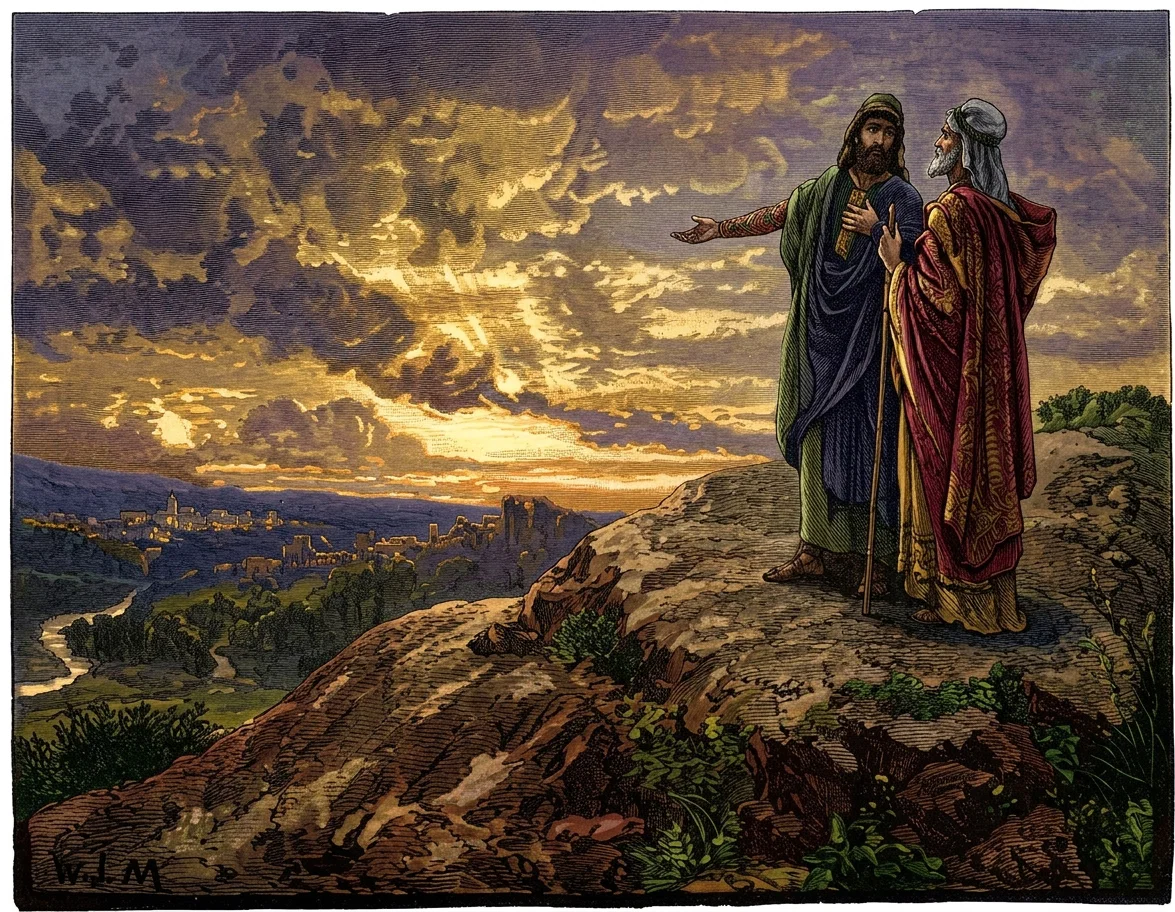
“Up, get you out of this place; for the Lord will destroy this city.” Gen. 19:14.
When Lot in Sodom, on that portentous night, visited his sons-in-law, by the promptings of the two angel guests who were in his house, he gave them the significant warning quoted above; but all he received for his anxious solicitude was stoical incredulity, and they spurned his warning, and believed he was mocking them with a chimerical tale. They took it that the patriarch was just coming into his dotage, and this was the first evidence of general deterioration. To leave Sodom now, at the most opulent and prosperous moment of her history, with fullness of bread, and without need of tiresome, wearying exertion to gain a livelihood—preposterous! You mock us, father! Let those who have no investments in this section evacuate if they wish to do so, but we will attend to our property holdings a while longer.
Is it hard to believe that what was so characteristic of “the cities of the plain” in the days of Abraham and Lot is now the leprosy of universal sin, so that, as stated by another, “the earth is one great lazar house of iniquity,” and awaits destruction by fire, even like Sodom and Gomorrah, which were overthrown and turned into ashes?

Conditions of Sodom Repeated

The declaration of Christ in Matt. 24:37 is, “As the days of Noe were, so shall also the coming of the Son of man be”; and in Luke 17:28, 30: “Likewise also as it was in the days of Lot. . . . Even thus shall it be in the day when the Son of man is revealed.”
With the knowledge of frightful, flagrant, open sin on every side chronicled in the daily papers, and with a cruel, uncalled-for, sanguinary war in progress, the very cause of its origin shrouded in mystery, and inexplicable, but directly fulfilling the last-days prophecies of the Word, is it difficult to locate the times in which we live, and see that they are very dangerous ones, or to prove that the execution of the threatened destruction of this world is now about due?

Significant Fortunes

We are also in the age of all ages of rich men, when colossal fortunes are a sign of the last days of time, as a fulfillment of prophecy. James 5:3 states, “Ye have heaped treasure together for [or in] the last days”—just shoveled it together, as it were, piles of it, and vast stores of it idle and doing no one good. The same verse declares, “Your gold and silver is cankered; and the rust of them shall be a witness against you, and shall eat your flesh as it were fire.”
“Even like Sodom and Gomorrah, which were overthrown and turned into ashes.”
The mere possession of vast wealth does not bring all joy and pleasure, while in every quarter extreme poverty exists, and misery because of poverty; for this wealth hoarded, and not used for humanity or for God’s cause, is and will be a menace to the possessors. Zech. 2:9 reads, “Behold, I will shake Mine hand, . . . and they shall be a spoil to their servants”; and Zeph. 1:13, 14: “Their wealth shall become a spoil, and their houses a desolation.” A. R. V. “The great day of the Lord is near, it is near, and hasteth greatly, even the voice of the day of the Lord: the mighty man shall cry there bitterly.”

A Thousand for One Job

An advertisement for a mechanic brings a thousand applicants, some coming at heavy expense on the trains, only to find the place filled, with consequent disappointment to the unsuccessful. Men with large families of children are in forced idleness; and though the mercantile statements report the times excellent and business improving, the multitude of idle men do not credit it, and their hearts are distressed at the conditions. There is in the cities and in large communities a spirit of unrest, and an undercurrent of repressed feeling against society, which needs but the match of favorable opportunity to ignite the tinder. Farsighted men are seeking to hold this element peaceable, believing that an uprising would be like a repetition of the scenes of 1793 in the French Revolution.
God has forecasted all this in Dan. 12:1,—that there is to be “a time of trouble, such as never was since there was a nation even to that same time.” Wars and rumors of wars, and earthquakes in many places, are but the beginning of sorrows. Evil men and seducers will wax worse and worse, and men’s hearts will fail them for fear of the things that are coming on the earth.

The Service of Prophecy

Through an understanding of the prophecies, God wishes to preserve His people from the troubles that will take all of the world unawares. He asks those to whom He has given power to get wealth, to give their means into His keeping now, as the time is near when what they hold on to will be taken from them, and endanger their lives.
One says: “I saw it was a fearful thing to hold on to a perishable substance when He has said that if we will sell and give alms, we can lay up treasure in heaven. As the work is closing up, and the truth is going forth in mighty power, those rich men will bring their means and lay it at the feet of the servants of God, begging them to accept it. The answer from the servants of God will be, ‘Go to now, ye rich men.’ Your means is not needed. God will not accept your riches now.”
At the time when God will refuse the means offered, it will be seen that sufficient is already in hand for His work. He wanted their affections with their money, and not money alone, for they had loved and trusted in their wealth.

Would Save the Wealthy

The constant plea of the servants of God for wealthy men to give their money into God’s keeping is for the purpose of saving the souls of all such; for the cause of God is going through to sure and speedy victory on the gifts of those who do give,—the poor with their nickels, which God does not despise; the dollars of the many who are not able to give more; the hundreds from the few who are willing to sacrifice for God because they love Him. He says that which is given they have lent to the Lord, and He will repay them again, “good measure, pressed down, and shaken together, and running over.”
“Knowing the time, that now it is high time to awake out of sleep: for now is our salvation nearer than when we believed. The night is far spent, the day is at hand.” Rom. 13:11, 12. Let us, like wise people, dispose of all the property we have in Sodom, and get as much of it into the Lord’s hands as can be spared, and trust Him who cannot lie, to repay us in times of need, as He has promised to do.
“The time is short. If thou would’st work for God, it must be now. If thou would’st win the garland for thy brow, Redeem the time.”

Liberty, Order, and Virtue

The only liberty that is valuable is a liberty connected with order; that not only exists with order and virtue, but which cannot exist at all without them.— Edmund Burke.

Crossing the Kidron

By S. J. Townsend
King David's soul was troubled. From the throne Of Judah, from Jerusalem, he fled, And as he went, sore weeping, did bemoan His kingdom's loss. Barefoot, with covered head, O'er the brook Kidron eastward then he sped, Fleeing the wrath of Absalom, his son; For to the king a messenger had said: “Lo, Absalom all Israel's hearts hath won. “He now in Hebron reigns, Thy kingdom is undone!”
“Father, the hour is come,” our Saviour spake. From the impenitent city of His care, He weeping turned, His sorrowing way to take O'er the brook Kidron to Gethsemane, there At last to plead in agony of despair: “O righteous Father, wilt Thou that I sup This wine of sorrow? May I not forbear?” With traitor's kiss was brought the bitter cup, And He on Calvary for sin was lifted up.

Great Gifts Bestowed on Men

We Receive That We May Impart—The Influence of Importunate Prayer—The Divine Science of Praying—Things That Bring Angels to Our Side
By Mrs. E. G. White
CHRIST was continually receiving from the Father, that He might communicate to us. “The word which ye hear,” He said, “is not Mine, but the Father’s which sent Me.” John 14:24. “The Son of man came not to be ministered unto, but to minister.” Matt. 20:28. Not for Himself, but for others, He lived and thought and prayed.
From hours spent with God He came forth morning by morning, to bring the light of heaven to men. Daily He received a fresh baptism of the Holy Spirit. In the early hours of the new day, the Lord awakened Him from His slumbers, and His soul and His lips were anointed with grace, that He might impart to others. His words were given Him fresh from the heavenly courts, words that He might speak in season to the weary and oppressed.

LORD, TEACH US TO PRAY

Christ’s disciples were much impressed by His prayers and by His habit of communion with God. One day, after a short absence from their Lord, they found Him absorbed in supplication. Seeming unconscious of their presence, He continued praying aloud. The hearts of the disciples were deeply moved. As He ceased praying, they exclaimed, “Lord, teach us to pray.” Luke 11:1.
In answer, Christ repeated the Lord’s Prayer, as He had given it in the Sermon on the Mount. Then in a parable He illustrated the lesson He desired to teach them.
“Which of you,” He said, “shall have a friend, and shall go unto him at midnight, and say unto him, Friend, lend me three loaves; for a friend of mine in his journey is come to me, and I have nothing to set before him? And he from within shall answer and say, Trouble me not: the door is now shut, and my children are with me in bed; I cannot rise and give thee. I say unto you, Though he will not rise and give him, because he is his friend, yet because of his importunity he will rise and give him as many as he needeth.” Verses 5-8.
Christ represents the petitioner as asking that he may give again. He must obtain the bread, else he cannot supply the necessities of a weary, belated wayfarer. Though his neighbor is unwilling to be troubled, he will not desist his pleading. His friend must be relieved; and at last his importunity is rewarded, his wants are supplied.
In like manner the disciples were to seek blessings from God. In the feeding of the multitude and in the sermon on the bread from heaven, Christ had opened to them their work as His representatives. They were to give the bread of life to the people. He who had appointed their work, saw how often their faith would be tried. Often they would be thrown into unexpected positions, and would realize their human insufficiency. Souls that were hungering for the bread of life would come to them, and they would feel themselves to be destitute and helpless. They must receive spiritual food, or they would have nothing to impart. But they were not to turn one soul away unfed. Christ directs them to the source of supply. The man whose friend came to him for entertainment, even at the unseasonable hour of midnight, did not turn him away. He had nothing to set before him, but he went to one who had food, and pressed his request, until the neighbor supplied his need. And would not God, who had sent His servants to feed the hungry, supply their need for His own work?

LONGS TO GRANT THE REQUEST

But the selfish neighbor in the parable does not represent the character of God. The lesson is drawn, not by comparison, but by contrast. A selfish man will grant an urgent request, in order to rid himself of one who disturbs his rest. But God delights to give. He is full of compassion, and He longs to grant the requests of those who come to Him in faith. He gives to us that we may minister to others, and thus become like Himself.

DIVINE SCIENCE IN PRAYER

Christ’s lessons in regard to prayer should be carefully considered. There is a divine science in prayer, and His illustration brings to view principles that all need to understand. He shows what is the true spirit of prayer. He teaches the necessity of perseverance in presenting our requests to God, and assures us of His willingness to hear and answer prayer.
(Continued on page 8)

Great Gifts Bestowed on Men

(Continued from page 3)
Our prayers are not to be a selfish asking, merely for our own benefit. We are to ask that we may give. The principle of Christ’s life must be the principle of our lives. “For their sakes,” He said, speaking of His disciples, “I sanctify Myself, that they also might be sanctified.” John 17:19. The same devotion, the same self-sacrifice, the same subjection to the claims of the word of God, that were manifest in Christ, must be seen in His servants.
Our mission to the world is not to serve or please ourselves. We are to glorify God by cooperating with Him to save sinners. We are to ask blessings from God, that we may communicate to others. The capacity for receiving is preserved only by imparting.

PRAYER DOES NOT CHANGE GOD

In the parable, the petitioner was again and again repulsed, but he did not relinquish his purpose. So our prayers do not always seem to receive an immediate answer; but Christ teaches that we should not cease to pray. Prayer is not to work any change in God; it is to bring us into harmony with God. When we make request of Him, He may see that it is necessary for us to search our hearts and repent of sin. Therefore He takes us through test and trial, He brings us through humiliation, that we may see what hinders the working of His Holy Spirit through us.
God does not say, Ask once, and you shall receive. He bids us ask. Unwearyingly persist in prayer. The persistent asking brings the petitioner into a more earnest attitude, and gives him an increased desire to receive the things for which he asks. Christ said to Martha at the grave of Lazarus, “If thou wouldest believe, thou shouldest see the glory of God.” John 11:40.
But many have not a living faith. This is why they do not see more of the power of God. Their weakness is the result of their unbelief. They have more faith in their own working than in the working of God for them. They take themselves into their own keeping. They plan and devise, but pray little, and have little real trust in God. They think they have faith, but it is only the impulse of the moment. Failing to realize their own need, or God’s willingness to give, they do not persevere in keeping their requests before the Lord.
Our prayers are to be as earnest and persistent as was the petition of the needy friend who asked for the loaves at midnight. The more earnestly and steadfastly we ask, the closer will be our spiritual union with Christ. We shall receive increased blessings because we have increased faith.

THE PLAN FOR ALL-COMPREHENDING STRENGTH

When perplexities arise, and difficulties confront you, look not for help to humanity. Trust all with God. The practice of telling our difficulties to others, only makes us weak, and brings no strength to them. It lays upon them the burden of our spiritual infirmities, which they cannot relieve. We seek the strength of erring, finite man, when we might have the strength of the unerring, infinite God.
You need not go to the ends of the earth for wisdom, for God is near. It is not the capabilities you now possess, or will ever have, that will give you success. It is that which the Lord can do for you. We need to have far less confidence in what man can do, and far more confidence in what God can do for every believing soul. He longs to have you reach after Him by faith. He longs to have you expect great things from Him. He longs to give you understanding in temporal as well as in spiritual matters. He can sharpen the intellect. He can give tact and skill. Put your talents into the work, ask God for wisdom, and it will be given you.

HE IS BACK OF EVERY PROMISE

There are many who long to help others, but feel that they have no spiritual strength or light to impart. Let them present their petitions at the throne of grace. Plead for the Holy Spirit. God stands back of every promise He has made. With your Bible in your hands, say: I have done as Thou hast said. I present Thy promise, “Ask, and it shall be given you; seek, and ye shall find; knock, and it shall be opened unto you.” Matt. 7:7.
We must not only pray in Christ’s name, but by the inspiration of the Holy Spirit. This explains what is meant when it is said that the Spirit “maketh intercession for us with groanings which cannot be uttered.” Rom. 8:26. Such prayer God delights to answer. When with earnestness and intensity we breathe a prayer in the name of Christ, there is in that very intensity a pledge from God that He is about to answer our prayer “exceeding abundantly above all that we ask or think.” Eph. 3:20.

GOD WILL HONOR THAT NAME

Christ has said, “What things soever ye desire, when ye pray, believe that ye receive them, and ye shall have them.” Mark 11:24. “Whatsoever ye shall ask in My name, that will I do, that the Father may be glorified in the Son.” John 14:13. And the beloved John, under the inspiration of the Holy Spirit, speaks with great plainness and assurance: “If we ask anything according to His will, He heareth us: and if we know that He hear us, whatsoever we ask, we know that we have the petitions that we desired of Him.” 1 John 5:14, 15. Then press your petition to the Father in the name of Jesus. God will honor that name.

THE ANGELS PRESS TO HIS SIDE

In the parable, he who asks bread for the stranger, receives “as many as he needeth.” And in what measure will God impart to us that we may impart to others?—“According to the measure of the gift of Christ.” Eph. 4:7. Angels are watching with intense interest to see how man is dealing with his fellow men. When they see one manifest Christlike sympathy for the erring, they press to his side and bring to his remembrance words to speak that will be as the bread of life to the soul. So “God shall supply all your need according to His riches in glory by Christ Jesus.” Phil. 4:19. Your testimony in its genuineness and reality He will make powerful in the power of the life to come. The word of the Lord will be in your mouth as truth and righteousness.

The War Spirit in Australia

Compulsory Military Act—The Fijian Chief and the Warring Christians—Will This European War Be the Last?
By J. E. Fulton
Now that this great war has broken out so soon after Australia had launched her national defense scheme, Australians are complimenting themselves on their prudence in being in a measure ready to have an honorable part in the fray. And the destruction of the elusive German cruiser Emden by one of Australia’s warships, the Sydney, has of course increased Australia’s pride. There is no doubting the fact now that this country is strongly committed to militarism.

COMPULSORY DEFENSE ACT

Australasia led the young countries of the world in a compulsory military scheme for boys and young men; and while there was some violent criticism from a very respectable and considerable portion of the population, now that the great European conflict is on, nothing is heard by way of protest, and it is likely that any opposition to the “Defense Act” would be decidedly unpalatable at this juncture.
The Society of Friends of this country have, until the outbreak of the war, been very active in opposing the compulsory clause in the Military Defense Act, but now they have thought best not to press their opposition at such an inopportune time.
Throughout Australasia and New Zealand, great interest has been taken in the war, and the unity of these “over the sea” possessions with the motherland is very apparent. Loyalty to the empire, and a willingness to sacrifice men and means to uphold the integrity of Great Britain in this awful crisis, is all that a government could expect.
From “Hamburger Fremdenblatt”
THE GERMAN CRUISER EMDEN, AND HER COMMANDER, CAPTAIN VON MUELLER
From “Hamburger Fremdenblatt” THE GERMAN CRUISER EMDEN, AND HER COMMANDER, CAPTAIN VON MUELLER

MANY TROOPS SENT

Many thousands of troops have gone on their long journey across the Indian Ocean to the battle front, and as many more are getting ready, and the numbers will probably be more than doubled soon. Word has come that our soldiers have been landed in Egypt, and soon, most likely, they will be in the conflict against the Turks.
A very remarkable idea obtains in the minds of many, and that is that this is the last great war, and that it is a war for peace. “All that is now necessary is to break Prussian militarism, and then the millennium is assured.” So while the war is raging, men are proclaiming for the future “peace and safety.”
How few know that the prophetic Word is being fulfilled in this awful conflict! Our great boasted civilization has broken down; for while man has undoubtedly been refined and educated and “cultured,” it is scarcely more than veneer, for in battle he oftentimes seems as barbarous as in the days of Attila or Alaric.
In a cartoon that appeared in one of the late magazines, the savage’s view of this war was well and truly presented. In his native wild sits the savage, reading a “war special,” under a tree, against which leans his great spear. And as he reads the terrible records of destruction and barbarity, he exclaims in disgust: “Och! The heathen!”

FIJI CHIEF AND WARRING CHRISTIANS

It is undoubtedly true that this war between so-called “Christian nations” must strike the non-Christian onlooker very strangely. Years ago, when the writer was a missionary in the Fiji Islands, the war broke out between Great Britain and the Boers. He was editing a little paper at the time, in the Fijian language, and some articles concerning that war were presented to our Fijian readers.
One day a Fijian Christian sought and obtained an interview. He was exercised over the war. His statement of the case from a native standpoint was pointed and convincing. It was much as follows: “The English and the Boers are both Christian people. They both employ chaplains to accompany and encourage their soldiers. These chaplains on both sides pray to the same God for the success of their respective armies. How can God answer both?”
Further the Fijian went on to remark: “We Fijians were a warlike people when English missionaries came to us with the gospel and told us it was wrong to fight. We listened to the gospel of peace, and after years of faithful teaching, yielded to the good advice. Our King Thakambau gave his war club to Queen Victoria, and war ceased in these islands. How is it that the English people, who taught us peace, now go forth to kill? Would it not be good, he asked seriously of the writer, “for some Fijian missionaries to go to England and preach the gospel of peace?”
What could be said in answer to such a searching argument? How could I explain that there is a good reason for war? What a severe stricture on our advanced civilization and reputed Christian teaching!

INDIVIDUALS, BUT NOT NATIONS

The nations are not Christian. Many individuals in all of them are; but the “narrow way” to life is not, and can never be, broad. The Bible teaches us that in the last days men will prepare for war and not for peace. They are doing what God said we might expect. See Joel 3:9-12.
Beneath the modern veneer of civilization and hypocritical refinement, man is, generally speaking, selfish, lustful, and easily stirred to wrath,—a prey to the great foe, who now, with his many agents, goes forth to the nations of the whole world to gather them to battle. Rev. 16:12-16.
There may come a lull in the storm, but peace cannot be assured. “There is no peace . . . to the wicked,” God has said. The end is near. The nations are angry; and the coming of Christ, which ends the reign of sin, is the only hope for peace. His coming is the “blessed hope,” and He is the “Prince of peace.”

“The Home Where Changes Never Come”

Plan for a Future That Brings Peace—Our Faulty Lives May Be Exchanged for Perfection
By A. M. DART
How sad the change for the human family when Adam and Eve chose the path of disobedience! Their Eden home—the perfection of beauty and loveliness—was changed for one with the curse of sin resting upon it, with death at the end of the short race.
A God of infinite love beheld the change, and instituted one to offset it, as astonishing to heaven’s intelligences. The Son of God changed His life of equality with the Father for one in human garb, in which a perfect life was lived, and yet an ignominious death endured.

Offers a Perfect Life in Exchange

Here are the possibilities for us, dear reader, in this change: His death, unmerited, may answer for the death which our sins have merited. His life of perfection He offers for our lives of imperfection. “For if, when we were enemies, we were reconciled to God by the death of His Son, much more, being reconciled, we shall be saved by His life.” Rom. 5:10.
But all this calls for a wonderful change on our part. “But we all, with open face beholding as in a glass the glory of the Lord, are changed into the same image from glory to glory even as by the Spirit of the Lord.” 2 Cor. 3:18.
Sad and many are the changes in this old world since sin caused the loss of man’s Eden home; but the way is paved for us yet to enjoy the “home where changes never come.” Obey we must; but in the language of another, “Man’s obedience can be made perfect only by the incense of Christ’s righteousness, which fills with divine fragrance every act of obedience.”

Plan for a Bright Future

We are nearing the end of this world’s changes. Marvelous and rapid changes are taking place continually. The nation of rest, quiet, and prosperity of to-day is one of war and devastation to-morrow. The city with its gay and thoughtless inhabitants, eagerly planning for the future, finds itself on the morrow but a gruesome graveyard as the result of the unexpected changes of mother earth.
Listen, reader, to God’s statement of the last change awaiting the faithful: “We shall not all sleep, but we shall all be changed, in a moment, in the twinkling of an eye, at the last trump: for the trumpet shall sound, and the dead shall be raised incorruptible, and we shall be changed.” 1 Cor. 15:51, 52.
Are you daily deporting yourself in the light of this change? What change is it necessary for you to make in order to enjoy this one? Do you know that soon it will be too late to make any change for the better? The awful fiat will go forth: “He that is unjust, let him be unjust still; and he which is filthy, let him be filthy still.” And, praise God, there will be no change for the worse in him who is fitted for the change to immortality. “And he that is righteous, let him be righteous still: and he that is holy, let him be holy still.” And then—glorious thought!—“Behold, I come quickly; and My reward is with Me, to give every man according as his work shall be.” Rev. 22:11, 12. And now we go to—
“The home where changes never come, Nor pain nor sorrow, toil nor care. Yes, ’tis a bright and blessed home. Who would not fain be resting there?”
Continue reading: The Creator the Supreme Governor