Your ShelfYour Projects

Signs of the Times, Vol. 25, No. 37.

The One Great Physician

Signs of the Times

Sep 13, 1899

Pacific Press Publishing Company · OAKLAND, CALIFORNIA · Sep 13, 1899

The One Great Physician
Jesus Christ is the One Great Physician; for He heals not only the body but the soul. He cleanses us from sin and also from disease.
The work of Christ when here on earth in person was largely that of healing the sick. He showed most clearly in this that He is not the author of disease, but that, on the other hand, sickness is a foe to be combated by the divine Spirit of God, the same as any other evil.
The work of the Master upon earth also showed that even those who have suffered the extreme penalty of sickness are to be raised up; for He not only healed the sick, but on several occasions did He raise the dead. Thus is death, as well as sickness, pointed out as a foe of mankind that the great Conqueror has overthrown. And what could be more profitable to us, or serve better to strengthen our faith, than to read again and again those inspired accounts of the Saviour's mighty working in healing the sick and raising the dead?
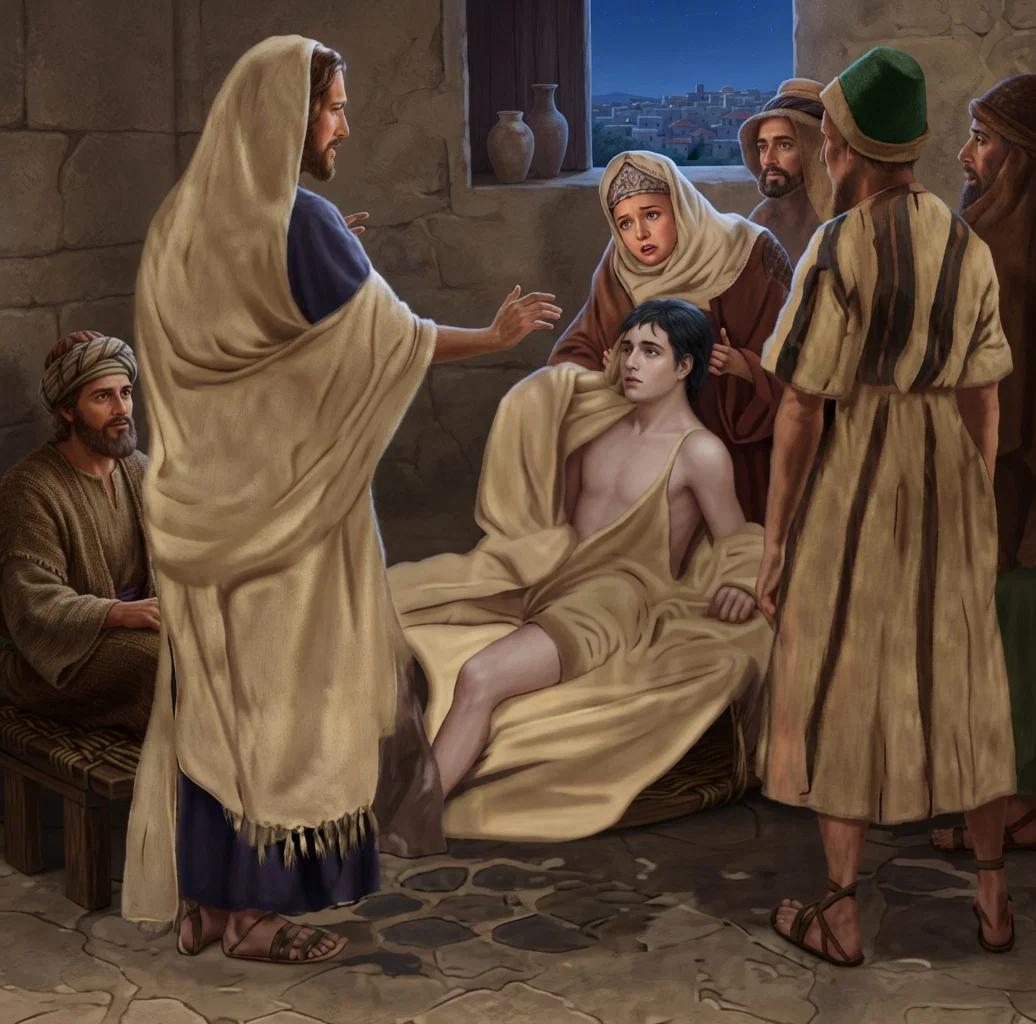
"And it came to pass the day after, that He went into a city called Nain; and many of His disciples went with Him, and much people. Now when He came nigh to the gate of the city, behold, there was a dead man carried out, the only son of his mother, and she was a widow; and much people of the city was with her. And when the Lord saw her, He had compassion on her, and said unto her, Weep not. And He came and touched the bier; and they that bare him stood still. And He said, Young man, I say unto thee, Arise. And he that was dead sat up, and began to speak. And He delivered him to his mother. And there came a fear on all; and they glorified God, saying, That a great prophet is risen up among us; and, That God hath visited His people. And this rumor of Him went forth throughout all Judea, and throughout all the region round about." Luke 7:11-17.
There is nothing to indicate that God is any the less willing to work for mankind to-day than He was when Christ was personally in Palestine. In fact, everything in the Word shows that the Lord is willing and anxious to heal our physical ills as well as our defects of character and to cleanse us from all sin. "Beloved, I wish above all things that thou mayest prosper and be in health, even as thy soul prospereth." 3 John 2. Here the prosperity of the physical man is clearly placed on the same plane with the prosperity of the soul. In fact, if we would enjoy the very highest pleasures of the soul we need physical soundness, for any mutilating of the handiwork of God obscures more or less our vision of His pure spirituality. Hence "above all things" the Lord would have us prosper and be in health, even as our soul prospereth.
And he that was dead sat up, and began to speak. And He delivered him to his mother.
But the Lord can only work on right principles. And when we refuse to go with Him in the path of right, He can not help us. "Ye lust, and have not; ye kill, and desire to have, and can not obtain; ye fight and war, yet ye have not, because ye ask not. Ye ask, and receive not, because ye ask amiss, that ye may consume it upon your lusts." James 4:2, 3. The Lord can not give us physical soundness when the only reason we desire it is that we may further debase ourselves in lust. Satan has so thoroughly degraded many persons that they can think of no higher enjoyment than the sensual gratification of some fleshly desire. But the Lord knows better, and so He will not give us health when the gift would be an encouragement to us to wander farther away into the miseries of sin. The Lord has our best welfare at heart, and we can safely trust Him. And if we are sick and desire Him to heal us, the first thing for us to do is to seek to know His will and then fully yield to that. And as we yield to Him He sends us the best that heaven can devise and bestow.
"And God hath set some in the church, first apostles, secondarily prophets, thirdly teachers, after that miracles, then gifts of healings, helps, governments, diversities of tongues." 1 Cor. 12:28. Here is a list of some of the things that God hath set in the church. Note particularly that these things are set in the church, and furthermore that they are set in the New Testament church, and above all that it is God who has set them there. It would be impossible for anything to be made plainer than this verse of scripture makes this great truth.
And is it not, indeed, a great source of comfort to us to know that our God has set these good "gifts" in His church? And how particularly should we observe that "gifts of healings" are among these things that the kindFather in heaven bestows upon us in this dispensation? The apostles in their day had wonderful power in healing the sick, and even raising the dead. But after the apostles passed off the stage of action this precious gift of healing was largely withdrawn from the church. Only here and there do we hear of any well-authenticated cases of the divinely miraculous interposition in the healing of disease. Can it be true that God set these 'gifts of healings' in the church to be obscured in this way?—Certainly it can not be so. Then may we not look for the cause of the frustration of the plan of God in the shortcomings of humanity? And if we wish to enjoy these wonderful gifts of God is it not the first thing for us to do to go to searching our hearts to find out what rubbish sin has drifted in upon us to thus shut out the blessings from on high?
God created us, and in that creation He formed us to be governed by certain laws. And while we are in harmony with those laws, everything runs smoothly because we are in the powerful and health-giving currents of the Divine. But when we turn our backs upon God, and say that we will have our own way, then we begin to run against the breakers, and one disaster follows another in quick succession. Disease tortures us, and death consumes us. God did not intend it to be this way. But since He saw that the only thing to make us perfectly happy was to give us the power of choice, and since we have chosen the road of transgression, the Lord can not help it and we alone are to blame.
So, then, is it not perfectly clear that the road to 'divine healing' is to first make a study of God's Word, so as to know His way, and then follow it to health? Sometimes He will heal us instantly when we turn back to Him, and sometimes His all-seeing eye can detect that it will be better for us to be allowed to get well gradually. But in either case it is 'divine healing' just the same. Indeed there is no real healing except the divine. If some natural remedy is applied and the patient gets well, we are apt to say that it was the remedy that cured the person of disease. But instead of that it was God acting through the law that He had long ago established.
The world is all out of harmony with God. Men eat and drink for gluttony and drunkenness. They seek to gratify the earthly and sensual, when, if they would only look up, they would see that the Lord is holding blessings of untold value over their heads. And they may have these at any time when they are willing to take the best, instead of clamoring for something that is inferior.
The Word of God clearly shows that healing is one of the gifts of our Father in heaven. And everything indicates that we are coming into a time when there will be those who will let the Lord have His own good way and work for them wonderfully in the healing of disease.
But it has been true in all the history of the past that when God set His hand to do a mighty work Satan has exercised his most powerful cunning to lead men away from the genuine blessings of God into that which will please, intoxicate, and finally destroy. So we need to be on the lookout for the spurious. And the one sure way to be able to detect the spurious is to make a close study of the genuine. For if we know the genuine perfectly when we see it we are able to discard the counterfeit at once.
The Guide-book that tells us all about the genuine working of God is the Bible. And if we make a close study of that Book we will be led aright, provided we submit to its teaching, and freely drink in its depths of spiritual truth. And in studying the Bible, we should be sure that we study the Bible itself, and not what some person has taught about the Bible. We may use the help that men can give us in the study of the Bible, but we must be sure that our faith reaches clear through any of the sayings of men and lays hold on the Word itself. We are in the perils of the last days, and we must absolutely know that we stand with God, else we will go down in the storm of delusions that will sweep over the world.

TAKE HEED HOW YE HEAR.

GOD desires us to give attention to the words of truth. We are to hear and practise them; for the truth is a message of heaven to those who take heed. The oft-repeated charge of the Lord is, "He that hath ears to hear, let him hear." Of the Israelites the apostle says, "The Word preached did not profit them, not being mixed with faith in them that heard it." This opens before us the reason why so little is accomplished by the many discourses given. The words may be indited by the Holy Spirit, but if those who hear do not hear with a desire to be benefited, the words spoken do not profit them.
It makes every difference whether the Word spoken is received into good and honest hearts. The Israelites had the Word spoken to them by Christ from the pillar of cloud, but, like many who to-day hear the glad tidings of truth and righteousness, they did not hear with consecrated ears. They brought guilt upon themselves by failing to hear by faith, and practise the Word spoken. Selfishness and pride, murmuring and unbelief, compassed them about as with a garment.
It was faith that men lacked in the days of Noah, and it was this lack that brought destruction upon them. How different would have been the result had they heeded Noah's appeals as the voice of God speaking through him! But they were unwilling to hear and receive the Word which would have saved them.
The teacher of truth is to take heed how he presents the truth. He is to speak every word plainly and distinctly, with that earnest conviction which carries conviction to hearts. If the words spoken are crowded upon each other, the impression that should be made is lost. The talent of speech needs to be cultivated, that the truth be not spoken in an excited, spasmodic style, but slowly and distinctly, that not a syllable may be lost.
Rapidity of speech can and should be corrected. The teacher must learn daily in the school of Christ, that he may speak in such a way as to make the best and most lasting impression upon his hearers. The appointed guardian of truth, he must conscientiously guard the sacred treasures. He is not to gather only a limited number of surface truths, but is to purchase the field, that he may possess the treasure it contains. He is to seek to improve in methods of labor, and make the very best use of the organs of speech. If the words of truth are of sufficient importance to be spoken before an audience, they are of sufficient importance to be spoken distinctly. The guidance of the Spirit never leads to indistinctness of speech. The Spirit takes the things of God and presents them through the human instrument to the people. Then let them come from our lips in the most perfect manner possible.
When the pure Gospel of Christ is cherished and appreciated, the jewels of truth will be presented as precious pearls. Every teacher in our schools, every minister in our conferences, is to make an earnest effort to obtain knowledge from the Source of all knowledge. All are to have a daily increasing appreciation of the wisdom which is eternal life to the receiver. The teacher of truth needs to learn daily of Christ. He is not to be satisfied with human acquiescence; for they are narrow and insufficient. He is to hunger for a deeper knowledge of Christ. "This is life eternal," the Saviour said, "that they might know Thee the only true God, and Jesus Christ, whom Thou hast sent."
God would have us realize that as His delegated messengers we are to grow in grace and in the knowledge of Christ, until we perfect a character that is in entire conformity to His will. His attributes have been presented to us that we may cherish them, and thus learn to use the treasures of truth in such a way as to draw souls to Him.
Christ says to us, "A new heart also will I give you." You shall act on new, strong principles. By believing and obeying, we are brought into fellowship with Christ, and we partake of the glory revealed by Him. The willing, obedient soul will continue to advance, following the Lord Jesus step by step, until he is complete in Him. God loves those who are one in Christ, even as He loves His only-begotten Son.
Earnest and sincere is the Author of our redemption. He humbled Himself that He might uplift the perishing and give them a knowledge of the true God. He desires His followers to represent Him by showing a faith that works by love and purifies the soul, bytelling others of the love that has done so much for them. He has made the plan of redemption so definite and complete that the attention of all who are led to look to Him will be attracted.
The words of the true Christian are a power for good; for they are the living echo of the Scriptures. When the teachers of truth learn from Christ as they should, those who listen to their words will not say with indifference, I have heard that discourse a number of times; it is only a repetition. If the Lord's ambassador is what he should be—an earnest seeker for the hidden treasure—he will have a daily-filled treasure-house from which he can draw things new and old; and if his hearers take heed how they hear, they will go from the service fully prepared to testify. Did not our hearts burn within us, while he talked with us, and opened to us the Scriptures?
Many religious teachers have opposed the precious light sent from heaven. They have refused to obey the words, "Take heed how ye hear." They think they complete their work and secure their conquests by a continual repetition of fables and traditions, and by shouting, "Victory." But their efforts are the essence of feebleness, tho put forth with an authority which misleads those who do not search the Scriptures for themselves.
Through His Holy Spirit the Lord is seeking to teach men humility. Those who are privileged to hear truth need to listen with receptive minds, appreciating the precious words spoken. Those who are trusted with the presentation of the sacred oracles need to feel the necessity of being taught by the great Teacher. They must remember that instruction is often sent through their fellow-laborers and through laymen whom the Lord has set apart to teach the truth.
Let every teacher be a constant worker. Then the Lord will educate and train the soul, molding and fashioning it after the divine similitude. Teachers may learn in many ways. They are to gather every ray of light from those who, they have reason to know, have a living experience in the things of God. They are to accept abundantly from the great Teacher, that they may give abundantly. They are not to depend on old discourses, which they have had for years, but they are to go on progressing, digging for the precious jewels of truth, that they may present them to their hearers.
The teacher must be willing to surrender his will to the will of God. Preparation for the Gospel ministry can be obtained only by searching the Scriptures and seeking the Lord with full purpose of heart. At the altar of God, by self-renunciation, the soul is educated to believe and receive and impart. Those who receive this education realize their own insufficiency and the wonderful power of God.
MRS. E. G. WHITE.

REJOICE.

I HEAR the bells on Sabbath morn Ring merrily from the town; And sweetly on the air is borne Glad voices up and down; The children sing, And robins sing, And the swallow gay is flying; The lark is making the fields to ring, And all the world seems crying, “Rejoice.”
Here mothers croon to little ones, And little ones, aglee, Laugh till their merry music runs In rippling harmony; Their cheeks are bright, Their eyes are bright, With every nod espying— Their little souls so pure and white— They too are gladly crying, “Rejoice.”
And here an old man, thin and gray, Sits musing in the shade; His toil has lasted many a day In harvest field and glade; His pulse is slow, His step is slow, But tho he's surely dying, His soul its journeying fain would go; He hears all nature crying, “Rejoice.”
Thanks be to Thee, Thou God of love, For this sweet day of rest, Thanks to the Christ in heaven above, In whom our souls are blessed. This day is Thine And we are Thine. Should any heart be sighing? May God forbid that ever mine Shall other be than crying, “Rejoice.”
FLOYD D. RAZE. Charlotte, Mich.

LOVE AND HATRED.

WE may make a diagram illustrating the spirit of Christianity contrasted with the spirit of persecution, in this manner: Draw a circle, and have the area white; and write beneath it, "Spirit of Christianity." Draw another circle, and blacken the area; and under it write, "Spirit of Persecution." Allowing the New Testament to be our guide, this diagram is a true representation of the spirit of genuine Christianity, and its opposite spirit of hatred and persecution. Love never leads to persecution; but hatred is the source of all persecution. Who can read the New Testament without often seeing the truth cropping out, that love "suffereth long and is kind," "envieth not," "vaunteth not itself," "rejoiceth not in iniquity, but rejoiceth in the truth," and "endureth all things"?
But how different is the spirit of hatred and persecution! We trace this spirit of hatred through the New Testament history. Taking up subsequent history, we trace the same in Christian spirit through paganism, then through the apostasy of Christianity down to the present day. Can a persecuting church be the church of the God of love? Did genuine Christianity ever persecute? Is not the spirit of persecution a sure sign of the apostasy of the persecutors?
E. S. BROOKS.
Blue Lake, Cal.

THE MANNER OF CHRIST'S COMING.

JESUS is coming again. The pen of every inspired writer proclaims this glorious truth. He is coming to usher in the glad day of redemption. He is coming to break the power of sin and death, and set every captive free. He is coming to take His children home unto Himself.
As we contemplate the many important events growing out of His return, the questions naturally present themselves to every thoughtful mind, How are these things to be accomplished? How will Christ return to the earth? What will be the manner of His coming?
Regarding these inquiries there are many diverse views entertained by His professed children to-day. Is this because the Bible is silent upon this point, and each one is left to conjecture for himself? God has revealed in His Word every essential to salvation, and upon this all-absorbing theme He has not left us in darkness. Hence, upon the authority of the Scriptures of truth, we are prepared to state that the second coming of Christ to this earth will be—

1. Personal.

He says, "And if I go and prepare a place for you, I will come again and receive you unto Myself, that where I am there ye may be also."
The second coming of Christ will be—

2. Literal.

He will not come through a representative. Since His departure, Christ has been with His people by His Holy Spirit, and thus in their need has more fully supplied their lack than could the personal presence of Christ; but now that their warfare is over, the Lord Jesus Christ comes to receive them unto Himself. Says the apostle Paul in scripture already quoted, "The Lord Himself shall descend from heaven with a shout," and in the words of the angel as recorded in the first chapter of Acts, "This same Jesus which is taken up from you into heaven," will come again. These words must have indeed imparted comfort to the sorrowing hearts of the disciples. It was to be the same Jesus who was to come; not another, but the One with whom they had been associated during His earthly ministry for three and one-half years. The One who had raised the dead, who had opened the eyes of the blind, who had unstopped the ears of the deaf; the One who had broken for the hungry multitude the bread created by His power; the One who had stilled the tempest on the stormy Sea of Galilee and saved them from a watery grave, and who, when their sorrows and perplexities and discouragements were ready to overwhelm, had stood as their ready friend and sympathizer. He was coming once again to receive them unto Himself. His Spirit would sustain while He was absent; but His blessed Spirit could not make up or fill the place of His own blessed personal presence.
The coming of Christ will be—

3. Visible.

In the hour of death, Jesus comes near by His blessed Spirit, to console and comfort. Many a weary warrior, as he has come down to the end of his pilgrimage, has been given blessed experiences in the Lord as a crowning evidence and assurance of his acceptance by the Saviour. Some have even seen visions of the heavenly land, and their eyes have been opened so that they have seen the angels of God about their bedside; but this, altho so blessed and a foretaste of the heavenly glories, was not the coming of Jesus. Says our Saviour, in speaking of that time, "Wherefore, if they shall say unto you, behold, He is in the desert; go not forth: behold, He is in the secret chamber; believe it not. For as the lightning cometh out of the east, and shineth even unto the west; so shall also the coming of the Son of man be." The words of the angels at the ascension may again be quoted with special application to this point: "This same Jesus, shall so come in like manner as ye have seen Him go into heaven." Then if we are to determine how Christ will come the second time, it is but necessary for us to determine how He went away, and that can readily be done by the ninth verse of the first chapter of Acts, where it says, "While they beheld, a cloud received Him out of their sight." He went away with the clouds of heaven; He is to come again in like manner. And this is confirmed by the words of the beloved disciple, "Behold He cometh with clouds, and every eye shall see Him, and they also which pierced Him; and all the nations of the earth shall wail because of Him." It does not follow that the clouds spoken of in these scriptures are the misty, vapory clouds of our atmosphere, but doubtless the myriads of angels that surround the Son of God as He will descend to this earth—angels whose glories are veiled from mortal sight, appearing in the far distance as the clouds of our natural atmosphere. But as Christ nears the earth the glory will become brighter and more resplendent, until it will become to the wicked a consuming fire, and to the righteous a transforming power, changing them into the glory of immortality.
Hence, in these days of peril, it is not for us to be deceived by the voice of pretenders. Says Christ of this time, "If any man shall say unto you, Lo, here is Christ, or there," "believe it not." The second coming of Christ is not in the deserts of the west, not in the regions of the Sahara, nor will any land or nation or clime vie with another in claiming that honor. His return will be worldwide in knowledge and results. If we pay heed to the "sure word of prophecy," we shall not be deceived, and so ensnared and engulfed.
May the Lord anoint our eyes with the heavenly anointing, that we may be able to discern between the true and the false, the chaff and the wheat. To every humble, believing, trusting soul, God will reveal a knowledge of His will, and will show unto him the salvation of our God.
F. M. WILCOX.

Faith, Hope, and Love

FAITH that increaseth, walketh in light; Hope that aboundeth, happy and bright; Love that is perfect, casting out fear— These will insure you a happy career. —Frances Ridley Havergal.

The Happiest Heart

The happiest heart that ever beat Was in some quiet breast That found the common daylight sweet, And left to heaven the rest. —J. V. Cheney.

TAUGHT TO MEDO-PERSIA.

THE night in which Babylon fell Daniel had been appointed by King Belshazzar "the third ruler in the kingdom" because of his interpretation of the terrible handwriting on the wall. The reason that the highest honor that could be bestowed on him was that of third ruler was that Belshazzar was only associate king with his father. This gave two kings, and so a first and second ruler; and another could not be higher than third ruler.
Thus it was with Daniel; and when that same night Babylon fell, Belshazzar was slain, and his father was a prisoner, and no longer king, this left Daniel the chief official, with whom the conquerors could communicate in rearranging the affairs of the Babylonian state. Because of this, and more particularly "because an excellent spirit was in him," the king of conquering Media and Persia thought to set him over "the whole realm." Thus "this Daniel was preferred above the presidents and princes."
When all the other presidents, princes, governors, and captains saw that Daniel, a captive Jew, was preferred before themselves, who were high and mighty Medes and Persians, they were much dissatisfied. And when they discovered that he was likely to be yet further promoted, they determined to break him down utterly. Therefore they formed a conspiracy, and diligently "sought to find occasion against Daniel concerning the kingdom."
But with all their diligence, and with all their suspicions and prejudiced care, "they could find none occasion nor fault; forasmuch as he was faithful, neither was there any error or fault found in him." There was, however, one last resource, which, by a trick, they might employ. They knew that he feared God. They knew that his service to the Lord was actuated by such firm principle that, in rendering that service, he would not dodge, nor compromise, nor swerve a hair's breadth, upon any issue that might be raised.
"Then said these men, We shall not find any occasion against this Daniel, except we find it against him concerning the law of his God." But even in this there was nothing upon which they might find an "occasion." In order to find it they must create it; and create it they did. Pretending to be great lovers of their king and country, and to have much and sincere concern for the honor of the king and the preservation of the State, "they assembled together to the king," and proposed "to establish a royal statute, and to make a firm decree," that whosoever should ask any petition of any god or man for thirty days, save of King Darius, should be cast into the den of lions. They presented the case in such a plausible way, and with such evident care for the public good, that Darius was completely hoodwinked, and "signed the writing and the decree." Thus the invention of the conspirators became "the law of the land."
Daniel knew that the writing was signed. He knew that it was now the law—the law of the Medes and Persians too, which could not be altered. Yet, knowing this, "he went into his house" and "kneeled upon his knees three times a day, and prayed, and gave thanks before his God, as he did aforetime." He knew perfectly that no law of the Medes and Persians, nor of any other earthly power, could ever, of right, have anything to say or do with any man's service to God. He went on just as aforetime, because, practically, and in principle, all things were just as aforetime; so far as concerned the conduct of the man who feared God, any law on that subject was no more than no law at all on that subject.
In the Medes and Persians a new set of men had come upon the world's stage; the power of empire had passed into new hands. And these new rulers, as well as Nebuchadnezzar, must be taught the truth of the separation of religion and the State. And in order that they should have opportunity to learn this, Daniel, who was the possessor and representative of this great truth, must stand, unswervingly, to the principle. And so he did.
"Then these men assembled, and found Daniel praying and making supplication before his God." They expected to find him praying; that was exactly what they "assembled" for. And Daniel was not afraid that they would find him doing so. They immediately hurried away to the king, and asked him: "Hast thou not signed a decree, that every man that shall ask a petition of any god or man within thirty days, save of thee, O king, shall be cast into the den of lions? The king answered and said, The thing is true, according to the law of the Medes and Persians, which altereth not. Then answered they and said before the king, That Daniel, which is of the children of the captivity of Judah, regardeth not thee, O king, nor the decree that thou hast signed, but maketh his petition three times a day."
Then the king suddenly awoke to the fact that he had been duped. And "he was sore displeased with himself, and set his heart on Daniel to deliver him; and he labored till the going down of the sun to deliver him." But it was all of no avail; the conspirators were persistent to frustrate every effort which the king could make. And they had a ready and conclusive argument against everything that might be proposed. That argument was the law: "Know, O king, that the law of the Medes and Persians is, That no decree nor statute which the king establisheth may be changed." There was no remedy; the law must be enforced. Accordingly, tho most reluctantly, "the king commanded, and they brought Daniel, and cast him into the den of lions."
The king passed the night in fasting and sleeplessness, and very early in the morning went in haste to the den of lions, and "cried with a lamentable voice, . . . O Daniel, servant of the living God, is thy God, whom thou servest continually, able to deliver thee from the lions?" To the infinite delight of the king, Daniel answered: "O king, live forever. My God hath sent His angel, and hath shut the lions' mouths, that they have not hurt me; forasmuch as before Him INNOCENCY was found in me; and also before thee, O king, have I done no hurt."
That is divine testimony, published to all the world, that innocence before God is found in the man who disregards any law touching his service to God. It is also divine testimony that the man who disregards such laws, in so doing does "no hurt" to the king, to the State, nor to society.
Thus God taught to the rulers of the Medo-Persian Empire the separation of religion and the State, that with men's relationship to God, rulers and States can have nothing whatever to do. And it was written for the instruction of all rulers and States unto the world's end.
In these two experiences recorded in the book of Daniel—the one of Nebuchadnezzar and the worship of his great golden image, the other of the conspirators against Daniel's service to God—all people are taught in the most impressive way that the God of heaven forbids any ruler to require his subjects to conform to his ideas in religion, and forbids all people to frame any law on any subject touching men's relation to God. In these two experiences the God of heaven, in the strongest possible way, teaches all people, and particularly His own people, that in the presence of the rights of conscience, in the presence of men's relationship to God, and in all matters of religion, the word and authority of every king or ruler must give way; that all laws framed, which touch in any manner men's relationship to God, which touch any matter of religious observance, are simply naught—are no more than no law at all on such subject. In it all the God of heaven also teaches to all that He vindicates and declares innocent all who refuse obedience to such decrees of kings and rulers, all who utterly disregard all such laws; and also certifies to all kings, rulers, and people that those who do disregard all such laws do "no hurt" to either king, ruler, or people.
And, these lessons need to be perseveringly taught everywhere to-day, and, of all places, in the United States. In almost every State in this Union, and in the national government, the schemes and inventions of men in matters religious, and particularly as to the observance of Sunday, are crowded into the law and so forced upon all the people. These men profess to be jealous guardians of religious liberty and the rights of conscience. They "do not believe in enforcing religion upon anybody." Yet all the time they are steadily working to get religious dogmas and institutions recognized and fixed in the law, and then demand obedience to the law, and throw upon the dissenter the odium of "lawlessness, and disrespect for constituted authority," while they pose as the champions of "law and order," the "conservators of the State, and the stay of society," exactly as did the conspirators against Daniel.
Sunday, not only according to their own showing, but by every other fair showing that can be made, is a religious institution, a church affair, only. This they all know. And yet, all over this land, those people are working constantly to get the church institution fixed, and more firmly fixed, in the law, with penalties attached that are more worthy of barbarism than of civilization; and then, when anybody objects to the enforcement of such laws, they all cry out: "It is not a question of religion at all; religion hasn't anything to do with it; it is simply a question of regard for law. The law! The law! It is the law of the land! We are not asking any religious observance by anybody; all that we ask is respect for the law."
But the lessons in the book of Daniel teach to all people that no religious or ecclesiastical institution or rite has any right to any place in the law. And that when against right it is put into the law, it gains no force whatever from that, and is to receive no respect nor recognition whatever.
And thus by the word and work of God in the book of Daniel, there is taught to all kings and all people unto the end of the world, the total separation of religion and the State. ALONZO T. JONES.

KNOWING GOD.

“Can two walk together except they be agreed?” Amos 3:3. When we see two persons walking together for any length of time, we conclude there must be some agreement between them. And when they choose to spend their lives together, there is, or should be, complete harmony between them; for people of good judgment do not go into partnership with strangers. They first become acquainted with them and satisfy themselves that they can be trusted.
So it is in the Christian life. In order to desire to walk with God we must know Him or become acquainted. We read in Job 22:21, margin. “Acquaint now thyself with God, and be at peace; thereby good shall come unto thee.”
When we see the goodness and love of God, and what He has done for us, while we were enemies, we are led to desire to be like Him. We therefore surrender to Him, and the result is peace. God is not fighting us; we are at variance with Him. And all we have to do to have peace is to stop fighting; then there is harmony.
And more than this, with the “peace of God” will come to us eternal life—the one thing without which all other gifts are of no value whatever. “This is life eternal that they might know Thee, the only true God, and Jesus Christ, whom Thou hast sent.” Eternal life! That is what the Lord wants each one of us to receive, and what we shall have if we walk with Him through this life.
“We love Him, because He first loved us.” 1 John 4:19. When we see His love and compassion to us while we were yet sinners and enemies to Him, we are led to love Him and to desire to have His law, which expresses His character, written in our hearts. All who are finally saved will have this experience, for we read: “They shall all know Me, from the least of them unto the greatest of them, saith the Lord; for I will forgive their iniquity, and remember their sins no more.” Jer. 31:34.
But there is a sure test, whereby we may know, in this life, whether we know God or not. Let us read: “And hereby we do know that we know Him, if we keep His commandments. He that saith, I know Him, and keepeth not His commandments, is a liar, and the truth is not in him. But whoso keepeth His word, in him verily is the love of God perfected; hereby know we that we are in Him. He that saith he abideth in Him ought himself also so to walk, even as He walked.” 1 John 2:3-6.
If, therefore, we are keeping all of God’s commandments, we may know that we know Him. But if not, let us in the fear of God examine our lives to find where we are at variance, and then get in harmony with Him while yet there is hope.
And we are “to walk even as He walked.” He says: “If ye keep My commandments, ye shall abide in My love; even as I have kept My Father’s commandments, and abide in His love.” And further it is said of Him, “He went about doing good.” And this will be the result to each one of us when we know God. We will go about “doing good.” We will feel the same spirit of compassion and love for those around us that He manifested while here in the world.
And when we know the Lord, And strive to do His will, We’ll trust in Him, and then we’ll know Each promise He’ll fulfil. Soon will this life be o’er, So full of sin and strife, And if we’re faithful, He will give To us eternal life.
Bastrop, La. IRVING E. BAKER.
Continue reading: THE POWER OF OPINION