HINA to-day is again occupying the place in world politics that she did in the years just preceding the Boxer outbreak. We can easily believe that she would much desire to be left to work out some of her numerous problems herself. But this will never be, for she alone remains as an undeveloped market for the products of Europe, America, and Japan. The temptation for large returns, both financially and politically, to those who supply the funds for building her railroads and developing her natural resources, is leading the moneyed powers to force their help upon China.
Recent developments make it clear that China is losing her grip on one of her richest and most promising dependencies. Russia's hold on the northern half of Manchuria, and Japan's influence in the southern half, grow stronger with every piece of political maneuvering that has to do with the Manchurian situation.
Now that Japan has absorbed Korea, even going so far as to do away with the name entirely and making it part and parcel of the Japanese Empire, she can give more attention to developing her Manchurian interests.
Chinese National Exposition
The successful opening and carrying on of the first Chinese national exposition, is eliciting favorable comment from all sides. Its value educationally can not be overestimated. Then again the united action of various government boards and provincial officials that made the exposition possible is a most helpful omen. The outlay is very small when compared with that of the expositions held in America, yet for the first effort it is a credit to China.
Floods and Famines
Not a year passes without one or more floods or famines. The suffering and loss at such times are greatly aggravated by the poor facilities for transportation of food supplies from other districts. This year is having more than the usual quota of floods. The result is that the price of rice is something unheard of for many years. Uprisings and riots always follow in the wake of floods and famines, and the last few months have seen many local disturbances, the most serious one being the Chang-Sha riots, in which most of the mission property of the city was destroyed, together with the freight-houses of two of the large steamship companies.
China was long since deforested. This together with the slight fall in the large rivers,
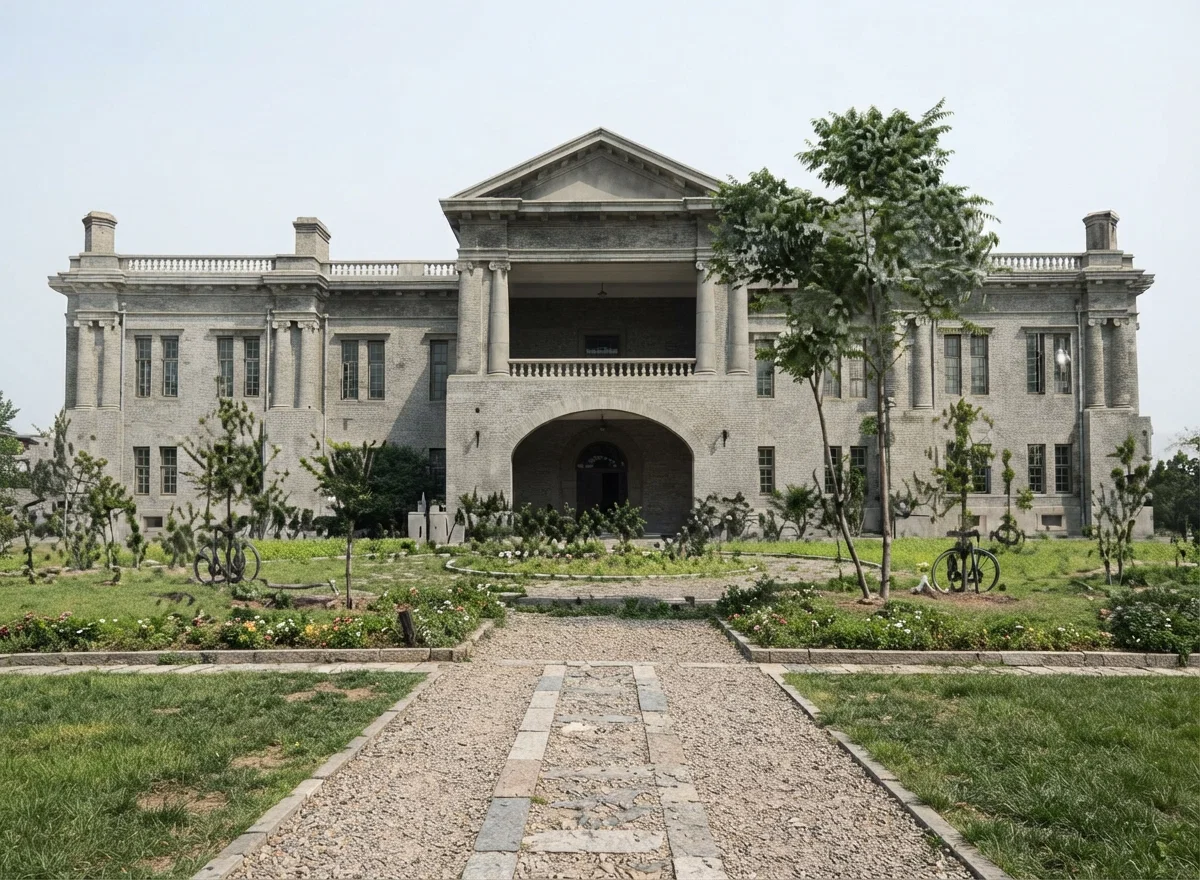
The new Waiwupu (Department of Foreign Affairs) Building at Peking
and the fact that no pains are taken to keep them from silting up, is a prime cause of the frequent floods. The magnitude of these floods can be better appreciated by referring to the recent case of Chang-teh, a large city in Hunan. For eight days the rain fell unceasingly. The Yuen River rose twenty-five feet in three days, and at least one thousand persons are estimated to have been drowned, besides live stock without number. The farmers throughout all that section will lose their entire rice crop for this year.
A Parliament for China
The changing conditions in China, and especially the advance educationally, have led to urgent requests on the part of the people for a parliament. During the reign of the deceased emperor Kwang Hsu, a period of nine years was set, at the expiration of which time (1917) a parliament was promised. This did not satisfy the people, and for the last two years, especially, they have been insistent in demanding a parliament at once.
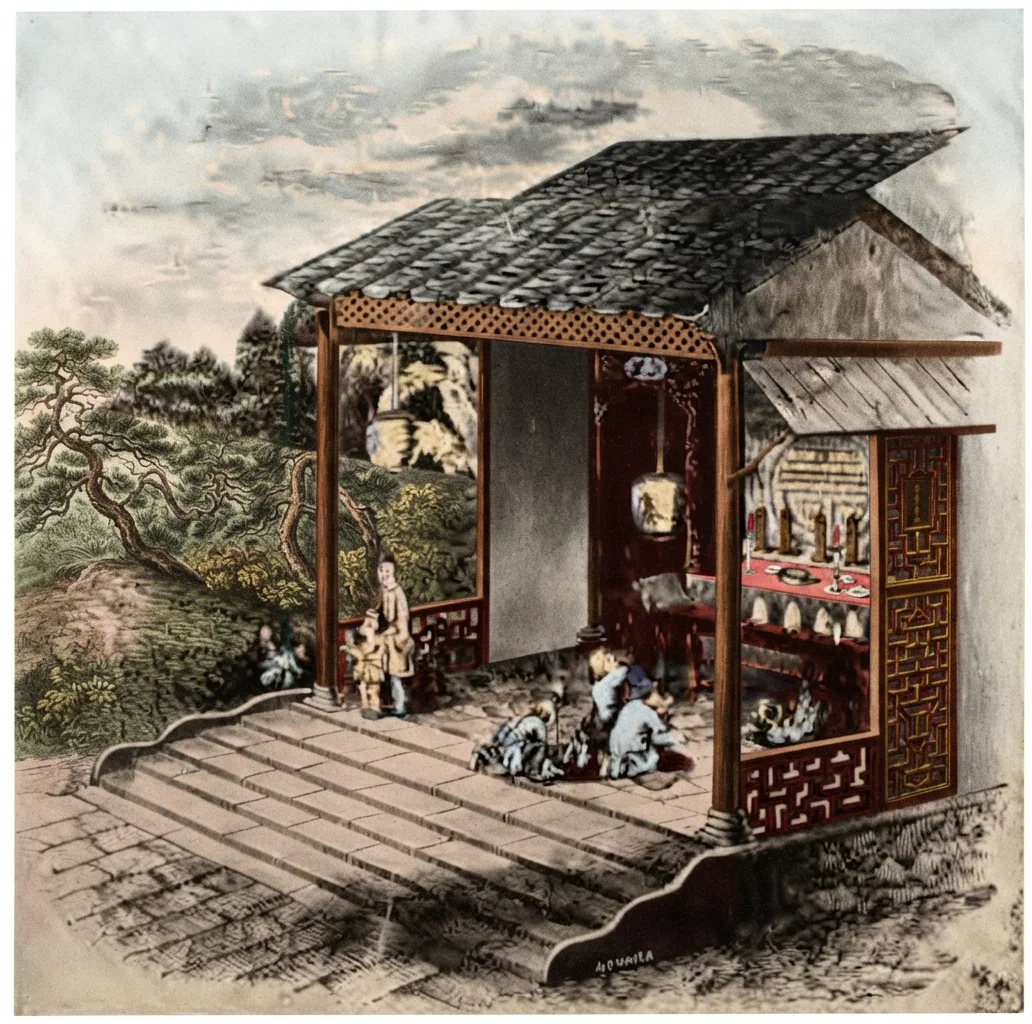
Ancestral Hall and mode of worshiping the tablets. Four tablets are shown on the innermost shelf.
Memorials are poured in from all sides with this request. But the Throne has recently refused a memorial sent in by provincial delegates, and states that it is impossible to shorten the period of nine years, formerly decided upon. It is pointed out by the Throne that the condition of the national finances and the recent riots show that the country is not ripe for a constitution.
Taken all in all, the political outlook in China is not promising. Nor can one have high hopes for the future, because of the lack of harmony between the central government and the provinces. In a general way it may be said that the influence of the central government over the provinces decreases in proportion to the square of the distance. Many of the edicts issued from Peking are nothing more than paper reforms. New boards are created from time to time in the capital, and this calls for increased revenue for salaries. The result is that taxation has been increased everywhere, and this naturally aggravates the prevailing unrest.
Population of China
The ministry of the interior recently reported that the total population of China is now 433,553,030. Out of this number 407,253,030 reside in the eighteen provinces.
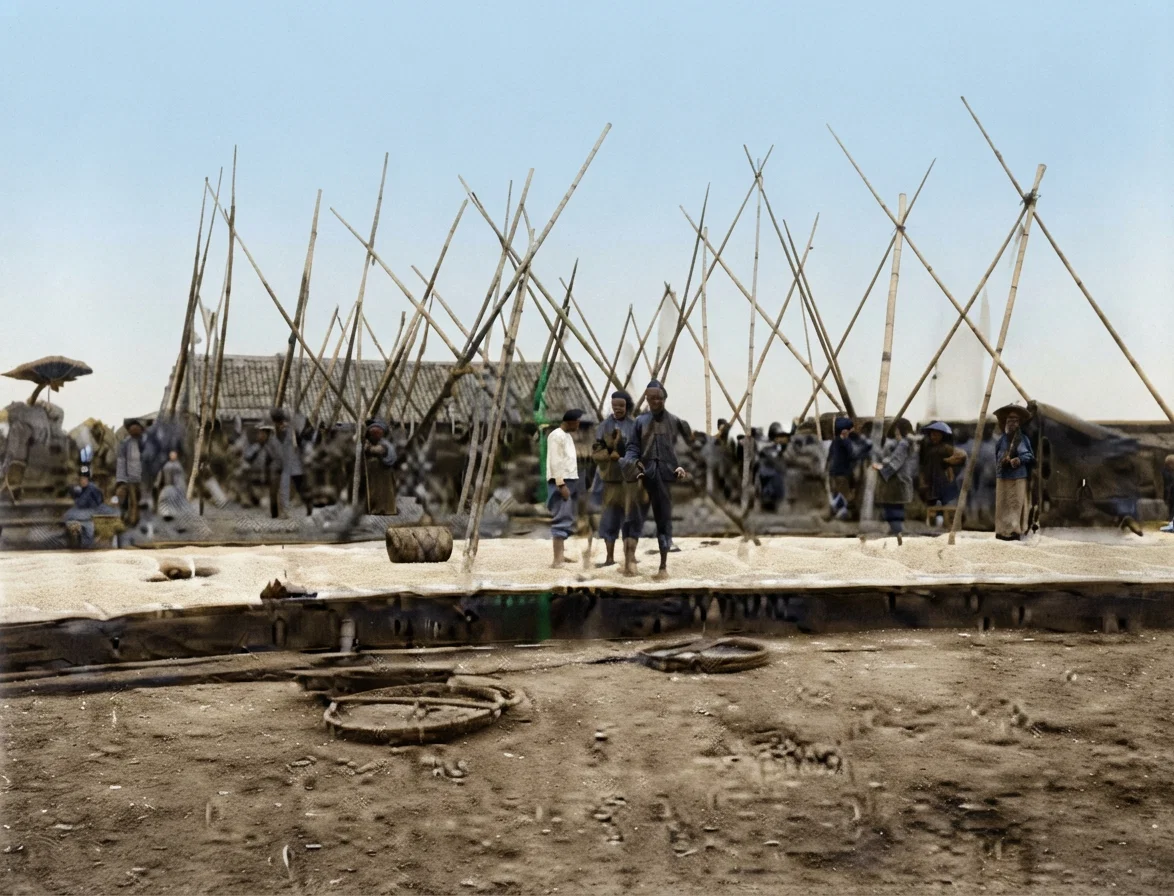
A public market-place where officials are collecting taxes which are paid in rice
Printing in China
is still in its infancy. As late as eight years ago it was not uncommon in cities of a hundred thousand population and over, to find not more than half a dozen newspaper subscribers. But this condition no longer exists, for to-day cities of this size not only have a host of people who read the news of China and the world, but many have their own dailies. The Chinese press is still under serious disabilities due principally to the vagueness of the press laws, which leave altogether too much to the discretion, or indiscretion, of the officials. Civil officials are apt to interfere with the conduct of the newspapers in a way that leaves no redress and destroys the independence that a well-conducted newspaper must have. But in spite of difficulties, marked progress is seen, and public opinion is being educated and shaped by the in many cases able editorials on questions of the day.
The Missionary Attitude toward Chinese Social Customs
This is a question which of late has been attracting no little attention among a large number of the missionary force in China. The attitude of an ever increasing number of missionaries — and as a rule they are those who have been many years in the field — is one of compromise and adaptation. I can do no better than to quote from some contributed articles which appeared in a recent number of the “Chinese Recorder and Missionary Journal.” The title of one paper is “Christian Suggestions in Chinese Superstitions.” The writer states that in view of the tendency of modern education in China to cast forth from the mind all belief in the spiritual, it behooves the missionary to conserve and cherish all absolute spiritual truth already existing in the minds of the Chinese. This writer recommends the attitude of “stooping to conquer,” because he says God did so of old in two striking instances — making use of existing and superstitious material:
“(1) Whatever the primeval origin of the week of seven days, for fully two thousand years before11Moses each seven days of the lunar month had been associated with the sun, moon, and the five planets (quoted in China as well). And of the days of the lunar month the 7th, 14th, 21st, and 28th were 'quiet days' on which it was unlucky to change the clothes, to offer sacrifice or worship of any sort, to eat flesh cooked at the fire, or even in sickness to take medicine. Here was an institution which, from time immemorial, had been one of superstitious avoidance of both work and worship; yet God, through His servant Moses, laid hold of that ancient superstition and elevated it, in connection with His finished work of creation, into a Sabbath observance of rest for the laborer, of refreshment for the soul, and of adoration toward Himself.
“(2) The second instance is still more striking. In the plague-stricken camp of Israel, Moses was divinely prompted to lift on a pole a serpent of brass; the serpent being an object of superstitious veneration in Egypt as connected in some way with the healing art. How boldly then did God risk the danger of encouraging serpent-worship itself (see 2 Kings 18:4) to bring His own salvation to the bodies of the multitudes, and to afford their descendants in after ages with a type of the Saviour (John 3:14) of more than the bodies of men! We are not called nowadays to run such risks as that, but may feel justified in pointing out certain underlying principles in the superstitions around us.”
Even thus would the professed servants of Christ base the Scriptures on heathen superstition.
Another writer discusses “Chinese Memorials to the Dead and Their Relation to Christian Practice.” He advocates retaining as far as possible the Chinese “Ching-Ming” festival. This festival is the feast of graves. On this
Chinese farmer plowing under clover as a fertilizer
day people of every rank repair to the graves of their ancestors to worship the departed spirits, and this they do by making offerings of food and wine, burning imitation money, and firing off crackers. The writer above mentioned advocates retaining the festival and the Chinese name for this festival in all Christian communions, just as the orthodox churches retain the old Anglo-Saxon title Easter. He points out that the two HEATHEN FESTIVALS (capitals ours) are almost an exact parallel, and both may be observed as the festival of the resurrection of Jesus. What this writer here advocates is already practised by Christian communities in some parts of China.
The hall of ancestors is found in the house of almost every family. It may be a room entirely devoted to this, or in the case of the poor there is merely a shelf or shrine. Here are found the ancestral tablets, usually a board about twelve inches long and three inches wide placed upright in a block. The inscription on the tablet states that it is the abode of the soul of the honored father, mother, or brother, as the case may be. Incense and paper are daily burned before these tablets, accompanied by a kotow, forming in reality a sort of family prayer. At stated times feasts are spread before these tablets.
Strange and inconsistent as it may seem, some missionaries are openly advocating the use of some form of memorial or ancestral tablet. They think it possible to retain the old ancestral tablets, disassociated from idolatry. The advocacy of such views as these by Protestant missionaries reminds one very forcibly of the attitude of the famous Jesuit, Matthew Ricci, who entered China in 1582. As a matter of expediency he allowed the converts to practise the rites of ancestral worship. It is said of Ricci that he was more a politician than a theologian, for he preached the religion of Christ according to his own fancy, disfiguring it by a faithful mixture of pagan superstitions.
In striking contrast to this policy of expediency and adoption is the teaching of our Lord through the apostle Paul: “What communion hath light with darkness? and what concord hath Christ with Belial? or what part hath he that believeth with an infidel? and what agreement hath the temple of God with idols? . . . Wherefore come out from among them, and be ye separate, saith the Lord, and touch not the unclean thing; and I will receive you, and will be a Father unto you, and ye shall be My sons and daughters, saith the Lord Almighty.”
A. C. SELMON.
The British Navy
By Henry Percy
By Henry Percy
THERE has been a great deal of talk in the American newspapers about the great possibility of a war between Great Britain and Germany for commercial supremacy, which at the present stage of the game is held tightly in the firm, strong hand of England, who will not give up without a struggle. It was by conquest England won her proud position as the wealthiest and most powerful nation of modern times, and by fighting she will retain it.
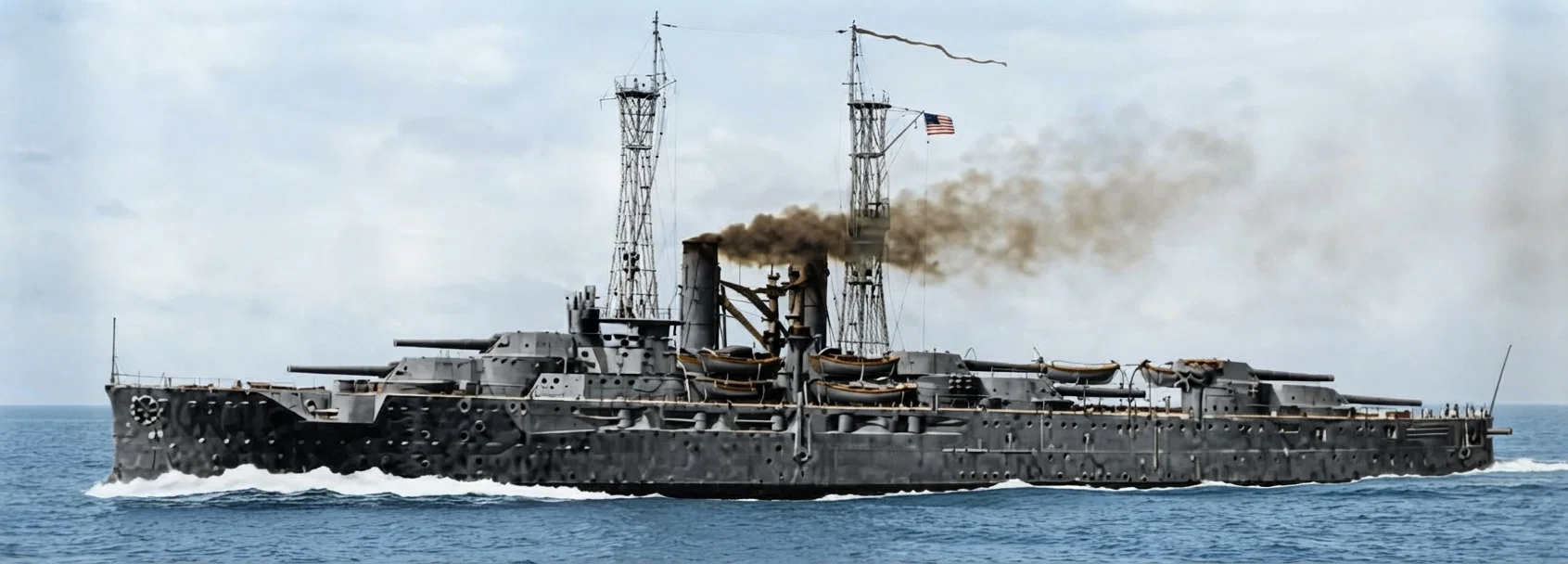
WYOMING AND ARKANSAS BUILDING FOR UNITED STATES NAVY
Great Britain is stronger now, relatively, than she has ever been before. Her commerce whitens every sea, and carries an annual valuation of nearly $7,650,000,000; and her merchant marine consists of about 35,650 ships, which are protected by a large navy of about 500 war-ships. Thus her mercantile marine forms more than one half of the entire world's shipping.
Among all modern navies, by far the largest and most powerful is that of Great Britain, whose government shows a fixed determination to keep its navy beyond the hope of rivalry. Ever since the great defense act of 1889, it has been England's policy to have a navy equal to the combined strength of an other two navies sent against her, plus a margin of ten per cent. No other powers could afford the enormous programs that she annually lays down, and at the same time keep the force that she maintains, unless they enjoyed an enormous amount of resources.
Millions of Tons of Destructive Engines
The British navy affords the most striking example of naval destructiveness the world has ever seen, composing in all 510 war-ships of a total displacement of 2,005,873 tons. In the number of first-class battle-ships she still maintains her lead over the other powers, having to her credit 62 battle-ships, with an aggregate displacement of 920,480 tons. In the number of armored cruisers we also find that she ranks first, with 94 cruisers of an aggregate displacement of 876,850 tons. Besides battle-ships and cruisers, she has a great number of submarines and torpedo-boat destroyers and scout ships.
In the year 1906, Great Britain surprised the world by launching her first Dreadnought; and since then the other great naval powers have been building Dreadnoughts for themselves. At the present time England has eight Dreadnoughts in commission, and by the close of this year she will have twelve. England's new Dreadnoughts are: the Collingwood, 19,250 tons; Neptune, 20,250 tons; St. Vincent, 19,250 tons; Vanguard, 19,250 tons; Fondroyant, 20,000 tons; Bellerophon, 18,600 tons; Temperaire, 18,600 tons; Superb, 18,600 tons; Lion, 26,000 tons; Colossus, 23,000 tons; Orion, 22,500 tons; and the Medusa, 24,500 tons. All these fighting monsters are in commission at the present time, with the sole exception of the Lion, the Medusa, the Colossus, and the Fondroyant, which will be ready for commission by the close of the present year.
Wide Extent of Fleets
The British navy is composed of eight squadrons; namely: The Home squadron of 240 ships, divided into three divisions, the Nore, the Portsmouth, and the Davenport divisions, under the command of Sir William May, K.C.B., the successor of Lord Charles Beresford; the Mediterranean squadron of 40 ships, located at Malta and Gibraltar; the India squadron of 10 ships, located at Calcutta; the China squadron of 16 ships, located at Hongkong (the India-China squadrons unite in time of war); the Australian squadron of 12 ships, located at Sydney; South Atlantic squadron of 10 ships, at Cape of Good Hope; the Caribbean Sea squadron of 5 ships, located at Jamaica; the military stations at Halifax, N. S., and at Esquimalt, B. C., will soon be reinforced by 4 ships. From the very latest report from the admiralty office in London we hear that each of these squadrons will have one Dreadnought to strengthen its fleet.
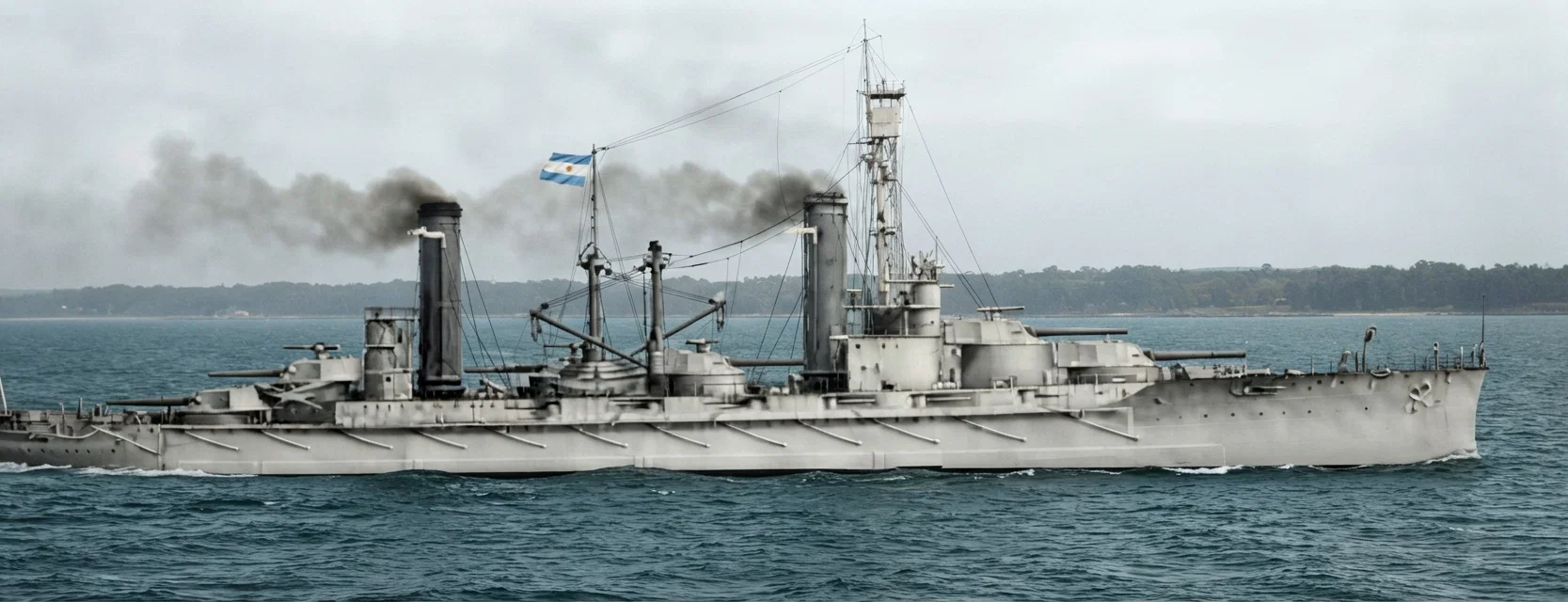
RIVADAVIA AND MORENO, ARGENTINE DREADNOUGHTS BUILDING IN AMERICAN YARDS
Thus one can readily see that in every part of the world the naval fleets of Great Britain overshadow the ocean, ever ready at the drop of the hat to begin hostilities. To man this powerful navy, over 125,000 men are required. Each sailor enlists for a term of twelve years; hence by the time he is ready to leave the navy, he has become a fine seaman, which goes to making the British sailor the best in the world. And as long as England's naval supremacy remains unbroken, any attempt at a war with her is mere lunacy.
A Vessel of 30,000 Tons
At the present time England is building four large battle-ships a year, not counting the cruisers and submarines that she builds each year; and it is also rumored that Rear Admiral Bacon, ex-director of naval ordnance, one of the cleverest officers in the British navy, has recently designed a Dreadnought of 30,000 tons which the British Government will build next year.
Signs of the Times
Shiloh: the Man of Sorrows
By Mrs. L. D. Avery-Stuttle
Chapter XXIX—The Lifegiver
MEANWHILE the miraculous work of Jesus of Nazareth had gone on. Day after day the surging multitudes sought His divine presence, bringing with them their suffering friends. The deaf heard, the dumb shouted the loud praises of the Shiloh of Jacob, and announced Him as the long-promised Messiah; while the sick and the suffering, who had been given a strength and health which many among them never before knew, united their voices in laudation and praise of the great Deliverer.
The beloved servant of Marcus the Roman centurion, was sick unto death. For a number of years past, this man, first introduced in this narrative as the companion of the cruel Varro, had made the city of Capernaum his home. Ever since the massacre of the children of Bethlehem in the days of his young manhood, this centurion, as though anxious to atone in some manner for the part he had acted in that night of horror, had favored the Jews. In fact, he had gone so far as to build them a synagog, thereby virtually disowning the gods of Rome, and acknowledging allegiance to the God of Israel.
In Capernaum he had heard much of the wonderful works of Jesus of Nazareth; and now that his beloved servant was ill, he conceived the idea of entreating the mighty Healer to save him. We know the result. With an exhibition of faith which the Master declared He had not seen in Israel, he pleaded only that "the word" be spoken. The faith of the kindly centurion was honored, and they "found the servant whole that had been sick."
In the village of Nain a woman sits in her humble home writing a letter by the dim light of a candle. We recognize her even in the uncertain light, as Adah, late of Bethabara, beyond Jordan,—the cousin of the household of Lazarus. She is writing to Martha, of Bethany.
"My dear cousin," she writes, "I have so many things to write unto thee, and such astonishing, such glorious news, that my weak pen almost refuseth to form words of such wonderful import!"
"Two days ago I began to write thee, with a sorrowful heart; for Reuben, mine only son, and the light of mine heart, had fallen the victim of a sudden fever, and I had but just closed his beautiful eyes — so like unto his dead father’s. O my dear Martha! how can I tell thee of my bitter agony?
"Never since we removed to Nain had he been in his usual health. But now, praises to the God of Israel, he standeth by my side in the strength and health of perfect manhood.
"Thou wilt know at once that this is the work of none other than the Messiah, Jesus of Nazareth; for as the Lord liveth, this is the Shiloh of the prophets. Canst thou understand my emotions? Dost thou remember thine own joy at the healing of thy beloved Magdalene?
"But I will hasten to tell thee. My son was ill of the sickness of which he died, but a few days. O how carefully I nursed him! Still, our ever growing poverty prevented to some extent my obtaining for him the aid of the best physicians. Yet, the kind physician Gideon, of Endor, scarcely left his side, and was present at his death. On the fourth day, the sickness became very violent.
"As I sat by my darling’s cot, holding his hot hand in mine, he spake to me. At first I thought his words were but the result of a feverish and diseased brain; but I soon discovered that my poor son was wholly conscious of his sad condition, and that he had a curiously strong premonition of the change which awaited him.
"‘Mother,’ he said, ‘I am sure that I must leave thee. I had hoped that the Master would be passing through Nain, and that I might be healed, even as was my cousin Magdalene and many others. But He cometh not, and we know not where He is; already my eyes are growing dim with the film of death, and I must sleep. But mother, tell me, tell me once again that the doctrine of the Sadducee is not true. Tell me, O my mother, tell me that I shall assuredly live again in the resurrection, at the last day!’"
"And I said: ‘This is the hope which comforted thy father when he died. Listen, my Reuben, while I read from the rolls of the prophets, for this shall strengthen thy faith. For even thus saith the prophet Isaiah: “Thy dead men shall live, together with my dead body shall they arise. Awake and sing, ye that dwell in dust: for thy dew is as the dew of herbs, and the earth shall cast out the dead.”’"
"When I had done my reading, I turned toward my son. A sweet smile rested upon his countenance, but behold, he was dead. Then, O my cousin, how can I tell thee my distress? Ah! how like unto his dead father he appeared, — the same broad, noble brow, the same clustering curls.
"Soon our humble room was filled with the mourning women, who ceased not to fill the air with their cries. But these knew not my grief, for alas! my heart was breaking. In a little while my boy was robed for the tomb, and after a few hours the dear form was stretched upon the bier, and directly I found myself following blindly on, on, with the procession who came to do us honor, — on through the narrow gateway of Nain, westward, toward the place of the dead. There was a large concourse of people which accompanied us, but this gave me no consolation. My heart seemed bursting. Constantly I bemoaned the fate which had condemned me to childless widowhood. And O Martha! may the God of Israel forgive me, but I know that in my heart I rebelled against the decree of the Almighty.
"The words of comfort which I had read but recently in the ears of my son, echoed in mine ears also; but alas! my rebellious spirit felt no thrill of comfort. The resurrection? Ah, yes; but my heart was too sick and rebellious to heed the comforting words of the prophets.
"Suddenly I noticed vaguely that there appeared to be a commotion among the people who accompanied us; but I did not lift my head. Then I heard some one cry: ‘Make way for the Nazarene! He cometh with His followers from the Plain of Esdraelon.’
"In the agony of mind which had followed the death of my son, I had forgotten the Master, and the astonishing miracles, the fame of which were filling all Judea and Galilee, — may the God of our fathers forgive me!
"At once, through my tear-blinded eyes, I perceived that the Nazarene was approaching the bier. This I saw without realizing its import. Then I heard His voice bidding the young men who carried the bier to stand still. The people looked one at the other at this strange interruption, but the bearers obeyed the command. Then I raised my tearful eyes to the face of the Master, and my heart melted at the expression of compassionate love which rested upon His countenance as He turned to me, gently reaching out His hand and laying it upon my head, bidding me ‘Weep not.’ Then, while my heart stood still, I heard the strange words, — strange, but sweeter and richer than any music which ever fell upon the ear of mortal, — ‘Young man, I say unto thee, Arise!’
"The gaze of the multitude was at once fixed upon the silent form out-stretched upon the bier. Instantly, at the command of the Nazarene, a tremor shook the body, and in another moment, O Martha! my beloved son was in my arms.
"‘Where art thou, my mother? and where am I? and wherefore this multitude which is gathered together?’
"The people surrounded us with expressions of astonishment and awe, while I hurriedly explained to my Reuben the wonderful truth. ‘Where hath He gone — the Nazarene — that I may worship Him?’ my son exclaimed, as soon as he had re-leased himself from my clinging embrace. But when we sought Him, He had already departed with His disciples.
"By this time many people, among whom were a great number of women, having recovered somewhat from their bewilderment, were voicing their astonishment and happiness in loud shouts of praise to the Nazarene, declaring that in very deed the long promised Messiah had at last come to deliver Israel.
"Is it not strange, Cousin Martha, that after witnessing so surprising a miracle, there could have been found any so hard of heart among all the multitude, who would cast reproach upon Him, — the Desire of the nations? But even so it was. As I fixed my gaze in the direction of Endor, in which direction the Man and His disciples were journeying, I heard two voices engaged in excited conversation. Turning, I beheld the face of Annas, the aged high priest. It was furious with anger. The purple veins upon his massive forehead were swollen, and his ordinarily calm and dignified manner had become unseemly and hateful. In close converse with him was Shaphan, the rabbi of Nazareth.
"‘What sayest thou, Rabbi Shaphan?’ questioned the high priest excitedly, ‘that thou hast known this Man — this Wizard — whose enchantments are verily chaining the senses of our people Israel?’
"‘Of a truth, O Annas, I have known Him even from His childhood, as has also my son Tubal,’ replied the rabbi, flattered at the attention of the chief priest, and turning toward a young man, with deep set black eyes, the image of his father. ‘Verily,’ continued the rabbi, ‘He hath been a begetter of strife and sedition since the days of His youth; and His coming to Nain bodeth no good to those of us in authority,’ he continued pompously, distending his thin nostrils, and tapping the high priest upon the shoulder with an air of familiarity. ‘I have now no doubt that this Wizard hath arranged the apparent miracle, that He may mislead the common people, and draw them from their lawful instructors and leaders. For behold, who knoweth that this young man was of a truth dead?’
"By this time, my dear cousin, there was great excitement among the people, as their attention was called toward the aged high priest and the rabbi. ‘Behold!’ exclaimed Annas loudly, as if intent upon disabusing the minds of the multitude that a miracle had indeed been performed, ‘behold, I am the high priest, even Annas, and I am a Sadducee! How then shall I believe in a resurrection from the dead? for of a truth Moses in the law saith not that the dead shall live.’
"As thou mayest imagine, my cousin, I could hold my peace no longer. ‘Behold, O Annas,’ I exclaimed, ‘this young man is my son, — and verily he was dead, but now he liveth!’
"‘What sayest thou, young man?’ interrupted Rabbi Shaphan, sneeringly, ‘what dost thou remember? How camest thou here?’
"‘I remember naught, O rabbi, save that I was sick unto death. But behold this concourse of people and this bier, and yonder is the Son of Joseph, the carpenter of Nazareth, who hath given me life again. Is not this the Messiah?’"
"‘Thou knowest nothing at all!’ growled Annas and the rabbi in one breath, and Annas continued: ‘Thou hast been only sleeping. Even Moses himself gave not life again to dead men! and who is this Pretender, who teacheth blasphemy! for the dead rise not at all.’
"Then I perceived that there was a division among the people; the venerable Rabbi Ben-Israel, whom thou rememberest well, my cousin, leading the sect of the Pharisees, contending for the resurrection from the dead; and because Rabbi Shaphan and his son Tubal were Pharisees also, they knew not what to say, except that in their opinion my son had been in league with the Nazarene;13while Annas, the high priest, declared that not only had the Man deceived the people, but that, without any doubt, the entire circumstance from the beginning to the ending had been prearranged and contrived by the Pretender and His friends, in order to make good His claim to the Messiahship.
"Thus, my dear Martha, are the most wonderful signs and miracles made of none effect before the people.
"At last I perceived on the outskirts of the crowd the physician who attended my son. In a moment he was by my side.
"‘Hold, O Annas! and thou, O Shaphan! and harken unto me, ye men of Israel! I attended this young man, who was sick of a fever, from which he died. And verily this morning, at the rising of the sun, there was no breath left in him.’"
"‘Ho! this fellow also is in league with the Nazarene!’ bellowed Annas, his face purple with rage.
"‘Behold, thou also art of Nazareth!’ retorted Gideon, the physician, turning to Rabbi Shaphan.
"‘Verily; and Tubal, my son, knoweth Him as well as I, and we testify unto you that He is regarded even in His own city Nazareth as a vain fellow and an impostor!’"
"‘A vain fellow and an impostor!’ echoed Tubal in a shrill voice.
"‘Nor is this all,’ continued Rabbi Shaphan, suddenly changing his expression to that of sanctimonious horror, while his voice sank to a deep whisper.
"‘What knowest thou further of this Nazarene, O rabbi?’ demanded Annas.
"Bending toward him till the long, white locks of the aged high priest touched his skinny cheek, Rabbi Shaphan hissed in his ear:
"‘The Impostor is born of fornication, and He shameth the house of Israel; for no man knoweth His father!’"
"My heart bled at these unrighteous words, my dear kinswoman; but seeing that we could do the cause of the Nazarene no good by remaining longer, and with our hearts filled with unspeakable emotions, we took our way homeward.
"I hope to visit Bethany in a few days; and if so, I shall see thee. But while I live, the praises of the Master shall be upon the lips of thy cousin, "ADAH."
(To be continued)
Washing Is Easy
By Alfred Mallett
Take your clothes from cold water, put them in boiler to which has been added E-Z Washing Tablet and soap as directed; let boil twenty minutes. Rinse, blue, and washing is done WITHOUT RUBBING. All dirt disappears. Positively will not hurt the finest fabrics. Costs little. Nine washings 25c, post-paid. Alfred Mallett, 721 H St., Sacramento, Cal.
"Food and Cookery"
Its relation to health, lessons in practical work. Compiled by H. S. Anderson. College Press Print, Loma Linda, California.
The object of the little book is to set forth the values of various kinds of foods, their constituent elements, the best food values, how this food should be cooked, proper combinations, etc., etc. A large number of recipes are given, showing how to prepare the best foods in the best way. It is a neatly printed and helpful pamphlet to every housewife, in fact every one who eats. Can be obtained by addressing the publisher. Price 25 cents. Send postage stamps. Address College Press, Loma Linda, California.
For Sale
Near the Pacific Union College on Howell Mountain, a beautiful home, a fine established business complete. Finest climate; best of spring waters. An excellent location for a sanitarium. Must be sold to close estate. Half cash; would take part in trade for bay properties. This place must be seen to be appreciated. Address C. A. Henne, St. Helena, California.
Life and Health
By Editor
A PRACTICAL health journal, published with a view of meeting hygienic needs in every home; teaching how to care for the health and how to preserve life; prescribing simple home treatments to assist nature in throwing off diseases rather than adding more poison by using drugs or unnatural stimulants as remedies; teaching how to avoid disease as far as possible, how to manage in the home when sickness does come, and how to combat the disease by simple remedies which nature provides.
Send for sample copy and special rates to agents. Price 10 cents per copy or $1.00 per year.