Signs of the Times, October 24, 1916

Catholic Week in New York

Signs of the Times

Oct 24, 1916

Pacific Press Publishing Association · Mountain View, California · Oct 24, 1916

Catholic Week in New York
By CHARLES T. EVERSON
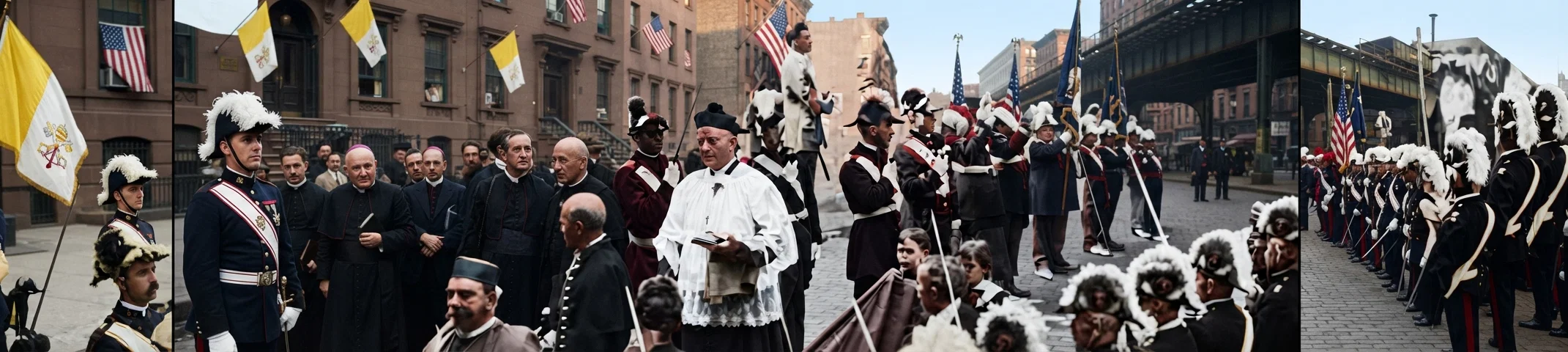
WHAT was considered the most notable gathering of Roman Catholics in the history of this country assembled in the city of New York during the week beginning August 20. It was occasioned by the meeting of the American Federation of Catholic Societies. The multiplicity of societies and activities represented by the federation would in themselves call together a very select group of Catholic spirits. But apart from this large delegation of prelates, priests, and prominent laymen, there were brought together for the first time on one platform, the three American cardinals and the papal delegate to this country.
It was known as “Catholic week” in the city, and was prominently kept before the public through the press as well as by the many flags decorating buildings throughout the metropolis. A feature of these decorations was an extensive use of the papal flag, with the tiara and the keys standing out strongly upon the background of yellow and white. While the American Federation of Catholic Societies was the chief body of the assemblage, representing, as it does, more than three million members, three other large organizations were represented by numerous delegations. The three societies that were associated with the American Federation in this convention were the German Catholic Central Verein, the National Conference of Catholic Charities, and the Catholic Press Association.
© Underwood
© Underwood
These various societies met in order to come to a better understanding of the problems confronting the Catholic Church, and how to coöperate more successfully in their solution. The plan proposed, and toward which the convention worked, was that the four societies not merely coöperate, but coalesce under the leadership of the American Federation. This would unite the activity of the laymen of the Catholic Church along the lines of social, charitable, press, educational, and propaganda work. The plan embraces the using of the Catholic press as a central clearing house and disseminator of Catholic ideas, and the creation of a national Catholic Chautauqua.
Among other things, Cardinal Farley, of New York, told the Catholic Press Association that he believed a daily Catholic newspaper should be founded. In this connection, he made use of the following language:"The first great gun against the calumniators of the church was fired here in New York years ago, when the Catholic World was started. At that time, newspapers had the habit of attacking Catholics, from the pope down, with a violence and a bitterness that they would not employ toward even the most insignificant sect. Things have changed since then, owing to the activities and abilities of the editors in Catholic publications. During this time, those opposed to us have become more respectful in their opposition. Let us not cease, in season and out of season, to contradict calumny after calumny, even at the risk of being thought monotonous. Don't care what is said; keep at it."
A pontifical mass opening "Catholic week" was celebrated at St. Patrick's Cathedral on Sunday morning. A procession was formed at Cathedral College, in which members of the convention, together with many of the New York parishes, participated, and marched to the cathedral. The apostolic delegate, John Bonzano, surrounded by his staff, was followed by Cardinal O'Connell, of Boston, and his staff, Cardinal Gibbons and his staff, and Cardinal Farley and his staff. These prelates were the chief attractions of the procession. As they passed, men and women knelt in the street. With such a coterie of church dignitaries present, the mass assumed a somewhat similar appearance to the big functions in Rome.

Delivering the Fatal Blow

But the really important meeting of the convention was held on the evening of the same day, in Madison Square Garden, the largest hall in New York City. The newspapers put the number present as twenty thousand, but that is probably a little over the capacity of the hall. However, the place was jammed, and thousands of persons turned away for lack of room. It was the occasion around which everything else circled. It was made exceptionally prominent in the press and before the public, as the Catholic Church of America had a pronouncement to make, which it wanted the whole country to hear. It was the church's great effort to convince the country that it stood for America and Americanism undiluted.
In keeping with this idea, the hall was decorated and draped extensively with American flags. The spirit of patriotism was made the order of the day. While there were three cardinals and the apostolic delegate present, the telling speech was evidently assigned to Cardinal O'Connell, of Boston, as the one most likely to stir the large audience and the country.
There had been bitter denunciations of the papers that were attacking Catholicism, during the Catholic Press Association meetings. "Scurrilous," "mendacious," and similar words were favorites with Catholic speakers in denouncing opposition journals. Strong pleas were repeatedly made for laws to be enacted by the government for the suppression of these attacks upon the Catholic Church. With these fiery speeches and denunciations as a background, the stage was set for Cardinal O'Connell amid ecclesiastical splendor calculated to give the active opposers of Catholicism such a blow as he hoped would ever after discredit them in the eyes of the public.
The following description of the manner in which the speech was given and the impression produced is especially interesting, as it comes from an unbiased source, the New York Times:
"It seemed, when Cardinal O'Connell, of Boston, in slow and solemn tones, and speaking, as he said, out of his acquaintance with the minds and purposes of three popes and the whole American hierarchy, had denounced 'once and for all' those who asserted that the church conspired for temporal control, the highest pitch of enthusiasm had been reached.
"But a moment later, Cardinal O'Connell struck even closer to the hearts of his hearers as he warned America of her need of her 20,000,000 loyal Catholic citizens, and demanded that she keep her side of the contract in return for their readiness to bleed and die for her. Seldom has a New York audience been more deeply affected than was the multitude in the garden when the cardinal, in a voice that reached every man, woman, and child, said:

No Whispers of Plotting

" 'Oh, yes, we know very well the whole litany of accusations against us. We give only a divided allegiance. We are scheming for government. These are all lies so patent that they need no answer. Indeed, those who fling them out will never listen to any answer. But I am going to answer them once and forever here to-night.
" 'As a cardinal, I may be supposed to know what I am saying on this subject. And, on my word as a gentleman of honor, I am speaking the simple, absolute truth. I have known intimately, personally, and officially three sovereign pontiffs — three popes of the Catholic Church. I am a priest now thirty-two years; I am a bishop fifteen years, and a cardinal five years. I have had the closest relations with not only the pope, but the whole Roman curia; I know well every priest in my diocese and every bishop in this country. Yet never, never, in all that experience, have I ever heard spoken, lisped, or whispered, or even hinted, by any or all of these, anything concerning America and American institutions but words of affection, of tender and kindliest solicitude for her welfare; never a syllable that could not be printed in the boldest type and distributed throughout the land; neither plot nor scheme nor plan, but only sentiments of admiration and love. If there is plotting, I ought to know it. Yet, absolutely and honestly, of such things I have never heard even a whisper. . . .
" 'If you stand by inactive, while under your very eyes, yes, through your very mails, which we pay for, we are insulted, scurrilously maligned, and openly vilified, in filthy journals, and nasty, indecent literature, unfit to be printed or read, spread broadcast, that dupes and bigots may be poisoned against us, so that we may be robbed even of our public rights — then you are not keeping your contract — this is not liberty.
" 'You are only wounding the hand, the strongest hand, held out to help you; you are spurning the aid of those who again and again you have found, in your hour of direst need, the most willing to die for you.' "

Wild Enthusiasm Results

That these words made a powerful impression upon the large audience, and put at least loyal Catholics in a frenzied state of mind, may be gathered from the following quotation taken from the same paper:
"Time and again, Cardinal Gibbons's thin hand, stretched out over the people, had stilled their tumult in an instant. This time, even his quiet authority was powerless. The Boston delegation's noisy band thumped its drum, and sent crashing chords of brass to swell the din; the somber, purple-garbed papal delegate, Archbishop Bonzano, nodded and clapped his hands; Cardinal Farley leaned out of his chair and beamed with gratification; Governor Whitman sat with his eyes glued on the heavy, lined face of the cardinal from New England; and the audience climbed on chairs, waved hats and handkerchiefs, and sent out deafening roars of 'Bravo!' and 'Long live O'Connell!"
It might be stated, however, that the plans our Romanist friends have for capturing this country for their church have not been learned from hostile papers, but are derived from Catholic sources.

Wiping Out the Reformation

That if their plans succeed, "Protestantism will be a study of the historian and antiquarian, together with Arianism," is a statement made by themselves. And the declaration that with the fall of Protestantism in America, the Reformation of the sixteenth century would be wiped out, is also from Catholic sources. What could the destruction of Protestantism mean, if not Catholic rule in the United States? It is therefore not so difficult to understand the program of Catholicism for our country.

HARVEST

BY RUTH LEES OLSON
SAY not ye, "Yet four months, and then the harvest cometh, And we with sharpened sickle to the fields will go, To gather in the sheaves of ripened grain low bending Beneath the burning kisses of the sun's bright glow." Lift up thine eyes to Africa's great sandy desert, The land where once the marvelous power of God was shown, Where thousands of the souls His love and power created, Now grope in fear and dread through sin's dark hours, alone. Look up and listen to the wail of China's millions Pleading for help to insensate gods of wood and stone, While lives of myriad helpless babes cry out for succor From crimson river's moan. To the sad eyes of hosts of India's childhood widows, To Russian peasant's calloused hands and pain dulled heart. To nations that, bound in the chains of heathen darkness, Beholding not the gospel light, still stand apart, Look up! Behold, the fields are ripe unto the harvest. Already doth the sickle wait thy listless hand. The Master calls for reapers in His needy grainfields; And art thou deaf to His command? Go forth, go forth, with eager footsteps hastening, And work with heart and hand while it is day, Thy place to fill. The sheaves thy hands may garner, Lest others bear the golden grain away.

Passing a Hundred Million Worlds

By Benjamin G. Wilkinson
The popular fancy that the righteous will spend the millennium upon this globe is as far from the truth as heaven is from earth; for the saints will be in heaven, and not on earth. The world will be uninhabited and unvisited by human beings during that memorable thousand years. The truth of this statement is ably presented by Dr. Wilkinson in this excellent series, which will be concluded in our next issue, under the title, “Satan’s Last Charge.” EDITOR.
OUT from their graves, like Lazarus of old, the righteous will arise at the beginning of the millennium, in response to the call of Christ. Many of these have, by His grace, been snatched from the service of Satan, like brands from the burning. Deep had been their attachment to the Saviour, and great had been His love for them. While He has ministered in glory by the throne of God, He has never forgotten them,
"For the heart that is truly loved never forgets, But as truly loves on to its close, As the sunflower turns on her god, when he sets; The same look that she gave when he rose."
Blessed and holy is he who takes part in the first resurrection. While the wicked dead sleep on for a thousand years, for a thousand years these resurrected righteous ones will live and reign with Christ. Their characters are fixed before His coming. They need no Judgment, for they have passed their sins beforehand into judgment. As far as lay within their power, they have settled everything with God before, and made everything right with their fellow men. There is in their bosom nothing that would lead them to hurt or destroy, and they are accounted worthy of the promise of the Saviour, “Blessed are the meek: for they shall inherit the earth.”
The millennium answers forever the contention of the unbeliever that it makes no difference whether we serve God or do not serve Him. While the wicked sleep on unlamented, ungathered, and unvisited, for a thousand years, the righteous are the companions of Christ. The splendor of His coming falls upon them, and raises them to the spot light.

Through a Star-Studded Corridor

As on a glorious float they make their way from earth to the throne of God. Unfallen worlds, if we may so say, come out to shower them with felicitations as the mighty throng pass by. Jupiter with its bands, Saturn with its mighty rings, Uranus, Neptune, and the stars, worlds yet unrevealed to the telescope, beauties and glories accessible neither to the telescope nor to the human eye, greet the redeemed at every turn as they fly through the regions of infinite space.
It is no dark, cold, unpleasant journey they take. Everywhere there is splendor, there is glory; and the presence of the Redeemer Himself lights up the chasms of the stellar deeps. Herculean walls of splendor, glowing with a pearly light—a light that knows neither night nor shadow, and studded through and through with some of the greatest suns that shine and wheel in God’s great universe—form for them a majestic corridor as they sweep on to the immortal throne. Just as the bee, amid trees and plants, will move for miles and miles, with unerring rapidity, to its honey-filled hive, so shall the redeemed fly with incredible velocity through regions never conceived of in the wildest flights of imagination. Friend, where will you be? Will you sleep, throughout those thousand years, in an unlamented grave upon this desolate earth, or will you be found with the Saviour on His triumphal journey to the mansions in our Father’s house?

Witnesses Throughout Eternity

It was on the earth that the battle of redemption was fought. Here the great rebel tried to seduce humanity into being his followers. With a cruel hate, with a refinement and subtlety of oppression, which none but those who have been redeemed by the Saviour’s grace could understand, he sought to malign the character of God.
No other world has witnessed such a terrific strife. Though, as astronomers tell us, this earth may lie on the very edge of the Milky Way, and the Milky Way itself may be a stellar band which surrounds God’s great universe, yet only after the throne of God does this earth stand forth, as the most important of a hundred million spheres.
The testimony of the redeemed, whose position is declared to be next to the throne of God, will be shot through and through with infinite power. The throne of God needs the redeemed as much as the redeemed need the throne of God. Their testimony will be of infinite value throughout the eternal ages. This is doubtless what is meant when the Revelator presents before us the throne of God, and then adds: “Round about the throne were four and twenty seats; and upon the seats I saw four and twenty elders sitting, clothed in white raiment. . . . And out of the throne proceeded lightnings and thunderings and voices.” Rev. 4: 4, 5.

No Monotonous Round of Song

As we read on a little further, we hear again the triumphal song of these four and twenty elders, as they sing: “Thou art worthy to take the book, and to open the seals thereof: for Thou wast slain, and hast redeemed us to God by Thy blood out of every kindred, and tongue, and people, and nation; and hast made us unto our God kings and priests: and we shall reign on the earth.” Rev. 5: 9, 10.
Another fact shows how important is the earth to God’s throne. We read that “in the midst of the throne, and round about the throne, were four beasts full of eyes before and behind. And the first beast [or living creature] was like a lion, and the second beast like a calf, and the third beast had a face as a man, and the fourth beast was like a flying eagle.” Rev. 4: 6, 7.
Of course, we know that the translation “beast” is not correct, both from the Greek, where the word really means living creature, and secondly from the fact that in the next verse these living creatures are said to sing, “Holy, holy, holy,” before the throne of God. Their song is not a monotonous round; but from the depths of their superior intelligence, each new manifestation of God’s creative power calls forth a new outburst of rapture.

The Cortège of Infinity’s Throne

But is it not remarkable that the terms used for comparison or symbol are the names of earthly creatures? Was it because of these four living creatures around the throne that God created on this earth a lion, a calf, a man, and an eagle? Or were they used in describing the cortège of Infinity’s throne, simply to show that the principles manifested in terrestrial life represent unfathomable depths in the great controversy between Christ and Satan?
We need not wait until, as some students of astronomy predict, the earth will be removed from the edge of the Milky Way close up to that world which is heaven, to see how closely knit are the activities of the eternal throne with this planet called the earth.
Moreover, do not the Scriptures also teach us that the Redeemer’s capital city, the New Jerusalem, will be located upon this earth, and here will be His kingly courts? And as the Son shall be subject to the Father in all things, yet of all creatures the most closely related to Him, so likewise shall not the earth be subject to the direction of heaven, but be to it the most closely attached of these hundred million spheres?

Men to Judge Angels

Throughout the thousand years, the saints, with the angels, will pass upon the cases of the wicked. For God Himself never sends forth an arbitrary judgment. Even when He commanded the great tree of Nebuchadnezzar (Continued on page 7)

Passing a Hundred Million Worlds

(Continued from page 3) to be cut down, in tears Daniel informed Babylon's mightiest monarch that "this matter is by the decree of the watchers, and the demand by the word of the holy ones." Dan. 4: 17. Myriad in numbers, angels and redeemed will judge not only the wicked dead, but also fallen angels. As says the apostle Paul, "Know ye not that we shall judge angels?" 1 Cor. 6: 3. Many dark chapters in earth's history will be opened up to them; and things which were too mysterious to be understood or known by human philosophy or human intelligence, shall come to light.
Thus the plan of redemption will be unfolding; and their time occupied with this, and with being introduced to God's great universe, the glories of the thousand years will make the resurrected righteous feel that at the price of surrender and suffering on earth, they purchased heaven cheap enough.

A Spiritual Paradox

BOTH

DEAD & ALIVE Excerpt from a Sermon by CHARLES THOMPSON TEXT: "Having a form of godliness, but denying the power thereof; from such turn away." 2 Tim. 3: 5.
POWER properly belongs to godliness; but there is a possibility of a person's having a form of godliness without having the power. A condition of this kind is very unfortunate — so unfortunate that we are admonished to "turn away" from it.
I would not have you get the idea that I think God wants us to turn away from any individual. He is speaking about an existing condition from which He desires us to turn away. When people go through the treadmill of religious ceremony and accomplish nothing, the situation is unfortunate; and the danger of such a condition is what I wish to warn against.
I do not decry forms and ceremonies; I believe in them. Every religion, whether Christian or heathen, is expressed in some form. A man who has no form of worship has no religion of any kind, because religion does not exist in the human heart without seeking to express itself in some form of worship. God is the author of forms.
We read in Ex. 25: 8, "Let them make Me a sanctuary; that I may dwell among them." God wanted to dwell among the people, and He instructed them to build a sanctuary. The earthly sanctuary was the center of a continual round of services and ceremonies, through which men had opportunity to give expression to their belief in God and their appreciation of Him. However, there is danger of having the form, yet being destitute of power.

A Name Not Enough

To have a form of godliness is entirely proper; but the breath of life must be in the form, so it will be a living, active, serviceable experience. It is possible to have a dead form; for we read in Rev. 3: 1: "And unto the angel of the church in Sardis write; These things saith He that hath the seven Spirits of God, and the seven stars; I know thy works, that thou hast a name that thou livest, and art dead."
It has its name among the denominations, has a church building, a pipe organ, a pastor, a choir, a congregation, a belfry, and a bell. The whole thing looks like a church. The form is there, but it is dead. Is there a possibility of a church's being dead when it has a pastor? Sometimes I think that the greatest blessing that can come to a church is to be without a pastor. Not that there is anything wrong with the pastor; but often all the activities of the church are wrapped up in one man, and that is most unfortunate for a church.

The Sign of a Dead Church

We read in 1 Tim. 5: 6, "She that liveth in pleasure is dead while she liveth." This is a sort of paradox, to speak of one as being dead while he is yet living. Some people believe in a death that never dies; but you might as well believe in a life that never lives. If you are seeking for a dead church, look for a pleasure-loving church. And, by the way, the "lovers of pleasures more than lovers of God" are the ones from whom we are told by our text to turn away.
The hour has come when this condition should cease to exist. God has placed in connection with the church and Christianity a power for the accomplishment of something in the individual life and in the world. Nothing sadder could overtake the church than to become pleasure-loving and worldly, so that the people would simply go through a form of worship, and cease to be a power in the world. Where you find the most form and ceremony, you frequently find the least godliness. When people feel the need of something to take the place of the religious life which they realize is receding, often, alas, they grasp after rituals instead of realities.
Show me a church that the world loves, and I will show you one that is not very spiritual; because the statement came from the lips of the Saviour Himself, that the world loves its own.
I would have you note a statement from Amos 5: 21: "I hate, I despise your feast days, and I will not smell in your solemn assemblies." Is not God the author of feast days and of solemn assemblies? — Most assuredly; yet there is a possibility of having such convocations without having the Lord's presence. Why? — Because of lack of heartfelt righteousness. God wants righteousness; and all forms that are expressive of it are acceptable to God.

Sin's Cloak of Forms

It is alarming to see to what extent individuals can go in the name of religion, and what they can educate themselves to do, going through the round of services, having a form of godliness, but at the same time doing many wicked things. You will recall the incident recorded in Acts 12: 1-4. Herod was king. He was using his official power to "vex certain of the church." He had killed James because it pleased the people. He had Peter in prison, waiting for a favorable occasion to slay him. What stood in the way? — The days of unleavened bread, and the Passover. This was a religious festival, and he would not cut off a man's head at this time. He could do it before, and was prepared to do it afterward; but he called a respite while he observed the forms of worship.
More striking still is the willingness of the Jewish leaders to murder the Prince of Life, though they scrupulously refused to allow His body to hang on the cross on the Sabbath day. John 19: 31.

He Accepts No Substitutes

In Jer. 2: 13, we read: "My people have committed two evils; they have forsaken Me the fountain of living waters, and hewed them out cisterns, broken cisterns, that can hold no water." A cistern is a form of well. Dr. Cruden, commenting on this text, says a cistern is anything that persons put their trust in besides God. There is danger in that. We get a substitute for what God has said, and depend on the substitute, and are destined only to disappointment in a crisis.
In Paul's comment on this statement of Jeremiah's, he says, "Therefore we ought to give the more earnest heed to the things which we have heard, lest at any time we should let them run out as leaking vessels." Heb. 2: 1, margin. Our danger lies in being leaking vessels,—getting a Christian experience, and then losing it all. The thing God wants changed is this leaky experience. Let us make the obtaining of the power of godliness the principal part of our religious service.

Christians to Be Flowing Wells

Our Saviour makes clear where help can be provided. In John 4: 13, 14, He said to the woman of Samaria, at the well: "Whosoever drinketh of this water shall thirst again; but whosoever drinketh of the water that I shall give him shall never thirst; but the water that I shall give him shall be in him a well of water springing up into everlasting life." Again in John 7: 38 we read, "He that believeth on Me, as the scripture hath said, out of his belly shall flow rivers of living water."
Thus we find the directions for becoming a living, flowing well, ready to help others when help is needed. "He that believeth on Me, as the scripture hath said," shall have this experience. If there is anything we need to educate ourselves to do, it is to believe what the Scriptures say. You will never have a living, flowing experience until you believe the Book.
John explains the figure by saying, "This spake He of the Spirit, which they that believe on Him should receive." Verse 39. Hence we find that the Saviour is teaching the importance of the Holy Spirit, and what it will do for us. But we need not pray for the baptism of the Holy Spirit until we are ready to believe the Scriptures. And when we receive the Holy Spirit, we have the form of godliness with the power; for the Saviour has said, "Ye shall receive power, after that the Holy Ghost is come upon you." Acts 1: 8.

A Dead Church Is a Liability

We need also to remember that power is given for service. If we do not intend to spend our lives helping others, we do not need an increase of power. God wants the church to be living and active, having both form and power.
No worse calamity could come to a community than to get a dead church on its hands. Such a church, instead of being an asset, is a great liability. The church on earth is designed to be the dwelling place of the Holy Spirit; and what the church needs is to receive Him, to commune with Him. God wants our prayer meetings, our communion services, the preaching, and the gospel singing; but He wants it all to be expressive of a life consecrated to God for service, and the overflowing of a Spirit-filled life, that knows the power of redeeming love, and is simple enough to believe what "the scripture hath said."

The Christian Nation Misrepresented

"PUTTING the name of Christ in the constitution will not make the nation Christian any more than putting a pure food label on a basket of partially spoiled fruit will make the fruit pure. One has said, 'To be converted does not mean to be whitewashed, but to be washed white.' Without the complete transformation of individual hearts, the labeling of this nation as 'Christian' is a misrepresentation of the facts."
Continue reading: MODERN RELIGIOUS TRUSTS