Review and Herald, Vol. 93, No. 39.

Life Only in Christ

Review and Herald

Aug 7, 1916

Review and Herald Publishing Association · Takoma Park, Washington, D. C. · Aug 7, 1916

Life Only in Christ

MAN'S NATURE AND HIS STATE IN DEATH

By W. A. Spicer

God Only Hath Immortality

A WIDE-OPEN door for Spiritualism is afforded by the teaching that man has life in himself,—immortality by nature,—and that death is not really death, but another form of life.
The Scriptures close this door of peril, teaching us that man is mortal, that death is really death, and that immortality is the gift of God through Christ by the resurrection from the dead.
Clearly and definitely the Bible teaches that God only has immortality:— "The blessed and only Potentate, the King of kings, and Lord of lords; who only hath immortality." 1 Tim. 6: 15, 16.
This scripture disposes of every idea that man is immortal by nature, and opens the way for a consideration of the Scripture teaching concerning man's nature, his state in death, and the promise of life and immortality in Christ.

Man by Nature Mortal

The word "mortal" as used in that ancient question by Eliphaz describes man's nature:— "Shall mortal man be more just than God?" Job 4: 17.
In the creation, life was conditional upon the creature's relation to Christ the Creator, in whom all things consist:— "All things were made by him; and without him was not anything made that was made. In him was life." John 1: 3, 4.
He was, as the psalmist says, "the fountain of life." Cut off from vital connection with him, there could be no continuance of life. The Lord warned Adam that his life was conditional upon obedience. "In the day that thou eatest thereof," he said of the forbidden tree, "thou shalt surely die." Gen. 2: 17. It was a declaration that man was not immortal, but was dependent for life upon God.
When man rejected God by unbelief and sin, the sentence must have been executed—death eternal—had not the plan of salvation intervened. But as the stroke of divine justice was falling upon the sinner, the Son of God interposed himself and received the blow. "He was bruised for our iniquities." In the divine plan, the great sacrifice for man was as sure then as later on at Calvary. Christ was "the Lamb slain from the foundation of the world."
And there, Adam, the sinner, with fallen human nature now, was granted an extension of life, every moment of which, for him and for his posterity, was the purchase of Christ by his own death, in order that in this time of probation man might find the forgiveness of sin and assurance of life to come. Originally Adam was placed on probation, and had he continued faithful, the gift of immortality must have been given him at some later time, after he had passed the test; for, as the original plan is carried out through Christ, "the Second Adam," the gift of immortality is bestowed upon all who pass the test of the judgment and are found in Christ, in whom alone is life.
Having fallen, Adam, possessed of a sinful nature, must die. "The wages of sin is death." It was impossible that sin should be immortalized in God's universe. So, inasmuch as the tree of life in Eden had been made the channel of continuance of life to man, the Lord said:— "Now, lest he put forth his hand, and take also of the tree of life, and eat, and live forever: therefore the Lord God sent him forth from the garden of Eden." Gen. 3: 22, 23.
This negatives the idea that there could ever be an immortal sinner marring God's creation forever. Sin works out nothing but death. "Sin, when it is finished, bringeth forth death." James 1: 15. Fallen himself, Adam could bequeath to his posterity only a fallen, mortal nature. So began the sad history summed up in the text:— "Wherefore, as by one man sin entered into the world, and death by sin; and so death passed upon all men, for that all have sinned." Rom. 5: 12.

Against Death Man Is Helpless

Mortality is written upon all creation. Ages ago the wise man wrote, "There is one event to all . . . after that they go to the dead." Eccl. 9: 3. Human hearts everywhere and in all time have cried out against the remorselessness of the great enemy. "Do people die with you?" was the question met by Livingstone in the untraveled wilds of Africa. "Have you no charm against death?" The Greek as well as the barbarian confessed the helplessness of man before the great enemy.
Centuries before Christ, Sophocles, the Athenian, wrote:— "Wonders are many! and none is there greater than man, who Steers his ship over the sea, driven on by the south wind, Cleaving the threatening swell of the waters around him. "He captures the gay-hearted birds; he entangles adroitly Creatures that live on the land and the brood of the ocean, Spreading his well-woven nets. Man full of devices! "Speech and swift thought free as wind, the building of cities; Shelters to ward off the arrows of rain, and to temper Sharp-biting frost—all these hath he taught himself. Surely Stratagem hath he for all that comes! Never the future Finds him resourceless! Deftly he combats grievous diseases, Oft from their grip doth he free himself. Death alone vainly— Vainly he seeks to escape; 'gainst death he is helpless."—Chorus from Antigone.
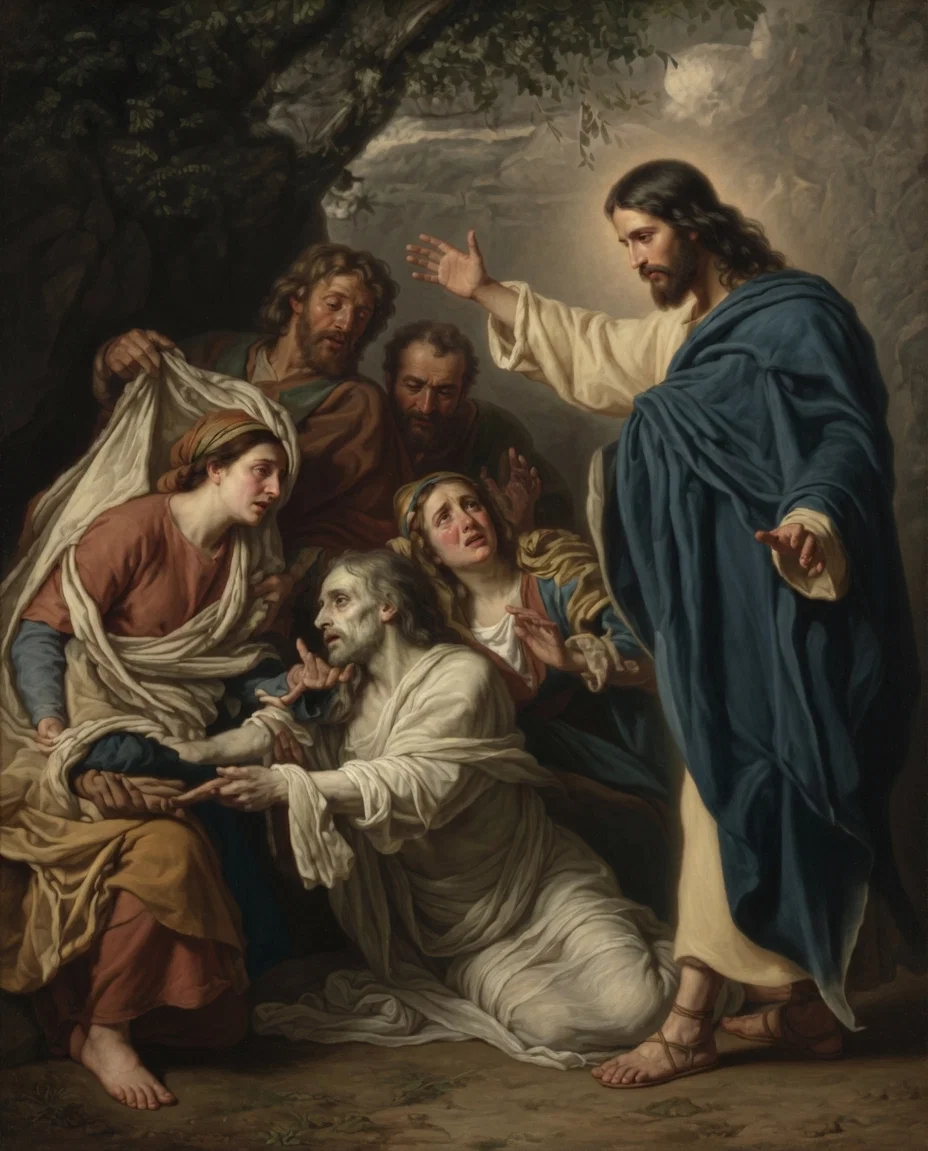
THE RESURRECTION OF LAZARUS
What unspeakable pathos in the cry of humanity's helplessness before death, the great enemy! But when Adam went out of Eden, it was with the assurance of life from the dead, if faithful, through the promised Seed. It is the message of the one gospel for all time—life, everlasting life in Christ Jesus:— "God so loved the world, that he gave his only begotten Son, that whosoever believeth in him should not perish, but have everlasting life." John 3: 16.
As there is none other name under heaven by which men can be saved, so there is no other way of everlasting life, or immortality, save in Christ Jesus our Lord.

When Life and Immortality are to be Bestowed

Christ said, "I am the resurrection, and the life; he that believeth in me, though he were dead, yet shall he live." John 11: 25.
He has turned death—that would have been eternal—into a little time of sleep, from which he will awaken the believer to immortality. It is in the resurrection of the last day that immortality is bestowed:— "In a moment, in the twinkling of an eye, at the last trump; for the trumpet shall sound, and the dead shall be raised incorruptible, and we shall be changed. For this corruptible must put on incorruption, and this mortal must put on immortality. So when this corruptible shall have put on incorruption, and this mortal shall have put on immortality, then shall be brought to pass the saying that is written, Death is swallowed up in victory." 1 Cor. 15: 52-54.
Not until the resurrection, "at the last trump," is immortality conferred upon the redeemed. Note that it is not something immortal putting on immortality; but "this mortal" puts on immortality. Mortal man, raised to life, is given the overcomer's reward—everlasting life.
Mark this: there is no life after death save by the resurrection. "If there be no resurrection of the dead . . . then they also which are fallen asleep in Christ are perished." 1 Cor. 15: 13-18.
This resurrection, as stated by the apostle Paul, is not at death, but in the last day, when Christ shall come, and all his children that are in their graves shall hear his voice. Jesus says:— "This is the will of him that sent me, that every one which seeth the Son, and believeth on him, may have everlasting life; and I will raise him up at the last day." John 6: 40.
That is why the coming of Christ has been the "blessed hope" of all the ages.

Man's State in Death

Between death and the resurrection, the dead sleep. Jesus declares that death is a sleep. Lazarus was dead, but Jesus said, "Our friend Lazarus sleepeth." John 11: 11. It is the language of inspiration throughout. The patriarch Job said:— "Man dieth, and wasteth away; yea, man giveth up the ghost, and where is he? As the waters fail from the sea, and the flood decayeth and drieth up: so man lieth down, and riseth not; till the heavens be no more, they shall not awake, nor be raised out of their sleep." Job 14: 10-12.
This hope of the resurrection at the last day was no indistinct hope to the believer in God's promises. The patriarch continued:— "If a man die, shall he live again? all the days of my appointed time will I wait, till my change come. Thou shalt call, and I will answer thee; thou wilt have a desire to the work of thine hands." Verses 14, 15.
Job tells us of the place of his waiting for the Life-giver's call: "If I wait, the grave is mine house." Job 17: 13. There is where Christ will call for his own when he comes. "The hour is coming," he said, "in the which all that are in the graves shall hear his voice, and shall come forth." John 5: 28, 29.

An Unconscious Sleep Until the Resurrection

Death is an unconscious sleep. It must of necessity be so: for death is the opposite of life. Therefore there is no consciousness of the passing of time to those who sleep in death. It is as if the eyes closed in death one instant, and the next instant, to the believer's consciousness, is the awakening of the last day, the glorious voice of Jesus calling to glad immortality, the angels catching up the loved ones to meet Jesus in the air.
A few scriptures, out of many, suffice to show that man is not conscious in death:— "His breath goeth forth, he returneth to his earth; in that very day his thoughts perish." Ps. 146: 4. "The living know that they shall die; but the dead know not anything . . . Also their love, and their hatred, and their envy, is now perished; neither know they any more a portion forever in anything that is done under the sun." Eccl. 9: 5, 6.
Death is a sleep until the resurrection. Then the Lord will bring forth from the dust the same person who was laid away in death.

A Cheering Doctrine and a "Blessed Hope"

Some have said that this Bible doctrine of the sleep of the dead until the resurrection is a gloomy one. Popular tradition thinks of the blessed dead as going at once to heaven, which, say some, is a beautiful thought. But they forget that the same teaching consigns their unbelieving friends to immediate torment—and that, too, while awaiting the judgment of the last day.
No; the Bible teaching is the cheering doctrine, the "blessed hope." All the faithful of all the ages are going into the kingdom together. This blessed truth appeals to the spirit that loves to wait and share joys and good things with loved ones. Of the faithful of past ages, the apostle says:— "These all, having obtained a good report through faith, received not the promise; God having provided some better thing for us, that they without us should not be made perfect." Heb. 11: 39, 40.
They are waiting, that all together the saved may enter in; and the time of waiting is not an instant to those who "sleep in Jesus."
David was a man of God, but the apostle Peter, speaking by the Spirit on the day of Pentecost, declared to the people of the city of David: "He is both dead and buried, and his sepulchre is with us unto this day . . . For David is not ascended into the heavens." Acts 2: 29-34. They without us have not been made perfect. They are all awaiting that glad day toward which the apostle Paul turned the last look of mortal vision:— "I have fought a good fight, I have finished my course, I have kept the faith; henceforth there is laid up for me a crown of righteousness, which the Lord, the righteous Judge, shall give me in that day; and not to me only, but unto all them also that love his appearing." 2 Tim. 4: 7, 8.
What joy in that day to march in through the gates into the eternal city, with Adam, and Abel, and Noah, and Abraham, and Paul, and all the faithful, and the loved ones of our own home circles, and dear comrades in service, every one clothed with immortality, the gift of God in Christ Jesus our Redeemer.
In a word, the Scripture teaches that God alone hath immortality, that man is mortal, that death is a sleep, that life after death comes only by the resurrection of the last day, that the righteous then are given immortality. Further, the Scriptures teach that later there will be a resurrection of the unjust, not unto life, but unto death, the second death, from which there is no release.
Every doctrine of Scripture and of the gospel is in accord with this Bible teaching as to man's nature and his state in death. But the traditional view of the natural immortality of the soul and of life in death, nullifies the Bible doctrine of life only in Christ, and the resurrection, and the judgment, and the giving of the rewards at Christ's coming, and the final judgment upon the wicked and its execution.

The "Living Soul"

"But," says one, "did not the Lord put into man an immortal soul?"—No; the Scripture says:— "The Lord God formed man of the dust of the ground, and breathed into his nostrils the breath of life; and man became a living soul." Gen. 2: 7.
The soul was not put into the man, but when the life-giving breath was breathed into his nostrils, the man himself became a living soul, a living being. The ordinary version (King James) gives "a living soul" in the margin of Gen. 1: 30, as showing the same expression used of all the animal creation in the inspired Hebrew text. The famous Methodist commentator, Dr. Adam Clarke, says on this phrase, "living soul":— "A general term to express all creatures endued with animal life, in any of its infinitely varied gradations."

Are "Soul" and "Spirit" Deathless?

"But are not the soul and spirit said to be deathless?" questions another. No. One writer says of the Scriptural use of the words "soul" and "spirit":— "The Hebrew and Greek words from which they are translated, occur in the Bible, as we have seen, seventeen hundred times. Surely, once at least in that long list we shall be told that the soul is immortal, if this is its high prerogative. Seventeen hundred times we inquire if the soul is once said to be immortal, or the spirit deathless. And the invariable and overwhelming response we meet is, Not once!"—Here and Hereafter, by U. Smith, p. 65.
On the contrary, the Lord declares, "The soul that sinneth, it shall die." Eze. 18: 20. It means that the person that sins shall die; for soul, mind, heart, spirit, are used to express life or the seat of the affections or of the intellect. One may commend his soul to God, or his spirit to God (really his life in the keeping of God), until the great day of the resurrection. The word "soul" is used for all animal life in New Testament usage as well as in the Old; as, "Every living soul died in the sea." Rev. 16: 3.

The Thief on the Cross

But did not Christ promise the thief on the cross that he would be with him that day in Paradise?—No; for Paradise is where God's throne is, and the tree of life, and the city of God, the capital of Christ's kingdom, and three days later Christ had not yet ascended to the Father. "Touch me not," he said to Mary after his resurrection; "for I am not yet ascended to my Father." John 20: 17. The dying thief, therefore, was not with him in Paradise three days before. Nor did the thief's question suggest such a thought. His faith grasped Christ's resurrection, the resurrection of his children, and the coming kingdom; and that day on the cross, in the moment of the deepest humiliation of the Son of God, the repentant sinner cried, "Lord, remember me when thou comest into thy kingdom." And the Saviour replied, "Verily I say unto thee today"—this day, when the world scoffs and the darkness presses upon me, this day I say it—"shalt thou be with me in Paradise." Luke 23: 42, 43. The punctuation that makes it read, "Today shalt thou be with me in Paradise," is not a part of the sacred text, and puts the Saviour's promise in contradiction with the facts of the whole narrative and the teaching of Scripture.
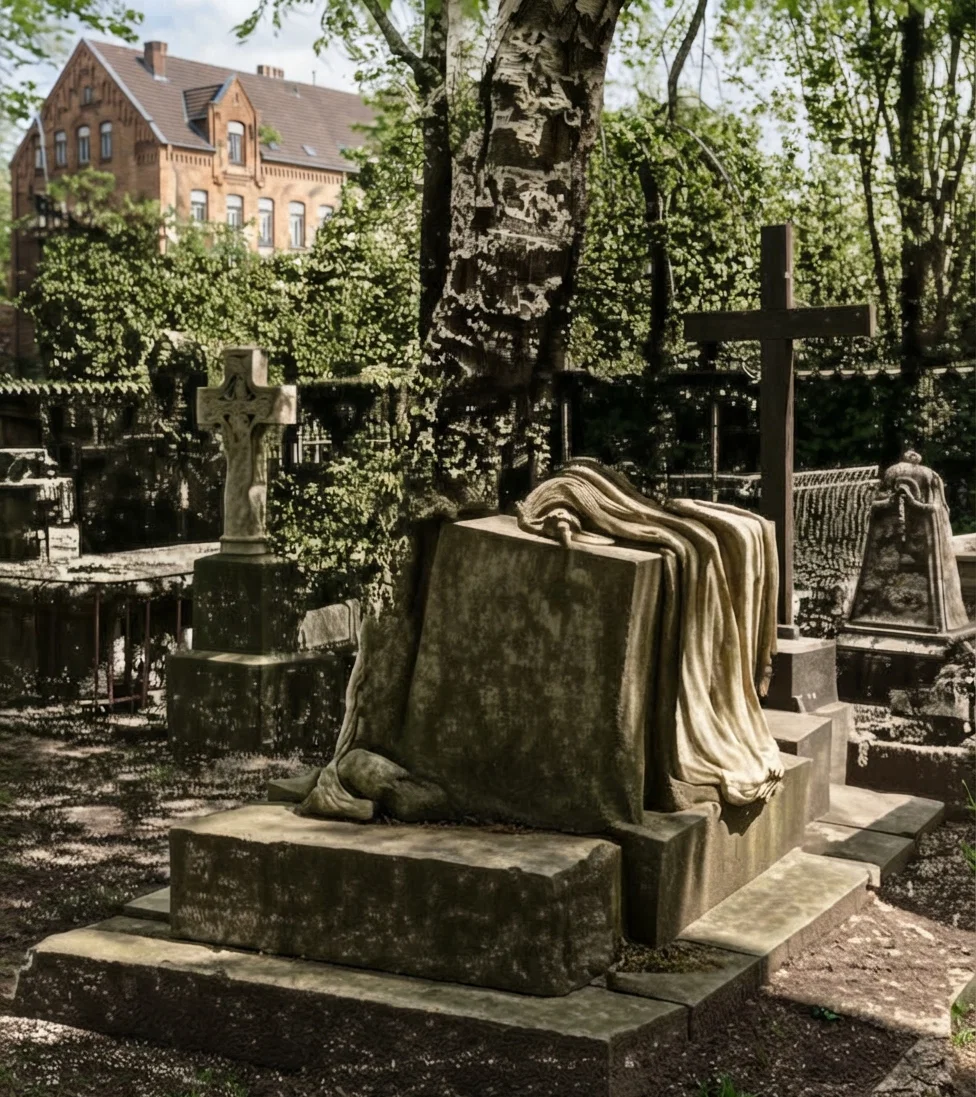
THE OPEN GRAVE AT HANOVER, GERMANY

The Rich Man and Lazarus

"Then there is the parable of the rich man and Lazarus," one says, "where Lazarus and Dives are talking, though dead—Lazarus in Abraham's bosom and the rich man in torment." But that is a parable; and no one can set the figures of a parable against the facts of positive Scripture. In parables, lessons are often taught by figurative language and imaginary scenes which could never be real, though the lesson is emphasized the more forcefully. In the parable of Judges 9, the trees are represented as holding a council and talking with one another. No one mistakes the lesson of the parable, or supposes that the trees actually talked. So in the parable of the rich man and Lazarus, the lesson is taught that uprightness in this life, even though with deepest poverty, will be rewarded in the future life; while uncharitable selfishness will surely bring one to ruin and destruction. In the face of the Bible teaching, no one can turn this parable into actual narrative, representing that the saved in glory are now looking over the battlements of heaven and talking with the lost writhing before their eyes in unending agony amid the flames. This is not the picture that the Scriptures give us of heaven, nor of the state of the dead, nor of the time and circumstances of the final rewards or punishments.

The End of the Wicked

Sin to be Blotted Out

So soon as ever Lucifer introduced sin into heaven, it was assured, in the righteousness and omnipotence of God, that the day would come when sin would be blotted out of his perfect creation. Inspiration tells us that a time of final reckoning with sin was assured when Satan and a host of the angels with him lifted up the standard of mysterious rebellion against the law and harmony of heaven:—
“The angels which kept not their first estate, but left their own habitation, he hath reserved in everlasting chains under darkness unto the judgment of the great day.” Jude 6.
The visitation of sin is assured. By listening to Satan’s temptation, man became involved in sin. Then a divine Saviour was provided, through whom every soul might escape from the kingdom of darkness and find salvation and life. But it is inevitable that those who refuse the way of life, and reject the salvation of God, must finally be involved with Satan and sin in the day when sin is visited.
By Adam’s sin, all his posterity inherited a sinful, dying nature. “In Adam all die,” says the scripture. But not a soul in the last day can plead Adam’s sin and the inheritance of a fallen nature. By Christ’s gift of his life for us, the sinner, with all his weaknesses, may become a partaker of the divine nature, and escape the power of the fleshly nature. By Christ’s death for all, all recover from the death they die in Adam, the first death. All have a resurrection, the unjust as well as the just; and then every one gives account to God according to his own life, and the use he has made of the light given him of God.

The Two Resurrections

The Scriptures emphasize the two resurrections. Paul, before Felix, declared his belief the same as that of all the prophets:—
“That there shall be a resurrection of the dead, both of the just and unjust.” Acts 24:15. Jesus declared it in these words:—
“The hour is coming, in the which all that are in the graves shall hear his voice, and shall come forth; they that have done good, unto the resurrection of life; and they that have done evil, unto the resurrection of damnation.” John 5:28, 29.
The first resurrection is that of the just, at Christ’s second coming. It is written of this:—
“Blessed and holy is he that hath part in the first resurrection: on such the second death hath no power, but they shall be priests of God and of Christ, and shall reign with him a thousand years.” Rev. 20:6.
At Christ’s coming, the righteous return with him to heaven, for the thousand years. The wicked living at the time of his coming are slain by the consuming glory of his presence; and they, with all the unjust of all the ages, await in the grave the second resurrection, at the end of the thousand years:—
“The rest of the dead lived not again until the thousand years were finished.” Rev. 20:5.

The Second Death

At the end of the thousand years, the city of God, with the saved, comes down out of heaven upon the earth. The wicked are raised in the second resurrection. Under Satan’s leadership they march up to attack the city of God. How naturally, we infer, may Satan persuade the lost that after all he was right when he declared to Adam, “Ye shall not surely die.” Here are all the lost of all the ages—living. Why may they not be immortal, beyond the power of God to destroy? The old battle that began in heaven is on again. Satan, the archrebel, marshals his hosts of fallen angels, and the myriads of fallen men, his legions stretching wide over the earth.
“They went up on the breadth of the earth, and compassed the camp of the saints about, and the beloved city; and fire came down from God out of heaven, and devoured them.” Rev. 20:9.
“This is the second death,” says the scripture. Verse 14. The great day has then come when sin is visited and destroyed.

The Punishment Everlasting

“The wages of sin is death.” And the second death is everlasting. There is no resurrection from this death. The Scriptures describe it in terms that affirm utter destruction, non-existence.
“Who shall be punished with everlasting destruction from the presence of the Lord, and from the glory of his power?” 2 Thess. 1:9.
“Behold, the day cometh, that shall burn as an oven; and all the proud, yea, and all that do wickedly, shall be stubble; and the day that cometh shall burn them up, saith the Lord of hosts, that it shall leave them neither root nor branch.” Mal. 4:1.
“They shall be ashes,” the third verse of this chapter says. Every expression that is possible to imagine is employed to denote utter destruction, everlasting death. That means non-existence. Sin and sinners are blotted out. The prophet Obadiah, speaking of the visitation upon the heathen, the unbelieving, in “the day of the Lord,” says:—
“They shall drink, and they shall swallow down, and they shall be as though they had not been.” Verse 16.
This is the utter end of sin and all sinners, and of the author of sin. Root and branch they are gone, “as though they had not been.” All this is in the description of the last judgment, so fully set forth in the twentieth of Revelation. “Death and hell [hades, the grave] were cast into the lake of fire. This is the second death.” Rev. 20:14. Death and the prison house of death are gone forever. Sin is wiped out of a perfect universe, and not even a trace will remain of the place of the fiery judgment.
“Yet a little while, and the wicked shall not be: yea, thou shalt diligently consider his place, and it shall not be.” Ps. 37:10.
The fires of the last day purify the earth, which is renewed in Eden-like beauty. In the whole universe of God, there is no sin, no sinner, but all is harmonious again, as before sin entered. The prophet was given a view of this glorious consummation, and the triumph of the Son of God over sin:—
“Every creature which is in heaven, and on the earth, and under the earth, and such as are in the sea, and all that are in them, heard I saying, Blessing, and honor, and glory, and power, be unto him that sitteth upon the throne, and unto the Lamb forever and ever.” Rev. 5:13.

Some Questions Briefly Considered

The doctrine of the immortality, the indestructibility, of the soul, is responsible for the traditional view that the wicked are kept alive in unending misery through all eternity. How different this picture from that which Holy Scripture gives of the second death, terrible and awful, but resulting in the utter destruction of sin and sinners, leaving a clean universe. The doctrine of the immortality of the soul came in from pagan philosophy. Herodotus, “the father of history,” said:—
“The Egyptians . . . were also the first to broach the opinion that the soul of man is immortal.”—Book 2, par. 123.
Evidently, they passed on the doctrine to the Greeks. Its origin was in the words of Satan in Eden, “Ye shall not surely die.” The pagans had their teaching of purgatory, and of the ceaseless round of the soul apart from the body. From these sources, and not from the Word of God, the traditional view has come into Christendom—representing the Lord as unable or unwilling to end sin, but keeping the sinner alive throughout eternity to suffer torture that can bring no remedy. The Scripture teaching is far otherwise. However, there are certain Scripture phrases that emphasize the severity of the punishment of sin, which are often taken as supporting the doctrine of never-ending conscious torment.

“Forever and Ever”

In Rev. 20:10 it is said that the devil and his chief agencies “shall be tormented day and night forever and ever.” The phrase emphasizes the certainty of their utter destruction. “Forever” means age-lasting, or life-lasting—so long as a thing exists by its nature. Thus, in Ex. 21:6 the servant who loved his master and did not wish to leave his master, was to have his ear pierced, “and he shall serve him forever,”—that is, without release as long as he lives. So the fiery judgment of that last day holds the wicked until life ends; there is no release until life is consumed.

“Everlasting Punishment”

“These shall go away into everlasting punishment.” Matt. 25:46. It is everlasting punishment, not everlasting punishing. The punishment is everlasting death—“who shall be punished with everlasting destruction.” 2 Thess. 1:9. The truth of the utter destruction of sinners is vital enough, but it commends itself in every thought of justice and mercy; for sin must be cleansed from a perfect universe. But the unscriptural view of everlasting conscious torment that never reaches the point of full punishment is unthinkable. Yet it is urged as a doctrine, and contended for as vital. The following description is taken from a book written for children, entitled “The Sight of Hell.” It is printed in Dublin—for children:—
“Little child, if you go to hell, there will be a devil at your side to strike you. He will go on striking you every day, forever and ever, without ever stopping. The first stroke will make your body as bad as Job’s, covered from head to foot with sores and ulcers. The second stroke will make your body twice as bad as the body of Job. . . . How then will your body be after the devil has been striking it every moment for a hundred million of years without stopping?”—Quoted in the London “Present Truth,” April 30, 1914.
What a relief to turn from this to the Bible doctrine of the “everlasting destruction,” of the second death, terrible though it be!

“Everlasting Fire,” “Eternal Fire,”

“Unquenchable Fire”

All these expressions are used in describing the fiery judgment upon sin and sinners. The effect of the fire is everlasting and eternal, and by a common usage in language the adjective that describes the effect is applied to the agent by which the effect is wrought. A specific example of everlasting fire in the punishment of evil is given in Scripture. Sodom and Gomorrah, the wicked “cities of the plain,” were destroyed by a rain of fire from heaven. These cities, Inspiration says, “are set forth for an example, suffering the vengeance of eternal fire.” Jude 7. The fire was everlasting, eternal, in its effect. The cities of the plain were everlastingly consumed. But the fire went out when the destruction was complete. It is not smoking still. Unquenchable fire is fire that cannot be quenched. It consumes utterly, until nothing is left; then it goes out of its own accord.

“Where Their Worm Dieth Not”

Jesus warned of the certain destruction of sin and sinners in the fire of Gehenna; for this is the word translated “hell” in Mark 9:43. Hence, Hades, often translated “hell,” is the grave, not the place of punishment. Gehenna, here used of the place of punishment, was the name of the valley where the refuse of Jerusalem was cast for burning. The map of Jerusalem, in any ordinary Bible with maps, shows just outside the southern wall a gorge marked “Valley of Hinnom (Gehenna).” It was here that the people, in the olden times, had sacrificed children to Moloch. “In order to put an end to these abominations, Josiah polluted it with human bones and other corruptions. 2 Kings 23:10, 13, 14.”—Hastings’s Dictionary of the Bible. It was regarded as a place accursed, and the smoldering fires became symbolical of the fires of the judgment. Here the fires consumed the refuse, and the worms and the fire utterly destroyed the carcasses of beasts flung into the place of destruction. The use of this illustration, instead of arguing that the wicked are never destroyed but always live, conveys the opposite idea. What went into the fires of Gehenna was utterly consumed, and nothingleft. This was used by Christ as a figure illustrative of the utter destruction of the unrepentant sinner in the day of visitation. This must suffice. The positive teaching of Holy Scripture is that sin and sinners will be blotted out of existence. There will be a clean universe again when the great controversy between Christ and Satan is ended. Death itself and the grave are cast into the lake of fire (Rev. 20:14), symbol of the removal of every mark of the curse. “And there shall be no more curse.”
Continue reading: Angels: Their Ministry