Your ShelfYour Projects

Signs of the Times, Vol. 29, No. 26.

WORDLINESS AND LICENTIOUSNESS

Signs of the Times

Jul 1, 1903

Pacific Press Publishing Company · Oakland, California · Jul 1, 1903

WORDLINESS AND LICENTIOUSNESS.

Lessons from the Past.

BY MRS. E. G. WHITE.
SATAN has ever achieved his greatest successes through the neglect of God’s people to maintain their separation from the world,—its customs, its practises and principles. There are but two great parties among men—the servants of Christ, and the servants of Satan. Their leaders are opposites in every particular. Our Lord Jesus Christ, who came to conquer the prince of darkness, says, “If ye were of the world, the world would love his own; but because ye are not of the world, but I have chosen you out of the world, therefore the world hateth you.” Here Christ makes a marked distinction between His followers and the world. Those who are of the world are in direct opposition to those who love God and keep His commandments. The heart must be kept with all diligence, that the human be not exalted above the Divine. If those who profess to love and serve God, follow blind impulse, rather than reason and conscience, they will fall by the artifice of Satan. The affections should be guarded and controlled lest they be placed upon unworthy objects that are forbidden in the Word of God.
A. D. 1635—ROGER WILLIAMS BANISHED FROM MASSACHUSETTS BY “PROTESTANT” PURITANS FOR OPPOSING SUNDAY LEGISLATION. SEE PAGE 7.
Samson, that mighty man of valor, was under a solemn vow to be a Nazarite during the period of his life; but, becoming infatuated by the charms of a lewd woman, he rashly broke that sacred pledge. Satan worked through his agents to destroy this ruler of Israel, that the mysterious power which he possessed might no longer intimidate the enemies of God’s people . It was the influence of this bold woman that separated him from God, her artifices that proved his ruin. The love and service which God claims, Samson gave to this woman. This was idolatry. He lost all sense of the sacred character and work of God, and sacrificed honor, conscience, and every valuable interest, to base passion.
The life of Solomon should prove a beacon of warning to God’s people in every age. The Lord had erected a barrier between Israel and other nations. He had made that people the depositaries of His law, and their safety lay in preserving their peculiar, holy character. But as King Solomon’s heart was lifted up in pride, he became eager for still greater wealth and power. To secure these, political alliances were formed with idolatrous nations .
Honor and riches flowed in to him as the result; but these temporal advantages were dearly purchased at the sacrifice of principle. His kingdom was enriched with the gold of Tarshish, but the fine gold of character was tarnished by the corrupting influence of paganism. Once over the wise barrier which God had erected, the king took, one after another, the fatal steps that led him away from hope and happiness and heaven. From the wisest of the rulers, Solomon became a despot. Satan triumphed as this man, who had thrice been called the beloved of his God, became a slave of passion, and sacrificed his integrity to the bewitching power of woman.
The cases mentioned are sufficient to show the danger of corrupting the soul by mingling with God’s enemies. These examples are placed on record for the benefit of those who live amid the perils of the last days. The devices of Satan are no less now than in ancient times. Indeed, as we near the period of Christ’s second coming, Satan redoubles his efforts to work with all deceivableness of unrighteousness. The youth especially are in constant and fearful danger of being overcome by his temptations.
Watchfulness and vigilance are needed now. The lustful eye must be turned off from beholding vanity. Boldness and immodesty must be met with a decided rebuke. Let none yield to a spirit of self-confidence, and feel that they are in no danger. As long as Satan lives, his efforts will be constant and untiring to make the world as wicked as before the flood, and as licentious as were the inhabitants of Sodom and Gomorrah. The prayer may well be offered daily by all who have the fear of God before them, that He will preserve their hearts from evil desires, and strengthen their souls to resist temptation. Those who, in their self-confidence, feel no need of watchfulness and unceasing prayer, are near some humiliating fall. All who do not feel the importance of resolutely guarding their affections will be captivated by those who practise their arts to ensnare and lead astray the unwary.
Satan exulted to see Samson, a man whom God could have used to His glory, so infatuated that he could betray his strength into the hands of Delilah. Satan knew that he had taken Samson captive. Few who go thus far again see clearly the aggravated character of sin. Reputation, strength, and usefulness are sacrificed for sinful indulgence. Blind infatuation leads men on in the way to destruction. The power of Satan, his arts and machinations,—who can know them? Those who, in defiance of all the warnings and entreaties of God’s Word, venture to indulge in sin are sleeping on the very brink of eternal ruin. Because God bears long with transgressors of His law, because He sends them warnings and entreaties, because punishment does not immediately follow their evil deeds, they abuse His mercy and forbearance, and blindly rush on in a course of crime. When assailed by temptation, many have not moral strength to say, as did Joseph, “How then can I do this great wickedness, and sin against God?” They do not give a decided refusal to the first invitation to transgress the law of God, and soon unlawful indulgence becomes habitual, and they are ready to deny that it is a sin.
Unwise marriages are the curse of this age. Such an alliance can but be disastrous to both parties. That love which has no better foundation than mere sensual gratification will be headstrong, blind, and uncontrollable. Honor, truth, and every noble, elevated power of the mind, is brought under the slavery of passions. The man who is bound in the chains of this infatuation is too often deaf to the voice of reason and conscience; neither argument nor entreaty can lead him to see the folly of his course.
Men and women professing godliness should tremble at the thought of entering into a marriage covenant with those who do not respect and obey the commandments of God. It was this that opened the flood-gates of sin to the antediluvians. Such a connection with the world is a direct departure from God’s express requirements,—“Be ye not unequally yoked together with unbelievers.”
In these alliances the creature receives the love which should be given to the Creator. There is danger in entering into any intimate relation with those who have no connection with Heaven. This is the friendship which Inspiration calls enmity with God. We can not be too jealous of ourselves, lest, by associating with worldlings, we fall into the same habits. It was for this reason that the Israelites were commanded to dwell alone, as a people separate from all other nations. The friendship of the Lord’s enemies is more to be dreaded than their enmity; for Satan is constantly working through pleasing, intelligent unbelievers, to tempt the people of God to sin.
When one commandment of the Decalogue is broken, the downward steps are almost certain. When once the barriers of female modesty are removed, the basest licentiousness does not appear exceeding sinful. Alas, what terrible results of woman’s influence for evil may be witnessed in the world to-day! Through the allurements of “strange women,” thousands are incarcerated in prison cells, many take their own lives, and many cut short the lives of others. How true the words of Inspiration, “Her feet go down to death; her steps take hold on hell.”
Beacons of warning are placed on every side in the pathway of life, to prevent men from approaching the dangerous, forbidden ground; but, notwithstanding this, multitudes choose the fatal path, contrary to the dictates of reason, regardless of God’s law, and in defiance of His vengeance.
Those who would preserve physical health, a vigorous intellect, and sound morals, must “flee youthful lusts.” Those who will put forth zealous and decided efforts to check the wickedness that lifts its bold, presumptuous heads in our midst, are hated and maligned by all wrong-doers, but they will be honored and recompensed of God.

TESTED IN TIME AND MEANS.

Should a Student for the Ministry Give a Tithe to the Lord?

[The following excellent setting forth of principles, which should obtain in every Christian life, is from “Notes on Letters,” in the Sunday School Times of May 23. It will answer many questions in the hearts of our own readers.]
Can a man be so devoted to God that all that he is and has is the Lord’s? In case this is so, does such a man need to give anything to the Lord except as he gives it to himself in the line of his work for God? This is a practical question with a great many. A young Christian in Ohio, who wants to be wholly the Lord’s, asks about his duty as to tithes:—
I am a young man with nothing more than a high school education. Both my parents are dead, and I am now a salesman for a Pennsylvania company, making money to go to college. My intention is to be a minister. The question is with me, “Shall I, or shall I not, give the tenth of my income to God’s cause?” Were I in another avenue of life, as other men, there would be no doubt about this. But as I intend to devote all my life to God’s work, and as now I am merely preparing myself for that work, the question is whether I am required, as others are, to give the tithe. I believe if all church-going people would tithe there would be greater prosperity among the givers themselves. But am I not really giving all my income to God’s cause, in that my education is to fit me for His work?
Perhaps it is my previous Christian training at the hands of my parents, and really not God’s requirements, that prompts me to give the tenth. There seems a sense of condemnation if I withhold, and yet a sense of doing really more than I should if I give. Perhaps others have been asking you this same question, and you can give help.
It has been found in the history of the human race that a man can do more good work in six days than in seven, and with nine-tenths of his income than with ten-tenths. The one-seventh of his time and the one-tenth of his income must specifically be given to the Lord. This is not a matter that began to be observed in the days of Moses. Both in the Bible record and in outside history we have evidence of this, long prior to the days of Moses, and among other people than the Israelites. The rule or custom is as applicable to ministers and missionaries as to blacksmiths and tailors. Like all other well-doing, its gain is to the one who gives the money or time, as well as to those who receive it. To observe the custom is a privilege and a duty.
The writer may refer to his own experience in the working six days rather than seven in a week. More than forty years ago he decided to devote his life as a Sunday-school missionary. He then felt that, as his whole time was the Lord’s, he need not observe any one day as a day of sacred rest. Accordingly, he worked—in the Lord’s service—three hundred and sixty-five days in the first year. In consequence, he broke down from this disregard of the Sabbath law, and had to give up all work for more than fifty-two days to make up for the fifty-two misspent days in the Lord’s work. He then came to realize that one day in each week belongs to the Lord in holy rest, and that if a man thinks he can use the days better than the Lord directs, he will suffer for his mistake. If he has work, even for the Lord, on the day when others rest, he must have rest another day. The same idea must be recognized in connection with money as with time.
Even if God does not need to receive the money, man needs to give it. A man must give to God, apart from what he spends on himself, a specified portion of his income. A tithe was recognized as the proper portion in the Mosaic law, and thousands of years before. He must live on the other nine-tenths, even if he is living wholly for the Lord. Being a clergyman, a minister, a pastor, is by no means the only way or the chief way of being in the Lord’s service or work. A child of God ought to be in the special place and occupation to which God assigns him, whether God tells him to be a blacksmith, or a physician, or a teacher, or a clergyman. But in any event a child of God ought to have the benefit and blessing of giving a specified portion of his income to the Lord. He will be poorly fitted for his work if he does not have that advantage. It would be both a hindrance and a temptation to a man to have no portion of his income which belonged to the Lord, as distinct from all that he uses on himself in God’s service. To have nothing that he gives to the Lord as the Lord’s special portion, would be a hindrance as he asked others to give. But to count all that he used on himself as a gift to God would be, indeed, a temptation. For example, on a hot day a man might feel that a saucer of ice-cream and a dish of strawberries would better fit him for his day’s work, yet it would cost more than a piece of corn-bread and a glass of water. At this point a man might say to himself: “I am in the Lord’s work, and therefore what is given to me is practically given to the Lord. Nothing is too good for the Lord, therefore I will eat the choicest food and will live in the best way I can, regardless of expense, within the limits of my income.” It is important to have a portion of one’s income set apart as exclusively the Lord’s, and to use the remainder as the Lord would have one use it. The two portions should not be confounded or combined. This is true both of income and of time.

Keeping the Eye on Heaven

He who seldom thinks of heaven is not likely to get there. The way to hit the mark is to keep the eye fixed upon it.—Bishop Horne.

PRESENT BABYLONIAN GOVERNMENTS.

The Sixth Head.
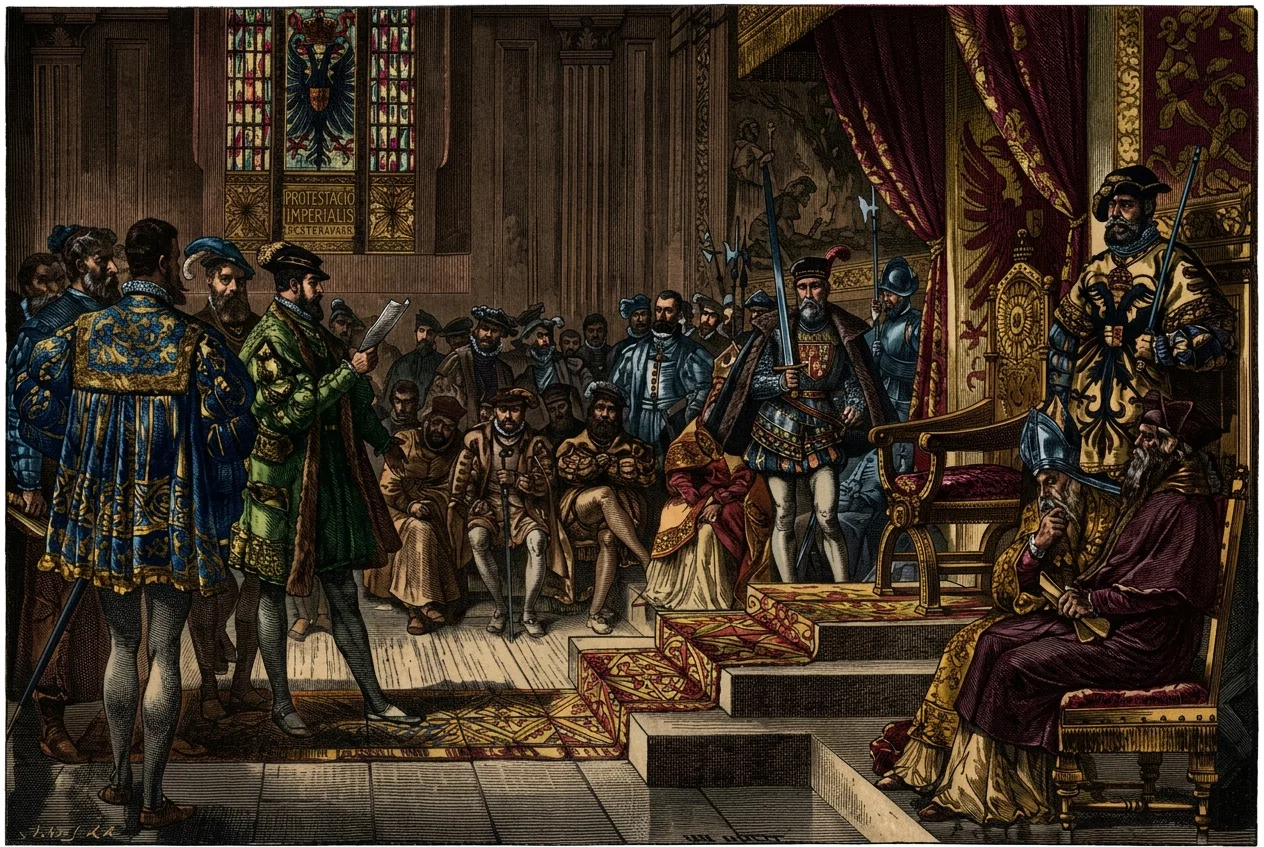
Reading the Protest at the Diet of Spires.
We have learned in past studies that the Papacy in its connection with worldly powers is only a phase of that evil system of union of Church and State which began with Babylon of old; and that behind it all is Satan, the deceiver, accuser, and adversary.
He has deceived the nations by making them believe that this system, in some of its forms, is necessary to salvation, to the maintenance of good order in society, to the perpetuation of civil government, to the preservation of religion in the earth. He has carried on this work of deception in every age, through the great and popular, but backslidden, apostate, religious bodies. These religious bodies have always, in the beginning of their history, known the truth, but, in departing from the truth and righteousness of God by faith, and in refusing to follow increased light, they voluntarily, decidedly, united with the powers of earth, in order to enforce religious dogmas by law. Through them Satan has always accused those who protested against this great prevailing system of religion, and the accusations have always ended in persecution, unless God interposed. And through this great system, with its various phases, has Satan always opposed the simple, but if received by faith, all-effectual, truth of God's free Gospel of grace.

The System One.

We speak of “system” in the singular; for the system is one, tho the phases of that system are many. There are gods many and lords many in all these phases, but all are founded upon, and all exist by virtue of, the principle of self-salvation apart from God. It is but the repetition, in various forms, of the old Babylonian cry: “Go to, let us build us a city and a tower, whose top may reach unto heaven; and let us make us a name, lest we be scattered abroad upon the face of the whole earth.” Both ideas—salvation of soul and earthly preservation—are contained in the purpose expressed; but the doers of it all are, the us. And so their monuments tell us, they named the city and the tower, Bab-il, “The Gate of God,” or “The Gate of Heaven;” but God called it just what it truly was, is, and always must be, “Babel,” confusion. In every phase of the system, from Babylon of old to the present time, is echoed and re-echoed the ambition of Babylon’s king of her ages, Lucifer, the once day-star of God: “I will ascend into heaven; I will exalt my throne above the stars of God; . . . I will ascend above the heights of the clouds; I will be like the Most High.” Isa. 14:13, 14. This is the spirit of Satan, and this is the spirit which has been manifest in all the phases of the great Babylonian system. Jesus Christ came as a Teacher from God, assuming no power to rule, dictate, oppress, judge, or condemn those who did not agree with His teachings. He was the Master of humility and meekness, and they clothed Him as garments. His ministers are not to be “lords over God’s heritage, but ensamples to the flock.” 1 Peter 5:1–5. They did not possess dominion over faith, but were helpers of the joy of all who believed. 2 Cor. 1:24. But in every phase of the Babylonian, or Satanic, system of religion there has been manifest in creed, in arbitrary decrees, in religious dogmas, in statute law, in a multitude of forms, the principle of religion by dictation, by law, by force.

Protestants in Every Age.

“Protestants” is doubtless too narrow a term. Not only have there been faithful servants of God in all ages who have protested against the Babylonian religion of self-salvation, of union of Church and State, of force, but they have held high in their own lives the principles of righteousness and truth. In Israel’s day the prophets of God lifted true voices amid the prevailing babel of false worship. When the captivity and travail of the church began in Babylon, Daniel and the three Hebrew children were lights in the center of earth’s empire. Faithful servants of God existed in the Medo-Persian and Grecian phases of the system. During the time that Satan was using Pagan Rome, John the Baptist, Jesus Christ our Lord, and the apostles, lifted the clearest light of all the centuries; its blazing beams showing the errors of all the mysteries of iniquity in past and future, and revealing clearly the only way of salvation—personal faith in God through Jesus Christ, with the Scriptures the one divine rule of faith, and the true church of Christ as those who are called out according to the Gospel, obedient to every known ray of light and precept of truth.
During the reign of the fifth head, the Papacy, God had also His faithful witnesses, some with less, some with more, light in the unnaturally darker ages of superstition which followed the days of the Pentecost, the falling of the early rain. Many of those who protested and held aloft the torch of truth confirmed their testimony with their life. The darkness increased, the light grew dimmer, the darker ages grew darker still, till, in the fifteenth century, was born the “Morning Star of the Reformation,” John of Wycliffe. Following came John Huss and Jerome of Prague. The former escaped death by martyrdom; but, to show the bitterness of the Babylonian system, his body was exhumed and burned after burial. Huss and Jerome were burned at the stake. A century later the Protestant Reformation burst forth, based on true Gospel principles. They are thus stated by D’Aubigne:—
The principles contained in this celebrated protest of the 19th April, 1529, constitute the very essence of Protestantism. Now this protest opposes two abuses of man in matters of faith; the first is the intrusion of the civil magistrate, and the other is the arbitrary authority of the church. Instead of these two abuses, Protestantism sets up above the magistrate the power of conscience; and above the visible church the power of the Word of God. It declines, in the first place, the civil power in divine things, and says with the apostles and prophets, We must obey God rather than man. In presence of Charles the Fifth it uplifts the crown of Jesus Christ. But it goes further; it lays down the principle that all human teaching should be subordinate to the oracles of God.
Here was again set forth the principles of Jesus Christ: The Word of God as the rule of faith, and personal, individual faith in that Word the means of salvation; and that over these the civil magistrate had no control, and with them no civil ruler, as such, had anything to do.

Fall of the Papacy.

In 1798 the papal head of the great Babylonian system fell under the deadly wound. Rev. 13:3, 10. Its power to persecute, to lord it over the faith and worship of men, was taken away in the controlling kingdoms of earth. The Papacy has not since possessed that power, tho still demanding it. Her enemies declare that she will never again possess that power. She is honored, perhaps, as never before as an ecclesiastical power, but she does not control the nations nor command them under the pains and penalties deemed due to heretics. But has the beast ceased to exist?—In the papal phase, under control of the papal head, yes; but as an existing, continuing system to the end, in the light of prophecy, no. The principles as embodied in the system continue operative; the form in which they are manifest changes. The basic principles in Pagan and Papal Rome are the same; they are self-salvation, a religion of force; but the forms are widely different; hence they are denoted by different heads.

The Sixth Head.

Satan, the originator and king of the system, after Pagan Rome, used his masterpiece, the Papacy, to 1798. When the Papacy passed away, another phase took its place. It no longer had one centralized head at Rome; but a phase of Church-and-State governments, similar in form to each other, followed. In the papal system the Church was dominant, the State subservient. In the phase which followed, manifest in the Church-and-State governments of Europe, the State was dominant, a modification of the Pagan idea among Christian peoples. This phase of the system is so well set forth by Bryce that we quote:—
The principles which had led the Protestants to sever themselves from the Roman Church should have taught them to bear with the opinions of others, and warned them from the attempt to connect agreement in doctrine or manner of worship with the necessary forms of civil government. Still less ought they to have enforced that agreement by civil penalties; for faith, upon their own showing, had no value save when it was freely given.
But whether it was that men only half saw what they had done, or that, finding it hard enough to unrivet priestly fetters, they welcomed all the aid a temporal priest could give; the result was that religion, or, rather, religious creeds, began to be involved with politics more closely than had ever been the case before. Through the greater part of Christendom wars of religion raged for a century or more, and down to our own days feelings of theological antipathy continue to affect the relations of the powers of Europe. In almost every country the form of doctrine which triumphed associated itself with the State, and maintained the DESPOTIC SYSTEM of the Middle Ages, while it forsook the grounds on which that system had been based.
It was thus that there arose national churches, which were to be to the several Protestant countries of Europe that which the Church Catholic had been to the world at large; churches, that is to say, each of which was to be coextensive with its respective State, was to enjoy landed wealth and exclusive political privilege, and was to be armed with coercive powers against recusants. It was not altogether easy to find a set of theoretical principles on which such churches might be made to rest; for they could not, like the old church, point to the historical transmission of their doctrines; they could not claim to have in any one man, or body of men, an infallible organ of divine truth; they could not even fall back upon general councils, or the argument, whatever it may be worth, “Securus judicat orbis terrarum.”
But in practice these difficulties were soon got over; for the dominant party in each State, if it was not infallible, was at any rate quite sure that it was right, and could attribute the resistance of other sects to nothing but moral obliquity. The will of the sovereign, as in England, or the will of the majority, as in Holland, Scandinavia, and Scotland, imposed upon each country a peculiar form of worship, and kept up the practices of MEDIEVAL INTOLERANCE without their justification.

Not Protestant Governments.

This is the condition of the Roman world, where has existed the empire of the great beast power, from which empire has gone forth the law to the rest of the world. The sixth head of that fearful system of government is the present phase of Church-and-State governments existing among the nations of Europe, the horns of the beast, the most influential of which profess to be Protestant. But if these governments were truly Protestant, they would not persecute. No church which holds to the principle of Protestantism will, in any way, unite with the civil power, or solicit aid from the civil power, or permit the civil magistrate to interfere in matters of religion. Her rule will be the Bible and the Bible alone, with no mixture of tradition. Her power will be in the Spirit of God, the life of Christianity. Her means of propagating her belief will be by persuasion and teaching. All recusants and enemies she will, in love, commend to the mercy and wisdom of God. And when the Protestant churches or any Protestant church turns from these principles to accept of tradition and human creed, she gathers and dispenses confusion instead of power, and becomes a part of Babylon, because moulded by the principles of Babylon. Her creed may be called “The Gate of God,” but God calls it Confusion. And when she unites with the State, to seek to enforce or better to maintain that creed, she commits fornication with the kings of the earth, and is a part of the Babylonian family. She is no longer Protestant. She may have true Protestants and Christians in her fold, but all such God will call out. So the Papacy has had within her fold in all ages true Christians, living up to all the light they possessed, but they were Christians not because of the papal system, but in spite of it. Germany, England, France, Denmark, Norway, and Sweden, are not Protestant governments or nations in the sense of being Christian. They may be called Protestant, and Christian; there are Christians in them, but the system of government is not Christian, but Babylonian; simply another phase in the great system of which Lucifer was the inventor, Babylon was the first head and prototype, and the Papacy the masterpiece.

Legitimate Earthly Government.

By this we do not refer to the legitimate rule and sphere of these governments or any civil government; for civil government is ordained of God. But we refer to the union of Church and State, or religion enforced by law, which is a characteristic of all these powers. When this Church-and-State principle is developed into law, it always leads to persecution for conscience’ sake. And this has been the case in all these countries. The persecutions under “good Queen Bess” were as truly of Satanic origin as were those under “bloody Mary.” The name does not alter the fact; the character of a government determines its author. In a general way “the powers that be are ordained of God,” but not to take God’s place. Nebuchadnezzar, the heathen king of Babylon, God calls “My servant” (Jer. 27:5–8; Dan. 2: 37); but when he aspired to take God’s place, to direct and control worship, to punish those who would not worship as he decreed, God humbled him, and proud Babylon with him (Daniel, chapters 3, 4). And so, in all ages, the dominant ruling powers of earth are God’s servants to restrain evil, and prevent incivility; but not to aid religion or to coerce conscience in any way. And when the powers of Europe revolted against the tyranny of the Vatican authority, they again justified it all by perpetuating the Church-and-State system in another form. It matters not how good the men, how mild the system at first, it logically and inevitably leads to evil. The first step means the second, and the second the third, until the last step is taken, and Jesus Christ is again mocked, maltreated, and put to death in the persons of His saints.
Thus far we have the following heads to the great Babylonian system: Babylon, Medo-Persia, Grecia, Pagan Rome, Papal Rome, Pago-Papal and Pago-Protestant governments of Europe. Other phases of the beast system will be considered in future articles.

LOST—RESTORED

When God created man, He made him in His own image, and thus God gave to the world a specimen of Himself. Man was the crowning act of creation. David, in contemplating this part of God’s workmanship, said, “I am fearfully and wonderfully made.” And again, “Marvelous are Thy works.” God Himself was pleased, for “God saw everything that He had made, and, behold, it was very good.”
Since that time, however, something has gone wrong. Man is still the crowning act of creation, but when we look for the image of God we fail to find it. Truly the “Wise Man” said, “Lo, this only have I found, that God hath made man upright; but they have sought out many inventions.” These “inventions” must therefore have corrupted man from the high, holy, and pure state, to the narrow, dwarfed, and sin-stained characters that may be seen to-day.
To man was given a dominion, and a mind to rule that dominion, and his body as well; but man’s inventions have so changed this order of things that we see men to-day unable, by any force of their minds, to bring their bodies into subjection, so that “Ye can not do the things that ye would.” We saw a forcible illustration of this a short time ago,—a gentleman of fine physique, well calculated, one might think, to show forth the glory of his Creator, but, as he dangled from his finger a tiny cotton sack drawn together at one end with a string, and filled with a choice quality of tobacco, he said, “Do you know that I must confess that I am a slave to that little sack? I’ve had many a battle with it, and it downs me every time, and I have no power to overcome it.” What a testimony! and yet how many there are who would testify to the same lack of power.
The mind was intended to control the tongue, but we hear men, contrary to their better judgment, engaging in vain and foolish conversation, speaking unkind and foolish words, or driving sunshine and happiness from their lives by indulging the fault-finding spirit which will insinuate itself into the life, and turn to bitterness every blessing. Contrary to the mind God has given them, men allow their ears to listen to evil surmisings, wicked songs and words, and a multitude of unprofitable things. Each of these has an important part to play indwarfing and lowering the the character of man.
The eyes are permitted to see those things which are unlawful for the sons of God to look upon, in spite of the statement that the upright man “shutteth his eyes from seeing evil.” The lips allow the enemy, through perverted appetite, to control them so far that the food of the glutton, tobacco, whisky, and their associate evils, are permitted within their precincts, there to carry on their soul-and-body-destroying work in the members of the body until the image of God is well-nigh obliterated from the whole man. The feet carry the body into strange and forbidden paths. The hands are allowed to meddle with that which is not theirs; and thus it goes on until the heart, which the Psalmist admonishes us to keep with all diligence, becomes the stronghold of every evil thing, and the man stands before his Creator with every faculty of the mind impaired; the body, with its ruined functions and organisms, bearing witness to the ruin that has been wrought within. In this condition the men are LOST. We see them daily.
But here let us turn from the sad picture; and in letters of gold, emblazoned with the light of eternal love, we read: “The Son of Man is come to seek and to save that which was lost.”
The Gospel is “the power of God unto salvation,” salvation from self, salvation from sin, and complete deliverance from this present evil world. It will restore to man all that has been lost through sin, and cause him once more to show forth the glory of Him who created him.
LILLIAN S. CONNERLY.
Mayaguez, P. R.

FREE FROM THE SERVICE OF SIN.

“Knowing this, that our old man is crucified with Him, that the body of sin might be destroyed, that henceforth we should not serve sin.”
Plainly, therefore, the Lord intends that we shall not serve sin, and, accordingly, has made provision that this intention shall be fulfilled.
“The body of sin” must be “destroyed,” in order that henceforth we shall “not serve sin.” If the body of sin is not destroyed, if sin is not taken up by the root, we shall certainly still serve sin, whatever our profession or desire.
Indeed, if I desire not to serve sin, if I desire to live without sinning, and yet do not desire it enough to have the body of sin destroyed, to have sin completely uprooted, whatever the cost, or however painful the process, then my desire is not sincere, and can not possibly be realized. I am simply tickling my fancy with a mirage.
No, the body of sin must be destroyed,—nothing short of destruction will do,—in order that we shall not serve sin. See, too, what “destroy” means: “To pull down; unbuild; demolish; to overthrow; lay waste; ruin; make desolate; to kill; slay; extirpate; to bring to naught; put an end to; annihilate; obliterate entirely; cause to cease, or cease to be.”
The Lord has made full provision for this destruction of the body of sin; it must be accomplished by crucifixion. “Our old man is crucified,” “that the body of sin might be destroyed, that henceforth we should not serve sin.” That is the straight, sure course to freedom from the service of sin.
But, thank the Lord, we do not have to go this way alone. “Our old man is crucified with Him.” He was made “in the likeness of sinful flesh” for us. He was in all things made like unto His brethren. He “was in all points tempted like as we are.” “The Lord hath laid on Him the iniquity of us all.” And He was crucified. He was crucified for us. He was crucified as we. He was “the last Adam.” He was humanity. And in Him the old Adam—the old, sinful humanity—was crucified. And “our old man is crucified with Him” in order “that the body of sin might be destroyed, that henceforth we should not serve sin.”
Are you indeed crucified with Him? Have you given up yourself to crucifixion, do you give yourself up to destruction, that you may be delivered from the service of sin? Is your desire to be free from sinning so sincere that you freely give yourself up to crucifixion—that you abandon yourself to destruction? If it is, then you can easily know the triumph that there is in knowing that the body of sin is destroyed, and that henceforth you shall not serve sin.
Why is this verse of scripture written, if it is not intended that you shall not serve sin? And when it is written to show you this, the Lord’s intention, then what good is that to you, what good can it ever be to you, if that intention is not fulfilled in you, and you are not kept from the service of sin?—A. T. Jones.
Continue reading: How They Became Convinced