Your ShelfYour Projects

Review and Herald, Vol. 88, No. 52.

The Gospel of Labor

Review and Herald

Dec 28, 1911

Review and Herald Publishing Association · Takoma Park Station, Washington, D. C. · Dec 28, 1911

The Gospel of Labor

But I think the King of that country comes out from His tireless host, And walks in this world of the weary, as if He loved it the most; And here in the dusty confusion, with eyes that are heavy and dim, He meets again the laboring men who are looking and longing for Him.
He cancels the curse of Eden, and brings them a blessing instead: Blessed are they that labor, for Jesus partakes of their bread. He puts His hand to their burdens, He enters their homes at night; Who does his best shall have as guest the Master of life and of light.
And courage will come with His presence, and patience return at His touch, And manifold sins be forgiven to those who love Him much; And the cries of envy and anger will change to the songs of cheer; For the toiling age will forget its rage when the Prince of Peace draws near.
This is the gospel of labor,— ring it, ye bells of the kirk,— The Lord of love came down from above to live with the men who work. This is the rose that He planted here in the thorn-cursed soil: Heaven is blest with perfect rest, but the blessing of earth is toil.
— Dr. Henry van Dyke, in “The Toiling of Felix.”

Have You Seen It?

The “Roman Peril” Number of

The Protestant Magazine

Is Already Creating a Sensation in the Literary World
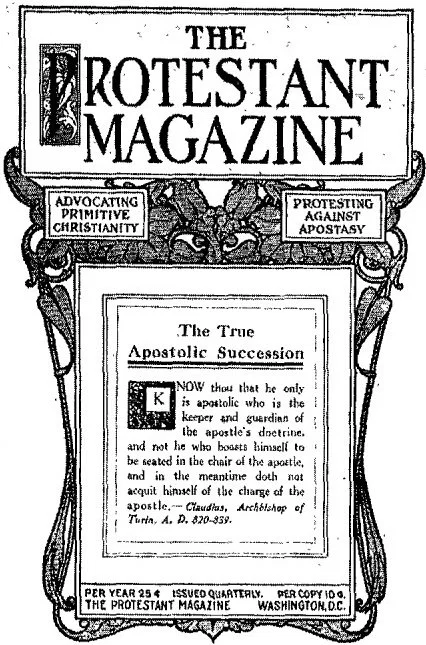
The striking double-frontispiece pictures showing the Pope in contrast with the humble “Christ before Pilate” preach a most eloquent sermon, which appeals to honest Catholics as well as true Protestants.
25 Cents a Year, 10 Cents a Copy

ROME EVER THE SAME

The following brief extracts are taken from an editorial one foot long, which appeared in the “Catholic Columbian” (Columbus, Ohio), August 18, 1911:—
“The ‘Protestant Magazine’ will be repudiated by all decent Protestants, no matter of what denomination. . . . Thousands of copies of these lying and scurrilous publications are being distributed free. . . . The enemies of free representative government seem to be able to secure funds to carry on their nefarious work. Let us meet their foul propaganda by distributing Catholic literature at every opportunity.
“It is no way lawful to demand, to defend, or to grant promiscuous freedom of thought, of speech, of writing, or of religion, as if they were so many rights which nature had given to man.”—Pope Leo XIII, in Encyclical on Liberty, issued June 20, 1888.
“Resolved, That the Congress of the United States be earnestly requested to amend Section 3893 of the revised statutes of the United States relating to the mailing of ‘obscene, lewd, and lascivious’ literature so that the same may include the mailing of books, papers, writings, and prints which outrage religious convictions of our citizens, and contain scurrilous and slanderous attacks upon Faith.”—Resolutions, Ninth Annual Convention, American Federation of Catholic Societies, New Orleans, La., Nov. 13-16, 1910. See page 12 of “Bulletin of A. F. of C. S.” for September-October, 1911.

MAKING MANY FRIENDS

Hundreds of letters of congratulation are pouring into this office accompanied by long lists of yearly subscriptions.
A government official in Washington, D. C., writes:—
“American Protestantism is in need of just such a publication as you are putting out in the ‘Protestant Magazine.’ If you are selling through the news agencies, you may expect to have your orders from these sources stopped at any time. Trust you will not use my name. These papists will not stand for reason and meet arguments in an open-handed manner, but instead, resort to boycott.”
Accompanying his second list of subscriptions, a Lutheran pastor of Iowa writes:—
“I shall continue to get new subscribers. I shall always remember you and the work you are connected with, in my prayers.”

Special Offer on Ten, One Year

10 or more copies, one year, to one address, or to 10 separate addresses, cash with order, only 15 cents each. Sender may include his own name as one of the ten.
A good proposition for agents. Send 10 cents for sample copy and particulars.

Order Through Your Tract Society

LIFE & HEALTH

The January Number of

LIFE & HEALTH

IS SELLING FAST!

Cover Design Printed in Three Colors
To see it is to know why. The beautiful snow scene on the cover, “Winter in Yosemite Valley,” is a work of art, and well worth more than 10 cents.
Until Jan. 15, 1912, all subscribers for one year will receive, in addition to the 12 numbers for 1912, the beautiful October, November, and December issues free of charge,—15 months for $1.

New Department

In Questions and Answers, the editor will reply to all reasonable questions by subscribers. Subscribe now. Send $3 for 5 years’ subscription; $2 for 3 years; or $1 for 15 months, as offered above.
We want you as our agent in your town. Send 10 cents for sample copy and particulars. Also induce your friends to become agents.

SOME FEATURES

Frontispiece—“Cathedral Spires,” Yosemite Valley, Cal.
The Benediction of the Snow, by George Wharton James. (6 illustrations.) “It falls upon the just and the unjust, the beautiful and the ugly.” Article written especially for this magazine.
What Is True Success? by F. W. Fitzpatrick. A great personal question. What notable dying people have said. A valuable analysis.
How Two Mothers Cared for Their Babies: Why One Succeeded and the Other Failed, by Lauretta Kress, M. D., of the Loma Linda (Cal.) Sanitarium staff. (5 illustrations.) The third and final article, telling how Mrs. Franklin’s baby boy was saved through the advice of Mrs. Lake.
Health Work in Milwaukee, by Carl D. Thompson, city clerk. (7 illustrations.) What a socialist city government is doing to solve the problems of public health, wages, and the abolition of slums and other insanitary conditions.
The Significance of Feeble-Mindedness, by Henry H. Goddard, M. D. (Chart showing feeble-minded family tree.) A leading cause of crime, prostitution, and pauperism. How to prevent these terrible conditions.
Paper-Bag Cookery (illustrated), by Geo. E. Cornforth, chef, New England Sanitarium. A revolution in modern cookery fully explained. How to avoid the cleaning of dirty pots and kettles. Many valuable recipes.
Questions and Answers. A new department of great value to every subscriber or reader of this magazine.
Chicago Vice Commission’s Report Barred From the Mails.
Experiences of a Nurse in Uruguay.
Total Abstinence as a Business Proposition.
Report of Minneapolis Vice Commission.
Drink and Higher Education.
The Brewers’ Show in Chicago, and 63 other articles.

Earn Your Own Subscription

By sending us two new subscriptions at $1 each, you may earn your own yearly subscription, including the three extra numbers offered above. These three extra numbers will also be sent to your two subscribers.
Send $2 for 50 copies; sell 20 to get your money back; then sell or give away the other 30 copies in the interests of true health reform.

PRICES

$1.00 a Year, 10 Cents a Copy; 5 to 40 Copies, 5 Cents each; 50 or more Copies, 4 Cents each.

Send all Orders Through Your Tract Society

The Lord's Supper

L. D. SANTEE
“For as often as ye eat this bread, and drink this cup, ye do show the Lord’s death till he come.” 1 Cor. 11:26.
Two cloths, white as snow, on the table, For the Supper of Christ has place; The light shines soft o’er the chalice, And illumines the pastor’s face, But the heart that bled on Calvary Beats now in the “holy place.”
On a simple plate on the table Are the squares of unleavened bread, A type of the “broken body,” While the wine in the cup is red; And above these solemn symbols, The pastor bows his head.
O words of the olden Thursday That Jesus spoke to us then! Ye bring us the Friday’s victim, Slain for the sins of men. He died, but he lives forever, Never to die again.
The broken bread is partaken As a symbol of the divine. These emblems, rich in their meaning, With our holiest hopes entwine; For the body and blood of Jesus, Are shown by the bread and wine.
They drink of the “living fountain,” They feed on the “living bread;” They know, by the world’s Redeemer Must the hungry of earth be fed. Then leave the place of communion, With hushed and reverent tread.
O love that shall last forever! Stronger than death or pain, We’ll treasure these sacred emblems Till thou shalt come again; And ever shall they remind us, Of the Christ on Calvary slain.
And ever in our bosoms Does the glorious prospect shine Of a crown, and a home in heaven, Through the blood of the divine; And the body and blood of Jesus, Are shown by the bread and wine. Sweet hope, that shall last forever, Of life through the Son of God; We would daily follow his footsteps, And walk in the path he trod. And the bread is the broken body, And the crimson wine is the blood.
Moline, Ill.

The Communion Service

J. N. LOUGHBOROUGH
BEFORE me are the questions, “Did the Saviour in instituting the ordinance of humility—the washing of feet—and the Lord’s Supper design them to be a test of Christian character? and did he empower his church to exclude from the sacrament all who might not stand complete in all the will of the Lord?”
Whatever the Saviour did on that occasion is safe for us to follow, for he said, “I have given you an example, that ye should do as I have done to you.” John 13:15. One thing is certain in the teachings of Christ, that he never empowered his people to sit in judgment here on the fate of their fellows. He said, “Judge not, that ye be not judged. For with what judgment ye judge, ye shall be judged: and with what measure ye mete, it shall be measured to you again.” Matt. 7:1, 2. Webster’s definition of judging is: “To examine and pass sentence on; to try; to condemn.” Luke’s record of this discourse of Christ is: “Judge not, and ye shall not be judged; condemn not, and ye shall not be condemned.” Luke 6:37. But, it might be asked, “Did not Christ say of false prophets, ‘Ye shall know them by their fruits’?” Matt. 7:16. Yes, but he did not say, Ye shall exclude all from your fellowship who are striving to serve the Lord, if they do not in everything come up to your standard of judgment.
Paul met those in his time who were placing themselves upon the judgment-seat to condemn others who did not meet their idea of things. He said of such, “But with me it is a very small thing that I should be judged of you, or of man’s judgment. . . . But he that judgeth me is the Lord. Therefore judge nothing before the time, until the Lord come, who both will bring to light the hidden things of darkness, and will make manifest the counsels of the hearts: and then shall every man have praise of God.” 1 Cor. 4:3-5.
Still later the apostle said to the Roman brethren, “But why dost thou judge thy brother? or why dost thou set at naught thy brother? for we shall all stand before the judgment-seat of Christ. For it is written, As I live, saith the Lord, every knee shall bow to me, and every tongue shall confess to God. So then every one shall give account of himself to God. Let us not therefore judge one another any more: but judge this rather, that no man put a stumbling-block or an occasion to fall in his brother’s way.” Rom. 14:10-13.
But to return to the sacrament question. What is the institution? and what place does it occupy in the gospel plan? Of this we read, “The cup of blessing which we bless, is it not the communion of the blood of Christ? The bread which we break, is it not the communion of the body of Christ?” 1 Cor. 10:16. The words of our Saviour when instituting the communion were, “For as often as ye eat this bread, and drink this cup, ye do show the Lord’s death till he come.” 1 Cor. 11:26. As the repentant sinner, in the past dispensation, came with his innocent lamb, confessed his sins, and in offering that blood showed his faith in the Saviour to come, so, in partaking of the bread and wine in the sacrament, our faith looks back to the cross, and accepts the blood of Christ, the innocent victim, as a propitiation for our sins.
It may be said, “Does not the apostle speak of an examination of those partaking of the Lord’s Supper?” Yes, but he says, “Let a man examine himself.” He does not say others must examine him, lest they become polluted with something about him which they imagine is wrong. Let us see what is implied in his examination. “But let a man examine himself, and so let him eat of that bread, and drink of that cup. For he that eateth and drinketh unworthily, eateth and drinketh damnation to himself, not discerning the Lord’s body.” 1 Cor. 11:28, 29. By reading this whole chapter we see that the apostle was correcting an abuse of the communion service. Hesaid: “When ye come together therefore into one place, this is not to eat the Lord’s Supper. For in eating every one taketh before other his own supper: and one is hungry, and another is drunken.” 1 Cor. 11:20, 21. They had turned the occasion into a feast of their own, instead of making it a special occasion of calling to mind the humiliation and death of Christ.
Did the Saviour, in instituting the communion service, limit it to those only who stood clear from all sin? Let us see the condition of his communicants. There was Judas. What was his condition? ‘Six days before the passover,’ immediately after the feast at Simon’s house, he ‘went unto the chief priests, and said unto them, What will ye give me, and I will deliver him unto you? And they covenanted with him for thirty pieces of silver. And from that time he sought opportunity to betray him.’ John 12:1; Matt. 26:14-16. Of the disciples at that time it is said, ‘And there was also a strife among them, which of them should be accounted the greatest.’ Luke 22:24. Here surely was a situation! Fit subjects were these for the ‘judgment’ of Christ, if he wished to leave an ‘example’ for us to follow in examining, and judging our brethren. Here was Judas, with revenge upon the Saviour in his heart, and the other disciples striving who should be accounted the greatest. Christ washed the feet of every one, and said to each, Take, eat of this bread, and drink of this cup.
We will quote from another source respecting the feast at Simon’s house, and what followed, ‘Six days before the passover,’ we read, ‘he [Judas] went directly from that supper to the chief priests, and agreed to betray him [Christ] into their hands.’—Spirit of Prophecy, also, Desire of Ages.
Again, ‘when Judas had become annoyed at the implied rebuke of Jesus because of his covetous spirit upon that occasion of Mary’s anointing his head with the costly ointment, he yielded to the temptation, and gave Satan easy access to his mind.’—Spirit of Prophecy.
‘He [Judas] finally became so penurious that he made bitter complaint because the ointment poured upon the head of Jesus was expensive. He turned it over and over in his mind, and counted the money that might have been placed in his hands to expend if that ointment had been sold. His selfishness grew stronger until he felt that the treasury had really met with a great loss in not receiving the value of the ointment money. He finally made open complaint to Christ. The Saviour rebuked him for his covetousness. This rankled in the heart of Judas, until for a small sum of money, he consented to betray his Lord.’—Id.
‘After Judas had closed the contract by which he agreed to betray his master into the hands of those who thirsted for his life, he mingled with the other disciples as if innocent of wrong, and interested himself in the preparation for the Passover. The betrayer thought that his purpose was hidden from his Master. . . . He only became more firmly settled in his plans as the discovery of his guilt was made apparent.’—Id.
It may be said that ‘when Christ washed Judas’s feet, and gave him the emblems of the Lord’s body and blood, the sin of Judas had not been made known to the disciples.’ It was not the disciples that washed his feet, nor the disciples that gave him the emblems of Christ. It was the Saviour himself who knew from the beginning who should betray him. John 6:64. ‘He knew who should betray him; therefore said he, Ye are not all clean.’ John 13:11.
Again we read: ‘Judas the betrayer was present at the sacramental service. He received from Jesus the emblems of his broken body and his spilled blood. He heard the words, “This do in remembrance of me,” and sitting there in the very presence of the Lamb of God, the betrayer brooded over his dark purposes, and cherished his sullen, revengeful thoughts.
‘At the feet-washing, Christ had given convincing proof that he understood the character of Judas. ‘Ye are not all clean,’ he said. These words convinced the false disciple that Christ read his secret purpose.’—Spirit of Prophecy.
‘Though Jesus knew Judas from the beginning, he washed his feet, and the betrayer was privileged to unite with Christ in partaking of the sacrament. A long-suffering Saviour held out every inducement for the sinner to receive him, to repent, and to be cleansed from the defilement of sin. . . . It was because the disciples were erring and faulty, that he washed their feet, and all but one were thus brought to repentance.
‘Christ’s example forbids exclusiveness at the Lord’s Supper. It is true that open sin excludes the guilty. This the Holy Spirit teaches [I Cor. 5:10]. But beyond this none are to pass judgment. God has not left it with men to say who shall present themselves on these occasions. Who can distinguish the tares from the wheat? ‘Let a man examine himself, and so let him eat of that bread, and drink of that cup.’ [I Cor. 11:28.]
‘There may come into the company persons who are not in heart servants of truth and holiness, but may wish to take part in the service. They should not be forbidden.’—Id.

Paul at Liberty

MRS. E. G. WHITE
WHILE Paul’s labors in Rome were being blessed to the conversion of many souls and the strengthening and encouragement of the believers, clouds were gathering that threatened not only his own safety, but also the prosperity of the church. On his arrival in Rome he had been placed in charge of the captain of the imperial guards, a man of justice and integrity, by whose clemency he was left comparatively free to pursue the work of the gospel. But before the close of the two years’ imprisonment, this man was replaced by an official from whom the apostle could expect no special favor.
The Jews were now more active than ever in their efforts against Paul, and they found an able helper in the profligate woman whom Nero had made his second wife, and who, being a Jewish proselyte, lent all her influence to aid their murderous designs against the champion of Christianity.
Paul could hope for little justice from the Cæsar to whom he had appealed. Nero was more debased in morals, more frivolous in character, and at the same time capable of more atrocious cruelty, than any ruler who had preceded him. The reins of government could not have been entrusted to a more despotic ruler. The first year of his reign had been marked by the poisoning of his young stepbrother, the rightful heir to the throne. From one depth of vice and crime to another, Nero had descended, until he had murdered his own mother, and then his wife. There was no atrocity which he would not perpetrate, no vile act to which he would not stoop. In every noble mind he inspired only abhorrence and contempt.
The details of the iniquity practised in his court are too degrading, too horrible, for description. His abandoned wickedness created disgust and loathing, even in many who were forced to share his crimes. They were in constant fear as to what enormities he would suggest next. Yet even such crimes as Nero’s did not shake the allegiance of his subjects. He was acknowledged as the absolute ruler of the whole civilized world. More than this, he was made the recipient of divine honors, and was worshiped as a god.
From the view-point of human judgment, Paul’s condemnation before such a judge was certain. But the apostle felt that so long as he was loyal to God, he had nothing to fear. The One who in the past had been his protector could shield him still from the malice of the Jews, and from the power of Cæsar.
And God did shield his servant. At Paul’s examination the charges against him were not sustained; and contrary to the general expectation, and with a regard for justice wholly at variance with his character, Nero declared the prisoner guiltless. Paul’s bonds were removed; he was again a free man.
Had his trial been longer deferred, or had he from any cause been detained in Rome until the following year, he would doubtless have perished in the persecution which then took place. During Paul’s imprisonment, the converts to Christianity had become so numerous as to attract the attention and arouse the enmity of the authorities. The anger of the emperor was especially excited by the conversion of members of his own household, and he soon found a pretext to make the Christians the objects of his merciless cruelty.
About this time a terrible fire occurred in Rome, by which nearly one half of the city was burned. Nero himself hadcaused the flames to be kindled, but to avert suspicion he made a pretense of great generosity by assisting the homeless and destitute. He was, however, accused of the crime. The people were excited and enraged, and in order to clear himself, and also to rid the city of a class whom he feared and hated, Nero turned the accusation upon the Christians. His device succeeded, and thousands of the followers of Christ—men, women, and children—were cruelly put to death.
From this terrible persecution Paul was spared; for soon after his release he had left Rome. This last interval of freedom he diligently improved in laboring among the churches. He sought to establish a firmer union between the Greek and the Eastern churches, and to fortify the minds of the believers against the false doctrines that were creeping in to corrupt the faith.
The trials and anxieties that Paul had endured had preyed upon his physical powers. The infirmities of age were upon him. He felt that he was now doing his last work; and as the time of his labor grew shorter, his efforts became more intense. There seemed to be no limit to his efforts. Resolute in purpose, prompt in action, strong in faith, he journeyed from church to church, in many lands, and sought by every means within his power to strengthen the hands of the believers, that they might do faithful work in winning souls to Jesus, and that in the trying times upon which they were even then entering, they might remain steadfast to the gospel, bearing faithful witness for Christ.

The Final Arrest

Paul’s work among the churches after his acquittal at Rome, could not escape the observation of his enemies. Since the beginning of the persecution under Nero, the Christians had everywhere been a proscribed sect. After a time, the unbelieving Jews conceived the idea of fastening upon Paul the crime of instigating the burning of Rome. Not one of them thought for a moment that he was guilty; but they knew that such a charge, made with the faintest show of plausibility, would seal his doom. Through their efforts, Paul was again arrested, and hurried away to his final imprisonment.
On his second voyage to Rome, Paul was accompanied by several of his former companions; others earnestly desired to share his lot, but he refused to permit them thus to imperil their lives. The prospect before him was far less favorable than at the time of his former imprisonment. The persecution under Nero had greatly lessened the number of Christians in Rome. Thousands had been martyred for their faith, many had left the city, and those who remained were greatly depressed and intimidated.
Upon his arrival at Rome, Paul was placed in a gloomy dungeon, there to remain until his course should be finished. Accused of instigating one of the basest and most terrible of crimes against the city and nation, he was the object of universal execration.
The few friends who had shared the burdens of the apostle, now began to leave him, some by desertion, and others on missions to the various churches. Phygellus and Hermogenes were the first to go. Then Demas, dismayed by the thickening clouds of difficulty and danger, forsook the persecuted apostle. Crescens was sent by Paul to the churches of Galatia, Titus to Dalmatia, Tychicus to Ephesus. Writing to Timothy of this experience, Paul said, “Only Luke is with me.” Never had the apostle needed the ministrations of his brethren as now, enfeebled as he was by age, toil, and infirmities, and confined in the damp, dark vaults of a Roman prison. The services of Luke, the beloved disciple and faithful friend, were a great comfort to Paul, and enabled him to communicate with his brethren and the world without.
In this trying time Paul’s heart was cheered by frequent visits from Onesiphorus. This warm-hearted Ephesian did all in his power to lighten the burden of the apostle’s imprisonment. His beloved teacher was in bonds for the truth’s sake, while he himself went free; and he spared himself no effort to make Paul’s lot more bearable.
In the last letter that the apostle ever wrote, he speaks thus of this faithful disciple: “The Lord give mercy unto the house of Onesiphorus; for he oft refreshed me, and was not ashamed of my chain: but, when he was in Rome, he sought me out very diligently, and found me. The Lord grant unto him that he may find mercy of the Lord in that day.”
The desire for love and sympathy is implanted in the heart by God himself. Christ in his hour of agony in Gethsemane longed for the sympathy of his disciples. And Paul, though apparently indifferent to hardship and suffering, yearned for sympathy and companionship. The visit of Onesiphorus, testifying to his fidelity at a time of loneliness and desertion, brought gladness and cheer to one who had spent his life in service for others.

Manner of Keeping the Sabbath

MRS. M. E. STEWARD
The observance of the Sabbath began in Eden, continues through time, and the day will be honored in the new earth.
Definite time. Three scriptures give us the exact hours of the Sabbath day; these hours being the same as those of any other day. The record of the making of the days is found in the first chapter of Genesis; evening signifies night, and morning the light part. Thirty-five hundred years later the Lord directed, “From even unto even, shall ye celebrate your sabbaths.” Lev. 23:32. In the days of Christ, even is defined as sundown. Mark 1:32. Hence, God’s Sabbath day is from sundown to sundown.
Three conditions:—
1. “If thou turn away thy foot from the Sabbath, from doing thy pleasure on my holy day.
2. “And call the Sabbath a delight, the holy of the Lord, honorable.
3. “And shalt honor him [in three ways], not doing thine own ways, nor finding thine own pleasure, nor speaking thine own words.”
Some one’s foot is on the Sabbath. Such an expression implies the greatest indignity and contempt. The indignity is intensified when God’s Sabbath is made the preparation day for a rival sabbath.
The Lord requires all people living to honor him by reverencing his holy day. He honored it himself by placing his blessing upon it, and on no other day. The Sabbath is the “delight” of the child of God, because it is the sign of the recreation of his soul in righteousness (Eze. 20:12); and the memorial of the creative power that is able to do this work. What reason we have for welcoming, delighting in, and deeply loving the creation Sabbath! what cause to “honor” and be grateful to him who gave it to us!
“Not doing thine own ways, nor finding thine own pleasure, nor speaking thine own words.” Every moment of the Sabbath is sanctified time, set apart by its great Creator to a holy use. Gen. 2:3.
No work is allowable except to alleviate distress. Conversation on worldly business, on dress, and secular reading are prohibited. There should be nothing anywhere out of harmony with the pure, refined tastes of holy angels, and in which they could not participate. O the blessing that sweetly fills the home where angels bring the holy atmosphere and rest of heaven!
Loyalty to the fourth commandment is followed by great blessing.
1. “Then shalt thou delight thyself in the Lord.” If one delights in the Sabbath, he will delight in its Lord; and if a person has an intelligent love for his Lord, he can not help loving the Sabbath also. Here is a test of true conversion.
2. “I will cause thee to ride upon the high places of the earth.” Christians “sit together in heavenly places in Christ Jesus.” Eph. 2:6. They are “above . . . and not beneath.” Deut. 28:13. And they have understanding superior to their teachers. Ps. 119:99.
3. “I will . . . feed thee with the heritage of Jacob thy father.” The heritage of Jacob was: (1) The forgiveness of sins, which he valued above everything else; (2) his were all the privileges of the first born; (3) as the lineal descendant of Abraham his was a world-wide blessing, and he had also the promise of eternal life.
These “exceeding great and precious promises” to the Sabbath-keeper have the guaranty of the highest authority in the universe,—“the mouth of the Lord hath spoken it.”
Sanitarium, Cal.
Continue reading: Turkey in Prophecy