Your ShelfYour Projects

Signs of the Times, Vol. 33, No. 3.

Contained in this Issue

Signs of the Times

Jan 16, 1907

Pacific Press Publishing Company · Mountain View, California · Jan 16, 1907

Contained in this Issue.

The Country and the City.

"Written and Engraven in Stone."

Second Corinthians Three.

Question Corner.

The Keys of the Kingdom of Heaven.

The Great Salvation.

Angels as Body-guards.

Miracles, Marvels, and Mysteries.

Search the Scriptures—Hebrews.

A Tribute to the Old Testament.

Hebrew and Heathen Laws.

Fifty Years in China.

The United States and the Vatican.

The Storer Incident.

COOPERATION CORNER.

Those who are interested in the Cooperation Corner will read with interest the following letter:
"I notice in your paper under date of December 19 that you ask for some one to help in the matter of keeping SIGNS OF THE TIMES in the rack at the railroad station. We beg to enclose herewith two dollars ($2.00) for that work. Trusting this will result in the salvation of some honest soul, I beg to remain
"Yours in the Master's work."

Papers for Poorhouse Mission Work

The following letter is just received from a brother in St. Louis:
"I am in the mission work at the poorhouse, and each Sunday I give out from 500 to 600 papers. So I thought if you had any back numbers you could donate to me in my work, I would be very grateful for them. I hold services every Sunday, and give out Christian papers. If you can furnish some of the SIGNS, as I am out of papers, it will be a great help to me."
St. Louis. SILAS SAMUELS.
We have sent a package of back numbers to help in this work, and thinking others might like to help, we mention our September issues which are excellent. We have some of these still on hand, and will be glad to furnish them at 1½ cents per copy for this work.
Will fill orders from friends the day received. Order direct from SIGNS OF THE TIMES, Mountain View, Cal.

Plans for the Signs of the Times

FROM THE SUBSCRIPTION DEPARTMENT.

A NEW BOOKLET, giving outline of plans for the SIGNS OF THE TIMES during 1907 has just been issued. It includes a list of the Bible subjects which will be presented in the series of 26 numbers to come in the middle of 1907. It gives a general description of each department of the SIGNS during the year; is nicely illustrated, and contains list of contributors.
This booklet will be valuable to every friend of the SIGNS OF THE TIMES, and will help you in interesting others in the paper.
Will be glad to furnish copies free on request. Ask for "Plans for 1907." Address, SIGNS OF THE TIMES.

Subscribers’ Letters

From subscribers:
"I wish to have my paper sent to my present address. Hope I shall not have to lose any of the numbers. It is certainly the best paper that I have ever taken. God bless you and the work that you are so faithfully doing. I am "Sincerely yours."
"I am a fast friend of the good old SIGNS, and have remailed many hundred copies of it. May prosperity attend it in its new home. May it continue to do a great work and bring the light of truth to many. I am glad we have this paper to read and to use in pointing others to the true and only Gospel of salvation."

School Text-Books

We are glad to make the following announcement concerning text-books:

Church School Readers

The readers known as the "Christian Educator Reading Series," were adopted by the General Conference at its Educational convention held in College View, Neb., June 29 to July 10, 1906, and recommended for use in all our church and primary schools. The first edition of this series of readers has for some months been exhausted. A new edition is now in preparation. It is to be known as the "True Education Reader Series." The series consists of the following books:
  • Book One for grade one.
  • Book Two for grade two.
  • Book Three for grade three.
  • Book Four for grade four.
  • Book Five for grade five.
  • Book Six for grade six.
  • Book Seven for grades above six.
Book No. 2 is now ready. Book No. 1 will be ready in about two weeks. Books No. 3 and No. 5 will follow soon thereafter. Book No. 7 is being pushed along rapidly, but we can not promise exact date of publication.
The author of books No. 4 and No. 6 promises us copy in time to have these books on the market before the fall terms open.
"True Education Reader Series" is the result of successful experience in teaching. An experimental edition of these books was issued during the year 1904. During the two succeeding years they have been used quite largely in our schools on the Pacific Coast. In many other conferences they have also been used to some extent. Almost without exception they have been welcomed by teachers as a blessing in their schools. Even from Australia and Africa have come words of the heartiest commendation.
These readers are no longer regarded as an experiment. The call has come for a new and larger edition. In preparing the present edition, the authors have counseled with a large number of our leading educators and our best teachers in different parts of the country. To these we owe many valuable criticisms and suggestions. We feel clear in saying that in every way the present edition greatly excels the former.
Most careful attention has been given to the subject-matter. No fairy tales or other objectionable matter has been admitted. Readings from the Word of God, readings on the works of God and His dealings with His people, occupy the chief place. All other matter has been measured by this standard. A pleasing variety of prose and poetry on a large number of subjects makes the books a delight with the pupil.
All the books are well illustrated, many of the master-pieces of art having been secured for this purpose. Every teacher knows the value of illustrations in the work of education.
Special attention has been given to developing the work in language, composition, and spelling. The lessons in these subjects, as well as the reading-matter itself, have been carefully graded. It is almost universally conceded by educators that language and spelling are greatly neglected in most schools. Experience has shown that this natural method of presenting these subjects not only saves the time of both teacher and pupil, but insures more thoro work, and, consequently, better results.
Prices on No. 1 and No. 2 will be 75 cents each post-paid. The prices on the other books are not yet decided upon.
As an evidence of the wide-spread interest in these readers, will say that we have just received an order from Australia for one hundred eighty copies to go to a school by mail.

McKibbin's Bible Lessons

Nearly all these books were destroyed in our fire. There are a limited number of No. 1, however, the post-paid price on which is 50 cents.

Bible Nature Studies

A few hundred signatures of these books were saved and are now being bound. Price, $1.00 post-paid.

Bible Nature Study Notebooks

These notebooks are now published in two ways,—the complete book bound in cloth at 85 cents post-paid,—in three paper-covered volumes containing about one hundred twelve pages each, at 40 cents each post-paid.
No. 1 is for fourth-grade work, No. 2 is for fifth-grade work, and No. 3 is for sixth-grade work. All the above books may be obtained by addressing your state tract society, or

PACIFIC PRESS PUBLISHING COMPANY

Mountain View, Cal. 285 Salmon Street Portland, Ore. 1109 East 12th Street Kansas City, Mo.

THE COUNTRY AND THE CITY.

DURING the month of December abundant rains have fallen in California. They fell in no raging tempest or storm of sleet, but quiet and soft and warm, and the thirsty ground drank them all in eagerly. Between the rains the genial sun has lightened land and hearts, warmed the earth, nurtured into life the seeds and roots, till now as far as eye can see the fresh, delicate first green is hiding the brown old earth, and cheering and resting wavering hearts with promise of coming crops. The old earth is beginning to put on her yearly garb of beauty in the Golden State, and as the days go by she will embellish and adorn it with thousands of various hued blooms from the sea to the Sierras, and from the valley to the mountain top. Bless God for the country!
But the city remains the same. Apart from the borrowed or imitated spots of country the city possesses, called gardens and parks, and the few more flowers as the season advances toward summer, the city is the same the whole year round. Its walls of brick and wood and stone greet us in the same cold stare day after day. Its whistles and bells, its yells and shrieks, its grind and growl, its noise and din, jar the ears and make interminable discord the whole day round. Its ugly sights, its sharp encroaching angles, its everlasting rush and roar and ravage and rage smite with brutal, ruthless hand all the tender sentiment and esthetic sensibilities of the mind. But worse than all, the faces, the human faces, the brute-human faces! Faces stamped with greed and inward grime, with sin and vice and crime! Gloomy, hard, disappointed faces, cheated by justice or providence of their prey! Hurried, harried, anxious, restless faces, fighting the flood-tide and undertow of the human sea for a mere existence! Shrewd, cold, calculating faces, measuring you up at what you may be worth to them in dollars and cents!
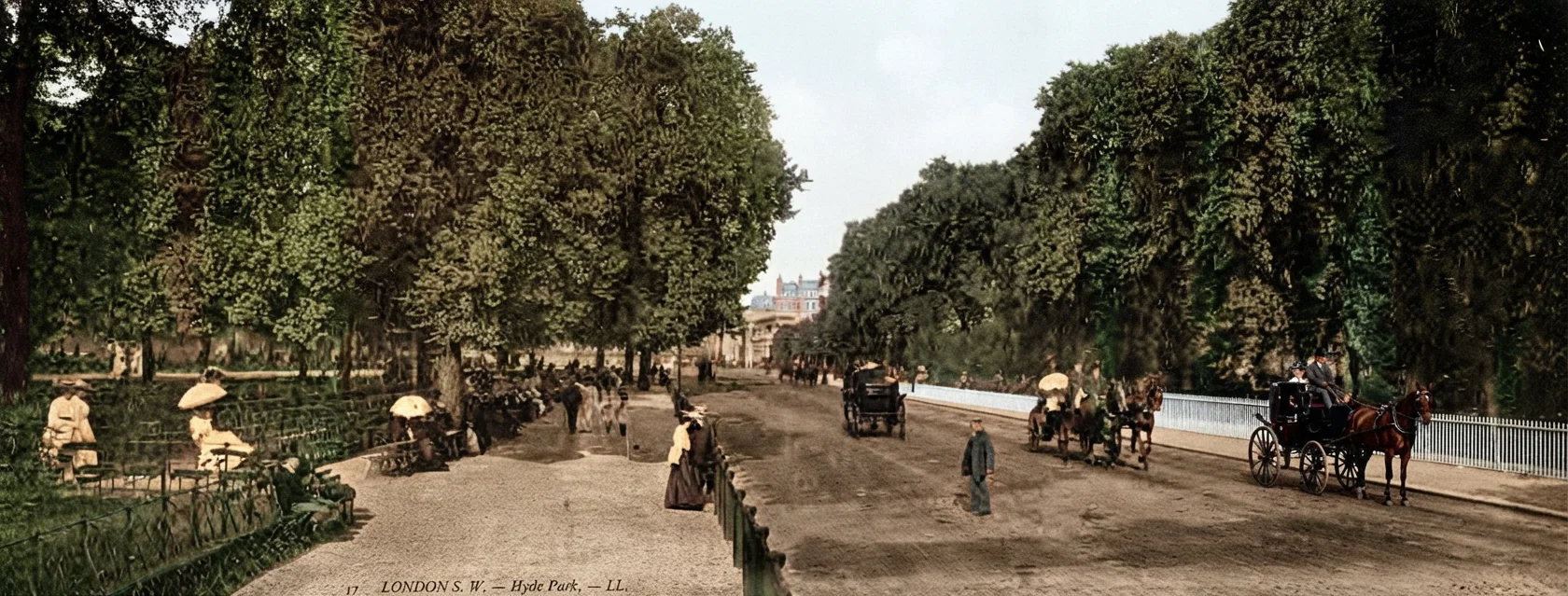
Hyde Park, London.
Hyde Park, London.
Stolid, apathetic, unthinking, dough faces, pushed on by the crowd, content with mere animal existence! Passion faces, child faces, seeking and chasing the brilliant bubbles of pleasure in the great Vanity Fair of city life, never more than half succeeding in the pleasure, always reaping at last the disappointment! Sad and sorrowful faces, needing no habiliments of mourning to tell the heart's story of the loss of much or all that life holds dear. A few sweet, patient, hopeful, helpful faces, which to look upon gives uplift and courage; which look into yours, and beyond you to what you might be if you would submit to Christ's school of faith, obedience, and the discipline of life! Oases in the desert of faces! And thousands of other faces, faces, faces too numerous in kind and grade and stamp to enumerate, throng you on every side, in that great, throbbing, restless, diseased nerve plexus of present-day civilization called a city.
It is little wonder that the city grows wicked. Its whole life is abnormal, unhuman, inhuman. It is ever driving to excess, and the excess in laudable lines crowds to excess in directions unlaudable, illegitimate. The constant strife in business, the rivalry for political and social position, the strenuousness of the very struggle for existence, throws life open to the constant challenges of the devil to do daring, desperate, devilish things. Greed—greed for gain, greed for pleasure, greed for power, greed for the perishing present—rules our cities to-day. What wonder there is graft and forgery, and embezzlement, and open, flaunting vice, the trampling underfoot of all that is pure and holy in marital and family relationships by unbridled lust, and murder in a thousand forms! These are the outworkings of the flesh intensified by the abnormal, diseased, congested city life.
THINK of the records of the last few years in the investigations which have been made, investigations blocked at every step by those high in position! Think of the revelations of vice and crime in New York, Philadelphia, Chicago, Minneapolis, St. Louis, San Francisco, Pittsburg. Did the disclosures clean them? In some cases it stayed the awful tide of crime for a little, but it has not beenlong in most cases ere the stream was rushing on the same as ever, over bank full. It would seem that the awful calamity thru which San Francisco recently passed would affect the hearts of the majority of her people with such a fitting, sober sense of sin and its consequences that the very atmosphere would be changed; that sober, earnest, honest work would follow, that evil would be held in check, and that a purer city would rise from the ruins of the old. But before the smoldering fires died out, and the stench of the buried dead had ceased to contaminate its atmosphere, greed opened the doors of saloons and brothels, and the mighty carnival of vice began on a larger proportionate scale than the city had ever known. It would seem that St. Petersburg, the center of a defeated, dejected, humiliated nation, would be humbling herself and crying unto God for a better way; but the reports are that in holiday carnival there was more reckless, open, wanton, shameless gambling and sin and vice manifest than other cities in Christendom had ever known.
IT needs no prophet to predict the doom, the decay, the destruction of these fostering places of sin and crime. Sin full-grown is death. Men may leave God out of their reckoning; they may scoff at His Book; they may trample on His law of Ten Commandments; they may ridicule Christ and His cross; they may go on and on in their shameless sin, unheedful of the warning of certain judgment, loving the sin, clinging to the sin, practising the sin, and they will find the sure result—death and destruction. They are writing their own doom in their own characters; and the shining scribes of God are writing in the record books of the Judge only what is written here. Men ought to learn this by pure reason. Yet God warns over and over in His Book; and just as surely as Babylon, and Nineveh, and Tyre, and No-Ammon, and Athens, and Sodom, and Samaria, and Capernaum, and Jerusalem met their doom because of fostering wickedness, just so surely will the wicked, selfish, shameless cities of to-day meet their doom. All that has gone before are God's merciful warnings to the present. The God of all grace would save every soul. 'As I live, saith the Lord Jehovah, I have no pleasure in the death of the wicked; but that the wicked turn from his way and live; turn ye, turn ye from your evil ways; for why will ye die?' Eze. 33:11. Christ the Lord would make grace super-abound where sin has abounded, if men will turn to Him. Rom. 5:20. But the abounding wickedness unchecked will lead us rapidly on to that time which the 'more sure word of prophecy' foretells: 'The cities of the nations fell; and Babylon the great was remembered in the sight of God, to give unto her the cup of the wine of the fierceness of His wrath.' Rev. 16:19.
THE refuge from that doom is found only in separation from sin and hiding in the righteousness of God in Jesus Christ. To those who yield to Him, He 'shall be as a hiding-place from the wind, and a covert from the tempest, as streams of water in a dry place, as the shade of a great rock in a weary land.' Isa 32:2.

WRITTEN AND ENGRAVEN IN STONE.

FROM two correspondents, very recently, comes a similar request concerning an important passage of scripture. Many others are puzzled over some of the expressions in the passage in question, because of the use which has been made of them in theological controversy. We do not propose to discuss it from that point of view. Such a course usually hides more truth than it discloses. The question is as follows:
Please explain 2 Corinthians 3, especially from the seventh verse onward. Was not the ministration "written and engraven in stone" the Ten Commandments, which the eleventh verse tells us was done away? E. C. and M. C. H.
The question opens before us the great subject of salvation, and our reply must at best be but suggestive.
First of all, then, let us note that it is not the truth itself, but the ministration of truth that the apostle is discussing. In the second chapter he tells us that his preaching of the Gospel made him a savor of life or a savor of death; savor of life to them who are saved, savor of death in them that perish. Which, depended on how they received the saving truth; yet he declared that the word of God must not be corrupted, but preached in sincerity. That his preaching was right, however, they who received it bore witness; and therefore he tells us in the next chapter that he needs not to commend himself, but that the Corinthian brethren were his epistle of commendation, "known and read of all men;" and that his ministration to them was by the Spirit, that wrote the very truth of God to them, not on tables of stone, but in tables that are hearts of flesh.
In the fifth verse he declares that he did not do this of himself; but God did it by the power of His Spirit. He makes us ministers of a new covenant, not of the letter but of the spirit; "for the letter killeth, but the spirit giveth life." That is the proposition. What follows is an illustration of the principles which the apostle states. He did not mean by "the letter" that the letter of some old truth killeth, but that the spirit of some new truth giveth life; but that the letter of any truth killeth, even the new covenant, while the spirit of any truth of God giveth life.
As an illustration of this he goes back to the time of the children of Israel. When God came down upon Mount Sinai, He desired to take that people into a wonderful nearness to Himself. He wanted to talk with them face to face, as a man speaketh to his friend. Thus He did talk with Moses, and the Spirit of God ministered unto Moses, writing in the heart of Moses the very precepts which God wrote on tables of stone, so that Moses' face shone with the glory which was in the law. Ex. 34: 29-35. The law gave to him not simply the glory of condemnation, which pointed out his sin, but as blessed Gospel enabling acts, it gave him power to do the law, thus making him a lover of the law, and bringing him into such wonderful connection with God that the law became a very part of his being, written in his heart. That was the ministration of the life of the Spirit.
When God came down on Mount Sinai and spoke His law, He did not design to drive His people away; He wanted them so to yield to Him that He could do by every one of them just as He did by Moses. But they, being sinners and holding to sin, feared lest they die. They saw God's glory, but it was the glory of condemnation, in contrast to Moses' view of the glory, which was the glory of justification and righteousness. Therefore, they plead with Moses, "Speak thou with us, and we will hear; but let not God speak with us, lest we die." Ex. 20: 19. "Behold, Jehovah our God has shown us His glory and His greatness, and we have heard His voice out of the midst of the fire; we have seen this day that God doth speak with man, and he liveth. Now therefore why should we die? for this great fire will consume us; if we hear the voice of Jehovah our God any more, then we shall die. . . . Go thou near and hear all that Jehovah our God shall say; and speak thou unto us all that Jehovah our God shall speak unto thee; and we will bear it, and do it." Deut. 5: 24-27.
By their own choice they interposed the human agency between themselves and God. It was not Moses' choice. Moses said, "Fear not; for God is come to prove you, and that His fear may be before you, that ye sin not." Ex. 20: 20. The Lord said, "O that there were such an heart in them that they would fear Me, and keep My commandments always, that it might be well with them, and with their children forever." Deut. 5: 29. That was God's desire, and yet He saw that in their sinful condition they could not bear His word, and so He said to Moses, "I have heard the voice of the words of this people, which they have spoken unto thee; they have well said all that they have spoken." Verse 28. They were not able in their sinful condition to hear the voice of God. Yet God gave that very law to them because He loved them. "Jehovah came from Sinai, and rose from Seir unto them; He shined forth from Mount Paran, and He came from the ten thousands of holy ones; at His right hand was a fiery law for them. Yea, He loveth the people." Deut. 33: 2, 3.
Moses gave them the law according to their request, but he could only minister to them condemnation because of their sinful condition, so that all that they received of the law was its moral lesson; all that they could do of the law was mere outward performance; all the glory which they received was the glory of condemnation. The ministration of the law to them was the ministration of death, because "sin when it is finished bringeth forth death." Yet it was glorious, so glorious did it come to them, even thru Moses, that they could not bear the shining of his face, because of the glory of his countenance. God designed to do away with that glory of condemnation in the greater glory of justification. This Moses experienced in his own life, so that the blessed presence of God was to him life and salvation, where he could tarry forty days and forty nights without eating; but the glory of condemnation without was such that it could not keep the children of Israel back from their idolatry and their idolatrous feast during the time that they were waiting for Moses to come from the presence of God. If they had received that law from the veritable presence of God, the lesser glory of condemnation would have been done away by the greater glory of justification, and the glory within would have been in perfect harmony with the glory without. Then the faces of the whole congregation would have shone as did the face of Moses. Then, indeed, God could have used them as a kingdom of priests to all nations of the world.
The Corinthian brethren received the law as from God; they heard God speaking thru Christ, and God by His Spirit spoke the law upon the very tables of their hearts and made it a very part of their being, so that the glory of their condemnation in sin was done away in the glory of the righteousness received from Christ Jesus. The law did not change; the ministration did. The ministration of condemnation came thru reception of the law in its letter; the ministration of true justification or righteousness came thru reception of that law in Christ Jesus by the Spirit. Therefore, they had the greater glory of righteousness.
The law was glorious, so that even the sinner would say with Paul, "For the law is spiritual, but I am carnal, sold under sin." "But the law is holy, and the commandment holy, and righteous, and good," but he found in him no power to do the law. But when he received Christ Jesus, the Lord, the living personification of that law, then the law became in him thru Christ a mighty worker of righteousness, manifest in obedience, the greater glory of righteousness. Rom. 8: 1-4.
Therefore Paul could use to the Corinthian brethren great boldness. They had received the law in their hearts. He did not have to do as Moses, put a veil upon his face. The children of Israel would not look to the end, where God would have done away the glory of condemnation, and so they would go with that veil lying upon their hearts still, and yet, whenever the heart turns to the Lord and looks to Him alone, the veil is taken away.
The lesson is that with unveiled faces we should look upon the glory of God, even tho it condemn us by revealing by its brightness our sins; that we should continue to look till the righteousness which is in Christ Jesus our Lord will shine all the sin away, and eclipse the glory of condemnation by the greater glory of righteousness. This, in brief, is the teaching of the chapter. It does not in any wise tell us that the eternal, immutable law of Jehovah is done away, but it does tell us, if our hearts will put away their unbelief, that the condemnation which always comes to us thru the letter, thru the mere reading of that law on the tables of stone, thru having it taught us by some one else and knowing only its condemnation, may all be done away by the greater glory of letting the Spirit of God write that law upon our hearts.

1979.—Laying on of Hands.

Please explain thru your Question Department Heb. 6:2; Acts 8:15-17. It seems from these verses that laying on of hands is an ordinance which should be observed the same as baptism, on each convert.
The passage in Acts 8:15-17 records one instance of the laying on of hands, in which the apostles had the power of imparting the Spirit to those who had been baptized. Baptism was, however, commanded of the Lord in the great commission, but nowhere in the Scriptures is the Christian ministry commanded to lay on hands. That seems to have been a matter for the Spirit of God itself to teach at the time, and that is in perfect harmony with the history of the Christian church from that day to this. In Acts 6:6 we learn that the seven deacons chosen were set apart and hands were laid upon them, even as the same ceremony is carried out in the ordination of ministers in the Christian church to the present time. But in Acts 10 we have the record of the Holy Spirit's falling upon the believers without the intervention of the laying on of hands, and even before baptism. Evidently there were certain teachings concerning it, but that teaching seems to be of the Spirit of God as occasion demands. It is only a reference to such a teaching that is referred to in Heb. 6:2. As the church of Jesus Christ cuts loose from the world and from sin, and yields herself wholly to His service, we shall see more and more of the manifestation of the power of the Spirit as in primitive times.

1980.—The Keys of the Kingdom of Heaven.

Please explain Matt. 16:19. It has been used to me as against the Sabbath, and I can not see anything about the Sabbath in it.
Matt. 16:19 is a part of the promise of the Lord to Peter. In the sixteenth verse we have Peter's confession of Jesus, "Thou art the Christ, the Son of the living God." In verse seventeen Jesus tells him that he is blessed because of this, that this did not come thru any earthly knowledge which he himself had, but that God had revealed it to him. In the eighteenth verse He tells him that because of that He made him a stone, Peter, a living stone, built into the Rock, Christ Jesus. See 1 Peter 2:4, 5; Eph. 2:19-22; 1 Cor 3:11. Christ Jesus is the Rock. Peter by that conversion became a living stone, grafted, so to speak, into the living Rock, being one with the foundation. The Rock is Christ Jesus; upon that He will build His church and the gates of Hades shall not prevail against it. Peter, because of his conversion, is to have a part in that; and because of his peculiar talents was given the keys of the kingdom of heaven. What is meant by this is told by Peter himself in the fifteenth chapter of Acts: "Brethren, ye know that a good while ago God made choice among you, that by my mouth the Gentiles should hear the word of the Gospel, and believe." Verse 7. Peter was the first also who preached to the Jews on the day of Pentecost. Acts 2. In other words, God honored him by giving him the glorious privilege of preaching the great, living Gospel of a resurrected Christ to both the Jews and the Gentiles, opening the door of salvation to them. The effect of the Gospel: "Whatsoever thou shalt bind on earth shall be bound in heaven; and whatsoever thou shalt loose on earth shall be loosed in heaven." Let Mark 16:16 explain this, "He that believeth and is baptized shall be saved; and he that disbelieveth shall be condemned." The binding and the loosing, the saving and the condemning, are not in the man, but in the message that he bears.
Of course we know that Catholics use this text to try to show that Peter is the head of the Catholic Church, and that the one who succeeds him in that church has power to bind or loose, to cast down the Sabbath or any part of God's law and to substitute for it the traditions or imaginations of men. God's word teaches nothing of that kind. Just as soon as God's messenger, let him be prophet, apostle, priest, or preacher, departs from the message which God gives him to carry, he takes himself out of the direction of God and is no longer an ambassador of the Most High.

1981.—More Sure Word of Prophecy. 2 Peter 1:18, 19.

Please explain in Question Department 2 Peter 1:18, 19. What do the words, "a more sure word" have reference to? If prophecy is sure, what can be more sure? or what is it that is "more sure"?
Please read from the sixteenth verse. Peter is giving evidences of Christ's second coming. As proof of this he relates his experience on the Mount of Transfiguration when Christ revealed Himself in glory, as He will at His second coming. First, he says, "We were eye-witnesses of His majesty." We saw it with our own eyes. Second, we listened to the voice of the Father with our own ears, when He declared, "This is My well-beloved Son." But stronger than the evidence of our own eyes, stronger than the evidence of our own ears, he tells us, is God's "more sure word of prophecy," which he has given of Christ's second coming. This is what the apostle means by the "more sure word of prophecy." Nothing could be more sure than that; for that is more sure than the evidence of our own senses.

1982.—Wine Drinking. 1 Tim. 5:23.

Please explain 1 Tim. 5:23.
The text reads, "Be no longer a drinker of water, but use a little wine for thy stomach's sake and thine often infirmities." All there is of it is special, particular instruction which the apostle Paul gave to Timothy. He had been with the apostle much; he evidently was not a well man; the apostle knew what he needed. When the Bible condemns drunkenness as it does, and tells us to "look not upon the wine when it is red," we have no idea that the apostle Paul instructed Timothy to drunkenness. A common-sense view of this is that he told Timothy not to drink so much water, which, in the locality where he was, may have been anything but pure, but to take a little wine. He did not tell him to become a wine drinker, even tho the wine was doubtless unfermented. There is in this passage no excuse whatever for drunkenness, nor the drinking of intoxicating liquors.

1983.—The Two Witnesses.

I write you with reference to question No. 1927 in your issue of Nov. 14, 1906. Please harmonize this with page 267, first paragraph on the two witnesses in "Great Controversy."
There is no inharmony. The answer in the Question Corner carried the thought farther, that is all. Primarily God's witness is His word. In the days of our Lord Jesus Christ, it was the Scriptures which had gone before and the Scriptures worked out in His life and the lives of His children. The Scriptures are still His witness, but He has also the living witness in the church, has had, and will have all the way thru, preeminently so in the very last days. There is very much more for earnest students of the Scriptures in the two witnesses than has yet been developed.

THE GREAT SALVATION

By GEO. W. REASER.

ANGELS AS BODY-GUARDS.

Angels Versus Soldiers.

"Take heed that ye despise not one of these little ones; for I say unto you, that in heaven their angels do always behold the face of My Father which is in heaven."
IN the days of Elisha the prophet the king of Syria warred against Israel. This heathen monarch called councils of his staff officers, and laid plans on numerous occasions to ambush the armies of Israel. Elisha was kept fully informed of the details of all of these war measures by an unseen messenger, and conveyed the intelligence which he received to the king of Israel, thus repeatedly saving God's people from overthrow and complete destruction. This procedure greatly mystified the king of Syria, and he inquired of his counselors if one of their number had not acted the part of a traitor. Being assured that all of these men were loyal to him, and that Elisha the prophet was responsible for the gloomy failure of his army in the campaign, he inquired as to the place of residence of Elisha, and sent out a strong detachment of his army to seize him.
They came by night and surrounded the city wherein was the abode of the prophet. His servant arose early in the morning, and discovering the presence of the armed host, and seeing no avenue of escape, was filled with dismay. Revealing his fears to Elisha, he was assured that there was no occasion for consternation, "for," said the prophet, "they that be with us are more than they that be with them." Then breathing a brief prayer to Heaven that the eyes of his servant might be opened, the young man saw, "and, behold, the mountain was full of horses and chariots of fire, round about Elisha." The soldiers were stricken with blindness, and, instead of taking God's prophet captive, were all led captive by him.
Altho our physical eyesight may not enable us to comprehend the presence of heavenly messengers, in the hour of danger, faith, stronger than sight, says, "the angel of the Lord encampeth round about them that fear Him, and delivereth them." If our eyes were "opened," we could daily see the presence of guardian angels.

Jacob's Ladder.

One of the most vivid and beautiful examples of the ministration of angels, appears in the history of the life of the patriarch Jacob. Fleeing from the wrath of his brother Esau, he tarried at nightfall at a certain place, and with his head pillowed upon a stone, fell into the slumber which comes alone to the weary. His sleep was not dreamless, for he saw, "and behold a ladder set upon the earth, and the top of it reached to heaven; and behold angels of God ascending and descending upon it." Thus an illustration is brought within our mental grasp of the glorious fact that heavenly angels are in constant communication with earth, and we are told that all blessings are sent from God to man thru the virtue of Christ, by the ministration of these heavenly beings.
An angel preannounced the birth of Samson; stayed the hand of Abraham when he was in the act of slaying his son; met Balaam in the way, and warned him against cursing God's people for reward; brought water to Hagar and Ishmael to prevent their perishing in the desert.

Angels Announce the Birth of John and Jesus.

The time in the history of the world when the great Deliverer was due to appear on the stage of action was at hand. One husband and wife were walking blamelessly before the Lord, and He had a great blessing in store for them. They were well advanced in years, but childless. While Zacharias, the husband, ministered in the temple before the Lord, Gabriel, Christ's angel, appeared to him and conveyed the joyful intelligence that he should have a son, who should go before and, in the spirit and power of Elias, announce the Messiah.
A few months elapse and the same heavenly messenger appears to another member of our human family,—a submissive servant who bore the name of Mary. The announcement was made to her that she should have a Son who should bear the name "Jesus," who was also to be the Son of the Highest. At His birth a group of shining angels, forming "His star," guided the wise men to Bethlehem and to the stable attached to the inn, while an angel made the announcement to the shepherds, and a multitude of the heavenly host joined in the glad acclaim, "Glory to God in the highest, and on earth, peace, good-will toward men."
We can but feebly appreciate the joy of the sinless angels when it was committed to them to proclaim to sinners that unto them a Saviour was indeed born.
When Satan would "devour" the child Jesus, God sent an angel to warn Joseph to flee into Egypt, and when the threatened danger was past, an angel guided the infant Saviour back to the land of His nativity.
Heavenly attendants accompanied the steps of Christ from the manger to the cross, and would have interposed to prevent the shameful scenes of Calvary had it not been for the necessity of Christ's yielding up His life for our redemption.
It may be of interest to note that ten thousand angels were in attendance with the Father and Son when the law was proclaimed from Sinai. The heavenly host are obedient to this law, which is God's rule in the judgment, on which occasion more than one hundred million attend. One instance is given where the angel of the Lord addressed all of the children of Israel in one vast audience, in reproof of sin, with the result that the whole congregation wept.
The host entire is composed of "mighty angels," all of whom are commissioned to exercise the power of Christ. There is not a feeble one among them. They have corporeal bodies, and the food of which they partake is called the "bread of the mighty." Their guardianship formed a "hedge" round about Job which Satan himself could not penetrate. In very truth this is the case with each trusting child of God; for upon whom the Lord bestows His affection, upon the same does Satan look with the most violent hatred, and one of the names which he most appropriately bears is Apollyon, "destroyer." Were it not for angelic protection, he would sweep the earth with a besom of destruction, destroy every worshiper of the Most High. One angel has ample power, which will be gladly employed when the divine command is given, to take Satan alive and bind him a thousand years.
Since angelic ministration was so fully manifested in the olden days, there is every reason for believing that these beings are engaged in the same work now as of old, even tho unseen by mortal vision. In fact, we are assured that we are brought by the Gospel to an innumerable company of angels, and they are all "ministering spirits sent forth to minister for them who shall be heirs of salvation." "How shall we escape if we neglect so great salvation?"

WHERE JESUS REIGNS.

WHERE Jesus reigns there is no night, For He is wisdom, love, and light; No raging sea, no tempest dread, But quietness and calm instead; No anxious care, no blind unrest, No heavy hearts by guilt oppressed; No discontent, no gloomy days, But brightest hope and sweetest praise; No stumbling oft, nor galling chains, No shame, no sin, where Jesus reigns. —Anon.
Continue reading: THERE IS NO NEED TO WORRY