Your ShelfYour Projects

Signs of the Times, Vol. 41, No. 12.

A VOICE OUT OF THE CLOUDS

Signs of the Times

Mar 31, 1914

Pacific Press Publishing Association · Mountain View, California · Mar 31, 1914

A VOICE OUT OF THE CLOUDS

A METHOD FREQUENTLY EMPLOYED IN SPEAKING TO MEN—THE SIGNIFICANCE OF FREQUENTLY OCCURRING STORM, EARTHQUAKE, AND FLOOD—THE CHEERING PROSPECT
By JOHN ORR CORLISS
VARIOUS methods have been used for Heaven's communications with men. At times God has pleaded by fire, but more commonly He has spoken from the clouds. He talked thus to the house of Israel on various occasions and in different situations. After this manner also He made known the mission of His only-begotten Son. Matt. 17:5. This voice was not always understood, because not all men were in touch with divinity. John 12:28-30.
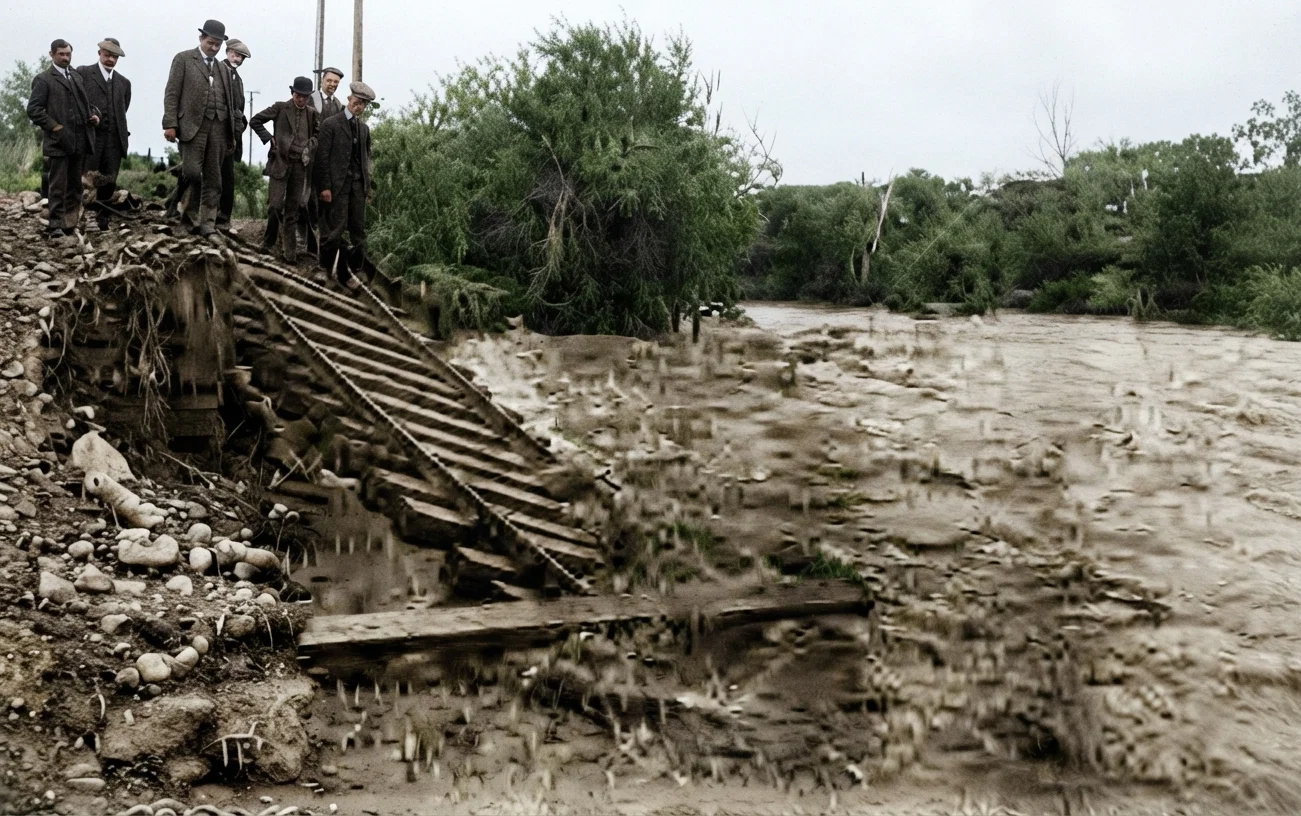
A STREET WASHED OUT IN THE SUBURBS OF LOS ANGELES, THE CONCRETE MANHOLE AT THE RIGHT WAS EVEN WITH THE SURFACE OF THE STREET, AND IS NOW A LANDMARK, SHOWING WHERE THE STREET WAS.
It is possible, yea, even probable that He who is the same yesterday, to-day, and forever, pleads at this day from the clouds with those of the human family who will lend a listening ear to His mode of speaking. It may be, however, that many, as of old—even most of the people—are too much absorbed with pleasure, and other worldly pursuits, through the import of His words. But these words are as verity the ancient words of divinity, which cannot fail to interpret the "taste of the storm-bound" clouds which are not due to dwellers of various proportions of their lives. Twice recently within a single month Pacific coast been deluged and storm-tossed. Beginning January 25, a violent storm, accompanied by cloudbursts, continued for some days, destroying much property, and taking its toll of lives. February 17 another tempest broke over the coast, more particularlyover southern California, carrying, in its three days of continuance, a wreckage of life and property beyond computation. With the wind blowing for a time at a forty-mile rate, and rain falling to the depth of an inch each hour, nothing could possibly prevent the results which followed. As seen from surrounding heights, the lower country presented an appearance of a vast inland sea.
Nearly every city and hamlet in southern California was inundated, having from two feet to six feet of water in the streets, according to location and elevation of the town. In Covina, every store on one avenue was flooded, water raging through the street like a mill-race, at the depth of three feet. Every bridge in the surrounding country was either carried away or greatly damaged, and many acres of orange-trees were destroyed.
About Whittier hundreds of acres of lowlands along the San Gabriel River were completely under water. At Carpinteria the stream from Fithians Canyon left its regular channel, and cut across country, furrowing out a new course regardless of the value of the land it intersected. At Monrovia the water at one point was as high as a man's head, putting out of commission all forms of traffic. Near Bairdstown a lake was formed half a mile wide, which floated away a portion of the town foundation.
In Pasadena the water was over five feet deep on Huntington Drive. One street was a raging torrent from side to side, tearing out large boulders, which were rolled down the course and dashed into stores along the way. Four feet of water rushed along Brand Boulevard, the principal thoroughfare of Glendale city. All the beach cities were for a time cut off by rail from other parts, and a dam seventy-five feet high back of the Soldiers' Home at Sawtelle was completely swept away.

HOUSES WERE FLOATED AWAY

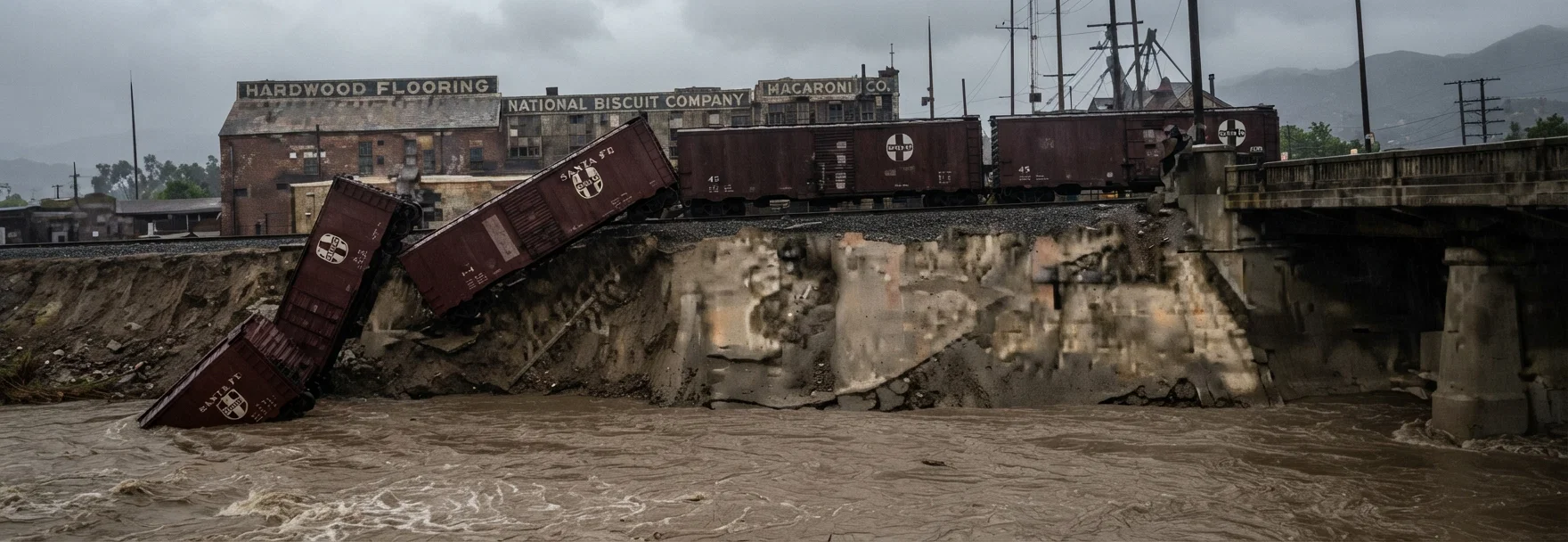
In some cases families were driven from their homes just in time to see their houses float away on the crest of the flood. More than fifty Mexican families were said to be huddled together at one time under trees on an elevation, from which place they were rescued with some difficulty. A wash, or creek, known as Arroyo Seco, which remains dry most of the year, became a raging torrent, sweeping away many houses along its banks, and threatening railroad terminal facilities. One bridge was dynamited to clear a way for the water backing up against it, and thus save homes on the bank above. The Santa Fe company dumped fourteen box cars from a bridge, hoping to turn the swirling waters of the Arroyo away from the bank upon which much of its terminal property was located. The general agreement was that no such havoc was ever before wrought in that region by the elements. A general estimate of the flood damages places them at the sum of $4,000,000.
But this storm was by no means local in its devastating career. In San Francisco, a portion of the great dome on the Panama-Pacific Exposition's palace of manufactures collapsed and fell, causing damage to the extent of $20,000. A part of the Stanford University grounds was flooded, and in Sacramento Valley low spots were inundated.
From east of the Rocky Mountains, terrific snow-storms were reported as having done much damage to life and property. As one said of the storm in southern California, "There's water everywhere," so one may safely say, There's storm and devastation everywhere.
Courtesy Los Angeles "Evening Herald"

WHAT DO THESE THINGS MEAN?

Concerning all this the question naturally arises as to what these late "record breakers" mean. To him who trembles at the word of Jehovah these happenings are significant, as fulfilling inspired warnings given to indicate the troublous days immediately to precede the coming of the Lord to judgment. Speaking of the all-absorbing greed to come when men would "buy the poor for silver, and the needy for a pair of shoes," and would so adulterate their marketable goods as to sell for food the refuse of wheat, which is utterly unfit to be eaten, and even then to sell by under weight, God says, "I will never forget any of their works." He then adds: "Shall not the land tremble for this, and every one mourn that dwelled therein? and it [the cause of mourning] shall rise up wholly as a flood; and it [the selfish greed] shall be cast out and drowned, as by the flood of Egypt." Amos 8: 5-8.
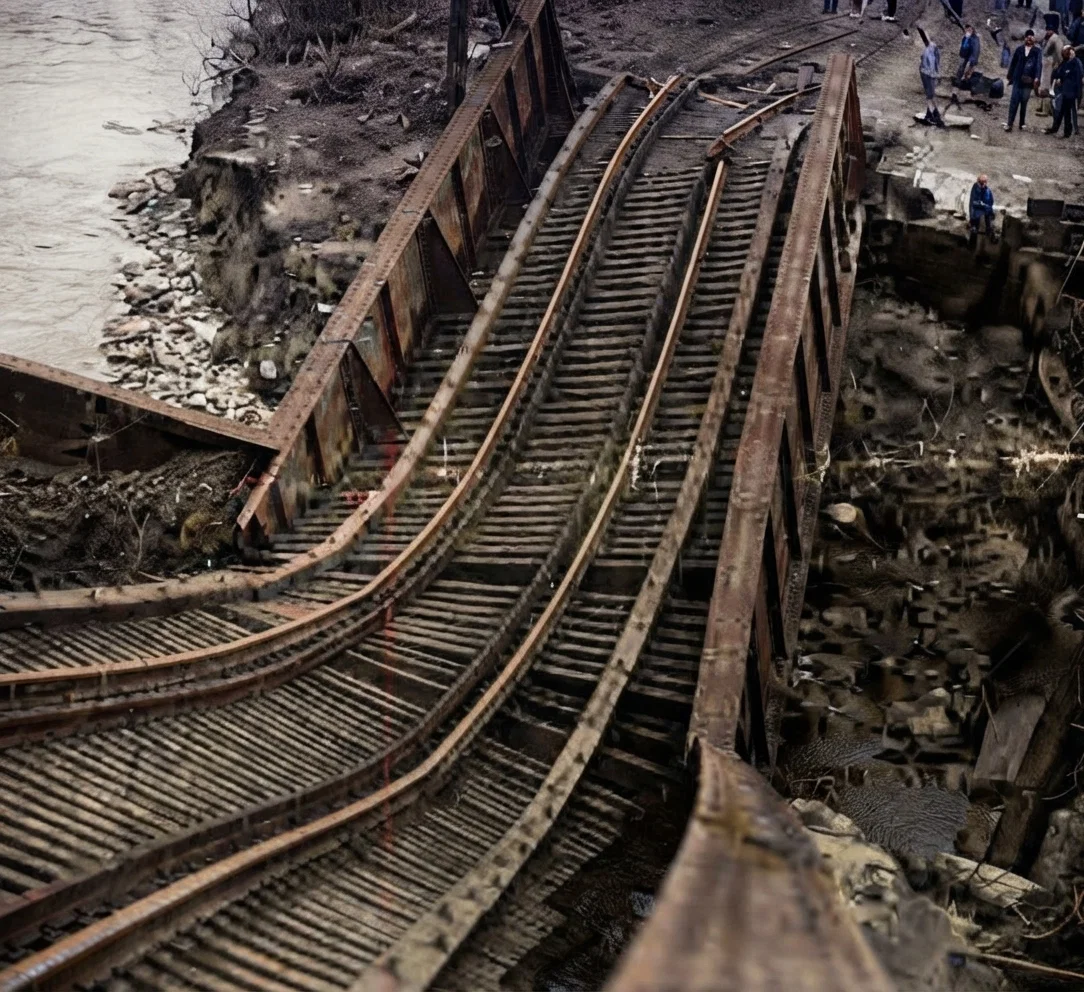
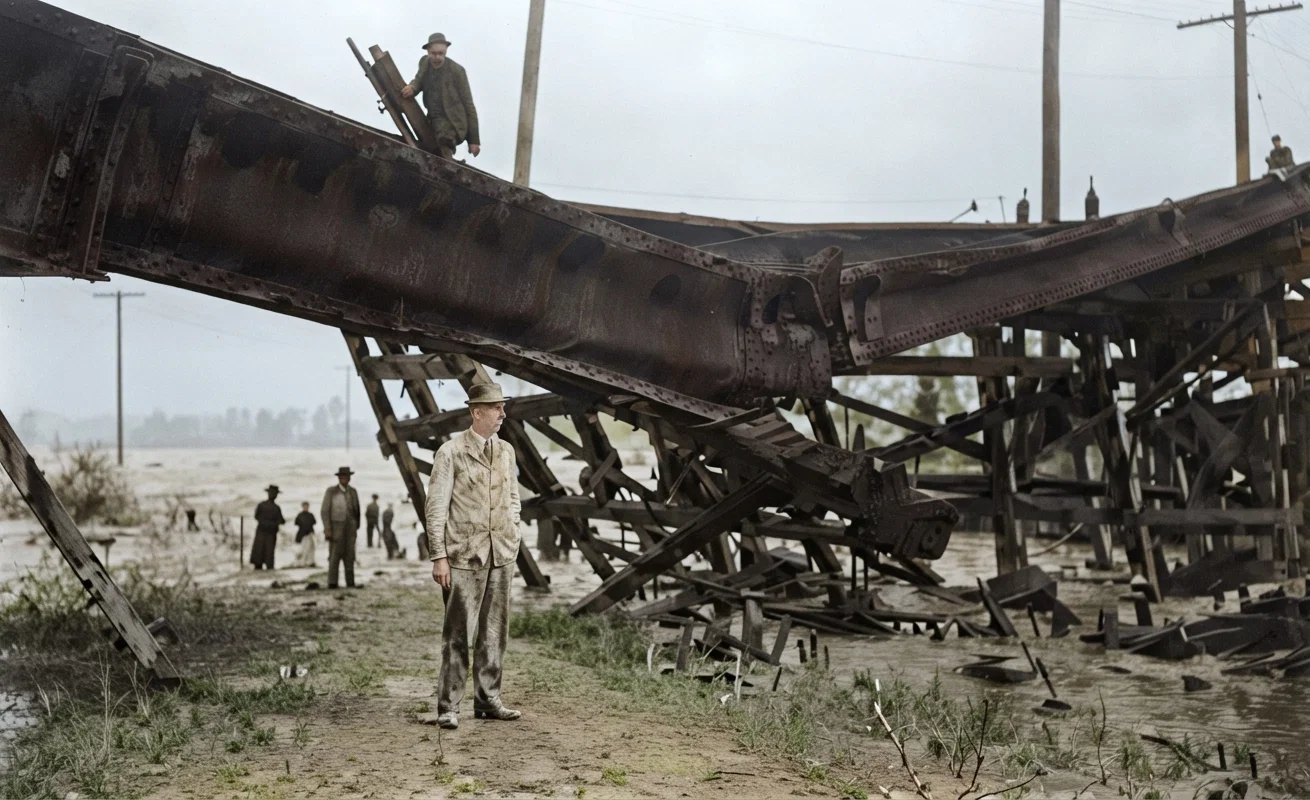
ONE OF THE MANY ELECTRIC RAILWAY BRIDGES WASHED OUT NEAR LOS ANGELES BY THE LATE STORM
In view of this, and other scriptures just as direct, is not one justified in concluding that the late frequent storms and tempests are the warning voice from "out of the cloud," calling upon men and women to halt in their mad career of greed, lust, and crime, to meditate upon the steady forbearance of God, which has mercifully borne with the nearly uniform baseness of the race? Indeed, human conditions of the present time are clearly set forth in the prophetic portrayal of the apostle when he says: "This know also, that in the last days perilous times shall come. For men shall be lovers of their own selves, covetous, boasters, proud, . . . heady, high-minded, lovers of pleasures more than lovers of God; having a form of godliness, but denying the power thereof." 2 Tim. 3: 1-5.
With a knowledge of the oft-repeated highway robberies, and the apparent disregard of life in seeking gratification of the senses,—in fact, the utter selfishness in every walk of life and every grade of society,—can any one honestly deny that the present generation is the one pointed out by the apostle's description of those living in the "last days"? Yet another inspired writer testifies beforehand that when these foreboding occurrences appear, many will chase away their temporary fears by lightly asking: "Where is the promise of His coming? for since the fathers fell asleep, all things continue as they were from the beginning." 2 Peter 3: 4.
It was the same when the Noachic Flood came as a besom of destruction to the earth. No one, except Noah's family, believed that the warnings and premonitions meant anything serious, until they were cut off from all help. Referring to this, the Saviour said, "As the days of Noe were, so shall also the coming of the Son of man be." Matt. 24: 37.

SOURCE OF SAFETY

But, that it is said that "unto the Lord for Him shall He appear the same, while without sin unto salvation." Heb. 9: 28. To all such the thickening signs of the times in earthquake, storm, and flood, and in the heartless actions of so many who were designed to be in the image of God, carry no terror of heart, but rather comfort; not because things are as they are, but because these appearances in this generation, in fulfilment of prophetic utterances, give the comforting hope of speedy deliverance from earthly trials, and a safe transport into the glorious presence of the great God and our Saviour Jesus Christ.

THE RIVERS SHALL NOT OVERFLOW

All those whose mind is stayed on God can readily avail themselves of that wonderful promise: "When thou passest through the waters, I will be with thee; and through the rivers, they shall not overflow thee. . . . For I am the Lord thy God, the Holy One of Israel, thy Saviour." Isa. 43: 2, 3. Such will always be ready to say with the psalmist, "Therefore will not we fear, though theearth be removed, and though the mountains be carried into the midst of the sea." This can be said with all confidence when one has heeded the exhortation, "Be still," or as the original will justify, "Let go, and know that I am God." Ps. 46: 2, 10.
Waiting in such attitude, every one can meet his Lord with the exclamation: "Lo, this is our God; we have waited for Him, and He will save us: this is the Lord; we have waited for Him, we will be glad and rejoice in His salvation." Isa. 25: 9.
ELECTRIC RAILWAY BRIDGE AT GLENDALE BROKEN BY THE FLOOD

SIGNS OF HIS COMING

The Gospel to All the World in This Generation—As in the Days of Noah—Formal Profession, but Lack of Power

By C. P. BOLLMAN
OUR Lord Jesus Christ, shortly before leaving this earth, gave to His disciples, and to us through them, a number of signs, or tokens, of His second advent. These signs are recorded in the twenty-fourth chapter of Matthew, and parallel scriptures. One of these signs is: "This gospel of the kingdom shall be preached in all the world for a witness unto all nations; and then shall the end come." Matt. 24:14.
It is certainly not without deep significance that we have now reached that time in the world's history when all Protestant denominations are enthused with the thought and the purpose,—
"THE GOSPEL TO ALL THE WORLD IN THIS GENERATION"
Everywhere this cry is echoed and re-echoed, until the Christian world rings with it. What does it mean? — It means that we have now reached the generation spoken of by our Saviour when He said, "Verily I say unto you, This generation shall not pass, till all these things be fulfilled." Matt. 24:34.
He could not have meant the generation then living. That generation did pass away without seeing fulfilled the things He foretold. But looking down the stream of time to the generation now living, He uttered those solemn words.

AS IN THE DAYS OF NOAH

Another of the signs given by our Saviour was, "As the days of Noe were, so shall also the coming of the Son of man be." Matt. 24:37.
There is no conflict between this sign and the sign of the preaching of the gospel to all nations "as a witness." The Lord did not say that all nations would accept the gospel. We know that there will be, in the throng of the redeemed, representatives of all nations. There will be saved some "out of every nation, and kindred, and tongue, and people," but not all of any nation nor of any generation will be saved; and as with the generation destroyed by the Flood, comparatively few will be saved out of the last generation. The doctrine of a temporal millennium wherein all the world will be converted is a delusion of the devil, designed to lull men into carnal security, to cause them to put off repentance until it shall be everlastingly too late.
All men were not converted in Noah's day. The masses did not believe Noah's preaching. They scouted the idea that the world was to be destroyed by a flood. They rejected the warning, and perished under the divine judgments. "As the days of Noe were, so shall also the coming of the Son of man be."

CONDITIONS AT THE LAST

Writing to his son in the gospel, the apostle Paul said: "This know also, that in the last days perilous times shall come. For men shall be lovers of their own selves, covetous, boasters, proud, blasphemers, disobedient to parents, unthankful, unholy, without natural affection, truce-breakers, false accusers, incontinent, fierce, despisers of those that are good, traitors, heady, high-minded, lovers of pleasures more than lovers of God; having a form of godliness, but denying the power thereof." 2 Tim. 3:1-5.
The "last days" must include the very last day. This must therefore be a description of the condition of the great mass of the world in the last generation, the generation of which the Saviour said, "As the days of Noe were, so shall also the coming of the Son of man be."
It will be observed that the apostle does not speak of the great wicked world, making no profession of religion, but of those "having a form of godliness, but denying the power thereof." Is not this true in large measure of the professed church to-day? May it not be possible that many who join in the cry, "The gospel to the world in this generation," and who even join in the work of sending the gospel to others, belong to the class described by the apostle?

CARPENTERS AND LABORERS ON THE ARK

Doubtless some who worked upon the ark were drowned in the waters of the Flood. Noah must have had many carpenters and laborers who helped him to build the ark; but only those who had real, living faith in the message which Noah preached were saved in the ark. And "as the days of Noe were, so shall also the coming of the Son of man be."
On every hand are seen the sins of which the apostle writes. An unbelieving and impenitent world confronts a cold and formal church. Pleasure-seeking has invaded even the precincts of the church itself to that extent that much of the money raised for missions and other church purposes comes as a result of entertainments under the auspices of the church. Instead of the members bringing to the Lord's treasury the product of self-denial, the offerings that come to altars of the modern church are the price of the worldly pleasures served up by the church at so much a head.
And why is this? Is it not because the leaders in the church, the ministry, the teachers, fail to see the significance of the rallying cry, "The gospel to the world in this generation"? Reader, know that when this work shall be accomplished, "then shall the end come." And in view of this soon-coming end the divine admonition is: "Gather yourselves together, yea, gather together, O nation not desired; before the decree bring forth, before the day pass as the chaff, before the fierce anger of the Lord come upon you, before the day of the Lord's anger come upon you. Seek ye the Lord, all ye meek of the earth, which have wrought His judgment; seek righteousness, seek meekness: it may be ye shall be hid in the day of the Lord's anger." Zeph. 2:1-3.

God's Yesterday

GOD does not forget. He forgets neither His gracious promises, nor the warnings against sin. With Him the events of a thousand years past are as fresh as are the events of yesterday to us, so that "with the Lord" "a thousand years [are] as one day" is with us.
A beautiful illustration of this is found in the book of Jeremiah. God had greatly blessed Israel, bringing them out of Egypt and placing them in the land of promise. Here they became a great nation. Then they forgot the Lord, and turned away from Him, to serve false gods. Long He bore with their perverseness, until there was no remedy. He was about to give His people over into the hand of Nebuchadnezzar. Faithfully He warned them of what He purposed to do, that they might repent and turn from their sins, and thus avoid this great evil. But they still rebelled. So God sent them this word:
"Therefore thus saith the Lord; Ye have not harkened unto Me, in proclaiming liberty, every one to his brother, and every man to his neighbor: behold, I proclaim a liberty for you, saith the Lord, to the sword, to the pestilence, and to the famine; and I will make you to be removed into all the kingdoms of the earth. And I will give the men that have transgressed My covenant, which have not performed the words of the covenant which they had made before Me, when they cut the calf in twain, and passed between the parts thereof, . . . I will even give them into the hand of their enemies." Jer. 34: 17-20.
The interesting part of this scripture is that the covenant to which the Lord refers was made with Abraham away back before Israel was a nation at all. See Gen. 15: 10-16. The chronology given places the time 1913 B. C., and this warning at 590 B. C. So this covenant to which God called their attention through Jeremiah was one that He and Abraham, the father of all who should by faith believe on Christ, had entered into 1,323 years before. The Lord refers to it as something of but a yesterday.
Surely God is not slack concerning His promise. His word He places above all His name. Well would it be for all to ponder with what unerring accuracy God fulfils His word. Many glibly pass by, to-day, the most solemn warnings found in God's book. They seem to think God neither remembers nor cares about what He has spoken through His prophets. Such should take warning. God deals with thousand-year periods as we deal with day-periods. He neither forgets nor slackens concerning His purposes. What the Son of God proclaimed on Sinai, what He taught on the mount and by the sea as He walked among men, is as fresh in God's mind as are the events of yesterday to us. Let us take heed, and become not only careful students of the Word, but faithful doers as well.
T. E. BOWEN.

Be Ye All of One Mind

"Be ye all of one mind, having compassion one of another, love as brethren, be pitiful, be courteous: not rendering evil for evil, or railing for railing: but contrariwise blessing."

Tortured Prisoners Sang and Prayed

PAUL AND SILAS JOURNEY TO PHILIPPI—THEIR LABORS ARE VERY SUCCESSFUL—OPPOSED BY A WOMAN POSSESSED OF A DEMON—FINALLY SCOURGED AND THROWN INTO PRISON—THEIR SONGS AND PRAYERS WROUGHT A MOST MARVELOUS DELIVERANCE—THE JAILER AND ALL HIS HOUSEHOLD CONVERTED
By MRS. E. G. WHITE
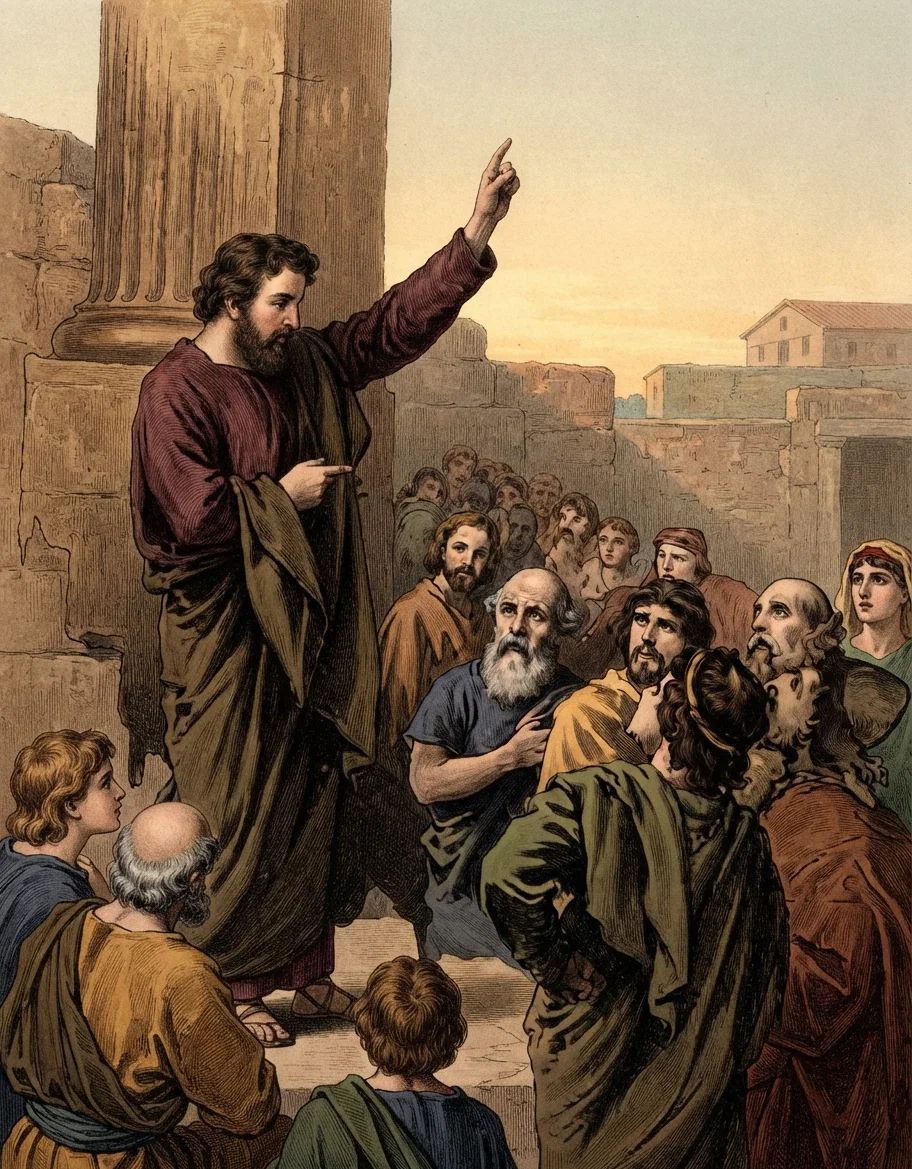
“Paul's labors at Philippi resulted in the establishment of a church.”
THE time had come for the gospel to be proclaimed beyond the confines of Asia Minor. The way was preparing for Paul and his fellow workers to cross over into Europe. At Troas, on the borders of the Mediterranean Sea, "a vision appeared to Paul in the night; there stood a man of Macedonia, and prayed him, saying, Come over into Macedonia, and help us."

ANSWERING THE IMPERATIVE CALL

The call was imperative, admitting of no delay. "After he had seen the vision," declares Luke, who accompanied Paul and Silas and Timothy on the journey across to Europe, "immediately we endeavored to go into Macedonia, assuredly gathering that the Lord had called us for to preach the gospel unto them. Therefore loosing from Troas, we came with a straight course to Samothracia, and the next day to Neapolis; and from thence to Philippi, which is the chief city of that part of Macedonia, and a colony."
"On the Sabbath," Luke continues, "we went out of the city by a riverside, where prayer was wont to be made; and we sat down, and spake unto the women which resorted thither. And a certain woman named Lydia, a seller of purple, of the city of Thyatira, which worshiped God, heard us: whose heart the Lord opened." Lydia received the truth gladly. She and her household were converted and baptized, and she entreated the apostles to make her house their home.

WOMAN POSSESSED BY A DEMON

As the messengers of the cross went about their work of teaching, a woman possessed of a spirit of divination followed them, crying, "These men are the servants of the most high God, which show unto us the way of salvation." And this did she many days. This woman was a special agent of Satan, and had brought to her masters much gain by soothsaying. Her influence had helped to strengthen idolatry. Satan knew that his kingdom was being invaded, and he resorted to this means of opposing the work of God, hoping to mingle his sophistry with the truths taught by those who were proclaiming the gospel message. The words of recommendation uttered by this woman were an injury to the cause of truth, distracting the minds of the people from the teachings of the apostles, and bringing disrepute upon the gospel; and by them many were led to believe that the men who spoke with the Spirit and power of God were actuated by the same spirit as this emissary of Satan.

BY THE SPIRIT'S POWER THE DEMON DRIVEN OUT

For some time, the apostles endured this opposition; then, under the inspiration of the Holy Ghost, Paul commanded the evil spirit to leave the woman. Her immediate silence testified that the apostles were the servants of God, and that the demon had acknowledged them to be such, and had obeyed their command.
Dispossessed of the evil spirit and restored to her right mind, the woman chose to become a follower of Christ. Then her masters were alarmed for their craft. They saw that all hope of receiving money from her divinations and soothsayings was at an end, and that their source of income would soon be entirely cut off if the apostles were allowed to continue the work of the gospel.
Many others in the city were interested in gaining money through satanic delusions; and these, fearing the influence of a power that could so effectually stop their work, raised a mighty cry against the servants of God. They brought the apostles before the magistrates with the charge: "These men, being Jews, do exceedingly trouble our city, and teach customs, which are not lawful for us to receive, neither to observe, being Romans."

ATTACKED BY THE FRENZIED MOB

Stirred by a frenzy of excitement, the multitude rose against the disciples. A mob spirit prevailed, and was sanctioned by the authorities, who tore the outer garments from the apostles, and commanded that they should be scourged. "And when they had laid many stripes upon them, they cast them into prison, charging the jailer to keep them safely: who, having received such a charge, thrust them into the inner prison, and made their feet fast in the stocks."
The apostles suffered extreme torture because of the painful position in which they were left, but they did not murmur. Instead, in the utter darkness and desolation of the dungeon, they encouraged each other by words of prayer, and sang praises to God because they were found worthy to suffer shame for His sake. Their hearts were cheered by a deep and earnest love for the cause of their Redeemer. Paul thought of the persecution he had been instrumental in bringing upon the disciples of Christ, and he rejoiced that his eyes had been opened to see, and his heart to feel, the power of the glorious truths which once he despised.

ASTONISHED PRISONERS HEARD THE SINGING

With astonishment the other prisoners heard the sound of prayer and singing issuing from the inner prison. They had been accustomed to hear shrieks and moans, cursing and swearing, breaking the silence of the night, but never before had they heard words of prayer and praise ascending from that gloomy cell. Guards and prisoners marveled, and asked themselves who these men could be, who, cold, hungry, and tortured, could yet rejoice.

HEAVEN WAS TOUCHED AND ANGELS CAME DOWN

All heaven was interested in the men who were suffering for Christ's sake, and angels were sent to visit the prison. At their tread the earth trembled. The heavily bolted prison doors were thrown open, the chains and fetters fell from the hands and feet of the prisoners, and a bright light flooded the prison.
The keeper of the jail had heard with amazement the prayers and songs of the imprisoned apostles. With these sounds in his ears, he had fallen into a sleep from which he was awakened by the earthquake and the shaking of the prison walls.

SAVED FROM SUICIDE

Starting up in alarm, he saw with dismay that all the prison doors were open, and the fear flashed upon him that the prisoners had escaped. He remembered with what explicit charge Paul and Silas had been entrusted to his care the night before, and he was certain that death would be the penalty of his apparent unfaithfulness. In the bitterness of his spirit, he felt that it was better for him to die by his own hand than to submit to a disgraceful execution. Drawing his sword, he was about to kill himself, when Paul's voice was heard in the words of cheer, "Do thyself no harm: for we are all here."Every man was in his place, restrained by the power of God exerted through one fellow prisoner.
The jailer dropped his sword, and calling for lights, hastened into the inner dungeon. He would see what manner of men these were who repaid with kindness the cruelty with which they had been treated. Reaching the place where the apostles were, and casting himself before them, he asked their forgiveness. Then, bringing them out into the open court, he inquired, "Sirs, what must I do to be saved?"

THE LIGHT OF HEAVEN IN THEIR FACES

The jailer saw in their countenances the light of heaven; he knew that God had interposed in a miraculous manner to save their lives; and with peculiar force the words of the spirit-possessed woman came to his mind: "These men are the servants of the most high God, which show unto us the way of salvation."
With deep humility he asked the apostles to show him the way of life. "Believe on the Lord Jesus Christ, and thou shalt be saved, and thy house," they answered; and "they spake unto him the word of the Lord, and to all that were in his house." The jailer then washed the wounds of the apostles, and ministered to them, after which he was baptized by them, with all his household.
The apostles did not regard as in vain their labors in Philippi. They had met much opposition and persecution; but the intervention of Providence in their behalf, and the conversion of the jailer and his household, more than atoned for the disgrace and suffering they had endured.
Paul's labors at Philippi resulted in the establishment of a church whose membership steadily increased. And such was their steadfastness in the faith, that he afterward declared, "I thank my God upon every remembrance of you, always in every prayer of mine for you all making request with joy, for your fellowship in the gospel from the first day until now."

TERRIBLE IS THE STRUGGLE

Terrible is the struggle that takes place between the forces of good and of evil in important centers where the messengers of truth are called upon to labor. "We wrestle not against flesh and blood," declares Paul, "but against principalities, against powers, against the rulers of the darkness of this world." Till the close of time, there will be a conflict between the church of God and those who are under the control of evil angels.

ELEMENTS OF CONFUSION AND REBELLION

The early Christians were often called to meet the powers of darkness face to face. By sophistry and by persecution the enemy endeavored to turn them from the true faith. At the present time, when the end of all things earthly is rapidly approaching, Satan is putting forth desperate efforts to ensnare the world. He is devising many plans to occupy minds, and to divert attention from the truths essential to salvation. In every city, his agencies are busily organizing into parties those who are opposed to the law of God. The arch-deceiver is at work to introduce elements of confusion and rebellion, and men are being fired with a zeal that is not according to knowledge.
Wickedness is reaching a height never before attained, and yet many ministers of the gospel are crying, "Peace and safety." But God's faithful messengers are to go steadily forward with their work. Clothed with the panoply of heaven, they are to advance fearlessly and victoriously, never ceasing their warfare until every soul within their reach shall have received the message of truth for this time.

The Christian

By Worthie Harris Holden
THE Christian has trials. Ah, yes; but the world, With its dire Herculean sorrow, Has only the bitterest night of wo, With never a glad to-morrow.
The Christian must mourn. His tears will flow By the sepulcher's gray stone; But "I am the resurrection" comes From the great white glory-throne.
The Christian must hunger and thirst and want, But he "shall be satisfied," While the wide-world famine from sea to sea Exists for souls who denied.
The Christian's peace like a river flows On, on to the ocean wide, With a broader span and a greater depth, Till it blends with the heaven-tide.
Cling not to the baubles of earthly dross, Whose tinsel must tarnish and cease, But strive for the prize that endures for ay In the glorious kingdom of peace.
Continue reading: The Christian's Credentials