Signs of the Times, Vol. 37, No. 29.

Our Lord's Teaching

Signs of the Times

Jul 26, 1910

Pacific Press Publishing Association · Mountain View, California · Jul 26, 1910

Our Lord's Teaching

And He . . . taught them, saying,
Blessed are the poor in spirit: for theirs is the kingdom of heaven.
Blessed are they that mourn: for they shall be comforted.
Blessed are the meek: for they shall inherit the earth.
Blessed are they which do hunger and thirst after righteousness: for they shall be filled.
Blessed are the merciful: for they shall obtain mercy.
Blessed are the pure in heart: for they shall see God.
Blessed are the peacemakers: for they shall be called the children of God.
Blessed are they which are persecuted for righteousness' sake: for theirs is the kingdom of heaven.
Blessed are ye, when men shall revile you, and persecute you, and shall say all manner of evil against you falsely, for My sake.
Rejoice, and be exceeding glad: for great is your reward in heaven: for so persecuted they the prophets which were before you.

3195.—Catholic and Protestant Bibles

Why is it the Catholics have the Apocrypha in their Bible?
1. The Catholics include in their Bible what we call the Apocrypha, composed of books like Tobit, Judith, Esdras, Maccabees, etc., because some of the early fathers placed them in the canon of Scripture. We know of no other reason. Other of the early fathers rejected them; and there is good reason to reject them, because there are things in them that are utterly different in character and in form and dignity from the other Scriptures. Many of the deeds recorded may have happened. Doubtless some of them did. Some of the things recorded there probably never happened, simply the imagination of some unknown writer.
2. These books were not written in the Hebrew, but in the Greek, and after the regular canon of Old Testament Scripture closed, at the time of Malachi.
3. Our Lord never quotes from these books, nor do the writers of the New Testament. Their quotations are from the recognized canon of Scripture as held by the Hebrews.
4. The Septuagint was translated from the original Hebrew Scriptures, but it did not translate any of the Apocryphal books from the Hebrew, because they are not written in the Hebrew. If you have access, as you must in your town, in some good library, to McClintock and Strong's Religious Encyclopedia, or to Schaff-Herzog Encyclopedia, you will find the history of the canon of Scripture, with fuller reasons for rejecting the Apocrypha than we can possibly give in this department.
5. The Latin Vulgate is not recognized as an original version of the written Word of God. It has undergone a great many changes in the Catholic Church itself. Certain versions have been set aside, even the most ancient, and a new version made, and later the new version set aside, and the church has reverted to the more ancient versions of the Latin Vulgate. The oldest versions of the Scripture are not in Latin; nor is the Latin Vulgate the best of the early copies.
6. The only account we have of Daniel's being thrown into the den of lions is given in the book of Daniel, and we have no reason to believe that he was cast there any other time.
7. Some Protestant Bibles, especially the large Bibles sold by subscription, have the Apocrypha simply to make it a selling feature, and to sell to Roman Catholics if their subscription can be secured. It is not placed in Protestant Bibles as inspired Scripture.
8. The verses in 2 Maccabees 12:43-46 are simply a record of that time. The faith of the Jews had been greatly perverted even at that time. They had mixed with the Grecians, and had imbibed more or less of the heathen philosophy. That is shown in their own traditions as well as in the Apocryphal books. They probably did just what the record says they did; but they were a long way from God, and had so intermixed His truth with heathen philosophy, that we must not look to their belief as the truth. This is shown in their holding the parable which our Lord used against them of the rich man and Lazarus. Josephus records it as a belief which they themselves held. Heathen philosophy had intermixed and perverted the truth of God.

Question Corner

“IF YE WILL INQUIRE, INQUIRE YE.”
This Inquirers' Department is conducted for the purpose of helping those who are studying the Bible. The answers are oftentimes only suggestive. They are never to be considered infallible, only as they agree with the infallible Word. The writer who may answer them does not consider that his opinion is infallible. He will simply give the best that he has, and plead with the inquirer to search the Word. Such questions only will be answered as, to the editors, seem to minister to the good of the readers and to the mission of the paper. We can not answer repeatedly in the same volume questions upon the same scripture. The name and address must accompany question, not for publication, but as an evidence of good faith, and that answer may be made by letter if deemed advisable. No letters are answered which do not contain the name of the writer. It is well always to enclose stamp for reply.

3196.—Blind Watchmen

Please explain Isa. 56:10, "His watchmen are blind; they are all ignorant, they are all dumb dogs, they can not bark; sleeping, lying down, loving to slumber." L. H.
Reading the prophecy and the context it will be seen that it refers to the last days when God's "salvation is near to come" and His "righteousness to be revealed." Verse 1. Compare Luke 21:28; Ps. 50:1-6. At that time surely His watchmen ought to be awake. They not only ought to be awake, but they ought to give warning of evils to come. Like the faithful watch-dog, they ought to bark and rouse the master if the foe is near. The meaning of the scripture is that they are faithless to their trust; they are not giving warning of the times in which God's people are living. They are not seeing, themselves, the conditions which the Lord has portrayed. Being blind, they are ignorant; being ignorant, they do not give warning.

3198.—The Sabbath and the Jews

A preacher declares that the seventh-day Sabbath can not be binding on any one now except the Jews in their own land, as the sun does not set at the same time in all places. Are we dependent on the sun for the days, or is the light independent of that? M. L. B.
The day is ruled by the sun. This is emphatically stated in Gen. 1:16, the greater light, the sun, to rule the day. This is also indicated in Matthew, Mark, and Luke, where it is clearly shown that the Sabbath closed with the setting of the sun. See Matt. 8:16; Mark 1:32; Luke 4:40. Evening came with the setting of the sun, and the day begins at evening. The Sabbath therefore begins at any place when the sun sets in that place; not when it sets in some other place.
During the time when the Bible was written, when no one denies that it was the duty of the Jews to observe the Sabbath, the Jews were scattered all the way from Babylon on the east to Rome, Italy, or Spain on the west, a difference of more than forty-five degrees longitude, or three hours of time. Daniel could keep the Sabbath in Babylon just as well as Paul could keep it in Rome. No one questions this. If they could keep it with one hour's difference of time, they could keep it with three hours' difference of time, or twenty-four hours' difference of time, if duty called them so to do.
The whole trouble will resolve before the simple fact that God does not ask any one to keep the Sabbath in two different places at one time. We are all so constituted that we can occupy only one place at one time. If we are here we are not in Palestine; if we are in Palestine we are not here. We are not to keep the Sabbath as it comes to Palestine while here, nor are we to keep the Sabbath as it comes here while we are in Palestine. Wherever the Jews were scattered, they kept the Sabbath if they were loyal to God. They do the same thing still,—keep that day, scattered as they are all over the face of the earth. Surely Christians can do the same thing.
The Sabbath was not made for the Jews alone. It is nowhere called in the Bible the Jewish Sabbath. It is said to be the Lord's holy day, "the Sabbath of the Lord thy God." It is given as a memorial of creation. As creation pertains to every soul which lives upon the earth, every soul is under obligation to keep God's memorial of creation. More than this. The only promises there are of salvation are to the Jews, to Israel through Christ. Christ the Jew declares that salvation is of the Jews. Paul tells us that the true Jew is not the Jew outwardly, but one who is circumcised in heart. Consequently the Sabbath is for all the Israel of God; and only the Israel of God, the truly converted in Christ Jesus, can keep it, for the Sabbath is a holy day, and only a holy man can keep a holy day. No Gentile, unless converted, could keep God's holy Sabbath; and just as soon as a Gentile is truly converted he is by that very fact one of the Israel of God. See Eph. 2:11-20. To the Gentiles as such there is not a promise in God's Word. The promises come only as they take hold of the Lord's covenant.

3197.—The Sheep and the Goats

Who are represented by the sheep and who by the goats in Matt. 25:32-46?
L. H.
It would seem from verse 32 that the sheep and goats are inclusive of all who shall render account at the judgment-seat of Christ; the sheep representing the righteous, the goats representing the wicked. Many of these, of course, have made high profession; and yet when tested by the lowliest deeds of service, they have failed to represent the Master whom they professed.

3199.—The Christian Era

Are we as true Israelites altogether in keeping, and in harmony, with God's plan when we use the Anno Domini reckoning of time instead of the Anno Mundi? History tells us that in the year which is now numbered A. D. 532 Dionysius Exiguus, a Scythian by birth, and a Roman abbot, who flourished in the reign of Justinian, invented the Christian era. But it was not established till the time of Pope Eugenius IV, A. D. 1431.
This change of time undoubtedly did not receive divine approval, or else there would not be a discrepancy of nearly four years between the birth of Christ and the Christian era.
The prophet points out very forcibly in Dan. 7:25 that the papal horn would "think to change times and laws;" and as time is there mentioned in the plural, is not one of the times brought to our attention by this prophecy, the change of computing the time from God's creation to the vulgar era, as well as the observance of the Sabbath from sundown to sundown? R. J. M.
This would be quite plausible did the Lord give us any positive directions in regard to the reckoning of time. But He has given us no epoch whatever. He has not told us to reckon time from the beginning of the world or the time of the Exodus or the beginning of the Christian era. If we trace the Bible through we will find that sometimes the time was recorded from some great promise which God gave; sometimes it was reckoned from the giving of the law; sometimes from rulers among God's own children, and sometimes from foreign rulers; but nowhere are we told that we should reckon time from any one particular date or epoch. So we can not see that the modern Christian era is out of harmony with the proper reckoning of time if we will take into consideration the mistake which was made. We would not take the matter of a mere mistake on man's part as indicative of sin in such a matter as reckoning dates, nor would one's correctness in reckoning dates be any evidence of God's approval.
The times and laws referred to in Dan. 7:25 seem to have clear and direct reference to times clearly set apart, to laws clearly enjoined. This is true of the day and the week, both of which are connected with the Decalogue; but this is not true of eras or ages.

3200.—Hours in a Day

How many hours each were the first seven days? R. W. T.
About twenty-four. The Bible does not measure the day by hours, but by the sun. They were from sunset to sunset, we learn from Genesis 1. There is no reason to believe that the days were different from the days now.

The Altar of Incense

3201.—The Altar of Incense.—A. K.—Heb. 9:3, 4 does not mention the altar of incense, but the censer, a movable instrument in which the priest burned incense, and not the altar of incense itself. The American revision has "the altar of incense," but the margin is "censer."

Signs of the Times

"Even as we have been approved of God to be entrusted with the Gospel, so we speak; not as pleasing men, but God, who proveth our hearts."

Doubt Not God's Pardoning Love

By Mrs. E. G. White
Be ye therefore perfect, even as your Father which is in heaven is perfect." As our heavenly Father is perfect in His sphere, so also those for whom Christ died are to be perfect in their sphere. "For God so loved the world, that He gave His only-begotten Son, that whosoever believeth in Him should not perish, but have everlasting life." We are to believe in salvation through Christ, and make manifest that faith in our life, not by our own strength, but by trusting in the strength and efficiency of Christ. "In this was manifested the love of God toward us, because that God sent His only-begotten Son into the world, that we might live through Him." "Who hath saved us, and called us with an holy calling, not according to our works, but according to His own purpose and grace, which was given us in Christ Jesus before the world began, but is now made manifest by the appearing of our Saviour Jesus Christ, who hath abolished death, and hath brought life and immortality to light through the Gospel."
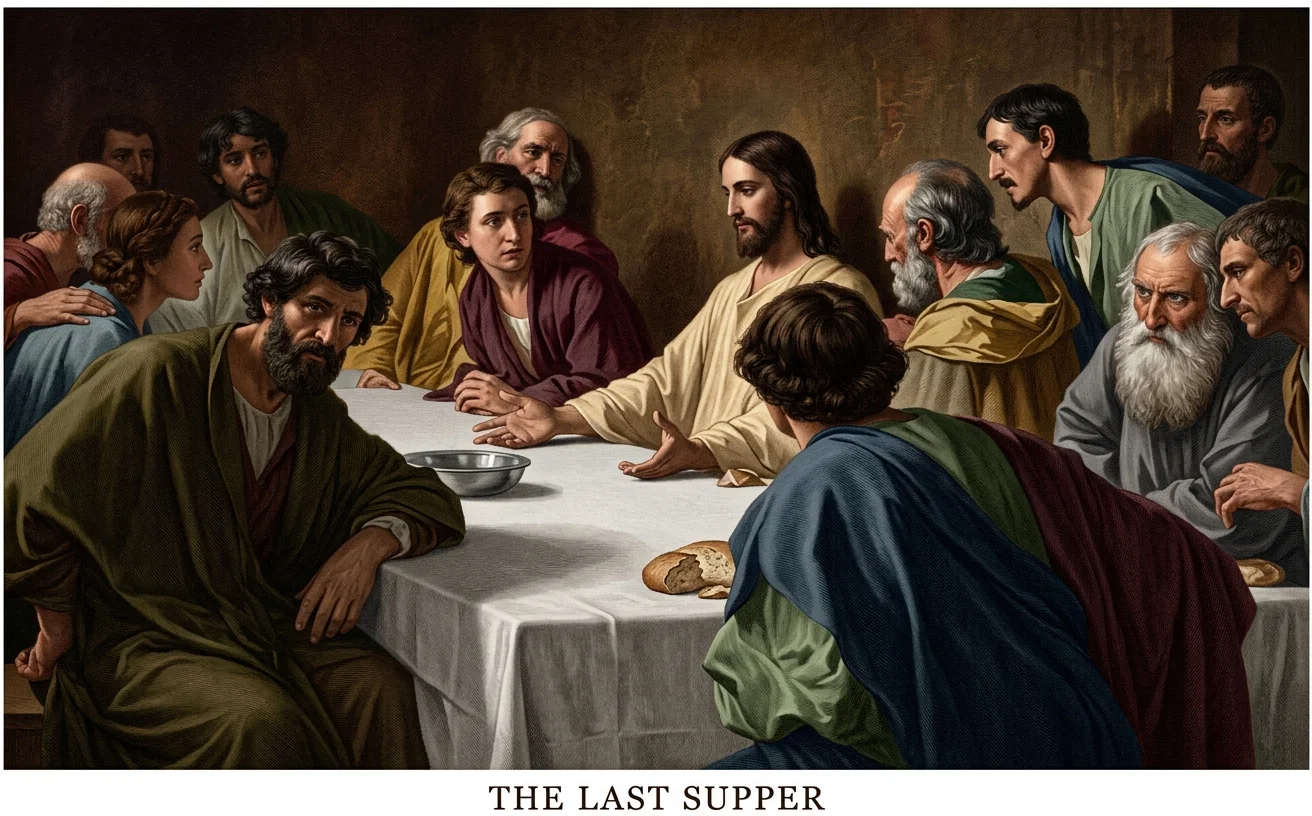
THE LAST SUPPER
THE LAST SUPPER
The Lord wills not the death of any sinner, but that all should come to repentance. His mercies are without number; and He will not leave those for whom He has given the ransom of His life, to become the sport of Satan's temptations. All heaven is given to those who believe in Jesus Christ as their personal Saviour. No soul can more dishonor God than by professing to believe in Christ, and yet going in mourning and sorrow to present to the world the aspect of orphans. "The Son of Man is come to save that which was lost. How think ye? if a man have an hundred sheep, and one of them be gone astray, doth he not leave the ninety and nine, and goeth into the mountains, and seeketh that which is gone astray? And if so be that he find it, verily I say unto you, he rejoiceth more of that sheep, than of the ninety and nine which went not astray. Even so it is not the will of your Father which is in heaven, that one of these little ones should perish."
The Lord does not leave His wounded and bruised sheep to the power of Satan to be torn to pieces. He is ever strengthening His own in their weakness. He delivers those who are tried and tempted, from the power of Satan.
Otherwise is to disown the fact that He loves us. When we go mourning and full of depression, covering ourselves with the garments of heaviness, we represent Christ to the world as a hard, tyrannical Master. But this is untrue. This is misrepresenting the One who gave His own life for us, that He might make it possible for us to believe in Him, and trust in His interest and love for sinful man. "He shall deliver the needy when he crieth; the poor also, and him that hath no helper." Speaking of His watchful care over us He says, "I the Lord do keep it; I will water it every moment; lest any hurt it, I will keep it night and day."
What great injustice is done to the Saviour, who gave His life for us, when those who profess to believe in Him walk in the shadow of darkness. Jesus has said, "He that followeth Me shall not walk in darkness, but shall have the light of life." If you have been walking in darkness, you have been following another leader than Jesus, and it is time for you to turn about and follow Jesus, the Truth, the Life, the Way, and the Light of the world. Is the Lord pleased to have you tossed about as the restless waves of the sea? — No, no. I tell you

He Wants You to Be Strengthened

Established, rooted and grounded in the truth, and built up in the most holy faith. You are not your own; you are bought with a price which can not be estimated. You belong to God, the mighty God, bought with the price that was paid for you on Calvary's cross. Then when you keep yourself in a state of fluctuating fear and doubt, you grieve the heart of Christ, who has given you unmistakable evidence of His love, and of His desire to have you with Him in His kingdom. He says, "Ye have not chosen Me, but I have chosen you, and ordained you, that ye should go and bring forth fruit, and that your fruit should remain: that whatsoever ye shall ask of the Father in My name, He may give it you."
Do not lose sight of Jesus, and separate from His companionship, and keep company with the prince of darkness, entertaining his suggestions, and heeding his directions, and acting out his plans. Cling to Him who has promised, "I will never leave thee, nor forsake thee." That you should take up with Satan, the apostate and traitor, and do after his works, after you have had a knowledge of Jesus Christ, is a mystery to the universe of heaven.

The Lord Never Forsakes

the soul that puts his trust in Him. Those who claim to be the sons and daughters of God must trust always in Jesus. To do

Man's Sin and Saviour

By E. J. Hibbard

III. A Saviour Given

THE first effect of sin was to alienate man from God, to make him afraid of God; and this alienation and fear led man to hide himself from the presence of his Maker. This effect was seen immediately, even on the first day that the experiment of sin was made. And how much more has this effect been intensified as the years have passed.
It seems that it had been customary for the Lord to meet with Adam and his wife in the Garden of Eden from day to day, or frequently at least; for at this particular time of which we speak, "They heard the voice of the Lord God walking in the garden in the cool of the day: and Adam and his wife hid themselves from the presence of the Lord God amongst the trees of the garden." Sin produces guilt, and guilt generates fear. Hence the hiding.
"And the Lord God called unto Adam, and said unto Him, Where art thou? And he said, I heard Thy voice in the garden, and I was afraid, because I was naked; and I hid myself. And He said, Who told thee that thou wast naked? Hast thou eaten of the tree, whereof I commanded thee that thou shouldest not eat?"
O, the nakedness of soul which the pure life feels, always, on the first experiment with sin! Even to-day we find it, now and then, among children, and even those of older years, whose lives have been pure and undefiled. But how much more did the alarm of conscience, and the remorse of sin, strip the heart of Adam from all its covering, and leave it naked and undone. His physical nakedness was not all, I am sure, which led to the hiding when they heard God coming.

Mercy before Justice

Another effect produced by sin, and not found among such as are free from it, is that of the justifying of self, and the accusing of others. So Adam justified himself, and accused Eve. Eve in turn justified herself, and accused the serpent. And both, indirectly, as we saw last week, cast the ultimate blame upon God. But notwithstanding this, the Lord had compassion on them, and in tender sympathy offered a way of escape. In their helplessness, He offered them a Saviour.
"And the Lord God said unto the serpent, . . . I will put enmity between thee and the woman, and between thy seed and her Seed; it [the Seed of the woman] shall bruise thy head, and thou shalt bruise His heel." This was the first intimation of a Saviour. And in this way hope was kindled in the hearts of the transgressors before sentence against their misdeeds had been pronounced; mercy before justice, then, now, and always. This is our God. Who can but love Him?
Man had fallen; his nature had been changed; he could not save himself from himself. So he must have a Saviour. His very nature being estranged from God, man must needs be reconciled; and he could not reconcile himself. Hence he must have a Saviour. With soul defiled, and body filled with the seeds of death, the image of God was marred; and none could restore this save the One who had created it. It therefore appears that no one could redeem, save the One who had power to create. Redemption is nothing short of re-creation.
That the very first man, Adam, who made the experiment of sin, lost, by this, the image of his Maker, is manifest in the fact that we, who are now in the image of Adam, are not in the image of God. Had Adam retained that image, then to bear the image of Adam, would still prove one in the likeness of God. But that divine likeness was lost; and it is now the work of Jesus Christ, through the Gospel, to restore this image of God. And here is the record:
"The first man is of the earth, earthy: the second man is the Lord from heaven. As is the earthy, such are they also that are earthy: and as is the heavenly, such are they also that are heavenly. And as we have borne the image of the earthy [the first man, Adam], we shall also bear the image of the heavenly." This is the work of Christ. This is the entire object of the Gospel—to restore that which was lost. Man lost innocence, character, dominion, life; and his home was cursed. The Saviour, for this reason, must be able to redeem and restore both man and his home, and make them as good as they were before sin entered. And I bless God that He will do this abundantly; that Christ will exalt both to a place higher than they occupied at first. But the proof of this must be left to future studies along this line.

The Philosophy of the Saviour's Death

Since, therefore, as we have observed, the first effect of sin was to alienate man from God, the first work of the Gospel must be to reconcile man to God, to bring him back to his heavenly Father. And in order to do this, it was necessary that Christ should take upon Himself man's nature, to be "found in fashion as a man;" to be "tempted in all points like as we are;" and in it all, not even once to yield to the promptings of sin. And since man is tempted even to the point of death, Christ must also meet this extreme of man's trial and suffering, without murmur or complaint — without yielding one point to the enemy of our race. It required all this, that we might be reconciled to God, and not, as it is so often misunderstood, that God might be reconciled to us. Man had alienated himself from God, not God from man.
And so the Scripture reads: "For if, when we were enemies, we were reconciled to God by the death of His Son, much more, being reconciled, we shall be saved by His life." Rom. 5:10. Thus the death of Christ was not to appease God's anger toward us, but to take away our anger toward God, our "enmity" toward Him.
Now in human affairs, if, by doing another a wrong, we get the idea that the one against whom the wrong is committed is angry toward us, we shun him, a barrier grows up between, and we are continually watching for him to "get even" with us; thus we embitter ourselves, and become his enemy. But let this supposed enemy of ours put himself out of his way to do us favors, and never once seek retaliation; let him even risk his life to save ours, — and at once we are convinced of his love toward us, notwithstanding our continual misdeeds; and, perceiving his love, as manifested in risking his life for ours, our enmity is consumed by his love; we love him in return, and we are reconciled. And so it is written again:
"Hereby perceive we the love of God, because He laid down [not simply risked] His life for us." And, "We love Him because He first loved us." And having become lovers again, the man who perceives God's love in this, is reconciled to God. "Greater love hath no man than this, that a man lay down his life for his friends" (John 15:13); "but God commendeth His love toward us, in that, while we were yet sinners[God's enemies], Christ died for us." Rom. 5:8. This is love unbounded; and if "perceived," it can not be resisted.
Another feature in the reconciliation is this, "To-wit, that God was in Christ, reconciling the world unto Himself, not imputing their trespasses unto them." Men had come to blame God for it all; and so the Lord said, "All right, I will take the blame." Not that God was in the wrong; not that He took the blame in that sense; but He "made Him to be sin for us, who knew no sin; that we might be made the righteousness of God in Him." "The reproaches of them that reproached Thee, fell on Me," said the prophet, speaking of Christ.
Also in this, Christ assumed the place of Adam, as head of the human race, won where Adam lost, redeemed Adam's failure, and, as father of the race, has made it possible for His nature to be transmitted to us who believe. "As many as received Him, to them gave He power to become the sons of God, even to them that believe on His name: which were born, not of blood, nor of the will of the flesh, nor of the will of man, but of God." John 1:12, 13.
By the natural birth, the first Adam's fallen nature became ours. And by the spiritual birth, the second Adam's divine nature is fully and freely ours. And the spiritual nature of Christ consumes the carnal nature of Adam. This is the way men are "converted," "regenerated," "redeemed," "born again." And thus it is that "as we have borne the image of the earthy, we shall also bear the image of the heavenly."

Some Queries

But why, you ask, is even the condition of believing made a prerequisite to our salvation? Why not take us back to Adam’s former estate en masse? There are many reasons for this; but two or three are sufficient. First, God will not govern any one against his consent. He can have no persons in His kingdom who do not want to be there. And if selfishness and greed should enter the realms of Eden restored, it would be “hell on earth” with a vengeance. Second, without faith, which is simply another word for “believing God,” he must needs continue to believe the devil; and that is the way he first got himself into trouble. Eve believed the devil in a saying which was exactly contrary to the Word of God. To believe this, was only to disbelieve God. To disbelieve God, was the way to disobey God; and this second part followed precisely on the heels of the first. Adam followed suit; and that is the way sin entered. Now the way to get out of trouble, is the exact opposite to the way you got in. Unbelief, disobedience, sin. Belief, obedience, righteousness.
But why did not God kill the devil?—He will, when the time is ripe for it. And that is what He meant when He told Eve that her “Seed” (a descendant of hers) should “bruise” the serpent’s “head.” But first He came to “destroy the works of the devil” (sin) out of our hearts, as it is written: “He that committeth sin is of the devil; for the devil sinneth from the beginning. For this purpose the Son of God was manifested, that He might destroy the works of the devil.” 1 John 3:8. What are the works of the devil?—Sin. Then sin must be destroyed. Next, Christ will destroy the devil, for so it is written:
“Forasmuch then as the children [ourselves] are partakers of flesh and blood, He [Christ] also Himself likewise took part of the same; that through death He might destroy him that had the power of death, that is, the devil.” Heb. 2:14. Thus the devil will eventually be destroyed; but inasmuch as man voluntarily chose him as his ruler and guide, God can not, in justice, destroy him until all mankind have declared openly and finally for the cause Satan advocates, or for God. And at that time probation will close. And then we shall see how God will deal with the devil. But that is another story, and will claim our attention more fully before this series of articles closes.
Let us, then, who read these lines, declare for God. Let us dare to believe Him. Tho men and devils dispute Him, let us believe God’s Word. Adam failed by believing one lie. Now the devil has flooded the world with lies and liars. And we are safe only as we believe, and implicitly trust, the Word of that God who “can not lie.”

Higher Criticism

By Earle Albert Rowell

XII. Higher Criticism and the Supernatural

FROM the material point of view this is an age of progress; from the social, an age of travel; from the intellectual, an age of science; from the medical, an age of hysteria; from the political, an age of democracy; from the judicial, an age of crime; from the commercial, an age of advertisement; from the social, an age of "publicomania;" and from the religious, an age of doubt.
Van Dyke comprehensively states the religious situation thus: "The questioning spirit of to-day everywhere asks for a reason, in the shape of a positive and scientific demonstration. When one is given, it asks for another; and when another is given, it asks for the reason for the reason. The laws of evidence, the principles of judgment, the evidence of history, the testimony of consciousness—all are called in question."—"Gospel for an Age of Doubt," page 8.
By the broad and liberal man is always meant the man who minimizes or flatly denies the miracles and all things supernatural. He disbelieves all evidence, however well attested, that contravenes his article of faith that "miracles do not happen." The Higher Critic, equally with the agnostic and infidel, is bound by his theory to reject as absurd all accounts of miracles, and endeavor to account for the recorded phenomena as either the delusions of a disordered mind, or the deliberate invention of a malicious deceiver.
While under the name of psychology scientists of the most "liberal" type are proclaiming marvels equal to the miracles of the Bible, they are bound by their materialistic dogma to deny the Bible miracles. They no longer regard the wonders of Spiritism as the vagary of a deluded mind, or the trickery of a charlatan, but they are accounted for as a manifestation of the power of the "subconscious mind," the "inner self," the "unfettered soul," etc.

The Fetters of the "Free Thinker"

Right here I take issue with those who boast that disbelief in the supernatural is any evidence of a "liberal mind," or a "free thinker." Since, as Gilbert Chesterton says, "a miracle is the liberty of God," those who discard the supernatural, not only bind God, but fetter themselves to a certain contracted creed, for they are not free to believe miracles. So instead of doubting miracles being an evidence of liberty of mind and freedom of thought, as the Higher Critics so loudly proclaim, it is just the reverse; for the man whose mind is ruled by adherence to a scientific pronouncement that he must teach in face of all contrary evidence, can not possibly be as liberal-minded as the man who has left his mind free to be impressed by the weight of any evidence. To claim as broad-minded a disbelief in miracles, is a delusion; for it is a hide-bound bigotry, propagated under the name of scientific freedom, in which vagueness of expression is taken for depth of thought, and learned phrases pass current for science.The man who denies the supernatural, is neither liberal nor logical. For, the moment a man admits the existence of an Omnipotent Power, and then denies the possibility of a miracle, he has contradicted himself; for if he binds Omnipotent Power, it is obviously not omnipotent. The man in this case has conceived as absurd an idea as the man who asked what would happen if an irresistible force came in contact with an immovable body.
Those who accept the supernatural in the Bible do so because there is ample evidence for it. Those who deny it do so mainly because they have swallowed a creed, usually in the form of Evolution, whose very life is dependent upon the denial of miracle. Thus, it is the Christian who is broad-minded enough to accept all evidence; but it is the learned scientist, or arrogant philosopher, or doubting divine, who is so creed-bound he must refuse to give credence to all evidence tending to prove the fact of miracles. Thus it is the Christian who rebukes the skeptical scientist, and doubting philosopher, and infidelic theologian, as the narrow-minded thinker, when not the creed-bound bigot.
Renan says that "it is because they relate miracles that I say the Gospels are legends." This is the attitude taken by the majority of those Higher Critics who so glibly deny, in the name of Christianity, the foundation principles of Christianity, and who so arrogantly maintain, in the name of Christianity, principles that would absolutely annihilate Christianity.

Essence of Christianity—Supernaturalism

When we read of the creation of the earth, of the animals, and of man in God's image; when we are charmed with the account of the Exodus with its numerous attendant providences; when we marvel at the fulfilment of numberless prophecies, made hundreds and even thousands of years before the event; when we are awed by the divine mystery of the incarnation of Christ; when our hearts are thrilled by His grand, triumphant miracles, and our souls are enraptured by the accounts of His glorious ascension—when we read these things, we see that they are more than marvels and signs and deeds of power; that they are the very essence, the kernel, of the Bible. We see that to eliminate, as do the Higher Critics, these and many other of the so-called "impossible" or legendary accounts, would be to cast away Christianity entirely.
On nearly every page of the blessed Book we find in the accounts of the supernatural the comforting evidence of the care of our Father for His children. And to eliminate the supernatural would not only so mutilate the Bible that it would be impossible to recognize it as the "good news" of God to a fallen race, but would give us the uncaring, unloving god of the Agnostic philosophers, or the inconceivable, adamant "Unknowable" of Herbert Spencer.
The supernatural permeates every page of the Bible. It is present in every prayer, in every action of Christ, and it will be present in every hour of the Christian's life. Christianity without the supernatural is as impossible as Christianity without Christ.
Not only did Christ perform occasional miracles, but He performed them repeatedly, continuously, thousands of them. Matt. 4:24; 12:15; 15:30; 19:2; Mark 1:34; 3:10; Luke 6:17; 9:11. Not only that, but He gave similar power to the twelve and the seventy. In fact the supernatural is so essential to the life of Christianity and to the Christian, that the most surprising thing about Higher Criticism is the fact Higher Critics actually deny all the essential foundation truths of the Bible and yet stand in the pulpit and claim to be the only real exponents of true "up-to-date" Christianity.

A Babylon for the Honor of Their Name

Higher Critics themselves recognize the fact that they are entirely changing the face of Christianity; nay, they boast of it as their work, with the same pride manifested by Rome in claiming to have changed the Sabbath from the seventh day to the first day of the week. Says W. J. Savage: "There never has been any fall of man, but there has been ascent from the beginning. . . . This one fact alone, logically carried out, compels a complete reconstruction of ALL the theological theories of the past; for there is NOT A SINGLE ONE OF THE DOCTRINES that enter into and make up the schemes that have been taught by the churches for hundreds of years that did not come into being as part of a plan to save man from the fall. If there has been no fall, . . . then all the doctrines which are logically a necessary part of this plan of salvation must be reconsidered."—"Religion for To-Day," page 28.
Since every part of the Bible has to do directly or indirectly with the salvation of man from the fall, it is evident what havoc Higher Criticism would make of the whole Bible, and how dry the few husks it would leave us.
To deny and discount the supernatural is both narrow-minded and unscientific; for as A. T. Robertson says, "After all, what we call the laws of nature are merely our notions or discoveries of God's ways, and these laws worked before we discovered them, as do many others that we have not yet found out."—"Life of Paul," page 41. The humble Christian, then, need feel no alarm at the onslaught on the Bible narratives of the supernatural, at the hands of theological professors, or ministerial infidels. Their attacks only make more evident to the child of God that those who have "tasted the good Word of God" (Heb. 6:5) can rest eternally sure and secure upon the fact that "the Word of our God shall stand forever." Isa. 40:8.
Continue reading: Assuredly Gathering