He lived in a big city. In some parts of it there were churches on every corner; but down where Jim Bettson lived, churches were scarce and saloons filled all the corners. Jim had spent his seventeen years of life in such neighborhoods, and was as completely a heathen in that city full of churches as could be found in China. He knew the name of God, it is true, and heard it often; used it indeed, himself, always in profanity. It was the only kind of praying he ever heard.
On this day of which I tell you Jim was in a rage; not a quick flash of anger, soon over, but a slow, deep rage, that meant hatred and evil-doing. Jim had an enemy, Jack Doyle by name. Why he was an enemy would take too long to tell, but there was reason enough.
If Jim could have “got even with him” by giving him an “awful walloping,” his hatred would not have burned so deep, but the chances were that Jack would always be the one to “wallop” him, as he was older and stronger than Jim. Burning in Jim’s heart, therefore, was the desire for revenge, and he lived for the purpose of finding out how to get it.
It was a windy morning, and on Jim’s alley scraps of all sorts were being blown about. One of them, a torn and dirty bit of printed page, fluttered to Jim’s feet. He picked it up, caught by part of a picture on it; but it was words that held his attention.
“If I only knew how to get even with him!” thus the line read. No wonder that Jim stared; here was another who felt as he did. Stop! What was that next line?
“That’s easy enough,” said Jim, “You must heap coals of fire on his ——.” Then came the picture, and below it the paper was torn zigzag. More words, in the next column, but not one about “coals of fire.”
Jim was miserable. The sun was scorching him and the wind that was filling his mouth and eyes with dust felt as tho it came from a furnace. On such a day “coals of fire” sounded fierce enough even for Jim, but how was he to find how to use them? The story must have told how to do it. If he could set fire to Jack Doyle and make him howl and dance with pain he would do it in a minute; but to burn up the tenement where he lived wouldn’t do, because there was the “little kid” and lots of other folks, too. It wasn’t likely that that was the way; he had got to find out! That was the conclusion Jim reached. He was a boy who always did what he made up his mind he had GOT to do.
It took him three days to find the rest of that sentence; the people in his alley were not well up in literature. Finally “Old Pete,” the worst drunkard in their alley, helped him out.
“Sho! I know them words; learned ’em when I was a little chap and went to Sunday-school. He heaped coals of fire on his head, that fellow did.”11
Jim’s eyes danced with delight; this sounded awful. “How did he do it?” was the eager question.
“Dunno,” said Old Pete; “dunno nothin’ about it; every word I remember is that about ‘coals of fire on his head.’ I’ll swear to that; and it’s in the Bible.”
Then was Jim dismayed. A Bible was harder to get than coals of fire; but he must find out how to use the coals. It was the wind that helped him again. It was Sunday, and a boy on his way home from Sunday-school, with a Bible under his arm, was having a brisk run for his hat that the wind had carried off. Jim looked on, and laughed, until he heard the boy call out to another across the street.
“Come hold my Bible for me, Charlie, while I give chase.” Then Jim made a dash for the hat, caught it, and passed it to its owner with an eager question: “Now will you let me look at that there Bible?”
The astonished boy without a word handed him the handsome book, and Jim turned the leaves in a perplexity that deepened; it was such a big book!
“What do you want to find?” asked the owner of the hat.
“Somethin’ about ‘coals of fire;’ I wanted to see the end of it.”
“All right,” said the boy, “I’ll show you the end and the beginning of that. It is one of the chapters I recited when I got this Bible for a prize.”
Imagine Jim’s amazement when he read the words pointed out: “If thine enemy hunger, feed him, if he thirst, give him drink; for in so doing thou shalt heap coals of fire on his head.”
“Thunder!” said Jim, and the boy with the hat may be thankful that he used no stronger word.
All day long these words stayed with Jim Bettson. Somewhere, somehow, he had got the belief that the Bible was to be trusted; that what it said was true. How there could be truth in a statement like that about the coals, he could not imagine, but he had a burning desire to try them.
Circumstances favored him. Two days after this he mowed a lawn for a woman who lived in the suburbs, and when she paid him she asked him if he was hungry. Jim was always hungry; he belonged to the class who rarely have what they call a “square meal.” He was taken to the kitchen and such food set before him as he had never eaten before in his life. When his hunger was satisfied the wistful look still stayed in his eyes. The woman, noting it, said: “Would you like to take some home with you?” And she filled a paper bag with cold chicken and rolls and cake and finally a great orange. “Perhaps you have a little sister at home?” she said inquiringly as she added the orange. Jim grinned. He had no little sister at home, and he had no home; but what was the use of telling that? The woman who filled the bag did not know she was preparing coals of fire!
All the afternoon Jim lay in wait for Jack Doyle; he had a chance to try his experiment. A better chance than he knew, for Jack, who had a home, and a little sister, had gone without his breakfast and dinner, in order to save his earnings for a liniment to rub the little sister’s lame and aching back. He was so hungry that evening that he had to shut his eyes and run past two bakeries for fear he should snatch something from the show windows. He sat on the lowest step of the tenement house front in which he and Janie and their generally drunken father had a back room on the fifth floor; he wondered if he should climb the stairs and try to go to sleep, with such a gnawing hunger? Just then there dropped into his lap two rolls and a huge piece of chicken. Jack looked up quickly, and on the steps above him stood Jim, the fellow to whom he had been mean, grinning at him.
“Are they pizened?” asked Jack, and then, with few bites, he had swallowed them. “Pizened” or not, the smell of the chicken was not to be resisted. Down dropped another roll, two more, and the leg of a chicken; then a cake, and then, as a climax, an orange! Jack ate like one starved, but when the orange rolled into his lap he turned and stared.
“Say?” he said, “Where’d you get ’em, and what does it mean? Be they stole?”
Jim shook his head. “Take a suck at the orange,” he said. Jack obeyed; never had there been anything so good; his thirst was almost equal to his hunger.
“Say,” he said again, “Be you doin’ it ’cause you know I ain’t had nothin’ to-day, honor bright? Did Janie tell you? If that’s what it’s for, it kind of burns me, Jim, it does so.”
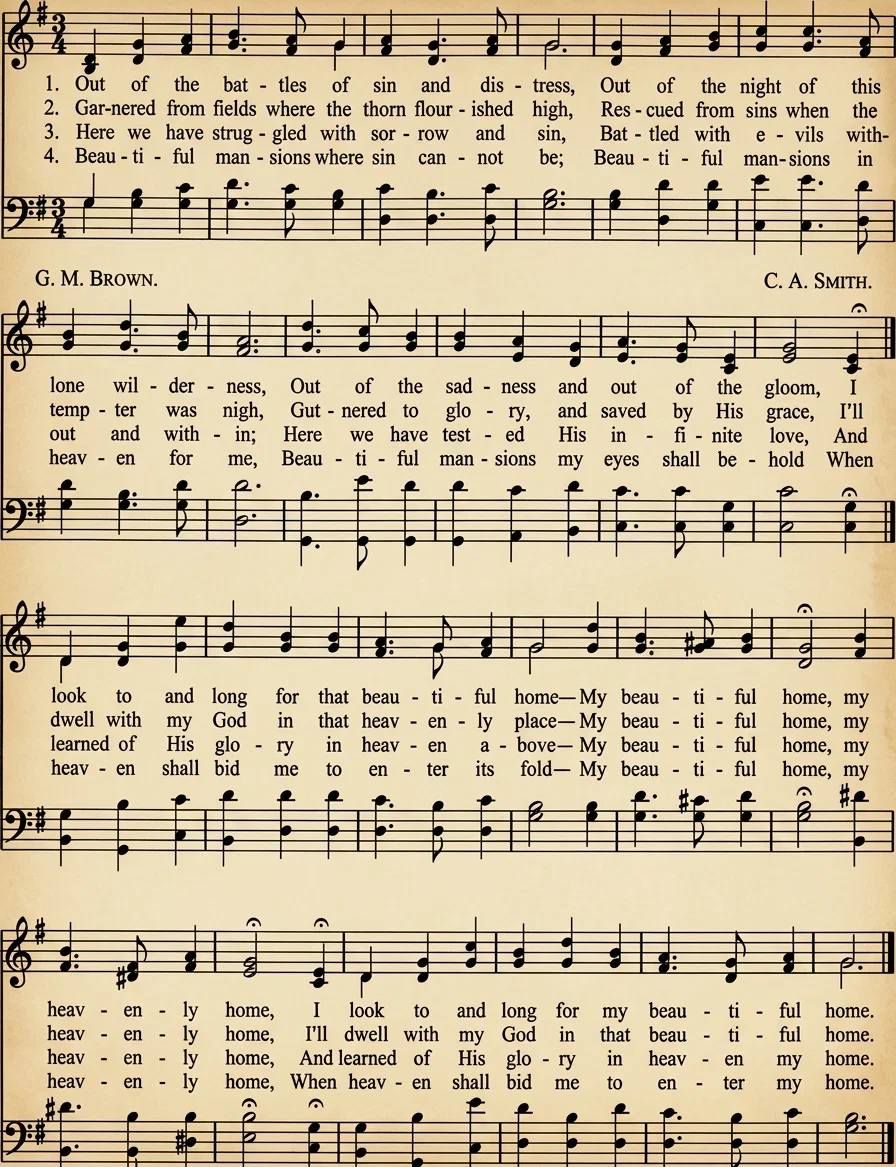
Copyright 1902, by C. A. Smith.
“Does it?” said Jim, and he chuckled. His experiment had worked, then; and he never felt so good in his life as he did at that minute!
Jack took three tremendous “sucks” of the orange, then drew his lips resolutely away, and rose up from the steps.
“I’ll take it to Janie,” he said. “Say, Jim, it’s true I hadn’t had no breakfast, nor no dinner, but I didn’t want Janie to find it out; I dunno how she did. I b’lieve I was pretty nigh starved. But the whole thing kind of burns me for all that. I wouldn’t have b’lieved you’d ever do such a thing; but I’ll tell you what, Jack Doyle ain’t the feller to go and forget it. Let’s see any one dare to be mean to you agin, Jim, as long as I live in these here parts.”
“All right,” said Jim as he chuckled again. Jack had evidently been “burnt.” If not in the way he had imagined, yet certainly in a strange way that had had a most remarkable effect, not only upon Jack, but upon himself. He was amazed to find that he did not hate Jack Doyle a bit, and that to get rid of the hatred made a warm, pleasant glow in his heart.
Something very strange happened in that alley during the next few weeks. In the first place, Jack Doyle, who was so large and strong that the alley people called him The Giant, and Jim Bettson, who was small for his years and not over strong, and who had been “bullied” by Jack all his miserable life, became firm friends and allies. But that was not the strangest part. Jim, having become interested in the Bible and anxious to try more “experiments” with it, did not rest until he got a “piece of one” for his own. This was the Gospel of John, printed by itself in a little book. That book Jim read and studied and experimented with, and it transformed his life!
He doesn’t live in the alley any more. He is a business man and has a home of his own; but he goes often to the alley, for he spends all his leisure and much of his savings in planning “coals of fire” for those who used to be his enemies.
There is one thing more, stranger than all else. That is, that the boy with the Bible under his arm who helped Jim to the first verse from it that he ever knew, scarcely ever looks at that Bible, never thinks of ordering his life by it, and is walking every day in dangerous paths, and drawing near to the time when it will be said of him: “There goes a perfect wreck!” Yet there is transforming power for his life, too, in that Bible of his. Strange! isn’t it?—Pansy.
MY BURDEN.
By Amos R. Wells
[Amos R. Wells, in Christian Advocate.]
God laid upon my back a grievous load,
A heavy cross to bear along the road.
I staggered on, and lo! one weary day,
An angry lion sprang across my way.
I prayed to God, and swift at His command
The cross became a weapon in my hand.
It slew my raging enemy, and then
Became a cross upon my back again.
I faltered many a league, until at length,
Groaning, I fell, and had no further strength.
“O God,” I cried, “I am so weak and lame!”
Then straight my cross a winged staff became.
It swept me on till I regained the loss,
Then leaped upon my back again a cross.
I reached a desert. O’er the burning track
I persevered, the cross upon my back.
No shade was there, and in the cruel sun
I sank at last, and thought my days were done.
But lo! the Lord works many a blest surprise—
The cross became a tree before my eyes!
I slept; I woke, to feel the strength of ten.
I found the cross upon my back again.
And thus through all my days, from that to this,
The cross, my burden, has become my bliss;
Nor ever shall I lay the burden down,
For God some day will make the cross a crown!
Auburndale, Mass.
SABBATHS
By H. Bonar
Bright days, we need you in a world like this!
Be brighter still—ye can not be too bright.
The world's six days of vanity and toil
Would, but for you, oppress us with their night.
Bright days, in you heaven cometh nearer earth,
And earth more fully breathes the balm of heaven;
The stillness of your air infuses calm,
Fairest and sweetest of the weekly seven.
Your dews are fresher, greener spread your fields;
Your streams flow by us with a sweeter song;
Your flowers give out a fragrance doubly soft,
And the unwearied hours the joy prolong.
Ye are like openings in a cloudy sky
Through which we see the hidden blue beyond;
Ye are like palm-trees in a wilderness,
Where all is barrenness and death around.
Bright days, abide with us; we need you still!
Ye are the ever-gushing wells of time;
Ye are the open casement where we hear
The distant notes of heaven's descending chime.
—H. Bonar.
THE DOCTOR’S ADVICE TOO LATE.
A STORY of a man who went to see a doctor. The doctor examined him carefully, and, with a grave face, told him that he was very ill, and asked him if he had consulted any one else.
“O,” said the man, “I went to see a chemist and asked his advice, and he—”
“Chemist?” the doctor broke in, angrily. “What was the good of that? The best thing to do when a chemist gives you advice is to do exactly the opposite.”
“And he,” the patient continued, “advised me to come to you.”—Cassell’s.
Foppish Dressing
Foppish dressing tells the world the outside is the best of the puppet.
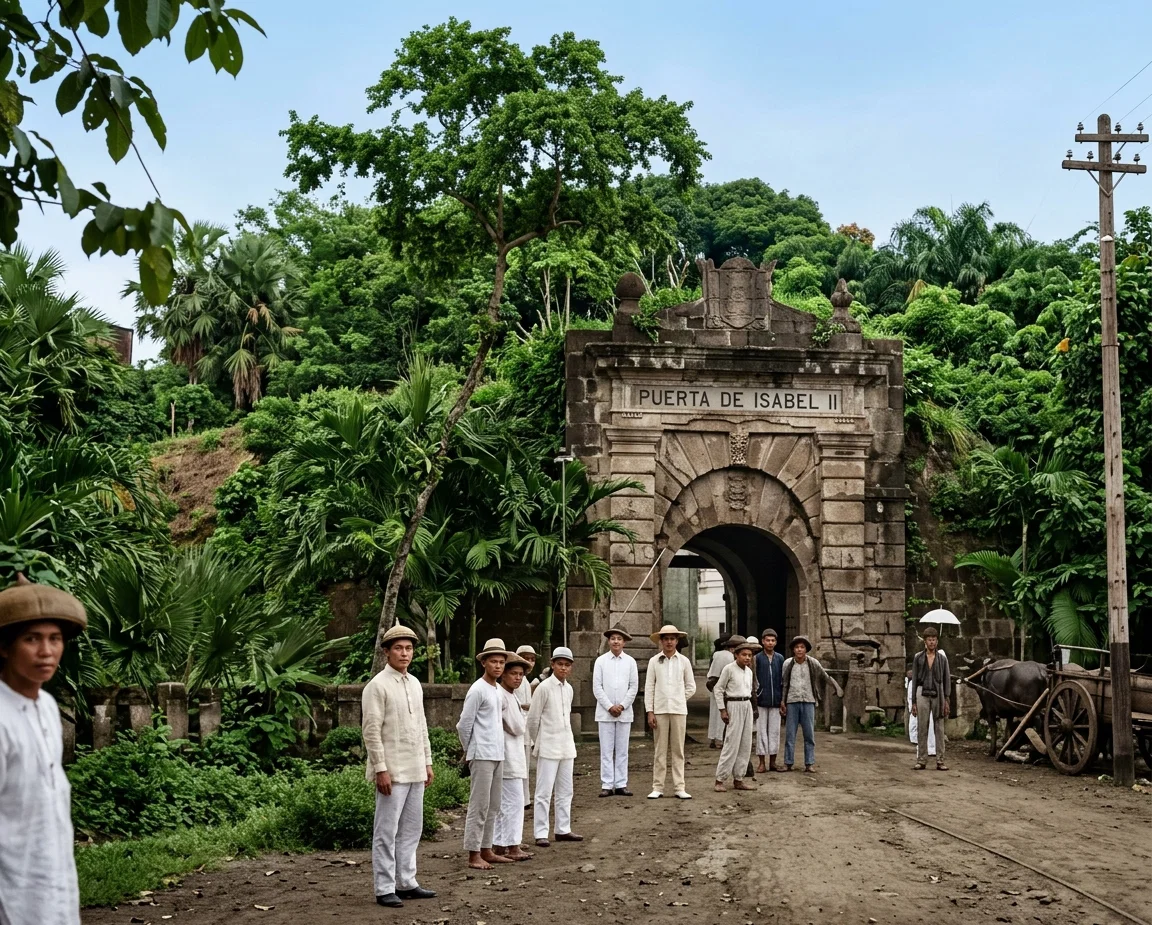
The Gate of Isabella, at Manila.
MISSION WORK IN THE PHILIPPINES.
By S.
The work of Protestant missionaries in the Philippines is claiming much attention at the present time. These missionaries have found a ready response on the part of the people to whom they have begun to preach the message of salvation. The islands are really occupying an advantageous position for missionary work. They are within two days' sail of China. It takes but little more than half as long to sail from Manila to Yokohama as it does to sail from San Francisco to Honolulu. A three days' sail from Manila will land one among the cannibals of South Borneo. Thus with the Philippines as a center one is within easy access of 700,000,000 of the most needy peoples of the world—ripened fruits of the most ancient heathenism, still practically unreached by God's last message of mercy and warning. While the Filipinos are spoken of as a child race, yet there is excellent material there, and the work so far accomplished gives great promise of an abundant harvest among that people.
The Catholicism has done little for them, missionaries admit that some good has come to that people from the Spanish occupancy. A measure of civilization exists there which is not found among neighboring peoples. The flag of a European power and the professed representatives of Christ were known there two hundred years before Australia was opened to civilization, the results seen in the Philippines are far from what they should be to-day. There are still people in portions of the islands who are in as dark heathenism as in any part of the world. Yet among a great number polytheism and pantheism have been discarded for a belief in the one God and redemption through Jesus Christ.
Among this people the missionaries report a “marvelous eagerness to hear and a strange readiness to accept the Protestant message, the like of which has not been seen in any other Roman Catholic country.” In speaking of the reception by this people of the Gospel message, Rev. H. C. Stuntz says:—
I never saw such readiness to hear. I have gone into the provinces on the invitation of the people of the city and preached for two or three hours to as high as 2,000 and 2,500 people, who would come in the morning and stay until noon.
Another missionary was in one town sixty-one hours, and during that time organized a Methodist church with sixty members, bought a lot, and had half the money raised to build the church. Mr. Stuntz declares that what was done in that town could be done in a hundred other towns and cities in the islands. The friars are withdrawn from the rural districts, and it is doubtful if the people would permit them to return. Truly the door is opened for evangelical work in the islands. Will the church rise to the opportunity?
S.
PORTO RICO AND THE PORTO RICANS.
By Ida M. Fischer
PORTO RICO is the smallest in size of the four principal islands of the Greater Antilles, and lies farthest out in the Atlantic Ocean, east of Haiti. It is about one thousand four hundred and fifty miles from New York and over four hundred miles from the east coast of Cuba.
It is about ninety-five miles long by thirty-five in width. Tho only three-fourths the size of the State of Connecticut it resembles it much in shape.
Its meaning is “rich harbor;” but in good harbors it is sadly deficient, the island being able to boast of only six good harbors, most of the cargoes being transported to land by large flat boats called “lighters.”
This island was discovered by Christopher Columbus, Nov. 17, 1493. He landed at a bay where he found many springs of pure water, and named the place “Aguadilla,” “watering-place.” Now the Presbyterians have a church company there and are planning to build a $7,000 church. The island was inhabited at this time by the Caribbean Indians, who were hospitable, kind, harmless, and happy; and when Ponce de Leon, a Spanish navigator, visited the island in 1508 and founded several of its cities, including the capital, San Juan (St. John), the Indians received him with delight. They gave him many presents, and showed
him and his soldiers gold which was found in the river beds.
Altho treated so kindly by the natives, the Spaniards killed the most of them and subjected the rest to cruel slavery and compelled them to work in mines. A revolution followed this, and as a result the Indian race was nearly exterminated. Only a few of their descendants are now living.
After Ponce de Leon sailed on his voyage of discovery of Florida, Porto Rico was left alone for a long time. Some years later Spain sent peasants to colonize the island. Slaves were then introduced from the west coast of Africa. In 1870 the island became a province of Spain and remained so until 1898, when it became a part of the United States. Slavery was abolished in 1873. Nature has done all she could to beautify the island of Porto Rico. Flowers bloom constantly and foliage is ever green.
While the bleak winds and cold rains of the fall and winter are felt in other countries, we are enjoying warm, pleasant days, the temperature ranging from 80° to 85°. This is our winter. We have only two seasons, the rainy and the dry, the rainy season beginning about July and lasting until December; the dry continues from January until June. During the rainy season we have rain not only every day but two and three times a day, and it is rain, too—it simply pours. In a few hours, however, the ground is dry in many places. Sometimes we have heavy winds with these rains, especially during the13hurricane season, between the months of July and October.
The houses are built with heavy doors and windows heavily barred, many of them having only holes seven inches in diameter above the windows and doors for ventilation. During these storms the people go into their houses, shut everything up tight and wait for the storm to abate or blow them over.
During one of these storms the house in which we lived rocked like a cradle. The storm lasted about twenty-four hours. We stood at our windows and watched the great coconut trees bend almost to the ground.
We could not help thinking of the great and terrible day of the Lord, when everything earthly will be shaken out of its place.
One of the most interesting places to the visitor to Porto Rico is the “Mercado,” or market. People from every race and nation seem to be here, and what a busy, noisy place it is; all kinds of people, big, little, and medium sized, all in a hurry and bustle; babies, roosters, dogs, donkeys, horses, pigs, alive and dead, vegetables and fruits of all description. At first sight, everything seems a jumble and confusion,—such talking, shouting, laughing, crowing, crying, barking, and braying that you can scarcely hear yourself talk. Most every one seems to be in good humor, even to the naked little babies tumbling about on the ground. This is a careless, happy, and contented people. Just as long as they have enough to satisfy hunger they ask for nothing more; I am speaking of the masses in general.
The Americans find it difficult to trade with this people, for they always ask us four times the value of an article; but we have learned to offer them just about what the articles are worth. They usually take it with a “Thank you;” it is all they expect.
Every one buys his bread, and we can not vouch for its cleanliness. Most of the stoves in the houses are without ovens. A loaf of bread weighs about eight ounces and sells for two cents. Nothing but white flour is used.
In many of the homes from one to five servants are employed, these receiving small wages, many of them getting only their board and clothes. Some of these are true and faithful, but many are not. The “better class” consider any kind of work degrading, hence their need of so many servants.
Many of the young ladies busy themselves with lace-making and other fancy work. The climate is not conducive to the performance of a great amount of work.
The towns are full of beggars, and it is an interesting sight on a Sabbath morning to see them streaming in from the country in companies of eight and ten. Many of these beggars have plenty to eat of the common food, but they are anxious for a change. As a result from one day’s begging they go home at night with enough food to last several days.
Ignorance and superstition abound everywhere, and we still find rites and ceremonies that partake of the former heathenism of the aborigines.
Many curious relics are found that reveal the nature of their former religion. One of the most interesting of these is a stone collar, shaped like a horse collar, nicely carved, showing their great skill in such lines of work. This collar was placed by the friends and relatives upon the breast of the dead person, the supposition being that it would protect him from harm.
Some of these relics represent the island as resting upon the backs of two animals, partly human in features. When the island was visited by earthquakes, it was an evidence that these gods were angry, and to appease their wrath the people must be good.
The message is marching right on even in this darkened corner of the earth. Souls are hungering for salvation. Every day we have evidence of the workings of God’s Spirit among this people. They are anxious for reading matter; many of them want Bibles, and as we talk to them of the evils prevalent here and elsewhere, and hold out to them the free gift of Jesus Christ, they drink it in gladly.
What the result of the work here will be eternity alone will reveal; but this we do know, that God has a people here anxious for the Gospel. Pray for the work here. IDA M. FISCHER.
REPENTANCE
By Ella Cornish
Thy goodness, Father, leads me to repent,
To come, confessing all my guilt, to Thee,
A prodigal, I've wandered far from home,
And spent Thy gracious gifts, and fed on husks;
Was clothed in rags of my own righteousness;
But now I cast them all aside, and stand
With nakedness of soul to plead Thy grace.
I am not worthy to be called Thy son—
Not worthy e'en to lift my eyes to heaven.
But O, I pray in Jesus' name, that Thou
Wilt cover my transgressions with His blood
And clothe me with His spotless righteousness.
Touch Thou my lips with sin-consuming fire;
Give me new thought, new purpose, new desire,
O give me of Thy grace from day to day
And guide me ever in the narrow way.
The power Thine, and shall be to Thy praise
Through endless ages of eternity.
Asylum, Neb. ELLA CORNISH.
IN THE BAY ISLANDS.
ENGLISH men and their families residing in the islands of Ruatan, Bonacca, Helene, Morat, Barburat, and Utilla, have found to their surprise and dissatisfaction that they are citizens of the Republic of Honduras. About forty years ago the Bay Islands were transferred to Honduras by Great Britain, and up to the present time English people who had not declared allegiance to Honduras had supposed that they were still subjects of Great Britain; but a recent communication from the home government to these islanders informs them that all who were living on the islands at the time of the transfer, and all the descendants of such, are subjects of Honduras. British subjects who have settled on the islands since the transfer retain their nationality if they desire.
To these discontented citizens the Honduran Government has made the promise of fair treatment, and has assured them that no effort would be spared to promote their peace and prosperity. The people of these islands are said to be industrious, progressive, and intelligent. Large numbers profess Christianity, and Christian churches are scattered over the different islands. Protestantism is represented in the islands by three denominations,—Baptists, Seventh-day Adventists, and English Wesleyan Methodists. The people are generous in their contributions to church work, and missionaries report that they are very free to help in any way they are able along missionary lines. No complaint is made by these missionaries in regard to their treatment by the government of Honduras. Altogether these islands are a promising field for missionary effort, and the efforts so far put forth have yielded good returns.
OUR WORK AND WORKERS.
WE learn from the Watchman that a church-school has been started at Franklin, Ky.
THE office of the Carolina Conference has been moved from Charlotte to Rock Cut, N. C.
NOVEMBER 22, six members were added to the church at Florence, Colo. This was part of the program of an ingathering service held that day by the church.
THE Iowa Industrial Academy was opened December 1, according to appointment. At last report there was an enrolment of twenty-seven students, with others planning to attend.
On the 3d inst., at Colorado Springs, Colo., Dr. W. W. Hills baptized ten candidates, five of whom were from one Sabbath-school class. A couple of weeks previous he baptized two candidates at Leadville.
FOLLOWING meetings held at Gaines Chapel, Ala., by Brother W. L. McNeely, fifteen adults decided to keep all the commandments of God and the faith of Jesus. They are all heads of families but one.
“THERE are none of us who have done all we could for foreign missions. If the future were opened to us, we would be surprised at the shortness of the time before Jesus comes. The Angel of Mercy is folding her wings, ready to depart never to return. Everything in the world is rapidly preparing for the last great conflict. As there is expectancy in the future, when a friend whom we have not seen for some time is soon to come, so there should be intense activity on our part to prepare to meet the soon-coming Saviour.”
THE twentieth session of the Colorado Conference will convene December 25, presumably in Denver; but the notices in the conference paper do not give the place. On account of this conference session the general week of prayer will not be observed in that State. Another week of prayer, in lieu thereof, will be commenced on January 9.
“THE members of the church of Christ are to be faithful workers in the great harvest field. They are to be diligently working, and earnestly praying, making progress, and diffusing light amid the moral darkness of the world; for are not the angels of heaven imparting to them divine inspiration? They are never to think of, much less speak of, failure in their work.”
OLD STAMPS
On letters received 30 or 40 years ago may be very valuable. Look them up and send them to me, and I will give you a price. Will return stamps at once if price is not satisfactory. Address “Collector,” Pacific Press, Oakland, California.
THE SCHOOL AT BETHEL, WISCONSIN.
By Wm. Covert
It was my privilege to attend chapel service in the Bethel school this morning, December 4. As nearly as could be estimated, 112 students attended chapel, and 28 were at the same hour in the primary department. I was told by Professor Washburn that he enrolled 141 students December 3, which was the opening day for the winter term. Counting the full enrolment since the fall term began, the number has reached 163. The attendance is surely encouraging.
The manual arts are receiving a large share of attention. The effort on the part of the faculty is to make these a part of the school work more than a matter of mercantile interest or drudgery. The domestic arts are receiving a good share of attention also, so that Bethel is approaching the true idea of an industrial school. The class in carpentry is erecting a fourteen-room cottage upon the premises. More than forty acres of ground have been cleared since the school opened, and the same in a very large measure is being utilized for the growing of fruits and garden stuff.
Every part and feature of work required to accomplish all this is done by the faculty and the students working together. Included in this work is the laying of stone and brick, the installing of heating plants, the placing of radiators, and plumbing work. No hired help apart from the school is employed. The great desire is to have students receive a practical Christian education. Bethel does not claim to be a finishing school for missionary workers, but a preparatory school for this work. Wm. Covert.
DONATIONS TO BARBADOS.
Previously reported . . . . . . . $227 33
Mrs. Eva Patterson . . . . . . . 1 00
Walter C. Twing . . . . . . . 2 00
E. J. Johnson . . . . . . . 1 00
A non . . . . . . . 4 00
E. A. Denike . . . . . . . 50
W. C. Chaplain . . . . . . . 5 00
Elizabeth Nicks . . . . . . . 5 00
Total received, to date . . . $245 83
MEN WANTED.
The world wants men—large-hearted, manly men;
Men who shall join in chorus and prolong
The psalm of labor and of love.
The age wants heroes—heroes who shall dare
To struggle in the solid ranks of truth;
To clutch the monster, error, by the throat;
To bear opinion to a loftier seat;
To blot the error of oppression out,
And lead a universal freedom in.
—Anon.
PUBLICATIONS WANTED.
COMPARATIVELY late, clean copies of all our periodicals, to use in missionary work. Send, post-paid, to Milo D. Warfle, Roswell, N. M., Box 630.
Refreshing Sleep Comes after a bath with Glenn's Sulphur Soap
It heals while it cleanses. Its medicative qualities render the skin free from impurities. Prickly heat, burns, cuts, dandruff, submit quickly to its healing effects.
CAUTION:—Glenn's Sulphur Soap (the only “original”) is incomparable and wonderful in its remedial effects. Take no other.
At all drug stores, or mailed on receipt of 80 cents by THE G. N. CRITTENTON Co., 115 Fulton Street, New York