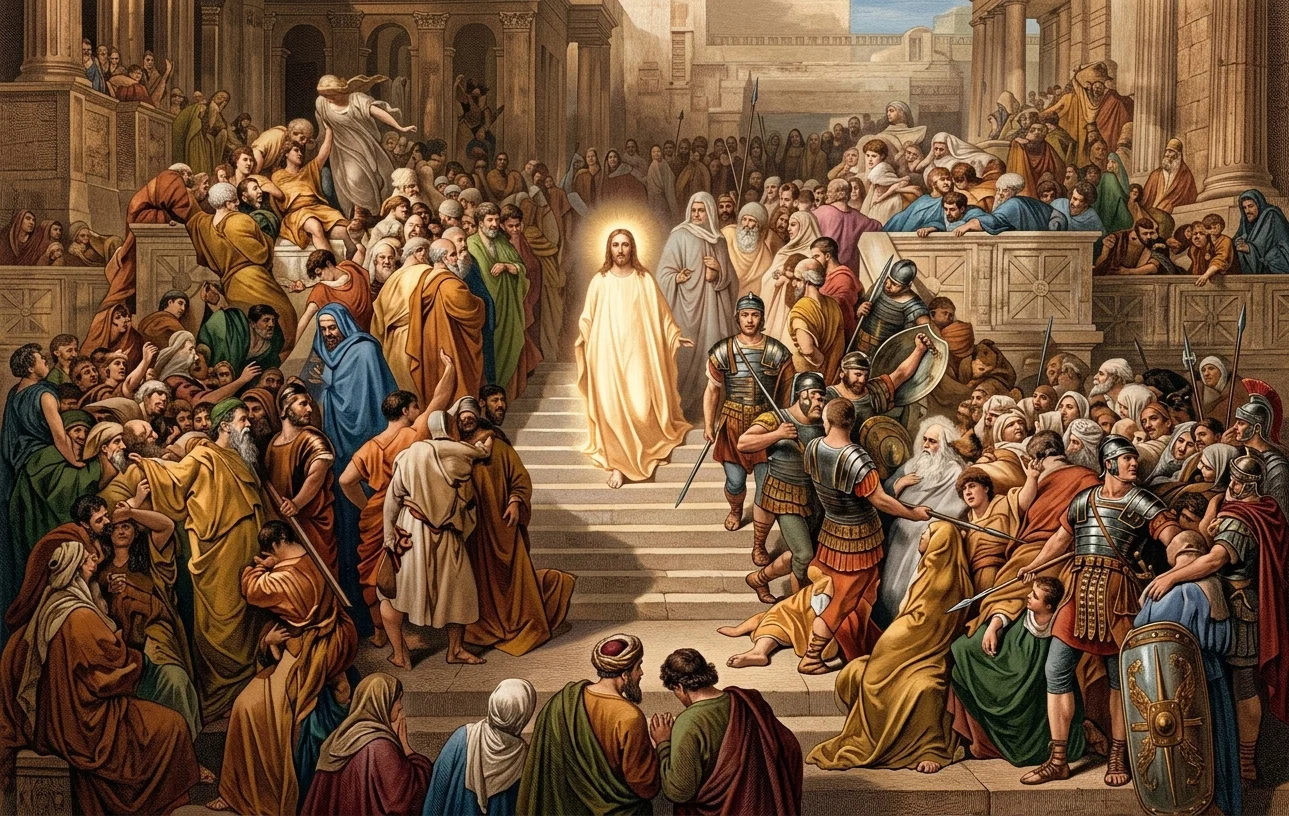
Master, the tempest is raging!
The billows are tossing high!
The sky is o’ershadowed with blackness;
No shelter or help is nigh;
Carest thou not that we perish?”—
How canst Thou lie asleep,
When each moment so madly is threatening
A grave in the angry deep?
Master, with anguish of spirit
I bow in my grief to-day;
The depths of my sad heart are troubled;
O, waken and save, I pray!
Torrents of sin and of anguish
Sweep o’er my sinking soul;
And I perish! I perish! dear Master;
O hasten, and take control.
Master, the terror is over,
The elements sweetly rest;
Earth’s sun in the calm lake is mirrored,
And heaven’s within my breast;
Linger, O blessed Redeemer,
Leave me alone no more;
And with joy I shall make the blest harbor,
And rest on the blissful shore.
“The winds and the waves shall obey My will,
Peace, be still!
Whether the wrath of the storm-tossed sea,
Or demons, or men, or whatever it be,
No water can swallow the ship where lies
The Master of ocean, and earth, and skies;
They all shall sweetly obey My will;
Peace, be still! peace, be still!
They all shall sweetly obey My will;
Peace, peace, be still!”
—M. A. Baker.
Our Publications
By Editor
All book lovers should watch this space each week for the interesting items it contains.
We want all our friends to have our 1906 catalog. It's free for the asking.
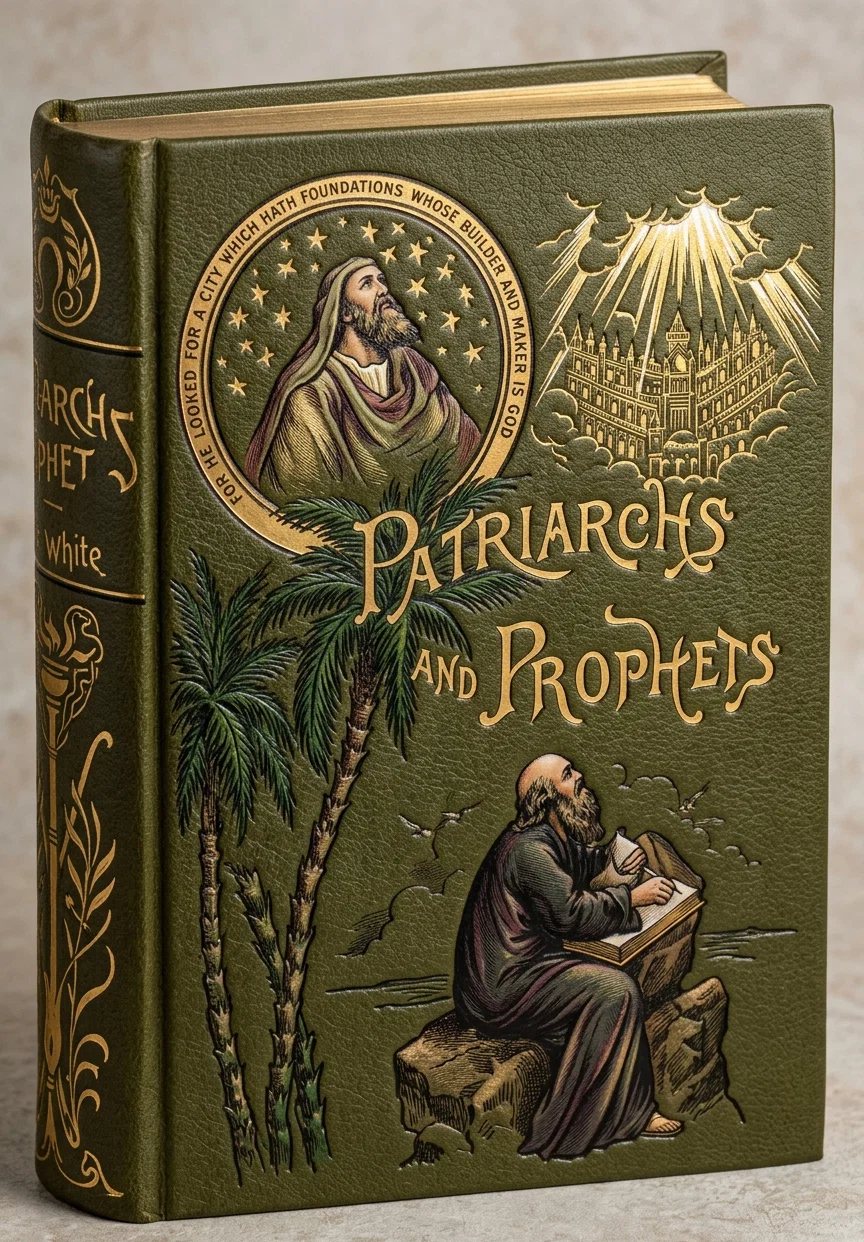
Patriarchs and Prophets, or the Great Conflict between Good and Evil, as illustrated in the lives of holy men of old. By Mrs. E. G. White.
This book treats on the themes of Bible history—themes not in themselves new, but so presented here as to give them a new significance. Beginning with the rebellion in heaven, the author shows why sin was permitted, why Satan was not destroyed, and why man was tested, gives a thrilling description of man's temptation and fall, and rehearses the plan of redemption devised for his salvation. The life of each of the patriarchs from Adam to King David, is carefully scanned, and from each a lesson is drawn. This volume traces the great conflict between good and evil from its inception down through the centuries to the time of David's death, and shows God's wonderful love for mankind by His dealings with the “holy men of old.” The book contains over 760 octavo pages. It is printed from clear new electrotypes on a fine quality of tinted paper. Its pages are adorned with more than 50 engravings, over 30 of which are full-page, and many were designed and engraved especially for this book and at great expense.
Full Morocco Binding. Price $4 50
Political Speeches and Debates of Lincoln and Douglas, 1854-1861.
There are portentous events in the political and social sky of to-day. Men see this, and believe that they have in the principles laid down by Lincoln a way of escape from impending evils. Lincoln was never more intensely exercised over the principles to which he had given himself than during his public discussions with Douglas. His speeches, and those of Douglas are here reproduced, and form a veritable armory of Lincoln's argument. Contains 555 pages
Bound in buckram cloth $1 75
A limited number in paper covers 75
Power for Witnessing.
The purpose and character of this work are clearly indicated by its title. “Ye shall be My witnesses” is the expression of the Great Teacher, and He longs to pour His Spirit upon His people. This book is a practical teacher of diligent doing, from the pen of one of experience, and treats in an able manner the following and many other important subjects which you have been longing to understand:
Something to Tell; Personal Experience in Receiving Repentance and Forgiveness of Sin; Righteousness, Then Power; The Holy Spirit and the Unpardonable Sin; Secret of Rejoicing in Tribulation; How to Find Faith; The Laying on of Hands; Miracles and Healing.
You should buy this book, and read every line of it. The author carries the reader with him step by step as he unfolds the Gospel truth in all its clearness, beauty, and simplicity, and imparts a new inspiration with the many practical suggestions and experiences given.
The book contains 44 chapters. 201 pages; also a beautiful and appropriate cover design.
Substantially bound in cloth $0 75
Paper covers 25
1. One new yearly subscription and one renewal, or two new yearly subscriptions, sent at one time, $2.50.
2. Two new yearly subscriptions, and one renewal, or three new yearly subscriptions, sent at one time, $3.25.
3. Three new yearly subscriptions and one renewal, or four new yearly subscriptions, sent at one time, $4.00.
Sample copies sent on application.
TO OUR PATRONS.
By Editor
Please be careful to write all names of persons and places plainly.
Send money by Post-office Money Order, Express Order, or Bank Draft on New York, Chicago, or San Francisco.
Orders and Drafts should be made payable to the Pacific Press Publishing Co.
Paper money or silver should be sent in a registered letter.
Registered mail is safe. Unregistered mail is at the risk of the sender.
The address label on your paper will indicate the time to which your subscription is paid. In case of non-receipt of papers, or any other irregularity, please notify us immediately.
When subscriptions expire, no more papers are sent to the party except by special arrangement.
You are requested to watch the date on your label, and renew early, and save the loss of papers. We can not always furnish missing numbers.
When requesting change of address, be sure to give both old and new addresses.
Important.—If you order Signs, Our Little Friend, books, etc., at the same time, use a separate sheet of paper for each. If this request is complied with, it will materially assist in the prompt and accurate despatch of the business.
When writing to the editor, be sure to use a separate sheet of paper.
THE ISLAND WORLD
Of the Pacific Ocean is the title of a handsome cloth-bound book of more than 330 pages of a very interesting, illustrated, descriptive history of the South Sea, Behring Sea, China Sea, Philippine, Hawaiian, Japanese, Society, Samoan, and other groups of islands, in the grand old Pacific Ocean. It has a large, clear, engraved map, showing both the North and South Pacific Ocean, and many islands from the large continent of Australia down to the historical little dot of Pitcairn Island, the home of the Mutineers of the Bounty.
Only a few copies of the book left, and while they last will be sent post-paid for only 95 cents. Address Pacific Press, Mountain View, Cal.
CALIFORNIA'S BIG TREES
and
THE FAMOUS YO SEMITE VALLEY
are attractively described and beautifully pictured in that remarkable book
LOVE is not an emotion. It is not an impulse. Love is a principle, steadfast, enduring, undying. It is born of the Spirit of God. Rom. 5:5. That which calls it forth is others’ needs. It serves souls, not because they are worthy, but to make them worthy; not because they are rich, but because they are poor, and love would make them rich; not because they can or will repay again, but only that they may be helped, to in turn be helpers of the needy.
LOVE includes benevolence, beneficence, charity, kindness, mercy, duty, and gratitude; and love is of God; for “God is love; and he that abideth in love abideth in God, and God abideth in him.” “We love, because He first loved us.” And he who has the love of God within will love as Christ loved, and do as Christ did.
LOVE grows by what it gives, not by what it withholds.
“There is that scattereth, and increaseth yet more;
And there is that withholdeth more than is meet, but it tendeth only to want.
The liberal soul shall be made fat,
And he that watereth shall be watered also himself.”
But love does not scatter that it may increase; it is not liberal that it may receive; all that may accrue from its exercise is left to God. Love gives and delights in giving.
“Love spends all, but still hath store.”
LOVE is served in serving. It is happy in bringing others happiness. When men of all parties and creeds applied to Mr. Howe, chaplain to Oliver Cromwell, for protection, he never refused his assistance to a worthy person, whatever his creed. “Mr. Howe,” said Cromwell, “you have asked favors for everybody except yourself; pray, when does your turn come?” Howe replied, “My lord Protector, my turn is always when I can serve another.”
The joy of John the Baptist was to fulfil the mission of proclaiming the coming of his Lord, even when he knew that that coming would completely eclipse his own mission. His joy was fulfilled—filled full—in the decrease of himself because it resulted in the increase of Christ. John 3:29, 30.
LOVE does not give for its own sake. It is not love which denies one’s self a meal for health’s sake, or to strengthen self-culture. It is love to give up that meal that one who is needy may eat and be strong. It is not love that bears pain and toil and suffering for the sake of bearing it, but it is love that bears it for others’ sakes. In a solitary place in Russia stands a monument with this inscription: “Greater love hath no man than this, that a man lay down his life for his friend.” The pillar marks a spot where a man died. A small party pursued by wolves had exhausted seemingly the last resource, and only another victim to the hungry, savage maws of the wild beasts could save the party. A servant, against the entreaties of his master, threw himself into the midst of the ravenous brutes, and so saved his master’s life. In gratitude the master erected the monument. But Infinite Love died to save us—His enemies. Does not His love for us lead us to give ourselves for those in the same peril as were we when He took our trembling hand and saved us from eternal death?
LOVE must give; love lives only by giving.
TRUE love is not satisfied in merely wanting to see all saved. There are few among professed4Christians that do not want all to be saved, and they pray eloquently for the heathen. Jesus saved men by saving each one. He did good to all by doing good to each. Do we love God? Do we want souls saved? Do we want one soul saved—any definite one so much so as to give our very life? That person has no burden of soul, no real love for the Master who does not have a burden of some one soul, his enemy, perhaps, because that soul needs saving. That is the spirit of the Master. “Love your enemies, and pray for them that persecute you; that ye may be the sons of your Father who is in heaven; for He maketh His sun to shine on the evil and the good, and sendeth rain on the just and the unjust; . . . ye therefore shall be perfect, as your heavenly Father is perfect.”
WHILE love seeks justice and practises severe economy, it is not economical in its giving. “He that giveth, let him do it liberally.” Love is not discouraged if its gifts are unused, perverted, squandered, misappropriated. They are given in good faith to God, and God will care for results. Often our gifts are like bread cast upon the waters, utterly lost to sight, perhaps never again seen by us in this earth-life. Sometimes it seems to us a right, wise use is not made of the means given; but never for this must our giving cease. We are to do good for good’s sake. It is said of Christ: “He shall not fail nor be discouraged till He set judgment in the earth.” Through all the millenniums, centuries, years, months, days, hours, minutes, seconds, He has poured out His undying, unstinted, self-denying love. How many times the precious seed has fallen by the wayside, by the stony places, among the thorns which choked; so many times love has been bestowed on unworthy, ungrateful wretches. How many times have we responded? Yet He has not been discouraged. Shall we ever be when He is not, and His almighty love and power are in control?
O, IT is love that is needed. Not maudlin sympathy or ecstatic feeling or fevered impulse, but love for souls, love begotten of Jesus Christ, in a heart cut loose from the world and emptied of sin; it is a living Christ within that is needed, a deep, abiding, eternal principle, seeking not our own ease or pleasure or gain, but others’ good.
LOVE is more than duty, more than gratitude. Divine duty tells what we ought to do. Gratitude seeks to know what we can do for Him who withheld not His life. And love compels the doing. It was love, and love only, that sent Judson to Burma, that gave courage to Brainerd, that placed the learning of Paul and of Morrison upon the altar of God, that quickened the mechanical skill of Williams, and the burning zeal of Duff, and constrained Kothah-by-u to spend whole nights in prayer for the salvation of his people, the Karens.
LOVE kindles the missionary spirit at home, opens closed hearts, unlocks earthly treasure-houses, makes liberal even the naturally covetous, stingy, and penurious. O, it is love that we need, Christ-begotten, Spirit-born love to open the arms of faith to embrace the great, needy races of earth, to tell the glad tidings to those in the prison-house of sin, to press “to its pitying bosom the orphan tribes of heathendom who, among their idols many, have no father God and no brother Saviour.” Are we honest before God sufficient to do our duty? Are we so truly grateful that we will render to Him and His devoted service for all His benefits to us? Does the love of Christ constrain us? Love is the law of His kingdom; are we children of His kingdom?
A GREAT TEMPERANCE LESSON.
By G.
By far the most effective temperance lesson that San Francisco ever has had was the recent great fire. Men were frightened out of their senses by the earthquake, and when the fire broke out and appeared to be beyond control, they became frantic and took to intoxicating drink. At the very time when the occasion demanded cool heads and sober minds, they were crazed with drunkenness. Civil law and municipal officials were not equal to the occasion; it was not till martial law backed by the regular army was given prestige that the diabolism was overcome.
The army, yes, the army—so often counted as the synonym of debauchery and rowdyism—had to step in and protect the citizen populace from themselves and from one another, because so many of them were drunk. And the army began its work of protection by a radical prohibition of the liquor traffic. There is no doubt that many lives and much property would have been saved had prohibition been in force before the fire.
It was not till the army had destroyed the supplies, and men became sober, that really effective work was accomplished in checking the fire fiend. Nor was order fully restored until the army went outside the city and closed the drinking resorts that hung upon the borders by sanction of the civil authorities of the adjoining county. Order, under the intense excitement and suffering and anxiety, was an utter impossibility until the demon alcohol was abolished from the community.
Even the city administration—elected by the combined labor union and saloon elements and the Examiner—had to concede the necessity of prohibiting the “personal privilege” of selling and drinking fiery beverages during the great emergency. The innate fiendishness that crops out of human nature where men are abnormally enmassed was all that the authorities could well keep under, without the addition of artificial intoxication.
The Examiner says: “The city has had before its eyes the salutary effects of closing the rum shops. The decrease in the amount of crime in a disorganized city has caused the astonishment of the police and the gratitude of the people.”
Yet the Examiner never has been, nor is it yet, a prohibition advocate, notwithstanding the logic of its admission leads one to wonder why. Here is a further admission in the same connection: “Crime is one of the most expensive luxuries in which a city can indulge. If half the crime could be cut off by closing the saloons, the cost of running the city government could very easily be kept under the dollar tax limit, and there would be plenty of money left for permanent improvements. It is the saloon that makes taxes high by making necessary the maintenance of a large and expensive system of police protection.”
Yet the Examiner, admitting that the saloon is such a prolific source of crime, is willing to continue the evil provided the saloon proprietors will pay a sufficiently high license to meet the expense of the necessarily increased police force. What would the editor, and other license advocates, say to a general licensing of crime provided that those who procured the licenses would pay enough to meet the expense of an increased police force?
But after the suggestion of a thousand-dollar saloon license, which it is supposed a thousand saloon-keepers would be willing to pay, the Examiner makes the further concession that “there should be no hurry about restoring the licenses” which the authorities “so wisely revoked.” And this concession is backed by the following good reasons: “If the city is quiet and orderly now, it is in no small degree due to the fact that a taboo has been put on whisky. It should be a matter of months at least before the ban is raised. The experience of the past month has demonstrated that the saloon is not necessary to the life of this city; it is a luxury that can well wait until the process of reconstruction is so far advanced that the opening of drinking-places will not add to the police and civic problems that beset the city.”
Here we have admissions from a leading political daily newspaper, not by any means a prohibition advocate on general principles, that the saloon at best is a dispensable “luxury;” that it is a prolific source of crime; that it is not to be tolerated at all in a time of general calamity; and that as a source of revenue it costs more than it produces. Surely a business that causes only evil and expensive disorder, whose revenue can be advantageously dispensed with at the very time the city is most in need of revenue, is a “luxury” that thoughtful people will hardly care to encourage at any time. The lesson certainly warrants prohibition for all time.
Even Oakland, just across the bay, has seen the wisdom of closing the saloons during the night time, at a time when the business has a boom. Were it a legitimate business, there would be general appreciation of an increased trade. That it is not a legitimate business is demonstrated in the fact that no one, excepting the liquor dealers, feels encouraged by its prosperity. They know that the safety of the community demands its limitation, and the more it is limited the better. G.
THE MISSION OF THE CHERUBIM.
By S.
The first mention we have in the Word of God of angelic beings is in connection with man's expulsion from the Garden of Eden. “He drove out the man; and He placed at the east of the Garden of Eden the cherubim, and the flame of a sword which turned every way, to keep the way of the tree of life.” Gen. 3:24.
There was a deep significance in the selection of this class of angels for that particular duty. They were not chosen for such work5without a purpose, but were acting in the direct line of their duty. That will be made plain by the scriptures which show their position and occupation in the courts of heaven.
“Jehovah reigneth; let the peoples tremble; He sitteth [margin, “is enthroned”] above the cherubim; let the earth be moved.” Ps. 99:1.
“Give ear, O Shepherd of Israel, Thou that leadest Joseph like a flock; Thou that sittest [margin, “art enthroned”] above the cherubim, shine forth.” Ps. 80:1.
The cherubim come in closest contact with the throne of God. They stand at either side of that throne, the guardians of its foundation. “Righteousness and justice,” says the psalmist, “are the foundation of His throne.” Ps. 97:2. And again he says, “Let my tongue sing of Thy word; for all Thy commandments are righteousness.” Ps. 119:172.
The commandments of God, then, are the foundation of His throne. The law of God is the foundation of His government. The cherubim are guardians of the throne's foundation, therefore guardians of the law of God, which is that foundation.
In the explicit directions which God gave for the construction of the sanctuary, the office of the cherubim is fully set forth; and as that earthly sanctuary was to be made according to the pattern of things in the heavens, we would expect to find the representations of the heavenly cherubim harmonizing with what the Word says of their office in the courts above. So we read:
“Thou shalt make a mercy-seat of pure gold. . . . And thou shalt make two cherubim of gold; of beaten work shalt thou make them, at the two ends of the mercy-seat. . . . And the cherubim shall spread out their wings on high, covering the mercy-seat with their wings. . . . And thou shalt put the mercy-seat above upon the ark; and in the ark thou shalt put the testimony [“the law of God,” Deut. 10:2] that I shall give thee. And there I will meet with thee, and I will commune with thee from above the mercy-seat, from between the two cherubim which are upon the ark of the testimony, of all things which I will give thee in commandment unto the children of Israel.” Ex. 25:17–22.
That was the visible representation of the throne of God, the place where He would meet His people to dispense judgment and mercy. In that ark, under that mercy-seat, was placed the law of God; and upon that mercy-seat stood the two cherubim; guardians of that representation of the throne of God, guardians of that law of God which is in the very foundation of God's government. There was an object-lesson to all Israel, and, through them, to all the world of the sacredness, the undying perpetuity, of the law of God. That law can not be tampered with without tampering with the throne of God. That law can not be abolished or changed without overturning the very throne of God. That is what God meant to teach in putting the tables of His law in the most inaccessible portion of the tabernacle, underneath the representation of His own throne, with the cherubim, the angels of His very presence, standing guard over it.
We can not conceive of the commands of God being given from any other place than His throne. So in this earthly representation of the court of heaven, we read: “And when Moses went into the tent of meeting to speak with Him, then he heard the Voice speaking unto him from above the mercy-seat that was upon the ark of the testimony, from between the two cherubim; and He spoke unto him.” Num. 7:89. He spoke from between the cherubim, spoke from above the mercy-seat, whereunder lay the law of God.
Can we imagine in those days one sufficiently God-defying to attempt to remove that law from its resting-place? For a less offense Nadab and Abihu were slain by the forth-shining glory of Him who dwelt between those cherub guardsmen. Could we consider ourselves less offensive in the sight of Heaven now if we seek to pluck that law from the foundation of God's government? Uzzah laid his hand unwarrantedly upon the ark containing that law, and was slain. It is a lesson which the ages have preserved for our admonition.
Adam and Eve, in coveting, stealing, and in dishonoring their common parent, broke that law, and found themselves outside the gate of Paradise, with the cherubim, the guardians of God's law, flashing toward them the sword of His displeasure. That sword turned every way to guard the way to the tree of life. Men are still outside Eden, and we may know that so long as we maintain in our heart enmity toward the law of God, the cherubim stand armed against us to prevent our approach to the tree of life. That means the denial of heaven to us, the loss of eternal life, if we set ourselves against the government of God in tramping upon His holy law. Christ said: “Whosoever therefore shall break one of these least commandments, and shall teach men so, shall be called least in the kingdom of heaven.” Matt. 5:19.
It is worth while to note here that the only class mentioned in the Bible as worthy of entering Paradise and coming to the tree of life is that company which has respect to the commandments of God. They must pass those appointed guardians of the law, and they can not do it while carrying in their heart hatred of that law. It reads concerning them, “Blessed are they that do His commandments, that they may have right to the tree of life, and may enter in through the gates into the city.” Rev. 22:14. Those angel guardsmen kept Adam and Eve out of Eden for disobedience to God's law; and neither can we pass them unless we are submissive and loyal to all its precepts. Let us learn the lesson of the cherubim with the flaming sword. S.
The text reads, “Let no man therefore judge you in meat, or in drink, or in respect of a feast day or a new moon or a sabbath day.” First of all the scripture is not one which enjoins moral duties in respect to meat and drink and feast days or Sabbath days. It does not say we should observe them in any way. God has given instruction abundant on this matter elsewhere. (2) It does not say that we should not keep them. God has given us instruction as to our “whole duty;” what lies outside of that is will worship. Eccl. 12:13; Col. 2:23. (3) Our duty is clearly set forth in this immediate connection, “As therefore ye received Christ Jesus the Lord, so walk in Him, rooted and builded up in Him, and established in your faith, even as ye were taught, abounding in thanksgiving.” Col. 2:6, 7. That is our duty, clear, concise. Why? —We owe Him our life. “You did He make alive together with Him, having forgiven us all our trespasses.” Verse 13. But He gives us life by giving us righteousness (Rom. 3:22; 8:10); and to that righteousness by faith the law bears witness (Rom. 3:21, 22). All this He does for us to “redeem us from all iniquity;” “that the righteousness of the law might be fulfilled in us.” Titus 2:14; Rom. 8:4. In other words, the work of Christ within writes upon our heart God’s law. If we receive Christ at all it must be as the righteousness of God. If we walk in Him, it will be to keep God’s commandments, to walk as Christ walked, with sweet assurance, with clear conscience. Therefore let no one deceive us or disturb us, or condemn us in respect to any of the things of God or the things of empty form. Of course, on their part men will seek to condemn the followers of Christ, as they always have done, but if we are walking in Christ, we will not be condemned.
1836.—Sin against the Holy Ghost.
What is meant by sin against the Holy Ghost? M. L.
It means the utter rejection of the means which God has to save. “The blood of the covenant” and “the Spirit of grace” are God’s means of saving humanity. When man utterly rejects these, calls the death of Christ nothing, and attributes the power of the Holy Spirit to natural or evil causes, and persists in this course, he sins beyond humility, beyond repentance, beyond forgiveness; for unrepentable sins are unforgivable sins. Man’s greatest danger is to cherish his sin, his own way, and resist the pleading of the Spirit till he knows it no more.
1837.—Healing or Forgiveness First.
Which comes first, healing of the body or forgiveness of sins? C. F. G.
It depends on the condition of the afflicted one and the faith which he exercises. In some cases, like the healing of the demoniacs, the healing must have preceded forgiveness or they must have come simultaneously. The word which spoke deliverance spoke forgiveness. When the ailing one was too ill to appreciate the love and forgiveness of God, healing must have come first. In the case of the palsied man, however, forgiveness came first, evidently the very thing over which his soul was most burdened. See Matt. 9:1–8. The healing came as a proof of Christ’s power to forgive.
First and locally it is a prophecy of the land of Edom; but in its fulness it is a type of the earth desolated by sin, during the thousand years. Man shall have no place in its awful desolation.
Would like an explanation through the columns of the Signs, as to the meaning of 2 Thess. 2:6, 7. Who is it that “letteth” or “restraineth” “until he be taken out of the way”? In what way is he removed? M. A. H.
1. The apostle foretold the great apostasy in the Christian church, under the terms “man of sin,” “son of perdition,” the one that exalted himself, “the mystery of lawlessness,” “the lawless one.”
2. There is one that hindered his development. What only can hinder such a power in the church of Christ? Whose right is it to reign in the church?—“Gave Him [Christ] to be head over all things to the church.” Eph. 1:22. But He reigns in the church, He dwells in the church, by dwelling in each member of the church by faith. Eph. 3:17; Gal. 2:20. Just as long, therefore, as the church retains Christ’s presence—His Holy Spirit—by faith, no apostasy could rule, no one could exalt himself. Christ alone would be exalted. And Christ in the hearts of His people, Christ’s Word and authority in the church, prevented the rise of the man of sin.
3. How was the restraining one removed?—By cherishing sin. “Grieve not the Holy Spirit of God.” Christ abides nowhere if He is not welcomed. To “as many as received Him” He gives “power to become the sons of God.” Therefore when that time came that the church of Christ, yielded to apostasy, setting aside the Word of her Maker that she might honor men and their tradition, she thrust Christ out, and the lawless one came in with all the sad consequences which have followed.
HIS GOODNESS.
NOTHING else is so winsome as goodness. Some men sneer at goodness. They think it an element of weakness. They sneer at the man who has a reputation for goodness. But they know not what they do. They are like the people who crucified our Lord. Smartness may charm us for a season. Power, statesmanship, scholarship, intelligence, and genius compel our admiration. But they may be, and often are, cold, selfish, and unlovely. But real goodness is always lovely. Even when found in connection with weakness and ignorance it commands the confidence and respect of sensible men.
But goodness joined with infinite power and wisdom is infinitely lovely. And this is the character of our heavenly Father. He is almighty and all-wise, but His goodness is equal to His power and wisdom. And this goodness He has poured out on you and me. O, my soul, what shall I do to repay Him for all He has done for me? “What shall I render unto the Lord for all His benefits toward me? I will take the cup of salvation, and call upon the name of the Lord. I will pay my vows unto Him now in the presence of all His people.”—Christian Advocate.