Signs of the Times, Vol. 57, No. 38.

The Cigarette—Helper or Hinderer?

Signs of the Times

Sep 30, 1930

Pacific Press Publishing Association · Mountain View, California · Sep 30, 1930

The Cigarette—Helper or Hinderer?

Dr. Daniel H. Kress
The following appeared in the Washington Evening Star of July 2, 1930: “A cigarette company offered the Hunter brothers, winners of the endurance flight record, $10,000 to indorse a cigarette. They turned it down with the remark, ‘We don’t smoke cigarettes.’” We are also told, “Coffee men came by the score to find the brand of coffee the boys drank, and learned they drink no coffee.” Milk and orange juice were their drinks, their sister informed the coffee men.
This reminds us of Colonel Lindbergh’s experience. When he landed in France after battling the rain, sleet, and storm at an altitude of ten thousand feet at times, he was immediately surrounded with friends. They naturally brought him some coffee as a stimulant; but he refused it, and asked for a glass of milk. Of course Lindbergh never smoked. In a letter received from his mother, she said, “He does not use stimulants of any kind.” Colonel Lindbergh was offered $25,000, I am informed, for merely indorsing a certain cigarette. He is in possession of too much manhood to consider such a proposition.
Whenever and wherever endurance is in demand, the cigarette and coffee are not. George Young, “the seventeen-year-old Canadian wonder lad,” swam from Catalina Island to the mainland of California, a distance of twenty-six miles; of the 103 seasoned contestants, he alone was able to “survive the terror of the cold water, the seaweed, and the darkness, conquering seeming impossibilities.” This victory was not by chance. It was a matter of brawn and endurance. The secret of his success, it was stated, was that he had previously “led a clean life, using neither tobacco nor drink.”

ATHLETES DO NOT DRINK OR SMOKE

Fabre of Montreal, who won the big Marathon race in the year 1915, says: “I believe that clean living has played a very prominent part in my success as an athlete. I do not drink, smoke, or chew tobacco.”
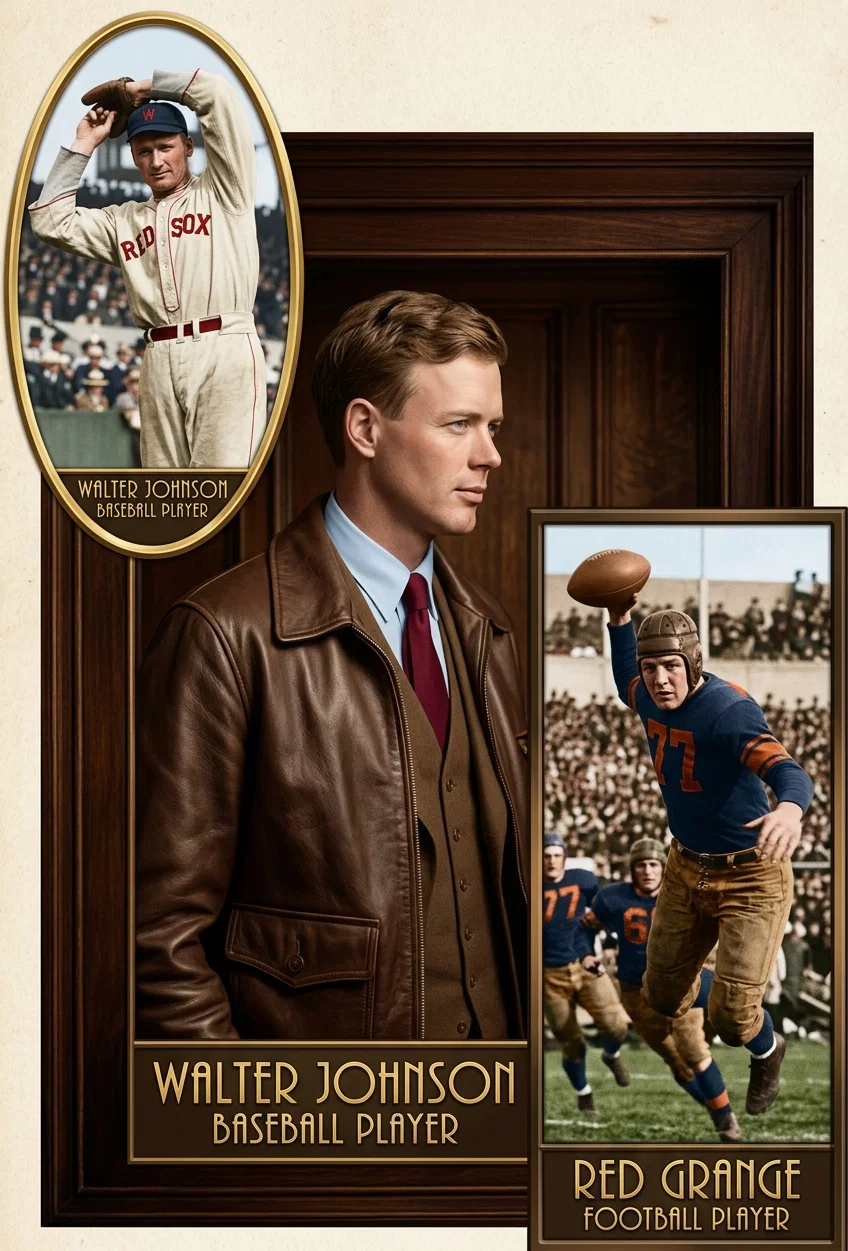
Red Grange, the noted football player, a nonsmoker, says to the youth possessing athletic ambitions, “You cannot drink, and smoke, and expect to succeed as an athlete.”
Cigarette smokers are not in demand on football or baseball teams, because they lack endurance. They may play well most of the time, but at a critical point in the game they are liable to fail. Their judgment is not reliable or dependable.
Three popular men who will have nothing to do either with alcohol or with tobacco: Walter Johnson, famous baseball player; Col. Charles A. Lindbergh; and Red Grange, noted football player. Their pointed testimonies, as given in this article, are worth thinking over.
Walter Johnson, who is held in such high esteem by all lovers of baseball, says: “I strongly advise any boy who hopes to become an athlete to let cigarettes alone. They are bad for the wind. It is true that some great ball players have smoked cigarettes, but my answer to that is that they would have been still greater ball players had they not used cigarettes.”
Connie Mack, for years one of the brainiest leaders in the baseball world, who has observed the rise and fall of many a star player, says: “We find that players who smoke never amount to a great deal in the profession. Players, for instance, who should have continued in the game until they were at the age of thirty to thirty-five years, have had to be let out years before their time, as the cigarette poison, getting into their system, had unnerved and weakened them so that they were utterly unfit for the duty they had to perform. There is very little smoking among our baseball boys. We do everything in our power to discourage the use of cigarettes, knowing the great harm it has done to those players who have been addicted to them.”
Ty Cobb, who has stood forth as one of America’s greatest baseball players, says: “Too much cannot be said against the evils of cigarette smoking. It stupefies the brain, saps vitality, undermines the health, and lessens the moral fiber of the man.”
Clark Griffith, president of the Nationals, the team that is making such an excellent showing this year, has had every opportunity to observe the effects of smoking on the members of his team. After their defeat in 1914, he said: “Our failure to come up to expectations has been largely due to the fact that some of the players on whom we depended were cigarette smokers. There will be no more of it. Any player who insists on smoking cigarettes is through, so far as the ‘Nationals’ is concerned; and that goes so long as I am manager of the team.” How far he has been able to carry this into effect I am unable to tell, but we have here his objective.
In boxing and pugilism it is endurance and good judgment that win. Eugene Tunney, who won the boxing championship from Jack Dempsey, in 1927, takes pride in saying over his own signature that he has “never used liquor or tobacco.”

DEMPSEY’S REFUSAL

A cigarette manufacturer sent an agent to Jack Dempsey when he held the world’s championship as pugilist, asking for his signature to a recommendation of a certain brand of cigarettes, and offered a tempting financial consideration. Dempsey read it and, turning upon the man, said: “You could not get me to sign that for ten times what you offer. I do not smoke cigarettes, and never did. Do you think I am going to ask the thousands of young boys who read about me to take up cigarette smoking? If you had a harmless candy or soda water, I wouldn’t mind giving you a testimonial for nothing, but I don’t sign your testimonials for a cigarette.”
Not every one has the moral stamina to turn down an offer of several thousand dollars merely for a signature. No one knows this better than the cigarette concerns.
In business the men who stand at the head are nonsmokers. Of the ten most successful business men and financiers of America, which include such outstanding characters as Andrew Carnegie, J. P. Morgan, Sr., John Wanamaker, Russell Sage, Marshall Field, John D. Rockefeller, Henry Ford, and others, nine were known to abjure the use of tobacco; all lived or are living to a ripe old age.
The success of Henry Ford, the world’s most level-headed business man, may be attributed in measure to the fact that he is a man of good habits. In referring to the use of cigarettes he says: “Employers of labor are each year becoming more strict in their requirements—for their own good and for that of the men in their employ. The physical strain imposed is such that only the strong can come through with credit.
“But even more essential than the question of brawn is that of brain. The youth who gets to the front in any line must be wide-awake, alert, with a mind that is clear and capable of tackling the problems that come up.
“The boy or the young man whose brain is fogged by the use of cigarettes finds himself hopelessly handicapped. His services are accepted only as a last resort; and if there is anyone else available, he is not intrusted with important matters or considered for future possibilities.”
This is the testimony of men in every walk of life—men who have made good, and who know exactly why some boys succeed and why others make a sorry failure of anything they attempt.
Principals and teachers in public schools and colleges are doing their utmost to discourage the use of tobacco, and especially the cigarette, because they recognize that the cigarette is one of the greatest enemies of our public schools. Every observing teacher knows that the boy smoker seldom makes good. He becomes nervous and restless, and unable to apply himself to close mental work for any length of time. He drops behind in his classes, and eventually drops out of school.

OPINIONS OF DOCTORS AND JUDGES

Judge B. S. Shaw of Hart, Michigan, said: “In every instance of juvenile delinquency in this court I have found that the boys were cigarette users.”
Judge Allen of Lisbon, North Dakota, said: “Every male juvenile delinquent brought before me for the last seventeen years has been a cigarette smoker.”
Judge Pollock of Fargo, North Dakota, said: “Every boy brought into this court the past sixteen years was a cigarette smoker.”
Dr. Hutchinson of the Kansas State Reformatory said: “Cigarettes are the cause of the downfall of more boys in this institution than all other vicious habits combined.”
Dr. Coffin, who for over twenty years was connected with the Whittier Reform School of California, said: “Fully 98 per cent of all youthful criminals who have been confined to this institution were cigarette smokers, and 95 per cent were cigarette fiends.”
Miss Winters, who is principal of one of the largest schools for delinquent youth in America, recently said: “Out of over eleven hundred inmates, only twenty were nonsmokers of cigarettes.”
Judge de Lacey of the Washington, D. C., Juvenile Court said: “There is something about this cigarette habit that weakens and unnerves the boy. It destroys his memory, impairs his reasoning faculties, robs him of his power of attention, saps his will power, and deprives him of his initiative. Often this habit has so fastened itself upon impressionable boy nature that it cannot be shaken off.”
Thomas Edison, some time ago, made the statement that the cigarette smoke has in it properties known as furfurole and acrolein, which tend to bring about degenerative changes “of an incurable nature” in the brain cells of the young addict. He attributes crime among our youth chiefly to the prevalent use of cigarettes. This should not come as a new revelation, for practically every thinking father and mother who have had any experience with a boy or girl who smokes know this to be the case. Teachers in our public schools will tell you that the cigarette unfits the youth for study, and that study virtually ends where cigarette smoking begins, and where study ends criminal tendencies begin.

OPINION OF PRESIDENT

President Herbert Hoover, in an address given before the members of the Associated Press in New York City, in dwelling upon the increase of crime in America, said: “Disrespect for the law threatens the future of this nation.” He did not attribute the increase in crime to Prohibition, since Prohibition, he said, was responsible for only 8 per cent of the convictions. “All crime is increasing, from murder to forgery,” he affirmed, “to the point where life and property are more unsafe in this country than in any other civilized country in the world. President Hoover himself knows that the cigarette is one of the chief sources of crime among our youth. Several years ago he made the statement: “There is no agency in the world to-day that is so seriously affecting the health, efficiency, education, and character of our boys and girls as the cigarette habit. Yet very little attention is paid to it. Nearly every delinquent boy is a cigarette smoker. Cigarettes are a source of crime, and to neglect crime at its source is a shortsighted policy unworthy of a nation of our intelligence.”
It does seem strange that a “nation ofour intelligence” should neglect to recognize this source of crime, and permit tobacco companies to spend millions of dollars annually in advertising cigarettes through the medium of the press, the billboard, and the radio, and in such a glaring and deceptive manner to encourage our boys and girls to take up with this destructive practice.
Inducements are held out by these concerns to unprincipled athletes similar to the one presented to the Hunter brothers, Lindbergh, and Dempsey. When testimonials are secured in this manner, they are presented to our youth—boys and girls—in a manner to encourage them to reach for a cigarette when tempted to reach for a sweet, et cetera.

MOST IMPORTANT PROBLEM

In the prevalent use of cigarettes by boys and girls, we are brought face to face with the greatest and most important problem that confronts us to-day. Were it not for the money there is behind the tobacco trade, a stop would speedily be put to this mode of advertising. But “the love of money” is still “the root of all evil.” It is the love of money that opens up the pages of our journals and daily papers to cleverly written “ads.” We permit these trusts, through these mediums, to make cigarette addicts of our boys and girls, and thus encourage the production of a criminal class. Certainly this is “a policy unworthy of a nation of our intelligence.”
But these tobacco concerns are overstepping their bounds. Public sentiment is being aroused against it. The better classes of Americans will not always tolerate this deceptive manner of appealing to our girls and boys. Referring to this in a recent appeal before the United States Senate, Senator Smoot said: “Not since the days when public opinion rose up in its might and smote the dangerous drug traffic, not since the days when the vender of harmful nostrums was swept from our streets, has this country witnessed such an orgy of buncombe, quackery, and downright falsehood and fraud as now marks the current campaign promoted by certain cigarette manufacturers to create a vast woman and child market for the use of their product.
“I rise to denounce insidious cigarette campaigns now being promoted by those tobacco manufacturing interests whose only god is profit, whose only bible is the balance sheet, whose only principle is greed. I rise to denounce the unconscionable, heartless, and destructive attempts to exploit the women and youth of our country in the interests of a few powerful tobacco organizations whose rapacity knows no bounds.”
It is time for every father and mother and every true American citizen to arise and second this effort by the Senator to suppress this evil. Let them use every means in their power to prevent the propagation of this body and soul destroying traffic.

How to Cure the Cigarette Habit

D. H. KRESS, M. D.
THE first step in giving up the cigarette is to give it up. Many fail because they never really reach this point.
Keep away from smokers and a tobacco-laden atmosphere as far as possible for about three weeks. After each meal, for one week, rinse out the mouth with a ¾-of-one-per-cent solution of silver nitrate. This creates a distaste for tobacco smoke, and will relieve throat irritation.
Purchase five cents’ worth of gentian root (or camomile blossoms), and chew it during the day when there is a desire to smoke.
To assist in eliminating the poison, take a dose composed of half a teaspoonful each of Rochelle salts and cream of tartar each morning before breakfast for one week. If possible take a Turkish bath, or a good sweat bath of some kind, twice during the first two weeks. Drink water, orange juice, or grapefruit juice freely.
Keep out in the open air as much as possible. Keep the mind occupied.
The greatest aid will be found in a change of dietetic habits. Smokers are fond of highly seasoned foods and stimulating drinks.
It is necessary to give up the use of pepper, mustard, the free use of salt and coffee and tea, and also the free use of meats.
The following diet will be found of the greatest aid. If followed carefully, the discovery will be made, by the end of the first week, that the craving has materially lessened, and by the end of the third week it is not unusual to find that the craving has almost entirely disappeared. With this assurance held out, the effort is certainly worth a trial.
For a period of two or three weeks make use of cereal foods, as Shredded Wheat Biscuits, bran flakes, Krumbles, Puffed Wheat, whole-wheat bread, rye or Graham bread, etc., with milk and cream, buttermilk, cottage cheese, nuts (well masticated). At the close of the meal use fresh subacid fruits, as oranges, peaches, pears, apples, pineapples, grapefruit. Figs, dates, and raisins, apple sauce, and canned fruits are indicated. Highly seasoned foods and stimulating drinks should be avoided.
A patient who had used tobacco for forty-two years, after adopting this treatment for three months, wrote: “It seems wonderful to me that I now have no craving for tobacco or drink.”
Another writes: “I am glad to say I have not used tobacco in any form for three weeks, and have no desire for it.”
Still another, after four weeks, says: “The desire for smoking has entirely disappeared. I have increased in weight and considerably in strength. My mind is clearer, not being doped. I am exceedingly glad I quit.”
No victory has ever been won without a conflict and fight. Divine aid is promised those who strive lawfully, and victory is assured.

Does Cigarette Smoking Build a Better Body?

Does cigarette smoking build a better body, make better morals, and enhance your chances for success?

What Is Mars Teaching China?

OTTO B. KUHN
CHINA'S population to-day is placed at 440,000,000, and if the present birth rate continues, and if there are no other than natural causes of death, it is estimated that by 1950 there will be 500,000,000, or an increase of 3,000,000 a year.
Throughout her long history China has suffered much from wars, pestilence, floods, and famines. From time to time large numbers have died as the result of these various calamities. The famine of 1877-78 caused the death of 8,000,000 in North China. In 1929, famine in Northwest China carried off 2,000,000. During the Tai Ping Rebellion of 1850-64, between 10,000,000 and 20,000,000 persons lost their lives. It is estimated that 4,000,000, or over one per cent of the people, die annually from starvation and preventable causes.

HUMAN LIFE CHEAP

These frequent afflictions that cause such untold suffering and hardship, and which bring about the premature death of so many of the people, is one reason why human life here is held so cheaply, and why there is so much cruelty practiced toward man and beast.
While many humane persons are horrified by these things and would bring about better conditions, the number who assume an attitude of indifference toward human suffering is astounding. When disasters and disorders are referred to, frequently we hear the remark, “Oh, we Chinese are too many. These things, so to speak, are safety valves against overpopulation and extreme competition for mere existence.”
The present civil war between the North and the South is the most appalling in all China’s experience. Nearly a million men are engaged in the terrific military struggle. These armies are equipped with the latest inventions known to military science,—airplanes, tanks, armored trains, machine guns, automatic pistols, improved rifles, field guns, and bombs. And in addition to these are the great beheading knives of ancient times. Furthermore, the soldiers are trained by foreign military officers in the wicked business of wholesale human destruction. The losses thus far are reported at 200,000; two thirds of these were killed in battle, and the others wounded.
Without attempting to discuss the causes of the present civil strife or to explain the political party policies and principles involved, we raise the question, What is China getting out of her civil wars? A few days ago a comparatively enlightened man, a graduate from a Chinese school of medicine, and the owner and superintendent of a hospital, who at the present time is caring for hundreds of wounded soldiers, asked me if the Republican party in America had first to conquer the Democratic party on the field of battle in civil warfare before they could elect their President.

MUCH HARM RECEIVED

Political parties in China may get out of their civil wars the ability and power to elect their special group of officials to run the government, but China is getting more than that out of it. She is getting much harm, financially, industrially, economically, and morally. There is also one grim and sinister gain accruing to her, and that is an experience of warfare in modern conditions, with modern equipment, and under expert modern instructors.
China is receiving a practical experience in scientific warfare, and is being trained to take a prominent part in the military activities leading up to, and culminating in, the world’s last war, Armageddon. The flag of the rising sun, symbol of those kings that come from the sunrising (Revelation 16:12, A. R. V.), is being accustomed to bloody battlefields.
Throughout China and the Far East emphasis is being placed more and more upon the emblem of the rising sun and what it stands for. Besides representing enlightenment and progress, it is the symbol of the political order and national ambitions of great Eastern peoples.

THE RISING SUN

In the Japanese language, Japan’s name is Rih-ben. Rih means day, and ben, origin. Japan’s name, therefore, is Day Origin. It is interesting to note that the day, theoretically and by international agreement, beginning at the day line on the 180th meridian, practically starts with Japan. Traveling westward the day crosses Asia, then passes on through Europe, and finally reaches America.
Japan’s national emblem is a red sun on a white background. China’s is a white sun in a blue field. At important centers in China beautiful monuments of the rising sun, emblem of the kings of the East, are being erected.
Far Eastern nations are drawing together in order to oppose Western powers. At China’s national capital patriots from India fly their new national flag, and they hope to secure the influence of Chinese officials with whose help they desire to gain political independence for India. Leading Chinese and Japanese realize that in spite of apparent outward animosities and contentions they possess much in common, and should form an alliance for the protection and advancement of their mutual interests.
One of the beautiful monuments of the rising sun that are being erected in China. This one is located at Pukow, just across the Yangtze River from Nanking, the new capital of China.
The powerful Nationalist political party of Shanghai stresses the importance and necessity of a union of yellow races. Their utterance, as it appeared in a recent issue of the Sin Wan Pao, an influential Chinese newspaper, was a circular letter addressed to “the oppressed races of the Orient.” It stated that “unless these races unite in one body and launch a counter attack against ‘the international imperialists’ who have been continually oppressing them, they will be annihilated separately.”
Dr. Sun Yat-sen’s famous book, which militantly sets forth his conception of government and demands a universal political order, “The Three People’s Principles,” is translated into Japanese. It will be translated into other Asiatic languages.

DISSATISFIED AND RESTLESS

The great nations of Asia are dissatisfied and restless. Constant agitation and propaganda are bringing them quickly to a state of revolt against existing governments. They are ripe for the changes demanded by Dr. Sun’s book, whose political ideal appeals to Oriental imagination and requirements.
Some of these nations have not as yet formulated any definite, adequate, or comprehensive political economy for themselves. China has just what they want, already made for them. Unable to conceive anything the equal of Dr. Sun’s work, they will readily accept his principles of universal government.
Dr. Sun’s political principles, in all probability, will form the basis of an alliance of Asiatic nations. Steadily and inevitably thisunion is developing for aggressive action against Western countries, and it will not be many years before the kings that come from the sunrising will be on the westward march.
Notwithstanding the many proposals for disarmament and the earnest efforts of benevolent men and women to bring about universal and permanent peace, developments in the world to-day indicate that the nations are really expecting war, are on the verge of it, and are preparing for it.
The book of Revelation gives a picture of four angels holding the four winds of earth. Another angel is seen having the seal of God, and he cries to the four angels not to loosen the winds of strife until the servants of God are sealed. (Revelation 7:1-3.)
The gospel message with its accompanying sealing work is progressing rapidly throughout the world. (Matthew 24:14; Revelation 14:1, 6-12.) Soon all peoples will have had the opportunity of hearing, reading, and receiving this message; and when this is accomplished, whether men will have accepted the gospel to their eternal salvation or rejected it to their eternal loss, the four angels will release those winds of warfare.
Then will come those military operations that plunge all nations into Armageddon. Then will be seen China and her allies eagerly gathering to the fray. Then will be witnessed the end of the world and the coming of the Lord Jesus Christ. (Matthew 24:3; Revelation 16:12-21.)
Continue reading: A Millennium in Iceland