Your ShelfYour Projects

Signs of the Times, Vol. 28, No. 33.

THE ROCK OF AGES

Signs of the Times

Aug 13, 1902

Pacific Press Publishing Company · Oakland, California · Aug 13, 1902

THE ROCK OF AGES.
IN a song of many minor notes and strains, "Moses the man of God" sings triumphantly, "For their rock is not as our Rock, Even our enemies themselves being judges."
How we are reminded of this blessed truth by the ruins of the nations and peoples who have set themselves against God. Many times we know them only because of their opposition to the work of God. For more than two thousand years it was the Bible alone which told us of the bold, blasphemous king, Belshazzar. He dashed himself against the Rock of Ages, and was utterly broken. Sometimes the enemies of truth are known by the names which they have carved in stone or baked in brick; but they themselves are dead and gone. They are known only by dead works. Their only records are the boastful ones which they themselves have ordered inscribed, and which would have long since been lost had they not been carved in the rock of God's creation.
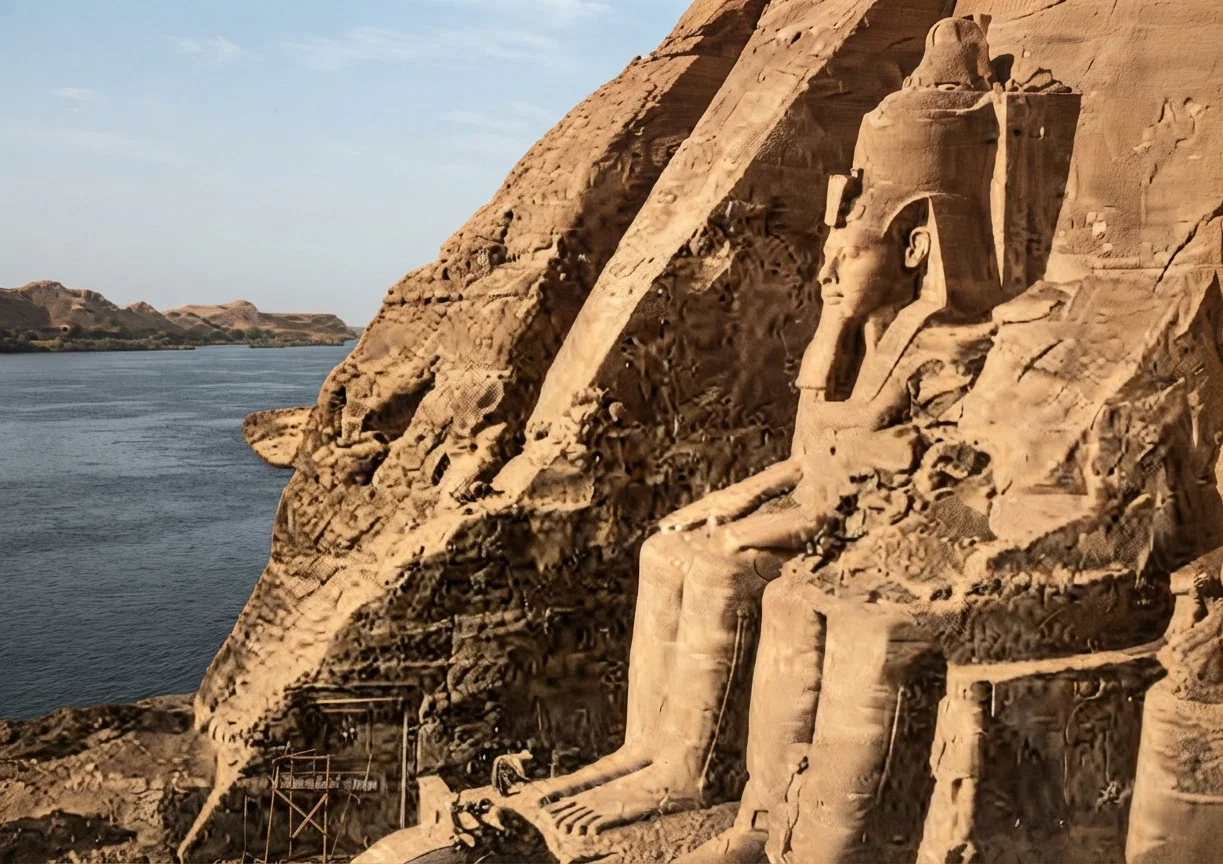
AN illustration of this is given on this page. A few miles below the second cataract of the Nile, in Nubia, or Upper Egypt, is Abu-Simbel, or Ipsambul, the ancient Abuncis. It is noted chiefly for the great rock-temple it contains, cut into the mountain by Rameses II., to the distance of 200 feet. The first chamber is a great hall in which are eight piers, before each of which is an image of Osiris seventeen feet eight inches high. Upon these piers and elsewhere are portrayed the military deeds of Rameses. Beyond this is a smaller pillared hall, then a vestibule leading to the sanctuary. Here are the figures of the Egyptian gods Amen, Ptah, Horus, and Rameses himself, placed by himself among the deities he worshiped. For the front of the temple the rock has been cut away to the extent of a hundred feet square, with a dog-headed ornamented cornice. Before the temple front are four enthroned figures of Rameses, sixty-six feet high, still quite perfect. The art of the man who preserved the old ruler's memory was more perfect and lasting than the character of the king.
Colossi of Rameses II. before the Great Rock-Temple.
THE great and wonderful temple stands as a monument of human, self-exaltation. Lucifer said, "I will exalt my throne above the stars of God; I will be like the Most High," and he fell forever. Then he came to man, whom he was persuading to sin against God, with the evil insinuation, "Ye shall not surely die; . . . ye shall be as God." And so man fell in his endeavor to exalt himself. This was the principle which moved the old Egyptian king. He exalted him-self. He could not place himself with God; but he could place his image with the images of the false gods he worshiped. And he, too, fell, as have and will all others who exalt themselves, and seek to put themselves in the place of God.
Great Rock-Temple at Ipsambul, Egypt.
RAMESES is dead. The rock-temple, perhaps his greatest monument, is only an interesting ruin. The gods he worshiped still look forth with sightless eyes upon the gloom of the rock-temple. His own images still stand or sit in the crystallization of eternal death. The great empire over which he ruled has become "the basest of kingdoms," as declared by God's prophet. And all he touched speaks only of decay, despair, darkness, and everlasting ruin.
THE Christian has a Rock-temple, even Jesus Christ. "Ascribe ye greatness unto our God, The Rock, His work is perfect; For all His ways are justice; A God of faithfulness and without iniquity, Just and right is He." He is not a dead temple carved out by human hands; He is the everlasting, living "Rock of our salvation." He is a cleft Rock; but it is not an evidence of weakness. From the cleft side flows the water of life, and into the great heart of the Eternal, the weary, the oppressed, the persecuted, may enter and find rest and contentment and safety, forevermore. "Their rock is not as our Rock, even our enemies themselves being judges." The might of Egyptian pride dashed the prow of its haughty Ship of State against this Rock, and went down to wreck and ruin. Through all the ages men, exalted in themselves, have pitted their puny efforts against the Rock of His Word, but the Rock stands; the men are not.
WHAT is the lesson?—There are many; but they may all besummed up in God's message to this generation. The gods of Egypt still exist in principle. Men still exalt themselves. Men still fear and worship men. Men are still exalted by men to the place of God. And the only remedy is God's message of life: "Fear God, and give glory to Him; for the hour of His judgment is come; and worship Him that made heaven, and earth, and the sea, and the fountains of waters." "Trust ye in Jehovah forever; for in Jehovah, even Jehovah is a rock of ages." In Him is cleansing and keeping for all who will come. "Rock of Ages cleft for me, Let me hide myself in Thee."

Health and Disease not Matters of Chance

THE MISSION OF PAIN AND THE LANGUAGE OF DISEASE. NO. 4.

Health and Disease not Matters of Chance.

‘Affliction cometh not forth of the dust, Neither doth trouble spring out of the ground.’
HEALTH and disease are conditions regulated by the great universal law of cause and effect, sowing and reaping. Many have given so little thought to the question of sowing and reaping with reference to health and disease, that they are actually unable to recognize the ‘seeds of health,’ and are therefore unable intelligently to sow for good health.
It would seem that many individuals expect to discover the blessed boon of health either accidentally or providentially; or in some mysterious way to possess themselves of physical strength without having faithfully and intelligently co-operated with God in these matters.
But health is not a matter of chance. We must diligently sow the seed of conscientious obedience to physical and spiritual law, if we would reap the desirable harvest of spiritual and physical health; and unless we have received from our ancestors an enormous legacy of physical health and resistance to disease, it will soon become apparent that a state of physical well-being is secured only as a result of physical well-doing. The inestimable treasure of good health comes to us only as the result of good sowing, tho sometimes we are able to continue long in transgression before we begin to experience its evil effects, because our parents bequeathed to us such a generous legacy of physical health that it has required considerable time to squander it.
The realization of health is no more a matter of chance or accident than is the farmer's harvest which he reaps in autumn. Sickness must not be regarded merely as the punishment of God, the visitation of divine Providence, an accident, or ill luck. These erroneous views of the cause of disease lead us into wrong methods of seeking to effect its cure,—methods which resemble picking the leaves off a tree in an effort to destroy it. In reality the tree is little harmed, for it will soon put forth other leaves; whereas if an ax had been laid at the root, the undesirable tree would have been disposed of once for all.
The physician who is called upon to deal with the physically sick, and the minister who is called upon to deal with the heart-sick, should inquire into the cause of the afflictions of those who seek their help, and counsel them, and not only treat them for the results of transgression, but also seek to correct the practise or disposition which is in reality the root of the many distressing and annoying symptoms of spiritual or physical disease that appear on the surface. We must come to realize that the harvest of health can only be secured by the same painstaking and diligent cultivation that we see manifested on the part of the successful farmer in tilling the soil, and the prosperous business man in the building up of his commercial interests. We do not receive the blessing of health to be squandered in disobedience, or in the gratification of a perverted appetite; and when health is lost, it is ordinarily regained only by intelligent and conscientious effort. We do not regain physical health by accident or without sowing for it, any more than we receive spiritual forgiveness and moral healing without repentance and prayer.
W. S. SADLER.

CHRIST OUR MEDIATOR.

The Lord is honored when we trust in Him, bringing to Him all our perplexities. "Whatsoever ye shall ask in My name," He says, "that will I do, that the Father may be glorified in the Son." God's appointments and grants in our behalf are without limit. The throne of grace is the center of attraction, because occupied by One who permits us to call Him Father. "God so loved the world, that He gave His only begotten Son, that whosoever believeth in Him should not perish, but have everlasting life."
Jehovah did not deem the plan of salvation complete while it was invested only with His own love. He has placed at His altar an Advocate clothed with our nature, whose office it is to introduce us to God as His sons and daughters. Christ intercedes in behalf of all who receive Him. He gives to them power to become the sons of God. And the Father demonstrates His love for Christ by receiving and welcoming Christ's friends as His friends.
He is satisfied with the atonement made. He is glorified by the mediation of His Son. We are accepted in the Beloved.
In Christ's name our petitions ascend to the Father. He intercedes in our behalf, and the Father lays open for our appropriation all the treasures of His grace. "Ask in My name," Christ says. "I do not say that I will pray the Father for you; for the Father Himself loveth you, because you love Me. Make use of My name. This will give your prayers efficiency and power, the Father will give you the riches of His grace. Wherefore ask, and ye shall receive, that your joy may be full."
What more could God do for us than He has already done? The rainbow encircling the throne is an everlasting promise that all who approach Him will find pardon. Christ encourages us to pray always. He seeks to draw us to Him, that He may satisfy His desire to help us. He urges us to present our needs. His heart of love is filled with an earnest desire to bring us in close touch with God.
When Satan tells you that the Lord will not regard you with favor, because you have sinned, say, "Jesus gave His life for me. He suffered a cruel death that He might enable me to resist temptation. I know that He loves me, notwithstanding my imperfection. I rest in His love. God has accepted His perfection in my behalf. He is my righteousness, and I trust in His merits. He takes away my sin-stained garments, and clothes me with the robe of His righteousness. Clothed with this garment, I stand before the Father justified."
"What shall we then say to these things? If God be for us, who can be against us? He that spared not His own Son, but delivered Him up for us all, how shall He not with Him freely give us all things?" "I am persuaded, that neither death, nor life, nor angels, nor principalities, nor powers, nor things present, nor things to come, nor height, nor depth, nor any other creature, shall be able to separate us from the love of God, which is in Christ Jesus our Lord."
Yes; Christ has become the medium of prayer and of blessing between God and man. He places the whole influence of His righteousness on the side of the suppliant. He pleads for man; and man, in need of divine help, pleads for himself, using the name of the One who gave His life for the life of the world. As we approach God in Christ's name, acknowledging our appreciation of His sacrifice, fragrance is given to our petitions. We are clothed with His priestly vestments. The Saviour draws us close to His side, encircling us with His human arm, while with His divine arm He grasps the throne of the Infinite.
MRS. E. G. WHITE.

THE LOVE OF CHRIST.

THE scene was laid in Bethany. Around the board, partaking of the solemn feast Prepared, sat they, the twelve, the honored Twelve, who, followers of Him now Sitting in their midst, were favored more Than men had ever been, or have been since. The Master sat among them. On His Face had grown a sadness sweet, a Tender radiance, for well He knew The Father's will, that soon, ah! very soon, He would be called to Him.
They were at solemn feast in Bethany. But lo! the opening door revealed a woman's Form; O why should she be there? Each face expressed the thought,— Each tongue almost conveyed. A woman! Yes—had been a woman once—a babe, An innocent, a laughing child, A youthful maiden, treading with light feet The dewy grass, and letting fall pure words From lips that gleamed with childish innocence. But ah! the hour had come,— The tempter loves to sting the fairest fruit;— And she, the precious lamb, had strayed Without the fold A while—only a while—for on her life There broke "Glad tidings of great joy," Tidings of One who peace would bring— Sweet peace—into each life.
O, could not she, sin-stricken as she was, For pardon hope? She had no jewels rare, No golden gifts; but she had come, And with a cry for pardon, and a heart So filled with deep humility and love, She cast herself low down at Jesus' feet; And with the precious ointment (all she had) She bathed His feet; then wiped them with her hair. O, gracious, pitying Christ! He comfort gave, Poured balm into her wounds, and straightway they Were healed. She went her way. But Jesus caught The selfish words of those who followed Him. Upon His face had grown a radiant look Such as the world's applause could give to none. "She loveth much," He said; "And what she could, That hath she done; I do not ask for more." Berkeley, Cal, ANNA DUTTON MICHENER.

SENT UP.

A rich lady dreamed that she went to heaven and there saw a mansion being built. "Who is that for?" she asked of the guide.
"For your gardener."
"But he lives in the tiniest cottage down on earth, with barely room enough for his family. He might live better, if he did not give away so much to the miserable poor folks."
Further on she saw a tiny cottage being built. "And who is that for?" she asked.
"That is for you."
"But I have lived in a mansion on earth. I would not know how to live in a cottage."
The words she heard in reply were full of meaning: "The Master Builder is doing His best with the Material that is being sent up."
Then she awoke, resolving to lay up treasure in heaven.—Anon.

DISAPPOINTMENTS.

THE world is full of disappointments. They come to individuals, to families, to States, to churches, to kingdoms, and to empires. Disappointments are often the result of false hopes, and are the common experience of mortals, largely, if not wholly, on account of sin.
The first disappointment came to the mother of all living, who expected to obtain greater exaltation by transgression, by believing and acting a lie, but found instead, humiliation, degradation, and death, the sad end of which is not yet reached. That wrong laid the foundation for every other disappointment to the present day.
A second disappointment came to the first human pair when their first-born son, whom they fondly hoped would be the promised Seed, proved to be, instead of a Saviour, a murderer, a fratricide.
On the eve of a lovely day in the spring-time when the passover season was at hand, when five thousand men, besides women and children, were on the point of laying hands upon Jesus to make Him king, it was a great disappointment to the disciples to be sent across the sea, and to the multitude to be sent to their homes, while Jesus, all alone, went to the mountain to pray.
Later, at another passover season, when Jesus rode into Jerusalem on a colt, and glad disciples spread their garments in the way while others strewed his pathway with branches of trees, and the mighty host cried, "Hosanna, our King cometh," it was a sore and almost overwhelming disappointment to, a few days later, see the same Jesus, instead of being crowned and seated upon the throne of Israel, crucified and dying on Calvary.
This is June 26, 1902. One of the greatest nations on earth had fixed this day for the coronation of their new king, Edward VII. Without sparing expense, the preparations long under way are completed. London, the greatest city on earth, the capital of this mighty kingdom upon whose possessions the sun never sets, is gorgeously arrayed. The representatives and dignitaries of all nations have arrived. All is in readiness for the grandest coronation that has ever occurred on earth since the fall of man. Now, who can measure the extent, the expense, the bitterness of the disappointment that comes from the message, "King Edward's life is trembling in the balance. The Coronation must be postponed for a time." (And it may be for all time.) Human projects and prospects hang upon the brittle thread of human healthand life, and hence are liable to be dashed to pieces at any moment.
In 1844, thousands of good people scattered abroad in the earth were sadly disappointed. They confidently expected to see the Lord come in glory to set up His kingdom, and then they would reign with Him in glory. But He did not come at the time they appointed, nor has He yet come. But when He does come, as He surely will at no distant day, kings and captains, and mighty men, and rich men, and nations, and kindreds, and tongues, and peoples, will be wofully disappointed. They have not believed He would come at all, hence are unprepared to meet Him, and are doomed to destruction by the brightness of His appearing. The saints are not destroyed, nor are they disappointed, for they are looking for Him, and will look up and say, "Lo, this is our God; we have waited for Him, and He will save us." And they are saved with an everlasting salvation.
There is no such word as disappointment in the vocabulary of those who abide in the love of God, even in this world. The sting and sadness is all taken out of the word by substituting the letter h for the letter d, in the spelling. Then it becomes His appointments instead of disappointments. And the recognition of this change makes a world of difference in the way things that come to us affect us. Now if it be true that "all things work together for good to them that love God," then how else can we regard the seemingly objectionable and unpleasant things that come to us, but as the appointments of an all-wise and loving heavenly Father, intended for our best good, and His highest glory; and it is well-pleasing to Him that we receive them as such, and instead of mourning over disappointments, to cheerfully accept them as His appointments, and go on our way rejoicing. H. A. ST. JOHN.

The Coming of the Lord

BY L.A.PHIPPENY
BY L.A.PHIPPENY

THE SECOND ADVENT.

(Continued.)

The Resurrection.

LONG ago, even in Eden, there were sown by the devil the seeds of an error that took root and grew into a doctrine, and waxed exceeding great, and spread forth into every nation of the earth. This was the doctrine that proposed that man should not die; that even tho the body might perish and the man seem to die, yet the soul, the spirit, the real man, lived on,—the doctrine of the inherent immortality of the soul.
The devil said, “Thou shalt not surely die;” and this doctrine has been popular throughout the ages, because men did not want to die, and at the same time did not wish to believe God’s revealed truth which condemned sin, and foretold a day of judgment and a day of punishment for evil deeds. And so the greater portion of mankind, wittingly or unwittingly, has accepted the devil’s assertion as truth, with the result that the scriptural teaching concerning the state of the dead and the resurrection and future rewards, has been interpreted in this way and that, and the Bible has come to be regarded as a book hard to understand, or else extremely contradictory in its statements, and unreliable on many points.
This is precisely what the devil designed should be the result. And he has elaborated his first deception, and followed it up and propped it up with signs and wonders, and apparent and perhaps real miracles, and pretended communications from the dead. Now it is fair to ask, If individuals receive their rewards at death, and go to heaven or hell or to any other place as disembodied spirits at that time, what need is there of a resurrection afterwards of the body? No answer can be given that is a substantial reason whatever for the resurrection of the body, if the real man—the ego—passes on at death into conscious existence. If the commonly accepted doctrine of the conscious state of the dead be true, the Bible teaching on the question of the resurrection and the judgment is absolute folly.
It is undoubtedly true that a great many good people have died expecting to receive a glad reward at death. They will receive their reward, but it will be received at the time indicated in the Scriptures, and at no other time. On the other hand, righteous ones in all ages have been cheered by the hope of a resurrection from the dead as they have passed to their last earthly rest. “Thou shalt be recompensed at the resurrection of the just,” said Jesus concerning the well-doer. “I know that he shall rise again in the resurrection, at the last day,” were the words of faith uttered by the sister of Lazarus.
Nothing is plainer than the Bible teaching that the dead are unconscious, quietly resting until the coming of the Life-giver. The subject can not be discussed here at length, but a few texts will suffice to demonstrate this positive truth:—
“The living know that they shall die; but the dead know not anything. . . . Also their love, and their hatred, and their envy is now perished; neither have they any more a portion forever in anything that is done under the sun.” Eccl. 9:5, 6.
“Put not your trust in princes, nor in the son of man, in whom there is no help. His breath goeth forth, he returneth to his earth; in that very day his thoughts perish.” Ps. 146:3, 4.
“But man dieth and wasteth away; yea, man giveth up the ghost, and where is he? As the waters fail from the sea, and the flood decayeth and drieth up; so man lieth down, and riseth not; till the heavens be no more, they shall not awake, nor be raised out of their sleep.” “His sons come to honor, and he knoweth it not; and they are brought low, but he perceiveth it not of them.” “If a man die, shall he live again? all the days of my appointed time will I wait, till my change come. Thou shalt call, and I will answer Thee; Thou wilt have a desire to the work of Thine hands.” Job 14:10-12, 21, 14, 15.
The inspired psalmist of old, looking forward to that time of calling and answering, gives expression to the following sublime words:—
“Our God shall come, and shall not keep silence; a fire shall devour before Him, and it shall be very tempestuous round about Him. He shall call to the heavens from above, and to the earth, that He may judge His people. Gather My saints together unto Me; those that have made a covenant with Me by sacrifice.” Ps. 50:3-5.
To the same time apply the words of the Saviour Himself:—
“Then shall appear the sign of the Son of Man in heaven; and then shall all the tribes of the earth mourn, and they shall see the Son of Man coming in the clouds of heaven with power and great glory. And He shall send His angels with a great sound of a trumpet, and they shall gather together His elect from the four winds, from one end of heaven to the other.” Matt. 24:30, 31.
This locates definitely the time of the gathering together,—the end of the age, and the second coming of Christ.
It is to this time that the righteous must look for recompenses—immortality with all its blessings, eternal life. A mighty and glorious change it will be, from mortality to immortality. The prevailing theory that the soul is immortal and lives on with a spiritual body after the death of the body of flesh leaves no place for the teaching of the Word respecting the change referred to: “Behold, I shew you a mystery: We shall not all sleep [die], but we shall all be changed, in a moment, in the twinkling of an eye, at the last trump; for the trumpet shall sound, and the [righteous] dead shall be raised incorruptible, and we [the righteous living at that time] shall be changed. For this corruptible must put on incorruption, and this mortal must put on immortality.” 1 Cor. 15:51-53. Mortals do not have immortality before that time.
Why will this change be so felicitous?—“For our conversation is in heaven; from whence also we look for the Saviour, the Lord Jesus; who shall change our vile body, that it may be fashioned like unto His glorious body.” Phil. 3:20, 21. “Beloved, now are we the sons of God, and it doth not yet appear what we shall be; but we know that, when He shall appear, we shall be like Him; for we shall see Him as He is.” 1 John 3:2. “The Lord Himself shall descend from heaven with a shout, with the voice of the archangel, and with the trump of God; and the dead in Christ shall rise first. Then we which are alive and remain shall be caught up together with them in the clouds, to meet the Lord in the air; and so shall we ever be with the Lord.” 1 Thess. 4:16, 17. No language could be clearer, that the change from mortality to immortality embraces the body of the individual as well as the soul.
This resurrection is the resurrection of the righteous dead, and is called the resurrection of life. Nothing is said concerning the wicked dead in these scriptures, because they will not be raised from their graves until a thousand years later. Theirs is the second resurrection, and is called the resurrection of damnation. See Acts 24:15; John 5:29; Rev. 20:5. Their rewards will be given them. But the righteous dead and the righteous living enter into their reward at the same time, at the “appearing” and “kingdom” of the Lord Jesus Christ. 2 Tim. 4:1; also Heb. 11:39, 40.
And this time is near,—from every prophetic and fulfilling indication, even at the door.
This phase of the subject will be continued next week under the subdivision, “The Forth-shining of His Presence.”
Continue reading: PICTURES OLDER THAN THE FLOOD