Your ShelfYour Projects

Review and Herald, Vol. 80, No. 8.

MOUNT MORIAH AS IT IS TO-DAY

Review and Herald

Feb 24, 1903

Seventh-day Adventist Publishing Association · Battle Creek, Mich. · Feb 24, 1903
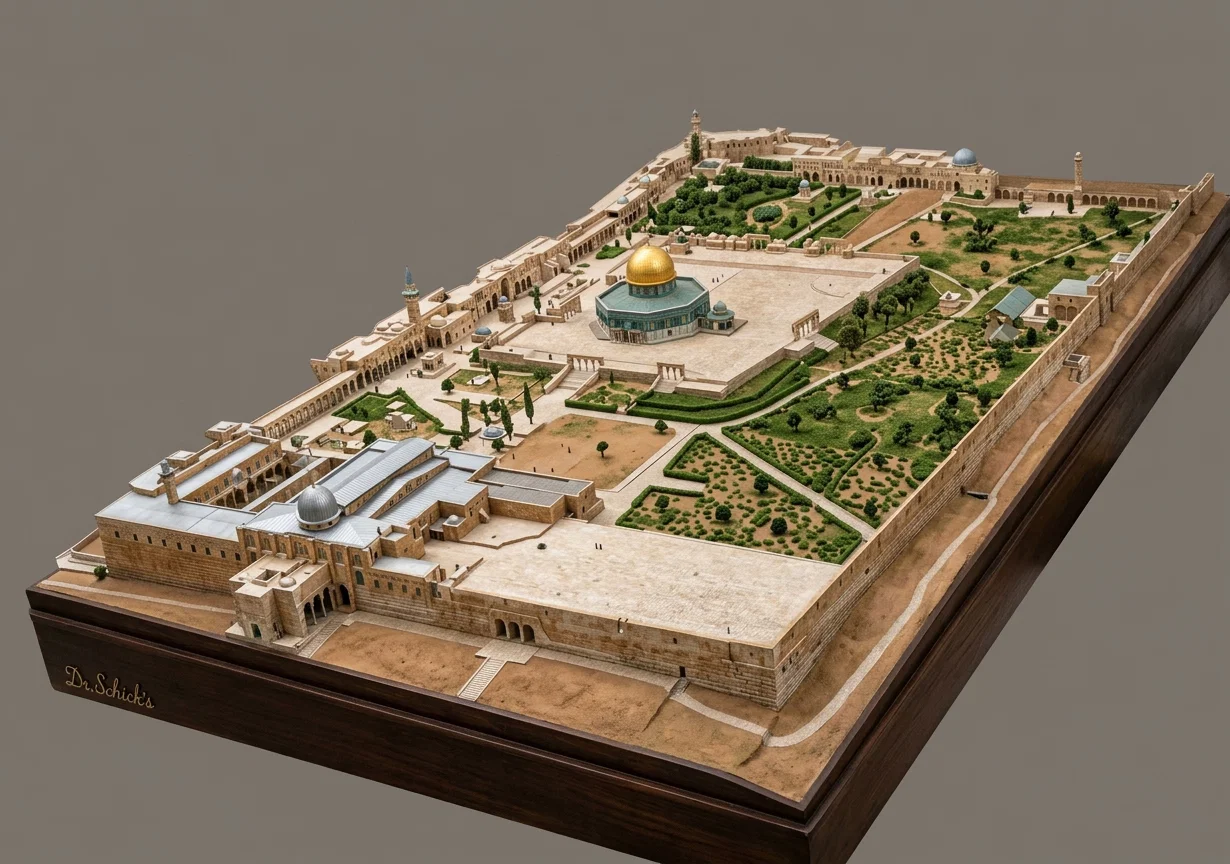
From The Scientific American

MOUNT MORIAH AS IT IS TO-DAY

THIS third picture is from a photograph of the model of the temple site as it now appears. Here the mosque of Omar has taken the place of the house of the Lord. “The first building within the inclosure is the Aksa mosque, and close to it the mosque for women, once the armory of the Knights Templars. The great mosque shows traces in its architecture of all the phases of ownership it has seen—Byzantine, Crusader, and Saracen.” A comparison of the three pictures which have now been printed will make an interesting study. “It is impossible to know in certain instances the exact architecture of the buildings, but all are agreed that Dr. Schick’s models represent with marvelous ingenuity and faithfulness the great and ancient worshiping places that have stood upon the famous temple site at Jerusalem.”

Publishers' Page

Conducted by the Department of Circulation of the Review and Herald Publishing Company

Special Sale of Slightly Damaged Books

THERE yet remains a limited supply of slightly damaged English books which we will mail to those desiring them at the special prices.
The sale will continue only a short time longer. All, therefore, who desire to secure these good books at the reduced prices should place their orders as early as possible.
All the books offered are about as good as new. The defect in each book is scarcely noticeable. Yet the reduction in the price is sufficient to allow for damages that would materially affect the value of the books.

Desire of Ages

In the cloth binding, reduced from $3.50 to $2.60, postpaid.

Great Controversy

In the cloth binding, reduced from $2.75 to $2. Full morocco, from $4.50 to $3.30.

Patriarchs and Prophets

Cloth binding, reduced from $2.75 to $2.

Easy Steps in the Bible Story

Cloth binding, reduced from 50 cents to 35 cents.

Looking unto Jesus

The cloth binding, reduced from $1 to 75 cents.

Marvel of Nations

Cloth binding, reduced from $1.25 to 75 cents, postpaid.

Home Hand-Book

Cloth binding, reduced from $4.50 to $3.35; the library from $5.50 to $4.10, postpaid.

Ladies' Guide

Cloth binding, reduced from $3 to $2.25, postpaid.

Man, the Masterpiece

Cloth binding, reduced from $3 to $2.25, postpaid.

Prophecies of Jesus

Cloth binding, reduced from $1.75 to 85 cents; library, marble edges, from $3 to $1.40; Russia, $3.75 to $1.90.

Empire Series

Containing Empires of the Bible, Great Empires of Prophecy, and Ecclesiastical Empire
Reduced from $6 to $4, for the set.

Two Republics

Cloth binding, reduced from $2.50 to $1.25; the half morocco binding from $4 to $2; the full morocco binding from $4.75 to $2.35, postpaid.

The Abiding Spirit

By Mrs. S. M. I. Henry. Neatly bound in cloth, with plain edges; 316 pages. As good as new. Reduced from 40 cents to 30 cents, postpaid.

Here and Hereafter

Neatly bound in cloth; 357 pages. Reduced from $1 to 75 cents, postpaid. The damage is scarcely noticeable on this book.

Gospel Workers

Cloth binding; 480 pages. Reduced from $1 to 75 cents. As good as new.

The Nonsuch Professor

In a nice cloth binding, with 367 pages. Price reduced from $1 to 40 cents, postpaid.

Drummond's Addresses

Especially good for boys. Price reduced from 75 cents to 30 cents, postpaid.

The Master's Greatest Monosyllables

The faith-maker and the soul-winner. Reduced from 50 cents to 35 cents, postpaid.

Prophetic Charts in Series

Reduced from $4 to $2.50 per set.

Facts for the Times

A compendium of important facts in a simple form for ready reference; 329 pages; cloth binding. Price reduced from 75 cents to 50 cents.

Story of Daniel the Prophet

We have only 160 copies of this excellent book in stock. The average sale is 50 copies per month. At this rate our stock will last only a short time. Those who desire a copy of this book should order at once. It will soon be out of print. Neatly bound in cloth; 295 pages; 75 cents, postpaid.

Heralds of the Morning

Printed on extra fine paper; 280 large pages. Reduced from $1.25, marble edges, to 60 cents, and from $1.50, gilt edges, to 75 cents, postpaid.

Living Fountains or Broken Cisterns

By Prof. E. A. Sutherland. Contains 428 pages. Printed from new type. Substantially bound in cloth. Reduced from $1.25 to 65 cents, postpaid.

A Critical Harmony of the Gospels

75 cents each. Reduced from $1.25.

Mothers' and Teachers' Manual

Paper covers, 25 cents. Cloth binding, 35 cents. All as good as new. Reduced from 35 cents and 50 cents. Supply limited.

History of the Sabbath

In three volumes. Bound in paper covers, slightly damaged; 40 cents per set.

The Gospel Reader

Nicely illustrated, bound in board and cloth, 192 pages. Reduced from 75 cents, cloth binding, to 35 cents, and from 50 cents, in the board binding, to 25 cents.

Life Sketches

The complete life of Elder James White, and the biography of Mrs. E. G. White, together with a thrilling history of the rise, early struggles, and progress of the work of Seventh-day Adventists. Books as good as new. Neatly bound in cloth, 435 pages. Price reduced from $1.25 to 75 cents. Stock limited.

Mental Arithmetic

Damage not sufficient to hurt the durability of the book. Substantially bound in cloth, 240 pages. Reduced from 65 cents to 40 cents, postpaid.

Good Form and Christian Etiquette

Neatly bound in cloth with gilt edges, 144 pages. Reduced from 50 cents to 25 cents. Paper covers reduced from 25 cents to 15 cents, postpaid.

Peril of the Republic

A splendid treatise upon the principles of liberty and good government. A book full of good things that never grow old. To close them out at once, we place the price at 30 cents, postpaid. The regular price is $1.

The Eastern Question

A book for the times. Substantially bound in cloth, 276 pages. Reduced from $1 to 50 cents.

Rights of the People, or Civil Government and Religion

We have 80 slightly damaged copies of this important work, neatly bound in cloth, 378 pages, which we propose to close out at 50 cents per copy. Regular price is $1.
It is among the best books ever published on the relation of civil government to religion. In these times of peace, prosperity, and civil and religious liberty, our readers should be studying the principles of right government, and thereby preparing themselves for the prophetic future of this nation.
Orders should be sent in early for this book. Our stock will soon be exhausted at the price quoted.

History of the Sabbath in Poetry

The principal facts in the Sabbath arguments are made in verse. The Sabbatic institution is traced from Eden to Paradise restored, and the rhythm of the verse adds materially to the force of the great historical and Biblical facts set forth in defense of this great memorial. It is an appropriate present for a friend, or an excellent book to loan to neighbors. Many people will read a poem on subjects they would refuse in prose. It is neatly bound in cloth and paper; 64 pages; reduced from 30 cents to 15 cents in the cloth binding, and from 15 cents to 10 cents in the paper cover.

Special Sale of Foreign Books

NEXT week we will begin a special sale of slightly damaged foreign books. What has been said of the English books relative to the extent of the damage of the books offered as damaged stock, is true of the foreign books. All books offered at the reduced prices are about as good as new. The injury is just enough to spoil their sale for new books. They are all just as good as books usually are after being used a short time.
This will be an excellent opportunity for our foreign people to secure a good collection of our best books in their own languages for personal and missionary purposes.
All our missionary societies having foreign neighbors should secure some of these cheap foreign books to loan. There are great possibilities in this kind of missionary work.
What better missionary work can any individual do than to secure a lot of these books and systematically loan them to the foreigners in his immediate community? Usually our foreign neighbors are willing to read, especially when they can have books in their native languages. The majority of them are honest, candid, religious people, and take kindly to the matter contained in our books.
This special sale of the slightly damaged books will open the way for many to secure a good collection for missionary work.

I Know

Editorial

I Know

THERE are some things worth knowing. It means life and salvation to be able to say of some things, “I know.” Job could say, “I know that my Redeemer liveth.” Paul could say, “I know whom I have believed.” The blind man could say, “One thing I know, that, whereas I was blind, now I see.” Martha could say of her brother who had fallen asleep, “I know that he shall rise again in the resurrection at the last day.” It is not presumption to speak positively concerning the things of the kingdom of God, when our experience with them is a real one. Jesus spoke in this way. He said to Nicodemus, “We speak that we do know, and testify that we have seen.” A positive testimony, emphasized by a consistent daily life, may have more influence to win souls to Christ than many eloquent sermons. Let us seek that acquaintance with Christianity and its author that we may be able to say, as did these believers of old, “I know.”

Doing the Work

IT is encouraging to note the response which is being made to the call to service. Conference organizations, churches, people,—all are giving their most earnest attention to the actual work to be done to spread the warning message. There is a decided feeling that a definite message ought to be given to the world, and that it ought to be given quickly. There is certainly abundant reason for such a feeling. Mark the signs of the times. Observe how rapidly the whole spirit of things is changing. Very significant is the daily drift of affairs now, and the prophecies are being rapidly fulfilled. Notable developments both in the church and in the world emphasize the demand for the giving of this gospel message with great clearness and power. By distributing the literature which deals in a forcible way with the situation as it is, and pointing out the one only way of deliverance from it, all believers can have a direct part in this great work. Why should not we plan definitely to bring these issues directly to the attention of all the people? Millions of people are in perplexity as to the meaning of the present situation, and they are groping for the light. This message explains the past, throws light upon the present, and gives a clear lead for the future. Then let us give the message. Let the preachers preach it with definiteness and power. Let the literature, from the penny tract to the large bound books, be circulated everywhere. Let the churches be lights in their communities, each member following the example of Jesus, “who went about doing good.” Let us rise up as one man to do this work. And while heartily responding to this call, let us remember that it is “not by might, nor by power, but by my Spirit, saith the Lord of hosts.” So we must be filled with the Spirit in order to do the work. “The heavenly universe is waiting for channels through which the tide of mercy may flow throughout the world. The same power that the apostles had is now for those who will do God’s service.” What a blessed assurance! Let us be the channels.

Jehovah—Saviour

AT the beginning and at the close of Psalm 104, which has been recently studied in our Sabbath schools, there is the exhortation, “Bless Jehovah, O my soul.” The whole Psalm sets forth the greatness of Jehovah, and his constant care over the works of his hands. Its purpose is to make us acquainted with the God who is “very great.” He is the Creator of all and the Upholder of all. In him and through him all his creatures live. The earth trembles at his look, and the mountains smoke at his touch. This is Jehovah, the God of all the earth. But every revelation of Jehovah is made through his Son. “Neither knoweth any man the Father, save the Son, and he to whomsoever the Son will reveal him.” “All things were made through him; and without him was not anything made that hath been made.” This Son, “through whom also he made the worlds,” is represented as “upholding all things by the word of his power.” The name given to this Son, before he was born into the world, was “Jesus,” and the reason for announcing this name was given in the statement, “For it is he that shall save his people from their sins.” “Neither is there any other name under heaven, that is given among men, wherein we must be saved.” This is “the name which is above every name.” But this name “Jesus” means “Jehovah is salvation.” This can be easily seen by remembering that “Jesus” and “Joshua” are the same in the Greek (see Heb. 4: 8, text and margin), and that “Joshua” is the contracted form of “Jehoshua,” which is compounded of “Jah” (an abbreviated form of “Jehovah”) and “Hosea,” meaning “salvation.” Thus the very name “Jesus” given to the Son of man indicates that he is the revelation in the flesh of the “Jehovah” of the Old Testament. It follows, then, that whatever is said of the greatness of Jehovah in the Old Testament is a revelation of the greatness of the Saviour “who gave himself for our sins.” With this view of it, we may find in the Psalms much to encourage us to put full confidence in “Jesus” as one who is abundantly able to save.

Former Things—Seventh Paper

We were about to tell why no Seventh-day Adventist can fix any time for the coming of the Lord, when the article reached its prescribed limits, making it necessary to throw these thoughts over to the present number.
By the development of light on the subject of the sanctuary, the exact spot on which our feet then stood, in the prophetic journey, was thrown into clear and definite light. The light was advancing; and our duty was to advance with it. The admonition of the Saviour is, “Walk while ye have the light.” The definite point of time necessary to enlist and infuse the whole heart of the people in the great crisis we had reached in our experience, had been passed. But, best of all, we had not been obliged to lie down in despair; for nothing had failed in all the prophecy. The cleansingof the sanctuary had begun. A new epoch had opened in the heavenly world, and among the holy angels. Time was prolonged to dwellers on the earth, and a new work was opened before us; and those holy beings who are sent forth to minister for them who shall be heirs of salvation had occasion to regard with new interest those whom they were trying to assist in the heavenly journey. We had entered the patience of the saints; and that, we have seen, was a period of absolute indefiniteness.
And how do we know that the period is so indefinite?—Because when Christ entered upon the work of cleansing the sanctuary, he entered upon a division of his work which he does not perform at random and intermittently, but accomplishes once for all, and hence goes on with it till he has interceded for the last being who will accept the offers of his grace, or would accept of them, however much longer they might continue; so that there would be no object to be gained by prolonging the work to any further extent. From this it will be seen that the patience of the saints continues uninterruptedly till the Lord appears. It is called “the patience of the saints” because they are left in uncertainty as to the time. “But of that day and that hour knoweth no man, no, not the angels which are in heaven, neither the Son, but the Father.” Mark 13: 32. It seems that the Father retains the knowledge of this point in his own power. But the time is coming when even this point will be known by the saints themselves. Under the heading “Deliverance of the Saints,” in “Early Writings,” pages 145, 146, we read: “And as God spoke the day and the hour of Jesus’ coming,” etc. From the same work, we read again, “Time has not been a test since 1844, and it will never again be a test.”—Page 64. Thus we see that definite time can never be fixed for the Lord to come; and the danger of repeating the mistake of 1844 is forever removed. And we see the reason why: while Christ is in the sanctuary engaged in his solemn work, only the Father knows the hour of Jesus’ coming, and only he can make it known. But there is nothing to prevent his doing this if he sees best to do so. However, this point will never again be a test among men. Hence any theory which claims to present ability to fix a time for the Lord to come, is not present truth, and we are not to give any attention to it.
And yet the very uncertainty that surrounds the subject is made a plea for watchfulness, which for its thrilling importance has no parallel in any other portion of Scripture: “Watch ye therefore: for ye know not when the Master of the house cometh, at even, or at midnight, or at the cockcrowing, or in the morning: lest coming suddenly he find you sleeping.” Mark 13: 35. These expressions can not apply to the visible appearing of Christ in the clouds of heaven, with all the appalling circumstances that will accompany that event; for, as described in Rev. 6: 14-17, every island and mountain will be moved out of their places, and kings, and the great and mighty men of the earth will be imploring the rocks and mountains to fall on them and hide them “from the face of him that sitteth on the throne, and from the wrath of the Lamb: for the great day of his wrath is come; and who shall be able to stand?” None at that day will be in danger of being caught sleeping. But these expressions can, and do, apply to that supreme hour of importance to the Christian when probation ends, the work in the sanctuary is finished, and Christ comes forth to pronounce the everlasting blessing upon his people.
With the light upon the sanctuary, new views of our work among men opened before us. We recognized the time when the sanctuary should be cleansed as the time when the temple of God should be opened, as brought to view in Rev. 11: 19. And the point that most forcibly arrested our attention in that scripture was that there was seen in his temple the ark of his testament. As given in the Revelation the expression is: “And there was seen in his temple the ark of his testament.” Every fundamental principle brought to view in a work of reform is sure to evoke a storm of opposition, which rages with virulence and fury against those who are carrying on the work of reform. The work of the Lord now touched a vital point, on which the great enemy of all truth was extremely sensitive. And well he might be. It attacked the fundamental principles of his government. It is the very point on which he has labored from the beginning of sin to seduce and mislead mankind. We can imagine the powers of darkness consulting together whether such a work as this shall be allowed to go on quietly, or whether an effort shall be made to stop it. Such a work will certainly be opposed. So all the powers of darkness were summoned to the strife. The work was noted in the prophecy in these words: “And the dragon was wroth with the woman, and went to make war with the remnant of her seed, which keep the commandments of God, and have the testimony of Jesus Christ.” Rev. 12: 17. This language means war, fierce and persistent, by all the weapons that Satan can command, with all his experience and his trained powers for evil.
In this warfare the great issue is joined between the powers of light and darkness. We may be sure that Satan will not calmly suffer those who are opposing him to override the principles of his government. There will be a desperate struggle, and war to the finish on this point, by all the arts and sophistries and deceptions at his command. The serpent is described as casting out of his mouth water as a flood to cause the adherents to the truth to be swept away. But God has weapons to match all those of the powers of darkness. All he has to do is to cause the earth to open her mouth (Rev. 12: 15, 16) and swallow up the flood, as the earth opened her mouth and swallowed up Korah, Dathan, and Abiram, as they rose up against the work of Moses. Thus all opposition to the work of the Lord easily comes to naught, no matter from whom the opposition comes. It may come from princes and men of renown; but the Lord is no respecter of persons. The people must stand true to their colors. U. S.

The Threefold Message of Rev. 14: 6-12

“Unto Every Nation”
THIS threefold message is not a mere local movement. This message is not an American message. All the world is included in this proclamation of “the everlasting gospel.” The statement is very explicit. The angel was seen “flying in mid heaven, having an eternal gospel to proclaim unto them that dwell on the earth, and unto every nation and tribe and tongue and people.”
It may be worth while to notice how clearly this scripture was fulfilled in the preaching of the advent message in the years previous to the expiration of the time in 1844. The following extracts are found in the “Rise and Progress of Seventh-day Adventists,” by Elder J. N. Loughborough:—
“E. R. Pinney, of Seneca Falls, N. Y., a devoted Baptist minister who gave his life to the proclamation of the advent doctrine, said: ‘As early as 1842, second advent publications had been sent to every missionary station in Europe, Asia, Africa, and America, both sides of the Rocky Mountains. . . . The commanders of our vessels and the sailors tell us that they touch at no port where they find this proclamation has not preceded them, and frequent inquiries respecting it are made of them.’”
“William Miller, in speaking of the extensive spread of this ‘cry,’ said: ‘One or two in every quarter of the globe have proclaimed the news, and all agree on the time,—Wolff, of Asia; Irving, late of England; Mason, of Scotland; Davis, of South Carolina; and quite a number in this region, are, or have been, giving the cry.’”
“Elder Joseph Marsh, in his advent paper entitled the Voice of Truth, January, 1845, said: ‘The everlasting gospel, as described in Rev. 14: 6, 7, has been preached to every nation, kindred, tongue, and people; saying with a loud voice, “Fear God, and give glory to him; for the hour of his judgment iscome: and worship him that made heaven, and earth, and the sea, and the fountains of waters.” No case can be more clearly substantiated with facts than that this message has been borne to every nation and tongue under heaven, within a few past years, in the preaching of the coming of Christ in 1843, or near at hand. Through the medium of lectures and publications, the sound has gone into all the earth, and the word unto the ends of the world.’”
After the passing of the time in 1844 and the consequent disappointment, those Adventists who adhered to their faith in God’s Word and continued to search the Scriptures, received further light concerning the third angel’s message, and accepted the instruction of the angel of Revelation 10, “Thou must prophesy again before many peoples, and nations, and tongues, and kings.” And this is the threefold message in threefold power which we are charged with giving to all the world in this generation. This is the closing work. This is the final and complete fulfillment of the prophecy and the promise, “This gospel of the kingdom shall be preached in the whole world for a testimony unto all the nations; and then shall the end come.”
The call for a renewed proclamation of “the everlasting gospel” to all the world in this generation is in itself a testimony to the condition of the world in these last days. It is not simply to the natives of far-off and almost unknown lands, not simply to the degraded and the half-civilized peoples of heathen countries, but it is to those as well who live in the full blaze of intellectual light that this threefold message must go. This shows that all alike have need of the true knowledge of the gospel of the kingdom and the coming King. All flesh must see the salvation of God.
Here is the problem which we face today. The coming of our Lord has been unnecessarily delayed by the failure to fulfill the commission. “Had the church of Christ done her appointed work as the Lord ordained, the whole world would before this have been warned, and the Lord Jesus would have come to our earth in power and great glory.” And now the final summons to action has come. There has been a revival of belief in, and a zeal for, the advent message, and there is a response to the call to rise up and give this message quickly in all the world. The union of the human effort with the divine purpose for this time will accomplish the work and bring the coming of the Lord. To the accomplishment of this glorious purpose let us all earnestly devote our time, strength, and means. We need not fear to risk all in this message. It is no human invention. It will not fail. The glory of the coming dawn is already visible, and the fullness of the day will soon be here. “Be ye also patient; stablish your hearts: for the coming of the Lord is at hand.”
The countries of the earth are open to those who will be the bearers of this last message to every nation. God’s providence is already far in advance of our movements. It only remains that we should realize the time and the work, and give ourselves wholly to the one effort to prepare the way for the return of our Lord. Do we love his appearing? Let this love be manifested in such service as will hasten his coming. “The advent message to all the world in this generation:” this is our watchword. “There shall be delay no longer;” this is our confidence.

The Essential Belief

WE all know the power of sin. We may all know a power greater than the power of sin. We have all known what it means to be conquered by sin. We may all know what it means to be “more than conquerors through him that loved us.” And in this very experience is shown the value of our Christianity. The heathen pray to a god that can not save. There is a God who can save, but those who do not lay hold of the salvation provided do not have any advantage over the heathen.
There is constant danger of losing sight of the simplicity of the gospel. It has one definite aim, and that is to save from sin. The central figure in the gospel is Jesus the Saviour of sinners. He gave himself for our sins. In him “we have our redemption, the forgiveness of our sins.” “He was manifested to bear sins.” “Faithful is the saying, and worthy of all acceptance, that Christ Jesus came into the world to save sinners.”
How, then, shall we obtain the victoryover sin? How shall we avail ourselves of the benefit of the provision made for us in the gift of Jesus for our salvation? There is only one way, and that one way is within the reach of all. It is simply by believing. It is all of faith. “This is the victory that hath overcome the world, even our faith.” But faith must be definite. Faith for salvation is more than a longing for salvation. In the exercise of faith we actually accept the salvation. We reach out the hand of faith to take salvation, just as we reach out the hand of flesh to take any offered gift. And our Saviour has made very clear the belief essential for salvation from sin. “Except ye believe that I AM, ye shall die in your sins.” Jesus was God manifest in the flesh. A sinless life dwelt in sinful flesh, and condemned sin in the flesh. Divinity and humanity were united in the man Christ Jesus. When faith accepts this great fact, we do more than merely assent to a historic experience; personal faith in this union of divinity and humanity in the incarnation of Jesus, humanity’s representative, means that we personally were included in this experience. Thus we by faith in the word and the promise take our place as members of the body of Christ, in whom divinity and humanity are united. Then the power of divinity works in our flesh to give us the victory over sin. Then we know “the exceeding greatness of his power to us-ward who believe, according to the working of his mighty power, which he wrought in Christ, when he raised him from the dead.” Then we can say, “Now thanks be unto God, which always causeth us to triumph in Christ.”
This faith is so simple, so definite, and so triumphant, that we urge all to exercise it. Study the Gospel of John for a foundation of your confidence that Jesus, the man of Nazareth, is the Son of God. See the weakness of our common humanity, so far as the flesh is concerned, and then observe how divinity wrought through his humanity to conquer Satan and to reveal the righteous character of the Father in heaven. This was not done for his sake, but for our sake, and we were included individually in that experience of victory. This will be manifested in our present experience, if we will simply believe it. Thus the salvation upon which we lay hold is the salvation already wrought out in the experience of Jesus in our flesh, and manifested now in our mortal bodies through the faith which unites us with him. “Christ brought human nature into a personal relation with his own divinity. Thus he has given a center for the faith of the universe to fasten upon.” “We have beheld and bear witness that the Father hath sent the Son to be the Saviour of the world. Whosoever shall confess that Jesus is the Son of God, God abideth in him, and he in God.” “Who is he that overcometh the world, but he that believeth that Jesus is the Son of God?” In Jesus of the New Testament we see the I AM of the Old Testament. This is the foundation of the gospel. The acceptance of this fact brings us into personal fellowship with divine power, and this is conquering power. This is the experience which is offered to all. Believe it to-day, and be saved to-day.

Planning a Revival

A “NATIONAL Lenten gospel campaign” has been inaugurated by the “National Central Committee of the Twentieth Century National Gospel Campaign,” which has its headquarters in New York City. This committee includes almost every well-known clergyman and evangelist in Massachusetts, New York, and Pennsylvania. The object of the campaign is to promote through existing organizations and agencies, a “national gospel awakening,” “for the spiritual, moral, and social rescue of the unsaved millions of our beloved country.” This campaign is to be initiated on “Ash Wednesday,” February 25, which has been appointed a “day of humiliation and prayer.” On that day special prayer is to be offered in the churches for certain specified objects, among which are “an immediate entrance of all Christians upon a campaign of personal work in seeking and winning lost souls, ‘beginning at Jerusalem’—at home—and reaching out to the ‘outermost parts of the earth.’” Also, “for a mighty outpouring of, and enduement with, the Holy Spirit,” to be experienced by “the church throughout the entire nation.”
In short, it is designed that there shall be a great religious revival extending over the entire country, similar to those experienced under the leadership of eminent revivalists in former times. A great revival to mark the opening of the twentieth century has long been contemplated, and this is the effort to realize the desired blessing.
No intelligent observer can shut his eyes to the fact that tremendous changes have taken place in the religious world since the days of the great revivals of the last century. Within the church, as a whole, there has been a wide drifting away from the former standards, so that the church to-day is not prepared, as a whole, to work along the lines that were followed by the Protestant church in its earlier days. Upon every side are to be seen the evidences of this truth. A new complexion is upon everything. In a hundred places the old safeguards against worldliness and spiritual delusions have been broken down, and a tide of error has come in which threatens to engulf all before it. Strange doctrines of which our pious forefathers knew nothing are taught and received by multitudes. New delusions are sweeping over the land, and vast numbers are joining themselves to movements which are Christian only in name. A change has come in the attitude of the church toward God’s Word. The higher criticism has come in, and has established itself in all the leading denominations. What revival can come from the higher criticism? What church in which the higher criticism is accepted can go to sinners in the power of the Spirit, pointing them to an infallible word by which they must finally be judged? What church that holds to it can manifest the old-time spirit and make use of the old-time methods? Can any such thing as a great Christian revival be possible in the present state of the Christian church?
These are questions which lie at the foundation of a sober, candid consideration of this subject. There are, we know, many earnest Christian men enlisted in this movement, who long to see the old-time power manifested in the church, followed by the old-time results. We believe, however, that the church as a whole must get back into the pathway of primitive Christianity and of God’s special message to the world, for this time, before it can as a whole do successful work for God, and carry out the great program of evangelistic work which, under the lead of this inter-denominational committee, it has undertaken.
L. A. S.

The Unsettling of Religious Belief

PROTESTANT church circles in New York City are much stirred up by a controversy which has arisen over the question of the divinity of Christ. That there could ever be any such question in the minds of people claiming to be Christ's followers is a mystery which could arise only from the spiritual perversity and blindness of this generation, which professing itself to be wise above the men who penned the sacred writings, has become vain in its imaginations. The controversy was precipitated by the Rev. M. J. Savage, of the “Church of the Messiah,” who in a Christmas day sermon declared that the doctrine of the divinity of Christ rested on no good proof either in the New Testament or in early church history. A newspaper report of the sermon started a discussion which soon overleaped newspaper bounds, and became the subject of pulpit discourses. The New York Sun, which in religion speaks from the Catholic standpoint, makes the following pertinent observations touching the cause and meaning of the controversy:—
The discussion as to the historic Jesus, at this time pushed into prominence, is a natural consequence of the unsettling of religious belief which comes inevitably from a scientific examination of the narratives of the Bible; from the critical analysis of the Christian evidence which has been introduced at this period. If the Bible is not accepted dogmatically as the Word of God, and therefore unquestionable; if its accounts of the dealings of God with man; if its solution of the problem of existence, its miracles and its narration of events, even though contradictory of natural possibility, are not believed in, simply because they are in the Bible, the whole structure of Christianity falls to the ground.
The Sun points out further that the real question in dispute is not whether proof of the divinity of Christ can be found in the New Testament, but whether the New Testament statements can be considered good proof for what they do assert. “The great question now agitating the Christian world is not as to the historic Jesus, whether the Gospels ascribe to him divinity, or agree or disagree in regard to his character, but whether the Gospels themselves are to be treated as historically indisputable, because supernaturally infallible, or are to be viewed as merely human documents of doubtful authorship and, chiefly, of no original historical authority.”
“When the Son of man cometh, shall he find faith on the earth?” said Jesus, speaking of his second advent. The signs of the times call to mind these words of the Saviour, and point to his coming as an event that must now be close at hand. L. A. S.
Continue reading: How Shall We Meet the Demands?