When the present asks the future, “Comest thou peaceably?” does the future answer, “Peaceably”?
ROBERT B. THURBER
This question fairly throbs with significance and interest today. Though it has been raised every morning and asked every evening for years, it still remains absolutely the most up-to-date question. Leagues, legislatures, vox populi, press, and pulpit have scores of replies to it—but no answer. There is but one answer, and that emanates from the only One who knows. The best that any man can do is to give clear voice to that answer, and then stand by.
Here is the answer:—
“There shall be signs in sun and moon and stars; and upon the earth distress of nations, in perplexity for the roaring of the sea and the billows; men fainting for fear, and for expectation of the things which are coming on the world: for the powers of the heavens shall be shaken. And then shall they see the Son of man coming.” Luke 21:25-27, A.R.V.
“Proclaim ye this among the nations; Prepare war; stir up the mighty men; let all the men of war draw near, let them come up. Beat your ploughshares into swords, and your pruning-hooks into spears: let the weak say, I am strong.” Joel 3:9, 10, A.R.V.
“For yourselves know perfectly that the day of the Lord so cometh as a thief in the night. When they are saying, Peace and safety, then sudden destruction cometh upon them.” 1 Thess. 5:2, 3, A.R.V.
A fair, serious study of these passages, with their contexts and related texts, proves conclusively, to the candid mind, that these are prophecies of our own times. The Almighty predicts no peace for the immediate future, nor does He picture any till the great Prince of peace shall come and put an end forever to all strife.
But the thoughtful reader questions: Isn’t such a prophecy blind and unreasonable? What are the indications of such a dire outlook? There was never such a desire for peace as at present.
Possibly this prediction is blind, to human eyes; but much less so than a similar prophecy which might have been made early in 1914. There are many more straws in the wind now than there were then, and withal the wind is stronger.345
From the standpoint of reason, why should there be any more fighting, since the world has learned its bitter lessons? Isn’t enough enough?
The individuals we meet seem to have learned the lesson, in theory at least; yet the world is plunging on under some hidden, irresistible impulse that seems to make impossible the end of hostilities. A year after “peace” had come, there were said to be forty wars in active operation.
In an ancient day, when a trembling king enquired of the man who drove “furiously,” “Is it peace, Jehu?” the intrepid revolutionist answered, “What peace, so long as the whoredoms of thy mother Jezebel and her witchcrafts are so many?” And a similar answer may be caught up and sounded today. What peace, when the seeds of strife have been and are being sown in the heart-soil of every people, with utter disregard of the harvest? Still, as through all time, thorns do not produce grapes.
We do not need to make a far search for signs of tomorrow’s times. Take the scalpel of observation, and lay open some of the seeds that are now germinating in the soil of every land on the globe, and the future is plain. Far be it from the writer’s purpose to seek out the thousand and one omens of evil, and scan them through the magnifying glass of pessimistic prejudice. But to the man who is heading up into the current of international events in these days, there are certain unescapable facts which beat into his consciousness as a blizzard into the face. They are so patent, that only those persons cannot see them who deliberately close their eyes, with the mistaken idea that not admitting the presence of the facts, will help to eradicate them. Such persons let their optimism border very closely on cheerful foolishness. Let us look at some of these things squarely.
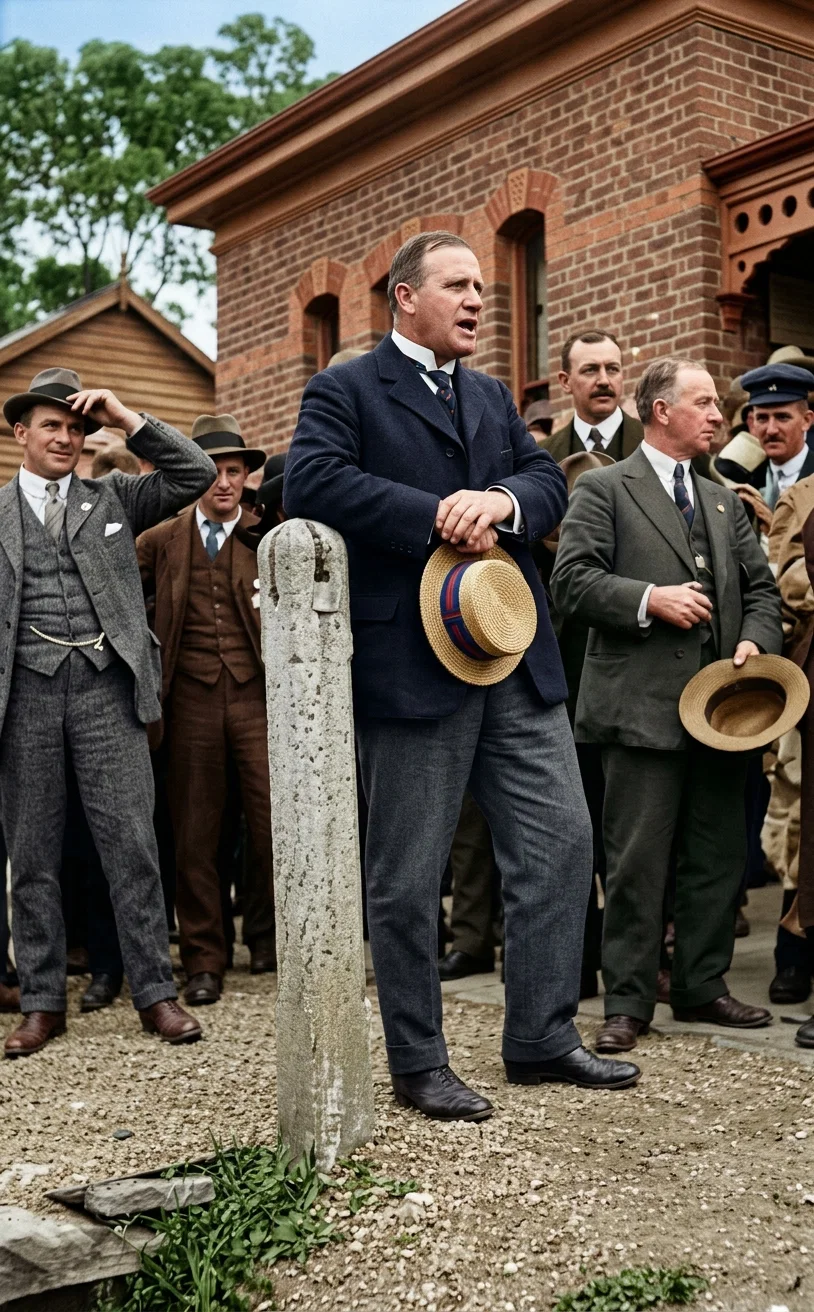
Pathe, Photo. THE PREMIER OF VICTORIA (MR. LAWSON)
SPEAKING AT LORNE
All through the wreckage of the late combat, may be found a sinister aftermath of joy-consuming hatred, an intense and uncompromising antipathy of one race or nation against another, and this of the no-quarter-given-or-asked variety that makes one shudder. And this hatred does not die with the dawn of peace, though it may find less opportunity for expression.
Practically all the different races commingled in the great struggle, and had a chance to size each other up. The backward and subject races saw the weak points of the more progressive and dominant races, and went home to spread the news. Distinctions that have always been made, favouring more civilised peoples and detrimental to less civilised ones, were made more evident by the close contact of millions of every sort of men in the long-drawn-out conflict. War in itself is a most uncivilised affair anyway, as those who have been in it are the quickest to testify; and in the great issues which it was used to decide, the less advanced races could not but compare themselves favourably with the more advanced, and therefore feel dissatisfied with the rewards which the sacrifice brought to them. This consciousness of equality—or superiority—made itself felt in numerous race riots afterward.346
Again, there grew up a most unnatural hatred against every individual on the side of the enemy, as if it were impossible that a good German, or a good Frenchman, or a good Englishman, as the case might be, could exist; as if goodness or badness inhered in nations as such. This feeling was by no means universal, but it was surprisingly wide-spread. Among peoples so compact and interwoven in mutual interests that all must be neighbours, even though not neighbourly, nothing could be a greater breeder of misunderstandings and future disturbances than this.
Ranking of Injustice
When the Paris Peace Congress met, every national government sent its delegates to make claims in the settlement of boundaries and rights. These claims ranged from the legitimate to the preposterous, from the hopeful to the hopeless. Not all of them could be met in a way satisfactory to the claimants, especially since, in many cases, several nations wanted the same territory. No doubt the peacemakers did the best they could; but as they were men, and dealing with men, some injustice, or fancied injustice, was done. And injustice, whether real or visionary, rankles. It continues to rankle. Nations never forget the invasion of their rights, and only await the opportunity to retrieve.
The small ones especially feel this injustice; and it is usually by smaller States, or their troubles, that great wars are begun. In history, the typical contest is that of little brothers getting into a fight, and the big brothers joining the conflict with the ostensible purpose of helping the little ones.
The war has left in the hearts of millions of people who feel that they got the worst of it, the surging desire to “get even.” As long as this hope remains in the hearts of a considerable number of people, peace is jeopardised every hour. And the history of the last century proves that such a desire does not pass away with the years, but may be willed to the children of the originators with added intensity. Peace can come only when every one feels that he is “even.” But there is only one way to “get even”; and for some reason, that way was not taken at the Peace Conference.
In spite of the national and race antipathies engendered, it is remarkable with what success class solidarity has developed; for class distinctions cut directly across those of race and nation. The advance wave of the class spirit is seen in Russia at the present time. Whether we say that the Soviet Government of Lenine and Trotzky is simply applied socialism or not, the extreme socialists of every nation are strongly advocating recognition of the Bolsheviks of Russia.
With their enemies beaten back and fast becoming discouraged because the great Powers have decided to let Russian Bolshevism work itself down or up in its own way, the Soviet Government seems in a fair way to become established and fairly stable. But this experiment in class rule, while it desires to be let alone just now to develop its scheme of government, is very far from the intention of letting others alone. It plans to spread Bolshevism all over the earth, by force of arms if necessary. There is a bare possibility that the ideas and ideals of the Bolsheviks are misunderstood by the rest of us. But it is very evident, as far as outward appearances go, that the majority is at present opposed to them with a flame of intensity that needs no fanning. Considering the fanaticism and determination—and withal the success so far—of the Soviets in converting others to their views, and the strong opposition of those outside of central Russia, I ask, Is Bolshevism tending to “follow after the things that make for peace”?
As to the desperate methods of these millions of men inspired with class hatred, E. T. Colton reports in Association Men, December, 1919, a conversation with one of their leaders:—
“He looked at me in a pitying sort of way, and said: ‘Mr. Colton, you have missed the whole point. There can be no compromise. This is war. No class has ever risen above self interest, and none ever will. When the other group were in power in Russia, they did not think of the workers; and now that the workers are in power they govern for themselves. We will either win it all or we will lose it all. We will either be exterminated or we will exterminate.’”
This is the war to the knife which we face in the growth of Bolshevism.
It is a notable fact that those most active in promoting peace and a league of nations are most apprehensive of another call to arms. With whatever visions peace commissioners went to the congress, they347saw something there that was far from reassuring, as is shown by what they did when they came home—not by what they said, but by what they did. What shall we think when the hearts of statesmen, who come the nearest to seeing the condition of the world as it is, fail them for fear, even in the midst of negotiations? At the peace table, there was a sincere proposal to bring about “universal reduction of armaments,” and this is involved in the treaty that was signed; yet the governments concerned continue to make preparations for future hostilities. Military and naval programmes for years to come give the lie to peace talk, and sow universal distrust.
The “peace” footing of the armies of the several greater countries is far beyond what it was before the last internecine grapple, which, according to the sanguine advocates of immediate and everlasting peace, is never to be repeated. But the most influential of the peace-desiring nations find it hard to get the world to trust them when they do not trust themselves.
The stanch proposers of compulsory military training are on every hand. Already the State of New York has taken the lead, and her young men must spend some time learning to fight. As other States follow, we wonder about dreams of peace. But we are assured that this preparedness is simply preventive. Because the boys are made better men, at least physically, it is declared to be a good thing for the country. But no mention is made of the numerous insidious temptations and dangers that haunt camp and barrack life.
“Prepare for war, and you get war,” says General Sir Frederick Maurice, former director of military operations of Britain. Or as Marshal Foch is quoted as saying: “War has ceased to be an art, and has become a science and an industry. As such, it can be evolved infinitely.”
Hand in hand with the development of industry will go preparations for war. No war ever ended wars, and no preparation for it will ever prevent one. History blazons the fact that the nations most active in preparation were most active in provocation. And wisdom cries that just in proportion as a man learns to do an act and do it well, just in that proportion will he be anxious to try his power and skill at that act.
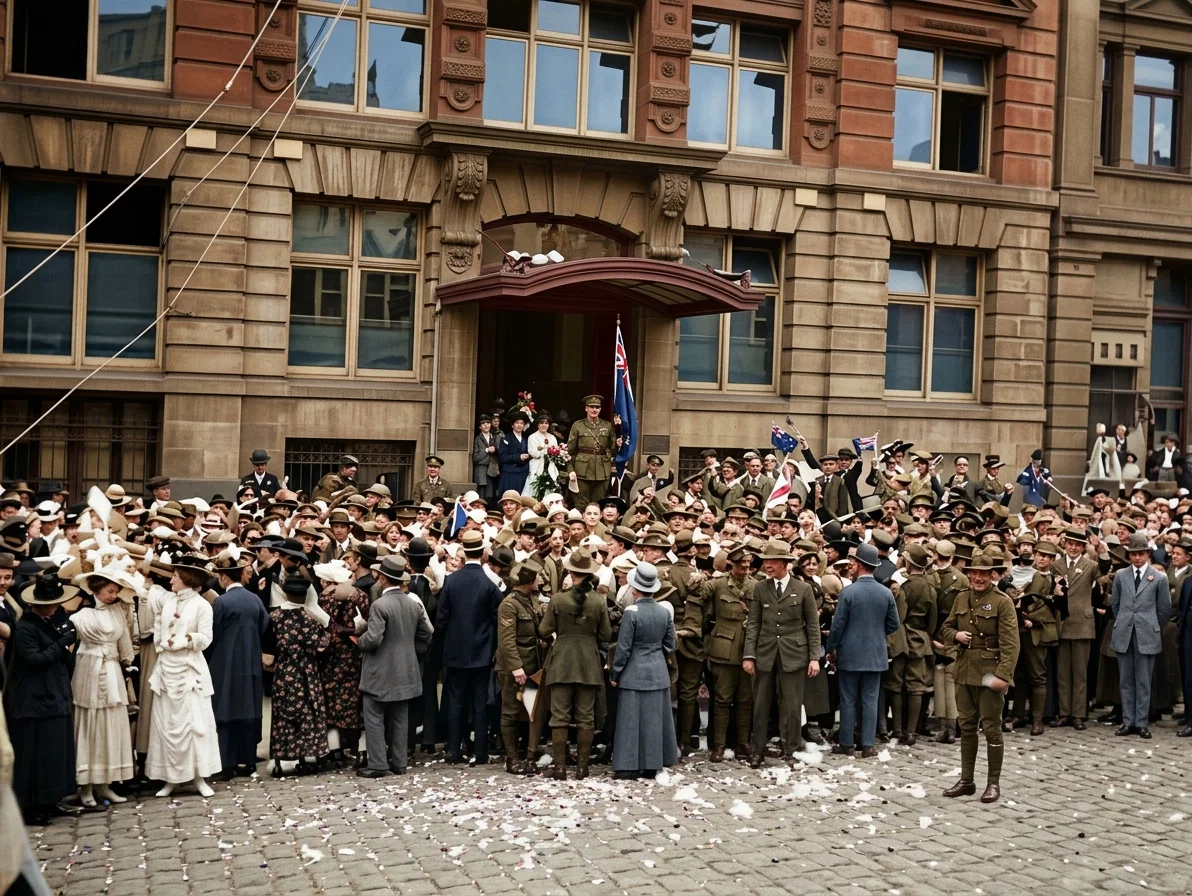
Pathe Photo.
CELEBRATING THE ARRIVAL OF THE LAST BATCH OF A.I.F.
RETURNED MEN AT MELBOURNE
What revolutionary changes five history-making years will bring! It is significant that in the four counts mentioned,—namely, race and national hatred, injustice real or fancied, class strife, and readiness for further conflict,—there are infinitely more indications of cause for future bloodshed than there were along the same lines early in 1914. And facts and present tendencies do not lead us to place faith in the explanation that the unsettled conditions we see are simply reactions, and that soon the world will stop swinging to extremes and will settle down to “wag” as formerly. No; the nations have learned the game, have perfected it to a science, and there seems to be a determination on the part of many to make no promise not to play it again in case of a serious dispute.
In view of the glaring signs that multiply about us, it is evident that peace for the near future exists only in the want-to-have-it-so of foolish optimists who close their eyes to the facts and to the prophecies of348God’s Word, and take the wish for the deed. There is only one remedy; and that is not civilisation, education, social and financial equality, or every man possessing his rights, although all these make for peace. The cure is the plain, simple religion of Jesus Christ in every man’s heart; and this condition is impossible until sin is exterminated and its author destroyed.
We may look, therefore, for “new heavens and a new earth”—a conception unknown to the popular mind, yet strictly according to Bible prophecy. Not an earth made new by the throes of a thousand years of revolutions and reforms, but one renewed by the utter and immediate destruction of everything that is wicked. Not a world repaired by evolution, but a world renovated by demolition and re-creation. Not a reformation, but a transformation. This is the real hope of peace, that “maketh not ashamed,” for it is not man-conceived, and will be realised. The citizens who will inherit that super-Utopia of which the half has not been told, are being transformed in character by a process similar to that which will renew the world—the redemptive power of Jesus Christ.
When We Know God
If we consent, He will so identify Himself with our thoughts and aims, so blend our hearts and minds into conformity to His will, that when obeying Him we shall be but carrying out our own impulses. The will, refined and sanctified, will find its highest delight in doing His service. When we know God as it is our privilege to know Him, our life will be a life of continual obedience. Through an appreciation of the character of Christ, through communion with God, sin will become hateful to us.
As Christ lived the law in humanity, so we may do if we will take hold of the Strong for strength. But we are not to place the responsibility of our duty upon others, and wait for them to tell us what to do. We cannot depend for counsel upon humanity. The Lord will teach us our duty just as willingly as He will teach somebody else. If we come to Him in faith, He WILL SPEAK His mysteries to us personally. Our hearts will often burn within us as One draws nigh to commune with us as He did with Enoch. Those who decide to do nothing in any line that will displease God, will know, after presenting their case before Him, just what course to pursue. And they will receive not only wisdom, but strength. Power for obedience, for service, will be imparted to them, as Christ has promised. Whatever was given to Christ,—the “all things” to supply the need of fallen man,—was given to Him as the head and representative of humanity. And “whatsoever we ask, we receive of Him, because we keep His commandments, and do those things that are pleasing in His sight.”—“The Desire of Ages, page 668.”
A Diviner Gift
A JAPANESE mother asked the head of one of our mission schools for girls, if only beautiful girls were admitted. “Oh, no,” the missionary answered, “we take any girls who desire to come.” “But,” protested the mother, “all your girls that I have seen are very beautiful.” The teacher answered, “We tell them of Christ, and seek to have them take Him into their hearts, and this makes their faces lovely.” The mother said, “Well, I do not want my daughter to become a Christian, but I am glad to send her to your school to get that look on her face.”
People everywhere are as short-sighted as this far-away mother of Japan. All people, pretty much, will join in the glad festivities of “Merry Christmas,” and yet the majority do not want Christ in their lives, any more than this pagan mother wanted her daughter to become a Christian. Like her, they simply do not see. They eagerly join the celebration of the birth of Christ without seeing it is Christ Himself who makes possible their gladness, and whose perfect service would bless them forever. If they could only see! Who, then, but would ask for the diviner Gift of Christ Himself?—Christian Advocate.
Reform Yourself Before Censuring Others
“THOSE are the best Christians who are more careful to reform themselves than to censure others.”
The Riches of Christ’s Poverty
“For ye know the grace of our Lord Jesus Christ, that, though He was rich, yet for your sakes He became poor, that ye through His poverty might be rich.”
Filming African Wildlife Expedition
ONE of the most ambitious moving picture enterprises ever undertaken recently landed at Cape Town to take the long trail northward. It is wholly in command of the veteran naturalist-explorer, Edmund Heller, who represents the Smithsonian Institution’s interest in the animal collections to be made. Possibly the party is at this moment in the throes of an effort to get “the last films of the elephants of the Addo Bush Forest Reserve,” before that troublesome herd is blotted out by the pressure of civilisation. The filming expedition will work its way northward through Rhodesia, where comparatively little big game now remains, it will take the Falls of the Zambesi, the game of Nyassaland, and it will break new ground in what once was German East Africa there lies a bewildering maze of opportunities, and we may be sure that Mr. Heller will choose the best ones. Beyond doubt the expedition will secure great pictures and a great collection of animal specimens for the United States National Museum.
Silver Coins Disappear in Germany
SILVER coins have now entirely disappeared from circulation in Germany owing to the extraordinary rise in the price of silver.
Weighing the Earth
“A STANDARD experiment which deserves to be carried out more frequently than seems customary is that of weighing the earth. The fact is, the earth weighs something like 6,000,000,000,000,000,000,000 tons; as the scientist would put it, 6 x 10²¹ tons; or in more ordinary language, six thousand-million-million-million tons. Nor is it such a great trick to find this figure with the apparatus that we are able to bring to bear upon the problem,” says the Scientific American.
Spiders Disrupt Telegraph Lines
SPIDERS are responsible for quite a number of troubles on the telegraph lines in Argentine Republic and Brazil. The ground spider spins a heavy web which the wind wraps around the wires in great masses, and when these become damp, short circuits are formed. Trouble men are obliged to follow the wires across the country and remove the webs. Of course, the spiders that grow in South America are not the small and harmless insects to which we are accustomed.
Inflatable Pontoons for Salvaging Ships
VERY successful results have been obtained in salvaging sunk and mined vessels “somewhere” up North, by means of a new device, the property of Vickers and Co. It consists of light, inflatable pontoons, each capable of raising a certain weight, but which have the advantage of being very strong, capable of standing heavy strain and much wear. Last but not least, they can be packed up in a small space, and carried about in the salvage vessels when not in use, which are then free to cruise about wherever they are needed, without heavy, cumbersome machinery. The weight these pontoons have been found capable of raising leads the designers and owners to hope that in the near future they may be able to raise the Lusitania. In this case pontoons, each capable of raising five hundred tons, will be required, a result which, in view of the recent operations referred to, is not beyond the bounds of possibility.
An Elephant’s Toothache
JULIE is one of the huge pachyderms that perform daily for the edification of the audiences at New York’s Hippodrome. Some time ago Julie went down with the toothache. The management was at first inclined to let the offending molar take the natural course; but Julie was so perturbed about it that this was out of the question. For weeks she made day and night hideous with her cries: and when at length in her frenzied rocking she began to threaten the safety of the floor, it was found necessary to do something about the tooth. Filling an elephant’s tooth, however, is not a job for the ordinary tooth-doctor; it resembles rather the operation with concrete and steel bars upon a big tree. The animal dentist who was called in to deal with Julie’s affliction found that her cavity would require fourteen ounces of filling! A photograph in the Scientific American shows the process of driving the filling home, and makes it clear that a crowbar is an essential feature of the zoologist’s dental equipment.
The Bodensee’s Commercial Service
OUT of Germany comes an interesting report on the operation of the dirigible Bodensee, which has been in regular commercial service for some time past, conveying to a credulous world the impression that the day of the passenger-carrying dirigible is here. Practical commercial dirigibles may be an immediate possibility, but for the time being they exist in the form of blueprints and lengthy specifications. That, in brief, is the new impression conveyed by a review of what the Bodensee has done. During the first month’s service, or from August 24 to September 23 last, the good airship Bodensee carried 1,300 persons in 30 voyages of 208 hours’ duration, thereby covering a distance of 20,000 kilometers (12,000 miles) without any incidents.
But subsequent service, especially during the windy days of autumn, did not prove quite so smooth. The Bodensee on a voyage from Friedrichshafen arrived at the airdrome near Berlin at 6:30 p.m. on November 2. About thirty persons were in the airship. The wind was very strong, no order was given for landing the vessel, and the crowd who were holding the landing ropes appeared to be friends of the passengers aboard the airship, with the exception of some half-dozen officials. The Bodensee nose-dived five times, and bumped the ground three. One of the people on the ground was killed and five were injured. The Zeppelin then ascended, the lights went out, and she vanished. When the airship had been held down the passengers were able to speak to their friends on the ground. One lady was heard to tell her husband that they had had a very bad voyage, and that she would never undertake it again. The Hamburg-Amerika Line afterwards issued the information that the vessel was safe, and came down in the Harz mountains. All the passengers were saved. The ship was not seriously damaged, and will return under its own power.
All of which points out the weakness of present dirigibles when operating in windy weather, such as prevails through at least half the year in most countries. With larger airships equipped with more power, together with the use of the mooring tower, it will be possible, no doubt, to operate in gusty winds with a minimum of danger.—Scientific American.
Our Grass Rug and—Other Things
By Elizabeth Price
Elizabeth Price
OUR house isn’t so very nice. We own it, of course, and that is a great deal, as mother has often reminded us when we grumbled. But we girls always thought there were some drawbacks even to that, because we couldn’t ask a landlord for new paper or fresh paint, and as for us—we never had money to spare for such superfluities.
There are only four of us,—mother and Jack, Rose and me. We children have been busy all our lives trying to get educated, so we could keep mother in luxury after a while. In the meantime she had done with bare necessities, for the means that father had left wasn’t enough to take any liberty with. Mother has things spick and span. No palace could be more beautifully kept than our home, but the furnishing is nothing whatever to boast of. Our room was almost the worst of all, with its odds and ends of things. “Other girls have silver-backed hair-brushes!” wailed Rose one night, regarding her old one with a scornful glance.
“Yes, and chairs that don’t tip one over,” I added, as I managed to save myself from a fall.
“Isn’t it horrid to be poor, Meta?” said Rose.
“It’s no joke.” I was very grim because I had bruised my hand on the rickety chair, and tomorrow was music-lesson day, as I remembered.
It was then and there that we rebelled. Not so that mother could hear us—we weren’t mean enough for that! She’d have been only too glad to help matters if she could. So we had our indignation meeting by our two selves. We said we’d had enough of old furniture and cheap sash curtains, and we decided it was time to act.
Having reached this decision, we proceeded to carry it out, and we surprised ourselves with the speed of our achievements. My hope lay in music, Rose’s in arithmetic. I trailed around the neighbourhood next day looking for scholars, and Rose betook herself straight down to the Cowans, who had been hunting for a “coach” for their twins. We had discussed the Cowan possibility some time before, but Rose declared then that she couldn’t spare a minute from the demands of her studies, while I knew it would keep me busy to be graduated on schedule time without doing anything outside.
It makes a difference when you get interested in something for yourself. As soon as ever we girls viewed these occupations in the light of furnishings for our room, we felt sure we could squeeze them in—and we did. I got six beginners, and Rose captured the Cowans root and branch—four instead of two; for it seemed they were not proficient in mathematical pursuits, and their mother was delighted to get them off her distracted hands. All our friends know that Rose adores sums and problems, and she didn’t need any other recommendation.
Well, we did it! It wasn’t easy, either. If my half-dozen aspirants for fame escaped shaking till their teeth chattered, it wasn’t because I didn’t ache to administer it. And Rose feared her hair would be white before the end of the term. You see, when there’s a certain amount of housework you feel obliged to do, and when your studies fairly clamour for attention the rest of the time, it sets your nerves all awry to keep the tempo for clumsy fingers that go just half as fast as they should; or to teach over and over again that four times five are always twenty.
But I suppose all these trials helped us to appreciate our possessions when we did get them. They were just as sweet and dainty as we had hoped. We got two single beds—white enamel with brass trimmings—and a pretty mirror in a neat frame. Our old dressing table looked like new with fresh drapery, and there were full-length curtains to match. Two cunning white rockers, two other chairs, and a little round stand made us feel simply blissful. We painted our book-shelves with white enamel paint, and did our woodwork ourselves. Jack painted the floor a soft grey that would blend with anything, and after it was dry we laid on it one of our chief treasures. It was a grass rug in two shades of green, with a stencilled border and a general air of elegance that almost overpowered us. It was large enough35almost to cover the floor, and we stencilled green borders on our curtains and drapery in the same Grecian pattern.
It seemed too good to be true, as we stood in the door and viewed the landscape o’er after we had it done. “It isn’t often that our dreams come true,” sighed Rose.
“But this one has,” I assured her.
She nodded happily. “Yes, and it’s just as nice as we thought it would be!”
“Won’t it do our hearts good to ‘give notice,’ as the cooks say?”
“I can hardly wait to tell those awful Cowans that they may get along as best they can. I’m so tired of them, Meta!”
“I know you are. I wouldn’t mind the music so much if I had time. But it’s dreadful when your own studies drag like millstones about your neck. I’m not so clever at learning as you are, Rose. I have to work for what I get. So I shall tell them, next Tuesday, that I’ve decided not to teach any more till school’s out.”
Jack stopped on his way down the hall to look over our shoulders. “Huh!” he said, if you know what that means.
“Doesn’t it look lovely?” asked Rose, her face all full of dimples. Rose is as pretty as a picture, anyway, and when she smiles, you can’t help smiling back. Jack patted her cheek, and said, “It certainly does,” and then he passed on abruptly.
“Something doesn’t suit him,” I declared as he shut his room door behind him. “I can’t imagine what it is, and it’s of no earthly use to ask him.” It wouldn’t have been. You can’t worm a thing out of that boy till he gets ready to tell.
Mother came up the stairs just then waving a note in her hand. “It’s from Helen Hunt!” she announced joyfully. “She is going to spend a day and a night with us next week on her way to Grovesport. I shall be so glad to see her.” Mrs. Hunt and mother have been friends more years than Rose and I have lived, and they very seldom meet any more. So we girls were almost as glad as mother was, because that dear woman doesn’t have as many pleasures as she deserves.
After we went to bed that night, we planned the surprise. The visitor should have our lovely new nest, and we’d go and camp in the shabby old guest-room. We knew it would please mother, for she hadn’t352had so pretty a place to entertain Mrs. Hunt in for many years. It did please her, too, so much that she almost cried, and she hugged us and thanked us till we felt very happy and self-satisfied. Jack was standing by, and he said “Huh!” again in that same queer tone. Then mother turned and hugged him, and Rose and I said to each other how strange it was that Jack should be jealous of his own sisters.
(Continued on page 352)
(Continued from page 351)
(Concluded next issue)
CAN YOU TELL?
WHAT will be the ultimate destiny of the world and the human family? Will wars, famine, pestilence, and disease always prey upon the human species? ¶ Will science conquer disease? ¶ Will the sun finally “cool off” with the result that “our world will eventually become a dead sphere”?
These questions are taken from the introduction to one of our latest books entitled
The World's Destiny
With a positiveness born of knowledge, this book, by logical reasoning and the use of Bible texts, proves that our world is to be “the centre of the universe.”
Chapter Headings: Revelation and Nature—The Earth to be Peopled—Replenishing the Earth—God's Purpose Unchangeable—Two Great Commissions—Foreordination Explained—A Great Pre-Advent Message—Heavenly Guidance—The Triumph of the Cross—Our World the Centre of the Universe.
95 pages, illustrated, with a most striking cover design printed in colours. Price 1/4 (postage 1/2 extra)
Signs Publishing Company, Warburton, Victoria
OUR GENERAL AGENTS
Victoria Tract Society, 22 Stanley Street, Richmond, Victoria
Tasmania Tract Society, Franklin Chambers, Macquarie Street, Hobart, Tasmania
N.S.W. Tract Society, The Boulevarde, Strathfield, New South Wales
Queensland Tract Society, cor. Peel & Gray Sts., S. Brisbane
South Australian Tract Society, 116 Grote Street, Adelaide
West Australian Tract Society, 46 Hay Street, Subiaco.
North N.Z. Tract Society, 84 Jervois Rd., Auckland, N.Z.
South N.Z. Tract Society, 902 Colombo St, Christchurch, N.Z.
Mission Opened at Aurangabad
As the result of some literature distributed at a railway station in India by a native colporteur, three Europeans and a considerable number of Indians have accepted the message, and a new mission station is being opened in this locality at Aurangabad. Thus does God honour the work of the humble and faithful colporteur.
Gospel Literature in the Marquesas Islands
PASTOR G. L. STERLING, who is doing pioneering work in the Marquesas Islands, has begun printing the literature of the third angel’s message in that language. He writes: “The language of the different islands of this group varies much, though I am informed that the Nukuhivan, in which the leaflets [which he sends with his letter] are printed, can be read throughout the group. The truth of God is thus proclaimed in a new tongue, and to a people who have been sitting in the darkness.”
Christian Books and Magazines in Korea
ALL kinds of devotional, biographical, and theological books, commentaries, books on Sunday-school organisation, and magazines are in demand at present in Korea. In the hope of supplying this demand, more than thirty small Christian book stores have been opened in various parts of the country, entirely aside from the regular mission book rooms.
Another comparatively recent development has been the launching of two Christian magazines, the Theological Review, a quarterly, and the Bible Magazine, bi-monthly.
The Christian Village of Chausubara
THE Christian village of Chausubara in Hyuga stands out as a shining example of what Jesus of Nazareth taught and lived. The Okayama Orphan Asylum is located there and its 270 cho of land is divided into nine plots each with a cottage, house-mother and family of twelve or thirteen children. There is primary school on week days and Sunday-school on Sundays. There are the homes of those connected with the work—the teachers and others in charge of the institution; and in addition to these are thirty homes of the Asylum graduates, in most cases both the young father and mother having been trained in the Orphan Asylum. They earned their little piece of land and were helped to build their home, adding to land and buildings as time went on. The police stationed in this village found theirs a superfluous job and were transferred elsewhere. The village is known for miles around for its high ideals.—Japan Evangelist.