Your ShelfYour Projects

Review and Herald, Vol. 86, No. 42.

“Liberty” for the Fourth Quarter of 1909

Review and Herald

Oct 21, 1909

Review and Herald Publishing Association · Takoma Park Station, Washington, D. C. · Oct 21, 1909

“Liberty” for the Fourth Quarter of 1909
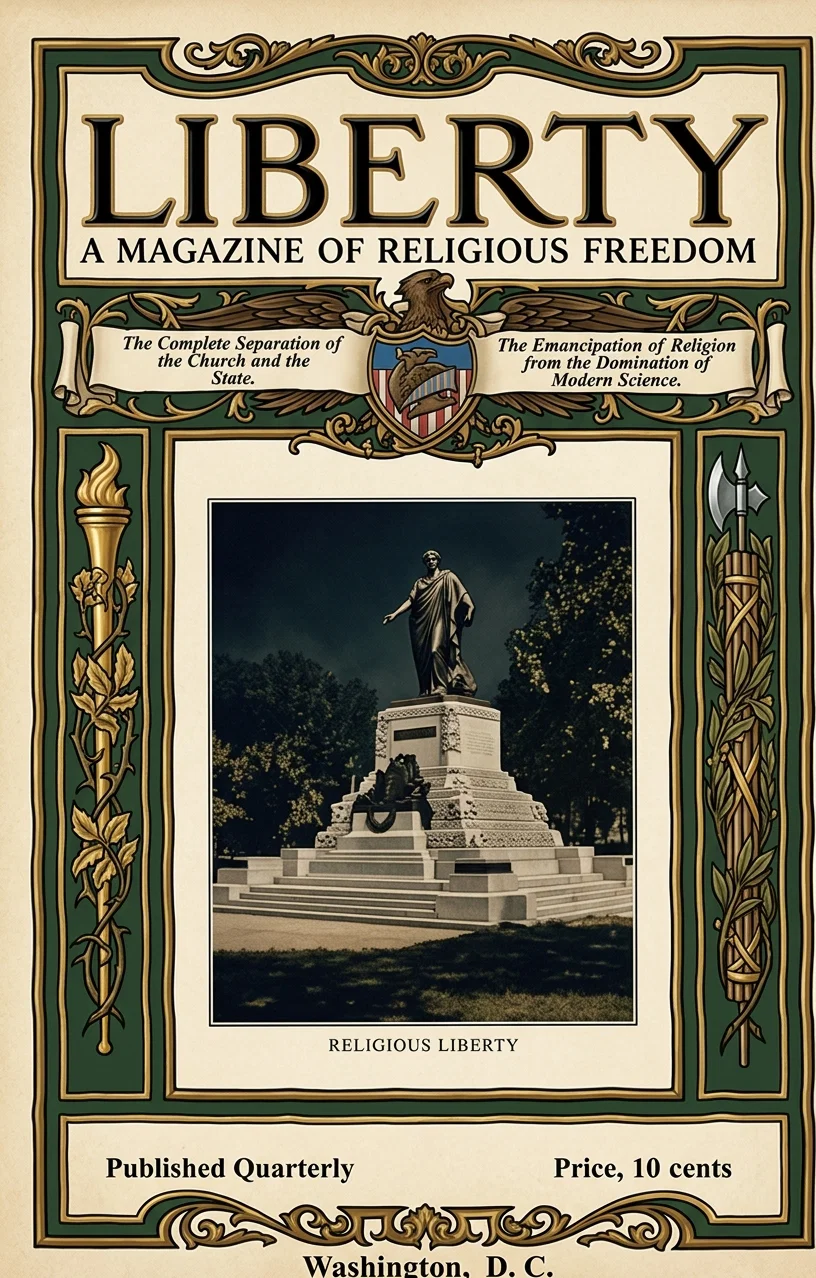
Liberty for the fourth quarter of 1909 is now ready to be mailed. It sparkles with many of the gems of religious liberty principles, involved in the discussion of the following topics composing its contents:—
EDITORIAL: The Golden Rule, or Rule Alone? — Will Italy Follow France? — An Important Lesson — Our Guaranty of Liberty — A Startling Comparison — An Imperial Sunday Alliance — A Great Truth in Few Words — How to Argue With a Protestant — Worthy of Emulation — The Crime of Crimes — America’s Ambassador and Sunday Racing — How National Reform Principles Work in Russia — The National Reform Idea in Korea — The Better Support.
CONTRIBUTED ARTICLES: Church and State in Modern Greece — Baneful Fruit of State Religion — Undermining the Foundations of American Liberty, No. 1 — Compulsion or Transformation — Against the Government — The Model Sunday Law — On Trial for Picking Strawberries on Sunday — A Righteous Decision — The Civil Sabbath Fallacy — Religious Liberty Principles Before the Inquisition — The Fall of the Church — Constitutional and Statutory Contrarieties and Contradictions — No Cause for Unbelief.
RELIGION AND SCIENCE: A Fatal Weakness in the Argument for Evolution — Science and Religion — Science and the Creator — Modern Skepticism.
TEMPERANCE: Liberty in Prohibition — A Saloonless State — A Mocker and a Waster.

Prices

Single copies, 10 cents; 5 to 20 copies, 5 cents each; 25 to 400 copies, 4 cents; 500 to 800 copies, 3½ cents; 1,000 or more, 3 cents.

Appreciation of the “Instructor”

MRS. CARRIE R. KING, in a recent letter to the editor of the Instructor, says: “Somewhere, not long ago, I read a sentiment something like this: ‘If you have a pleasant thought about a person, tell it now, and not wait to repeat it over his grave.’ I resolved to act upon the suggestion hereafter, and almost immediately followed the thought: ‘You’d better begin right now by telling the editor of the Instructor how you appreciate the paper.’”
“Really, if you could know all the good things I have thought about it, and said, too, you would know that I consider it most valuable reading for every member of the family, old and young. I think it is growing better all the time. The Temperance number, and the temperance items that have appeared from time to time, I consider the very best collection of such articles I have ever seen, and I have used a good many of them. I wish every young man and woman in the land could read them.”

THE WORK — AND — THE WORKERS

Some Valuable Books
ORDERS for “Christ in Song” are received in almost every mail. About five hundred copies were shipped by the Review and Herald Publishing Association the last week. Its being a large collection of songs upon many different subjects makes it a very popular book. Choice selections can be found upon almost any Bible subject. Prices: cloth binding, 60 cents; half morocco, $1; full Turkey morocco, gilt edges, $2.50.

The Lover’s Love; or John 3:16

“THE LOVER’S LOVE; OR JOHN 3:16.”—This book will prove a blessing to any who read it. The great theme of God’s love is presented in a beautiful and impressive manner, well calculated to bring forth a response from the heart of the reader. “The love of Christ constraineth us,” said the great apostle. No one can read this book without being deeply impressed with the love of God. A splendid book for both young and old. 176 pages. Cloth binding, 75 cents.

Power for Witnessing

“POWER FOR WITNESSING.”—A few words spoken by the apostle Peter on the day of Pentecost carried conviction to the hearts of his hearers, and thousands were converted. Why?—Because the Holy Ghost was with Peter and gave him power as he witnessed for the Lord Jesus. The same power is needed today. The book “Power for Witnessing” is a very practical teacher of this important subject. Only a few copies left. Order now. 201 pages. Bound in cloth, 75 cents.

The Struggle for Religious Liberty in Virginia

THE history of the struggle for religious freedom in this country should be studied by every individual who prizes liberty to worship God according to the dictates of his own conscience. The efforts being made at the present time by large and influential organizations of men and women once more to shackle the conscience, should awaken and alarm every true American. Shall we repeat the experiences of the past? The book “The Struggle for Religious Liberty in Virginia,” gives the history of the hard-fought battles for liberty in the worship of God in that State, and a clear enunciation of the principles for which they stood. Cloth binding, 272 pages. Price, $1.25.

What Others Say

Mrs. D. A. FRITCH: “The Protestant Magazine is meeting with a hearty reception. It is evidently just the journal that is needed for this time.”

Protestant Magazine Testimonial

W. M. CROTHERS: “I have read the Protestant Magazine from the first, and am convinced that it is the right thing at the right time. Shall solicit subscriptions.”

Life and Health Testimonial

NORMAN STRAWN: “100 copies of Life and Health at hand. Am well pleased with them. It is a clean magazine, and surpasses all preceding numbers. Every one says, ‘What a lovely cover design! contents very interesting.’”

Good Words for “Christian Education”

The following good words for Christian Education from several conference presidents came in after sample copies of the first number had been sent out:—
L. W. TERRY: “I am highly pleased with the magazine, Christian Education, and believe it will play a very important part in the homes of our people who take this publication and read it. The first article, ‘Specific Aims in Education,’ is a splendid one, and should be read by every youth.”
ELDER MORRIS LUKENS: “I consider Christian Education an excellent journal. I think it should be in every Seventh-day Adventist family. Am saying this because I appreciate the journal. I believe it will be a great good, and a source of encouragement to all interested in true Christian education.”
ELDER H. W. HERRELL: “I am very much pleased with Christian Education,—with its size, cover, design, make-up, and best of all, with what it contains. I consider it a fine, all-round educational magazine,—a magazine which should receive a hearty welcome in every home. It should be by every fireside and in the hands of every teacher. I feel confident that Virginia will lend a hand in the support and distribution of such a magazine.”
ELDER A. O. BURRILL: “I received the first number of Christian Education, and have read the first twenty-eight pages. I am very much pleased with its contents. Of course it will, like our other periodicals, grow better. I do not hesitate to say that it should be found in the homes of all our people; yes, and on the tables of all the teachers in this country. To read it is educational and inspiring. I shall do all that I can to place it in the hands of not only our people, but in the hands of teachers in our conference.”
ELDER E. K. SLADE: “Christian Education just reached me to-day. I am free to say that I am very much pleased with this new journal. I have looked it over carefully this evening, and I am happily surprised in finding it so well filled with splendidly prepared articles and decidedly helpful matter for educators. I had had some thoughts in mind as to what Christian Education would be, but I find it far surpasses my expectations in general make-up and true excellence. I believe it will fill a field of great usefulness in our educational work. Will do what I can to have it receive a very general circulation in our conference.”

Editorial

THE divine record is that “Enoch walked with God.” This brings to view a close and blessed companionship. Enoch had come to see the worthlessness of all things earthly. Heaven was his goal. In preparing for that blessed place he sought to cultivate the companionship of those with whom he would there be associated. The conclusion of his earthly experience is recorded in the words, “And he was not; for God took him.”
IT is our privilege to walk with God as did Enoch of old. We may place our hands in his, give to him our confidence, and enjoy his companionship in all life's experience. He will choose for us the path wherein we should walk; he will be our guide the whole journey through. We may safely follow his leadership and walk in his footsteps. Walking with God means an abiding daily communion with him, a constant drinking in of his Spirit, a reaching out to him every moment for divine guidance, humble submission to his will, and faithful obedience to all his requirements. As with Enoch, the result of this communion and the end of our journey will be the heavenly Canaan. There we shall literally look upon his lovely face, bask in the sunshine of his love, and find at his right hand, pleasures forevermore. Let us walk with God here, that we may live with him throughout eternity.

Calling on the Christian’s God

THE son of a chief on the Kongo, that great West African river, was a bitter opposer of the truth. His name was appropriately Nloko, meaning a “curse.” Mr. Henry Richards, of the Banza Manteke Mission, says that this man would often go about the villages where there were Christians, to make disturbance. As a head man over carriers, however, he was much employed by the mission, and as the Christian carriers always had worship and singing on the march, Nloko heard the gospel, oppose it as he might. Of an experience that wrought an entire change in his life, Mr. Richards says:—
Banza Manteke is ten miles south of the Kongo. The river is four miles wide, rapid, and rather dangerous to cross. There was difficulty in getting carriers enough on our side of the river, so Nloko decided to try the other. One day, when he had crossed the Kongo to get carriers, and had failed, he came back to the river, having used up all his cloth, which serves in place of money. He expected to find a canoe man there to take him across. There was no canoe and no man. He called, but could get no answer. The sun was setting, and he thought of the alligators there that carry off many people who go down to the river for water, or to bathe, or to fish. There are also snakes, panthers, leopards, and other wild animals in the country.
The man became greatly frightened, and was hungry, too. What was he to do? As he stood there all alone, the thought came to him: “Those Christians say that God answers prayer. I will pray.” So he prayed and said, “You see how I am situated, God. I am here alone, and don’t know what to do. Those Christians say you hear prayer. Can’t you help me?” He had never prayed before, but when he opened his eyes, the first thing he saw was the canoe man coming toward him. He was greatly rejoiced. The canoe man came along, and Nloko said to him, “I have nothing to pay you.” The man said, “Never mind. Give me the cloth on your shoulders, and I will take you across.” Nloko broke down as he thought of how God had heard his prayer, though he had always been fighting against him, and he began to shed tears. It takes a good deal to make those strong men cry. The canoe man said, “What are you crying for? I will take you across all right.” “O man,” cried Nloko, “it isn’t that; I can’t tell you why I am crying, for you wouldn’t understand.” He could not bear the thought that he had fought so hard against the very God who had heard his prayer, and helped him in his distress.
When he reached the other shore, he started homeward, and on his way he gave his heart to the Lord Jesus Christ, for he had heard the gospel, and knew the way of salvation.—Missionary Review, January, 1900.
He at first found difficulty, as the apostle Paul did, in persuading the Christians that he was really one of them, this man who had been their bitter enemy. But he soon convinced the believers, and Nloko, the curse, was renamed Paul, and his labors as teacher and evangelist were so blessed that he is written down in missionary records as “Paul, the apostle of Banza Manteke.”
W. A. S.

The Spirit of Speculation

THE spirit of speculation is rife in the world to-day. With the multitude it is a struggle for existence, and a strife for gold. How to obtain riches, and how to obtain them the most quickly, is the great absorbing thought in the minds of thousands. Covetousness has developed into idolatry, and men seek to make a prey of their fellows in order to carry forward their own selfish schemes and to accomplish their own evil purposes. Hazardous business enterprises are undertaken. Schemes are evolved which hold out no reasonable promise of ultimate success, and into these schemes the unwary are beguiled.
Of all the people in the world, those who believe this message and are engaged in this movement, should be free from this spirit of wild adventure and speculation. Every Seventh-day Adventist should count that which he possesses as belonging to the Lord. If it be ability to preach, then that ability should be dedicated to the public promulgation of the gospel. If it be ability to sell books, that should find its proper exercise. If it be the power to earn money or acquire wealth in honest and legitimate ways, that gift should be used for God and in behalf of his work.
This movement needs preachers; it needs canvassers to carry its literature; it needs business men and artisans in every trade, each in his place, dedicating his all to God. But it does not need anything in the line of speculators. It does not need men who evolve great schemes to draw money out of our institutions or out of some department of this cause to invest in some speculative enterprise. It has already seen too much of this. Thousands of dollars have been kept from the cause of God and invested in some mining scheme or land deal which has brought the investors no return but disappointed hopes.
This principle is particularly true asapplied to the gospel minister. The minister of the word should be an example to his brethren. “No man that warreth entangleth himself with the affairs of this life; that he may please him who hath chosen him to be a soldier.” For “even so hath the Lord ordained that they which preach the gospel should live of the gospel.” The apostle Paul warns Timothy against the temptations into which men fall through desiring to be rich, and concludes: “For the love of money is the root of all evil: which while some coveted after, they have erred from the faith, and pierced themselves through with many sorrows. BUT THOU, O MAN OF GOD, FLEE THESE THINGS.”
The editor of the Lutheran Standard, in a recent number of that journal, under the heading, “Speculating Ministers,” makes some excellent comments upon the question of gospel workers engaging in speculative enterprises. From his remarks we quote the following:—
When a man meets one of his fellow pastors these days, it is not at all an uncommon thing to have his fellow pastor assail him with an urgent request to invest in this, that, or the other sure-thing, fortune-coining venture. We are asked to take stock in oil lands, in brickyards, in vault manufactories, in pottery concerns, in Texas lands, in insurance companies, in brokerage concerns; and the requests come from ministers,—from men who are supposed to be leading souls away from earthly entanglements toward heavenly things.
It might be argued that ministers’ salaries are so low that they have a perfect right to feel themselves dispensed from the command of Scripture, “They that proclaim the gospel should live of the gospel.” But the argument does not hold. We happen to know that most of the men who have yielded to the desire to make more money than their salary is bringing them are men who have substantial salaries, most of them receiving an income of over a thousand dollars a year in addition to the free use of parsonages. Anyhow, it is not the poor three-hundred-dollar preacher who can afford to “invest,” which usually means “speculate.”
What excuse can a minister offer his conscience, when the ministry is yielding him a fair living, for applying the time which he sorely needs in the preparation of his sermons, in the keeping up of his reading and his studies, in the faithful pastoral care of his flock, to scheming and planning and consulting and weighing and thinking, and maybe by and by worrying, about various kinds of worldly investments? Some ministers are actually borrowing money in order to get in “on the ground floor” of some of these schemes. Some have drawn lawsuits upon themselves.
Will these practises and what they bring with them edify the church? Brother, even if the thing is sinless in itself, is it right for you as a minister of Jesus Christ? Dare you risk bringing reproach upon the church by entangling yourself in secular affairs? Dare you dissipate your spirituality by giving thought and energy to worldly matters? For the sake of the souls of others if not of your own, get this “malaria” out of your system!
Here are a few earnest questions for you to ask yourself: Does my library look as if I had a right to speculate? Is my pulpit work as strong and as brilliant as it might be? Am I as faithful as I should be in my pastoral work? What am I doing in the line of work for conference, and for my synod? What am I doing for the church at large? What influence is my example exerting? When intelligent, thinking outsiders come to my own members and express their disgust, is it not about time for me to do some thinking of my own?
To what extent these remarks apply to ministers of this denomination we can not say. We know that to scores of men, both in the home land and in the foreign fields, who have separated from friends, forsaken home, laid their all upon the altar, and taken their lives in their hands, going forth to give the message to the world, the comparison does not apply. The principles expressed, however, are worthy of careful consideration by every laborer.
When a man is chosen of God and his brethren to bear sacred responsibilities, he should be an example to the flock. It is proper that he should provide a home for his family, but if he devotes his energies to questionable ventures, to speculative enterprises, how can he hope to stand against the spirit of worldliness and covetousness entering in among his members? His influence will count for much. God’s ministers, above all others, should show that they believe the message for the hour. They can not show this by adding farm to farm, by putting forth half-hearted labor for God while their chief interest is in money-making, even in legitimate ways. Nor can they change the influence of their acts by the plea that they are seeking to make money for the cause. So long as they stand forth as the recognized representatives of this movement, they should exemplify its spirit in their lives as well as in their preaching. In no other way can they show men that they believe this generation is to witness the return of the blessed Lord.
While in Rochester, N. Y., Dec. 25, 1856, I was shown some things concerning those who are engaged in the work at the Office, also in regard to ministers whom God has called to labor in word and doctrine. Neither of these should engage in merchandise or traffic. They are called to a more sacred and elevated work, and it would be impossible for them to do justice to the work and still carry on their traffic.—“Testimonies for the Church,” Vol. I, page 585.
While you stand in the position of a herald of truth, a watchman upon the walls of Zion, you can not have your interest interwoven with mining or real estate business, and at the same time do effectually the sacred work committed to your hands. Where the souls of men are at stake, where eternal things are involved, the interest can not safely be divided.—“Testimonies for the Church,” Vol. V, page 530.
Special instruction has been given to me in regard to our ministers. It is not God’s will that they should seek to be rich. They should not engage in worldly enterprises; for this disqualifies them for giving their best powers to spiritual things.—“Testimonies for the Church,” Vol. VII, page 250.
We look with longing hearts for the time of refreshing, the loud cry in its fulness. Let us not forget or fail to realize that the day of power must be preceded by the day of complete consecration. This consecration should possess every worker and every believer in this message. Such a spirit will be a prelude to the mighty outpouring of the Holy Spirit, by which the message shall be carried triumphantly to earth’s remotest bounds, and the work cut short in righteousness. May we all have this spirit of consecration, share in the visitation of the Spirit of power, and triumph with the message in its glorious consummation. F. M. W.

Misrepresenting Christ

If Satan transforms himself into an angel of light to advance the cause of his own kingdom through that transformation, we know that he will also misrepresent the true messengers of light, that through that misrepresentation he may counterwork the purposes of the Almighty.
It is the outworking of such a design that has brought about the mischievous misrepresentation of the gospel of Jesus as seen in the prevalent idea that the kingdom of Christ can be advanced by any kind of political arrangement or human legislation, which we might fittingly denominate the “gospel of force.” In the gospel of Jesus Christ there is freedom and the equality and brotherhood of man. It is not so with that misrepresentation of the gospel. Each is the antipode of the other, in purpose, in the process by which it accomplishes its object, and in the object itself, when the program has been worked out.
Jesus refused to sit in judgment or condemnation upon those who, having heard his words, still did not believe. But the “gospel of force” judges, condemns, and executes. The gospel of Jesus Christ teaches, invites, convinces, and wins men, in order that eternal life may be bestowed upon them. The “gospel of force” beats down, compels, drives, browbeats, and even kills some, in order that its eminence may be recognized by those who remain, its greatness be acknowledged by men, even at the expense of the lives of some of the men. And that has been done even in our own day. It will be done in the future more than it is to-day; for the “gospel of force,” and government without “the consent of the governed” (that is, government by force), are the chief supporters of that phase ofprogress which dominates the so-called Christian nations of to-day.
In the imperial nations which call themselves Christian this dogma of force is the chief tenet in the creed of national progress; and in the republics which also call themselves Christian there is a continued and growing aping of that imperial program. It is not confined to one empire nor to one republic; and the principle is the same wherever found. Even men recognized in the church of Christ as Christian leaders have approved of war upon heathen countries by “Christian” countries as a precursor of missionary work among the people of the conquered country. The cruel and unchristian injustice of such a program seems never to have arrested the attention of such teachers. Christ has never authorized the use of the sword in opening a way to the hearts of the people. The idea of going to a heathen people with “the sword in one hand and the Bible in the other” is a pagan idea, even though proposed by one calling himself Christian. In the pagan mind religion and the sword are closely associated, and it has not been an uncommon thing for one heathen nation to conquer another, and then force the conquered nation to worship the gods of the conquerors. The “gospel of force,” the “gospel of powder and ball,” the gospel of “the sword in one hand and the Bible in the other,” is based upon the same idea. The principle of the Christian religion is, “Choose you this day whom ye will serve.” It is a matter of free choice. The principle underlying that false system, that system of force in religious things, is, Choose the religion we bring, or feel the fury of the sword.
Between that latter principle and the underlying principle of the gospel of Christ there is a great gulf fixed which no man can bridge. On the one side of that gulf is the throne of everlasting love; on the other side is the throne of the arbitrary despot, on which sits Lucifer, the fallen light-bearer. His church is the church of force; his ministers, the warriors who carry “the Bible in one hand” and the implements of death and destruction in the other. But God, who has warned men against an unequal yoking with unbelief, has never yoked himself with the proponents of any such cruel and ghastly policy. He who said, “I am come that they might have life,” never spoke of the human slaughter-weapon of oppression but to condemn its use as an instrument for the advancement of his kingdom.
We have entered upon a time, however, when armies of subjugation go out with the benediction of religious leaders upon them, exponents of the “gospel of force.” A “Christian” emperor, in sending forth his general to a heathen land, commanded him to “smite with the mailed fist.” That is the fist that mangles and bruises. But in the gospel of Christ the fist becomes an open hand, not smiting, but dispensing benefits; not bruising, but binding up whatever bruising has been done; not wielding the sword, but healing the wound the sword has made. That is the business of the true Christian. He has no fist—his hand is always open to relieve the needs and assuage the sorrows of others.
The “gospel of force” not only carries sorrow, misery, and death with it, but is a continual misrepresentation of the cause of Christ in the earth. He who, under the name of Christian, conducts such a campaign or takes part therein, holds the name of Christ and the gospel of Christ up to the derision and hatred of the heathen world, and compels Christ and his cause to bear cruel and unjust reproach. There is no greater enemy of Christ and his cause than he who, professing to be Christ’s representative, pursues a policy of injustice, cruelty, force, and oppression toward those who have not known him. Force and Christianity are as far apart as the east is from the west, as midnight and noonday, as death and life. Church and state united have given us imperial Christianity. We have found it in Russia, Germany, Austria, Norway and Sweden, England, France, Turkey, and Abyssinia. We found it in the conquests of the Moors; we found it in the Dark Ages; and we are finding it in America to-day, creeping in insidiously in the imitation of the ways of other nations.
There is a better way; there is a purer, kinder gospel; there is a King who never does nor will oppress. That way is the way he trod with bleeding feet; that gospel is the gospel of love and brotherhood; and that King is the maker of the heavens and the earth, the Prince of Peace, the everlasting Father, whose home is the habitation of love, whose throne is set in the hearts of those who are his. Into his service oppression never comes, and out of his hand go none of the cruel arrows that wound the hearts of men. Let us enlist in that service of love; let us preach that gospel of peace. Then shall we triumph in that victory that uproots all things that bruise and oppress, and misrepresent the work and purpose of God. C. M. S.

Note and Comment

The New Religion

The new religion which President-Emeritus Eliot of Harvard University has outlined as the religion of the new century, has its basis wholly in human philosophy, rather than in the Word of God. Concerning this religion Dr. Eliot himself says:—
This religion rejects the idea that man is an alien in the world, or a fallen being who is hopelessly wicked.
It will be an all-saints’ religion. It will respect all strong and lovely human beings. It will have no place for metaphysical complexities or for mysteries.
In the new religion there will be no supernatural element. In all its theory and in all its practise it will be completely natural. It will place no reliance on any sort of magic, or miracle, or other violation of, or exception to, the laws of nature.
A religion with no supernatural element must be a religion without divine sanction, one which divinity did not establish. If it is purely natural, it will glorify not divinity, but nature, and the instincts of the human. The religion which is brought to view in the Word of God is supernatural in all its functions and aspects; were it not so, there would be nothing in it which could lift man out of the low things, and implant within him a determined purpose to be like the Author of that religion. “The new religion is to be an all-saints’ religion,” which must mean that all who profess it are saved by their own powers and inherent goodness, for there is to be no work of mediation, no recognition of the need of such a work, no recognition of a savior, no divine condemnation for sin or the unrepentant sinner. For, says the author of this new religion:—
The new religion will magnify and laud God’s love, and will not teach condemnation for the mass of mankind.
According to this there is to be no destruction of the wicked, no inheritance of the saints in glory, no end of the world as taught in the Bible, and therefore no coming of Him who has purchased redemption from sin. In fact, Dr. Eliot himself says that this religion is “in harmony with the great secular movements of modern science.” That makes of it a secular religion, if such a contradictory statement can be permitted even for the purpose of illustration. And thus it becomes not a religion in any sense, but simply a system of human philosophy, antagonistic to the Word of God, and designed by its real author to destroy human faith in the true God, in the mediatorship of the Son of God, and therefore in the salvation of the human soul. For such a religion there is and can be no place in the heart of the true Christian. In truth, it is not a new religion at all, nor even a newphilosophy; for it is as old as the paganism of the ancients. The youngest convert, with a heart glowing with the love of God and the lamp of God shining upon his pathway, ought to be able to see that such a religion is no part of God’s message to men. It is, by its own confession, wholly human in origin, and is therefore necessarily “of the earth, earthy.” Such a religion can light the path of no sin-sick soul, give no comfort in trouble, offer no hope for a life beyond the grave; for all that comes to a ransomed soul in the life beyond must come from and through the supernatural, and “in the new religion there will be no supernatural element.” Its basis of morals will be a human basis only, frail, imperfect, and always subject to change. A religion with no message of God in it has no place in this world, which needs God so much.

God’s Gift and Human Choice

THE love of God was whole-hearted. In giving his Son for man's redemption he gave his dearest and best, and in this gift was included all else. The responsibility of salvation is thrown upon each individual soul. God invites by his Spirit, he exhausts heaven's resources in seeking to bring men to repentance, but he can not consistently with his character force man's will.

He Has Broken

MARY VALIANT NOWLIN
He has broken, and he will bind; He has bruised, and he will heal. God’s ways are hid from finite mind. Still in his presence let me find All, all I need for my heart’s weal.
I do not ask thy hand to stay— Break on, till every cord is riven That clings to idols but of clay. Break on, dear Christ, weep as I may: Take all the toys that earth has given.
O tender hand, O mystic touch, Strong as thy love, and full of peace, Help lest I sorrow over much If my heart’s quick thy hand should touch, And cry unwittingly, Release!
O Christ of God, all that I ask, If every heart-string must be riven, Stay not thy hand, nor quit thy task, Till everything thou dost unmask, Till every cord is bound to heaven.
Takoma Park, D. C.
Continue reading: The Work Before Us***