Your ShelfYour Projects

Signs of the Times, Vol. 24, No. 11.

THE ATONEMENT IN FACT

Signs of the Times

Mar 17, 1898

Pacific Press Publishing Company · Oakland, California · Mar 17, 1898

THE ATONEMENT IN FACT.
THE typical atonement, conducted by the Jewish high priest on the tenth day of the seventh month, was the closing ceremony of the Jewish religious year, and had to do only with the sins of the year just closing. Prospective sins did not come into the account, because they could not. From our last paper on this subject, it was learned that the atonement work consisted of cleansing the sanctuary from sin which had been carried in there through confessions of sinners, and which had made that building unclean in God’s sight. That atonement covered nothing more. If any of the people refused to bring an offering for sins committed, so that they might be conveyed into the sanctuary, where they could be included in the cleansing of the atonement day, the sins still rested on the individuals who committed them, and the cleansing of the sanctuary could not reach their sins to atone for them.
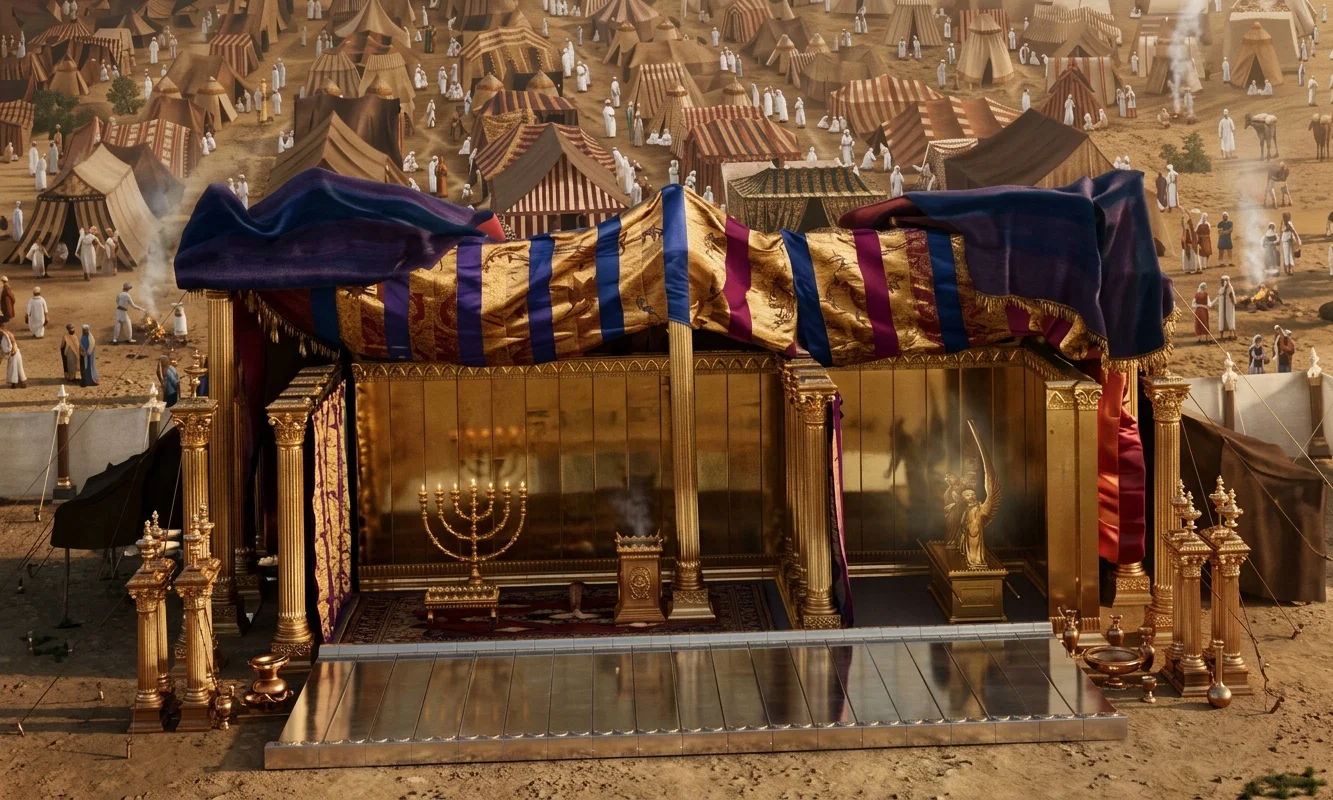
By permission of J. W. Kelchner. The sanctuary of the Lord, with a part of the camp of Israel in the background. One side of the sanctuary is let down, that the Holy and Most Holy Places may be seen. In the first apartment is the Table of Showbread, the seven-branched Golden Candlestick, and the Altar of Incense. In the second apartment, or Most Holy Place, is the Ark of the Covenant, in which were the Tables of the Law, over which was the Mercy-seat, where shone the Shekinah, God's visible Presence. A view of the entire camp and Mount Sinai was given last week.
No compulsion was used to make men give up their sins. If any chose to retain his own sins, they were not borne from the camp by the scapegoat, and the sinner consequently bore his own shame and disgrace, because he refused to be reconciled to the law of God which he had transgressed, which constituted him an open opponent of God’s government.
But the atonement of that time was only typical and shadowy. It was not then possible, any more than now, for the blood of bulls and goats to take away sins. Heb. 10:4. Could this sort of service have relieved the guilty conscience, it would have continued, and the death of Christ would not have been necessary. Those yearly atonements in figure were performed only to keep in mind the fact that the people were sinners, and needed a Saviour. Verses 2, 3. All its services, therefore, but pointed to the real atonement to be completed by the Lord Himself. When the blood of the divine sacrifice was offered on Calvary,—that blood which the Jewish sanctuary substitute foreshadowed,—the typical services of the earthly atonement were no longer necessary. The priesthood in behalf of sin was not to cease, but its service was to be transferred from an earthly, typical sanctuary to a sanctuary not made with hands, eternal in the heavens.
Just prior to His death the Saviour made a most significant statement concerning the temple, the place of the earthly ministrations. Looking upon Jerusalem, the devoted city, from the crest of an adjacent hill, He wept at the thought that the people, who had so scrupulously carried out the typical ceremonies of the temple, had rejected Him, who was the substance of all their shadowy services. Giving further vent to His pent-up sorrow, He cried out, “O Jerusalem, Jerusalem. . . . Behold, your house is left unto you desolate.”
The fulfilment of this saying was soon to follow. When hanging on the cross in His expiring agony, the divine Sufferer closed His eyes in death with the piercing cry, “It is finished.” At that instant, the vail of the temple was “rent in twain from the top to the bottom” (Mark 15:38), indicating that the two apartments of that earthly sanctuary were now both alike abandoned by the symbol of God’s presence, the work in them having been finished. There the typical service ended, and the priesthood passed from the Aaronic to the Melchizedek order, Christ Himself becoming the high priest of His people forever. Heb. 6:20; 7:11–17.
After dwelling at some length in the seventh chapter of Hebrews on various phases of the Levitical priesthood, especially the work of the high priest, the apostle then says, “Now of the things which we have spoken this is the sum: We have such an high priest, who is set on the right hand of the throne of the Majesty in the heavens; a minister of the sanctuary, and of the true tabernacle, which the Lord pitched, and not man.” Heb. 8:1, 2. From this we learn that Christ is the minister and high priest of a sanctuary; not of one made by man, but of one erected by the Lord. This is the true, real tabernacle, of which the Jewish one was but the shadow. But where is that sanctuary? and what is it like? The apostle answers: “For Christ is not entered into the holy places made with hands, which are the figures of the true; but into heaven itself, now to appear in the presence of God for us.” Chapter 9:24.
This reveals the matter clearly. The sanctuary of which Christ is minister, is in heaven. The holy places, that is, the two apartments of the earthly sanctuary, were figures of this true one. This means that the inside arrangement of the earthly sanctuary had the form, shape, or outline of the heavenly. Indeed, we learn that when Moses was commanded to build the earthly tabernacle, God showed him one already in existence, charging him to follow fully its pattern in making the temporary one. Ex. 25:40; 26:30; Acts 7:44; Heb. 8:5.
Comparing type and antitype still further, it must be admitted that, inasmuch as the two apartments of the earthly sanctuary, with their furniture, were made and placed according to the arrangement of the heavenly sanctuary, it is consistent to assume that the services in the earthly apartments, as ordained by God, must correspond to those of the heavenly as nearly as the shadow can represent the substance. Looking at the sanctuary services of the Levitical priesthood as expressive of faith in the atonement work of Christ, we can come fairly to no other conclusion.
Let us review a little. Did the earthly sanctuary have two apartments? So does the heavenly. Heb. 9:24. Did the earthly have a golden altar before which incense was offered? So does the heavenly. Ex. 30:1–10; Rev. 8:3, 4. Did the earthly have an ark, in which was kept God’s testimony of His righteousness,—the law of Ten Commandments? The heavenly shows the same. Ex. 25:10–22; Rev. 11:19. As the earthly sanctuary had service in both apartments, so must the heavenly, in order to be the true heavenly substance of the earthly shadow. As the atonement in figure was performed by a high priest in the most holy place of the typical tabernacle, so the real atonement must also be made by an actual High Priest in the most holy place of the heavenly sanctuary.
The real atonement could not have been completed by Christ while He was on earth, because He could not act as high priest while the Levitical priesthood continued, which was to cease only upon the offering of the divine sacrifice, of which their offerings were the shadow. This fact is plainly stated as follows: “For if He were on earth, He should not be a priest, seeing that there are priests that offer gifts according to the law; who serve unto the example and shadow of heavenly things.” Heb. 8:4, 5. He could not, therefore, become high priest, and as such make an atonement for sin, until the shadow work ceased, and the real work was inaugurated by the death of the true offering for sin.
In fact, the apostle tells us plainly that the way into the “holiest of all,” that is, the heavenly sanctuary, was not made manifest while the first tabernacle was standing. Heb. 9:8. This intimates that at the expiration of the shadowy service in the earthly sanctuary, the real work which that foreshadowed would begin in the heavenly temple. This was to be a “new and living way,” consecrated for men through the body of Christ. Heb. 10:19, 20.
Thus through the sacrifice of Christ a system was established by which the world’s atonement would be accomplished, just as foreshadowed by the priesthood and service of the earthly sanctuary, in all its appointments. But we will look further into this matter in a following article. JOHN ORR.

BIBLE OBJECT LESSONS.

(Concluded.)

The Deluge an Object Lesson.

WHEN, as the result of utter disregard for God’s law, the world became filled with crime and wickedness, the Lord purposed to destroy man from off the face of the earth; true to His nature, God sent Noah, a “preacher of righteousness,” to warn the world of its impending doom. Noah “prepared an ark to the saving of his house; by the which he condemned the world, and became heir of the righteousness which is by faith.” He gave to the world an example of believing just what God says. It was not their multitudes or majorities that were on the side of right any more than it is now. The world was arrayed against God’s justice and His law. The people, then as now, declared that if there were any truth to what Noah said, the men of renown, the wise men, the prudent men, the great men, would understand these matters. But the days of their probation were closing.
We may realize somewhat of how the servant of God made his last solemn appeal to the people, and again they rejected his words. They jested, and scoffed at his words. Suddenly a silence fell upon the mocking throng. Beasts of every description “were seen coming from mountain and forest, and quietly making their way toward the ark. A noise of a rushing wind was heard, and lo, birds were flocking from all directions, . . . and in perfect order they passed into the ark. Animals obeyed the command of God, while men were disobedient.” The storm burst upon a mocking and disobedient world in all of its fury. Above the roar of the tempest was heard the wailing of a people that had despised the authority of God. In that terrible hour they saw that their transgressions of God’s law had caused their ruin. So when God’s judgments shall fall upon the earth before its deluge by fire, the impenitent will know just where and what their sin is, —the despising of His law. The sins that called for vengeance upon the antediluvian world, exist to-day. The fear of God is banished from the hearts of men, and His law is treated with indifference and contempt. As it was in the days of Noah, so shall it be in the days of the Son of man. Multitudes are living in transgression of God’s law, and now God in mercy calls them to obey His commandments.
Many of the children of men think that they can glide along easily and still get into the soon-coming kingdom; but listen to the words of our Saviour: “Not every one that saith unto Me, Lord, Lord, shall enter into the kingdom of heaven; but he that doeth the will of My Father which is in heaven.” And the will of God is declared, in the following inspired words, to be His law. Hear Christ say through the Psalmist, “I delight to do Thy will, O my God; yea, Thy law is within my heart.” Ps. 40:8. Now the one who does the will of God, obeys all of the precepts of His law; and it is necessary to live in disobedience to but one of the commands of that law, to become a law breaker. James 2:10, 11. May all those who profess to be followers of Christ, but are ignoring the binding claims of the fourth commandment, and trampling underfoot God’s holy Sabbath day, realize that God meant exactly what He said when He set apart the definite seventh day of the week, from creation, as holy time, and make the necessary distinction between the sacred and the common, that they may be among those of whom it is said, “Blessed are they that do His commandments, that they may have right to the tree of life, and may enter in through the gates into the city.” Another flood is coming, not a deluge of water, but of fire; “for I have heard from the Lord God of hosts a consumption, determined upon the whole earth.” “Now therefore, be ye not mockers, lest your bands be made strong.” At that time, the shutting of the ark will have its parallel: the door of mercy will be closed, and that closing will be final.

The Destruction of Sodom.

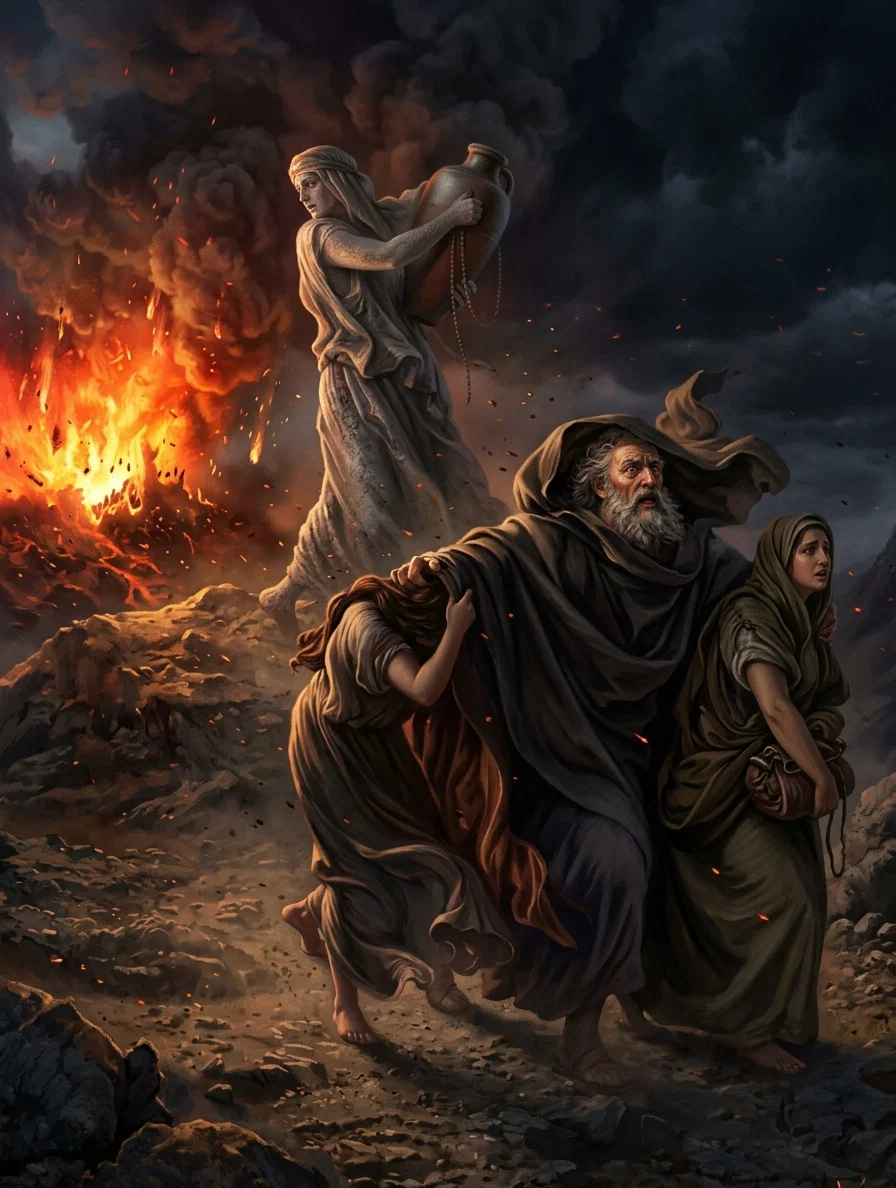
“There came two angels to Sodom at even” (Gen. 19:1), and Lot, the one righteous man in all the city, urged them to accept his hospitality, and thereby “entertained angels unawares.” The people of the place were living in open violation of the law of God, and the luxurious metropolis of the fertile plain was steeped in crime. They had the example of the destruction of the world by the flood, but, urged on by Satan, they heeded it not. The angels said to Lot, “We will destroy this place, because the cry of them is waxen great before the face of the Lord.” Gen. 19:13. They appealed to Lot to call his family out of the wicked city, so that they be not consumed in the general destruction that was so soon to make Sodom a scene of utter desolation; but when Lot, through the mercy of God, conveyed to them the warning, he seemed to them “as one that mocked.” Nevertheless, the last night of Sodom was at hand. Already the clouds of vengeance cast their shadows over the doomed city; but men perceived it not. They “were dreaming of prosperity and pleasure. The last day was like every other that had come and gone. Evening fell upon a scene of loveliness and security.” “And when the morning arose, then the angels hastened Lot, saying, Arise, take thy wife, and thy two daughters, which are here; lest thou be consumed in the iniquity of the city.” “The sun was risen upon the earth when Lot entered into Zoar. Then the Lord rained upon Sodom and upon Gomorrah brimstone and fire from the Lord out of heaven.” “And Abraham got up early in the morning; . . . and he looked toward Sodom and Gomorrah, . . . and beheld, and, lo, the smoke of the country went up as the smoke of a furnace.” Thus the Lord turned these once populous and luxuriant cities “into ashes, . . . making them an ensample unto those that after should live ungodly.” 2 Peter 2:6.
But Lot’s wife, disregarding the words of the angel, “Look not behind thee, . . . looked back, . . . and she became a pillar of salt.” When the Lord through the angel pronounced destruction upon these cities for their great wickedness, did He mean what He said? Likewise, when the instruction was given, “Look not behind thee,” were the words meaningless? Lest we fall into the same delusion that cost Lot’s wife her life, the Saviour warns us, “Remember Lot’s wife.” Luke 17:32. Will we heed the warning? Will we, as individuals, take the Lord at His word, and believe that when He speaks, He means what He says? Happy that person “whom his Lord when He cometh shall find so doing.”
G. W. REASER.

SUFFICIENCY IN CHRIST.

CHRIST would never have given his life for the human race if He had not had confidence in the souls for whom He died. He knew that a large number would respond to the love He had expressed for humanity. It is not every heart that responds, but every heart may, and can if it will, respond to that love which is without a parallel. “My sheep hear My voice,” Christ said. A heart yearning for God will recognize His voice. God can not work for one soul who does not respond to His grace offered, His love bestowed. But He is waiting for a response from souls. He bids them to the marriage feast; He sets before them the banquet that will satisfy every want. His word is full of marrow and fatness. “Ye shall seek Me and find Me,” He says, “when ye shall search for Me with all your heart.”
Christ is everything to those who receive Him. He is their comfort, their safety, their health. He is acquainted with all their peculiar weaknesses, all their wants and griefs. He appreciates the human beings for whom He has done so much. When about to suffer, bearing the sins of the whole world, He left them a rich legacy,—“even the Spirit of truth; whom the world can not receive, because it seeth Him not, neither knoweth Him.” “But ye know Him,” he said; “for He dwelleth with you, and shall be in you. I will not leave you comfortless: I will come to you. Yet a little while, and the world seeth Me no more; but ye see Me; because I live, ye shall live also.”
“I am come,” said Christ, “that they might have life, and that they might have it more abundantly.” “In Me is no darkness at all.” With sadness Christ saw that there were some who loved not the light, and would not come unto the light, because their deeds were evil. They would not come to Jesus to be delivered from the power of evil. But why can not all who need help and rest come to the Burden-bearer, that they may have light and life? The Lord wants them to receive Him, to learn to bear His yoke and lift His burdens, that Heaven may behold that they are laborers together with God. There need be no cloud between the soul and Jesus. We are not one of us to act as if the word, the life and the light, were to be given to us grudgingly. Christ’s great heart of love is longing to flood the soul with the bright beams of His righteousness. “And let him that is athirst come,” He says. “And whosoever will let him take the water of life freely.”
Every one will be tested and tried in the way that is the most trying. Men can not trust to their own wisdom. Self-sufficiency, if indulged, will prove a stumbling-block. Self must die—not to have a resurrection every other day. The words must be spoken from the heart, “I live, yet not I; but Christ liveth in me.” The “I” is a very hard personality to kill. “I” rises into life in full proportions if given the least encouragement. Then, confident in their own supposed wisdom, men forsake the right way. Thus many who have been real Christians, who have known the right way, but have forsaken it, come under the jurisdiction of Satan, to be used as his instruments against the truth as it is in Jesus.
Satan’s masterly power will be exercised to prevent men and women from obtaining the crown of life. But when the Lord sees that we will trust Him implicitly, He will work in our behalf, and we shall see the salvation of God. The Lord proves us, He tests us to see if we will make the Lord our only trust. We need a much keener faith than we now reveal. We need constantly to cultivate an earnest, living faith, and to keep our petitions constantly ascending, seeking the Lord for clear discernment. Sharp spiritual eyesight will be given every true seeker. The Lord bids us, “Seek ye My face.” And individually we should respond, “Thy face, Lord, will I seek.” This is the call of God, and this the appropriate answer to that call. The Lord wishes us to know Him as a kind, tender Father, who has our interest and happiness in mind.
We are now amid the perils of the last days, when many shall be purified, made white, and tried. But the wicked shall do wickedly, and none of the wicked shall understand; but the wise shall understand. The warning is given, “Let us not sleep, as do others; but let us watch and be sober.” O, that the work of reformation so essential might begin! O, that all on duty would stand at their post, saying, “Here am I, send me”! He who is wise in counsel is waiting for all to see their need of help; and it is abundantly provided; it is waiting for you. As a present help in every time of need, God’s presence is revealed. As you call upon His name for help, He says, “Here I am,” close beside you, ready to help you if you are ready to be helped.
Communion with God, personal and direct, is waiting for each one. Then watch unto prayer, and you will know that your life is hid with Christ in God. Those who live in these last days are to be overcomers by the blood of the Lamb and by the word of their testimony. There is no time now for levity, self-indulgence, and stupidity in the understanding of the work we have to do. Activity and devotion are to be united; work and piety must blend. Sufficient strength will be given for daily duties. The lamp must burn; and this is impossible unless it is fed with the holy oil. And the oil which is so precious is efficacious only as its light is shed upon the pathway of others.
MRS. E. G. WHITE.

ARE YOU LOOKING FOR GREAT MEN?

Noted men have always been regarded as leaders of the people. It matters not in what direction we look, the people are sure to follow in the wake of great men. These men are men of thought. They may be generals who organize armies and subdue opposing nations, or they may be those who introduce new ideas in the field of thought. When it is once established that a person is a great man, his word and example become the criterion for others to pattern after. Many of these men have sprung into prominence in a day, as it were, suddenly arresting the attention of the people, and in mad blindness the people have rushed after their self-appointed leader. Sometimes circumstances have quickly given an obscure man an opportunity to do something that has brought him into notice, and, allowing the tide to carry him, he has risen to the heights of earthly glory.
To-day many people are having their attention called to an obscure people, to a people so small that it is thought by some to be a disgrace to think of recognizing them as worthy of any high honor. But the persistent activity of this little handful compels the unwilling notice of many who dislike to give them a candid hearing.
These people are called Seventh-day Adventists. Measured by worldly standards they can not number very many great men among their followers, and nearly all feel as if they were going to turn their backs upon everything that is honorable in the eyes of the world, if they join these people. But is it a fact that no great men have ever been Seventh-day Adventists, that is, have held to the essential features of the name?
Reader, are you a Seventh-day Adventist? Perhaps not. But if you are, and have felt humbled to think that you could not point to the names of men of fame as being of your own faith and belief, you may be cheered to learn that some of the greatest men that ever lived were true Seventh-day Adventists. If you are becoming convinced that the views presented in the SIGNS OF THE TIMES and kindredpublications are true according to the Word, it may be reassuring to you to learn that men of great fame have belonged to the same faith.
Before we consider their name and history, it will be well to have the points of faith that make one a Seventh-day Adventist clearly before our minds. The first part of the name comes from the Sabbath of the Lord, which this people observe according to the commandment. The Lord’s day is the seventh day of the week. This day, made and sanctified by the Lord Himself in Eden, was given to man before sin entered the first dominion. Had the human family remained loyal to the Creator, they would all have been seventh-day keepers. Up to the time of Christ all the professed followers of the Lord observed the seventh-day Sabbath. There was no disagreement about the day, hence no need of any reference to that feature of faith to distinguish them from other people. But in this day, when professed Christians are divided into factions so numerous as to be almost innumerable, it becomes necessary to distinguish themselves from others nearly like them, by some name that sets forth the particular points of their faith and practise that makes them a separate people. This is why Sabbath-keepers are called “seventh-day” observers. To call themselves simply “Sabbath-keepers” would mean nothing, for the term Sabbath is quite frequently misapplied to Sunday. This is an entirely improper use of the term “Sabbath,” for it never belongs to any day but the seventh day of the week. This explains why Seventh-day Adventists take the term “seventh day” for the first part of their denominational name. It is not chosen because there is any real virtue in the name, but to honestly and squarely set themselves before the world in such a manner as to have all understand who and what class of people is intended.
The last part of their name comes from another prominent point of faith. The hope of the church in all ages has centered in the coming of Christ. His advent in glory has ever inspired hope and courage in the church militant. All the blessings of the present, all the promises of the future, center in the advent of the Son of man when He comes in the glory of the Father with all the holy angels. Then the dead will be resurrected, and the living changed in the twinkling of an eye, and together they are to be caught up to meet the Lord in the air. Faith in the coming of the Lord distinguishes these professors of religion from all other creeds. This is especially true when the advent doctrine is seen and preached as one of the great facts of truth for the time being. All who believe in the coming of Christ, all who believe that He is coming sometime, are adventists. When their faith is presented with power, when it influences and moulds public opinion, when it commands the attention of the world, the term is more deservedly applied, and conveys more meaning when used as a name. Hence, it is evident that Seventh-day Adventists, in taking this name, must both practise and preach that the seventh day is the Sabbath of the Lord, and that Christ is soon coming. Now, who that have been great men before the world, have been in deed and truth Seventh-day Adventists? Can this denomination claim to have had any of the great men of past ages along with them in faith and doctrine? A little study of this point may surprise many an honest soul, and give added joy to many others.
Adam, the first man to accept the Gospel, was a Seventh-day Adventist. God had given him the Sabbath before he sinned, and certainly he did not transgress the Sabbath commandment when he accepted salvation through faith. But when he accepted the gift of God, he ever afterward looked forward to the coming of the Saviour. His offering of sacrifices testified to this faith. And he saw beyond, the sacrifice of Christ, the glory of the coming kingdom, the advent of the King of kings in power and great glory. Believing in this made an “adventist” of him. And keeping the holy seventh-day Sabbath, united with this, made a good Seventh-day Adventist of him.
Abraham, the friend of God, was a Seventh-day Adventist. “He looked for a city which hath foundations, whose builder and maker is God.” He looked for the second coming of Christ, and hence was a devoted adventist. Being a Sabbath-keeper, gave him a clear title to the whole name.
Moses was another Seventh-day Adventist. God called him to lead his millions out of Egypt. Never did mortal man behold so fully the glory of God as did Moses, and never has earth seen so successful a general of earthly armies. The Hebrews had been in bondage and bound in ignorance. God called Moses to educate and lead them into the promised land. He was a Sabbath-keeper and believed in the coming of Christ, thus making him a Seventh-day Adventist.
Isaac and Jacob belong to the same list. They were both observers of the seventh day, and believers in the second advent. David was another. Isaiah and Ezekiel belong to the same household of faith. Jeremiah and all the other prophets were Sabbath-keepers and believers in the coming of the Lord in final glory. Every child of God up to the first advent of Christ was a Seventh-day Adventist. They may not have gone by that name, but that is what they were. Had the reasons existed for their taking the name, they would have doubtless had it.
Coming down now to the first advent of Christ, what do we find? First of all, Christ Himself, who had first made the seventh-day Sabbath, strictly observed its blessed hours when here in the flesh. Not only did He do this, but He taught all mankind how it should be kept holy. Instead of being a burdensome day of restraint, He showed it to be the chiefest day of gladness and joy in the service of Him who made all things and redeemed fallen men by His own precious blood. He taught His second coming as the time of reward, and exhorted all to watch.
Close to the Master of earth and heaven, stand the twelve apostles. These were all seventh-day observers and zealous advocates of the second coming of their ascended Lord. Paul, also, the greatest apostle, followed in the footsteps of his Master. And not only were all of these men, men whom the world now delight to honor, Seventh-day Adventists, but so also were all members of the early church. All of the 120 in that upper chamber upon whom the blessing of the Holy Ghost came on the day of Pentecost, were likewise Seventh-day Adventists. Never until the great apostasy came in did seventh-day observers, looking for Christ’s coming, cease to be the true church. Seventh-day-keepers have continued without interruption from that day to this, and hence from Eden to the present time. The true church of God throughout all ages has been distinctively marked by these characteristics. One day the lost world will be wonderfully surprised to find out how many great men have been Seventh-day Adventists. Reader, if you are one already, be firm and true. If you are not, examine the claims of salvation, yield all to God, and join the ranks of the truly great men of earth, by following the life and example of Jesus Christ. CHAS. F. WILCOX.
Battle Creek, Mich.

BLESSINGS IN CHRIST.

In many scriptures Jesus Christ is set forth as supplying all that we as sinners need. Taking into consideration man’s wants, God made in Jesus Christ provision for them all. Paul told the whole story in few words when he said, “But my God shall supply all your need according to His riches in glory by Christ Jesus.” Phil. 4:19. Notice the idea in the text. God is rich. From His glorious throne of the universe He supplies the needs of all His creatures, whether in this world or in others. This world is very needy. Sin has separated its inhabitants from their Creator. They joined Satan in his great rebellion, lost life, holiness, their spiritual likeness to God, their inheritance—everything. But God was equal to the emergency. The needs of mankind were great, but His supply of help was bountiful, immeasurable, infinite. The supply equals, yea, exceeds the demand; for “where sin abounded grace did much more abound.” God supplies not enough to barely cover our needs, but “according to His riches in glory.” The most precious thing, the most precious One, in glory was given so that our needs might all be supplied.
Our needs are fully supplied because we have all that Christ has. “For it pleased the Father that in Him should all fulness dwell” (Col. 1:19), and when we accept Him, we have all that He has, so that it is said of those who accept Him, “And of His fulness have all we received, and grace for grace” (John 1:16); and the apostle prays that the Ephesian brethren might be “filled with all the fulness of God” (Eph. 3:19). Let us see what He has; then we can know what we have in Him. “In Him was life; and the life was the light of men.” John 1:4. “And this is the record, that God hath given to us eternal life, and this life is in His Son. He that hath the Son hath life.” 1 John 5:11, 12. Christ is the Son of God; He is the “only begotten of the Father, full of grace and truth.” John 1:14. The believer also becomes a Son of God. “But as many as received Him, to them gave He power to become the sons of God, even to them that believe on His name.” Verse 12. “For as many as are led by the Spirit of God, they are the sons of God. For ye have not received the spirit of bondage again to fear; but ye have received the spirit of adoption, whereby we cry, Abba, Father. The Spirit itself beareth witness with our spirit, that we are the children of God; and if children, then heirs; heirs of God, and joint heirs with Christ; if so be that we sufferwith him, that we may be also glorified together.” Rom. 8:14–17.
See what the believer receives! He becomes an adopted son of God, one of God’s children. He is taken into God’s family, and, receiving the spirit of adoption, can say, “Abba, Father,” with the same confidence as Jesus, his Elder Brother. He is also, by virtue of this new relation, made a joint heir with Christ, the only-begotten Son, and is glorified with Him. He has his share, an equal share, too, of the “riches in glory” of the heavenly Father.
The above illustration gives something of an idea of one part of the big United States gun works in Washington, D. C. One thousand machinists are here busily engaged in completing the twenty-six mammoth 13-inch rifles, as well as the numerous smaller guns that are soon to be turned out of this factory. At a similar factory in Watervliet, N. Y., the largest gun ever forged is being made. Its projectile will weigh 2,350 pounds, and a thousand pounds of powder will throw it fifteen miles. It is to be six tons heavier than the famous Krupp gun that has held the record as the largest heretofore. When the people understand what is being done in the way of manufacturing arms, how can they be deluded into the idea that we are on the era of a universal peace?
The believer is also made fit to receive all these blessings by the same provisions of redeeming grace. Read these comforting words: “But of Him are ye in Christ Jesus, who of God is made unto us wisdom, and righteousness, and sanctification, and redemption.” 1 Cor. 1:30. Of whom are we?—We are of God. Says John, “And we know that we are of God.” 1 John 5:19. Yes, we are of God, in Christ Jesus, and Jesus, by God, is made unto us, for us, wisdom, righteousness, sanctification, and redemption. Through Christ this treasure-house of marvelous gifts is open to us—wisdom to direct, righteousness to cover all sins and imperfections, sanctification to make us wholly the Lord’s, redemption from the bondage of sin, and finally redemption from the earth-life of a mortal body to the glorious immortality to be given at the coming of Christ.
There are many other precious scriptures which under different terms convey to our minds the knowledge of the blessings which we receive through Christ. We are risen with Christ (Col. 3:1); in Him we have peace (John 16:33); and those who have a hope in Him (1 John 3:3), purify themselves through the means which He furnishes.
And now, seeing that we have so many things “in Him,” what better can we do than “abide in Him”? Outside there is danger. Satan is there; his agents hover round us; they would lead us farther and farther away from the warmth of the Father’s house, to the bleak, wind-swept moors of sin and destruction. Inside, in Christ, is peace, hope, joy, righteousness, and eternal life. Reader, if you are not in Him, if you have wandered away, return. The prodigal son, returning, is received with rejoicing; the best robe is put upon him, and a bounteous feast is spread for his entertainment. Thank God, it is the privilege of every one to say, “Return unto thy rest, O my soul; for the Lord hath dealt bountifully with thee.”
M. E. K.

WINTER CAN NOT LAST FOREVER.

Tho storm kings ride in fearful blast Through dreary wastes of winter’s snow, Yet spring shall bring sweet buds at last, When warmer winds shall sweetly blow.
And tho the world seem dark as night Through chilling mists and blight of tears, Glad spring shall dawn with living light, And chase away all gloomy fears.
Altho the raging storms may beat, And angry winds blow fierce at will, Yet gentle spring-time’s sun and heat Shall wake to life each blossom still.
Our gracious God shall clothe again With garlands fair the slumb’ring earth, And He will send the sun and rain To gladden nature with new birth.
Then, undismayed, trust ye in God, And doubt ye not His guiding care; For He shall be thy sure reward, And thou shalt rest in gardens fair.
Mrs. Alice M. Avery-Harper.
Laingsburg, Mich.
Continue reading: THE SECRET OF POWER