Signs of the Times, Vol. 40, No. 44.

World-Wide Industrial Revolution

Signs of the Times

Nov 18, 1913

Pacific Press Publishing Association · Mountain View, California · Nov 18, 1913

BLOWING UP OF GAMBOA DIKE. Copyright by Underwood & Underwood, N. Y.

World-Wide Industrial Revolution

Its Causes and Effects — Entirely New Conditions Confront Us — Some of the Resultant Problems

By PROF. G. W. RINE
It was in 1769 that James Watt patented his steam-engine, which was destined to exert an incalculable influence in shaping the world's industrial future. Napoleon gave Europe political democracy; but Watt's invention ultimately gave the world an industrial aristocracy—a new economic civilization. The stupendous change in modes of travel and transportation which has been effected since the beginning of the nineteenth century, is vividly illustrated by the following incident related by Dr. Josiah Strong:
"The late William E. Dodge told me that his grandfather, a resident of New York City, once asked the prayers of his church as he was about to undertake 'the long and perilous journey to Rochester.' An English friend of mine, on his westward way around the world, was overtaken by a business cablegram at Seattle. 'I concluded,' said he, 'that I would just take a run back to London and talk the matter over with my partners.'
"Now this 'run back to London,' including three thousand miles across the mountains, canyons, rivers, and plains of a continent, plus three thousand more across the ocean, involved less of time, less of discomfort, and less of actual danger, than 'the long and perilous' journey from New York to Rochester. The one incident represented the beginning of the nineteenth century, the other that of the twentieth."
This revolutionary change in travel and transportation wrought during the past century aptly represents the prodigious revolution in industry and virtually every aspect of civilization, the bulk of which has taken place within the last half-century.Down to the nineteenth century there was little or no contact between different peoples. They were separated, not only by almost insuperable distances, but by differences of language, of religion, of mental habit, of costume and custom, of government and social institutions; and isolation tended strongly to accentuate their divergences.
As expressed by a distinguished sociologist:
"Until the nineteenth century, the stream of tendency down all the ages was toward diversity. Then came a profound change, the results of which are, in their magnitude and importance, beyond all calculation. Steam annihilated nine tenths of distance, and electricity has canceled the remainder. Isolation is therefore becoming impossible, for the world is now a neighborhood. This means that differences of environment will, from this time on, become constantly less. The swift ships of commerce are mighty shuttles which are weaving the nations together into one great web of life."
True, there has been commerce since remote antiquity. But caravans and oar-propelled boats could afford to carry only the most costly goods—fine fabrics, rare spices, and gems. As these luxuries did not reach the multitude, they could not appreciably change environment. But the commerce of to-day disperses over all the world the products of every climate in progressively greater quantities. In earlier times, all peoples subsisted on local products, which were as unlike as were the climates producing them.
Similarly, nations were then restricted to the clothing that they were able to produce. To-day all the endless varieties of textile goods are exchanged by the most widely separated peoples. Commerce swelled to immeasurably greater magnitude than it had ever reached before, when, in the nineteenth century, it was so cheapened and extended by steam power that nations began to depend on one another in part for the necessaries of life.
Dr. Strong tells his readers that it would require a fleet of three hundred vessels such as the Greeks and the Phenicians propelled with oars, to carry the cargo of one modern steamer; and it would take from 375,000 to 500,000 camels to transport the wheat which during the busy season passes over any one of our great east and west railways in a single day. This colossal change in transportation facilities and in the volume of trade is not greater than the change which is effected by it in the conditions of national existence and in the creation of an essentially new world-wide social life.
Down to the past century, the work of the world had been done by vital or muscular power. This power was costly. But the supplanting of vital power by mechanical marked the beginning of a revolution in material civilization. The new power could be swiftly produced and cheaply maintained. In an incredibly short time, its application has wrought an utter transformation in agriculture, commerce, and industry. Although each of these three elements is fundamental in the civilization of to-day, the mechanical arts have been so sweepingly revolutionized and their products so prodigiously multiplied that the resultant civilization is aptly called "industrial," and this most profound change in the history of the economic world is known as the industrial revolution—a revolution so far-reaching that it has virtually re-created the western world.
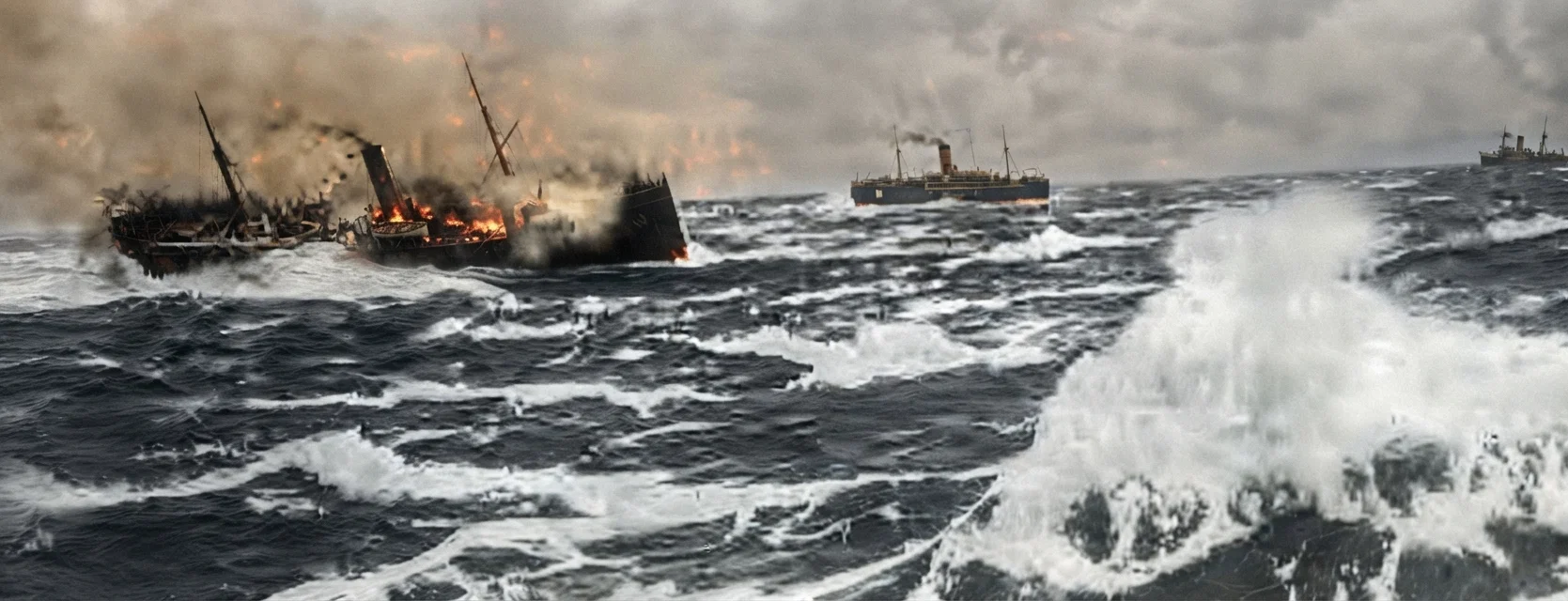
Photo by Paul Thompson. Photograph taken by a passenger on the Grosser Kurferst, of the burning steamship Volturno. When our fathers were young, there were no devices for calling half a score of vessels, within a few hours, to the aid of a ship in distress. The invention of the wireless telegraph was the crowning touch in bringing the whole world, whether on sea or on land, into one neighborhood.
Until mechanical power was substituted for muscular, the world's wealth consisted almost exclusively in land. And land was then nearly as unobtainable as it was immovable. Those who possessed it were the privileged class, not only in respect to wealth but also in respect to power and social prestige. The peasant never dreamed of ever being able to acquire wealth. As it was practically impossible to alienate land, the economic status of society was virtually crystallized. But with the advent of the industrial revolution, an ever-increasing proportion of wealth became portable. As long as the bulk of the world's wealth was practically static and inaccessible, commerce was necessarily confined to narrow limits, and capital for the development of natural resources was not available.
The cheap power, however, resulting from the application of steam, so stimulated invention that the productiveness of labor in the field of manufactures was almost indefinitely multiplied. This fact, in turn, resulted in a vastly augmented creation of movable wealth. As this kind of wealth multiplied, it passed more and more into the hand of such men as possessed exceptional aptitude for commerce. In a relatively short time this class of men succeeded in getting possession of a vastly disproportionate measure of the social wealth, and became gradually the ruling class. This change is commonly referred to by sociologists as the accession to power of the bourgeoisie, as the crowning of bold wealth—a step so momentous in its effects that it marked the downfall of the aristocracy of birth, and the evolution of the aristocracy of wealth.
So long as power remained muscular, every worker was independent in the possession of his own, and all industry was individualistic. But when it was mechanically produced and applied, it became necessarily and even automatically de-individualized and more and more centralized. And just as industry becomes de-individualized, civilization logically becomes de-individualized, and is thereby rendered essentially collective or social.
In the simple age of homespun and of muscular power, each family produced its own food and mostly its own clothing. Every village had its own gristmill, sawmill, stores, craft shops, etc., and was therefore in itself an economic unit. Each shopkeeper and artisan was a small monopolist. Communication between distant places was so difficult as to preclude competition between them. Professor McMaster says:
"Taking the country through, it may be said that to transport goods, wares, or merchandise cost ten dollars per ton per hundred miles. Articles that could not stand these rates were shut from market."
But as transportation facilities improved, the influence of competition began to be felt over vastly greater areas; and the coming of the railway marked the advent of a radically new economic era.
The area of competition was therefore determined by the facilities of transportation. Within this area the trader or manufacturer who commanded the greatest capital or the greatest natural advantages, or possessed the greatest business ability would in time crowd his competitor out of business, and command the trade of his former rivals. Thus this enlarged area of competition, made possible by better means of transportation,tended irresistibly to centralize and localize the several industries.
When the United States, or any other country, became threaded with railways, the cost of transportation was so greatly reduced and the area of competition so greatly widened that capital was gradually driven out of unprofitable kinds of industry into profitable, and transferred from the less competent to the more competent management. In this way national industries soon became localized in distinct sections of the country.
Hence New England no longer finds it profitable to produce her own food supplies. This inability is owing to the inevitable outworking of economic law. For in the production of wheat, she can no longer compete with the states of the northern Mississippi Valley; and, conversely, the latter states can not compete with vastly better facilities of New England for manufacture. Being thus differentiated and localized, industry, in all its phases, has become organized on a national scale; and as a necessary result, the several sections of the United States have become mutually dependent — each section necessary to all the others. Diversity of climate, and of natural resources, enhanced facilities for communication and transportation, and free competition were the conditions necessary to effect such an outcome. Through the operation of the same inexorable laws, the economic unity of the world is in rapid process of being realized.
The enormously accelerated growth of the facilities essential to a world commerce is attested by the fact that in 1840 the total foreign commerce of the world represented less than three billion dollars; at present that of Germany alone exceeds that amount, and that of our own country is in excess of four billion dollars, while that of Great Britain is to-day greater than was the aggregate commerce of all nations in 1850. Not long ago Dr. Strong wrote:
"The international differentiation of industries, which must take place under economic laws, will be accomplished by the reorganization of national industries, as capital is withdrawn from unprofitable and reinvested in profitable enterprises; and both of these processes, international and national, are now taking place."
This de-individualizing, specializing, and centralizing of industries has the effect of enormously augmenting them. During the latter half of the nineteenth century, the population of the United States increasedthree hundredfold, while manufacture increased eighteen hundredfold.
Prof. John B. Clark, of the department of economics at Columbia University, characterizes the old industrial system, which was made obsolete by machine power, as follows:
"The era was one of uneconomical methods of work, of divided and localized production, of large profits and small sales, of little general wealth, but of comparative equality and contentment among the middle class in the community."
This descriptive touch of the old system, by Professor Clark, leads Dr. Strong to say respecting the new:
"It is interesting to observe how precisely opposite at every point are the conditions under organized industry. We see a surprising economy in methods of work, centralized production supplying an ever-extending market, small margins of profit, and large sales, . . . an enormous increase of wealth, and a like increase of inequality between classes and of discontent among working men."
And this is the revolution which is on its way around the globe, transfiguring civilizations, and creating a new industrial world.
Throughout this revolutionary transition from the old industry to the new, "competition compelled concentration, and concentration stimulated competition, until its intensity found relief in practical monopoly." And the massing of capital, through successive stages, led up to the development of that institution so markedly distinctive of our day—the industrial trust.
We see, then, that the civilized world has entered upon a radically new era, the conditions of which have given rise to a number of unique social problems, all clamoring for solution. Among these problems are (1) the reconciliation of an industrial oligarchy with a political democracy; (2) the removing of the enormous disparity between the production and the distribution of wealth.
Will society find and apply a satisfactory solution of these and kindred problems? Or will it fail to solve them, and by such failure precipitate class wars?
These questions will be answered in subsequent articles of this series, by appeal to inspired prophecy and current history.
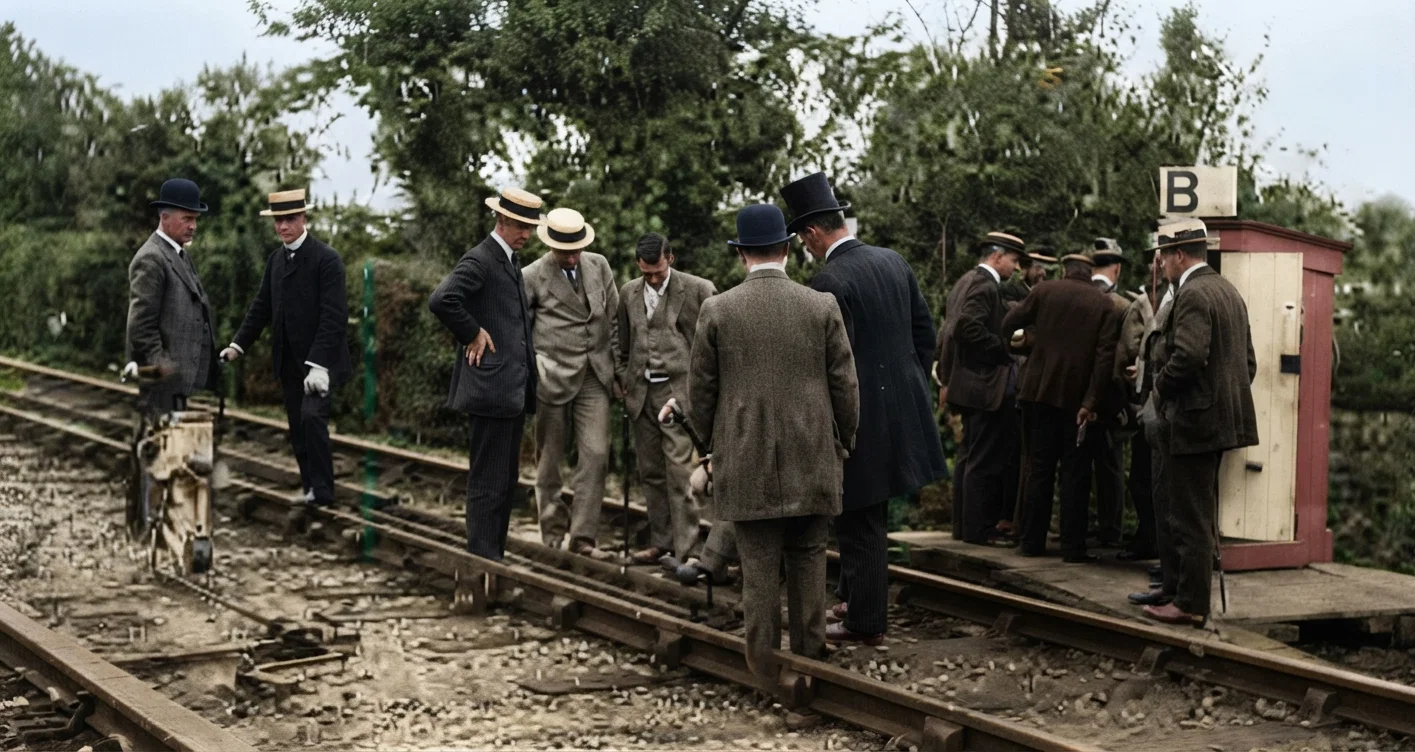
Photo by Paul Thompson. The Prentice system of operating trains by wireless. The "box" is being explained by means of which the engine picks up the wireless waves. Note the central rail by which the waves are transmitted. When the train passes into the "danger zone," it is not only warned, but brought to a standstill.

Economic and Industrial Conditions

THIS is the first of some six or seven articles that Professor Rine, of the Pacific Union College, will give us on the economic and industrial conditions of this time. Each article is complete in itself, and presents a distinct phase of the subject, while taken together they give a general view of these world problems. The next article will present the great concentration of wealth in the hands of a few men, and will begin calling the Bible prophets to the witness-stand to testify what they have foreseen concerning these conditions and times. EDITOR.

The People of the Valleys

The Waldenses, or the Israel of the Alps—What Was Their Faith?—Their Opposition to Saint Worship, Predestination, Purgatory, etc.

By H. H. HALL
FIRST of all, they held tenaciously to the literal interpretation of the Bible unless the text plainly indicated that it was to be taken figuratively. This was shown in an emphatic way in their discussion of the slight differences between themselves and the Reformers on points of faith. For example, notice their questionings upon predestination, then taught by some of the Reformers:
"And as to predestination, we are much troubled about it, having always believed that God created all men for eternal life, and that the reprobate only became so by their own fault; but if all things take place of necessity, so that he who is predestinated to life can not become reprobate, nor those who are destined to condemnation attain salvation, of what use are sermons and exhortations?"—"Israel of the Alps," volume 1, page 95.

THE BIBLE THEIR GUIDE

That the Waldenses had the Bible very early in their history may be shown by various authorities, but perhaps the following will suffice. In that six-day synod in which the Reformers of the sixteenth century for the first time met the men of the valleys, the old manuscripts that they had among them were examined with wonder and amazement. Says one who was there:
"The Reformers . . . were greatly rejoiced to see that people, who had ever proved faithful—that Israel of the Alps, to whose charge God had committed for so many centuries the ark of the new covenant—thus eager in His service. And examining with interest . . . the manuscript copies of the Old and New Testaments in the vulgar tongue which were amongst us, . . . correctly copied with the hand at a date beyond all memory, they marveled at that favor of Heaven which a people so small in numbers had enjoyed, and rendered thanks to the Lord that the Bible had never been taken from them."—Id., page 97.
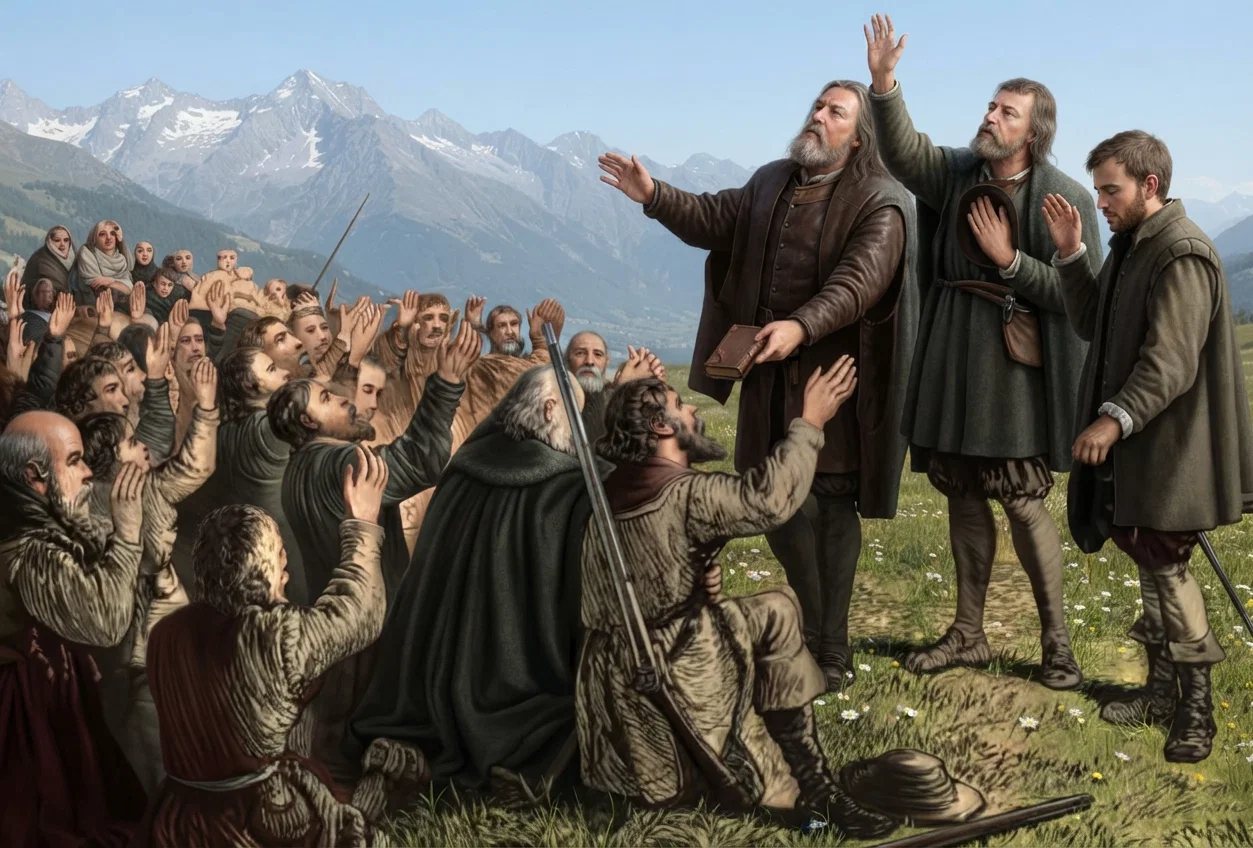
Another remarkable evidence of their reverence for the Bible and its teachings is found in the Campaign of 1561. They had been threatened with extermination if they did not attend the mass. In the face of a numerous army being raised to carry out the edict, representatives of the different valleys met, and standing in the midst of the assembled heads of families declared:
"In the name of the Vaudois churches of the Alps, of Dauphiné, and of Piedmont, which are all here united, and whose representatives we are, we here promise, with our hands upon the Bible and in the presence of God, that all our valleys will courageously stand by one another in what relates to religion without prejudice to the obedience due to their lawful superiors. We promise to maintain the Bible, entire and without admixture, according to the usage of the true apostolic church, steadfastly continuing in this holy religion, although it should be at the peril of our lives, in order that we may be able to leave it to our children intact and pure, as we have received it from our fathers. We promise aid and succor to our persecuted brethren, and not to regard individual interests, but the common cause, and not to wait upon men, but upon God."—Id., page 263.
THE VAUDOIS TAKING THEIR OATH
Strengthened by this trust, and animated by this high resolve, they drove the invaders from their valley in utter disorder.

QUOTATIONS FROM THEIR CATECHISM

But the reader may wish to know more in detail as to what they actually taught, so we give the following quotations from one of their old catechisms. It is found in Perrin's "Waldenses," issued in 1624, part 3, book 1, pages 1-10.
1. They believed in a faith that works by love.
"Q. What is a lively faith? "A. That which worketh by charity. "Q. What is a dead faith? "A. According to St. James, that faith which is without works, is dead. Again, faith is nothing without works; or, a dead faith is to believe there is a God, and to believe those things concerning God, and not to believe in God."
2. They held to the Ten Commandments.
"Q. By what means canst thou know that thou believest in God? "A. By this: because I know that I have given myself to the observation of the commandments of God. "Q. How many commandments of God are there? "A. Ten, as it appeareth in Exodus and Deuteronomy. "Q. Which are they? "A. Harken, O Israel, I am the Lord thy God. Thou shalt have no other gods but Me. Thou shalt not make to thyself any graven image, nor the likeness of anything that is in heaven, etc. "Q. Upon what do all these commandments depend? "A. Upon the two great commandments, that is to say: Thou shalt love God above all things, and thy neighbor as thyself."
3. They believed in justification by faith.
"Q. By what means do we hope for grace? "A. By the Mediator Jesus Christ, of whom St. John speaketh, chapter 1:17. Grace came by Jesus Christ. And again, We beheld His glory, full of grace and truth, and we have all received of His fulness. "Q. What is grace? "A. It is redemption, remission of sins, justification, adoption, sanctification. "Q. By what means do we hope for this grace in Christ? "A. By a lively faith, and true repentance, Jesus Christ saying, Repent and believe the gospel."
4. They taught that worship was due to God alone.
"Q. Dost thou adore and serve any other thing as God? "A. No. "Q. Wherefore? "A. Because of His commandment, whereby He hath straitly commanded, saying, Thou shalt worship the Lord thy God, and Him only shalt thou serve. As also, I will not give My glory to another. Again, I live, saith the Lord; every knee shall bow unto Me. And Christ Jesus saith, There shall be true worshipers, who shall worship the Father in spirit and truth. And the angel would not be adored by St. John, nor St. Peter by Cornelius."
5. They warned against the observance of tradition.
"Q. What are the things that divert a man from this hope?"A. A dead faith, the seducing of antichrist to any other than Christ, that is to say, to saints, and the power of that antichrist in his authority, words, benedictions, sacraments, relics of the dead. The teaching men to have hope, by those means that directly oppose themselves against the truth, and against the commandments of God, as idolatry after divers manners, and simoniacal wickednesses, etc. Abandoning the fountain of living water given by grace, to run after broken cisterns, adoring, and honoring, and serving the creature, by prayers, and fastings, and sacrifices, donations, offerings, pilgrimages, invocations, etc. Trusting thereby to attain grace, which none can give, but God alone in Christ Jesus. So that in vain they travel, and lose their silver and their life, and doubtless not only this life present, but that which is to come."
6. They did not accept the intercession of saints.
"Q. And what say you of the blessed Virgin Mary? For she is full of grace, as the angel testifieth, Hail Mary full of grace, etc. "A. The blessed Virgin hath been and is full of grace in herself, but not to communicate unto others, for her Son only is full of grace to bestow on others, as it is said of Him, And we all receive of His fulness grace for grace."
7. They accepted the sacrament as a figure. In one of their old tracts entitled "Our Lord Jesus Christ," found on page 46 of Perrin, we read:
"And therefore to eat the sacramental bread, is to eat the body of Christ in a figure; Jesus Christ Himself saying, Nevertheless, as oft as you do this, you shall do it in remembrance of Me. For if this eating were not in figure, Christ should be always bound to such a thing, for it is necessary that the spiritual eating should be continual. . . . In the celebration of this sacrament, prayer is profitable, and the preaching of the Word in the vulgar tongue, such as may edify, and is agreeable to the evangelical law, to the end that peace and charity might increase amongst the people."
8. They maintained gospel order.
"We choose amongst the people those that are to govern, and of the elders, according to the diversity of their employment, in the unity of Christ. According to that of the apostle, in the first of the epistle to Titus, I have left thee in Crete, that thou shouldest set in order the things that are wanting, and ordain elders in every city, as I have appointed thee." "Our nutriment and apparel are willingly administered unto us, and as it were by way of alms, very sufficiently by the people whom we teach." "The silver that is given for the relief of the people, is by us carried to the aforesaid council, and is there delivered for the common use in the presence of all, and afterwards taken by those that are in authority, and part of that silver is given to those that are to travel any long journeys, to employ as they shall think fittest, and part unto the poor. "Our pastors do call assemblies once every year, to determine of all affairs in a general council."—Perrin's "Waldenses," part 3, book 2, page 59; part 1, book 1, page 53.
9. They believed in temperance. From another old document, under the head of "Taverns," we read:
"A tavern is the fountain of sin, the school of the devil. . . . It is the custom of God to show His power in His church, and to work miracles; that is to say, to give sight to the blind, to make the lame to go, the dumb to speak, the deaf to hear; but the devil doth quite contrary to all these in a tavern. For when the drunkard goeth to the tavern, he goeth upright; but when he cometh forth, he can not go at all, and he hath lost his sight, his hearing, his speech. The lectures that are read in this school of the devil, are gluttonies, oaths, perjuries, lying, blasphemies, and divers other villainies."—Id., part 3, book 2, pages 62, 63.
10. They vigorously denied purgatory. In an eight-page tract evidently of ancient date, entitled "Of Invented Purgatory," we read the following, which takes an added interest when we consider that its use as a missionary document might mean a martyrdom to the giver:
"The purgatory which divers priests and monks seek to advance and teach . . . is this: They affirm that after this life, . . . the souls especially of those that shall be saved, not having satisfied in this life for their sins, endure sensible pains, and are purged in purgatory after this life, and that after they are purged, they come out of purgatory, some sooner, and some later, and some not until the day of Judgment; which souls all the faithful may and ought to help after they are departed this life, by the hand of charity, by prayers, fastings, alms-deeds, and masses. . . . By this means, and divers other the like dreams, avarice and simony is increased and multiplied, their cloisters advanced, their sumptuous temples are built and enlarged, their altars multiplied beyond measure; and infinite numbers of monks and canons have invented divers other things touching the deliverance and unbinding the said souls, bringing thereby the word of God into contempt. Thus the people are strangely mocked and deceived touching their souls, as also in their substance, inasmuch as they are made to put their trust in things uncertain, whilst in the meantime the faithful hide themselves, for when they refuse to preach and teach the said purgatory, as an article of their faith, they are cruelly condemned to death and martyred. "First therefore we say, that the souls of those that are to be saved, must in the end be purged from all their pollution, according to the ordinance of God, as it appeareth in the twenty-first of the Revelation; 'There shall in no wise enter into heaven anything that defileth, neither whatsoever worketh abomination, or maketh a lie.' Now we know that the Scriptures have set down many and divers means to purge those that are in this present life, of all their sins. But St. Peter telleth us in the fifteenth of the Acts, 9, that faith purifieth the heart, and that faith is sufficient to purge away the evil, without any outward help, as appeareth by the thief at the right hand of Christ, who, believing and confessing his sins, was made worthy of Paradise. The other manner of purging the spouse of Christ by repentance, is touched in Isaiah, chapter 1:16, 'Wash ye, and make you clean, put away the evil of your doings from before Mine eyes, cease to do evil.' And presently after, 'Though your sins be as scarlet, they shall be as white as snow; though they be red like crimson, they shall be as wool.' In which words the Lord offereth Himself to all that do truly repent." "In the third place, we think it a great deal the surer way, that every man do so live in this present world, that he may have no need afterwards of any purgation. For it is a great deal better to do good in this present life, than afterwards to hope for an uncertain help. And it is a surer course, that what good a man hopes shall be done unto him by others after his death, he do it himself whilst he liveth. "And first as touching the Scriptures, no man can prove it by them. For it is manifest, that if a man shall read the whole law, he shall never find therein any one place of Scripture that bindeth a Christian necessarily to believe as an article of his faith, that there is after this life, any place called purgatory, as some do affirm. And there is no place in the whole volume of the book of God which doth so much as name it, neither was there ever any soul found that hath entered the same purgatory and came out again."—Id., part 3, book 3, pages 87-92.
Such testimonies as the foregoing might be multiplied indefinitely; but these are enough to show that the Waldenses turned resolutely from human tradition, and clung to the Word alone. By it they measured every new custom or doctrine that came to them from friend or foe. By it they were accustomed to live, and for it thousands of them willingly died. With the psalmist they said, "Thy word have I hid in mine heart, that I might not sin against Thee." This was the secret of their purity and their constancy.

The Waldenses

THIS is the second of Mr. Hall's articles on the Waldenses. Last week he gave the history that traced them in an unbroken line back to the days of the apostles. We printed a large number extra of last week's issue. Any who failed to get a copy, and who would like all these studies, may secure them by addressing the business department.—Editor.
Continue reading: The Sure Mercies of David