Your ShelfYour Projects

Signs of the Times, Vol. 32, No. 11.

FUNDAMENTAL PRINCIPLES. No. 5.

Signs of the Times

Mar 14, 1906

Pacific Press Publishing Company · Mountain View, California · Mar 14, 1906

FUNDAMENTAL PRINCIPLES. No. 5.

From Virginia Declaration of Rights.
The Original Draft of these Two Articles was by Patrick Henry
Section 15. That no free government, or the blessings of liberty can be preserved to any people but by a firm adherence to justice, moderation, temperance, frugality, and virtue, and by frequent recurrence to fundamental principles.
Section 16. That religion, or the duty which we owe to our Creator, and the manner of discharging it, can be directed only by reason and conviction, not by force or violence; and therefore all men are equally entitled to free exercise of religion, according to the dictates of conscience; and that it is the mutual duty of all to practise Christian forbearance, love, and charity towards each other.

Our Publications

THAT our friends may become more familiar with our general line of books, tracts, etc., we are giving each week in this column a review of the items as they appear in our catalog. You will be instructed as well as interested by perusing this page carefully each week.

Fathers of the Catholic Church

By E. J. Waggoner. This book shows the condition of the heathen world at the time of Christ, briefly states the principles of ancient heathen philosophy, which was largely responsible for the immorality at that time, and shows how the adoption of these principles by prominent men in the church, and the incautious lowering of the standard of pure Christianity to accommodate the heathen element, developed the Papacy. 12mo, cloth, 400 pages, net $0 90

Fiji and Samoa

By Emma H. Adams. A graphic and interesting description of the Fijian and Samoan Islands, their geographical position, their government and religion, their social and physical peculiarities, and the wonderful productions of these islands. 160 pages, illustrated. Paper covers, net - - - - - - $0 25 Cloth, net - - - - - - - - 50

Friend in the Kitchen

This is an educational cook book. Its object is to educate people away from flesh-eating by presenting to them a far better way. This "better way" consists of 400 thoroughly-tested recipes for the preparation of good, wholesome dishes, none of which include meat of any kind. The book gives the nutritive value of foods, time required to digest various foods, rules for dyspeptics, best food for infants, substitutes for meats, and, in fact, about everything a person wishing to reform his dietary needs to study. Durably bound in flexible cloth $0 25 Oilcloth - - - - - - - - - 50

From Eden to Eden

By J. H. Waggoner. This book is a most interesting study of the more important historic and prophetic portions of the Scriptures. The author traces the world in its career from the time when "God saw everything that He had made, and, behold, it was very good," on through the period while "the earth also is defiled under the inhabitants thereof," to the future glorious time when Christ says to His followers, "Come, ye blessed of My Father, inherit the kingdom prepared for you." Contains 264 pages. It is illustrated with numerous full-page engravings. Brown English cloth, plain stamp, embossed in jet and gold, marbled edges - - $1 00

The Glad Tidings

A verse-by-verse study of the book of Galatians. By Dr. E. J. Waggoner. 265 pages. Paper covers - - - - - - - - $0 25 Cloth, net - - - - - - - - 50

Good Form and Christian Etiquette

By Mrs. S. M. I. Henry. Treats good manners as related to society rules and Gospel work, and is a most helpful book for old and young, laity and clergy, Christian and unbeliever, notwithstanding it was not primarily written for either the world or the nominal professor of Christianity, but "for those who are earnestly looking for the best means of serving God and humanity." It tells how to avoid those things which give offense and lessen our influence for good among the best classes of the world, before whom we are to "shine as lights." The reproach of the Gospel is inevitable, but this should not be augmented by reproach for violation of those rules of social etiquette which refined society has laid down for its own protection against boorishness and immorality. Every Christian needs to know how to "avoid the appearance of evil," "giving no offense in anything, that the ministry be not blamed." 144 pages, felt-paper cover - - - - - - $0 25

Terms of Subscription.

Per Year, post-paid . . . . . . . . . . . . $1.50 Six Months, 75 cts. Three Months, 40 cts. To Foreign Countries, per year, $1.75.

SPECIAL TERMS.

1. One new yearly subscription and one renewal, or two new yearly subscriptions, sent at one time, $2.50.
2. Two new yearly subscriptions and one renewal, or three new yearly subscriptions, sent at one time, $3.25.
3. Three new yearly subscriptions and one renewal, or four new yearly subscriptions, sent at one time, $4.00.
Sample copies sent on application.

“SIGNS OF THE TIMES:

“Your letter of some weeks ago at hand, also the paper you sent me, which I read and enjoyed very much, and thank you kindly for same. To-day I write to renew my subscription which expired a few months ago, also to send the paper to some other parties for three months each. Enclosed you will please find money-order for $5.50 for which you will please send the paper to the following addresses (ten names and addresses), and send it to me for one year. Most respectfully,
“Mrs. E. J. Bridgeforth.”

Signs of the Times

"SIGNS OF THE TIMES: "Please find enclosed P. O. Order for $8.00 for which please send the SIGNS OF THE TIMES for one year to each of the following eight names and addresses. I intend sending in another list after a while. Indeed the SIGNS is a splendid paper. It ought to be in every home."

CO-OPERATION CORNER

A very encouraging letter comes from a brother in a state penitentiary. Those of our friends who help keep up our Co-operation Corner work will be glad to read a portion of it.
Yes, I am still in prison, and unless the dear Lord opens the way that I might regain my liberty, I will, in all probability, remain the remainder of my natural life in this prison. I understand that when we respond to the invitation, 'My son, give Me thine heart,' that henceforth all our affairs are supervised by the Lord, to the extent of overruling all things for our good. . . . I have no friends, except those who belong to Christ (and consequently no money), and should any of the SIGNS OF THE TIMES friends wish to send me the paper, I shall be thankful to you and them both.
Yours in the fellowship of Christ,—
Our Co-operation Fund makes it possible to continue the subscription for a year.

A RESPONSE.

Dear Brethren: Herewith find order for $3.00 for Co-operation Corner to give the SIGNS to those in the penitentiary, or to some other place, or to that place where the needs are the greatest. This is in response to the call of February 14.
Yours sincerely, OSCAR REINKE.
Would you not like to help in similar work, by sending a donation to SIGNS OF THE TIMES (Co-operation Corner), Mountain View, Cal.?

FOLLOWING AFAR OFF AND ITS RESULT.

WHEN Jesus was apprehended in the Garden, all the disciples "forsook Him and fled." A certain young man, probably Mark, "followed with Him," but as they sought to take Him, he fled. Then, Jesus, alone with His enemies, was bound—an utterly needless precaution—and taken to Annas, the former high priest, and father-in-law to Caiaphas who then held the office. The leaders in the plot against Jesus sought to allay all jealousy, and unite all possible against Him.
SIMON PETER, still smarting under the Master's rebuke in his use of the sword, could not forget his Lord. He could not leave Him. There might be an opportunity for him to fight for Christ still. The Master might assert the authority Peter had seen Him use in the cleansing of the temple, and then He would know how valiant was Peter's heart and how strong his right hand. So little had he learned of the spirit of the Master and the principles of the kingdom! Even so now there are many who profess His name, who would seek to promote and advance His kingdom by means that are carnal. All these profit nothing. All they that take the sword shall perish with the sword.
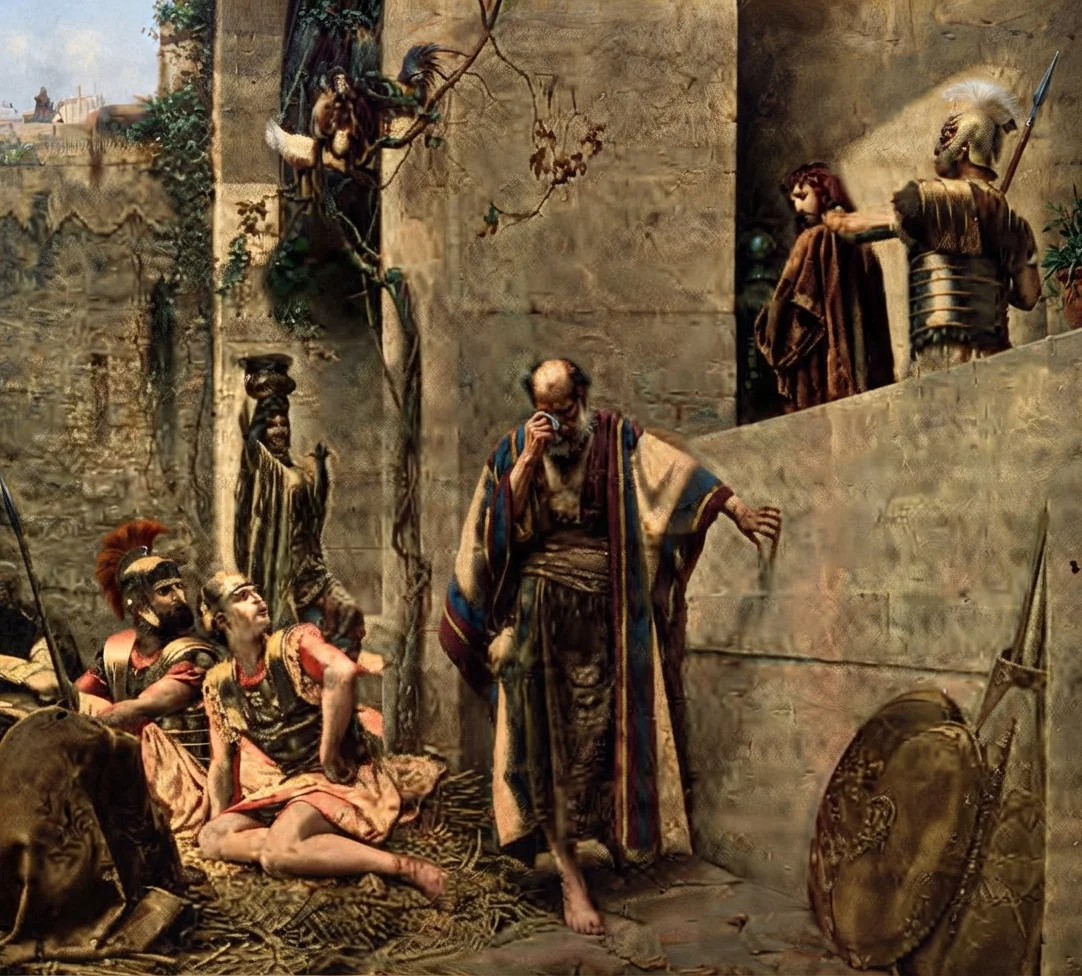
PETER followed, but he followed "afar off." The cause of the Nazarene was unpopular just now. A few days before the whole city seemed to go wild with joy in welcoming Him as king. It was a proud thing then to have been His disciple. Now there were none to do Him honor, and Peter did not wish to meet their sneers and persecution, or suffer with the Master. John also returned, and the high priest knowing him, he entered into the court with Jesus, none forbidding. All knew where he stood. None needed to question him. His nearness to the Master, his clearly-evinced interest, were testimony sufficient. Knowing that Peter wished to see the outcome of the arrest, John spoke to the maid at the door and brought in Peter. As he passed in, he betrayed his anxiety, and the sharp-eyed doormaid, with pert inquisitiveness, asked, "Art thou also one of this Man's disciples? But he denied, saying, Woman, I know Him not." He had taken the first step in wrong and compromise as the result of following "afar off."
“And he went out and wept bitterly.”
HAVING taken the first step in the wrong way, his pride demanded that he should pursue it. Seeing a brazier of burning coals around which were gathered the officers and servants in the cool, spring night, Peter walked over among them, and stood "warming himself," yet listening, keenly attent, to all that was taking place concerning Jesus. The cock crew, but he gave little heed. He heard the Master's calm words. He saw an officer with no provocation smite Him in the face. Perhaps the fisherman's eyes flashed and his muscles knotted as he saw the cruel act. He wanted to seem to be indifferent, but he betrayed his anxiety, so that various ones asked him, "Art thou also one of His disciples?" He denied with an oath, and said, "I am not." The second step had been taken. Peter was rapidly losing all that he seemed to have gained, and he was nearing rapidly the low, coarse level of his old fisher life.
AN hour passes by. The fisherman's mind is still in tumult of conflicting emotions. His heart is still boiling, and he is angry that his Lord will submit to the mock trial He is receiving. Another servant gets a clearer view of the fisherman's rugged face. That servant was with the party which arrested Jesus. He also had a kinsman, perhaps a brother, there. That kinsman was wounded in the garden, and also healed. The servant remembered the incident. He saw many of the faces around Jesus. Some motion on Peter's part told him that he had seen Peter in the Garden. Therefore He asks Peter, "Did not I see thee in the Garden with Him?" And as Peter was about to deny, he presses home the charge: "Of a truth thou art also one of them; for thy speech betrayeth thee; for thou art a Galilean." Peter became so desperate that all self-control vanished, "and he began to curse and to swear, I know not the Man of whom ye speak." He fell back to the old life level and habits. Such men have ever done when they let go of Jesus Christ. We can read Peter's old habits in his backsliding. Like many other fishermen of all ages, he was a rough, profane man; and when control of self was gone, he fell to his old level, and cursed and swore. And then the cock crew again. "And Peter called to mind the word, how that Jesus said unto him, Before the cock crow twice, thou shalt deny Me thrice. And when he had thought thereon, he went out and wept bitterly."How many, many Peters there are to-day who are following "afar off." Piqued or offended because of imaginary grievances, wounded in their selfish pride, making mistakes, but too proud to acknowledge them, they soon come to deny the One who redeemed them and suffered and is suffering in their behalf. Many, unlike Peter, will not weep at the climax of their rebellion and denial, but with ever-harder heart will push on to destruction.
But many, rash and foolish tho they be, will turn from the sin to the Saviour, will see the wrong in self, not in others; will remember the words of warning from friends whom they denied and hated and maligned, because they hated the words of reproof needed. For such the Master waits. For such time the Master waits. And not till such time comes can He help them. Then, while they weep and wonder and wait, the Master's messenger will say, "Go, tell His disciples and Peter" (Mark 16:7), their Lord lives, and would still lead them on out of self, into more blessed fields.
WOULD you never deny the Master? Never follow "afar off." Follow with Him. Keep close to Him under all circumstances, as well in the judgment hall or toiling up Calvary, as on the Mount of Transfiguration or in the triumphal entry. "Better fire-walled hell with Him than golden-gated Paradise without."

PLEASURE.

THE Creator designed that the universe should abound in pleasure. The creatures around His throne testify: "Thou art worthy, O Lord, to receive glory and honor and power; for Thou hast created all things, and for Thy pleasure they are and were created." Rev. 4:11. And what God designed for His own pleasure was also to be the pleasure of His creatures. "The Lord taketh pleasure in His people; He will beautify the meek with salvation." Ps. 149:4.
The purpose of redemption is to have a people that will take pleasure in the things that are pleasure to the Redeemer. So His parting promise to His disciples as He ascended from earth was, "I will come again, and receive you unto Myself; that where I am, there ye may be also." John 14:3. There would be no blessing in salvation if the saved ones could not enter with joy into the joys and pleasures of the Redeemer.
The Lord said to His disciples, "Fear not, little flock; for it is your Father's good pleasure to give you the kingdom" (Luke 12:32); but those who shall attain that honor will be such as have had their hearts so changed and purified by the Spirit of God that He can work in them "to will and to do of His good pleasure." Phil. 2:13. It is only by having the mind of Christ in all, and every sense of pleasure in harmony with His, that there can be an entire universe in harmony with God and therefore acceptable to Him. "Blessed be the God and Father of our Lord Jesus Christ, who hath blessed us with all spiritual blessings in heavenly places [margin, "things"] in Christ; according as He hath chosen us in Him before the foundation of the world, that we should be holy and without blame before Him in love; having predestinated us unto the adoption of children by Jesus Christ to Himself, according to the good pleasure of His will, to the praise of the glory of His grace, wherein He hath made us accepted in the Beloved." Eph. 1:3-6.
The angels of God that "do His commandments, harkening unto the voice of His word," are the same "ministers of His, that do His pleasure." Ps. 103:20, 21. And this is what is designed of those who are the subjects of His mercy: "The mercy of the Lord is from everlasting to everlasting upon them that fear Him, and His righteousness unto children's children; to such as keep His covenant, and to those that remember His commandments to do them." Verses 17, 18. The Lord our Saviour says, "Blessed are the pure in heart; for they shall see God." Matt. 5:8. And it is this class that will enjoy the "pleasures forevermore" to be found at the right hand of God. Ps. 16:11. God has no pleasure in wickedness (Ps. 5:4), nor in the death of those who indulge in wickedness. Eze. 33:11.

Worldly Pleasure.

No man ever more thoroughly tested the pleasures of this world than did Solomon. No one ever was better situated for testing his heart's desires. He had wealth and honor and power and wisdom; everything that heart could wish was at his command. So he set himself to "enjoy pleasure" of the carnal variety, and tells his experience in the second chapter of Ecclesiastes. He sought pleasure in mirth, and folly, and wine; in great works, and houses, and vineyards; in gardens, and orchards, and pools of water; in servants, and maidens, and great possessions; in silver, and gold, and "peculiar treasure;" in men and women singers, and all kinds of instrumental music; whatsoever his eyes desired he kept not from them.
Solomon greatly perverted the wisdom God had given him by spending his energies in gratification of the flesh; and after he had enjoyed it all to the full, he looked back over his experience and found nothing but regret. He says: "Then I looked on all the works that my hands had wrought, and on the labor that I had labored to do; and, behold, all was vanity and vexation of spirit, and there was no profit under the sun." This, too, with reference to the most practical part of his worldly pleasure—the works he had built.
Now if such a man with such opportunities could not get good results or permanent satisfaction out of the pleasures of the world, what chance is there for common people in such effort? "For what can the man do that cometh after the king? even that which hath been already done." The king—the wealthy, influential, keen monarch, with no human power to deny him aught—found the quest of worldly pleasure to be only a fountain of trouble; therefore the man who "cometh after" him, who attempts a like course, must expect to meet like consequences. The king's experience was "written for our learning," and it is still true that "whatsoever a man soweth, that shall he also reap."
God wants all his creatures to enjoy life. He wants them to have an eternity of pleasure. And Satan, wishing to draw men away from God, sets before them his counterfeit enjoyments. These are very alluring to the "carnal mind" of the "natural man," who "receiveth not the things of the Spirit of God; for they are foolishness unto him." These so-called pleasures are very captivating to the superficial people of the world, who know that they are but transient, and are even accompanied by many pains and sorrows.
But God has plainly set before us the fruitage of such pleasures, and has contrasted therewith the happy results of accepting and learning to love the joys of His salvation. "He that soweth to his flesh shall of the flesh reap corruption; but he that soweth to the Spirit shall of the Spirit reap life everlasting." This probationary life is designed as a school in which men may learn to love the things that please God and give eternal joy. If we do not learn this lesson in this life, we never can participate in the everlasting pleasures which God hath prepared for them that love Him and keep His commandments. G.

BABYLON'S PERSISTENT INFLUENCE.

BABYLON has had much to do with the people of God in all ages. Her name appears no less than two hundred sixty-four times in the sacred Volume. With her history is inextricably intertwined the history of the church of God from earliest times, and it will continue so to be until that church shall triumph over all the powers and deceptions of great Babylon, the ensnaring enchantress of the ages.
The long-buried bricks that babble of the glories of ancient Babylon tell us what her character was—and just as truly what modern Babylon's is. God named her when the bolt of His displeasure smote the head of her great tower; when He drove the wedge of a confused speech into her organization. That bolt of His disapproval, like a meteor fallen in the sea, sent wave on wave of humanity in concentric circles widening and expanding to the confines of the earth, with Babylon, "the beginning of kingdoms," the center of the radiation; but wherever they went, they carried with them that distinguishing element of Babylon—confusion. That character persists. It has worked out along different lines in different lands, but the result is the same, tenacious, insistent, persistent, unchanging—confusion.
God did not leave man in ignorance as to the creation of the various forms of life that exist upon the earth. We have the record of it in His Word; Adam had it from God's own lips; and the world had Adam for the space of nine hundred and thirty years to testify truly concerning the creation of man; and that true testimony was handed down by his posterity. Nevertheless, Babylon from earliest times taught a pantheistic evolution, a doctrine of the emanation of the human from the divine substance. The historian says of Babylon upon this point:
The fundamental ideas of the pantheistic and emanative theories which were the basis of all religion in Chaldea and Egypt, as well as in India, left everything uncertain as to the creation of mankind. Men, as well as all other created beings, were supposed to have issued from the very substance of the Deity . . . and they came into being spontaneously.
Evolution, pantheism, agnosticism, and infidelity—these are not inventions of modern times or modern genius. They are as old as Babylon; they spell confusion; they were all germinant in the character and teachings of the Babylon of old.
God gave to man explicit instruction in regard to the order of creation, the distinction between the various species. But great Babylon must confuse the minds of men upon this point also. So we have among the fragments of the writings of Berosus the following account of the condition of things in the new-created world, as believed in Babylon:
There was a time in which there existed nothing but darkness, and an abyss of waters, wherein resided most hideous beings, which were produced of a twofold principle. There appeared men, some of whom were furnished with two wings, others with four and with two faces. They had one body but two heads—the one that of a man, the other that of a woman—and likewise in their several organs both male and female. Other human figures were to be seen with the legs and horns of goats; some had horse's feet; while others united the hind quarters of a horse with the body of a man resembling in shape the hippocentaurs. Bulls likewise were bred there with the heads of men; and dogs with fourfold bodies, terminating in their extremities with the tails of fishes. In short, there were creatures in which were combined the limbs of every species of animals.
Here again are the teachings of Babylon spelling out in plainest letters that name which God gave to that system as well as to that system's great monument—confusion.
Situated at the junction of upper and lower Asia, within reach of the two great rivers communicating with the Persian Gulf and the Indian Ocean, the city of Babylon became the depot for caravans from the East and the West, as well as the port for ships arriving from Africa, Arabia, and India. "Everything proves," says the historian, "that this great city was from remotest antiquity, one of the chief commercial centers of the East." International highways radiated in all directions from Babylon, and the most precious fabrics and products from all countries were exchanged there. She manufactured the most gorgeously colored cloths of woollen and linen; and while Babylon fondled the nations upon her knees, she taught them the secrets of her traffic in virtue. "Everything proves," again says Lenormant, "that the most unbounded and shameless naturalism played a great part in the worship of the Babylonians. . . . Belit had a magnificent temple in the center of Babylon, where an infamous custom compelled every woman once in her lifetime to give herself up to a stranger. . . . At Cutha, Nana or Zarpanit was worshiped under the name of Succoth Benoth, a name referring to the prostitutions in honor of that goddess."
Knowing these things, what a striking meaning there is in these words of the Revelator, picturing the iniquities of spiritual Babylon in the doings of her prototype, Babylon of old:
"I saw a woman sitting upon a scarlet-colored beast, full of names of blasphemy, having seven heads and ten horns. And the woman was arrayed in purple and scarlet, and decked with gold and precious stone and pearls, having in her hand a golden cup full of abominations, even the unclean thing of her fornication, and upon her forehead a name written, Mystery, Babylon the Great, the Mother of the Harlots and of the Abominations of the Earth. And I saw the woman drunken with the blood of the saints, and with the blood of the martyrs of Jesus." Rev. 17:3-6. "Fallen, fallen is Babylon the great, that hath made all the nations to drink of the wine of the wrath of her fornication." Rev. 14:8. "For by the wine of the wrath of her [Babylon's] fornication all the nations are fallen; and the kings of the earth committed fornication with her, and the merchants of the earth waxed rich by the power of her wantonness." "And the merchants of the earth weep and mourn over her, for no man buyeth their merchandise any more; merchandise of gold, and silver, and precious stone, and pearls, and fine linen, and purple, and silk, and scarlet; . . . and merchandise of horses and chariots and slaves; and souls of men." "Thy merchants were the princes of the earth, for with thy sorcery were all the nations deceived. And in her was found the blood of prophets and of saints, and of all that have been slain upon the earth." Rev. 18:3, 11-13, 23, 24.
As Babylon of old sat at the gate of the nations dispensing delicacies, soul corruptions, and doctrines of confusion to all corners of the earth, so sits spiritual Babylon to-day with the same influence over the nations, disseminating dogmas of confusion, trafficking in the "souls of men," the pages of her history red with the blood of martyrs; arrayed in purple and scarlet and silk and fine linen and precious stones, but stall-feeding in her heart the lion of an undying lust for the lives of those who deign to serve God as they believe God requires, untrammeled by her trappings and unswerved by fear of her anathemas.
As Babylon of old turned aside from the laws of God and trampled upon their precepts and brought confusion into the ways of men and nations, so has spiritual Babylon opposed herself to the law of God, set up rites and ceremonies of her own, and exalted herself even above the God she professes to serve. Babylon of old sought to seat herself in the sky by building a tower that would place her there; and in harmony with that persistent character we find the leader of spiritual Babylon denominated in holy writ "the son of perdition," who "opposeth and exalteth himself above all that is called God, or that is worshiped; so that he as God sitteth in the temple of God, showing himself that he is God." 2 Thess. 2:3, 4. This thing spiritual Babylon has done in declaring the pope above all law, able to grant indulgences and forgiveness for sin, able of the wrong to make right, and able to change even the law of the Most High. Her boast is that she never changes. How true it is! Every step in the history of spiritual Babylon was taken, before she took it, by her temporal prototype, and every such step in every age has spelled her name CONFUSION.

Inner Man

1782.—Inner Man.
Is there not an immortal soul inside a man? What does Paul mean by expressions "in me," "my flesh," "the inward man"? Rom. 7:18, 22; 2 Cor. 4:16.
Paul tells us in the seventh chapter of Romans that there was in him a desire to do what was right. The inner man, tho bound in slavery to the sin that was in him, approved the right, approved God's law, but had no power to do God's law. When he saw Christ and yielded to Him, he found power from on high to fulfil the righteousness which is in the law. The inner man then became dominant. The flesh with all its lusts he called the outward man. But there is absolutely nothing given to show that that inner man is a separate entity, or that the outward man is such. If there were such an inner man, and such an inner man were immortal, why does not the apostle say so? It takes very few words. On the other hand, he tells us that God "only hath immortality," and that it is only put on by faithful continuance in well-doing, that man will receive it only when the Lord Jesus Christ comes the second time. Rom. 2:7; 1 Cor. 15:51-54. The desperate need of evidence to prove the immortality of the soul is indicated by catching at terms like this to bolster it up. "God only hath immortality." 1 Tim. 6:16.

Question Corner

1781.—Angels That Sinned. 2 Peter 2:4.
Will you tell me the meaning of "the angels that sinned being cast down to earth and delivered into chains of darkness"? 2 Peter 2:4.
The angels that sinned are the same as those of whom Jude speaks in his epistle, that kept not their first estate. They were those who, when their great leader assumed to be like God, as intimated in Isa. 14:12-14, followed him and fell with him, and they were cast down to earth. The original word is used only once in the New Testament, that is tartarus, and is held to be the aerial region around the world. They are not allowed, as formerly, to enter heaven, and are kept there as literally and as truly as tho they were chained.

Entering into the Holy Place

1783.—Entering into the Holy Place. Heb. 9:24.
If Christ did not enter into the most holy place and sprinkle the atoning blood for us until 1844, what did Paul mean by, "Christ is not entered into the holy places made with hands, . . . but into heaven itself, now to appear in the presence of God for us?" Heb. 9:24.
It would take more space than we can give in this department to answer this question fully; in fact, it would mean a study of the sanctuary question and the priesthood of Christ in the light of the types. Suffice it to say that all that Christ did He did once for all; as in the type when He entered upon this priesthood He anointed both places, and of course entered them at that time. When He began His service, He began it for the very purpose that was indicated by the priest who began his yearly round of service and in the holy place. But that priest went many times into both places of the sanctuary, in the first daily, and in the latter yearly as long as he was priest. But not so with Jesus, He entered into it once for all. The book of Hebrews deals in fulfilments; it ever looks forward to the end. When Christ died He died once for all, meeting in His death the antitype for every sacrifice of the past. When He entered upon His work as priest, He entered upon it once for all, ever looking forward to the end of that work, the closing of the Day of Atonement, and the putting away of sin, the last day of His ministry in the most holy place. Is the question not answered in the light of these principles?

1784.—Can One Converted Apostatize?

If a person who is converted and born again can apostatize and be destroyed, what does John 6:47, 37; 14:19, "Because I live, ye shall live also" mean?
John 6:47 and kindred texts are simply statements of the fact that when man comes into perfect harmony with the will of God, the inflow of God's eternal life takes place. He holds that life by faith. If he yields the faith, he yields the life. There are many earnest injunctions in the Scriptures to endure unto the end, "We are made partakers of Christ, if we hold the beginning of our confidence steadfast unto the end;" "He that endureth unto the end, the same shall be saved." In the life to come, after probation has passed, the children of God will have eternal life absolutely. Here it is held conditionally. One of the greatest errors that men follow in the interpretation of the Scripture is to take some figure that is used and press it to its fullest meaning. The Lord used various figures to show what conversion means. No one of them should be pressed to an unreasonable conclusion that is not borne out by the Scripture. For instance, the distinction of character between a child of God and a worldling is indicated by the wheat and the tares, they are different in nature. Should we press that to its fullest limit, we would say, Once wheat, always wheat; once tares, always tares. But the parable is not designed to teach that. It simply shows that the two classes are thoroughly distinct. "Ye must be born again," or be begotten again in Christ, indicates that there must be a complete change in our nature, a new life, born from above. Conversion is another thing which indicates the attitude of the individual; a turning about. Just as long as the child of God holds by faith to Jesus Christ, there can be no distrust, no turning away, no breaking of the connection between himself and his Lord; but when he turns from the power and life of the Lord, he is living to himself and getting the things that are of the earth earthly. In the light of these general principles, we are sure that these texts will be plain.
Continue reading: CHURCH FEDERATION