Your ShelfYour Projects

Review and Herald, Vol. 90, No. 4.

HIS DAY IS MARCHING ON

Review and Herald

Jan 23, 1913

Review and Herald Publishing Association · Takoma Park Station, Washington, D. C. · Jan 23, 1913

HIS DAY IS MARCHING ON

Mine eyes have seen the glory of the coming of the Lord: He is tramping out the vintage where the grapes of wrath are stored; He hath loosed the fateful lightning of His terrible, swift sword; His truth is marching on.
I have seen Him in the watch-fires of a hundred circling camps; They have builded Him an altar in the evening dews and damps; I can read His righteous sentence by the dim and flaring lamps; His day is marching on.
He has sounded forth the trumpet that shall never call retreat; He is sifting out the hearts of men before His judgment-seat; O, be swift, my soul, to answer Him! be jubilant, my feet! Our God is marching on.
In the beauty of the lilies Christ was born across the sea, With a glory in His bosom that transfigures you and me; As He died to make men holy, let us die to make men free, While God is marching on.
— Julia Ward Howe.

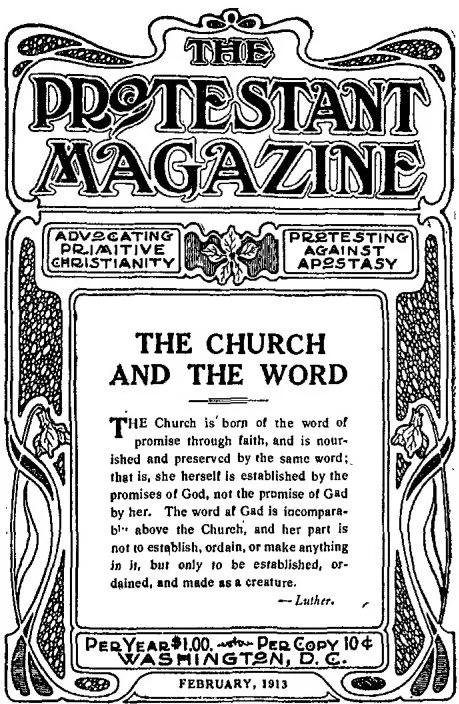
“Rome and the Heretics” and “Papal Persecutions” Number

Every statement in this number supported by evidence which Rome herself can not break nor twist.

IN THE FEBRUARY NUMBER

Double Frontispiece: Vasari’s St. Bartholomew Massacre Frescos in the Vatican The Persecution of Heretics “Heresy” Officially Defined The Great Papal Persecutions Roman Catholic Testimony Concerning Persecution and Tradition Responsibility for the Civil Punishment of “Heresy” Attempting to Reverse History The Sin of Cain and Salvation by Works The New Interpretation of History A Challenge to Roman Catholics
Notes and Extracts: Four Hats of Cardinals—As to Bigots—Jerusalem, Rome, Washington—A Gigantic Conspiracy—“Ne Temere” Again—Protestant Literature Questioned by Catholic Customs Officers—The Cardinals and the Public Press—Mrs. Woodrow Wilson’s Secretary a Catholic.

YOUR SUBSCRIPTION FREE

By sending us two yearly subscriptions accompanied by $1.00 each, you will be entitled to your own subscription free of charge.
For $3.00 we will mail the magazine to five different addresses for one year, or to ten different addresses for six months.

ORDER THROUGH OUR NEAREST AGENCY

(If you do not know the address of our Agency, ask the “Protestant Magazine,” Washington, D. C.)
PRICES, POST-PAID
PRICES, POST-PAID
Yearly subscription - - - - - $1.00 Six months - - - - - .50 (Subscriptions for less than six months not accepted) Three years (or 3 subs. 1 year) - - - - 2.00 Five years (or 5 subs. 1 year) - - - - 3.00

NO EXTRA CHARGE ON FOREIGN SUBSCRIPTIONS

"Alcohol," "Narcotics," and

"Common Ailments" Number

$1.00 a Year 10 Cents a Copy

FEBRUARY FEATURES

Is Alcohol a Food? Accidents and Common Ailments Overcrowding and Bad Housing Physical Labor a Blessing Special Exercises for Women How Shall We Educate Our Girls? The Farm Baby The Baby’s Training How to Make Healthful Soups Alcohol and Narcotics The Medical Faker Mark Twain’s Bad Habits Why Eat Breakfast? White and Standard Bread What to Do for Cold Feet Brain Workers and Indigestion Is Pellagra Curable? Questions and Answers
Earn your own subscription by sending us two yearly subscriptions at $1.00 each. Selling this magazine is easy and profitable work. Our agents make $2.00 to $5.00 a day.
Send 10 cents for sample copy. Address our Nearest Agency or Desk "R"

LIFE AND HEALTH,

WASHINGTON :: :: :: D. C.
PRICES, POST-PAID
PRICES, POST-PAID

PRICES, POST-PAID

Yearly subscription - - - $1.00 Six Months - - - .50 (Subscriptions for less than six months not accepted) Three years (or 3 subs. 1 yr.) - - - 2.00 Five years (or 5 subs. 1 yr.) - - - 3.00 Five copies, one year to one or more addresses - - - 3.00
NO EXTRA CHARGE ON FOREIGN SUBSCRIPTIONS

Heaven's Reward

LILLIAN S. CONNERLY
The task that has been given to thy hand, Do it, my child; but not as unto man, Lest man's reward be given unto thee, And not reward which comes alone from Me,
Man may give glory, or the pomp of power Which satisfies the soul but for an hour; He may give joys which perish in a day, Of wealth or flattery which fade away:
But my reward is an inheritance Eternal in the heavens. No circumstance Of time or chance can change or e'er remove This heavenly inheritance — reward of love.
Its glory may not here revealed be; But faith appropriates the word to thee. And so, whatever work thy hand may do, Do thou it heartily the whole day through.

A. G. DANIELLS

Does the History of Turkey and Egypt Since 1798 Fulfil the Prophecy of Dan. 11:40-44? — No. 4

A. G. DANIELLS

“And at the time of the end shall the king of the south push at him: and the king of the north shall come against him like a whirlwind, with many chariots, and with horsemen, and with many ships; and he shall enter into the countries, and shall overflow and pass over.” Dan. 11:40.
WE have come in the study of this prophecy to the “king of the north.” It is at “the time of the end” that this king is now brought into the prophecy. He is at war with another power, and comes out of the conflict the victor. But later, trouble overtakes him, and presses upon him until he comes to “his end.” “And at that time shall Michael stand up, the great prince which standeth for the children of thy people: and there shall be a time of trouble, such as never was since there was a nation even to that same time.”
Thus the king of the north continued to be the subject of this prophecy through to its close, when he comes to his end. And from the standpoint of this prophecy, the final overthrow and utter extinction of the king of the north will be the signal for the overthrow and destruction of all the kingdoms of the world, and the beginning of the eternal reign of Christ.
These considerations should impress every one who attempts an explanation of this part of the prophecy with the importance of proceeding with the greatest care and candor. The supreme desire should be to know the exact truth and to reach true and sound conclusions. In the desire to maintain traditional views, the eyes must not be closed to facts. On the other hand, this is not the time and place to venture into speculative theories. The facts, Scriptural and historical, alone are of value, and are what are wanted now.
As pointed out in the first article of this series, the first step to take in ascertaining the meaning of any part of a prophecy is to study all the other parts of that same prophecy. The next step is to study other prophecies relating to the subject under investigation, and with this study of the Scriptures search the history that fulfils the prophecy.
This is the method of procedure in the study and interpretation of the other prophecies recorded in the second, seventh, and eighth chapters of Daniel. In the prophecy of chapter 2, the metallic parts of the great image, and the stone cut out of the mountain without hands, are placed before us as symbols of great meaning. Where do we go first for information regarding their meaning?—To other parts of the same prophecy. There we get the key to the true interpretation. The same is true of the prophecy recorded in the seventh chapter. Without going outside of the prophecy, we get the interpretation of the four beasts, the ten horns, and the little horn. To this information we add what we find in other lines of prophecy, and in the history of the nations and powers that have fulfilled the prophecy.
Following this course in the study of the king of the north brought forward in verse 40, we shall give attention first to the entire prophecy of which this is a part. And we are not long in finding data for our guidance. We find the king of the north brought to view in the first part of the prophecy as follows: “And in the end of years they shall join themselves together; for the king’s daughter of the south shall come to the king of the north to make an agreement.” Verse 6. This power designated the king of the north is one of the principal subjects of the prophecy from verse 6 to verse 15.
Now, is there any relation between the king of the north in these verses and the king of the north in verse 40? Why not? The perfectly natural conclusion to reach is that they are one and the same. And without plain, reliable evidence to the contrary we are forced to hold that the king of the north of the first part of the prophecy is the king of the north through the entire prophecy. It is taking unwarranted liberty with the prophecy to apply the same designation in the same prophecy to entirely different powers. We maintain, therefore, that in verse 5 we find the king of the north of verse 40. We believe that the information given regarding the origin, location, etc., of the king of the north in the first part of the prophecy will help in reaching true conclusions concerning the king of the north in the closing part of the prophecy.
Tracing the origin of the king of the north, we find that it was one of the divisions of the Grecian Empire. The details of the prophecy are these: After the death of the “mighty king,” the “great dominion” of Grecia was to be “broken,” and “divided toward the four winds of heaven,” not to “his posterity,” but for “others besides those.” Verses 3, 4.
The brief paragraphs of history quoted in last week’s article record the fulfilment of every detail foretold in these verses. The facts stated are these: (1) The battle of Ipsus, B. C. 301, resulted in the division of the vast empire founded by Alexander the Great into four parts; (2) within twenty-two years from Alexander’s death the whole of his family and all his relatives perished;(3) the four divisions formed were, Egypt, with Ptolemy as king, in the south; Babylon and Syria, with Seleucus as king, in the east; Thrace and Asia Minor, with Lysimachus as king, in the north; and Macedon and Greece, with Cassander as king, in the west. Thus the prophecy was fulfilled with the nicest accuracy. The kingdom was divided toward the four winds of the heavens,—east, west, north, south,—and not to Alexander’s posterity.
But another important change was to be made in this territory: two of the divisions drop out of sight, while the other two occupy the entire field of the prophecy for a long period. After foretelling the divisions into four parts, the prophet immediately adds:—
“And the king of the south shall be strong, and one of his [Alexander’s] princes; and he shall be strong above him, and have dominion; his dominion shall be a great dominion. And in the end of years they shall join themselves together; for the king’s daughter of the south shall come to the king of the north to make an agreement.” Verses 5, 6.
The history of these two kingdoms from the division of the empire is full of interest, and sustains the prophetic utterances in every particular. Egypt, the kingdom of the south, founded by Ptolemy, became strong, but the kingdom founded and enlarged by Seleucus became greater and stronger. Of Egypt, the king of the south, the historian says:—
“When the empire of Alexander was parcelled out among his generals, the most desirable lot perhaps was that which fell to the share of Ptolemy. That astute general chose Egypt for his portion, and despite the efforts of his rivals, he was able, thanks in part to the isolated geographical position, to retain it, and ultimately to become its recognized sovereign and the founder of a dynasty of kings which was to hold unbroken sway there for the long period of three hundred years. . . . It was a curious and interesting revival through which Egypt, which for some centuries had ceased to play an important part in the great game of the nations, came to be again the center of culture of the entire world, even though this time it bore an exotic and not an indigenous culture.”—Historians’ History of the World, Vol. IV, chap. 66, pages 562, 563.

What Shall Our Children Read?

MRS. E. G. WHITE
What shall our children read? This is a serious question, and one that demands a serious answer. It troubles me to see in Sabbath-keeping families periodicals and newspapers containing continued stories, which leave no impressions for good on the minds of children and youth. I have watched those whose taste for fiction was thus cultivated. They have had the privilege of listening to the truth, of becoming acquainted with the reasons of our faith; but they have grown to mature years destitute of true piety and practical godliness. They manifest no devotion, and reflect no heavenly light upon their associates to lead them to the Fount of all true knowledge.
It is during the first years of a child's life that his mind is most susceptible to impressions, either good or evil. During these years decided progress is made either in a right direction or in a wrong one. On one hand, much worthless information may be gained; on the other, much solid, valuable knowledge. The strength of intellect, the substantial knowledge gained, are possessions which the gold of Ophir could not buy. Their price is above gold or silver.
The kind of education that fits the youth for practical life, they naturally do not choose. They urge their desires, their likes and dislikes, their preferences and inclinations; but if parents have correct views of God, of the truth, and of the influences and associations that should surround their children, they will feel that upon them rests the God-given responsibility of carefully guiding the inexperienced youth.
Many youth are eager for books. They read anything that they can obtain. I appeal to the parents of such children to control their desire for reading. Do not permit upon your tables the magazines and newspapers in which are found love-stories. Supply their places with books that will help the youth to put into their character building the very best material,—the love and fear of God, the knowledge of Christ. Encourage your children to store the mind with valuable knowledge, to let that which is good occupy the soul and control its powers, leaving no place for low, debasing thoughts. Restrict the desire for reading-matter that does not furnish good food for the mind. The money expended for story magazines may not seem much, but it is too much to spend for that which gives so much that is misleading and so little that is good in return. Those who are in God's service should spend neither time nor money in light reading.

Worthless Reading

The world is deluged with books that might better be consumed than circulated. Books on sensational topics, published and circulated as a money-making scheme, might better never be read by the youth. There is a satanic fascination in such books. The heart-sickening recital of crimes and atrocities has a bewitching power upon many, exciting them to see what they can do to bring themselves into notice, even by the wickedest deeds. Even the enormities, the cruelties, the licentious practises portrayed in some of the strictly historical writings, have acted as leaven on many minds, leading to the commission of similar acts.
Books that delineate the satanic practises of human beings are giving publicity to evil. These horrible particulars need not be lived over, and none who believe the truth for this time should act a part in perpetuating the memory of them. When the intellect is fed and stimulated by this depraved food, the thoughts become impure and sensual.
There is another class of books—love-stories and frivolous, exciting tales—which are a curse to every one who reads them, even though the author may attach a good moral. Often religious statements are woven all through these books; but in most cases Satan is but clothed in angel robes, to deceive and allure the unsuspicious. The practise of story reading is one of the means employed by Satan to destroy souls. It produces a false, unhealthy excitement, fevers the imagination, unfits the mind for usefulness, and disqualifies it for any spiritual exercise. It weans the soul from prayer and the love of spiritual things.
Readers of frivolous, exciting tales become unfitted for the duties of practical life. They live in an unreal world. I have watched children who have been allowed to make a practise of reading such stories. Whether at home or abroad, they were restless, dreamy, unable to converse except upon the most commonplace subjects. Religious thought and conversation were entirely foreign to their minds. With the cultivation of an appetite for sensational stories, the mental taste is perverted, and the mind is not satisfied unless fed upon this unwholesome food. I can think of no more fitting name for those who indulge in such reading than mental inebriates. Intemperate habits of reading have an effect upon the brain similar to that which intemperate habits of eating and drinking have upon the body.
Those who indulge the habit of racing through an exciting story are simply crippling their mental strength, and disqualifying their minds for vigorous thought and research. Some youth, and even some of mature age, have been afflicted with paralysis from no other cause than excess in reading. The nerve power of the brain was kept constantly excited, until the delicate machinery became worn, and refused to act. Some of its fine mechanism gave way, and paralysis was the result.
There are men and women now in the decline of life who have never recovered from the effects of intemperance in reading. The habit formed in early years grew with their growth and strengthened with their strength. Their determined efforts to overcome the sin of abusing the intellect were partially successful; but many have never recovered the vigor of mind that God bestowed upon them.

Infidel Authors

Another source of danger against which we should be constantly on guard, is the reading of infidel authors. Such works are inspired by the enemy of truth, and no one can read them without imperiling his soul. It is true that some who are affected by them may finally recover; but all who tamper with their evil influence place themselves on Satan's ground, and he makes the most of his advantage. As they invite his tempta-tions, they have not wisdom to discern or the strength to resist them. With a fascinating, bewitching power, unbelief and infidelity fasten themselves upon the mind.
We are constantly surrounded by unbelief. The very atmosphere seems charged with it. Only by constant effort can we resist its power. Those who value their salvation should shun infidel writings as they would shun the leprosy.
(To be concluded)

The Need of Power

The Holy Spirit—No. 2

The Need of Power

G. B. THOMPSON
EMERSON says, “Life is a search after power.” That which men most long for is power, and the real measure of manhood is in its units of power. The things we eat, the things we wear, books, pictures, institutions, machinery, wealth, represent in some form or degree, power, either physical, intellectual, or moral. Educational institutions are valuable, not in proportion to the money expended in the buildings, but in proportion to the mental power which they can stimulate, and the great thinkers they can produce. Churches are valuable; not for the outlay in the buildings, but in proportion as they are centers of moral power for the regenerating of individuals, and their salvation from the forces of evil.
The great need of the church individually to-day is spiritual power. For this the heart of the believer yearns and fervently prays. Without this our code of moral ethics is of little value. The heathen have a religion, but it is a religion without power, and as a result the millions who blindly and ignorantly worship at the pagan shrines are as degraded and miserable as if they had no religion.
But Christianity is a power. It is God’s almighty power. It is the power that made worlds, and swings them in space. Paul says, “I am not ashamed of the gospel of Christ: for it is the power of God unto salvation to every one that believeth; to the Jew first, and also to the Greek.” Rom. 1:16. Jesus, the great head of the church, and the “Captain of our salvation,” is declared to be the Son of God “with power.” Rom. 1:4. The chief thought of the religious leaders of his time was to maintain certain forms of worship and propagate certain systems of doctrine. No real power was seen in the life. There was nothing to create right desires and affections, or to influence other lives and transform the life. Their worship was dead; the temple, where the Shekinah of glory was once seen, was left unto them “desolate.” But Jesus did not teach as the scribes and Pharisees; he infused spiritual life and power into his doctrine. Truth was made dynamic and clothed with life. To his followers he imparted power against disease and over “all devils.”
This heavenly power is the church’s greatest need to-day. But too often, as another has said, “churches are like factories, splendidly built and furnished with the most perfect of modern machinery, but having neither steam-engine, water-wheel, nor dynamo.” The power of the church is not materialistic, but supernatural and invisible. And as the chilling clouds of doubt and unbelief gather about us, and a hellish power from beneath is seizing hold upon the world in preparation for its final overthrow, how much we need the potential agency of invisible, spiritual power!
A spiritual preacher, now dead, has said: “If we would draw the people to church that we may win them to Christ, the first question with scores of Christians nowadays is, What new turn can be given to the kaleidoscope of entertainment? What new stop can we insert in our organ, and what richer and more exquisite strain can we reach by our quartet? What fresh novelty in the way of social attraction can we introduce? or what new coruscation can be let off from the pulpit to dazzle and captivate the people? O for a faith to abandon utterly these devices of naturalism, and to throw the church without reserve upon the power of the supernatural! Is there not some higher degree in the Holy Spirit’s tuition into which we can graduate our young ministers, instead of sending them to a German university for their last touches of theological culture? Is there not some reserve power yet treasured up in the church, which is the body of Christ,—some unknown or neglected spiritual force which we can lay hold of, and so get courage to fling away forever these frivolous expedients on which we have so much relied for carrying on the Lord’s work?”—“The Two-fold Life,” pages 13, 14.
Without the power born of the Holy Spirit, forms and ceremonies will be valueless. The bodily organs may be ever so perfect, but if the Spirit of life has been grieved and withdrawn, the church is no longer a living body, but a corpse.
“In a word, so vital and indispensable is the ministry of the Spirit that without it nothing else will avail. Some trust in creeds, and some in ordinances; some suppose that the church’s security lies in a sound theology, and others locate it in a primitive simplicity of government and worship; but it lies in none of these, desirable as they are. The body may be as to its organs perfect and entire, wanting nothing; but simply because the Spirit has been withdrawn from it, it has passed from a church into a corpse. As one has powerfully stated: ‘When the Holy Spirit withdraws, . . . he sometimes allows the forms which he has created to remain. The oil is exhausted, but the lamp is still there; prayer is offered, and the Bible read; churchgoing is not given up, and to a certain degree the service is enjoyed. In a word, religious habits are preserved, and, like the corpses found at Pompeii, which were in a perfect state of preservation and in the very position in which death had surprised them, but which were reduced to ashes by contact with the air, so the blast of trial, of temptation, or of final judgment will destroy these spiritual corpses.’”—“The Ministry of the Spirit,” page 147.
The same writer says in another place: “Do we not know of churches once fervently evangelical which are now lying under the doom of desertion by the Spirit? The writer thinks, with all charity, that he has seen such; churches upon which the Lord’s sentence has gone forth, ‘Thou hast a name that thou livest, and art dead.’ The body may still remain indeed, the creeds and confessions may continue intact, and the forms of worship may even be multiplied and vastly enriched’ as the years go on, but these outward forms are only memorials of a departed glory, like the death-masks which preserve the mold of features which have long since crumbled into dust.”
The foregoing analysis by this godly divine is given of the church as a whole, and in a large measure is a sad yet true diagnosis. And while we are profoundly grateful for the wonderful power of the Spirit of God in the carrying forward of this great message from the beginning, and thankful for its triumph over seemingly insurmountable obstacles, especially in other lands, where difficulties are such that only a church strengthened by the Spirit of God could advance, or even exist, yet we confess there is a dearth. Our churches need more of God’s Spirit. The death-mask is upon far too many. The form without power is seen. The following solemn instruction has come to us:—
“My heart is filled with anguish when I think of the tame messages borne by some of our ministers, when they have a message of life and death to bear. The ministers are asleep; the lay members are asleep; and a world is perishing in sin. May God help his people to arouse and walk and work as men and women on the borders of the eternal world. Soon an awful surprise is coming upon the inhabitants of the world. Suddenly, with power and great glory, Christ will come. Then there will be no time to prepare to meet him. Now is the time for us to give the warning message.”—“Testimonies for the Church,” Vol. VIII, page 37.
The watchman asleep on the wall, the people asleep inside, and an “awful surprise” at hand! What a picture! Surely the energizing power of the Holy Spirit is needed. While recognizing God’s Spirit all the way along, the time has fully come for that greater abundance of the Holy Spirit which the Scriptures have encouraged us to look for in the closing struggle of the church militant.
We may consider the church as a temple, of which Christ is the chief cornerstone, the believers “lively stones.” In this temple, where Christ sits enthroned as head, the Shekinah of the Holy Spirit should glorify, regenerate, vitalize, and control the whole body. Here the Spirit must rule, otherwise spiritual death and decay will take place. Regeneration is the need of the hour, and this is a work which only God, through the Holy Spirit,can do. As another has said: “If it were only a little mending, a little patching, a little turning over of a new leaf, then man might do this. But when it is a translation, a creation, a resurrection, God must do it.”

True Solution of the Labor Problem

S. B. HORTON
In the war between capital and labor it is very seldom that fundamental principles are considered by either of the parties to the controversy when the matter of ameliorating conditions is considered. Many are the panaceas proposed, consisting for the most part of unionism, combine, and legislation, all of which are, however, admittedly but temporary reforms.
The Michigan State Labor Commissioner, Perry F. Powers, seems to appreciate the true principles involved, and recognizes the true solution. In an address before a Grand Rapids, Mich., society recently on “The Labor Problem,” Mr. Powers maintained that “the application of Christianity to real life is the only true and permanent solution of the labor problem.” He continued:—
“I am a union man. I have struck with the union, and lost my job as a consequence. I appreciate unionism. And yet I say that neither unionism, single tax, socialism, nor legislation will solve the labor problem until every employer and employee realizes that what benefits his fellow man, high or low, benefits him.
“These reforms are temporary. They smooth over the surface. But they offer no solution to the underlying cause, deep as human nature, the ambition of one man to push ahead of another. That is what we must deal with to solve the problem. . . .
“We all must surrender some things to arrive at this end. Even in our religion, when we pray to ‘Our Father,’ that very badge of heredity on which we pride ourselves necessarily implies that we place ourselves on a level before him with all humanity, his other sons.
“Let us respect our brothers. Our spirit of ambition to rise is laid deep as human nature. I should not wish to eradicate it. The thing we must strive for is the higher ambition, where every man will climb to the mountain height of his ambition by the side of his brothers, and will lend them a helping hand.”
It were well if all parties to this controversy would recognize and stand for the spirit contained in the foregoing address.
Grand Rapids, Mich.

Will a Man Rob God?

W. H. BRANSON
There are two things that God declares to be holy; namely, the Sabbath and the tithe. Both are holy and both are to be given up entirely to the service of the Lord. Of the Sabbath we read, “Six days may work be done; but in the seventh is the Sabbath of rest, holy to the Lord.” Ex. 31:15. Also of the tithe it is said: “And all the tithe of the land, whether of the seed of the land, or of the fruit of the tree, is the Lord’s: it is holy unto the Lord. . . . And concerning the tithe of the herd, or of the flock, even of whatsoever passeth under the rod, the tenth shall be holy unto the Lord.” Lev. 27:30-32.
God calls no more for one seventh of our time to be devoted to him and his service than he does for one tenth of our money and earthly possessions. All our time belongs to the Lord, but he allows us to use six days in the secular pursuits of life for our own interests, and reserves only one day for himself. It is holy unto the Lord. Just so all our money belongs to him, but he permits us to have the control and use of nine tenths of it, reserving only one tenth for himself, with which to carry on his work in the earth. It is holy unto the Lord. When we withhold the tithe, we virtually deny God’s sovereignty over us and his ownership of the earth.
“All should remember that God’s claims upon us underlie every other claim. He gives us bountifully, and the contract which he has made with man is that a tenth of his possessions shall be returned to God. The Lord graciously entrusts to his stewards his treasures, but of the tenth he says, This is mine. Just in proportion as God has given his property to man, so man is to return to God a faithful tithe of all his substance. This distinct arrangement was made by Jesus Christ himself.”—“Testimonies for the Church,” Vol. VI, page 384.
“God lays his hand upon all man’s possessions, saying, I am the owner of the universe, and these goods are mine. The tithe you have withheld I reserved for the support of my servants in their work of opening the Scriptures to those who are in the regions of darkness, who do not understand my law. In using my reserve fund to gratify your own desires, you have robbed souls of the light which I made provision for them to receive. You have had opportunity to show loyalty to me, but you have not done this. You have robbed me; you have stolen my reserve fund. ‘Ye are cursed with a curse.’”—Id., page 387.
It would seem sad indeed to know that some of those who have been careful to keep the Sabbath and to live out before the world the great principles of this truth, had failed to recognize the importance of faithfulness in tithe paying, and that in the record books of heaven their names were recorded as unfaithful stewards. Brethren and sisters, here are some thoughts that deserve our most serious consideration. Let us be careful how we deal with God’s holy things, that we may be found faultless before him at last.
Continue reading: Receiving the Truth